
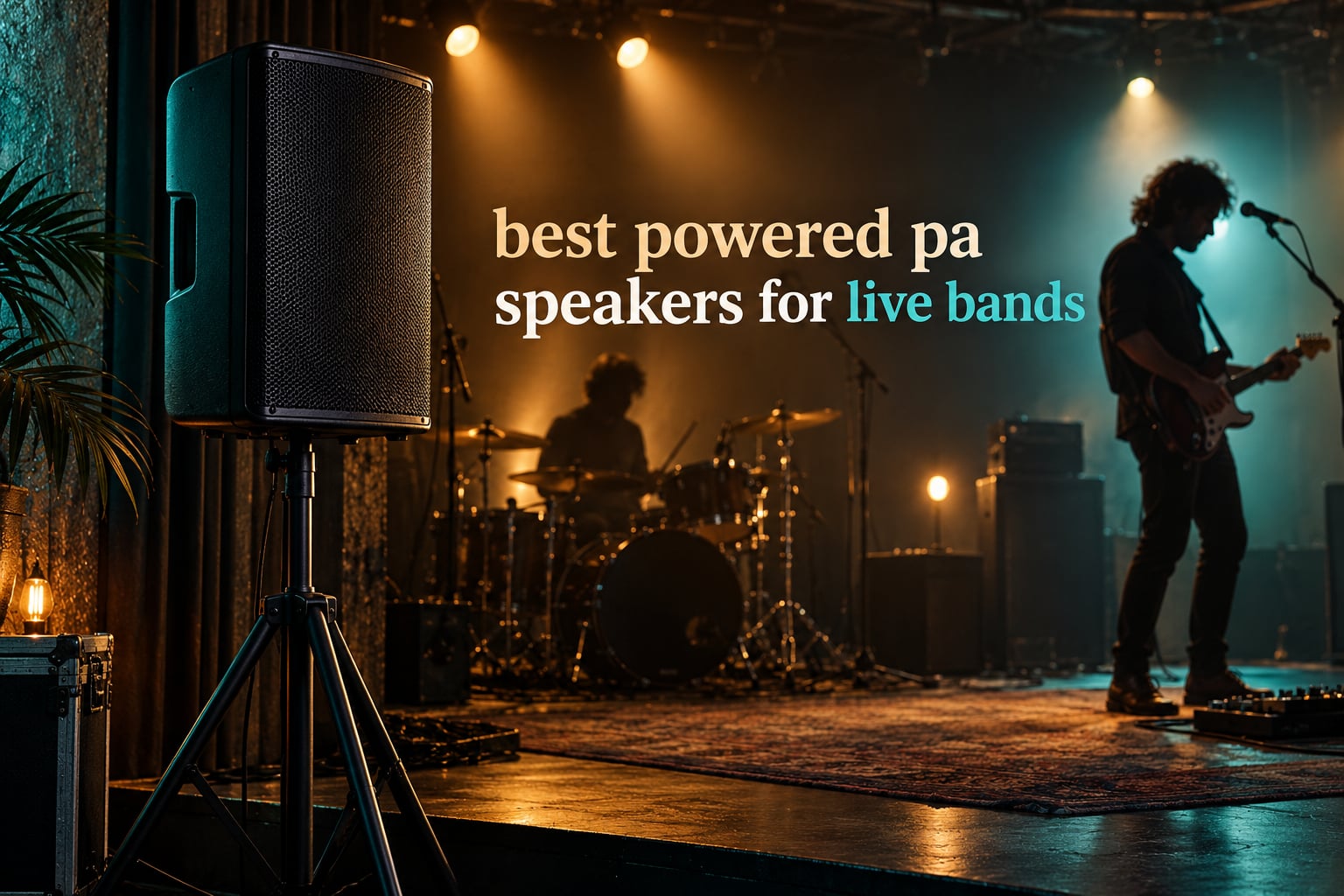
If you only read one thing here, read this: the Bose S1 Pro+ is the best all-round powered PA speaker for live bands in 2026, the ALTO TS415 gives you the most output and bass per pound for heavier rock and indie, and the Behringer Eurolive B205D is the cheapest way to get intelligible vocals into a small room. Everything else in this roundup is a variation on those three use cases.
We spent weeks putting together the best powered PA speakers for live bands available right now, from a 7-pound practice-room box to a 52-pound column array. The list is deliberately mixed: battery-powered and mains-powered, 8-inch and 15-inch drivers, budget and premium, because bands are not all the same shape.
One warning before we start. Marketing wattage on these speakers is inflated in a way that is genuinely misleading. A speaker rated at “2500W” and one rated at “1000W” are frequently within a few decibels of each other at the listening position. What matters is continuous (RMS) power, maximum SPL, and how much headroom the amplifier has before the DSP limiter starts pulling levels down. We use the published manufacturer numbers where they are given, and we tell you plainly where a figure looks optimistic.
We also handle the thing nobody asks about until it goes wrong: gain staging. A speaker with plenty of headroom still feeds back if your preamps are wrong, and a small room can still be too loud for a full band no matter what you buy. If you are still putting a mixer together, our guide to the best powered mixers for bands covers the signal chain side of things.
Table of Contents
Top 3 Powered PA Speakers for Live Bands in 2026

Those three cover most situations. The Bose wins because it does more with one box than anything else in the category, the ALTO because a 15-inch driver that you can still lift is exactly what a full band wants, and the Behringer because a lot of bands need a monitor and a small PA, not a full system.
All 12 Powered PA Speakers Compared in 2026
| Product | Specifications | Action |
|---|---|---|
| Bose S1 Pro+ |
|
Check Latest Price |
 Behringer Eurolive B205D Behringer Eurolive B205D |
|
Check Latest Price |
 Mackie Thump212 Mackie Thump212 |
|
Check Latest Price |
 ALTO TS415 ALTO TS415 |
|
Check Latest Price |
 JBL EON715 JBL EON715 |
|
Check Latest Price |
 Rockville BPA10 Rockville BPA10 |
|
Check Latest Price |
 JBL IRX108BT JBL IRX108BT |
|
Check Latest Price |
 QSC K12.2 QSC K12.2 |
|
Check Latest Price |
 Yamaha DBR12 Yamaha DBR12 |
|
Check Latest Price |
 Bose L1 Pro16 Bose L1 Pro16 |
|
Check Latest Price |
 Electro-Voice ZLX-15BT Electro-Voice ZLX-15BT |
|
Check Latest Price |
 ALTO TX410 ALTO TX410 |
|
Check Latest Price |
1. Bose S1 Pro+ – Best Powered PA Speaker Overall for Live Bands
Bose S1 Pro+ All-in-One PA Speaker – Powered, Wireless PA System, Multiple Positioning Options, Ergonomic Carry Handle, Up to 11 Hours of Playtime, Black
150W active
14.4 lbs
Lithium-ion battery
3-channel mixer
Up to 11 hours playtime
Pros
- Integrated 3-channel mixer removes the need for a separate mixer
- Four positioning options with automatic EQ adjustment
- 14.4 lbs with an integrated ergonomic carry handle
- Rechargeable battery for unplugged performances
Cons
- Bluetooth connections reported dropping and units not staying powered on
- App can be finicky or occasionally unreliable
- No deep low end compared with a 15-inch top
This is the speaker we keep coming back to, and the reason is not raw output. It is how much of a PA system it removes from your van. The integrated three-channel mixer takes two mic or instrument inputs plus a dedicated playback channel, so a singer-songwriter, a duo, or a three-piece band can run the whole show without a separate mixer.
The battery is the part that changes how you gig. Up to 11 hours of playtime on a charge means an outdoor set in a field with no power is a normal event rather than a crisis. At 14.4 pounds with an integrated carry handle, one person can load it into a car unaided, which matters more than people expect when you are doing four shows in a weekend.
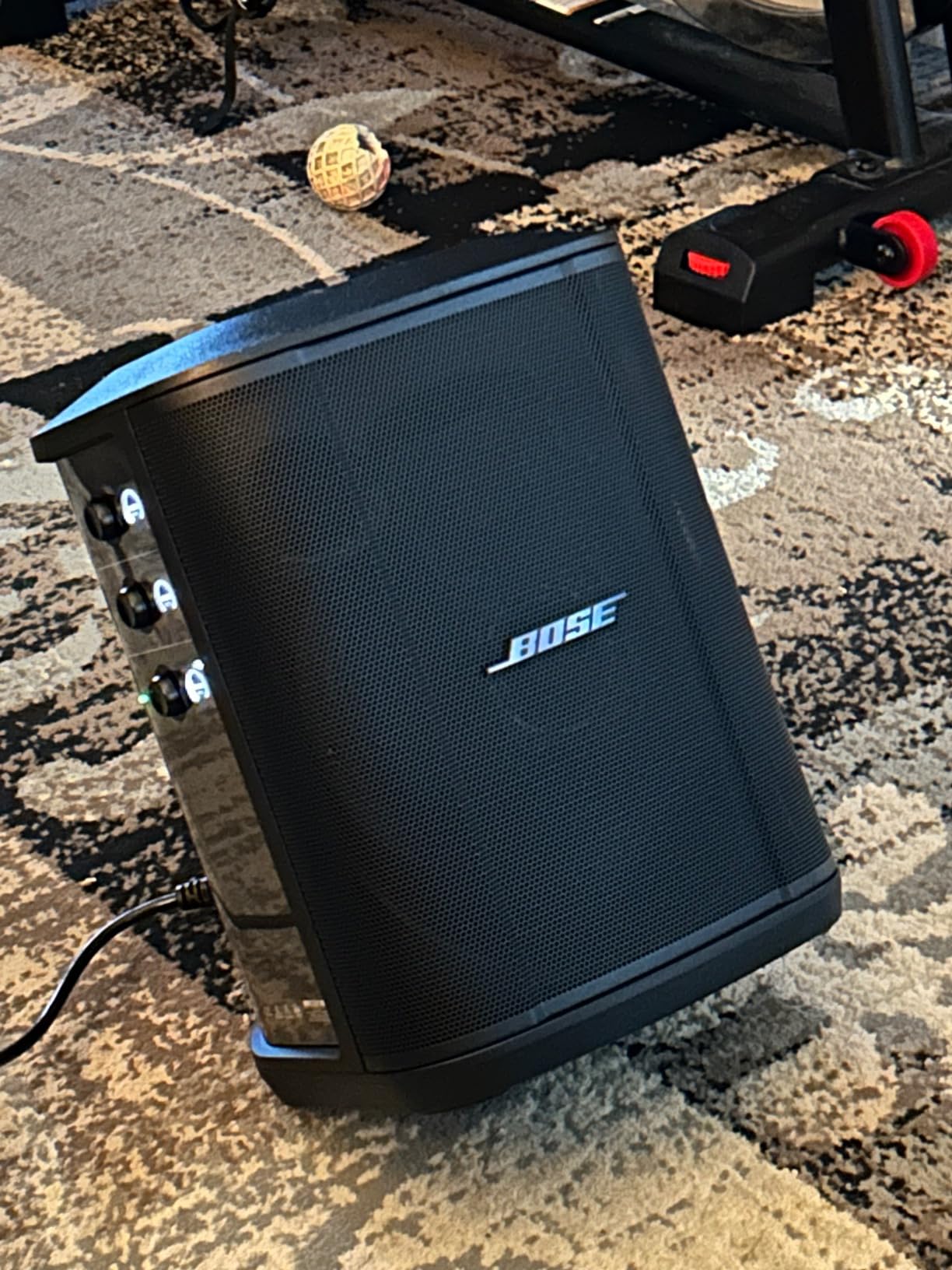
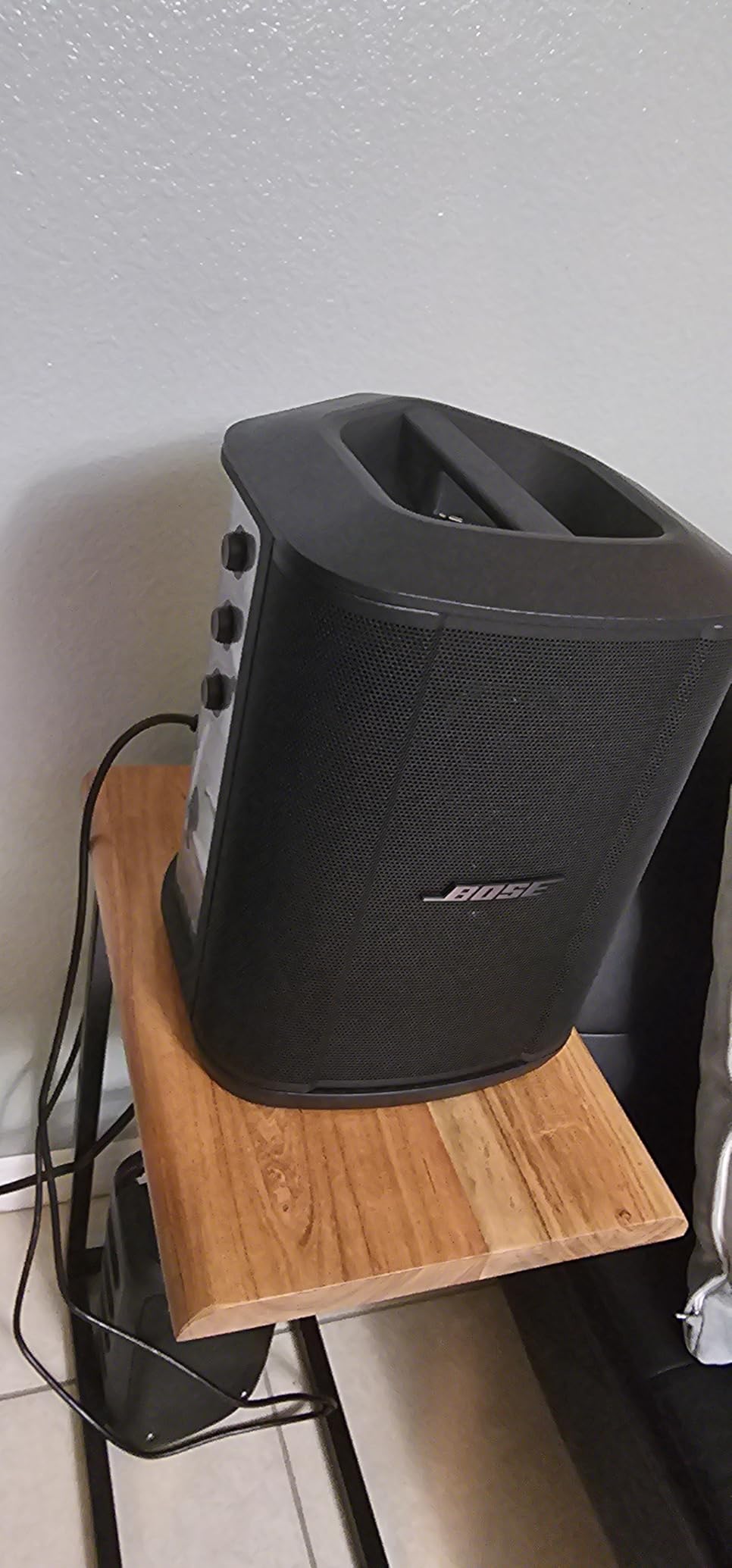
Sound quality is where it justifies the money. Owners describe rich, balanced output with crisp highs, full mids and more bass than a cabinet that size has any right to produce. The four positioning options – vertical, tilted back, horizontal, or on a stand – trigger automatic EQ adjustment, so the same box works as a main, a side-fill, or a front-of-house position.
There are also optional wireless RF transmitters that pair with the integrated receivers, so a band can go cable-free for vocals and guitar. That is the feature that tips it from “portable speaker” to “portable PA system” in our view. If your band mostly plays acoustic, folk, jazz or singer-songwriter sets, this is the pick.
Who this speaker works for
Bands playing bars, cafes, courtyards, weddings and acoustic sets, especially where there is no house PA and no power outlet. It also works well as a monitor wedge for a small stage, since the automatic EQ handles the tilt.
Anyone who travels. The battery and the 14.4-pound weight mean one person can do the load-in, which is the difference between a comfortable show and a stressful one.
Where it falls short
A small minority of owners report Bluetooth connections dropping or units that will not stay powered on out of the box, and a few note the app can be unreliable. If you plan to run a full drum kit through it from a mixer, 150 watts will not be enough – this is a small-room and unplugged-gig speaker, not a club filler.
There is no real low end for a guitar-heavy set. You get clean, balanced tone and vocals that sit on top of a mix, not the chest-thump that a full band in a loud room needs.
2. Behringer Eurolive B205D – Best Value Powered PA for Rehearsals and Small Gigs
Behringer Eurolive B205D Active 150-Watt PA/Monitor Speaker System
150W Class-D
7.05 lbs
5.25 inch neodymium full-range
3-channel mixer with 3-band EQ
Pros
- Two phantom-powered mic preamps plus an instrument input in one box
- XLR thru output for linking to a larger system
- At 7.05 lbs it doubles as a personal or on-stage monitor
- Outstanding price-to-performance ratio
Cons
- Only two physical inputs limits duos and full band use
- Single full-range driver has no deep bass
- Mains power only with no battery option
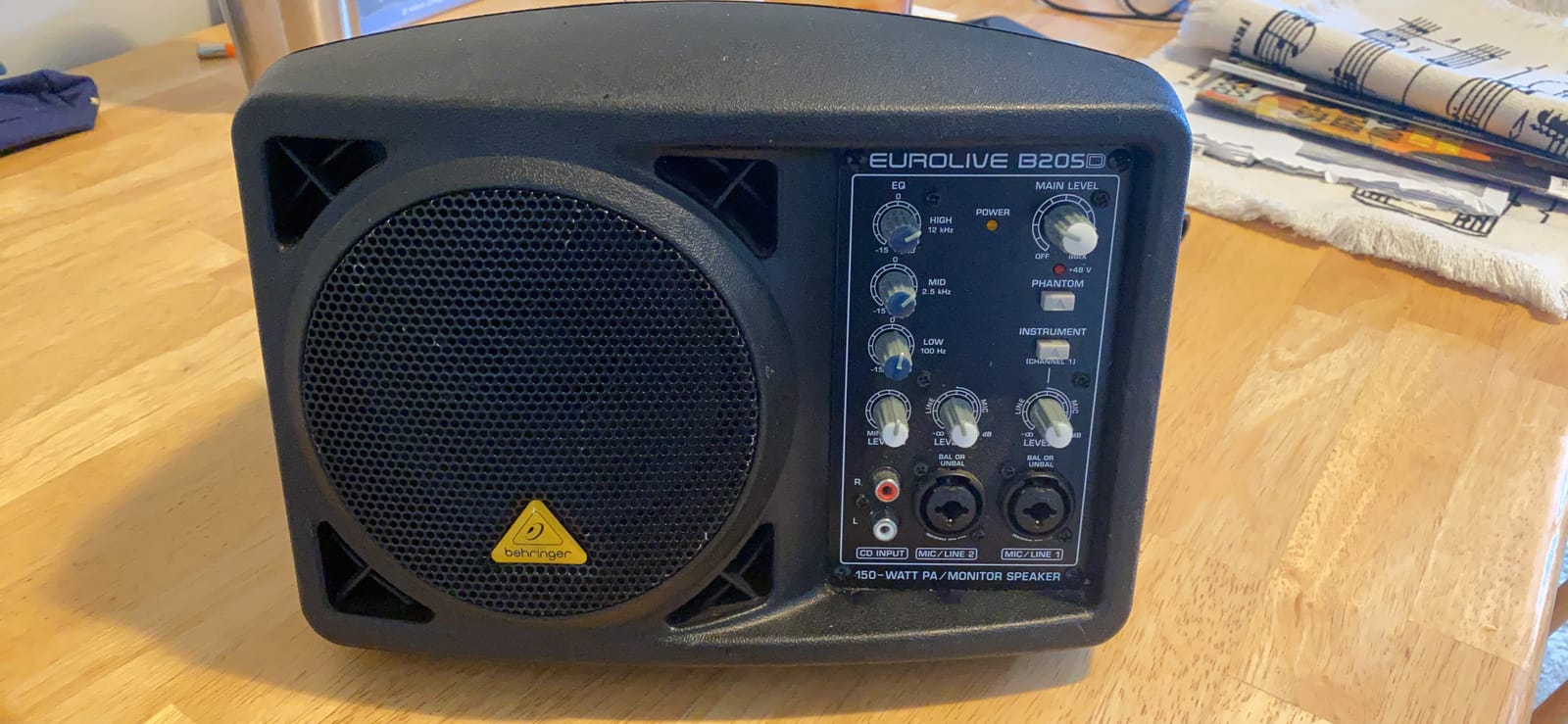
The B205D is the old guard that will not die, and there is a reason: it does three jobs at once. It is a practice amp, a personal monitor, and a genuinely usable small-room PA for 50 to 100 people. At 7.05 pounds you can carry it with one hand and set it on a mic stand.
For a rehearsal room, the onboard mixer is the selling point. Ultra-low noise, three channels with three-band EQ, two invisible mic preamps with phantom power for condenser microphones, and one instrument-ready input so no DI box is needed. That is a complete acoustic duo rig in one cable run.
Long-standing owners praise the clarity and low noise floor, and the XLR thru output lets you link to a larger system or an external amp when the room outgrows it. Community consensus on the live sound forums keeps pointing at Behringer Eurolive as the sensible choice for practice and rehearsal on a tight budget.
Class-D amplification keeps the weight down and the noise floor low. Nothing about the electronics is cutting-edge, and that is precisely why it works: there is very little to go wrong in a box this simple.
Who this speaker works for
Rehearsal spaces, home studios, acoustic duos, singer-songwriters, and any band that needs a monitor it can carry in one hand. It is also a very cheap way to get sound in a small room for a party or a community event.
Bands that already own a mixer and just need a monitor or a small front-of-house box will find the thru output useful.
Where it falls short
Only two physical inputs. That is fine for a duo and tight for a three-piece plus drum overhead, and the input count is the single most repeated limitation in owner reviews. There is also no battery option, so it needs mains power.
A single 5.25-inch full-range driver has no deep bass. No amount of volume changes that; the low end simply is not there. And one owner reported a channel failure after a short period of use, so treat it as a rehearsal tool rather than a touring investment.
3. Mackie Thump212 – Best Powered 12-Inch Speaker for Bass-Heavy Bands
Mackie Thump212 12″ 1400W Powered Loudspeaker with Heavy-Duty Drivers
1400W Class-D
12 inch woofer
128 dB max SPL
47 Hz to 23kHz
29.1 lbs
Pros
- Owners rarely exceed 20 to 25 percent gain in small to medium rooms
- Deep bass that several buyers compare to larger 15-inch cabinets
- Built-in feedback eliminator and music ducking
- XLR and TRS input plus XLR output for easy linking
Cons
- This variant has no Bluetooth for phone playback
- Low end can be excessive for acoustic and bluegrass sources
- Not water resistant
- One review reports cluttered sound at higher levels
The Thump212 solves the problem most bands actually hit first: not enough output, and not enough low end without a subwoofer. 128 dB max SPL and a 47 Hz low-frequency limit give it real room-filling capability, and owners routinely report running it at 20 to 25 percent gain in small-to-medium rooms, which means real headroom rather than a limiter working constantly.
That headroom matters for feedback control. If your amplifier is clipping into the DSP limiter, the waveform distorts and your vocal mics squeal. Having genuine clean headroom is the single most effective anti-feedback upgrade you can make, and the Thump has more of it than most boxes at this level.
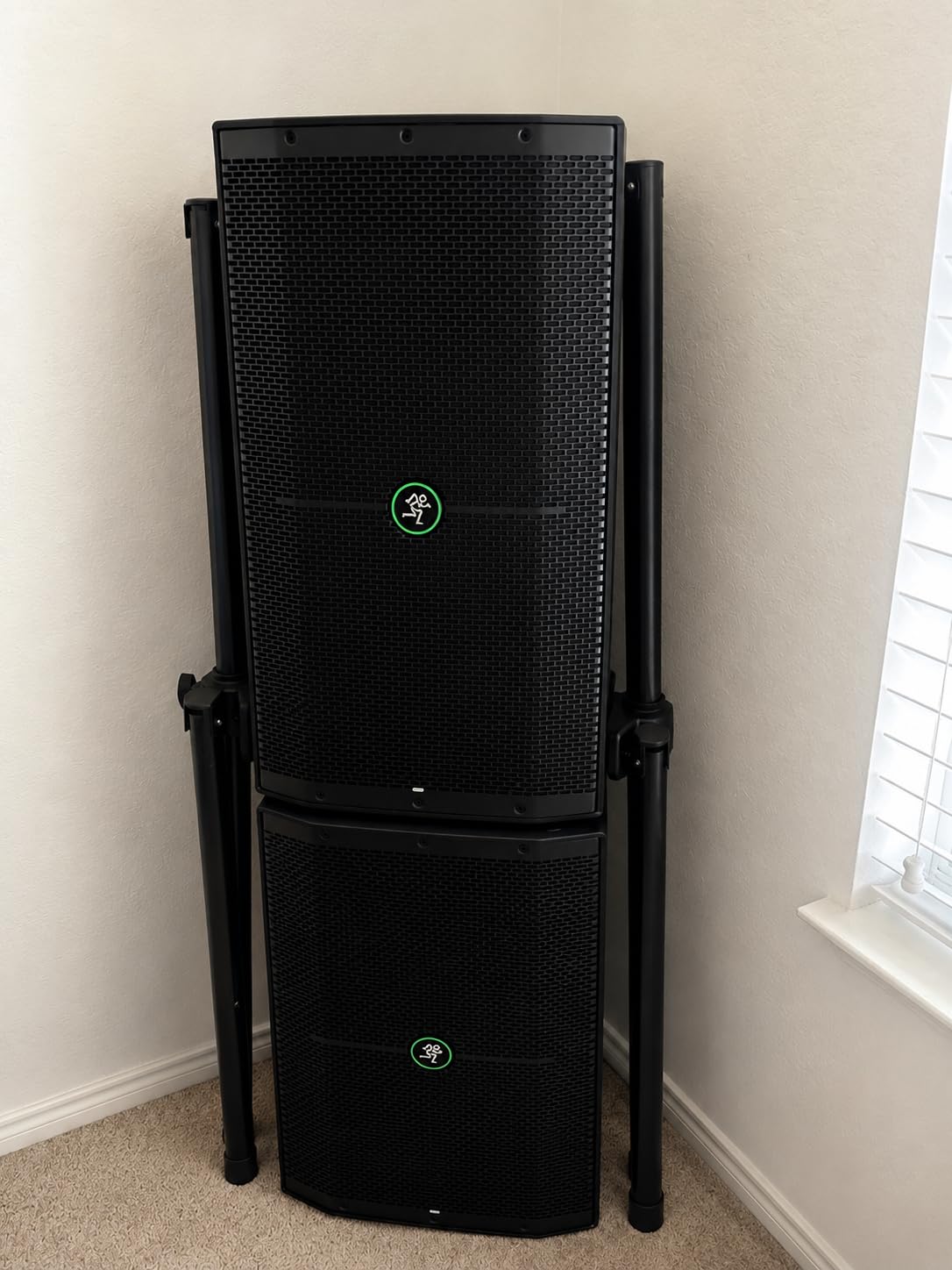
The built-in feedback eliminator and music ducking are useful beyond DJs. Ducking pulls background music down when a mic comes in, which is handy between songs, and the feedback eliminator gives you an extra layer of insurance in a small, reflective room.
Connectivity is XLR and TRS with an XLR output, so daisy-chaining a second box or feeding a sub is straightforward. At 29.1 pounds it is heavier than most 12-inch boxes but still liftable by one person for a short carry.
Who this speaker works for
Rock, punk, metal and indie bands playing bars and small clubs with no house system, especially if you have no subwoofer and need the low end to come from the top. A Gearspace poster who A/B tested a Mackie Thump 12 against a Presonus AIR-12 described the Thump as muddy with poor instrument separation, which is exactly the trade-off here: more output and more bass, less definition.
Where it falls short
This version has no Bluetooth, so phone playback needs a mixer or a separate receiver. The low end is more than an acoustic duo, bluegrass set or spoken-word event needs, and the box is not water resistant for outdoor work.
There is a report of faded, cluttered sound at higher levels, and the 12-inch driver does not substitute for a sub in a large outdoor festival stage. If you need to cover a crowd outdoors, buy a sub with it.
4. ALTO TS415 – Best Powered 15-Inch Speaker for Full Bands Without a Sub
ALTO TS415 2500W 15″ Powered PA Speaker
2500W peak
15 inch LF and 1.4 inch HF
Integrated 3-channel mixer
36 mm pole socket and M10 points
Pros
- Very high SPL and ample power for house parties and small venues
- Deep low end that reaches surprisingly low for a single top box
- Integrated 3-channel mixer with dual XLR and 1/4 inch combo inputs
- App-based custom EQ and true wireless stereo linking
Cons
- Highs can turn harsh in the 1k to 5k range at loud levels
- Factory EQ is overly bass-heavy and bright so it needs adjustment
- App parametric EQ is awkward to configure
- Draws around 1100W at peak so watch circuit loading
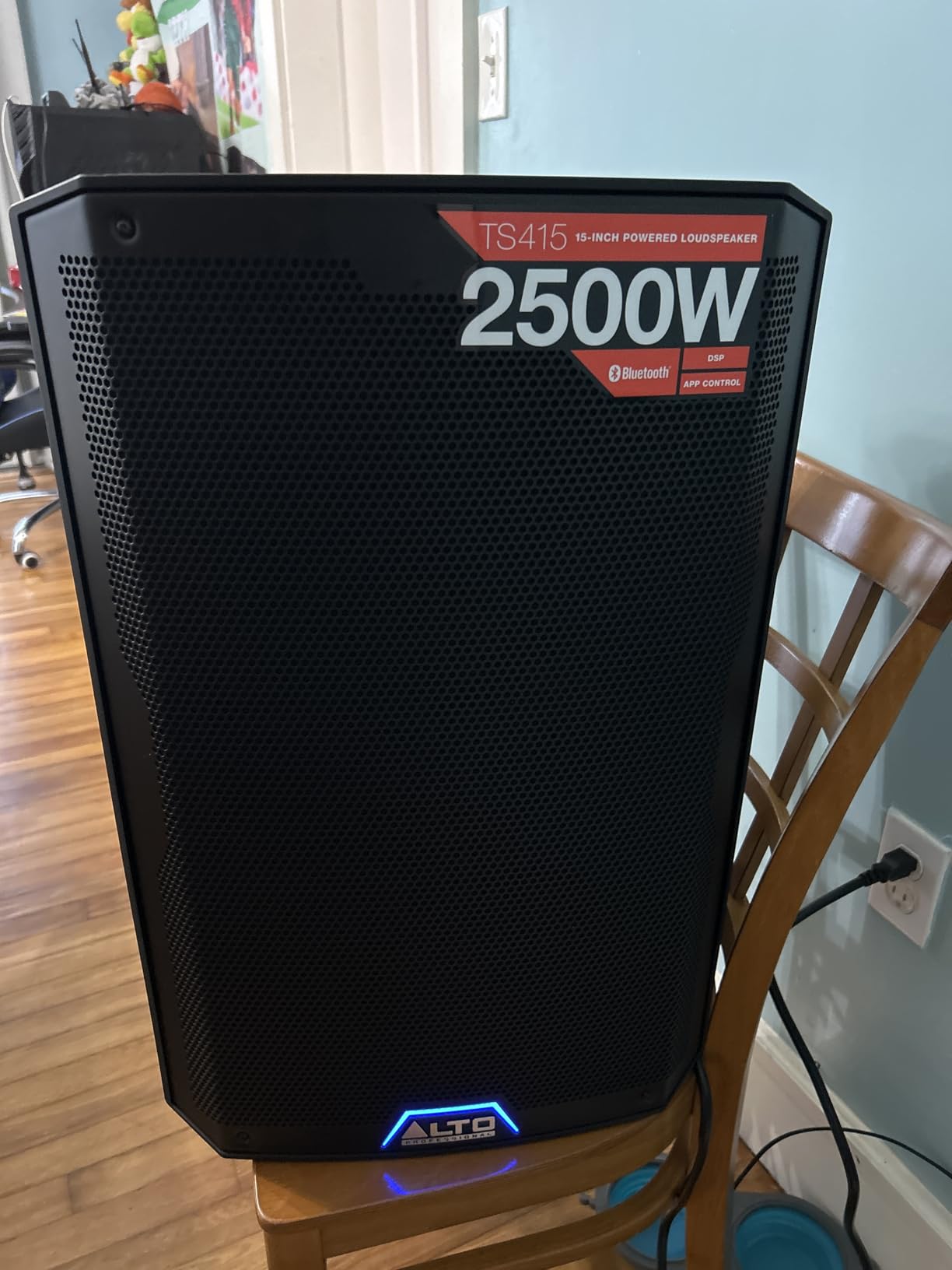
This is the pick for the question that comes up constantly on live sound forums: can a 15-inch top cover a full band with no subwoofer? Owners of the TS415 say yes for small-to-medium rooms, and the deep low end from a single 15-inch driver is the reason. You still will not get festival-sub energy, but you will not be missing the kick drum either.
The integrated three-channel mixer is unusual at this size and genuinely useful. Dual XLR and 1/4-inch combo inputs mean you can patch a vocal mic, a guitar amp output, and a playback source without buying anything else. There is also a USB Type A charging port and an XLR link output.
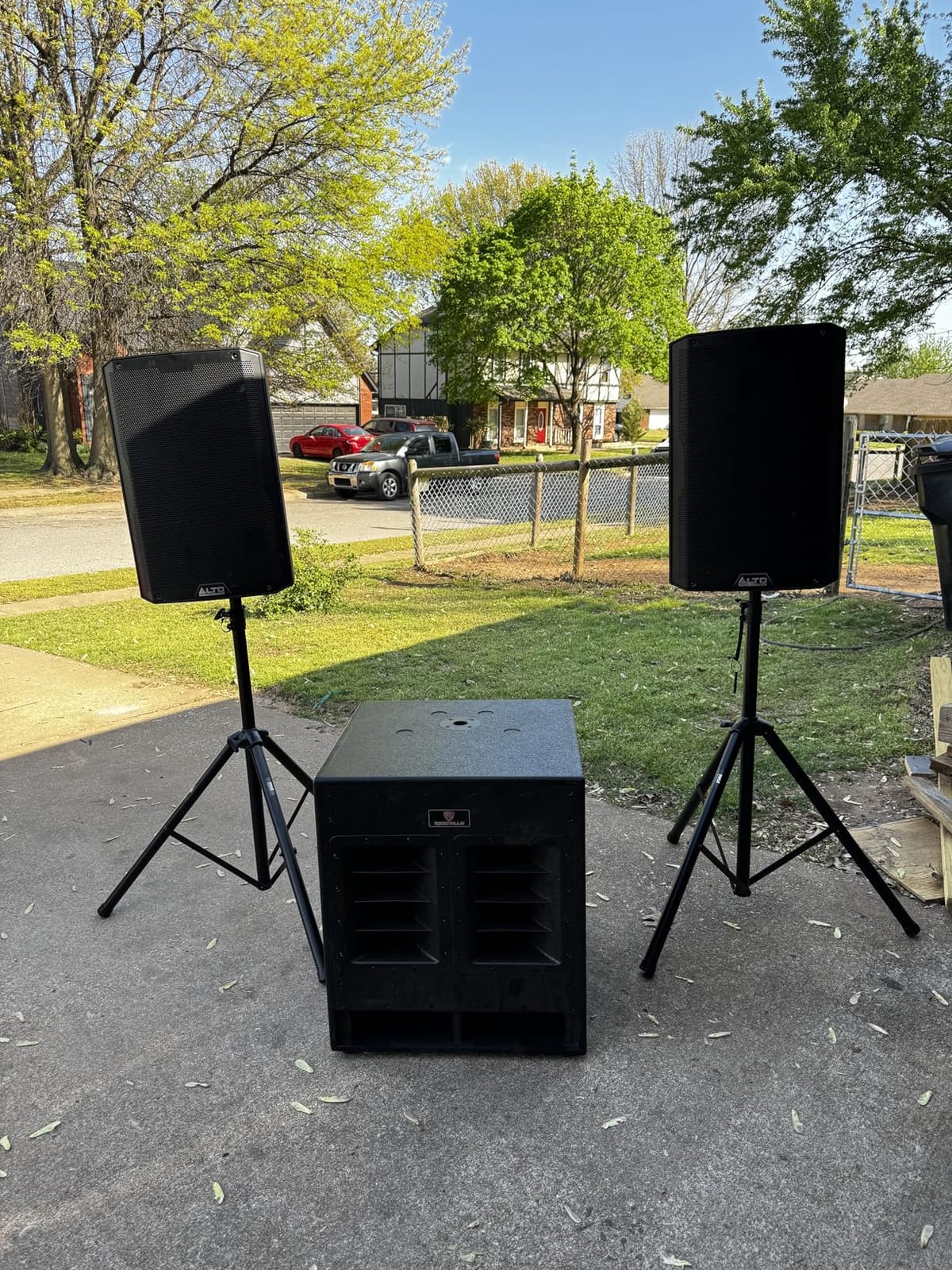
Four speaker use modes, plus custom EQ through the ALTO app for iOS and Android, and True Stereo Wireless linking between two boxes at up to 30 meters. Mounting is flexible: freestanding, wedge monitor, pole-mounted on a 36 mm socket, or suspended via the integrated M10 points.
The honest caveat is tuning. Buyers treat the TS415 as exceptional value and consistently flag the default EQ as too bass-heavy and too bright, particularly for dense rock mixes. Plan on spending fifteen minutes with the EQ before the first soundcheck, and the payoff is there.
Who this speaker works for
A full rock, indie or pop band playing bars, small clubs, community halls and outdoor events where mains power is available. It works as a wedge monitor too, which makes a single box work for front of house and monitoring.
Anyone who wants 15-inch bass without the punishment of a traditional 15. The listed weight is 20.8 kg, which is a two-person carry for long distances but manageable from a car to a stage.
Where it falls short
The harshness in the 1k to 5k range at high levels is the most common complaint, and it is a tuning issue you can fix rather than a design flaw. Input gain is attenuated, so some sources need roughly 5 dB of extra drive to reach the level you expect.
Peak draw around 1100W means you need to be careful on an overloaded bar circuit, particularly if you run two boxes. And because the app EQ is described as awkward, plan to have your laptop or phone ready before load-in rather than during the set.
5. JBL EON715 – Best Powered 15-Inch Speaker for Maximum Output
JBL EON715 1300-watt 15-inch Powered PA Speaker
1300 watts
15 inch 2-way with waveguide
1 inch tweeter
Bluetooth 100 m range
46.5 lbs
Pros
- Crisp clear sound with bass reviewers say you feel in your chest
- Genuinely loud output for small and medium venues
- Works cleanly with a mixer for live vocals and instruments
- Dual handles make lifting onto stands straightforward
Cons
- JBL Pro Connect app criticized by several owners
- Bluetooth may need re-pairing each time it is used
- True Wireless Stereo pairing has a reported firmware bug
- Heavy at 46.5 lbs making transport a two-person job
JBL’s Waveguide Technology spreads the high frequencies across the room rather than sending them in a narrow beam, which is why the EON715 sounds even from the back of a small room rather than only in the middle. Owners describe crisp, clear sound with bass you feel, and genuinely usable output for small and medium venues.
It pairs cleanly with a second speaker for stereo, works with a mixer for vocals and instruments, and Bluetooth reaches 100 meters, which is genuinely useful at an outdoor event. Two power levels let you trade maximum output for lower power draw on a constrained circuit.
For a band that wants one box to do front of house and to double as a wedge, the dual handles make lifting onto stands straightforward. That is a real advantage over lighter boxes with a single recessed grip.
This is the pick if you want a 15-inch system that plays loud without a subwoofer. JBL’s waveguide gives you even coverage in a rectangular room, which is where most small-venue problems come from.
Who this speaker works for
Bands that need volume more than they need portability, and can accept a two-person load-in. It suits rehearsal spaces, small clubs, and outdoor events where mains power is available and the ground is level.
Anyone playing a room with an odd shape. The waveguide’s dispersion means you are less dependent on where the speaker sits in relation to the audience.
Where it falls short
At 46.5 pounds, this is a genuinely heavy box. Community consensus on the live sound forums is blunt about the category: 15-inch speakers are described as not the prettiest option but they last a long time, and they are hard for one person to load.
The JBL Pro Connect app is criticized by several owners, Bluetooth may need re-pairing each time it is used, and True Wireless Stereo pairing has a reported firmware bug that requires repeated reconnection. The box is also not water resistant.
6. Rockville BPA10 – Best Low-Cost Powered PA for a First Gig
Rockville BPA10 10″ Professional Powered DJ PA Speaker with Bluetooth
400W peak 100W RMS
10 inch woofer
1 inch titanium compression driver
18.5 lbs
ABS enclosure
Pros
- Bluetooth plus USB and SD card and FM radio with remote in one box
- Rugged ABS enclosure reported still working after a 6-foot drop
- XLR output allows daisy-chaining to another speaker or a sub
- Adjustable bass and treble on the rear panel
Cons
- Advertised 100W RMS appears optimistic in real output
- Can buzz or distort when pushed to maximum volume
- Included remote has a weak battery and limited range
- Thermally protected so not intended for sustained heavy bass
Look at the feature list on this one and it reads like a speaker costing three times as much: Bluetooth, USB and SD card playback, an FM radio with 10 presets, a wireless remote, and inputs covering XLR, 1/4-inch, RCA and 1/8-inch aux. There is a 2-channel onboard mixer, 2-band EQ and an XLR output for linking to another speaker or a sub.
The 45-degree horizontal waveguide horn gives wide dispersion for a 10-inch box, which is the right choice for a bar where the speaker is in a corner pointed at an audience spread across a room. The long-throw 10-inch woofer pairs with a 1-inch pure titanium-diaphragm compression driver, and the enclosure is stand-mountable and flyable.
Build quality is a genuine surprise at this tier. Owners report the ABS enclosure surviving a 6-foot drop and continuing to work, which tells you something about how it handles a load-in. At 18.5 pounds it carries comfortably with the ergonomic handles.
This is the pick if your budget is genuinely tight and you are playing small rooms, rehearsals, classrooms and community events. For context on how these entry-level systems compare, we also cover the best portable PA speakers for events.
Who this speaker works for
A first band buying its first PA, a rehearsal space, a classroom, a fitness studio, or anyone who needs playback sources and microphone inputs in a single inexpensive box. The XLR output makes it easy to start small and grow later.
Anyone who plays somewhere with no mains power nearby and wants Bluetooth from a phone. It runs from an AC adapter, so it needs power but does not need a heavy extension run.
Where it falls short
The stated 100W RMS looks optimistic against measured real output, and this is exactly the inflated-wattage problem we flagged earlier. It can also buzz or distort when pushed to maximum volume.
The thermal protection means it is not built for sustained heavy bass output, so pushing it as a main PA in a loud room is a bad idea. The included remote has a weak battery and limited range, and the box is not water resistant.
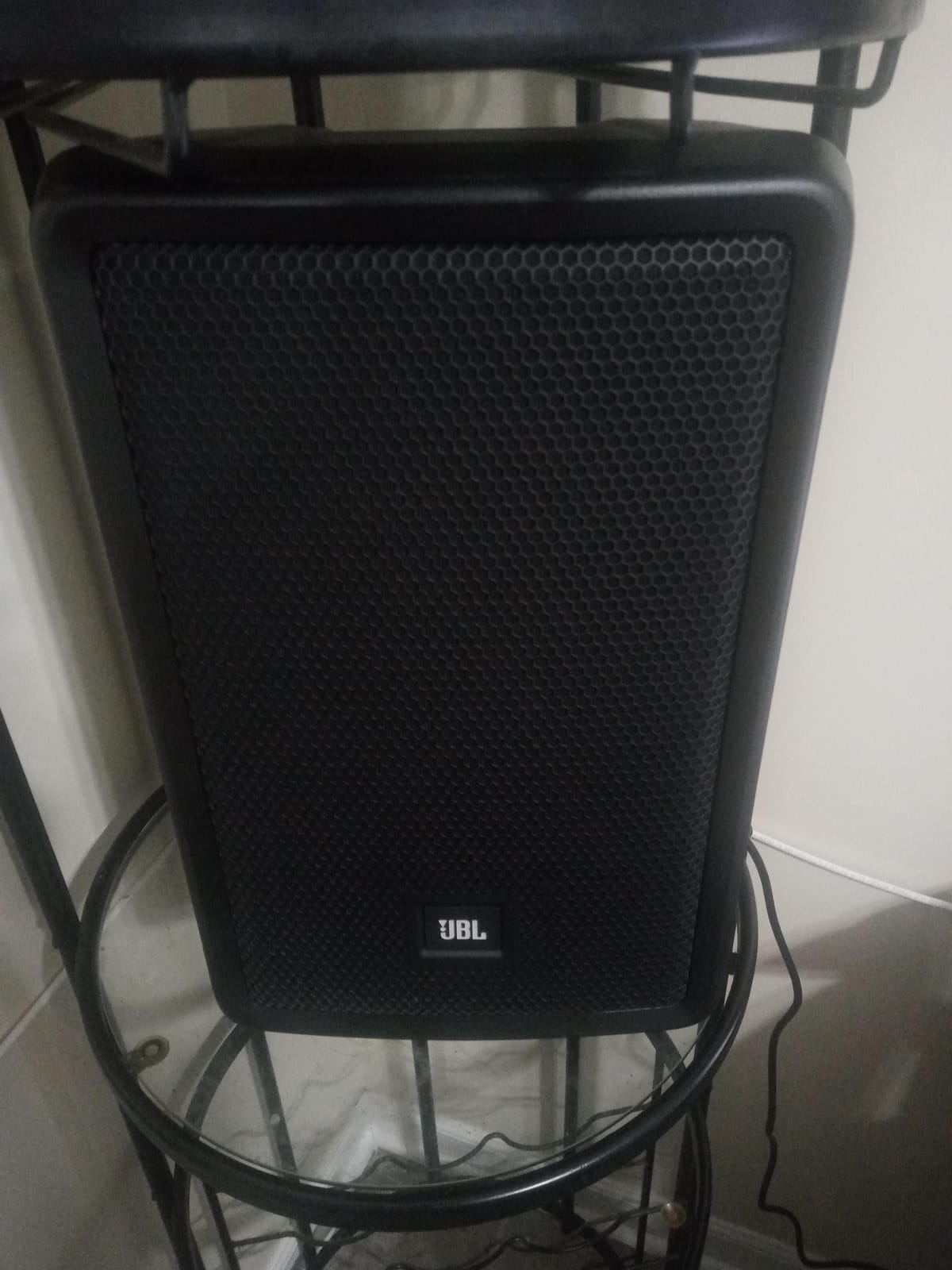
7. JBL IRX108BT – Best Powered 8-Inch Speaker for Stage Monitors
JBL Professional IRX108BT Powered PA Speaker, Portable Loudspeaker with Bluetooth, 8 Inch Woofer, 1300 Watt, Mobile DJ, Musicians, Small Venues, Ceremonies and Sports Events, Black
1300 watts
8 inch woofer
2 XLR and TRS combo inputs
Feedback suppressor
17.4 lbs
Pros
- Crisp clear sound that stays intelligible for speech over a wireless mic
- Lightweight and easy to set up with dependable Bluetooth
- Two combo inputs plus a mix-through output for feeding FOH
- Reported fully functional after being submerged in a flood
Cons
- Limited bass extension from the 8-inch driver so a sub is recommended
- No battery power so mains is required
- Onboard effects are minimal
- Some owners find the enclosure feels lighter and cheaper
Eight inches sounds small, but this is the box most bands end up buying four of. At 17.4 pounds it is a proper stage wedge, and the 1300-watt amplifier means it can be your monitor and a small front-of-house position depending on where you point it.
Two XLR/TRS combo inputs plus a feedback suppressor and one-touch ducking cover most live uses, and owners single out the Bluetooth as holding its connection far better than cheaper brands – a common complaint elsewhere at this price. The mix-through output lets you feed front of house from the monitor position, which saves cable runs.
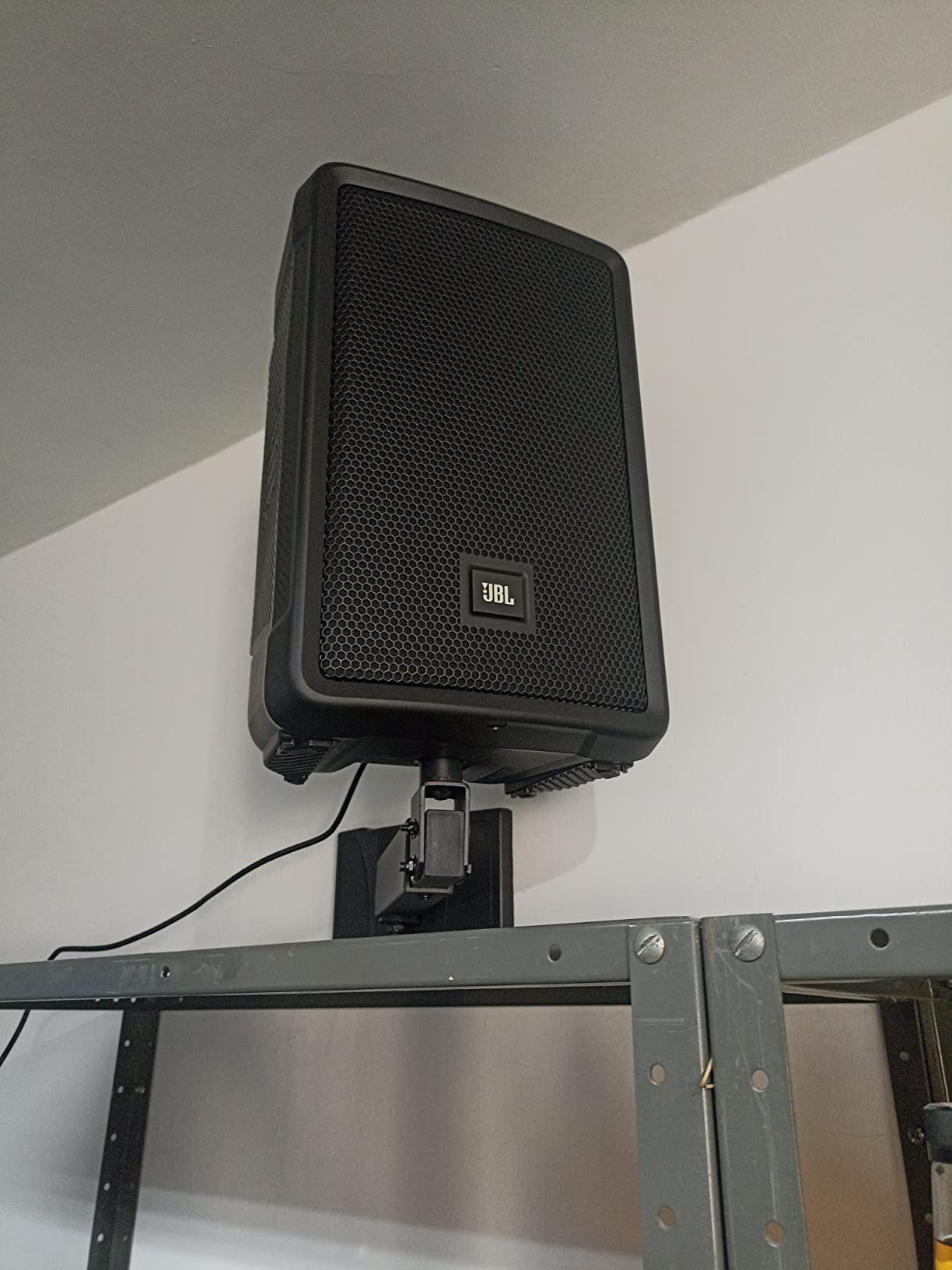
There are onboard EQ settings including a music mode and a speech mode for use with a sub. That makes it genuinely useful for a band that also does hosting or DJ sets at the same event.
Durability is the standout story in owner reports: one owner describes the unit remaining fully functional after being submerged for hours in a flood. If your band does bars and outdoor work, that kind of resilience matters.
Who this speaker works for
Bands buying wedges, a four-piece system of one main plus two monitors plus a spare, or a singer-songwriter who wants a light main. It is also a sensible FOH box for a small bar or a restaurant.
Anyone who runs a wireless mic for speeches or karaoke alongside live music, because the vocal clarity is consistently praised for speech reproduction.
Where it falls short
Bass extension is the honest limit of an 8-inch driver, and owners recommend a subwoofer for full music impact. You will not cover a full band in a club with this alone.
There is no battery, so mains power is required. The onboard effects are minimal, some owners find the enclosure feels lighter and cheaper than older JBL models, and one review reports an initial manufacturing defect that required a replacement – which is worth knowing about given how many of these get sold.
8. QSC K12.2 – Best Powered PA Speaker for Presets and Detailed Control
QSC K12.2 Active 12″ Powered 2000 Watt Loudspeaker
2000W Class-D module
12 inch woofer
Factory presets and scenes
Digital display
3 year warranty
Pros
- Detailed even coverage across the room
- 2000W Class-D module gives high output for demanding rooms
- Factory presets and savable scenes speed up setup
- Digital display makes configuration easy in low light
- 3 year full warranty
Cons
- Heavy at 47.8 lbs for a portable PA
- No Bluetooth on this model
- Costs more than most 12-inch powered speakers
- Not water resistant
The K12.2 is the speaker you buy when you want control rather than convenience. Factory presets plus savable and recallable scenes mean you can store a configuration for a bar, one for an outdoor event, and one for a rehearsal room, then recall it in a couple of button presses instead of rebuilding the EQ every time.
The multi-function digital display is more useful than it sounds. Loading a van in the dark, you can see what preset and level you are on without guessing, which eliminates a whole class of pre-show mistakes.
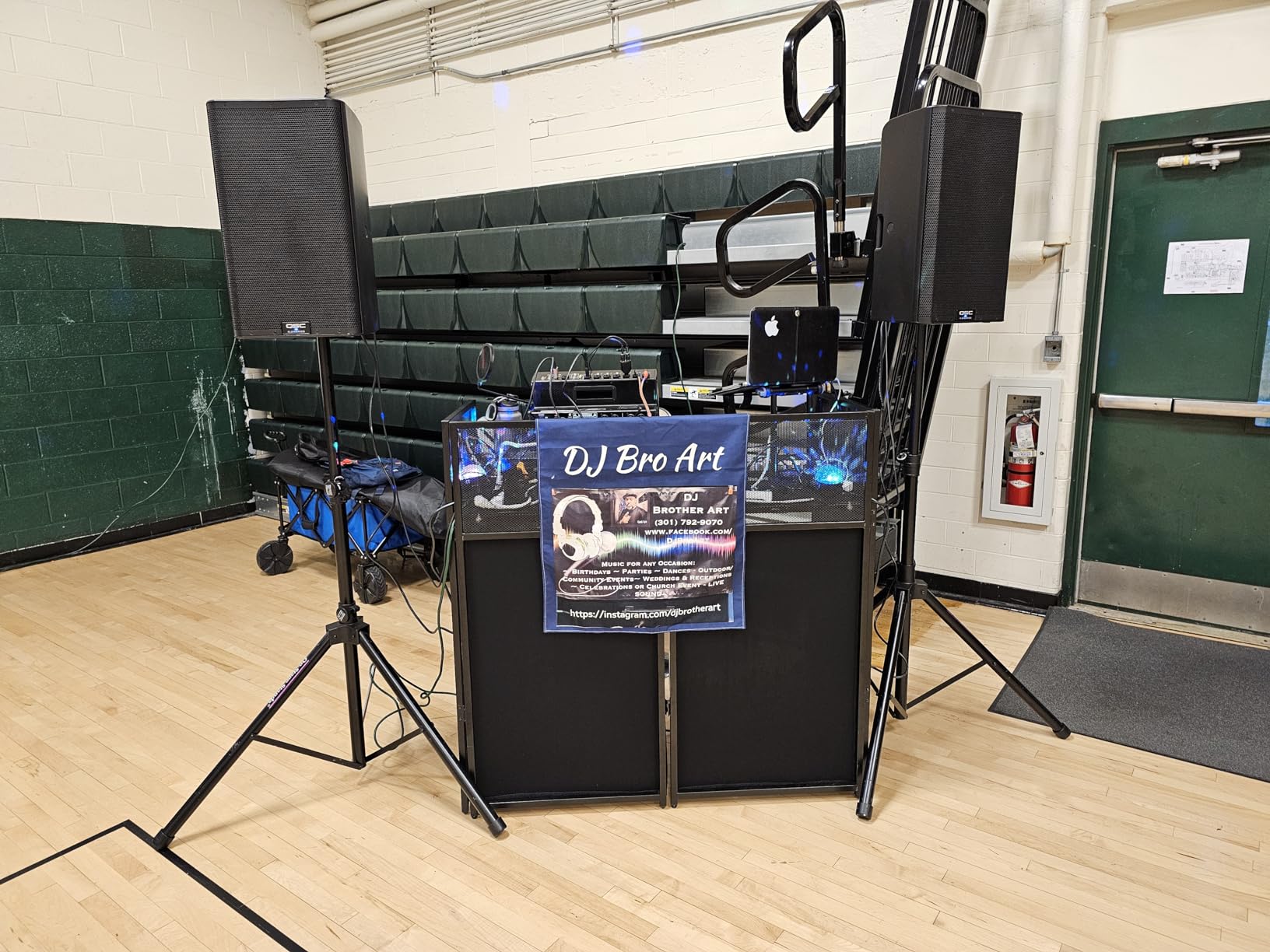
Sonically, owners describe best-in-class audio performance with detailed, even coverage across the room. A long-standing Gearspace user who bought six QSC K12s points to build quality and warranty as the reasons to pay more, and that is a view shared widely on live sound forums where QSC is repeatedly recommended as the reference point.
The 2000W Class-D module gives high output for demanding rooms, and the low-noise variable-speed fan means the box stays quiet in a quiet room and cools properly when you push it. Connectivity is XLR.
Who this speaker works for
A band that moves between different rooms and wants repeatable settings rather than rebuilding EQ each time. The even coverage also makes it a good fit for awkward venue shapes where a narrow horn would leave gaps.
Anyone buying once and keeping it. The 3-year full warranty is among the longest in this category and is one of the most repeated reasons to pay more on the forums.
Where it falls short
At 47.8 pounds this is the second-heaviest box in the roundup, and transport is a real cost. There is no Bluetooth on this model, so wireless playback needs a separate device.
It costs more than most 12-inch powered speakers in the category, which makes it a hard sell for a band still working out whether they will keep gigging. If your budget is tight and you are undecided, our live band gear guides cover the rest of the rig.
9. Yamaha DBR12 – Best Powered 12-Inch Speaker for Warranty Coverage
Yamaha DBR Series DBR 12″ Powered Speaker Cabinet
1000W digital power
131 dB SPL
12 inch bi-amp
FIR-X tuning
7 year warranty
Pros
- 131 dB SPL is serious output for a 12-inch powered cabinet
- Bi-amped with FIR-X tuning for consistent protected performance
- Works well as both a main PA and a stage monitor
- Listing states 7-year warranty coverage
- Clean reliable digital power delivery
Cons
- No Bluetooth on this model
- Listed item weight appears inaccurate so verify before planning transport
- Treble response less refined than newer models
- Not water resistant
131 dB SPL from a 12-inch box is the number that should draw your attention. Yamaha’s bi-amplification gives separate amplification to the low and high sections, and FIR-X tuning shapes the response so the amp is protected without the box sounding squashed. That combination is why owners report consistent output rather than a speaker that gives up at high level.
The second reason to like it is flexibility. Owners use the DBR12 as a main PA and as a stage monitor, which means a two-box system covers both jobs. For a band that does not want to carry wedges, that is a genuine saving in volume and in cable.
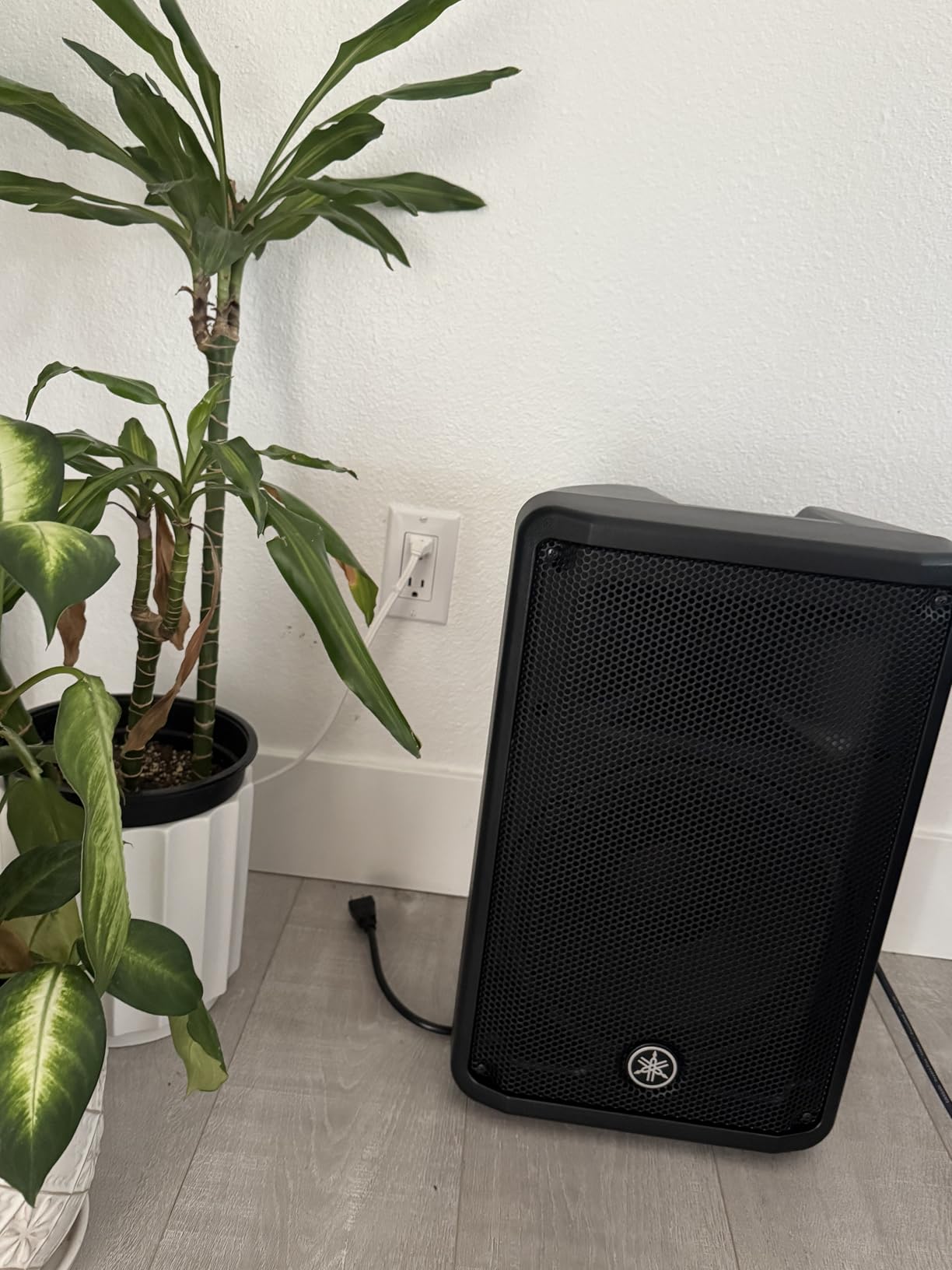
Reliability history is the third reason. Yamaha’s proven track record comes up repeatedly when people on live sound forums discuss whether budget brands can be gigged with, and the listing states 7-year warranty coverage – a long time horizon if you are worried about buying something that will be discontinued or unsupported.
Frequency response is listed at 52 Hz, which is respectable for a 12-inch box, and connectivity is XLR, which is what you want in a live band rig.
Who this speaker works for
Bands that want maximum output from a 12-inch format, and anyone who wants one box to work as both main and monitor. The frequency response at 52 Hz means it will hold up on a rock set better than most 12s.
Anyone planning to buy a speaker they will keep for a decade. Warranty length and manufacturer support are the deciding factors for plenty of long-term buyers.
Where it falls short
There is no Bluetooth on this model. The listed item weight appears inaccurate in the specifications, so verify the real weight before you plan your load-in – we would not rely on the figure of 2 kg shown in the listing.
Some reviews note the treble response is less refined than newer models, so a vocal-heavy acoustic set may sound slightly less crisp than a newer alternative. The box is not water resistant.
10. Bose L1 Pro16 – Best Powered PA for Even Coverage in Small Rooms
Bose L1 Pro16 – Portable PA System Portable Line Array Speaker with Integrated Bluetooth Built-in Mixer and Wireless App Control
600 watts
16 articulated 2 inch drivers
10 inch by 18 inch Racetrack woofer
180 degree horizontal
52 lbs
Pros
- Consistent premium full-range tonal balance with superb vocal clarity
- 180 degree horizontal coverage keeps sound even across the audience
- Built-in three-channel mixer and app control make setup fast
- Single-box solution that packs faster than a top plus sub setup
Cons
- Very heavy at 52 lbs for a single portable system
- Battery runtime limits long sets or continuous high volume use
- Costs a lot relative to conventional tops and subs
- Narrower vertical dispersion than a point-source speaker
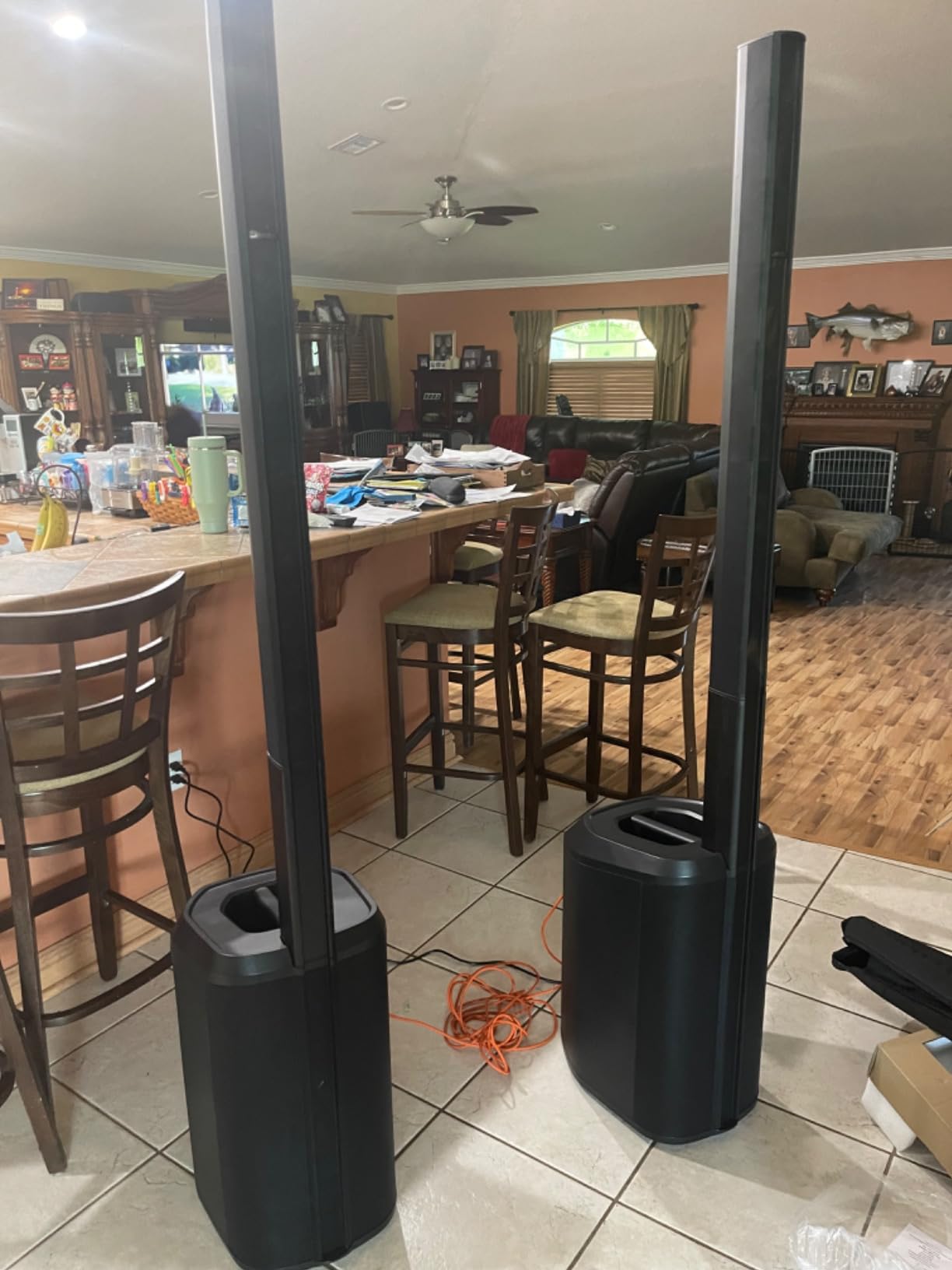
This is a different shape of answer. Instead of a box pointed at the audience, the L1 Pro16 is a column array that throws sound across the room with 180 degrees of horizontal coverage. Owners single out vocal and instrument clarity as the standout, and even coverage is exactly what solves the uneven-SPL complaint that comes up constantly in small-room discussions.
The integrated 10 by 18 inch high-excursion neodymium Racetrack woofer delivers bass owners compare to a conventional 15-inch driver while occupying a smaller footprint, and the J-shape extended-frequency array with 16 articulated 2-inch neodymium drivers handles the top end. You get a full-range system in one box, with no separate sub to carry.
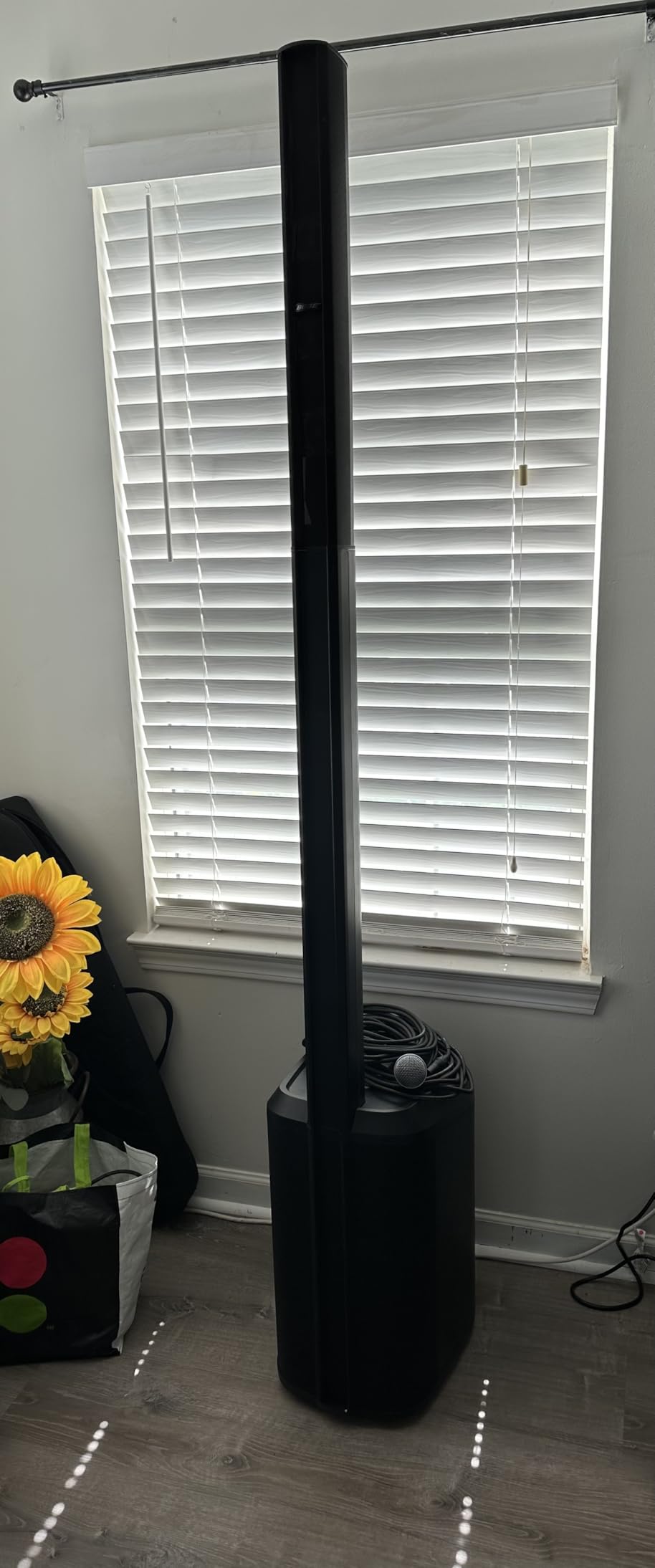
The built-in three-channel mixer with smartphone app control means setup is fast for mobile performers, and Bluetooth streaming covers playback. For a singer-songwriter, mobile DJ or small ensemble that packs light, the single-box solution sets up faster than a conventional top and sub pair.
It is optimized for small-to-medium clubs, bars and similar rooms. That is the honest scope: this is not a festival main.
Who this speaker works for
Singer-songwriters, duos, small ensembles and mobile DJs who play oddly shaped rooms and need even coverage more than they need raw output. It is also excellent for events and ceremonies where the audience is spread out rather than deep.
Anyone who values vocal clarity above everything else. Owners describe the tonal balance as premium and consistent.
Where it falls short
At 52 pounds it is the heaviest single system here, so you are carrying a lot for one box. Battery runtime limits long sets or continuous high-volume use, and the cost is high relative to conventional tops and subs.
Vertical dispersion is narrower than a point-source speaker in some setups, which matters if you need to throw sound upward or downward. For a full band needing volume and bass weight, a conventional 15-inch top plus sub is the better shape.
11. Electro-Voice ZLX-15BT – Best Powered 15-Inch Speaker With Built-In Bluetooth
Electro-Voice ZLX-15BT 15″ 1000W Bluetooth Powered Loudspeaker, Black
1000W Class-D amp
127 dB peak SPL
15 inch woofer
1.5 inch tweeter
QuickSmartDSP
Pros
- 1000W Class-D amplification reaching 127 dB peak SPL
- QuickSmartDSP provides selectable presets for common applications
- Bluetooth works well for accompaniment between sets
- Three strategically placed handles make transport and rigging easier
- 3 year warranty
Cons
- Bluetooth range limited to roughly 10 meters
- Listed item weight of 5 pounds appears inaccurate for a 15 inch cabinet
- Heavier and bulkier than 10 and 12 inch alternatives
- No battery capability
The ZLX-15BT is a straightforward 15-inch workhorse with 1000 watts of Class-D amplification reaching 127 dB peak SPL. That is enough output for a small-to-medium room with a full band, and the high-efficiency amplifier means you are not carrying dead weight to get it.
QuickSmartDSP gives you selectable presets for common application types, which is the most useful feature here. Rather than rebuilding EQ on a dark stage, you pick the application and go. Owners also point to three strategically placed handles and a rugged polypropylene composite structure as making transport and rigging easier than most 15s.
Bluetooth streaming is useful for background music between sets or for accompaniment, and the 3-year warranty from a recognized pro audio brand is one of the better ones in the category.
A Reddit r/livesound comparison thread covering the 400 to 600 price band shows the real decision set buyers face at this money: the ZLX-15BT, a JBL EON715, a Mackie Thump 15BST and a Harbinger V4115. All four trade the same ground, and the deciding factors are usually weight, Bluetooth reliability and how much bass the room needs.
Who this speaker works for
Bands playing small clubs and bars with mains power who want 15-inch bass and wireless playback in one box. The three-handle layout also suits anyone rigging the speaker rather than just standing it on the floor.
Anyone who wants a recognised pro audio brand with a 3-year warranty but does not need the very latest waveguide technology.
Where it falls short
Bluetooth range is limited to roughly 10 meters, which is short for a large outdoor event. The listing shows an item weight of 5 pounds, which is clearly inaccurate for a 15-inch powered cabinet, so verify the real figure before planning transport.
It is heavier and bulkier than 10-inch and 12-inch alternatives, and it has no battery capability despite the listing metadata indicating battery power. It also has fewer user reviews than the leaders in the category, so you have less long-term owner feedback to go on.
12. ALTO TX410 – Best Powered 10-Inch Speaker for Rehearsal Spaces
ALTO TX410 350W 10″ Powered PA Speaker
350W bi-amp 250W LF plus 100W HF
10 inch LF
1 inch titanium HF
90 by 60 degree horns
6.8 kg
Pros
- Surprisingly full powerful sound for a compact 10 inch cabinet
- Lightweight with ergonomic handles for on-the-go setup
- Excellent as a stage monitor or small PA for gigging musicians
- Bluetooth TWS pairing for cable-free stereo between two units
- Metal grille and sturdy enclosure survive regular transport
Cons
- Only one physical combo XLR and 1/4 inch input despite 2-channel marketing
- Limited usable bass particularly for guitar monitoring
- Real output well below the 350W headline figure
- No phantom power for condenser microphones
The TX410 is the one to buy for a rehearsal room, because it does the thing rehearsal needs: it is loud enough to hear a full band over a drum kit, light enough to move with one hand, and it takes abuse. At 6.8 kg with a rugged metal grille, it is built to be dragged out of a car twice a week for years.
Sound quality surprises people at this size. Owners describe a full, powerful sound for a compact 10-inch cabinet that cuts through crowd noise in bars and restaurants while retaining clarity at maximum volume. The 90 by 60 degree wide-dispersion horns give more even coverage than a typical narrow 10-inch horn.
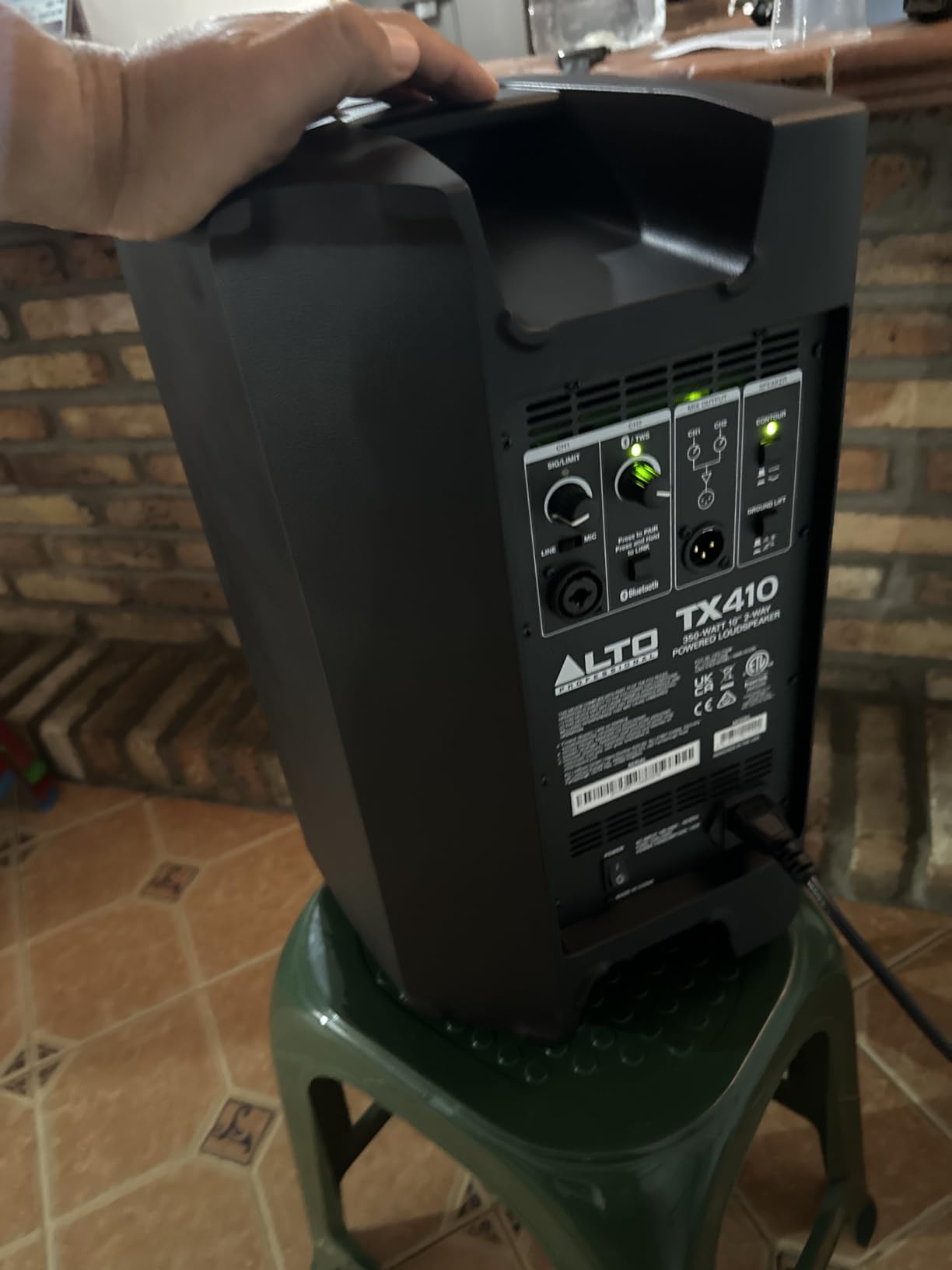
Pro giging musicians use these as stage monitors and small PAs, and Gearspace regulars praise Alto cabinets for being good value and easy to lay down as a wedge. The mix output allows linking multiple speakers, and there is an integrated 36 mm pole socket.
Bluetooth True Wireless Stereo pairs two units for cable-free stereo, and there is a contour EQ for music playback. It is designed and tuned in the USA, which is unusual for a box at this tier.
Who this speaker works for
Rehearsal rooms, practice spaces, small bars and restaurants, and bands that want a monitor they can carry with one hand. Two of them plus a mixer covers a lot of small-gig ground.
Anyone who moves gear constantly. The weight and the metal grille make this the most transport-friendly box in the roundup alongside the Behringer.
Where it falls short
There is only one physical combo XLR and 1/4-inch input, and the second mixer channel is Bluetooth. Several buyers found the 2-channel marketing misleading, so plan your patching accordingly. There is no phantom power, so condenser microphones need an external supply.
Bass is limited, particularly for guitar monitoring, and real output is well below the 350W headline figure. The included power cable is only about 6 feet long, so plan your cable run.
How to Choose a Powered PA Speaker for Your Band
How much power do you actually need?
Ignore the peak wattage. A speaker advertised at 2500W is not 2.5 times as powerful as one advertised at 1000W. Peak figures are marketing arithmetic – they describe the briefest possible burst before the amplifier cuts out. Continuous (RMS) power is the number that tells you what the speaker can sustain for a two-hour set.
Once you have a continuous figure, the second number is maximum SPL, measured in decibels. This is the one that matters at the audience position. A speaker rated at 128 dB can out-play one rated at 120 dB by a wide margin, and because decibels are logarithmic, every 6 dB of extra SPL sounds roughly twice as loud.
There is a third consideration that most buyers skip: headroom. If your amplifier runs constantly at 100 percent of its rated power, the DSP limiter is working all night and the sound distorts. You want to sit at roughly 60 to 80 percent of the amplifier’s capability at maximum volume, which means buying a little more than you think you need.
What is the 83% rule for speakers?
The 80/83% rule is a gain-staging convention that solves the question of where to set your faders and gain knobs so you have headroom left in reserve. Set your preamp fader to about 80 percent of its travel – 83 percent if you are working on a 0 to 10 scale – and then set the input gain so that normal playing level puts the fader at that position.
What that gives you is roughly 6 dB of gain reduction in reserve before the preamp itself starts to distort. When the singer leans in and the whole band plays harder, you push up to unity and you still have clean signal. Set the fader at the top of its travel instead, and the first thing that happens is clipping, which is the fastest route to feedback and to a muddy sound.
This is why we keep saying a higher-rated speaker fixes more sound problems than a better EQ. A speaker with real headroom lets you gain-stage correctly, and correct gain staging is worth more to your band’s sound than any setting on the back panel.
10 inch vs 12 inch vs 15 inch: which size for a full band?
A 10-inch woofer moves air efficiently and gives you the best output per pound, which makes it the right choice for wedge monitors, rehearsal rooms and small rooms. Its weakness is low end – you will not hear the kick drum properly with a 10 alone.
A 12-inch woofer is the all-rounder. It has enough low end for a rock band without a subwoofer, enough efficiency to run at low levels for an acoustic set, and it stays liftable by one person. Most bands that play bars should end up here.
A 15-inch woofer moves the most air and gives you the deepest extension from a single top box, which is why it shows up constantly in full-band discussions on live sound forums. The trade-off is weight – anything over 40 pounds is a two-person load – and cost. Choose 15s when you play loud rooms without subs and load in with two people.
Should you buy one good speaker or two cheaper ones?
One good speaker. This is the most consistent piece of community advice in the live sound forums: a single good speaker is always better than multiple poor ones. Two cheap boxes give you uneven coverage, more failure points, and two things to load instead of one.
Start with one high-quality speaker. Add a second matching box when your venue size demands it, not before. A note from the forums worth repeating: engineers repeatedly steer beginners toward a floor wedge or in-ear monitors rather than a bigger front-of-house speaker, mainly to protect hearing and avoid feedback in small rooms.
Battery powered or mains powered for outdoor gigs?
Battery power changes what an outdoor gig is. Two picks in this roundup run on battery: the Bose S1 Pro+ for up to 11 hours of playtime, and the Bose L1 Pro16, which uses a rechargeable battery for a line array system. Both let you play a field or a courtyard with no mains power.
Everything else on this list is mains powered. That is fine indoors, and for outdoor events near a stage power box it is usually the better choice, because you get unlimited runtime and the unit is lighter and cheaper. Battery speakers are worth the premium when there is genuinely no power, not as a default.
Do you need a subwoofer?
Only if you play in a room big enough for the audience to hear the difference. A subwoofer exists to give you low frequencies at high volume. If your room is small enough that a 15-inch top already fills it, a sub adds cost, weight and cable runs for very little.
If you play in a room over roughly 200 capacity, or outdoors, a sub changes the impression of your band dramatically. Gearspace regulars make a related point often: a top like the JBL PRX series can reach very high volumes but will never satisfy you on bass alone. That is a sub’s job.
Make sure the sub has an XLR output or link so you can feed it from the mix or from the speaker, and check the top’s high-pass filter. If your top is fighting the sub for the same frequencies, you will get worse sound, not better.
Gain staging, inputs and feedback control
Use XLR wherever you can. Balanced connections reject the hum and buzz that unbalanced 1/4-inch and RCA cables pick up, and it is the difference between a clean sound and an irritating one in a small room. XLR outputs on these speakers let you daisy-chain a second box or feed a sub.
The biggest mistake beginners make is running your mixer output too hot into a speaker that could have taken a lower signal. Start with the speaker volume down, bring the fader up to the 83% position, set your gain, then bring the speaker up. Working in that order means you never feed hot signal into an amplifier.
Several picks here help directly: the Mackie Thump212 and the JBL IRX108BT both have built-in feedback eliminators, and the Thump also has music ducking. Treat them as a safety net, not a fix. A feedback eliminator cannot rescue a badly positioned mic – move the mic behind the speaker’s rear plane, keep it off axis, and raise the floor monitor instead.
If your band is simply too loud for the room, a bigger speaker is not the answer. Move the mains forward, drop the low-mid band on the EQ, and use the subs to keep the low end while pulling the tops down. Buying more power for a room that is already at its limit just gives your band more ways to hurt the audience.
Frequently Asked Questions
What is the best PA system for gigging?
For most bands playing bars and small clubs, the best PA system for gigging is a pair of matching 12-inch or 15-inch powered speakers with a small digital mixer. The Bose S1 Pro+ is the strongest all-in-one for unplugged and small-room work, and the ALTO TS415 or Mackie Thump212 give the output a full band needs when mains power is available.
Which speaker is best for live performances?
The Bose S1 Pro+ is the best all-round speaker for live performances because it combines a built-in three-channel mixer, a battery and four positioning options in a 14.4-pound box. Bands playing loud rooms with mains power are better served by a 15-inch top such as the ALTO TS415, which reaches lower without a subwoofer.
What is the 83% rule for speakers?
The 83% rule is a gain-staging convention: set your preamp fader to roughly 80 percent of its travel (83 percent on a 0 to 10 scale), then set the input gain so normal playing level sits at that position. This leaves about 6 dB of clean headroom so louder moments do not clip the preamp and cause distortion and feedback.
Who makes the best powered PA speakers?
QSC and JBL are most often recommended for build quality, warranty length and resale value, with QSC’s long warranty cited on live sound forums as a reason to pay more. Mackie and Electro-Voice offer strong output for the money, while Alto and Behringer deliver the best value for rehearsal, practice and small-room use.
How many watts do I need for a band PA?
Ignore peak wattage and look at continuous (RMS) power and maximum SPL instead. A full band in a medium room typically wants a 12-inch or 15-inch powered speaker rated around 1000W continuous with 127 dB SPL or higher, and you should sit at 60 to 80 percent of the amplifier’s capability at maximum volume so the DSP limiter is not working all night.
Final Verdict for Bands on the Road in 2026
The best powered PA speakers for live bands come down to what your gigs look like. Buy the Bose S1 Pro+ if you play unplugged, travel constantly, or need one box to act as mixer, main and monitor. Buy the ALTO TS415 if you play full bands in loud rooms and want bass without a subwoofer. Buy the Behringer Eurolive B205D if your budget is small and you need a monitor and a practice PA in one.
For everything in between, match the woofer size to the room rather than to the marketing. A 10 for a wedge, a 12 for most bars, a 15 when you play loud with no subs. Check the maximum SPL, ignore the peak wattage, and leave yourself headroom.
Whichever you pick, do the soundcheck properly. Set the faders to the 83% mark, use XLR, walk the room, and check the coverage from the back corner. That ten minutes will do more for how your band sounds than any upgrade you can buy later.