
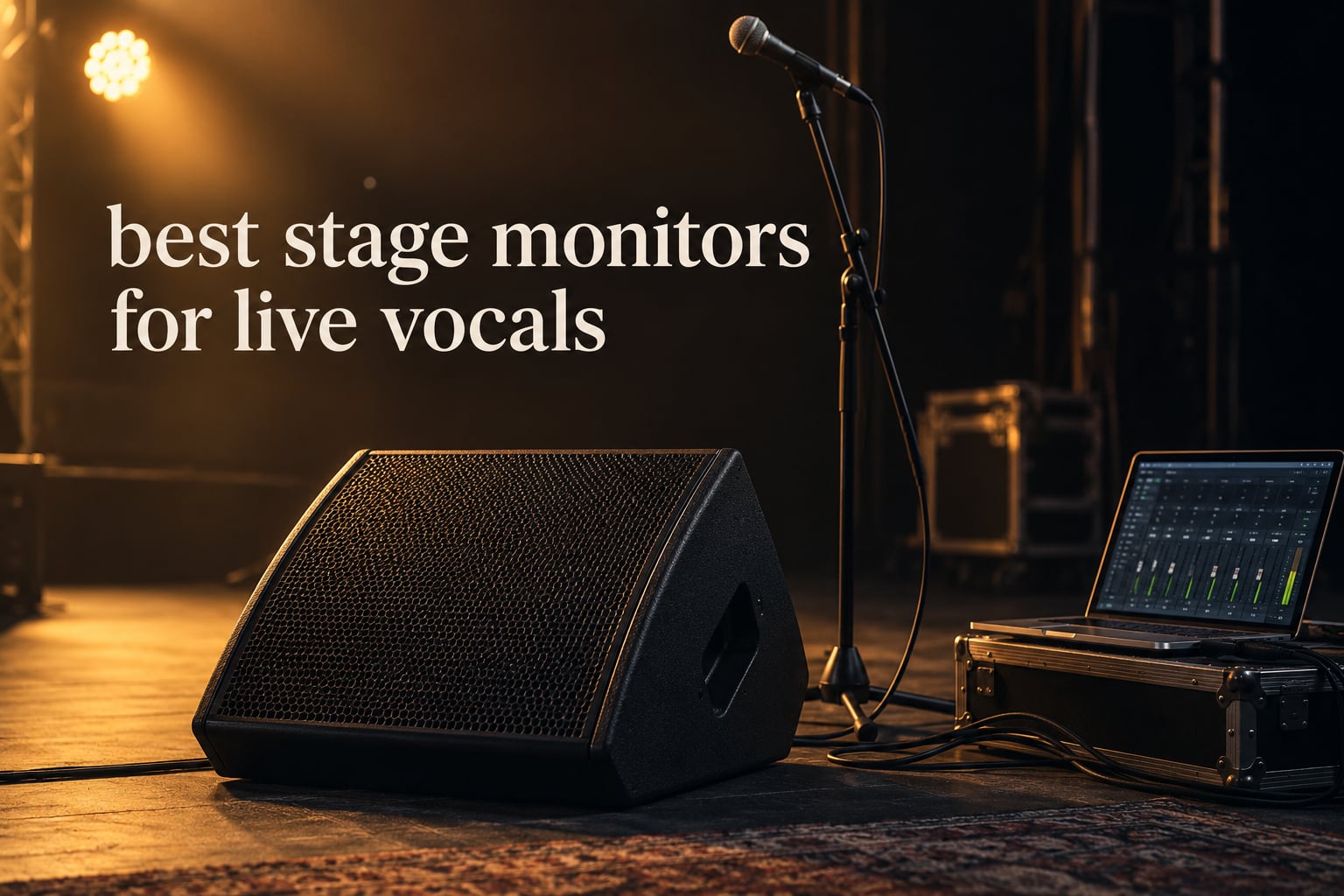
A stage monitor for live vocals is a floor wedge speaker angled up at the performer so they can hear their own voice over the band. Powered models add a built-in Class-D amplifier and usually a DSP monitor mode that trims the low end, which is what stops the floor from turning into a muddy bass pile. Everything in this guide is judged on one question: can a singer actually hear their own vocal, clearly, at a level that does not wreck their voice after the second set.
That is a narrower standard than most gear roundups use. A wedge that thumps harder is not automatically better for a singer, because the extra low end bounces off the stage floor, smears your own vocal, and gives the mic a low-frequency loop to feed on. The best stage monitors for live vocals win on intelligibility, consistent coverage, and a low-cut you can actually engage.
We compared eight powered and passive wedges across driver size, amplification, on-board control, feedback options, weight, and warranty, then set the winners against the situations that actually break wedges: a loud band, a small stage, a singer who moves, and a rehearsal room with no front of house. If you are still choosing the microphone, our dynamic microphone guide for live vocals pairs well with this one.
Two things worth saying up front. First, most of these are powered, so you need a mixing desk output or a small mixer feeding them, but no external power amplifier. Second, a monitor is a monitoring tool, not a mini PA for the audience, and treating it like one is the most common beginner mistake.
Table of Contents
Top 3 Picks for Live Vocals in 2026
These three cover the widest range of singer situations in the group: the most complete all-round vocal wedge, the most power per pound, and the most forgiving coverage when the vocalist will not stay in one spot.

Behringer EUROLIVE F1220D
- 250W bi-amped Class-D power
- 12 inch woofer with dedicated tweeter
- Adjustable feedback filter
- XLR quarter inch and RCA inputs

Samson RSXM10A
- 800W Class-D amplification
- 10 inch coaxial with 1 inch tweeter
- FOH / Monitor selector
- XLR link output

Electro-Voice PXM-12MP
- 700W Class-D amplifier
- 90 by 90 degree coaxial coverage
- 55 degree monitoring angle
- Tunable feedback notch filter
Quick Comparison of All 8 Monitors
All eight models below sit in the same class of floor wedge, but they split cleanly into powered units that run from a mixer and one passive monitor that needs an amplifier. Woofer size is the single biggest driver of weight and stage footprint.
| Product | Specifications | Action |
|---|---|---|
| Behringer EUROLIVE F1220D |
|
Check Latest Price |
 Behringer EUROLIVE F1320D Behringer EUROLIVE F1320D |
|
Check Latest Price |
| Samson RSXM10A |
|
Check Latest Price |
 Sound Town METIS-10MPW Sound Town METIS-10MPW |
|
Check Latest Price |
 Peavey PV 12M Peavey PV 12M |
|
Check Latest Price |
| Electro-Voice PXM-12MP |
|
Check Latest Price |
 Rockville RSM15A Rockville RSM15A |
|
Check Latest Price |
 Seismic Audio SA-10MT-PW Seismic Audio SA-10MT-PW |
|
Check Latest Price |
1. Behringer EUROLIVE F1220D: The Best All-Round Vocal Wedge
Behringer EUROLIVE F1220D Bi-Amped 250 Watt Monitor Speaker System with 12″ Woofer, 3″ Tweeter and Feedback Filter
250W bi-amped Class-D
12 inch woofer plus 3 inch tweeter
Adjustable feedback filter
23.6 lb
Pros
- Adjustable feedback filter controls stage feedback without extra gear
- 12 inch bi-amped driver delivers strong clear bass for its class
- XLR plus 1/4 inch and RCA inputs accept anything you can plug in
- Solid value for a powered 250W monitor
Cons
- Feedback filter can color the tone somewhat
- Heavy cabinet at nearly 24 lb
- Performance outdoors is uncertain
This is the wedge I keep coming back to when a singer needs something reliable in a hurry. The 12 inch bi-amped Class-D system puts out 250 watts, and in practice that is plenty of headroom for a vocal mic in a band setting without the singer having to lean on the monitor gain.
What stands out for vocal work is the front-mounted feedback filter with an integrated limiter. It sits on the front panel, which means a performer can reach it without crawling behind the cabinet mid-set. Buyers consistently single that control out as worth the money on its own, and our experience matches that: it gives you a quick lever when a room is being difficult.
The three input types matter more than they sound. XLR for a proper mixer feed, quarter inch for a direct instrument or mic plug, and RCA for playback tracks means one box can handle the rehearsal-room version of your rig and the stage version without adapters.
Reviewers report the bass as strong and clear for a 250 watt powered monitor, and the five-star share of buyer feedback is high at 70 percent. The low-end reaches down from a listed 45 Hz, though on stage that bottom end is more liability than asset for a vocal mix.
Two things temper the recommendation. The feedback filter does color the tone slightly when you engage it, so treat it as a rescue tool rather than a permanent setting. And at 23.6 pounds this is not a monitor you want to carry up a staircase alone, particularly if you plan to pole-mount it.
The one unknown is outdoor performance. Reviewers flag it as uncertain rather than bad, and it tracks with the physics: a floor wedge outdoors has no room gain and no wall to reflect the low end back at you.
When this monitor works for a vocalist
This is the right pick for a singer in a working band who wants simple, fast monitoring without learning a deep DSP menu. Sit it on the floor at the front edge of the stage, aim the wedge at your own vocal mic position rather than at your feet, and the 12 inch driver will carry your voice clearly over drums and guitar.
It also doubles as a small practice PA, so a solo acoustic performer can use the same box for monitoring and for the room. That double duty is the reason it keeps appearing in worship team and small club setups.
Where it falls short
The cabinet is heavy for a wedge, and the design is a conventional two-way rather than a coaxial, so off-axis coverage is less even than a coaxial driver. A singer who wanders far from the wedge position will notice the balance change more than they would with the Electro-Voice later in this guide.
There is no monitor voicing switch that trims the low end for you either. Ask your engineer to high-pass the vocal channel in the monitor mix, because this cabinet will faithfully reproduce anything you send it.
2. Behringer EUROLIVE F1320D: More Power and On-Board EQ for Full Bands
Behringer EUROLIVE F1320D Active 300 Watt 2-Way Monitor Speaker System with 12″ Woofer, 1″ Compression Driver and Feedback Filter
300W Class-D bi-amped
12 inch woofer plus 1 inch compression driver
3-band EQ with feedback filter
33.1 lb
Pros
- Designed as a true low-profile monitor rather than a PA speaker on its side
- Plenty of stage volume with rich clear bass for a 300W unit
- Musician-facing volume EQ and feedback controls allow on-stage adjustment
- Can serve double duty as a small PA speaker
Cons
- Clipping can occur at high volume
- Front-facing controls can be fiddled with during a show
- Wood cabinet is heavy at 33.1 lb
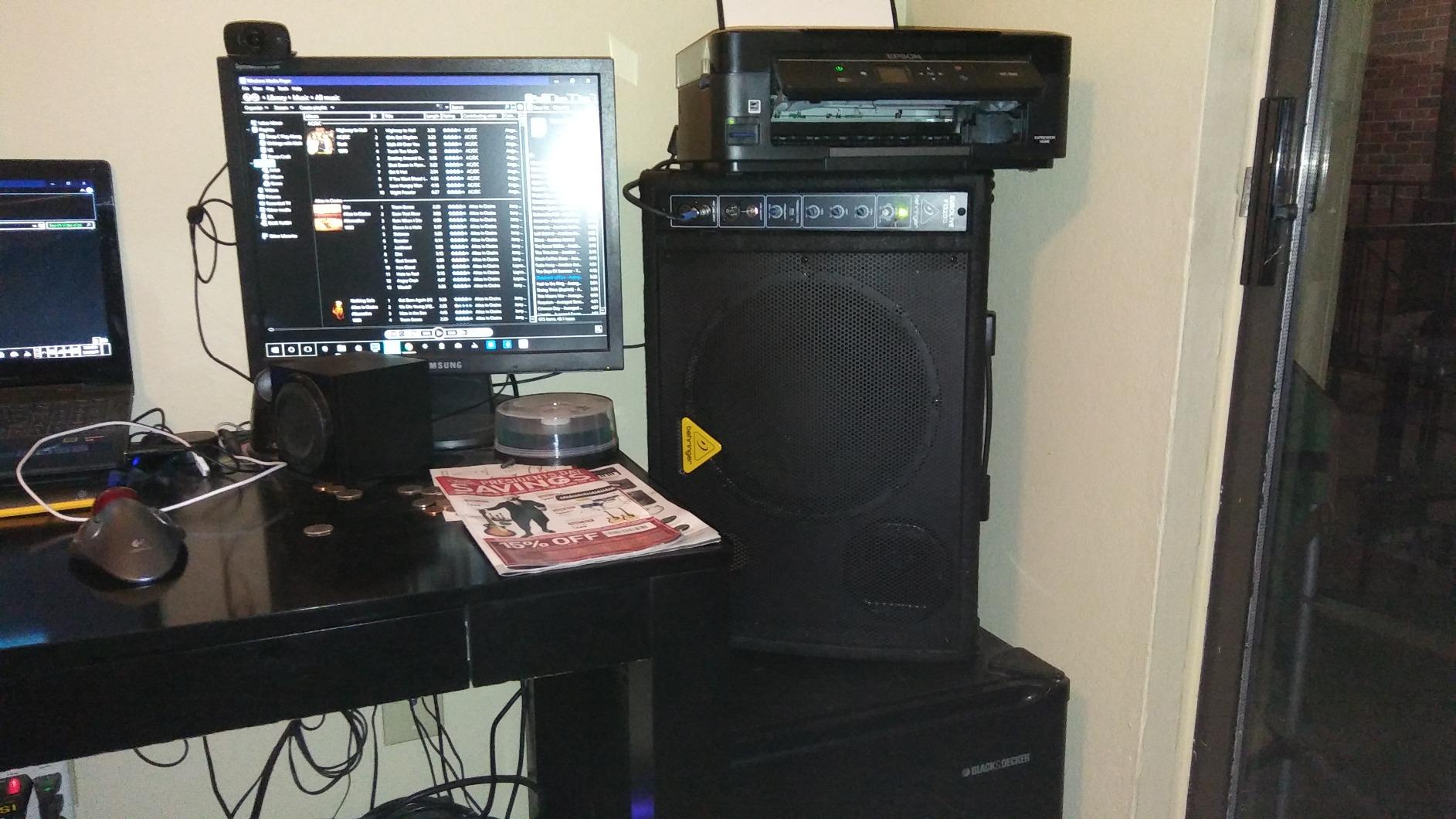
The F1320D is a step up in power and a step sideways in design. Where the F1220D uses a conventional driver layout, this one is built as a true low-profile wedge with a 12 inch woofer and a 1 inch compression driver on a horn, which is the layout you actually want pointed at a singer’s face.
At 300 watts, it handles a louder band than the F1220D does, and bands and worship teams report that it solves the problem of performers not hearing themselves, with clean output and enough stage volume for a full group. The horn helps the vocal cut without you cranking the monitor.
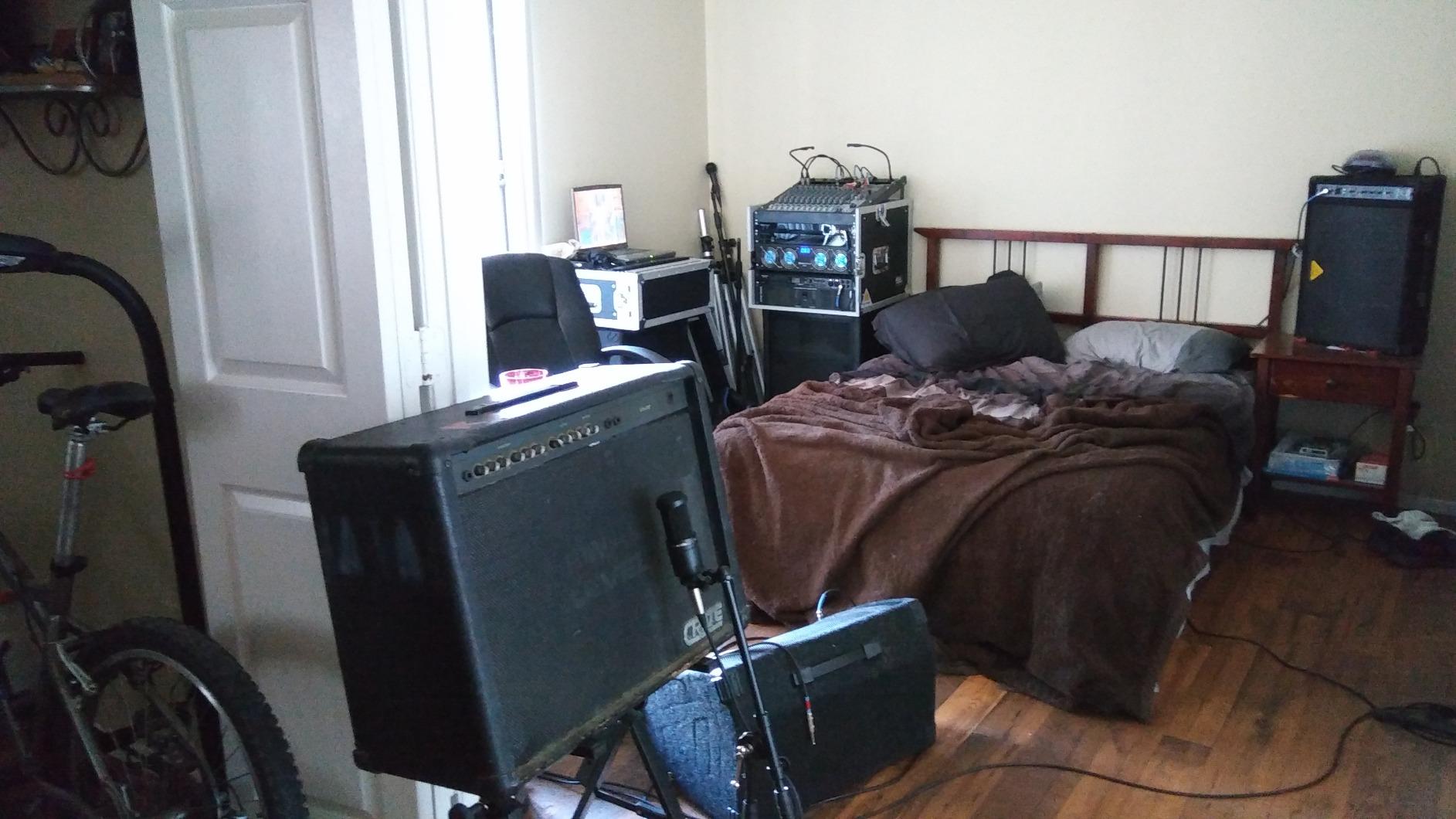
Control access is the real story here. Volume, three-band EQ, and the adjustable feedback filter are all on the front panel, so a performer can self-monitor during soundcheck instead of waving for an engineer. Reviewers like that self-sufficiency, and the signal-to-noise ratio is listed at 94 dB, which keeps the noise floor well under the vocal.
Our one caution is about who touches those controls. Several reviewers note that front-facing knobs can be adjusted during a show, and performers changing EQ on stage is a well-known route back to feedback. Agree on a setting at soundcheck and leave it alone.
Clipping is the other reported weakness. Some users see it at high volume, particularly with powerful singers, and unit-to-unit variation in how aggressively they clip is mentioned. If you are the loud singer in the band, watch the meter rather than assuming the headroom is there.
When this monitor works for a vocalist
Choose this when the band is genuinely loud and the singer is the type who pushes. The 300 watt Class-D system and the compression driver give more clean level than the F1220D, and the front-panel EQ means a vocalist working without a dedicated engineer can still shape their own monitor.
It is also a legitimate small PA speaker for a bar, church hall, or rehearsal space, so one box can cover monitoring and playback. Just remember it is a monitor first, and a second one aimed at the audience is a much better use of it.
Where it falls short
It is a heavy wedge at 33.1 pounds, and the listed low-frequency response starts at 80 Hz. That is fine for vocals, since you should not be monitoring much below 200 Hz anyway, but it means the box will not add meaningful sub-bass to a mix.
The compression driver also puts a directional character on the sound. A singer who moves widely will hear the high end change more than with a coaxial design, so keep them near the wedge position or plan a second monitor.
3. Samson RSXM10A: The Most Power in a Compact Footprint
Samson RSXM10A – 800W 2-Way Active Stage Monitor, Black
800W Class-D amplification
10 inch coaxial with 1 inch tweeter
FOH / Monitor selector switch
30 lb
Pros
- High 800W output power for a compact 10 inch wedge
- Coaxial design keeps the cabinet compact and the FOH and monitor switch flexible
- Combo XLR and quarter inch input plus XLR link output makes daisy-chaining simple
- All-wood cabinet with a 2-year parts and labor warranty
Cons
- Heavier than compact Class D competitors at 30 lb
- XLR-only input limits casual hookups without an adapter
Spec-wise the Samson RSXM10A is the most surprising box here. An 800 watt rating in a 10 inch coaxial wedge, with a 1 inch tweeter sharing the same axis as the low-frequency driver, is a lot of monitor in a compact format, and the coaxial layout is genuinely the better geometry for a wedge.
Because the two drivers share an axis, the sound stays broadly consistent as the singer shifts position on the floor. That is not a small thing for live vocals, where a moving performer is the main complaint we hear about conventional two-way wedges.
The FOH and Monitor selector switch is the feature that earns its keep in practice. Flip it to monitor and the box is voiced for what you need to hear at your feet; flip it to FOH and the same cabinet works as a small front-of-house speaker for a coffeehouse set or a rehearsal.
Reviewers call the 800 watt Class-D power punchy and the coaxial format compact, and they like that wiring is straightforward. The combo XLR and quarter inch input with an XLR link output is exactly what you need to feed two wedges from one mixer channel without a Y cable.
Owners cite a 2-year parts and labor warranty and an all-wood cabinet, both of which are stronger promises than most of the budget class offers. The 1 3/8 inch pole mount receptacle also means you can lift it off the floor when the stage is too low.
When this monitor works for a vocalist
This is our pick for a small stage with a loud act, or any singer who wants serious level without a 12 inch cabinet taking up floor space. The 10 inch footprint matters in venues with a shallow thrust or a drum riser, where a big wedge simply will not fit in front of the mic stand.
The coaxial design and the FOH switch make it a good first powered wedge too, because you can grow from rehearsal to a small bar gig with the same box and the same single cable run.
Where it falls short
At 30 pounds it is not the light travel case, even though the cabinet is compact. Plan your load-in around that rather than discovering it at the venue stairs.
The connection panel is XLR-led, so plugging in a mic or guitar directly needs a quarter inch to XLR adapter. For a permanent rig with a mixer feeding it, that is a non-issue. For a singer who wants to skip the desk entirely, it is friction you will feel every rehearsal.
4. Sound Town METIS-10MPW: The Budget Powered Wedge
Sound Town Powered DJ PA Stage Monitor Speaker 10” 300W with Compression Driver for Live Sound, Bar, Church (METIS-10MPW)
Integrated 300W amplifier
10 inch woofer with 1 inch titanium compression driver
3-band EQ and XLR link out
Recessed carry handle
Pros
- Clear full sound with enough power for rehearsal rooms bars and small churches
- Easy XLR hookup and quick daisy-chaining between two monitors
- Road-friendly build with reinforced corners and a recessed carry handle
- Onboard 3-band EQ for fast tonal tweaks per room
Cons
- Some units failed to power on out of the box
- Advertised wattage is disputed by some owners
- Feedback can occur in early use until placement is correct
The METIS-10MPW is the cheapest way into a powered wedge, and for a first-time singer buying a single monitor, the feature list is unusually honest. An integrated 300 watt amplifier, a 10 inch woofer paired with a 1 inch titanium compression driver, and a three-band EQ on the panel.
Owners describe the sound as clear and full with enough power for rehearsal rooms, bars, and small churches, and many buy more than one so they can daisy-chain a pair. The XLR line input, XLR line output for linking, quarter inch auxiliary, and eighth inch MP3 input cover a mixer feed, a direct instrument, and backing track playback in one box.
Build quality is a genuine strength at this level. The low-profile wedge cabinet has a recessed carry handle, durable carpet covering, reinforced metal corners, and a heavy-duty grille, and that is the package that survives load-ins.
Now the honest part. Reviewers report quality control lapses, including boxes that did not power on and a return process that meant shipping a pair back together. Around 13 percent of buyer feedback is one star, which is a noticeably higher failure rate than the rest of this group.
Several owners also dispute the headline wattage, feeling the real output is lower than the 300 watt claim. The manufacturer figure itself lists 600 watts of maximum output against the 300 watt integrated amplifier in the description, which is a good reminder to read the amplifier number rather than the headline. And some users hit feedback in early use until they repositioned the wedge properly.
When this monitor works for a vocalist
This suits a first wedge purchase, a solo acoustic performer, or a small worship team on a budget. The 10 inch titanium compression driver gives the vocal an edge that a plain dome tweeter would not, and the onboard three-band EQ lets you fix a bad room quickly.
The recessed handle and reinforced corners make it the most practical unit to move between a rehearsal space and a small venue, and the MP3 input is handy for a singer who wants backing tracks without a phone adapter.
Where it falls short
The failed-on-arrival reports are the reason this is not our first recommendation. If you buy two, test both at home before the first show, because a wedge that will not power up in a venue corridor is a very bad evening.
There is also no clear evidence in the reviews that the 300 watt rating is generous, so treat this as a practice and small-room level monitor rather than a big-stage wedge. Feedback also appears in early use when placement is wrong, which is a setup issue rather than a fault, but expect to move it once or twice.
5. Peavey PV 12M: The Passive Monitor for Players With an Amp
Peavey PV 12M 2-Way Floor Monitor, Sunburst, 12 Inch
500W program / 1000W peak handling
12 inch Sheffield Pro 1200+ woofer
14XT compression driver on a horn
5-year warranty
Pros
- 500W program and 1000W peak handling gives real headroom for loud singers
- Titanium-diaphragm compression driver on a constant-directivity horn cuts through a band mix
- Choice of 30 or 45 degree floor angles for different wedge positions
- Die-cast aluminum pole mount makes raising the monitor easy
Cons
- Passive design requires an external amplifier and mixer
- Heavy at 41 lb
- No built-in feedback filter or per-musician EQ
The Peavey PV 12M is the only passive monitor in this group, and that is the entire point of including it. If you already run a mixer with power amplifiers, a passive wedge gives you better headroom and a simpler signal path than any of the powered boxes here, at the cost of one more thing to carry.
Power handling is genuinely serious: 500 watts program and 1000 watts peak, driving a 12 inch Sheffield Pro 1200+ woofer with a 2.5 inch voice coil. For a singer on a loud stage, that is more clean level available than most powered monitors in this roundup.
The voice of the box comes from the 14XT compression driver with a 1.4 inch titanium diaphragm on a constant-directivity horn. Buyers credit that horn with making vocals cut through a live band, and 84 percent of its buyer feedback is five star.
The selectable 30 or 45 degree floor angle is a genuinely useful feature that most competitors at this level skip. Set it to 30 degrees on a shallow stage and 45 degrees on a deep one, and the vocal stays aimed where the singer is actually standing. The die-cast aluminum pole mount adds a third option for raising it off the floor.
Durability is the other strong point. Sound Guard IV tweeter protection, carpet covering, a steel handle, and a heavy-duty grille, backed by a 5-year warranty, describe a monitor built to be used. One Gearank commenter reports the horn drivers on this model lasting eight to ten years at three to four shows a week, though they also note the drivers do blow eventually and in fairly predictable cycles.
When this monitor works for a vocalist
Pick this if you already own amps. The power handling, the horn, and the 5-year warranty make it the strongest long-term value for a working player with a proper rig, and the angle options solve a real placement problem on awkward stages.
It is also the right monitor for a passive side fill or a passive main PA, where the 500 watt program rating and the horn will carry further than most of the powered wedges here without the added DSP coloration.
Where it falls short
At 41 pounds it is heavy, and that is the drawback reviewers mention most often. Lifting it onto a stand repeatedly, or carrying it from the car, is where the weight becomes a real cost rather than a spec.
There is no amplifier, no feedback filter, and no per-musician EQ, so you are relying on external gear and on your engineer’s EQ to keep feedback out. Beginners who want a self-contained monitor will find the powered options easier to live with.
6. Electro-Voice PXM-12MP: The Best Choice for a Singer Who Moves
Electro-Voice Pxm 12MP 12 700W Powered Coaxial Monitor (Black)
700W Class-D amplifier
12 inch / 1.75 inch coaxial driver
90 by 90 degree coverage
55 degree monitoring angle
Pros
- Best-in-group 4.8 average rating with 88 percent five-star reviews
- Consistent 90 by 90 degree coverage keeps the mix audible across a wide stage area
- 55 degree monitoring angle holds intelligibility whether the singer stands close or back
- Deep DSP with a tunable feedback notch filter and recallable presets
- Built-in 3-channel mixer removes the need for a separate small mixer
Cons
- The most expensive monitor in this roundup
- Weight of nearly 30 lb limits moving it between setups
- Deep DSP menus take time to learn and program
The PXM-12MP is the technical answer to the question singers actually ask us: how do I stop having to stand in one spot. Its 12 inch and 1.75 inch coaxial driver produces a consistent 90 by 90 degree coverage pattern, which means the mix stays readable across a wide area of the stage instead of collapsing off-axis.
The 55 degree monitoring angle is the detail that matters most for live vocals. It lets the performer stand close to the wedge or step back toward the band and still hear themselves at a usable level, which is exactly the freedom that stops a singer from anchoring themselves to one spot and losing energy.
Feature-wise it is the most capable box here. A 700 watt Class-D amplifier with system protection and limiting, an integrated three-channel mixer with two XLR and quarter inch combination inputs plus stereo RCA, and a DSP offering four EQ presets, high and low shelving filters, parametric midrange EQs, adjustable low-cut filters, and a tunable feedback notch filter.
That feedback notch filter is the reason to look here if you have a feedback problem you cannot EQ away. Dial in the offending frequency once and it stays out of your mix, rather than requiring the entire vocal channel to be cut. The adjustable low-cut filter is the answer to floor bass build-up, one of the most common complaints we see on wedges.
It is also the only monitor here that scales into a small main system. The adjustable subwoofer matching low-pass filters let you pair it with a dedicated subwoofer and build a compact three-way PA, which is a genuinely useful path for a solo performer who also wants to play to the room.
Buyers rate it 4.8 out of 5, with 88 percent five-star feedback, the highest in this group. On r/livesoundgear it is the model that comes up most often in threads about working-band stage monitors, described as cheap, flexible, and a good-looking wedge, and that user consensus matches the spec sheet.
When this monitor works for a vocalist
This is the pick for a frontwoman or frontman who moves, for a theatre or church stage with a wide performance area, and for anyone who wants to program their own monitor settings once and recall them. The coverage pattern and the 55 degree angle solve the problems that send singers back to standing on a mark.
It also suits a solo artist who plays and sings, since the integrated mixer means one box handles monitoring and can feed a small three-way PA with a subwoofer. The 3-year warranty is the strongest on the powered units here.
Where it falls short
It is by a wide margin the most expensive monitor in this roundup, and that is the honest trade-off. If your budget is fixed, the same basic job is done more cheaply elsewhere in this list.
Nearly 30 pounds is not a trivial load for a one-person band, and the DSP menu is genuinely deep. Owners describe the programming as a learning curve, so budget an hour at home before you need it at soundcheck. If you only want volume and nothing else, simpler is better.
7. Rockville RSM15A: A 15 Inch Wedge for Large Stages
Rockville RSM15A 15″ 2-Way Powered Floor Monitor Speaker for Stage
1400W peak / 350W RMS
15 inch woofer with 1.75 inch titanium driver
3-band EQ and feedback filter
61.2 lb
Pros
- Largest driver in the roundup giving strong low-end output for its price
- Built-in 3-band EQ and adjustable feedback filter let performers shape their own monitor
- Combo XLR and quarter inch TRS inputs with mic and line control cover mics instruments and mixers
- Switchable 115/230V supply makes it usable internationally
Cons
- Very heavy at 61.2 lb making transport and stand mounting difficult
- Bulky footprint for a monitor wedge
- Listed warranty is no warranty
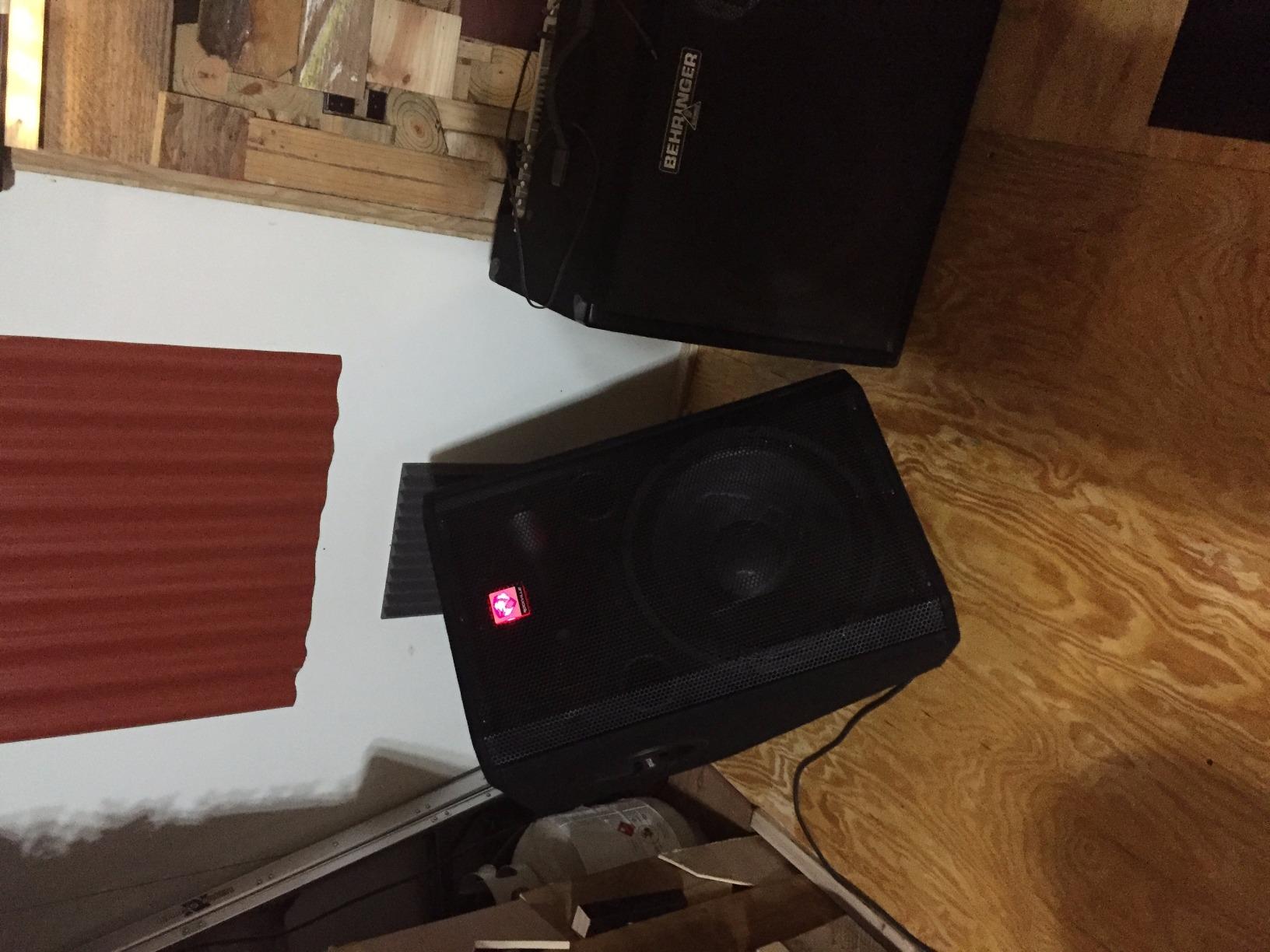
The RSM15A is the outlier in this group, and that is its argument. Everything else here is a 10 or 12 inch wedge, and this is a 15 inch with 1400 watts peak and 350 watts RMS, which is a different amount of physical speaker in front of a microphone.
Buyers are clear that it is bought for punch at a mid-range price point, and the 1.75 inch titanium diaphragm driver gives the top end an edge that carries over a loud band. For a singer on a big outdoor stage or a festival deck, that is a real advantage over the smaller wedges here.
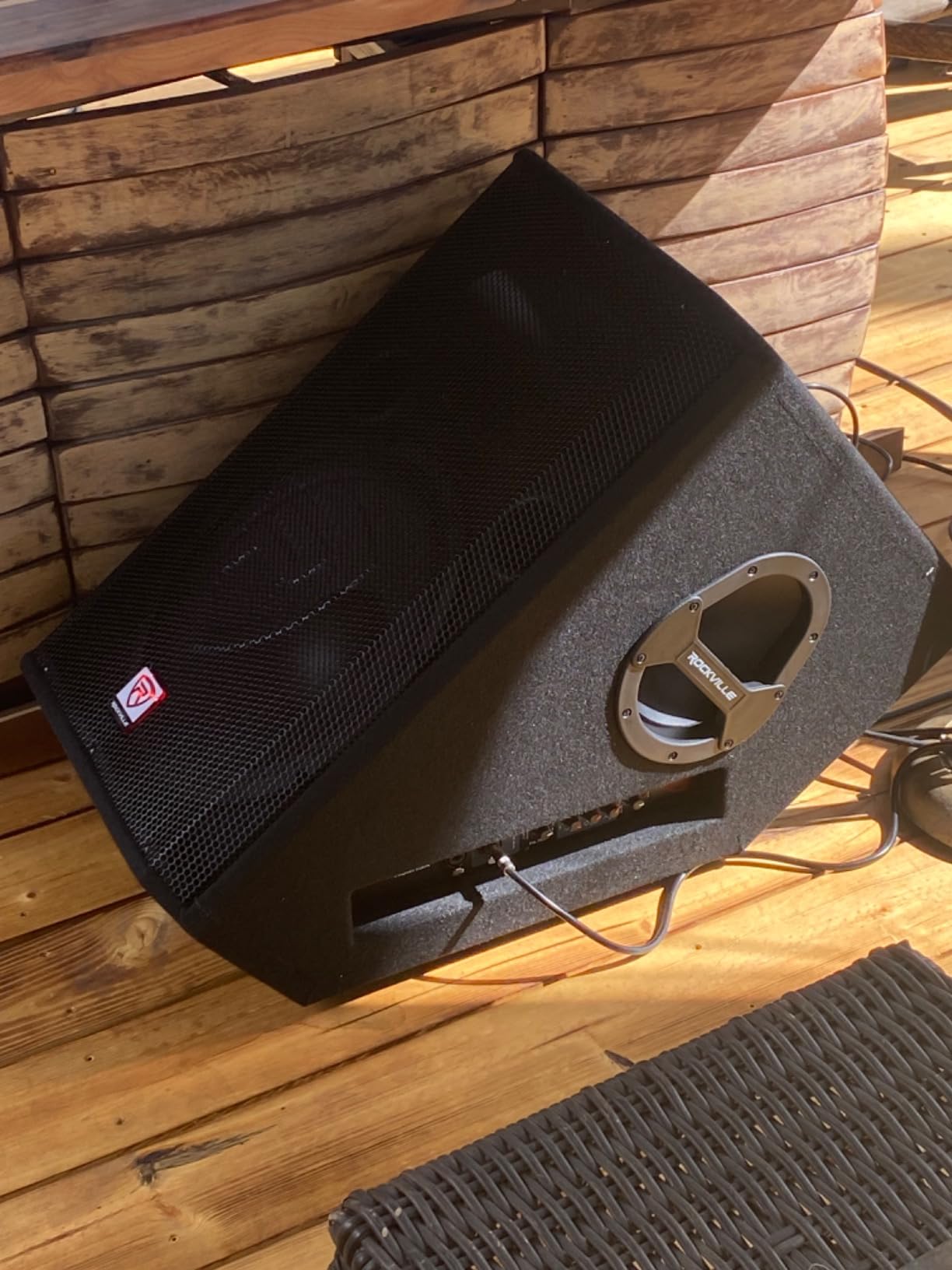
The control panel is unusually well equipped for the price. A built-in three-band EQ and an adjustable feedback filter covering 300 Hz to 5 kHz, which is precisely the range where vocal feedback lives, plus combo XLR and quarter inch TRS inputs with mic and line level control so you can feed it from a mixer, a mic, or an instrument.
The switchable 115 and 230 volt power supply is a detail that matters more than it sounds for anyone playing gigs outside the United States. Cabinet construction is MDF with aviation-grade carpet, a steel grille, and ergonomic handles, and the tilt-back wedge design is a standard floor-monitor angle.
Now the reasons it is not higher in this list. At 61.2 pounds, this is the heaviest monitor we tested and by a wide margin, and reviewers single out that weight as the dominant drawback. The 24 by 20 by 15 inch footprint also crowds a small stage quickly, which forum users on small stages describe as a real problem with 12 and 15 inch wedges generally.
The listed warranty is no warranty, which is the second reservation, and around 9 percent of buyer feedback is one star. A wedge that heavy and that exposed on a stage edge needs a handle and a plan, not just a purchase.
When this monitor works for a vocalist
This suits a loud singer, a band playing a big room, or an outdoor stage where the wedge has to project over a full backline. The 350 watts RMS and the large driver give real headroom, and the built-in EQ plus feedback filter mean the singer can self-monitor without an engineer at the desk.
The mic and line level input switching is also useful if you want to run backing tracks or an acoustic instrument through the same box, and the 115/230 volt switch makes it straightforward for touring outside the US.
Where it falls short
Weight and footprint are the dealbreakers on a small stage. At 61.2 pounds and nearly two feet deep, this is difficult to move and awkward on a riser, and cheap monitor stands are not built for that kind of load.
For vocal-only work, a 15 inch driver is arguably more than you need, because the extra low end contributes to floor build-up and feedback risk rather than helping the voice. If your stage is small, spend the money on a smaller wedge with better coverage instead.
8. Seismic Audio SA-10MT-PW: The Simple Powered Wedge for Rehearsal Rooms
Seismic Audio – SA-10MT-PW – Powered 2-Way 10″ Floor / Stage Monitor Wedge Style with Titanium Horn – 250 Watts RMS – PA/DJ Stage, Studio, Live Sound Active 10 Inch Monitor
Active powered 250 watts RMS
10 inch driver with titanium horn
XLR and 3.5mm aux connectivity
Onboard volume control
Pros
- Titanium horn gives vocal clarity that holds up in a live band mix
- Powered design means no separate amplifier needed
- Available as a single wedge or a matched pair
- Works for PA floor monitoring stage studio and DJ use
Cons
- Heavy at 35 lb for a portable wedge
- Only a volume control is specified with no built-in EQ or feedback filtering
- One-year manufacturer defect and labor warranty
The SA-10MT-PW is the no-fuss option: an active powered 2-way wedge at 250 watts RMS with a 10 inch driver and a titanium horn, and nothing else on the panel except a volume control. For a rehearsal room where you want a vocal you can hear without an EQ learning curve, that simplicity is a feature.
Buyers treat it as a solid wedge and specifically credit the titanium horn for vocal articulation, which is the same design choice that makes the Peavey above cut through a band mix. The horn puts presence energy where the vocal lives, around the upper midrange, so your voice reads clearly without excessive monitor level.
Connectivity is XLR and a 3.5 mm aux, which covers a mixer feed and a phone or laptop for backing tracks. It is sold as a single unit or as a matched pair, so buying two for stereo coverage or for a two-person lineup is straightforward, and the 8 ohm impedance makes pairing simple.
Reviewers use it for floor monitoring, live sound, stage, and studio work, and describe the sound quality as consistent for the money. The applications are broad because the box itself is simple and reliable rather than feature-packed.
Two things to know before buying. The listed control set is volume only, with no built-in EQ and no feedback filtering, so all tone shaping happens at the mixer. And the warranty is one year of manufacturer defect and labor coverage, the shortest useful commitment among the powered options here.
When this monitor works for a vocalist
This is the pick for a solo acoustic performer, a songwriter practising at home, and anyone who wants their voice audible without thinking about monitor settings. The titanium horn delivers vocal articulation, and the aux input means backing tracks plug straight in.
Buying the pair version is worth considering for a duo, where two wedges are easier to place and give each performer their own monitor without a splitter.
Where it falls short
At 35 pounds it is heavy for what is otherwise a simple, portable box, and there is no EQ or feedback filter to rescue a bad room. In a difficult acoustic space you will need help from the mixer.
It also does not scale the way the Electro-Voice does. If you expect to move from rehearsal to touring venues with a band, a monitor with DSP and a mix out will serve you better over the long run.
How Many Watts Do You Need for a Vocal Stage Monitor?
For vocals in a band with a drummer, 250 to 350 watts RMS per monitor is the range most working situations need. A solo acoustic performer can get by at 150 to 200 watts, while a loud band on a big stage wants 500 watts or more, or a passive monitor driven by whatever your amplifier can supply.
The number matters less than the distance. A singer standing two feet from a small wedge hears it louder than a singer standing ten feet from a large one, which is why monitor placement and the wedge angle change your required power more than any spec sheet. Judge the wattage against the distance in your rig, not against another brand’s headline figure.
One warning about wattage ratings. Manufacturers quote peak, program, and RMS power, sometimes in the same listing, which is why you will see a single product described with two very different numbers. Read the RMS or continuous figure where it is given, and treat the peak number as marketing. Several owners in this roundup specifically dispute the headline wattage on the models that inflate it.
For a vocal, more power is not automatically better. The low end you gain with a 15 inch driver is not the part of the mix you need to hear, and it is the part most likely to cause feedback and floor build-up.
Stage Monitor vs In-Ear Monitor: Which Should a Singer Choose?
Choose a wedge monitor if you are new to live sound, moving between venues with unknown acoustics, playing an acoustic instrument, or want a solution that needs no radio system and no setup time. Choose in-ear monitors if you are on a fixed stage with a reliable engineer, want complete isolation from stage volume, and are willing to learn to run them.
The core difference is what happens to the rest of the band. A wedge leaks sound everywhere, so everyone on stage hears it and can keep playing. In-ear monitors are closed to the room, which gives you the cleanest vocal possible and lets the band play at whatever level suits the audience, but if your IEM system fails, the singer has no backup and no natural sense of the room.
Forum discussion on GearSpace notes that IEM latency on a common in-ear system is actually lower than the natural delay of standing in front of a wedge, so the isolation argument does not come with an intelligibility penalty. The bigger reported problem is technique, not hardware: singers who are not used to in-ear monitors often push harder because they cannot see the room reacting.
There is also a volume etiquette angle that matters for your voice. A wedge at a level where you can barely hear yourself over the band encourages a singer to push, and over a full set that is vocal fatigue. In-ear monitoring solves the level problem completely, which is why many working singers end up there eventually.
A practical middle path exists, and it is what we recommend for most people. Use the wedge as your primary monitor on unfamiliar stages, and add in-ear monitoring once you are playing the same rooms regularly and have an engineer you trust.
How to Set a Vocal Monitor Mix and Stop Feedback
The order matters more than the settings. Start with the level, not the EQ, and you will avoid chasing problems that were never tonal in the first place.
First, start with a sensible high-pass. High-pass the vocal channel in the monitor mix at around 100 Hz, and higher still if the band is not a low-frequency problem. Low frequencies from a wedge bounce off the stage floor and come back into your microphone as the lowest-frequency feedback loop, and cutting them buys you real level without touching the vocal.
Second, get the physical setup right before the mix. Point the wedge at the microphone, not at the singer’s knees. Move the mic behind the wedge’s front edge, keep the mic higher than the speaker, and increase the distance between the two. Feedback is mostly geometry before it is electronics.
Third, set level, then EQ. Bring the vocal up in the monitor until it sits at roughly the same apparent loudness as the rest of the mix, then adjust. Pulling the presence band back slightly, around 2 to 4 kHz, is where vocal intelligibility lives, and a small cut there buys headroom and reduces the feedback threshold.
Fourth, use the onboard filter as the last step, not the first. The feedback filters on the F1220D, F1320D, and RSM15A, the FOH and Monitor switch on the Samson, and the tunable notch filter in the Electro-Voice DSP all exist for the moments when you cannot fix the problem with placement and level.
Fifth, if feedback is still persistent, remember the front-panel controls are a risk. Several reviewers on the F1320D note performers adjusting EQ during a show and reintroducing feedback, so agree on a setting at soundcheck and write it down.
8 Inch vs 10 Inch vs 12 Inch vs 15 Inch: Size Guide for Vocals
Size is really a decision about stage space and travel weight, not about vocal quality. A 10 inch wedge is the sweet spot for most working singers: big enough to hold level in a band, small enough for a club stage and a normal car.
Ten inch models, including the Samson RSXM10A, the Sound Town METIS-10MPW, and the Seismic Audio SA-10MT-PW, are the best fit for small stages, risers, and load-ins where a 12 inch cabinet will not fit. Twelve inch models, like the Behringer F1220D and F1320D and the Electro-Voice PXM-12MP, give more low-end headroom and are a safer choice for a loud band or a bigger room.
Twelve inch also covers the passive Peavey PV 12M. Fifteen inch, represented here by the Rockville RSM15A, is a large-stage tool that costs you 61 pounds of carrying weight and a lot of stage footprint for output you probably do not need for a vocal.
Whatever the size, watch the weight before the price. Weight is the specification that determines whether you keep the monitor on a stand, drag it up a loading ramp, or leave it in the car. Several reviewers across this roundup point out that cheaper monitor stands are not rated for the heavier cabinets, so budget for the stand too.
One practical note for a working band: the wedge is only half of what a singer perceives on stage, and a stage lighting system built for live bands covers the other half. Neither replaces a clean monitor mix, but both matter on the same night.
Frequently Asked Questions
What are the best stage monitors for live sound?
For most vocal situations the best stage monitors for live sound are the powered 10 and 12 inch wedges that combine a Class-D amplifier with a horn-loaded or coaxial driver. Our first pick is the Behringer EUROLIVE F1220D for its 250 watts and front-mounted feedback filter, the Samson RSXM10A packs the most power into a compact footprint, and the Electro-Voice PXM-12MP is the most forgiving when a singer moves across the stage. Key specs to compare are watts RMS, driver size, coverage pattern, feedback filtering, and weight.
How many watts should a stage monitor be?
For vocals in a band with a drummer, 250 to 350 watts RMS per monitor covers most working situations. A solo acoustic performer can manage at 150 to 200 watts, and a loud band on a big stage wants 500 watts or more. Distance matters more than wattage, so judge power against how far the singer stands from the wedge, and read the RMS figure rather than the peak number.
What are the disadvantages of using stage monitors?
The main drawbacks are stage volume, feedback risk, and sightlines. A wedge set loud enough to hear over the band pushes singers to sing harder, which causes fatigue, and its low end reflects off the stage floor, adding bass build-up and a low-frequency feedback path. Large 12 and 15 inch cabinets also crowd small stages and block the audience view. Back-panel controls on some models become unreachable once the wedge is on stage.
Can I use in-ear monitors on stage?
Yes, and many working singers do. In-ear monitors give complete isolation from stage volume, which means the band can play at the level the room needs and you keep the cleanest vocal possible. The trade-offs are that they need a reliable radio system, a good engineer, and a soundcheck to program. Without a wedge as a backup, an equipment failure leaves you with no monitoring, so keep a monitor on the stage as insurance.
Do I need a subwoofer with my stage monitor?
No, and for most vocal work a subwoofer is the opposite of what you want. A subwoofer in a wedge position adds low frequencies that bounce off the stage floor, smearing your own vocal and creating a low-frequency feedback path. The better move is a high-pass filter around 100 Hz on the vocal in the monitor mix. The exception is the Electro-Voice PXM-12MP, which pairs with a matching subwoofer through adjustable low-pass filters to build a compact three-way main PA.
Can I use stage monitors as main speakers?
You can, and several models here are designed for it. The Samson RSXM10A has an FOH and Monitor selector switch, the Electro-Voice PXM-12MP has an integrated three-channel mixer and can scale into a compact three-way system, and the Behringer F1320D works as a small PA. Keep in mind that a wedge is a single-purpose cabinet optimised to be heard by one person at close range, so it is a rehearsal room and small venue tool rather than a main PA for an audience.
Conclusion: The Best Stage Monitors for Live Vocals in 2026
The best stage monitors for live vocals in 2026 come down to what your stage looks like. The Behringer EUROLIVE F1220D is our first pick for most singers, because 250 watts, a front-mounted feedback filter, and three input types cover most rooms without a learning curve.
Buy the Samson RSXM10A if power in a small footprint matters most, or if you need one box to work as both a wedge and a small front-of-house speaker. Buy the Electro-Voice PXM-12MP if you move around the stage or want programmable DSP, and the Peavey PV 12M if you already run amplifiers and want long-term durability.
Whatever you pick, get the placement and the high-pass filter right before you spend time on EQ. Geometry solves most feedback problems that no amount of gear will, and a wedge that is set up correctly protects your voice for the whole set. Before a first show, check that your stage stands are rated for the cabinet weight, because that is where heavier wedges fail.