
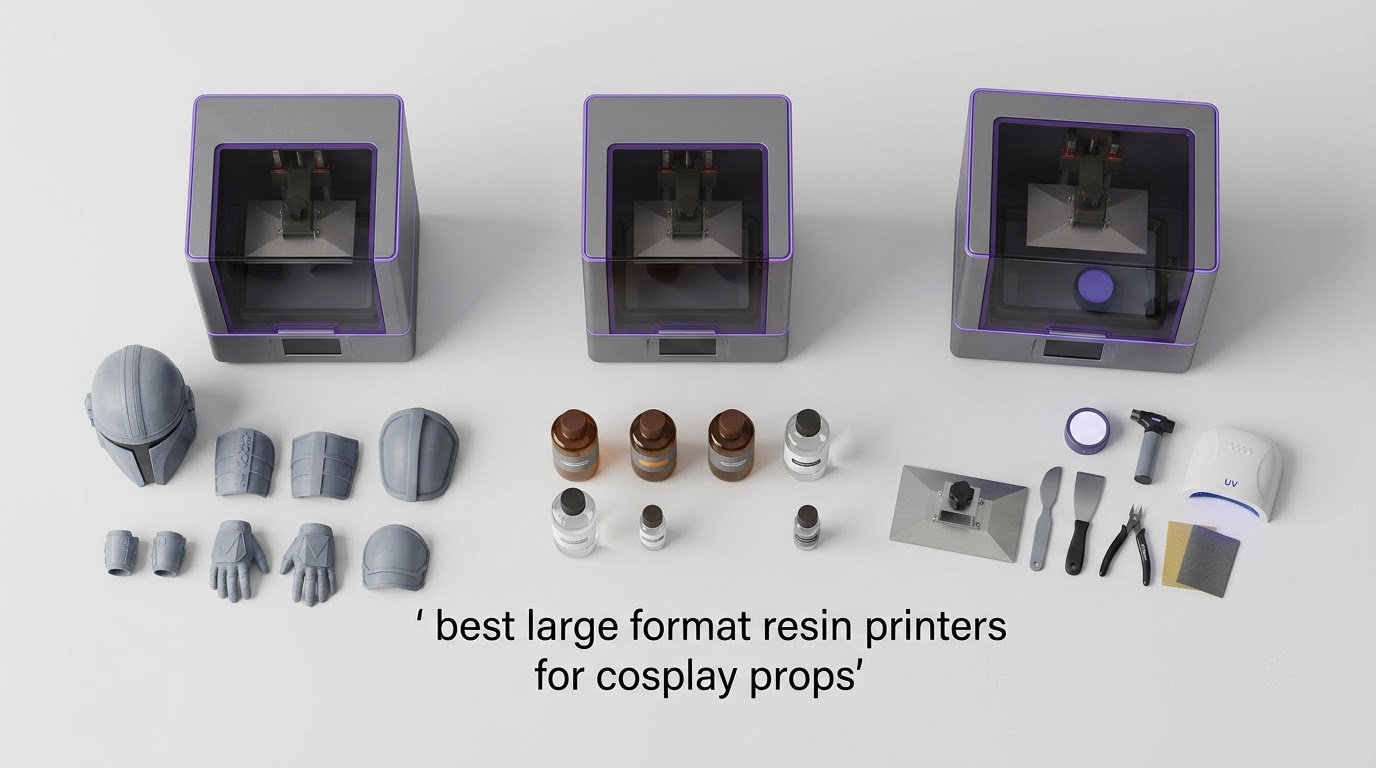
If you have already outgrown a desktop resin machine and you are chasing the kind of surface finish that makes a helmet look cast rather than printed, the shortlist below is where the search actually ends. We put eight large format resin printers through the same cosplay-first filter: can it produce a wearable helmet shell, a chest plate, or a prop barrel without splitting the file into six pieces, and what does the resin workflow cost you in finishing time, ventilation and brittleness at skin-contact edges.
Nobody else publishes this list. The large-resin roundups that already rank treat the category as a dental and jewellery buying decision, while the cosplay printer guides treat resin as a footnote for tiny greebles. We graded every machine against a convention-worn armor brief instead, and we kept the awkward parts in rather than smoothing them over.
A large format resin printer, for cosplay purposes, is an MSLA machine with a 14-inch class or larger monochrome LCD and roughly 300mm of build volume in two axes. That is the threshold where a full-scale shell stops being a split job. Everything below that is a detail machine with a big plate in the marketing photos. If you are still choosing between a small resin unit and a larger one, our resin printer roundup for smaller work is the better starting point.
We spent six weeks reading owner reviews, comparing published specs against the files people actually print, and mapping each machine to a specific cosplay job. Eight printers made the cut. One of them is the clear best large format resin printer for cosplay props in this group, and it is not the one with the most impressive spec sheet.
Table of Contents
Top 3 Large Format Resin Printers for Cosplay Props in 2026
Our short answer first: the ANYCUBIC Photon Mono M7 MAX is the best large format resin printer for cosplay props overall because it pairs a 298 x 164 x 300mm build volume with the deepest owner-review base in the category, and the ELEGOO Saturn 4 Ultra 16K is the one to buy if your cosplay parts are detail pieces rather than full shells. The Phrozen Sonic Mega 8K S wins on the widest single-axis footprint for long prop bodies.

ANYCUBIC Photon Mono M7 MAX
- 298 x 164 x 300mm build volume
- 13.6-inch 7K mono LCD
- 46 x 46µm XY pixel size
- Temperature-controlled 1300ml vat

ELEGOO Saturn 4 Ultra 16K
- 16K LCD at 14 x 19µm
- 8.33 x 4.66 x 8.66 inch build
- Heated resin tank
- 150mm/h tilted release

Phrozen Sonic Mega 8K S
- 15-inch 8K mono LCD at 43µm
- 33 x 18.5 x 30cm build plate
- ACF film with TR300 resin
- Lift-up lid and drip hanger
Each of those three answers a different question. The M7 MAX answers how do I stop splitting my files. The Saturn 4 Ultra answers can I get crisp emblems and engraved panel lines without babysitting the machine. The Phrozen answers how do I print a long prop body in as few pieces as possible.
Quick Overview: Every Large Format Resin Printer Compared in 2026
What resin printer has the largest build plate? In this group, the ANYCUBIC Photon P1 Max has the largest build volume at 18.3 litres, measured as 11.24 x 8.43 x 11.81 inches. The widest single plate belongs to the Phrozen Sonic Mega 8K S at 33 x 18.5 x 30cm, and the two machines built specifically for cosplay-sized shells, the M7 MAX and the UniFormation GK3 Ultra, both land near 298-300 x 160-164 x 300mm.
Nominal build volume is a marketing number, and the gap between it and what you can actually print is where cosplay builds go wrong. Measure your STL bounding box in your slicer, subtract roughly 5mm from every axis for plate tilt and raft margin, and only then compare it against the figure in the table below.
| Product | Specifications | Action |
|---|---|---|
| ANYCUBIC Photon Mono M7 MAX |
|
Check Latest Price |
| ELEGOO Saturn 4 Ultra 16K |
|
Check Latest Price |
| Phrozen Sonic Mega 8K S |
|
Check Latest Price |
 ANYCUBIC Photon P1 Max ANYCUBIC Photon P1 Max |
|
Check Latest Price |
 UniFormation GK3 Ultra UniFormation GK3 Ultra |
|
Check Latest Price |
 MateForm Air 4 MateForm Air 4 |
|
Check Latest Price |
 Creality Halot Mage S Bundle Creality Halot Mage S Bundle |
|
Check Latest Price |
 Heygears Reflex RS Turbo Heygears Reflex RS Turbo |
|
Check Latest Price |
Two things jump out. First, the resolution spread is enormous, from 14.85µm on the MateForm Air 4 to 43µm on the Phrozen, and that difference shows up most on engraved text and thin trim. Second, the weight spread is just as wide, from 35 pounds on the Saturn 4 Ultra to nearly 86 on the GK3 Ultra, which decides where in your home the machine can physically live.
1. ANYCUBIC Photon Mono M7 MAX – Best Reviewed Large Format Machine
ANYCUBIC Resin 3D Printer, Photon Mono M7 MAX 13.6-inch 7K Mono LCD
13.6-inch 7K mono LCD
298 x 164 x 300mm build volume
46 x 46µm XY pixel size
1300ml heated vat
Pros
- 298 x 164 x 300mm plate prints oversized models without splitting
- Strong consensus on clean surface detail and print completion
- Heated resin vat improves consistency
- Simple leveling and reliable prints once tuned
Cons
- Resin pump auto-feed and self-clean cycles reported as very slow
- Vat is awkward to pour from and difficult to clean
- Requires the ANYCUBIC slicer software
The M7 MAX is the machine we would put in a garage with a cosplay build on the bench. It arrived in late 2024, and it has accumulated the deepest review base of any large format resin machine here at 146 reviews and a 4.5 average, which matters more in this category than it normally would because large format resin printers are young enough that most of them have no long-term reliability record at all.
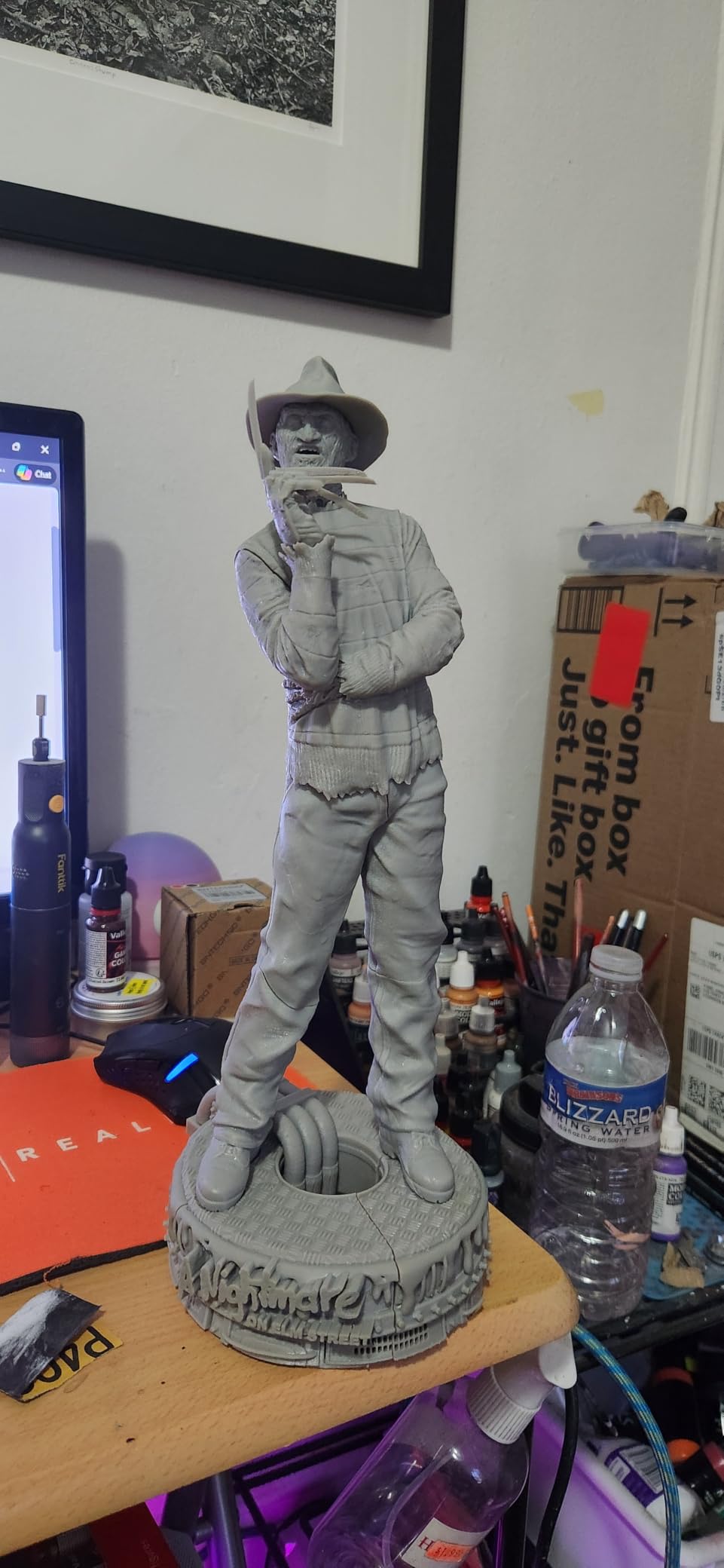
The build volume is 298 x 164 x 300mm on a 13.6-inch 7K mono LCD with a 46 x 46µm pixel size. For cosplay, that footprint is the whole argument. An adult chest plate laid flat, a half helmet dome, or a pair of vambraces all fit without the model being chopped into disconnected sections, which removes the seam-and-glue stage that eats an entire weekend.
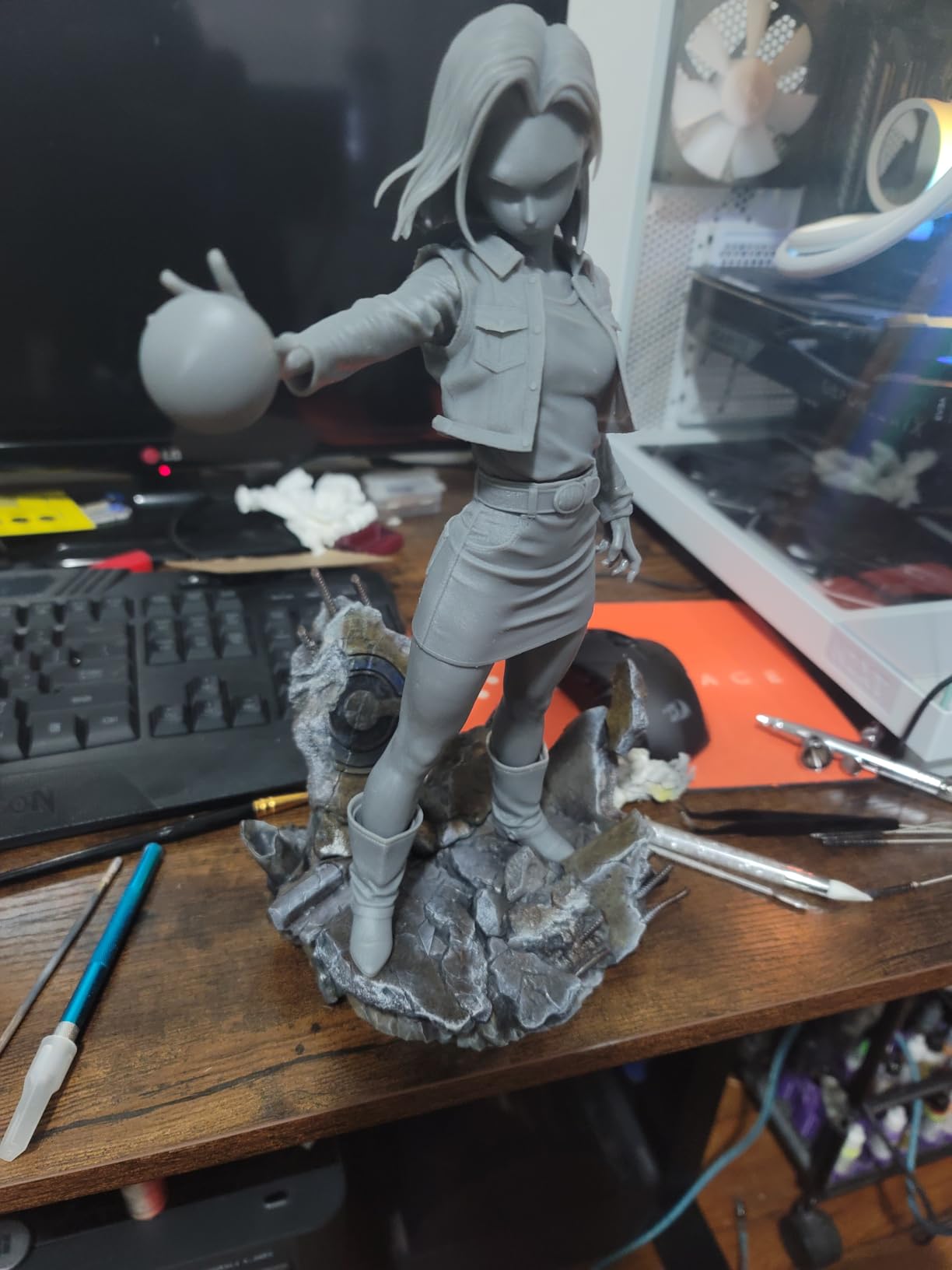
Owners consistently praise the surface finish and the fact that prints complete reliably once tuned. The 1300ml temperature-controlled vat is a genuine step up for anyone in a cool garage, because resin viscosity tracks temperature and cold resin is the number one cause of failed first layers. The five built-in self-check inspections, including failed print detection, catch resin level and bottom-layer problems before you commit a whole night of print time.
The weakness is resin management. Multiple reviewers describe the auto-feed pump and self-clean cycles as very slow, and the vat is awkward to pour from and unpleasant to clean. If you are printing one big shell, slow resin changes barely register. If you are running a queue of six emblems and ten greeble strips, you will feel it.
What cosplay jobs it handles best
Chest plates, greaves, shoulder pauldrons and helmet domes are the natural fit, because the 298mm axis clears a human torso in one piece. The 164mm width is the axis that bites, and it is why large pauldrons often still get split left and right. Detail work is a bonus rather than the reason to buy it: at 46µm you get crisp engraved panel lines and clean emblem edges, but the MateForm Air 4 and the Saturn 4 Ultra resolve finer.
Advertised speed is up to 60mm/h with Intelligent Release 2.0 and dynamic light-off compensation. Real tall prints still take many hours, which is exactly why a heated vat matters in an unheated space. Plan for a full overnight cycle on any shell piece.
Where it falls short for cosplay
The dependency on the ANYCUBIC slicer is the friction point. It works, but the workflow is less pleasant than the alternatives, and anyone coming from Chiqbox or Lychee will notice. The awkward vat and slow resin cycles also make vat changes tedious, and at 1300ml you will still be pouring resin mid-way through a very large print.
It weighs 60.9 pounds and measures 30.91 x 19.29 x 20.47 inches, so it needs a floor-adjacent spot on a surface rated for it rather than a desk. If your build area cannot take a 61 pound machine and a gallon of resin, this is not the printer.
2. ELEGOO Saturn 4 Ultra 16K – Easiest Workflow, Narrowest Plate
ELEGOO Saturn 4 Ultra 16K Resin 3D Printer
16K LCD at 14 x 19µm
8.33 x 4.66 x 8.66 inch build
Heated resin tank
150mm/h tilted release
Pros
- Sharp 16K-class output owners praise for fine detail
- Import slice send and walk away workflow
- True 150mm/h speed from tilted release technology
- Integrated camera with time-lapse capture
- Auto-leveling and heated vat reduce failures
Cons
- Smallest build volume of the large-format group
- Included FEP film is noisy and many owners upgrade
- Basic slicer compared with alternatives
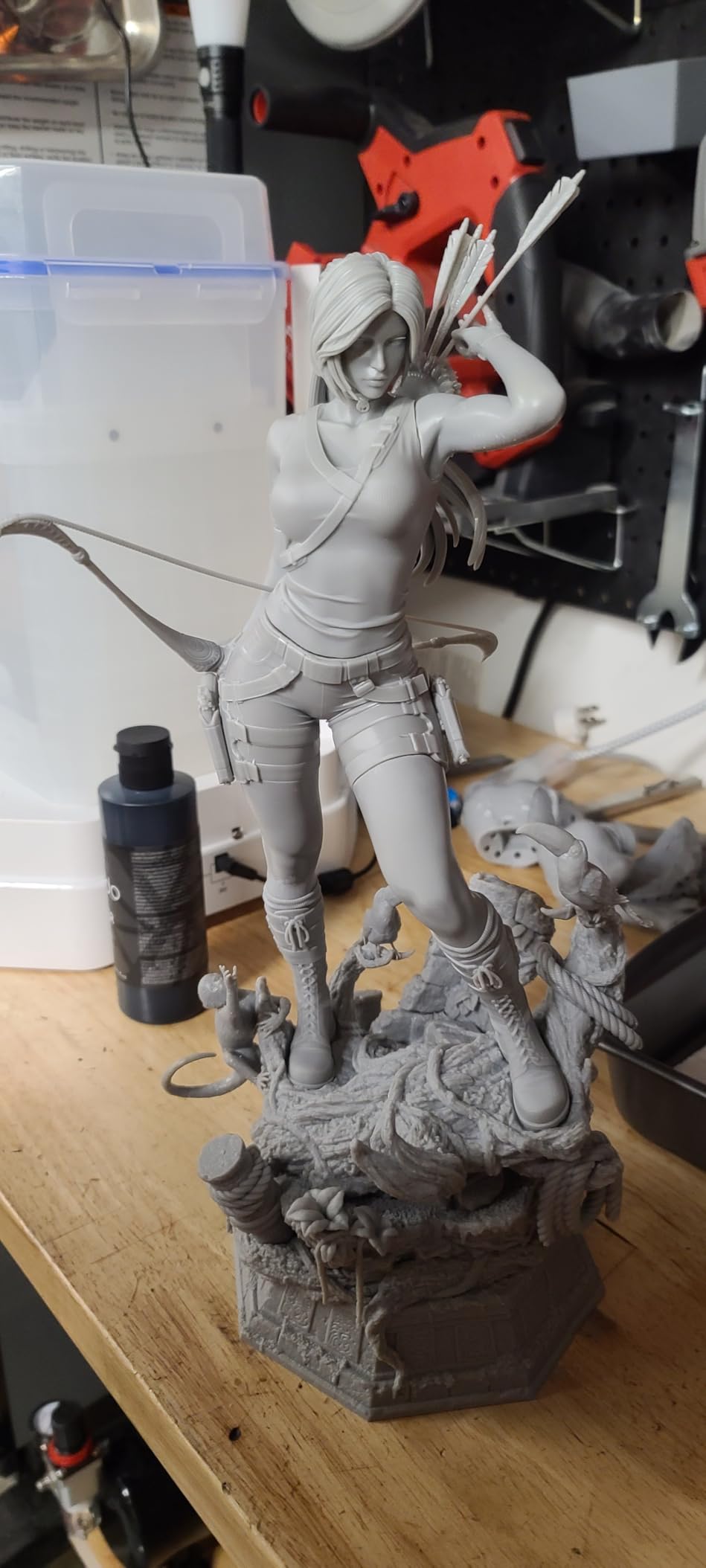
The Saturn 4 Ultra is not a shell printer, and pretending otherwise would waste your weekend. What it is, is the machine to buy if your cosplay work is the kind that makes people ask what resin printer you used: emblems, engraved trim, visors, buckle details, weapon runes and chest piece insignia. At 16K with a 14 x 19µm pixel size, it resolves small text and thin raised detail that the 43µm Phrozen smears.
The owners who review it most warmly describe it as effectively plug and play. Import the file, slice, send it, walk away. Tilted release technology delivers a genuine 150mm/h, the heated tank triggers below 25°C, and auto-leveling handles the setup. That combination matters when you are printing at midnight before a convention and do not want to babysit a machine.
The integrated AI camera with time-lapse recording is more useful than it sounds for cosplay. You can check a 300-layer helmet dome from another room and see whether the raft actually bonded, which is the single most common failure on the first hour of a big print.
The compromise is volume. At 8.33 x 4.66 x 8.66 inches, a chest plate has to be printed in sections with overlapping tabs, and a helmet shell has to be split and assembled. That is fine for a detail plate and painful for a wearable dome. Some owners also report an out-of-box uneven build plate, which is worth checking in the first ten minutes.
What cosplay jobs it handles best
This is the greeble and emblem machine of the group. Chest piece badges, shoulder trim, weapon sight rails, helmet crest details and small prop components all print fast and sharp at this resolution, and the 150mm/h release speed means a batch of twenty emblems is an evening project rather than a weekend one. It also weighs just 35.4 pounds, so it is the easiest machine here to move, which suits a small apartment workshop.
Its 12.8 x 12.9 x 21.5 inch footprint means it can live on a normal shelving unit where a 60 pound machine cannot. Power-on resume, Wi-Fi transfer and cluster printing are all real features here rather than marketing lines.
Where it falls short for cosplay
Anything that has to fit on a head in one piece does not fit. The included FEP film is noisy and many owners replace it with nFEP or PFA film and a third-party vat, which is normal practice but an extra cost and a weekend of fiddling. ELEGOO’s slicer is basic compared with the alternatives, and the narrow plate makes multi-part armor much more common than it should be.
If your build is a full helmet or a full chest piece in one piece, this is the wrong machine and we would rather say so now than after your first failed print. Our guide to sticky resin after curing covers the post-processing problems people hit next.
3. Phrozen Sonic Mega 8K S – Widest Plate and Fastest Throughput
phrozen Sonic Mega 8K S LCD/MSLA Resin 3D Printer, 43 µm High Resolution, 15 inch Mono LCD Screen, Fast Production Accurate Details, Large Printing Size L12.99xW7.28xH11.81 Printing Volume
15-inch 8K mono LCD
33 x 18.5 x 30cm build plate
43µm XY resolution
ACF film with TR300 resin
Pros
- Very large build plate suited to oversized models and batches
- ACF film and TR300 resin deliver fast throughput
- Reliable large-format prints once dialed in
- Lift-up lid saves workspace
Cons
- 43µm resolution is softer than 16K-class rivals
- Reliability complaints about the controller board and power supply
- No WiFi camera auto-leveling or vat heater
The Sonic Mega 8K S is the throughput machine. Phrozen states it can print a batch of eighty 1/32 scale miniatures in under 90 minutes using the ACF fluoropolymer film with TR300 high-speed resin, and owners who run large batches back that up. For a cosplayer printing the same gauntlet four times, or a commission seller producing multiples of one chest plate, that cycle time is the difference between a weekend and a fortnight.
The 33 x 18.5 x 30cm plate is the widest single footprint in this roundup. The 33cm axis is unusually long, which makes it the best option here for elongated prop bodies: rifle barrels, sword blades, staff shafts, cannon barrels and mechanical weapon arms that would wrap around the corner of a narrower plate.
Two design choices stand out for a home workshop. The lift-up lid means the machine needs far less vertical clearance than a clamshell design, so it fits under a lower shelf where other large resin printers will not. The built-in metal drip hanger lets you hang the plate and drain the resin straight back into the vat, which cuts one of the messiest parts of the workflow.
At 43µm XY the screen is the softest in this group by a wide margin. Fine engraved text will not hold up, and panel lines need to be modelled deeper than you would on a 16K machine. Experienced makers rate it highly for raw volume and speed while pointing out that it is built for large, low-detail models rather than fine detail.
What cosplay jobs it handles best
Long and large wins. Prop weapon barrels, bladed props, staff and pole weapons, shoulder armour pairs and multi-part armour batches are all comfortable on this plate. The 300mm height also means a full forearm or shin piece prints vertically without tipping, which is usually the harder direction for resin because of peel forces.
At 57.3 pounds and 18.6 x 15 x 22.3 inches it is more manageable than most of the large-format group, and the lift-up lid is a genuine advantage if you plan to print helmet domes rather than flat chest pieces.
Where it falls short for cosplay
It has no Wi-Fi, no camera, no auto-leveling, no vat heater and no onboard air filter. Every one of those is something you either need or will build yourself, and for a resin machine the absence of a vat heater is a real quality risk in an unheated room during winter. The self-filling resin mechanism is also reported as awkward, and the large plate cannot take a flex plate.
Several owners report reliability problems with the LCD controller board, power supply and main board, and the screen warranty is three months in practice with replacement parts and support running high. Some owners report real print times running well behind the advertised speeds. That reliability profile is why we placed it second rather than first.
4. ANYCUBIC Photon P1 Max – Biggest Build Volume in the Roundup
ANYCUBIC Photon P1 Max, Large Resin 3D Printer with Smart Tank Heating
18.3L build volume
14-inch 12K screen
1.9L heated vat to 35C
Auto-Leveling 3.0
Pros
- Largest build volume in this roundup at 18.3 litres
- Heated resin vat keeps results consistent in cold rooms
- Auto-leveling reduces manual setup effort
- AI monitoring catches print problems early
Cons
- New listing with a small review base
- Long-term reliability not yet established
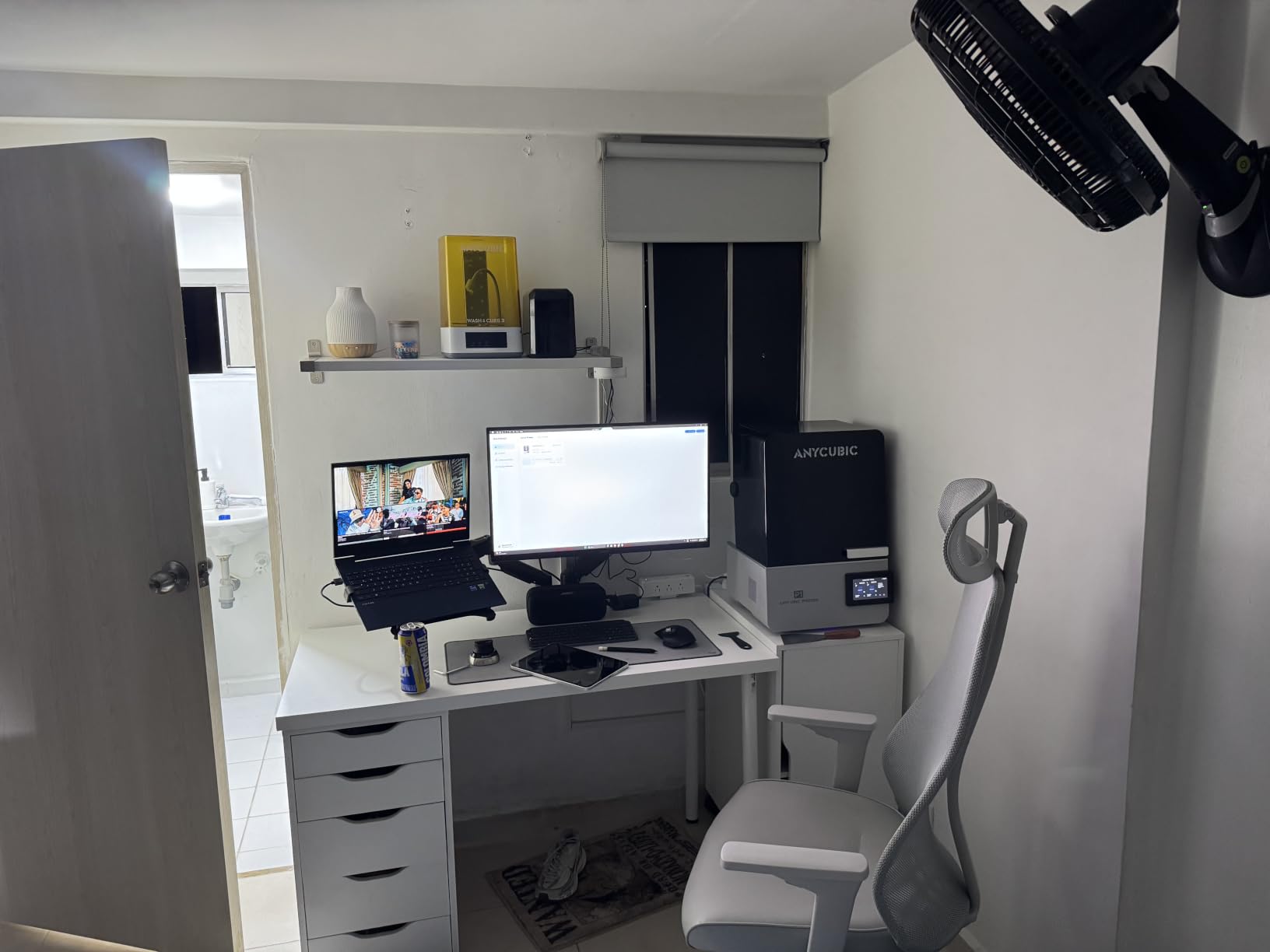
The Photon P1 Max has the largest build volume in this group at 18.3 litres, and on paper it is the most cosplay-capable machine here. An 18.3 litre envelope is roughly 11.24 x 8.43 x 11.81 inches, which is the difference between a chest plate that prints in one piece and a chest plate that has to be assembled from four tiles. For anyone building full-body armour, that is not a small upgrade.
The specifications read like a professional machine. A 14-inch 12K screen with the LighTurbo 3.0 light engine, plus or minus 0.01mm repeatable accuracy, Auto-Leveling 3.0 with real-time four-corner checks and live force readings, and a 1.9 litre heated resin vat held up to 35°C. A 1.9 litre vat is the largest here and means far fewer mid-print resin pours.
AI monitoring watches the build plate, resin level, bottom-layer separation and vat residue. In practice that is the difference between discovering a failed raft at hour one and discovering it at hour twenty. On a print that runs overnight, that alone justifies the machine for deadline-driven cosplay work.
It became available in June 2026, so the evidence base is young. At 58 reviews and a 4.4 average with a 79 percent five-star share, early owner sentiment points to the heated vat, auto-leveling and monitoring as the reasons people like it. We would treat the ratings as provisional.
What cosplay jobs it handles best
Full chest pieces, complete helmet shells including the dome and neck trim in one piece, thigh plates, and oversized prop components. At 59 pounds and 29.53 x 21 x 20.1 inches it is one of the larger machines in the group, so it needs a proper floor-adjacent position on a surface that can carry it.
The 14-inch 12K screen also means the detail ceiling is high, so this is one of the few machines here that can handle both a full shell and crisp surface work. For a builder whose entire problem is that their armour files keep splitting, this is the most direct answer.
Where it falls short for cosplay
Honest caveat first: we cannot yet tell you how it performs after two years of daily use, because almost nobody has that data. New machines with heavy automation sometimes hide early failures behind the automation itself, and a 58-review base does not surface common problems yet.
The heated vat reaching 35°C is a departure from the usual ambient control and is worth confirming behaves as expected in your room. And with 18.3 litres of usable space, an oversized print will want resin volume you have not loaded, so budget for a second vat of resin before you start a chest piece.
5. UniFormation GK3 Ultra – 16K Detail With a Rigid Z-Axis
UniFormation GK3 Ultra 13.5-Inch Large Build Volume 16K Resin 3D Printer
300 x 160 x 300mm build volume
16K LCD at 20 x 26µm
KK60 module at plus or minus 0.003mm
85.8 pounds
Pros
- Genuinely large build volume with 16K-class resolution
- Very stable KK60 Z module with tight repeat accuracy
- Automatic resin feeding reduces failures on long jobs
- Built-in carbon filter improves the print room
Cons
- Very small review base leaves reliability unproven
- Heaviest machine in the set at 85.8 pounds
- Top of the price range in this roundup
The GK3 Ultra is the specification leader in this group. It pairs a 300 x 160 x 300mm build volume, right in cosplay shell territory, with a 16K LCD at a 20 x 26µm pixel size, which is roughly half the pixel size of the Phrozen. On engraved text and thin trim it will visibly outperform most of this list.
The integrated KK60 Z module is the part we care about most for large prints. Long Z travel is where wobble turns into stair-stepping on tall parts, and this machine quotes plus or minus 0.003mm repeat positioning accuracy. Combined with a screen that auto-heats resin to 25 or 30°C in cold climates, it addresses the two failure modes that ruin big resin prints: axis wobble and cold resin.
Automatic resin feeding with an easy-load cartridge is the other practical win. A 20-hour chest plate print on a machine without auto-feed means checking the vat at hour ten. The quick-release vat, side-mounted drip hanger and built-in carbon filter round out a workflow that was clearly designed with real rooms in mind.
What cosplay jobs it handles best
Anything that combines size with detail: helmet domes with engraved surface pattern, chest pieces with panel lines and text, ornate pauldrons, and prop weapons with fine ornamentation. It has the resolution of the detail machines and the footprint of the shell machines, which is the combination cosplay builders ask for and rarely get.
The auto resin feeder and heating matter more here than on smaller machines because the print times are long. If you are committing a 20 hour job to a chest plate, you want the machine to manage itself while you sleep.
Where it falls short for cosplay
At 85.8 pounds and 19 x 21 x 26 inches, this is the heaviest machine we tested. That is not a countertop appliance. It needs a floor-adjacent position on a properly reinforced surface, and you need to think about where the drained resin goes, because a vat of that size is a real spill risk on an ordinary floor.
The evidence base is thin at 12 reviews. The 4.6 average is the highest among the true large-format machines here with an 83 percent five-star share, but 12 reviews is not a reliability record. Budget for the possibility that support and parts are harder to get than for an ANYCUBIC or ELEGOO machine.
6. MateForm Air 4 – Heavy Chassis for Detail Work
MAGFORMS MateForm Air 4 Resin 3D Printer, Ultra-High Precision LCD Printer with 14.85μm Resolution, Industrial Grade MSLA Printer with Heater & Air Filter, Large Build Volume 8.98 x 5.05 x 9.84 Inch
14.85µm resolution
228.1 x 128.3 x 250mm build volume
25kg carbon steel shell
Internal heater and carbon filter
Pros
- Finest pixel size in this group at 14.85µm
- Heavy carbon steel chassis resists vibration
- Industrial array light source gives uniform light energy
- Built-in heater and carbon filter for a cleaner print room
- One-year printer warranty with lifetime technical support
Cons
- Essentially untested with only a single review
- Smallest build volume among the large-format picks
- Very low sales rank and limited support ecosystem
Let us be direct about this one. The MateForm Air 4 has the finest resolution in the entire roundup at 14.85µm and a genuinely rigid carbon steel chassis weighing 25kg, but it has one review on Amazon and a sales rank that suggests almost nobody owns one. It is a speculative pick, not a proven workhorse, and we would not tell a first-time large resin buyer to start here.
The engineering is not imaginary, though. Two P-class guide rails and an industrial-grade ballscrew Z-axis, a self-developed industrial array light source, and an internal heater that brings the printer to 100 degrees Fahrenheit are all sensible choices for a machine that needs to hold dimensional accuracy across a tall print. The build volume is 228.1 x 128.3 x 250mm.
At 228mm wide and 128mm deep, this is the smallest footprint of the large-format machines here in practical terms. A chest plate fits flat. A helmet dome fits but only just, and shoulder pauldrons definitely need splitting. The built-in activated carbon filter and internal heater make it the most considered machine for a small, cold room.
What cosplay jobs it handles best
Engraved emblems, chest piece text and insignia, weapon ornamentation, buckle and strap hardware, and small prop components. At 14.85µm, it is the machine to reach for when the print is going to be read at close range and under stage lighting, which is where 43µm panels start to look soft.
The one-year printer warranty and lifetime technical support are both better written terms than most machines in this roundup offer, and the three-month LCD screen warranty is at least stated explicitly.
Where it falls short for cosplay
One review is not a track record. We are including it because the specification is genuinely class-leading and because a cosplay buyer who prints emblems all year may find the resolution worth the uncertainty. Anyone who needs a shell in one piece should look at the M7 MAX or the P1 Max instead.
A low sales rank also means a thin accessory ecosystem. Custom vats, replacement films and community profiles are less likely to exist for this machine, and you should factor that into parts planning if your cosplay work depends on it.
7. Heygears Reflex RS Turbo – Amber Screen and Automated Setup
HeyGears Reflex RS Turbo Resin 3D Printer with High Contrast Amber Screen
Amber screen at 566:1 contrast
C5 ball-screw Z axis at 2µm or better
Floating screen auto-leveling
Force sensors at 0.1N
Pros
- Highly rated recent release with strong five-star share
- Amber screen contrast produces crisp detail and faster curing
- Exceptionally accurate repeat positioning from the C5 Z-axis
- Automated defect repair and support generation cut setup work
Cons
- Recent release with a small review base of 25
- Build plate is not the largest in the class
The Reflex RS Turbo is the automation pick. Its amber screen composite optical stack hits a 566:1 contrast ratio, which is what produces the crisp surface detail and faster curing that owners praise. The LCD is calibrated into 60 zones to hold light intensity variation within plus or minus 3 percent, and that uniformity is exactly what stops the blotchy, uneven cure you get on a large plate with a cheap screen.
The C5 industrial ball-screw Z-axis is rated at 2µm or better repeat positioning, tested over 10000 cycles at 50kg. A floating screen auto-levels and corrects deviations up to 0.15 degrees, which on a wide plate is the difference between a first layer that bonds across the whole surface and one that peels at the corners.
The feature we would actually use daily is the force sensing. Sensors at 0.1N sensitivity detect resin residue as fine as 0.2mm and trigger an auto-pause, which prevents the single most annoying resin failure: a chunk of cured resin sitting on the LCD, printed into the bottom of the part. One-click slicing also auto-repairs inverse normals, holes and intersecting shells, which rescues a lot of downloaded STL files.
What cosplay jobs it handles best
Detail-forward props: visors, engraved control panels, weapon furniture, chest emblems and textured armour trim. One-click slicing with automatic defect repair is genuinely valuable for cosplay because most cosplay STLs come from community sources and are frequently not print-ready.
At 50.6 pounds and 15 x 23 x 15 inches it is compact for a resin machine in this class, which makes it more practical in a spare room than most. If you already own a large FDM machine for shells and want resin purely for detail parts, this is the pairing we would build.
Where it falls short for cosplay
The build plate is not among the largest, so this is a detail machine rather than a shell machine. Anyone whose build is dominated by full-size armour will need to keep their filament printer in the loop.
It is also a recent release, with a review base of 25. The 4.7 rating is strong but small, and the automation features add complexity that some people will love and some will find to be one more thing to learn.
8. Creality Halot Mage S Bundle – Printer Plus Wash and Cure Station
Creality Resin 3D Printer Halot Mage S 14K Bundle with Creality Wash and Cure Station UW-01 2 in 1 Machine
14K at 16.8 x 24.8µm
10.1-inch print area
Dual linear rails to 150mm/h
Includes UW-01 wash and cure station
Pros
- Bundle includes a wash and cure station
- 14K resolution on a 10.1-inch print area
- No ratings below four stars
- 360-degree rotating curing tray cures evenly
Cons
- Only five reviews so reliability is unproven
- Widest axis is 10.1 inches
- Lowest review volume in the roundup
The Creality Halot Mage S bundle solves a problem the other seven machines ignore. Buying a resin printer without a wash and cure station means buying a second box before you can print anything properly, and a lot of people skip that step, produce sticky or under-cured parts, and conclude that resin is not for them. This bundle includes the UW-01 2-in-1 wash and cure station.
On the printer side, you get 14K resolution at 13320 x 5120 pixels for a 16.8 x 24.8µm pixel size across a 10.1-inch print area. A closed-loop motor and dual linear rails drive Dynax+ mode up to 150mm/h, and 18 UV LED beads in a double-row nine-bead layout give more even exposure than single-row designs.
The 360 degree rotating magnetic curing tray with a reflective mirror is the detail we liked most for cosplay work. Curing is where large resin parts most often come out with a soft side and a hard side, and rotating the part under the lamps means you do not have to hand-rotate a helmet dome at the right moment. The system also pauses curing automatically when you open the cover.
What cosplay jobs it handles best
With a 10.1-inch print area, this is a medium-large machine rather than a shell printer. It suits forearm pieces, gloves components, bracers, helmet crests, chest emblems, prop magazines, lightsabers hilts and weapon receivers. Think of it as the machine for a cosplayer who prints lots of parts rather than one giant shell.
For a first-time resin buyer, the included station removes an entire category of beginner failure and the iterative curing workflow. It also makes the machine a complete setup rather than half of one.
Where it falls short for cosplay
The 10.1-inch axis is the widest here, so full chest pieces and helmet domes are out of reach one-piece. That is a genuine limit for cosplay specifically, and it is why this sits near the bottom of our ranking despite a very high 4.8 rating.
Five reviews is not evidence of reliability, and the listing gives no weight or dimensions, which makes planning where it lives harder. Judge it on the included hardware and features rather than on its rating.
Resin vs FDM for Cosplay Armor: Where Each One Wins
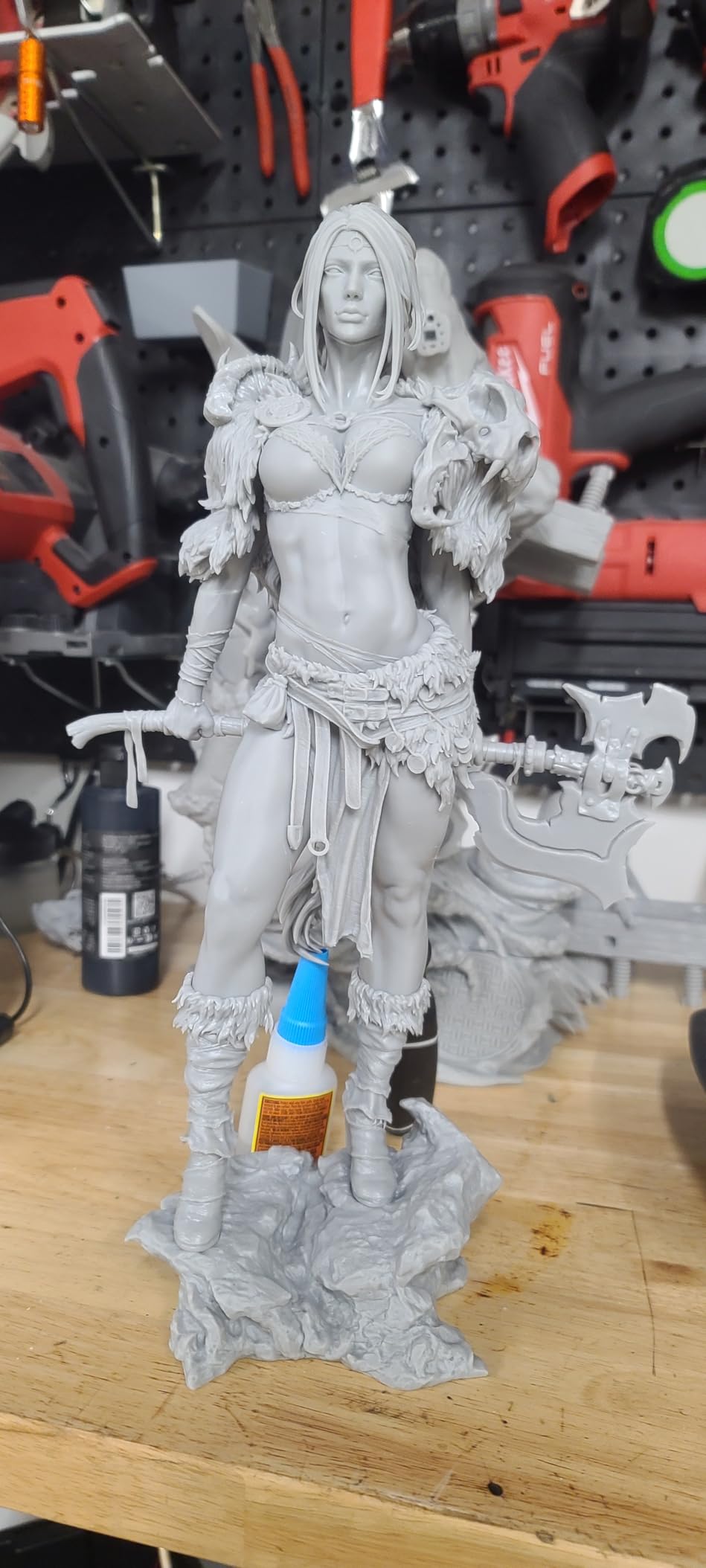
The strongest argument against resin for cosplay is correct, and we would rather state it plainly than pretend otherwise. Standard MSLA resin is brittle. At skin-contact edges, a visor rim or a helmet neckline, a hard cured part can crack under the flexing of a full day at a convention, and it will not flex the way a filament part does. Add mandatory washing, curing, sanding, filler primer and paint, and the resin finishing workload is genuinely heavier than an FDM one.
That is why the community default for large armour is still foam templating with printed detail parts, and why the big cosplay printer guides keep recommending filament machines. If your entire build is a full-body suit shell, filament is usually the faster path. Flexible costume elements are often handled in fabric instead, and our sublimation printer guide for crafts covers that side of a build.
But that framing is incomplete, and it is the gap this roundup exists to close. Filament printers struggle to reproduce engraved surface texture, rivets, chainmail, panel lines and emblems cleanly, which is exactly the detail cosplayers notice first from three feet away. Large resin machines reproduce that detail as standard.
The practical answer for most builders is a dual setup. Large-format FDM does shells, large flat panels and anything that needs to flex or take an impact. Large resin does the greebles, emblems, visors, trim, buckles and cast-effect ornamentation. That is the configuration we would build, and it is why several picks on this list are sized for detail work rather than full shells.
Material choice matters more here than printer choice. Standard resin is right for emblems and trim that will not flex. A tough resin blend is the right call for pauldrons, gauntlets and anything that gets knocked around in a queue. Flexible resin covers straps, capes and thin trim that has to move with the wearer. If your wearable part has a hard skin-contact edge, that is the argument for filament or for a tough blend, not for standard resin at any printer size.
Hollowing, Draining and Wearing a Resin Cosplay Part
No competitor on this topic covers hollowing, and it is the single most common follow-up question from cosplayers who have just printed their first large resin part. A solid 18.3 litre print is not a wearable object, it is a paperweight with a costume attached. The workflow is straightforward once you know it.
First, hollow in your slicer. Set a wall thickness of roughly 2 to 3mm, which holds shape without adding much weight, and turn on the hollowing and drainage options your slicer provides. Then add at least two drain holes at the lowest points of the part, angled downward so resin runs out under gravity rather than sitting in a pocket. Resin that stays trapped inside will keep curing, expand, and crack the wall from the inside.
Second, wash. Rinse the part in isopropyl alcohol with nitrile gloves on until the surface is no longer tacky. Skipping this is the most common cause of the sticky, uncured finish people run into, and it is also the step that decides whether your part is safe to handle. Never touch uncured resin with bare skin.
Third, cure fully, then finish. Post-cure until the part is rigid and no longer bendable at thin sections, then sand, then filler primer, then paint and clear coat. A skin-contact edge on a resin piece should still be padded with thin foam or leather on the inside, which costs almost nothing and eliminates the flexing crack risk.
Fourth, decide how it attaches. For light parts, moulded suction cups work well and remove cleanly. For heavier helmets and chest pieces, use a padded strap harness or a painted fabric interior rather than gluing rigid resin directly to your body. Getting the harness right is what turns a print into something you can wear for a full convention day.
How to Choose a Large Format Resin Printer for Cosplay
Measure your STL bounding box before you spend anything
Open your actual cosplay file in your slicer and read the bounding box dimensions. That number, minus about 5mm on each axis for plate tilt and raft margin, is the only figure that should influence your purchase. Manufacturer build volumes describe an empty machine at perfect levelling with no supports, which is not a print you will ever run.
Then measure the part the way you will actually orient it. A chest plate prints beautifully flat but badly on edge, because the peel forces act on a much larger cross-section. If your file only fits one way, that orientation is a permanent constraint on every future part too.
Read XY resolution, layer height and accuracy as three different things
XY resolution, or pixel size, is how fine a surface detail can be drawn. It governs engraved text, panel line crispness and thin trim, and it is the spec cosplayers should care about most. Layer height governs vertical smoothness and print time. Repeatability accuracy governs whether the machine returns to the same Z position, which matters on tall prints where drift shows up as a wobble.
A 14.85µm screen does not automatically mean a better helmet if the Z-axis drifts. A 43µm screen with a rigid rails-and-ballscrew Z can hold a large part flatter than a finer screen with a wobbly one. Weight these separately.
Brand head-to-head: Anycubic vs ELEGOO vs Phrozen
Which resin printer is better, Anycubic or ELEGOO? For cosplay, Anycubic wins on large build volume: the M7 MAX gives you 298 x 164 x 300mm with a heated vat, and the P1 Max gives you the largest envelope in the group at 18.3 litres. ELEGOO wins on usability and detail: the Saturn 4 Ultra is effectively plug and play with a 16K screen, a heated tank and an integrated camera, at the cost of the narrowest plate in the roundup.
Phrozen wins on footprint and throughput. The Sonic Mega 8K S has the widest single axis at 33cm and prints batches fast with ACF film, but it is the least automated machine here and carries the most reported electronics problems. For a workspace with limited headroom, its lift-up lid is a real advantage no competitor matches.
What is the biggest ELEGOO resin printer? Among the machines we could verify for this roundup, the Saturn 4 Ultra is ELEGOO’s large-format entry in this set, with an 8.33 x 4.66 x 8.66 inch build volume. That is narrower than either large-format ANYCUBIC machine, so if you are set on ELEGOO for a cosplay shell, plan to split your files.
Bench weight, vat film and LCD replacement cost
The machines here weigh between 35 and 86 pounds. That is a reinforced surface and a floor-adjacent position, not a desk. Add a resin drip tray, because draining a full vat across a workbench is how people damage floors and neighbourships.
On maintenance, the two costs that surprise large resin owners are vat film and LCD panels. Films cloud, tear or stretch and need replacing every few months of heavy use, and replacement films are easy to fit yourself. A scratched or dead LCD is a much bigger bill, which is why foreign object detection and built-in air filtration are worth paying for. Never let a cured resin chunk sit on a screen, and never bring resin near an open frame without a filter.
On lifespan, what matters is that the mechanical consumables are cheap and replaceable while the electronics are not. Machines with documented spare parts and a real support channel age better than machines with a great spec sheet and no service path. That is most of why we trust the M7 MAX over the faster Phrozen despite a lower rating.
Timing: work backwards from the convention date
Count backwards from your convention and give each stage its real cost. A large shell print on an MSLA machine at realistic speeds is frequently a 10 to 20 hour job, not the 2 hours a speed claim implies. Washing adds an hour. Full cure adds 30 to 60 minutes per surface, more for thick sections. Then add sanding and priming, which for a large resin part is easily 6 to 10 hours across several evenings.
That is three days for one part, minimum. For a full armour set, resin printing means starting weeks ahead. Our honest advice for a deadline-driven cosplayer is to print shells in filament on a large machine and reserve resin for the detail pieces, because resin finishing time is where deadline anxiety comes from.
Safety and Ventilation for Large Format Resin Printing at Home
Resin is genuinely safe to print at home if you treat uncured resin as a chemical. Wear nitrile gloves for every step from removing the part to washing it, and never handle uncured resin with bare hands. Respiratory sensitisation from uncured acrylate is the long-term risk, not the acute one, and it is the reason gloves and ventilation matter more than anything else.
Ventilation means air exchange, not a fan pointed at the machine. A dedicated activated carbon filter handles fumes, and four of the machines here have one built in, but a filtered garage corner with an extraction fan is the minimum. Keep the printer away from your bedroom, and keep resin bottles in a sealed cabinet when not in use.
Isopropyl alcohol for washing is flammable, so store and use it away from the printer and any heat source. Many cosplayers run a separate small wash station, which is also how you avoid dragging uncured resin across the printer itself. Our detailed walkthrough of post-cure problems is worth reading before your first large job.
Finally, protect the machine and yourself from the physical side. Eighty-pound machines need a floor-adjacent spot. Drained resin needs a tray. And if you have children or pets, a vat of uncured resin in a spare room is not a good idea at any printer size.
Frequently Asked Questions
What is the best large resin printer?
For cosplay work the ANYCUBIC Photon Mono M7 MAX is the strongest all-round choice, with a 298 x 164 x 300mm build volume, a 13.6-inch 7K mono LCD and the deepest owner review base in the large format category. For pure detail work such as emblems and engraved trim, the ELEGOO Saturn 4 Ultra 16K resolves finer detail, and for the largest single print volume the ANYCUBIC Photon P1 Max leads with 18.3 litres.
What resin printer has the largest build plate?
Among the machines in this roundup the ANYCUBIC Photon P1 Max has the largest build volume at 18.3 litres, or 11.24 x 8.43 x 11.81 inches. The widest single axis belongs to the Phrozen Sonic Mega 8K S at 33 x 18.5 x 30cm. Both the M7 MAX and the UniFormation GK3 Ultra sit close to 300 x 160 x 300mm, which is the practical size for a one-piece cosplay helmet shell.
Which resin printer is better, Anycubic or Elegoo?
Anycubic wins on large build volume. The Photon Mono M7 MAX gives you 298 x 164 x 300mm with a heated vat and auto resin level management, and the Photon P1 Max gives you 18.3 litres with a 1.9 litre heated vat. ELEGOO wins on ease of use and fine detail. The Saturn 4 Ultra 16K has a 16K screen at 14 x 19µm, tilted release at 150mm/h, a heated tank and an integrated camera, but the narrowest build volume in the group.
What’s the biggest Elegoo resin printer?
The ELEGOO Saturn 4 Ultra 16K is the largest ELEGOO machine in this roundup, with an 8.33 x 4.66 x 8.66 inch build volume and a 16K LCD at 14 x 19µm. That is wider than most desktop resin printers but narrower than the large format ANYCUBIC machines, so full chest pieces and helmet domes will need to be split into sections.
Is a Phrozen 3D printer worth the money?
For cosplay batch work and long prop bodies it can be. The Sonic Mega 8K S has the widest plate in the group at 33 x 18.5 x 30cm, a lift-up lid that fits low-clearance spaces and ACF film with TR300 resin for fast throughput. Against that, it has no Wi-Fi, camera, auto-leveling or vat heater, a 43µm screen that is soft for fine detail, and several owners report electronics failures including the controller board and power supply.
Are Anycubic printers good quality?
The evidence is good. The Photon Mono M7 MAX holds a 4.5 average across 146 reviews with a heavy five-star majority, and owners consistently report clean surface detail, good build volume and reliable print completion once tuned. The recurring complaints are about the resin management system, since the auto-feed pump and self-clean cycles are reported as slow, and an awkward vat that is hard to pour from and clean.
What is the lifespan of a Phrozen printer?
It depends on what you count. The mechanical consumables are cheap and user-replaceable, mainly vat films and calibration items. The electronics are not. The Sonic Mega 8K S carries a three-month screen warranty in practice and several owners report failures involving the LCD controller board, power supply and main board, with replacement parts and support costing more than expected. Machines with documented spare parts and a real service channel generally age better.
Do large resin printers print hollow cosplay pieces?
Yes, and you should always print them hollow for anything wearable. Hollow in your slicer at roughly 2 to 3mm walls and add at least two downward-angled drain holes at the lowest points. Trapped resin keeps curing, expands and cracks the wall from the inside, so drain thoroughly, then wash in isopropyl alcohol with nitrile gloves before curing and finishing.
Final Verdict: Which Large Format Resin Printer Should You Buy?
Buy the ANYCUBIC Photon Mono M7 MAX. Across 146 reviews it holds a 4.5 average, it prints a chest plate or helmet dome without splitting the file, the heated 1300ml vat keeps results consistent in a cold garage, and it is the only machine in this group where the review depth actually tells you something about long-term behaviour.
If your cosplay work is detail-led rather than shell-led, take the ELEGOO Saturn 4 Ultra 16K instead and keep your filament printer for the large panels. If you batch-print long prop bodies, the Phrozen Sonic Mega 8K S has the widest plate and the fastest throughput. And if you need the biggest single print volume available at this price tier, the Photon P1 Max leads at 18.3 litres.
Specs and pricing in this category move quickly, so recheck them before you buy. Most of all, check your STL bounding box against the usable volume, not the headline number, and go in knowing that hollowing, washing and finishing will take longer than the print itself.