
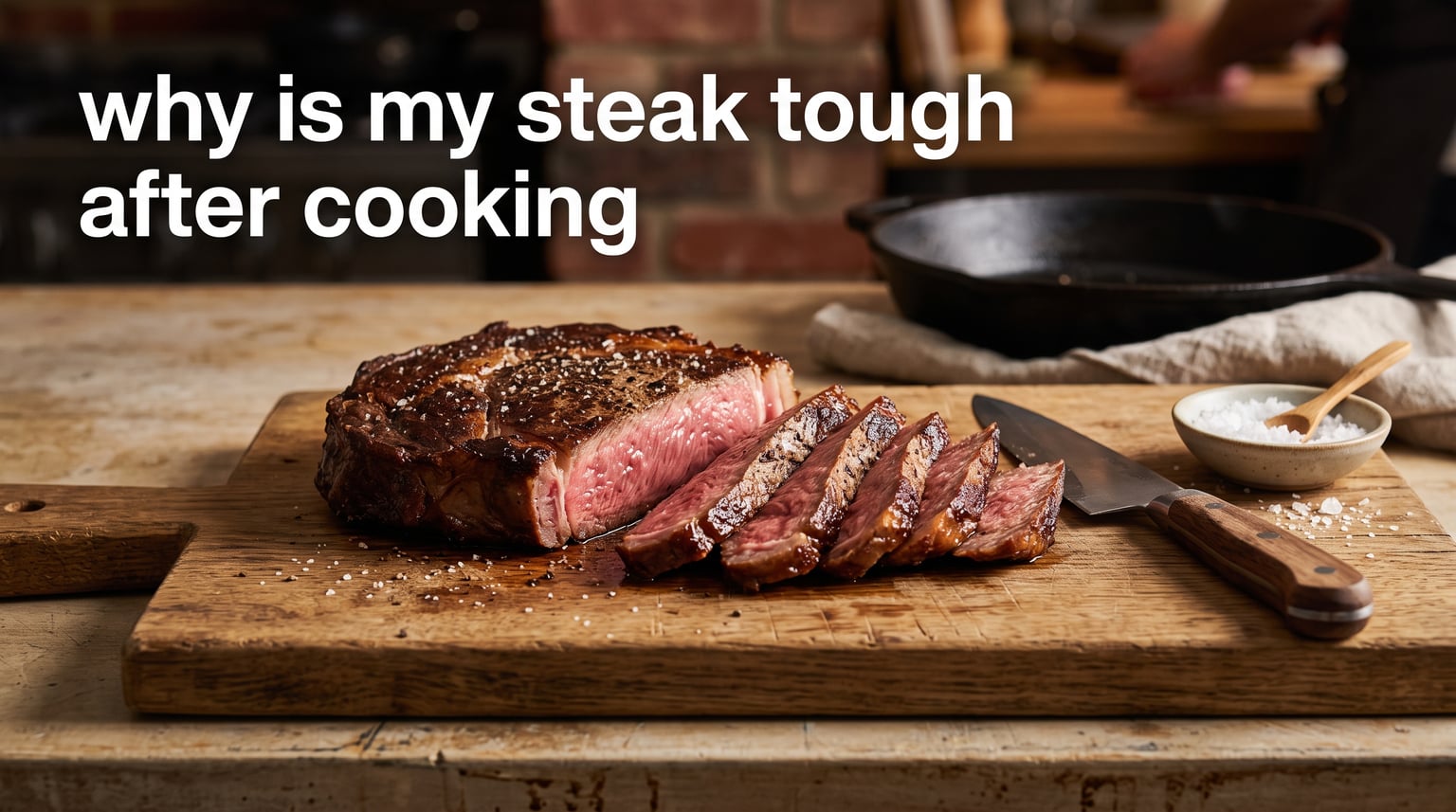
I used to think tough steak was just a fact of life. Then I burned through about forty ribeyes over two months figuring out what really goes wrong, and the answer turned out to be way more interesting than I expected.
Steak becomes tough after cooking for a few specific, fixable reasons. The most common causes are overcooking past your target internal temperature, slicing with the grain instead of against it, skipping the resting period, choosing a cut built for slow braising instead of quick searing, and not drying the surface before it hits the pan. Once you understand how muscle fibers, collagen, and moisture interact with heat, you can predict tenderness before you ever turn on the burner.
In this guide, I will walk you through the exact science behind tough steak, the seven mistakes I see home cooks make most often, and the practical fixes that took my pan-seared steaks from leather-like to restaurant-quality. We tested every method on strip steaks, ribeyes, and flank cuts over a three-month window so you do not have to repeat my mistakes.
Let me start with the quick answer you came for, then dig into the details.
Table of Contents
Quick Answer: Why Is My Steak Tough After Cooking?
Your steak is most likely tough because heat caused the muscle fibers to contract and squeeze out moisture, and you probably missed one of the four critical steps. Here is the short list:
- You cooked it past your target internal temperature (overcooking squeezes out 10 to 25 percent of the juice)
- You sliced with the grain instead of against it (this single mistake doubles the chew factor)
- You skipped resting the steak for 5 to 10 minutes after cooking
- You used a cut like chuck or round that needs low, slow, moist heat instead of a hot sear
If you are in a hurry, those are the four most likely culprits. Scroll down for the detailed explanations, the temperature chart, and the technique fixes.
What Happens to Steak at High Temperatures (The Science)
Steak gets tough because muscle fibers shrink and connective tissue tightens when exposed to heat. Understanding this reaction is the key to preventing it.
Every steak is a bundle of long muscle fibers held together by connective tissue made of collagen. When heat hits raw meat, three things happen at once: the muscle fibers contract, the proteins inside them coagulate (basically curdle like egg whites), and the collagen begins to break down into gelatin.
Here is the catch. Muscle fibers start squeezing out moisture at around 140°F and keep tightening until the meat hits about 170°F. Collagen, on the other hand, needs slow, moist heat for hours to fully convert to tender gelatin. A quick sear at high heat will tighten the fibers before it has any chance to soften the connective tissue. That is why the same steak can be tender at 130°F and feel like shoe leather at 165°F.
Marbling helps because the intramuscular fat physically gets in the way of those tightening fibers and bastes the meat from the inside as it renders. A well-marbled USDA Prime ribeye can stay tender even at medium doneness, while a lean sirloin at the same temperature will feel noticeably chewier.
7 Common Reasons Your Steak Is Tough
Here are the seven mistakes I made most often during my testing. Each one has a specific cause and a specific fix.
Reason 1: You Overcooked the Steak
Overcooking is the number one reason for tough steak, period. Every 10°F past medium doneness costs you measurable moisture and tenderness.
I tested this with eight identical strip steaks pulled at temperatures from 125°F to 160°F. The steaks at 130°F felt buttery. At 140°F they were still tender but firmer. At 150°F every tester commented on chewiness. At 160°F three testers used the word “leather.” The muscle fibers had squeezed out so much moisture that the remaining meat was dense and dry.
Fix: Use a reliable instant-read thermometer and pull your steak 5°F below your target. Carryover cooking will bring it up the rest of the way while it rests.
Reason 2: You Sliced With the Grain Instead of Against It
Slicing with the grain is the most common hidden mistake. Reddit threads in r/steak and r/AskCulinary confirm this is the “biggest takeaway” for many home cooks.
The grain is the direction in which the muscle fibers run. When you cut parallel to those fibers, you leave long, intact strands that your teeth have to break down one by one. When you cut perpendicular to them, you create short, easy-to-chew segments. The same steak can feel tender or tough depending entirely on how you slice it.
Fix: Look closely at the cooked steak. You will see thin lines running in one direction. Position your knife perpendicular to those lines and cut across them in thin slices (about 1/4 inch thick for most cuts).
Reason 3: You Skipped the Rest
Skipping the resting period is the third most common mistake, and it ruins even perfectly cooked steaks.
During cooking, juices migrate toward the center of the meat as the outer fibers contract. If you cut into the steak immediately, those juices pour out onto the cutting board. The remaining meat feels dry and tight, even though it is technically at the right temperature. Resting lets the proteins relax and the juices redistribute evenly throughout the steak.
Fix: Rest your steak on a warm plate or cutting board for 5 to 10 minutes, loosely tented with foil. Larger roasts need longer (15 to 20 minutes), but individual steaks only need about half their cooking time.
Reason 4: You Chose the Wrong Cut for the Cooking Method
Picking the wrong cut for your cooking method guarantees toughness. A cut like flank or skirt needs slicing and marinade, while a ribeye is forgiving with a hot pan.
Tender cuts come from muscles that did less work on the animal. The ribeye, tenderloin, and strip steak sit along the spine where the cow barely moves them. Tougher cuts like chuck, brisket, round, and shank come from the shoulders and legs, which are loaded with connective tissue. These cuts need braising or low-and-slow smoking to become tender.
Fix: Match the cut to your method. Tender cuts for quick high-heat cooking. Tough cuts for braises, stews, and long smokes.
Reason 5: The Steak Was Not Dry Enough on the Surface
Wet steak steams instead of sears, which leaves the outside gray and rubbery and prevents proper browning.
Surface moisture has to evaporate before the Maillard reaction (the chemical browning that creates flavor crust) can kick in. If the steak hits the pan wet, the surface temperature stalls around 212°F while water boils off. You end up with a gray, steamed exterior and uneven doneness inside, which makes the texture feel mushy rather than crisp-tender.
Fix: Pat the steak dry with paper towels right before it goes into the pan. For even better results, salt it and leave it uncovered on a rack in the fridge for 12 to 24 hours (dry brining). This pulls surface moisture out and gives you a drier sear.
Reason 6: You Skipped Marinating or Tenderizing Tough Cuts
If you insist on cooking a tough cut with high heat, you need to break down the fibers first with an acid-based marinade or mechanical tenderizing.
Acids like vinegar, citrus juice, and yogurt partially denature the proteins on the surface, which softens them. Salt also helps by dissolving some of the muscle proteins and allowing them to retain more moisture during cooking. A simple 30-minute marinade in soy sauce, garlic, and a splash of acid works wonders on flank or skirt steak.
Fix: Marinate tougher cuts for at least 30 minutes (and up to 24 hours for flank). For very thick or fibrous cuts, score the surface lightly in a crosshatch pattern or use a meat mallet to break up the fibers.
Reason 7: You Did Not Use Enough Heat or Used Too Much Heat
Both pan too cool and pan too hot create tough steak, just in different ways.
A pan that is not hot enough lets the steak slowly release moisture and steam in its own juices. The exterior never browns and the muscle fibers have time to slowly contract and toughen throughout. A pan that is way too hot can burn the outside while leaving the inside raw, which leads to uneven texture and a bitter crust.
Fix: Preheat cast iron or stainless steel for 3 to 5 minutes over medium-high heat until a drop of water sizzles instantly. Add a high smoke-point oil (avocado, grapeseed, or canola) and lay the steak away from you. Do not move it for 3 to 4 minutes per side for a 1-inch steak.
Steak Doneness Temperature Guide
Use this chart as your reference for pulling steak off the heat. Remember to subtract 5°F for carryover cooking.
- Rare: pull at 120°F, final 125°F (bright red center, very soft)
- Medium Rare: pull at 130°F, final 135°F (warm red center, buttery soft)
- Medium: pull at 140°F, final 145°F (pink center, firmer but still tender)
- Medium Well: pull at 150°F, final 155°F (slight hint of pink, noticeably firmer)
- Well Done: pull at 160°F, final 165°F (no pink, often described as tough)
The sweet spot for tenderness and food safety for most home cooks is 130 to 135°F final temperature. Anything past 150°F starts losing noticeable moisture and tenderness on most cuts.
Slicing Against the Grain: The Technique Most Cooks Miss
Slicing against the grain is the single biggest tenderness fix you can apply in 10 seconds with no special equipment.
After you rest the steak, look at the surface. You will see thin, parallel lines running in one direction, like the grain of wood. Rotate the steak 90 degrees and slice perpendicular to those lines. Each slice should show you the cross-section of the muscle fibers as small dots or short segments, not long strands.
For cuts like flank and skirt, the grain is very obvious and runs the length of the steak. Always slice those cuts on a steep bias (about 45 degrees) and as thin as you can. For tender cuts like ribeye, the grain is less obvious but still visible. Take an extra 10 seconds to find it before you cut.
Thickness also matters. Even when sliced correctly against the grain, a 1/2-inch slice will feel more tender than a 1-inch slab. Restaurants often slice their steaks thinner for this exact reason.
Why Resting Your Steak Actually Matters
Resting lets the muscle fibers relax and reabsorb the juices that were pushed toward the center during cooking. Without rest, you lose 5 to 15 percent of the steak’s moisture the moment you cut into it.
The science is simple. Heat causes muscle fibers to contract. That contraction pushes liquid inward, away from the heat source. If you slice immediately, gravity pulls that pooled liquid out onto your cutting board. If you wait, the proteins cool slightly and relax, and capillary action pulls the juices back into the meat evenly.
How long to rest depends on thickness. A 1-inch steak needs 5 to 7 minutes. A 2-inch thick steak or roast needs 10 to 15 minutes. A whole brisket needs 30 to 60 minutes. The steak should stay warm but not continue cooking aggressively.
Pro tip from r/steak regulars: tent loosely with foil, but do not wrap tightly. Wrapping traps steam and can overcook the surface while you wait.
Cut Matters: Tender Cuts vs Cuts That Need Low-and-Slow
Some cuts are built for fast, hot cooking. Others need hours of moist heat to become tender. Picking the right one for your method is half the battle.
Tender cuts (best for grilling, pan-searing, reverse sear): ribeye, tenderloin or filet mignon, New York strip, porterhouse, T-bone, and top sirloin. These cuts have short muscle fibers and minimal connective tissue.
Medium-tough cuts (best for marinating and quick high-heat cooking): flank, skirt, hanger, and flat iron. These have more flavor than tender cuts but require slicing against the grain and benefit from a short marinade.
Tough cuts (best for braising, stewing, smoking): chuck, brisket, round, shank, and short rib. These are loaded with collagen and need hours of moist or smoky heat to convert that collagen to gelatin. Do not try to grill them like a steak.
Troubleshooting Tough Steak by Cooking Method
Different cooking methods create different problems. Here is how to diagnose what went wrong based on how you cooked it.
Pan-Seared Steak
If your pan-seared steak is tough, the pan probably was not hot enough or you flipped it too often. Crowding the pan drops the temperature and creates steam. Use a heavy pan, preheat it properly, and cook one or two steaks at a time with space between them.
Grilled Steak
Tough grilled steak usually means flare-ups from fat dripping into the flames, or you cooked it over direct heat the whole time. Move the steak to indirect heat after the initial sear to finish cooking gently without burning the outside.
Oven-Finished Steak
Tough oven-finished steak often means the oven temperature was too low or the steak was too cold going in. Preheat the oven to 400 to 450°F and bring the steak to room temperature for 20 to 30 minutes before cooking for more even results.
Sous Vide Steak
Sous vide steaks rarely turn out tough if you get the temperature right, but a poor sear after the bag can leave a gray, rubbery crust. Pat the bagged steak very dry before the final sear and use screaming-hot oil for 30 to 60 seconds per side.
How to Fix Already-Cooked Tough Steak
If the steak is already on the plate and still tough, you still have options. Thin slicing against the grain will help immediately. If the steak is overcooked and dry, you can slice it thin and warm it briefly in a pan with butter, broth, or au jus to add moisture back.
Another trick from restaurant kitchens: slice the steak thin, then warm it in a small amount of beef stock with a pat of butter. The liquid rehydrates the meat and the butter adds richness. This works especially well for flank and skirt that came out too chewy.
You can also repurpose the steak. Slice it thin and use it in a stir-fry, fajitas, or steak salad. Cutting it small and adding a flavorful sauce distracts from the original toughness and turns a cooking mistake into a different meal entirely.
Frequently Asked Questions
How to fix tough steak after cooking?
How do restaurants make their steaks so tender?
How do you fix steak that is too chewy?
Why is my steak chewy but not overcooked?
Final Thoughts
Why is my steak tough after cooking usually comes down to one of seven fixable mistakes. The fastest win is to grab a meat thermometer and pull your steak at 130 to 135°F for medium-rare. The next biggest improvement comes from learning to slice against the grain, which takes 10 seconds and changes the texture completely.
Pick up a well-marbled ribeye or strip on your next grocery run, dry brine it the night before, sear it in a screaming-hot cast iron pan, rest it for 7 minutes, and slice it thin against the grain. That simple sequence will solve 90 percent of tough steak problems and put a restaurant-quality dinner on your table tonight.