
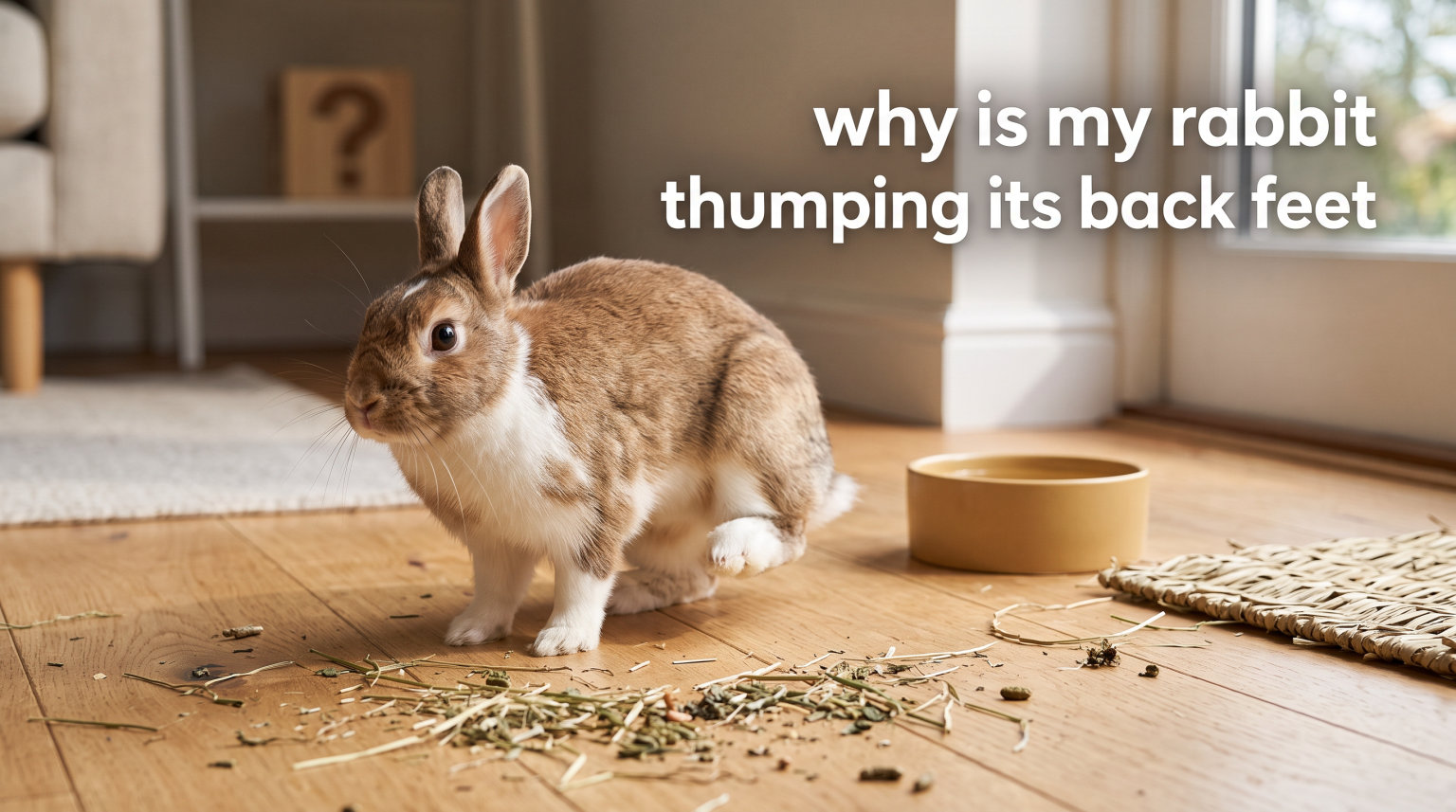
That sudden, loud THUD from across the room is enough to make any rabbit owner jump. If you are asking yourself why is my rabbit thumping its back feet, you are far from alone. It is one of the most common and confusing behaviors new bunny parents encounter.
The good news is that rabbit thumping back feet is a completely normal form of communication. Rabbits cannot speak, so they use their powerful hind legs to send messages loud and clear. Once you learn what those messages mean, you and your bunny will understand each other much better.
In this guide, I will walk you through every reason your rabbit might be stomping, how to tell the difference between a fear thump and an anger thump, and exactly what to do when it happens. I have spent years working with rabbit owners, and the patterns are surprisingly consistent once you know what to look for.
Table of Contents
What Is Rabbit Thumping?
Rabbit thumping is when a rabbit lifts one or both hind legs and forcefully stamps them against the ground. It produces a surprisingly loud sound for such a small animal. This is a primary form of rabbit communication, rooted deep in prey-animal instinct.
In the wild, rabbits live in underground warrens with limited visibility. They cannot see a hawk circling overhead or a fox approaching through the grass. Thumping sends a vibrations-and-sound warning that travels through the ground and air, alerting the entire warren to potential danger. Every rabbit in the area freezes, listens, and prepares to bolt.
Your house rabbit still carries those same instincts. Even though there are no predators in your living room, your bunny’s brain is wired to thump first and ask questions later. The behavior itself has not changed in thousands of years of domestication.
What has changed is the context. Pet rabbits thump for many reasons beyond danger. They thump when they are angry, frustrated, annoyed, or even when they simply want you to pay attention to them. Understanding which trigger is at play takes a little observation.
Why Is My Rabbit Thumping Its Back Feet? Common Triggers
There are several distinct reasons your rabbit might be stomping. Each one comes with its own set of body language cues, and learning to read them is the key to responding the right way.
Perceived Danger and Fear
This is the original purpose of thumping, and it is still the most common trigger. Rabbits are prey animals, and their survival depends on spotting threats early. A strange noise outside, a shadow passing by the window, or a new pet in the house can all register as a potential predator.
A fear thump usually comes with a tense, frozen posture. Your rabbit’s ears will point upward and forward, eyes wide open, body low to the ground. They are scanning for the source of the threat and ready to run if needed.
Common fear triggers include loud trucks, thunder, slamming doors, unfamiliar animals nearby, and sudden movements. Even a new piece of furniture in the room can set off a cautious rabbit. The thump is essentially your bunny saying, “Something is not right here.”
Anger, Frustration, and Annoyance
Rabbits have opinions, and they are not shy about expressing them. If your bunny is annoyed, they will let you know with a stomp. Rabbit frustration is real, and it shows up more often than many owners expect.
I have talked with dozens of rabbit owners on forums who describe the exact same scenario. The rabbit’s favorite nap spot gets rearranged, a wire gets moved from their usual path, or dinner is served five minutes late. The result is an indignant thump followed by a pointed stare.
An anger thump tends to be forceful and deliberate. Your rabbit may turn their back to you afterward, which is the bunny equivalent of giving you the cold shoulder. Their ears may be pinned back, and you might notice a quick tail flick.
Attention Seeking
Some rabbits learn that thumping gets results. If every time your bunny stomps you come running, they quickly figure out that thumping is an effective way to summon you. This is rabbit attention seeking in its purest form.
Attention thumps are often lighter and more playful. Your rabbit might thump, then run to their food bowl or nudge your hand. They are telling you exactly what they want, and they expect you to deliver.
This behavior is common in rabbits that are bonded closely with their owners. It is a sign of trust and comfort, not anxiety. Your bunny feels safe enough to demand your time and affection.
Nighttime Thumping
If your rabbit is stomping at night, you are not imagining things. This is one of the most frequent complaints I hear from rabbit owners, and it is a topic that almost no competitor covers in detail. Crepuscular by nature, rabbits are most active at dawn and dusk, which means their energy peaks right when you are trying to sleep.
Nighttime thumping is usually driven by a combination of factors. The house is quieter, so every small sound is amplified. Shadows shift as cars pass by outside. And your rabbit’s natural activity cycle is telling them to move, explore, and patrol their territory.
If your bunny’s enclosure is in or near your bedroom, nighttime thumping can seriously disrupt your sleep. The good news is that there are practical ways to reduce it, which I cover in the response section below.
Fear Thump vs Anger Thump: How to Tell the Difference
One of the biggest sources of confusion for rabbit owners is figuring out whether a thump means fear or anger. The two emotions look similar on the surface, but the body language is actually quite different once you know what to watch for.
A fear thump comes with tension and alertness. Your rabbit will freeze after stomping, ears erect and rotating like satellite dishes. Their eyes will be wide, nostrils flaring rapidly. The body stays low and tight, ready to flee. You may notice rapid breathing and a general stillness in the room.
An anger thump is more relaxed but pointed. After stomping, your rabbit often moves away deliberately rather than freezing. They might flick their back feet at you as they hop off, a dismissive gesture that says “I am not happy with you right now.” Ears may be held sideways or back.
Here is a practical test. After your rabbit thumps, watch their ears. If the ears are scanning and rotating, fear is the likely cause. If the ears are pinned or angled backward and your bunny is avoiding eye contact, you are probably dealing with annoyance.
Context matters just as much as body language. Did the thump happen right after a loud noise outdoors? Probably fear. Did it happen after you moved their litter box or stopped petting them? That is frustration. Reading the situation together with the posture gives you the most accurate read.
Variations in Thumping Behavior
Not all rabbits thump the same way or for the same reasons. Breed, age, and living situation all play a role in how often and how intensely your bunny stomps.
Breed and Personality Differences
Some rabbit breeds are naturally more reactive than others. Smaller breeds like Netherland Dwarfs and Dutch rabbits tend to be more alert and high-strung, which can translate to more frequent thumping. They have strong prey instincts and are quick to sound the alarm.
Larger, calmer breeds like Flemish Giants and Rex rabbits often thump less. Their laid-back temperaments make them more tolerant of environmental changes and less likely to perceive minor disturbances as threats. But every rabbit is an individual, and personality matters more than breed.
I have met high-strung Flemish Giants and bomb-proof Netherland Dwarfs. The key is to learn your own rabbit’s baseline behavior and notice when something changes from their normal pattern.
Age Factors
Young rabbits under a year old tend to thump more frequently. They are still learning about their environment, and everything is new and potentially scary. As rabbits mature and settle into their routine, thumping often decreases.
Senior rabbits may thump less due to reduced energy and mobility. However, if an older rabbit who rarely thumps suddenly starts stomping frequently, it could signal pain or discomfort. Always pay attention to behavior changes in aging bunnies.
Unneutered rabbits of any age may thump more due to hormonal fluctuations. Spaying or neutering often reduces territorial and anxiety-driven thumping within a few weeks of recovery.
Solo vs Bonded Rabbits
Solo rabbits thump differently than those living with a bonded partner. A single rabbit’s thumps are often directed at you, their primary companion. They are communicating specifically to get your attention or warn you.
Bonded pairs thump to communicate with each other. One rabbit will thump, and the partner responds by freezing or retreating to a safe spot. This is their built-in warning system working as nature intended. Bonded rabbits may actually thump less at their owners because they have each other for reassurance.
If you have a solo rabbit that thumps excessively, consider whether loneliness might be a factor. Many rabbits become significantly calmer and more secure after being bonded with a compatible partner.
Thumping vs Foot Flicking vs Stamping
Rabbit body language includes several behaviors that involve the hind legs, and they are easy to confuse. Here is how to tell thumping, foot flicking, and stamping apart.
Thumping is a single, powerful downward strike of one or both hind legs against the floor. It is loud, deliberate, and communicative. The purpose is to send a warning or express a strong emotion. After a thump, the rabbit usually holds still and listens.
Foot flicking is a lighter, more casual gesture where the rabbit kicks one or both back feet out while hopping away. This is a dismissive or offended behavior. It is the bunny version of “whatever” or “I am mad at you.” Foot flicks are common after you stop petting your rabbit or do something they dislike.
Stamping is essentially the same action as thumping, but the term is often used to describe repeated, rapid strikes. Some owners use stomping and stamping interchangeably. If your rabbit is stamping repeatedly in quick succession, it usually indicates escalating anxiety or agitation that needs immediate attention.
How to Respond When Your Rabbit Thumps
Knowing how to react when your bunny stomps makes a big difference in their stress levels and your relationship. Here is a step-by-step approach that works for most situations.
Step 1: Stop and listen. Do not immediately rush over or make sudden movements. Your rabbit is on high alert, and adding more activity can increase their anxiety. Pause for a moment and let your bunny assess the situation.
Step 2: Check the environment. Look around for the trigger. Did a door slam? Is there an unfamiliar animal outside? Did something fall over? Identifying the cause helps you address it directly rather than just soothing the symptom.
Step 3: Remove the trigger if possible. Close the window that is letting in traffic noise. Move the new object that startled your rabbit. Turn down the television. Eliminating the source of fear lets your bunny calm down naturally.
Step 4: Observe their body language. Are they frozen and wide-eyed, or annoyed and turning away? Your response should match the emotion. Fearful rabbits need a calm, quiet environment. Annoyed rabbits may just need their routine respected.
Step 5: Offer gentle reassurance. Speak softly to your rabbit and let them approach you on their terms. Do not force interaction. A scared rabbit needs space to feel safe again, while an attention-seeking rabbit may come right over for pets.
Reducing Excessive Thumping
If your rabbit thumps constantly, there are several strategies you can use to reduce the frequency over time. This is an area where most competitor guides fall short, but it makes a real difference for both you and your bunny.
Establish a consistent daily routine. Rabbits thrive on predictability. Feed, play with, and handle your rabbit at the same times each day. A predictable schedule reduces anxiety-driven thumping because your bunny knows what to expect.
Provide plenty of enrichment. Bored rabbits are more likely to thump for attention. Offer puzzle feeders, cardboard tunnels, digging boxes, and rotating toys to keep your rabbit mentally stimulated. A busy bunny is a quieter bunny.
Desensitize your rabbit gradually to common triggers. If your bunny thumps at the vacuum cleaner, start by turning it on in a distant room for just a few seconds, then offer a treat. Over weeks, slowly decrease the distance. Positive association helps your rabbit learn that the noise is not a threat.
For nighttime thumping specifically, try covering part of your rabbit’s enclosure with a breathable cloth to reduce visual triggers from outside. Move the enclosure away from windows. Consider a white noise machine to mask sudden outdoor sounds. Some owners find that a late-evening play session helps burn off energy before bedtime.
Most importantly, do not reward attention-seeking thumps by immediately jumping up every time. If your rabbit has food, water, a clean litter box, and has had attention recently, a demanding thump can be acknowledged calmly but not reinforced with treats or immediate fuss. Consistency is the key to changing the pattern.
When Thumping Signals a Health Problem
Most thumping is behavioral and harmless. But there are times when stomping can indicate something medical that needs a veterinarian’s attention. Knowing the warning signs helps you catch problems early.
Pain is the most common medical cause of thumping. Rabbits hide pain instinctively because showing weakness makes them vulnerable in the wild. If your rabbit is thumping and also showing other signs of discomfort, such as hunching, teeth grinding, reluctance to move, or a hunched posture, pain could be the culprit.
Gastrointestinal stasis is one of the most serious conditions in rabbits. It occurs when the digestive system slows down or stops. Warning signs include a rabbit that stops eating, stops producing droppings, becomes lethargic, and may thump or shift position repeatedly due to abdominal discomfort. This is a medical emergency that requires immediate veterinary care.
Dental problems, urinary tract infections, and arthritis in older rabbits can also cause pain-related thumping. If your rabbit suddenly starts thumping more than usual and there is no clear environmental trigger, schedule a vet visit to rule out underlying health issues.
Watch for these red flags that mean you should call your exotic vet right away: thumping combined with not eating for over 12 hours, no droppings for over 12 hours, a hunched and pressed-to-the-floor posture, loud teeth grinding, or sudden aggression when being handled. Trust your instincts. You know your rabbit better than anyone, and early intervention saves lives.
FAQ
What does it mean when a bunny thumps their feet?
Are rabbits happy when they thump?
What to do if a bunny thumps?
Why is my rabbit stomping at night?
Conclusion
Understanding why is my rabbit thumping its back feet comes down to paying attention. Your bunny is talking to you through their hind legs, whether they are warning of danger, expressing frustration, or simply asking for your time. The more you observe their body language and environment, the better you will get at reading the message.
Start by watching those ears after the next thump. Are they scanning with fear, or pinned back with annoyance? That single detail tells you most of what you need to know. With patience and consistency, you and your rabbit will build a shared language that goes far beyond stomping.