
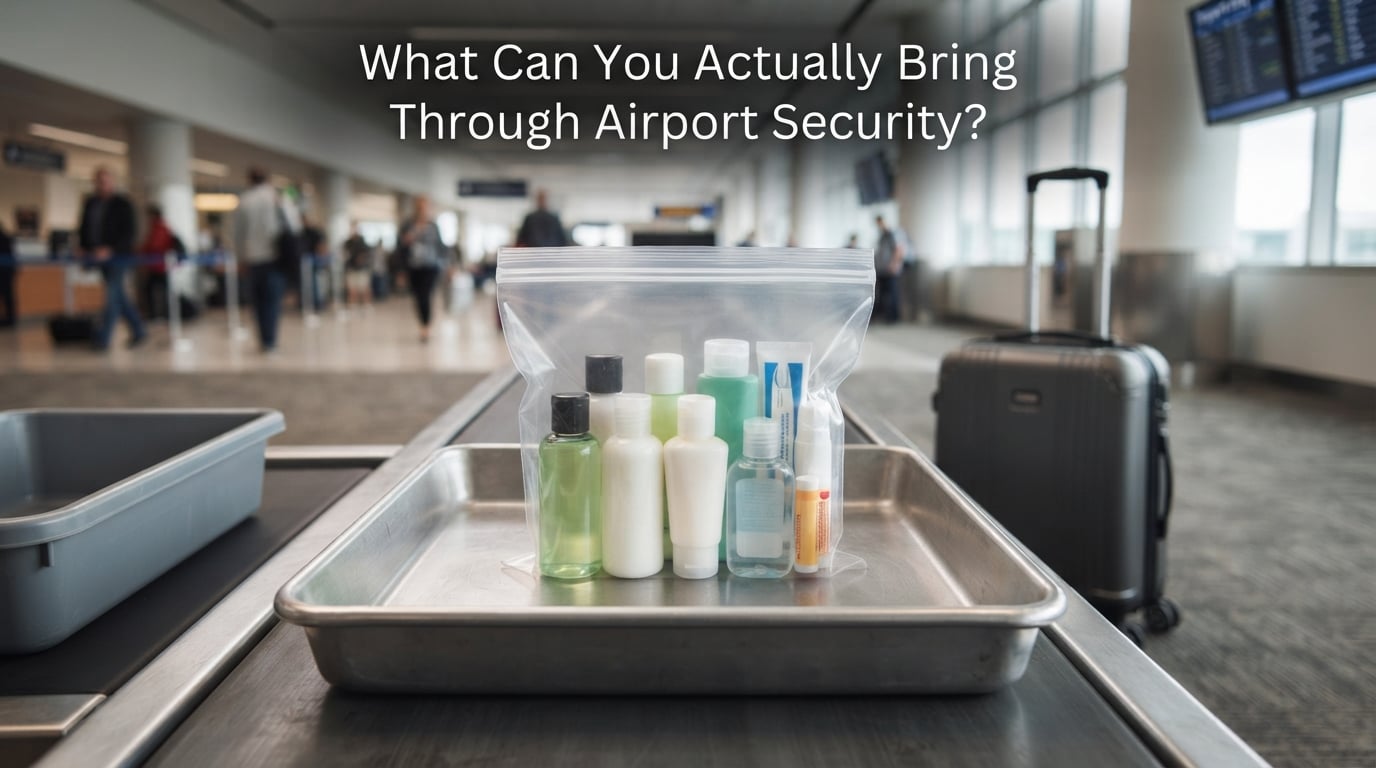
I’ve been through TSA checkpoints more times than I can count, and I still get nervous pulling my bag onto the belt. The rules feel like they change every flight. One agent waves me through with a half-empty water bottle; another confiscates the same toothpaste I brought last month.
This guide cuts through the confusion. I’ll walk you through exactly what you can bring through airport security in 2026, based on current TSA rules, with real examples from travelers who’ve been there. No vague “check with TSA” advice. Just clear answers you can use right now.
Table of Contents
The TSA 3-1-1 Liquids Rule Explained (With Real Examples)
The 3-1-1 rule is the single most important thing to understand before you pack a carry-on. Get this wrong and you’ll lose your shampoo, sunscreen, or that fancy face cream to the confiscation bin.
What the 3-1-1 Numbers Actually Mean
Each number in 3-1-1 represents a specific limit:
- 3 = Each liquid container must be 3.4 ounces (100 milliliters) or smaller
- 1 = All containers must fit inside 1 quart-sized clear plastic bag
- 1 = Each passenger gets 1 bag
The 3.4-ounce limit applies to the container size, not how much liquid is actually inside. That means a half-empty 6-ounce bottle still violates the rule. TSA officers measure the container, not the contents.
How to Pack Your Liquids Bag Correctly
Your quart-sized bag needs to be clear, resealable, and plastic. Ziploc bags work fine. The bag must close completely with everything inside. If items stick out above the seal, a TSA officer will make you repack at the checkpoint, and that’s never fun with a line forming behind you.
Place your liquids bag at the top of your carry-on so you can pull it out quickly. Most travelers put it in a separate compartment or a small pouch for easy access.
Common Items That Count as Liquids
Here’s where people get tripped up. TSA defines “liquids” broadly. It includes anything that spreads, pours, flows, or gels:
- Shampoo, conditioner, and body wash
- Toothpaste and mouthwash
- Lotion, sunscreen, and face cream
- Perfume and cologne
- Salad dressing, ketchup, and mayo packets
- Peanut butter, hummus, and yogurt
Yes, peanut butter counts. I know that sounds wrong, but TSA classifies it as a liquid because it spreads. We’ll cover that in the food section.
Carry-On vs Checked Bag: What’s the Real Difference?
The distinction between carry-on and checked bag rules trips up even experienced travelers. Some items are banned from carry-on but allowed in checked luggage. Others work better in your carry-on. Knowing the difference saves time and stress.
What Must Go in Checked Bags
Several items are completely prohibited in carry-on bags but permitted in checked luggage:
- Large bottles of alcohol (over 3.4 oz and under 70% ABV)
- Box cutters and large utility knives
- Self-defense sprays like bear spray or pepper spray (in most cases)
- Sharp tools longer than 4 inches (screwdrivers, wrenches, pliers)
- Pool cues and baseball bats
For checked bags, I always recommend wrapping anything fragile in clothing and marking the bag as “FRAGILE.” Liquids in checked luggage don’t face the 3-1-1 rule, but airlines can refuse hazardous materials regardless of bag type.
What Works Better in Carry-On
Valuables, electronics, medications, and important documents should always go in your carry-on. Airlines lose checked bags more often than people realize. About 1 in 100 bags gets mishandled, according to industry data.
Carry-on bags must fit in the overhead bin or under the seat. Most U.S. airlines allow 22 x 14 x 9 inches for carry-on and 18 x 14 x 8 inches for personal items like backpacks or purses.
Standard Carry-On Size Limits
Bag size limits vary slightly by airline, but most stick close to these dimensions:
- Carry-on: 22 x 14 x 9 inches (including handles and wheels)
- Personal item: 18 x 14 x 8 inches (must fit under the seat)
- Weight: No FAA limit, but airlines may cap at 25-40 pounds
Low-cost carriers like Spirit and Frontier are stricter. Check your airline’s specific rules before you fly to avoid gate-check surprises.
Complete List of Allowed Items Through Airport Security
Now for the main event: what you can bring through the checkpoint. TSA allows far more than people expect. Here’s the full breakdown.
Personal Care Items
Most everyday items pass through TSA screening without issue, as long as they follow the 3-1-1 rule for liquids:
- Deodorant (solid sticks only for carry-on; aerosol allowed in checked)
- Razor blades and disposable razors (allowed in carry-on)
- Electric razors and trimmers
- Hair brushes and combs
- Nail clippers and files (under 4 inches)
- Tweezers
- Contact lens solution (in 3.4 oz containers within your quart bag)
Solid deodorant is fine in carry-on. Gel or aerosol versions fall under the liquids rule.
Electronics and Gadgets
Electronics have their own set of rules. Larger devices must come out of your bag at the checkpoint:
- Laptops and tablets (must be removed and placed in their own bin)
- Smartphones and e-readers (can stay in your bag)
- Portable chargers and power banks (carry-on only, under 100Wh)
- Bluetooth headphones and earbuds
- Game consoles like Nintendo Switch
- Cameras and lenses
Lithium batteries must always go in carry-on, never checked bags. A damaged lithium battery in the cargo hold can cause fires that are nearly impossible to extinguish.
Sports and Outdoor Gear
Outdoor enthusiasts often worry about their equipment. Good news: most gear is allowed:
- Fishing rods and tackle boxes
- Tennis rackets and golf clubs (check airline oversized policies)
- Hiking poles (collapsible ones are fine; fixed-length poles must be checked)
- Ski and snowboard bindings (without the boards)
- Crampons (allowed in carry-on, surprisingly)
- Antlers and animal skulls (yes, really)
Southern Living reported that TSA even allows light sabers. The key rule: if it could be used as a weapon and isn’t a tool, it gets confiscated.
Items You Cannot Bring Through TSA Checkpoints
Knowing what’s banned matters just as much as knowing what’s allowed. Here’s what’s prohibited in carry-on bags.
Weapons and Sharp Objects
Most weapons belong in checked bags or don’t fly at all:
- Firearms (allowed in checked bags if declared, unloaded, in a hard case)
- Box cutters and razor blades (disposable razor blades are the exception)
- Knives with blades over 4 inches
- Swords and machetes
- Throwing stars and brass knuckles
Pocket knives used to be a gray area. TSA changed the rules in 2013, and now most knives must go in checked luggage regardless of size.
Flammables and Explosives
Anything that catches fire or explodes stays home:
- Lighter fluid and torch lighters
- Aerosol sprays over 3.4 oz (some are allowed in checked)
- Fireworks and sparklers
- Gasoline and propane tanks
- Strike-anywhere matches in bulk (one book of paper matches is allowed)
Regular lighters are fine in carry-on. Disposable Bic lighters pass through every day without issues.
Why Some Foods Get Confiscated
Food rules frustrate travelers the most. The main rule: anything that spreads, pours, or has high liquid content falls under the 3-1-1 liquids limit. Solid foods are usually fine, but spreads and sauces aren’t.
TSA confiscated over 9,000 pounds of prohibited items at checkpoints in recent years, with food items making up a significant chunk. The most confiscated food? Jars of pickles and tubes of toothpaste.
Food Through Airport Security: What’s Actually Allowed
Food rules deserve their own section because the answers are genuinely surprising.
Solid Foods Are Usually Fine
You can bring most solid foods through security in your carry-on:
- Sandwiches, wraps, and burgers
- Fresh fruits and vegetables
- Baked goods like cookies, cakes, and bread
- Chips, crackers, and nuts
- Candy and chocolate bars
- Cheese (solid blocks)
I’ve brought full sandwiches, apples, and protein bars through TSA dozens of times. Never had an issue.
The Spreadable Food Problem
This is where peanut butter becomes controversial. Anything that spreads is treated as a liquid under TSA rules:
- Peanut butter and almond butter
- Hummus and dips
- Yogurt and pudding cups
- Jam and jelly
- Nutella and other chocolate spreads
- Salad dressing packets
Peanut butter gets confiscated not because TSA hates sandwiches, but because at room temperature it flows. TSA tests items at room temperature. If it pours, spreads, or splatters at that temperature, it counts as a liquid.
Workaround: buy peanut butter after you pass security, or check your bag.
Beverages, Ice, and Frozen Items
Empty your water bottle before the checkpoint. TSA allows:
- Empty reusable water bottles (fill at a fountain after screening)
- Ice (melted or frozen, in any quantity)
- Baby formula and breast milk (in reasonable quantities)
- Solid ice cream (fully frozen is fine)
If ice has melted at all, TSA treats it as a liquid. That melted ice cream in your cooler? That falls under the 3-1-1 rule.
Medication and Medical Device Exceptions
Medical items get special treatment. TSA recognizes that people need access to medications and devices, and the rules reflect that.
Prescription Medication Rules
You can bring prescription medications in your carry-on in any quantity. The 3-1-1 rule does not apply to medically necessary liquids. TSA officers may ask you to open containers for inspection, but they won’t confiscate your insulin.
- Pills and capsules (any quantity)
- Liquid medications (any size container, declared at checkpoint)
- EpiPens and auto-injectors
- Inhalers and nebulizers
- Insulin and glucagon
Pills don’t have to be in original bottles, though I recommend keeping them labeled. If you’re traveling internationally, rules differ by country. Some require original packaging with your name.
Medical Devices That Trigger Pat-Downs
Medical implants and devices often require additional screening. TSA uses full-body scanners and metal detectors that can detect:
- Pacemakers and defibrillators
- Insulin pumps and continuous glucose monitors
- Chemo ports and central lines
- Metal plates, screws, and joint replacements
- External prosthetics
Your chemo port won’t necessarily set off alarms, but TSA may use a wand or pat-down regardless. This is standard procedure, not suspicion. You can request a private screening at any time.
Liquid Medication Exception
Medically necessary liquids are exempt from the 3-1-1 rule. Tell the TSA officer at the checkpoint that you have medically required liquids. They’ll likely inspect them separately.
For ice packs keeping medication cold, they must be fully frozen when you reach the checkpoint. Partially melted ice packs count as liquids.
Surprising Items TSA Actually Allows
Some items pass through TSA that most travelers assume are banned. This is where the rules get genuinely fun.
Unusual Outdoor Equipment
- Antlers and deer skulls
- Crampons and ice picks (in checked bags)
- Handcuffs (must be unlocked)
- Hockey sticks and lacrosse sticks (in some airports)
- Cricket bats (in checked bags)
TSA’s logic: if an item doesn’t function as a weapon in its current form, it’s probably allowed. A fishing rod isn’t going to hijack a plane.
Crafting and Hobby Items
- Knitting needles and crochet hooks
- Sewing needles and small scissors (under 4 inches)
- Spinning tops and yo-yos
- Frisbees and small toys
- Musical instruments that fit in overhead bins
Knitting needles were banned after 9/11 but reinstated in 2008. Experienced knitters know the relief of finishing a project mid-flight.
Strange But Permitted Things
- Light sabers (yes, the toy kind)
- Honest-to-goodness funeral ashes (in a container that can be X-rayed)
- Fresh flowers and plants
- Wrapped gifts (TSA will unwrap if needed)
- Small household tools like screwdrivers under 4 inches
If you’re bringing cremated remains, use a TSA-friendly container that allows X-ray inspection. TSA officers are trained to handle remains with respect.
Baby, Family, and Special Traveler Rules
Families traveling with kids get extra allowances, and TSA recognizes that babies need specific supplies.
Baby Formula and Food Exemptions
Baby items are exempt from the 3-1-1 rule in reasonable quantities:
- Breast milk (any amount, declared at checkpoint)
- Formula (ready-to-use or powder)
- Baby food jars and pouches
- Juice and water for infants
- Diapers and wipes (any quantity)
TSA may test liquids for explosives, but they won’t take them. Allow extra time for screening if you’re traveling with formula or breast milk.
Items for Children Traveling Alone
Unaccompanied minors can bring the same items as adults, but airlines have their own rules about what unaccompanied children can carry. Contact your airline before the trip for specifics.
Strollers and car seats gate-check for free on most airlines. They don’t count toward your carry-on limit.
What Actually Happens at the Security Checkpoint
Knowing the rules is half the battle. Knowing what to expect at the checkpoint is the other half.
What to Take Out of Your Bag
From Reddit threads and FlyerTalk forums, here’s what travelers consistently report taking out:
- Liquids bag (quart-sized clear bag)
- Laptop and tablet
- Large electronics over the size of a phone
- Food items (sometimes required, sometimes not)
- Outer layers like jackets, hoodies, and belts
A Reddit thread on r/tsa confirmed that food doesn’t always need to come out, but officers can ask. If they ask, comply without argument. It’ll go faster.
How TSA Officers Make Decisions
TSA officers have discretion. The same item can pass at one airport and get flagged at another. An officer at JFK once waved me through with a 6-ounce sunscreen because the container was clearly under 3.4 oz when measured. Another officer at LAX confiscated a similar bottle the next week.
Officers follow training, but enforcement varies. If something is borderline, they’ll usually let it through. If it’s clearly prohibited, they have no choice but to confiscate or call law enforcement.
Airport-by-Airport Variations
FlyerTalk forums are full of travelers complaining about inconsistent enforcement. Some airports use CT scanners that don’t require liquids removal. Others still use older X-ray machines that do.
Major hubs like Atlanta, Dallas, and Denver often have newer equipment. Smaller regional airports may still use older tech that flags more items.
If you’re connecting through an unfamiliar airport, build in extra time. Don’t assume your experience at one airport applies everywhere.
FAQ: Common Questions About Airport Security
What is not allowed through airport security?
Can I bring full size shampoo in my checked bag?
What is the TSA 3-1-1 rule?
Why is peanut butter not allowed through TSA?
What surprising items are allowed through TSA security?
Can I bring a 12 pack of soda on a plane?
Conclusion
Knowing what you can bring through airport security comes down to a few core rules. Master the 3-1-1 liquids rule, understand the carry-on versus checked bag difference, and remember that solid foods are usually fine while spreadable foods aren’t.
Before your next flight, double-check TSA.gov for any rule updates. The agency updates its prohibited items list regularly. When in doubt, pack it in checked luggage or leave it at home. A little preparation saves time, stress, and the heartbreak of watching your fancy face cream land in the confiscation bin.