
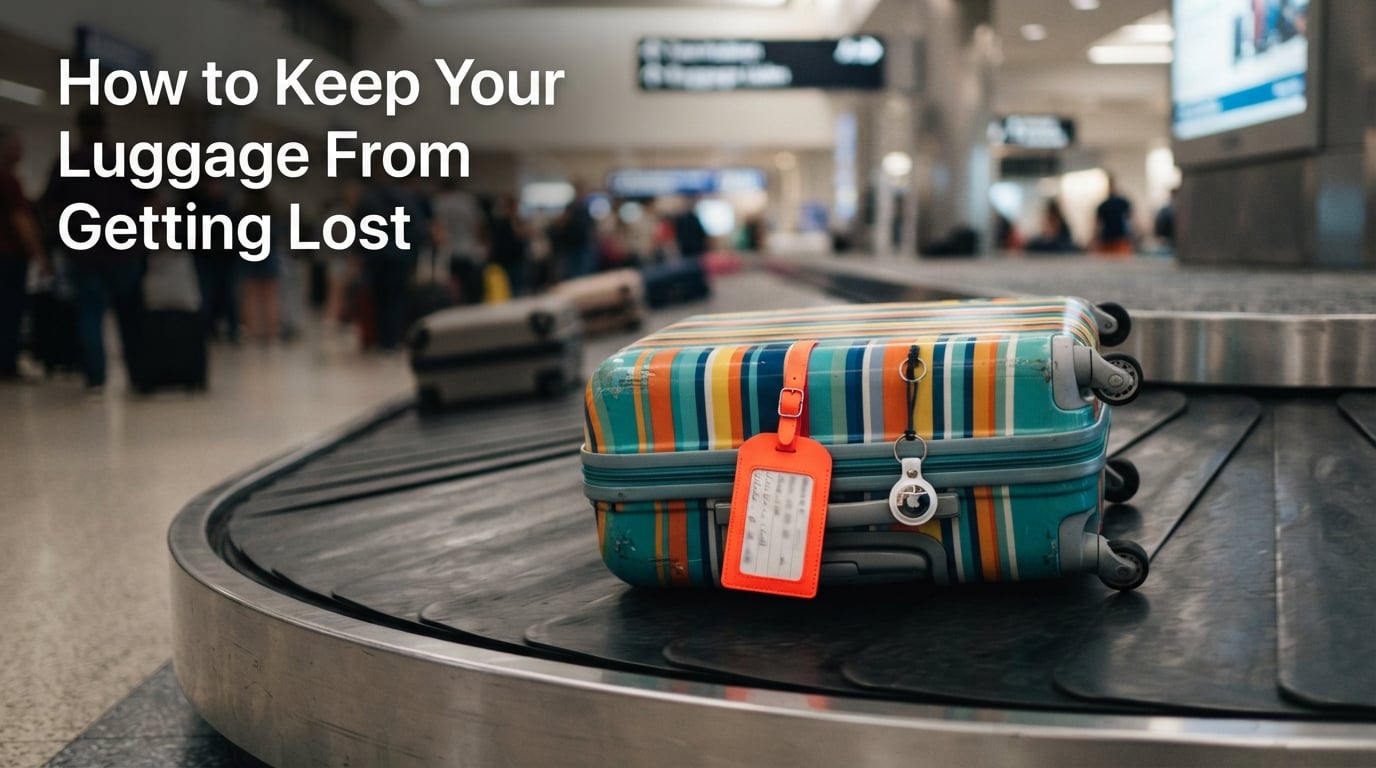
Nothing ruins a long-anticipated trip quite like standing at the baggage carousel, watching everyone else grab their bags while yours never appears. According to the latest SITA Baggage IT Insights report, airlines mishandle roughly 7.6 bags per 1,000 passengers. That translates to over 36 million mishandled bags worldwide each year.
The good news is that most luggage losses are preventable. After analyzing advice from frequent travelers, baggage handlers, and airline staff, we have put together a comprehensive guide on how to keep your luggage from getting lost. These are practical, proven strategies that work whether you are flying domestically or heading overseas with connecting flights.
You will learn why bags go missing in the first place, the 12 most effective prevention tips, which luggage trackers are worth using, and exactly what to do if your bag does not show up. Let us start with understanding the problem so you can avoid it.
Table of Contents
Why Does Luggage Get Lost? Understanding the Causes
To effectively keep luggage from getting lost, it helps to understand what goes wrong behind the scenes. Bags rarely vanish into thin air. Instead, they get misrouted, delayed, or separated from their tracking tags at specific points in the journey.
Connecting flights are the number one culprit. When your layover is short, your bag may not make the transfer even if you do. Baggage handlers need time to unload, sort, and reload bags between flights, and tight connections simply do not leave enough room for error.
Mislabeled or damaged barcode tags cause major problems too. If the adhesive fails, the barcode smudges, or the tag tears off during handling, the automated sorting system cannot tell where your bag needs to go. This is why removing old barcode stickers from previous trips matters so much.
Human error and system glitches also play a role. Baggage handlers occasionally load bags onto the wrong cart or flight. Software systems can glitch and send bags to incorrect destinations. Weather delays pile up the pressure, leading to rushed handling and mistakes. Customs and security checks can pull bags aside for inspection, and if the process runs long, the bag misses its flight.
Finally, overloaded flights mean more bags than the cargo hold can accommodate. When that happens, some bags get bumped to later flights, sometimes without notifying the passenger.
How to Keep Your Luggage From Getting Lost: 12 Proven Tips
Here is the core of this guide. These 12 strategies cover everything you can control before, during, and after your flight to prevent lost luggage. We recommend implementing as many as possible, especially for international travel or trips with connections.
1. Use a Durable Luggage Tag with Contact Information
This is the simplest and most effective step you can take. Attach a sturdy luggage tag to every checked bag with your name, phone number, and email address. If the barcode tag fails, the luggage tag gives airline staff a way to identify and reach you.
Use a tag with a cover to keep your information private from casual observers. Avoid flimsy paper tags that can tear off during transit. Many travelers on Reddit recommend silicone or leather tags with steel loops that will not snap under pressure.
2. Put a Label Inside Your Bag Too
External tags can fall off. That is just reality. Place a sheet of paper with your contact details inside the bag, on top of your clothes where it is immediately visible when the bag is opened. Include your name, phone number, email, home address, and itinerary.
If the outside tag goes missing, airline staff will open the bag and find your information inside. This single step has helped recover countless misplaced bags that would otherwise have ended up in the unclaimed baggage pile.
3. Add a Bluetooth Tracker to Your Checked Bag
This is the tip that frequent travelers swear by most. Dropping an Apple AirTag, Tile, or Samsung Galaxy SmartTag into your suitcase lets you see its location from your phone. When airlines say they cannot locate your bag, you can show them exactly where it is.
Reddit is full of success stories from travelers who recovered lost bags thanks to AirTags. One user tracked their suitcase to a storage room in a different airport terminal and directed staff to retrieve it. Another watched their bag sit in Chicago for two days while the airline claimed it was in transit.
The key advantage is leverage. When you can say “my tracker shows the bag is at Gate C14,” airline staff take you far more seriously than when you simply report it missing.
4. Book Nonstop Flights Whenever Possible
The fewer connections, the fewer opportunities for your bag to go astray. Every transfer point is a chance for something to go wrong. If you can book a direct flight, do it. If connections are unavoidable, choose layovers of at least 90 minutes for domestic travel and two to three hours for international flights.
This gives baggage handlers adequate time to move your suitcase from one plane to another. Tight 45-minute connections are a recipe for separated luggage.
5. Remove Old Barcode Stickers from Previous Trips
Every time you check a bag, the airline attaches a barcode sticker. If that sticker is still on your bag from your last flight, the automated sorting system may scan the old code instead of the new one. Your bag could end up flying to your previous destination.
This is a surprisingly common mistake. Peel off every old sticker before you head to the airport. Check the handle, the sides, and the bottom of the bag. A clean suitcase ensures only the current routing code gets scanned.
6. Choose Distinctive or Colorful Luggage
Black suitcases dominate the baggage carousel, which makes identification harder for both you and airline staff. If everyone has a similar-looking black bag, mix-ups happen. Choose luggage in a bright color, a unique pattern, or add colorful straps and stickers to make it stand out.
When your bag is visually distinct, you can describe it instantly to airline staff if it goes missing. “A bright yellow hardshell with an orange ribbon on the handle” is much easier to locate than “a black roller bag.”
7. Take Photos of Your Luggage Inside and Out
Before you leave for the airport, photograph your suitcase from every angle. Take a picture of the inside too, showing how it is packed and what items are in there. These photos serve two purposes.
First, they help you describe your bag precisely if it is lost. You can show the photo to baggage claim staff instead of relying on memory. Second, if you need to file a claim for lost or stolen items, having visual proof of what was packed strengthens your case significantly.
8. Arrive Early and Check In Your Bags Promptly
Rushing to the airport with barely enough time to make your flight increases the chance your bag will not make it. When you check in late, your bag enters the handling system under time pressure, which means it is more likely to be rushed, misrouted, or bumped.
Arrive at least two hours before a domestic flight and three hours before an international departure. Give your bag the best possible chance to move through the system smoothly.
9. Secure or Remove Loose Straps and Parts
Loose straps, dangling handles, and detachable wheels can snag on conveyor belts and cause damage or separation. Before checking a bag, tuck in all straps, zip up every pocket, and secure any removable parts. If a wheel is loose, get it fixed before your trip.
Baggage handlers move thousands of bags per shift. A snagged strap can rip a tag off or tear a handle, making your bag harder to identify and route correctly.
10. Pack Essentials in Your Carry-On
Even with perfect preparation, delays happen. Always pack a change of clothes, medications, toiletries, electronics, and any valuables in your carry-on bag. If your checked luggage is delayed by a day or two, you will not be stuck without necessities.
Forum users consistently emphasize this point. Travelers who packed essentials in their carry-on reported far less stress when their checked bags were delayed. Those who did not ended up buying replacement items and chasing reimbursement.
11. Use a Credit Card with Lost Luggage Coverage
Many premium travel credit cards offer lost or delayed luggage protection as a built-in benefit. If you book your flight with one of these cards and your bag is lost or delayed beyond a certain threshold (often six to twelve hours), you can file a claim for reimbursement of essential purchases.
This is a tip that most competitor articles miss entirely, but Reddit users mention it constantly. Check your credit card benefits guide before traveling. Cards like Chase Sapphire Reserve, Amex Platinum, and several others offer coverage that can save you hundreds of dollars if your bag goes missing.
12. Consider Shipping Your Luggage Instead of Checking It
For travelers who have experienced repeated luggage loss or who are carrying high-value items, shipping your suitcase ahead can be worth the cost. Services like ShipGo, Luggage Forward, and even FedEx or UPS can deliver your bag to your hotel or destination directly.
This eliminates the airline handling chain entirely. No carousel, no connections, no baggage handlers. It costs more than checking a bag, but for expensive gear, formal wear, or irreplaceable items, the peace of mind may justify the price.
Choosing the Right Luggage Tracker
Bluetooth trackers have become one of the most powerful tools for preventing permanent luggage loss. Here is a quick comparison of the three main options travelers rely on.
Apple AirTag is the most popular choice among travelers, and for good reason. It taps into the massive Find My network, meaning any nearby iPhone helps pinpoint your bag’s location. Battery life runs about a year, and replacement batteries are inexpensive. The main limitation is that it requires an iPhone to work and has no GPS of its own.
Tile works across both iOS and Android, making it the best cross-platform option. Tile has a smaller network than Apple’s Find My, but it still covers major airports and cities well. Tile Premium adds extended range and free battery replacements.
Samsung Galaxy SmartTag is ideal for Android users, particularly those with Samsung devices. It uses the Galaxy Find network, which is large and growing. Like the AirTag, it works best when other compatible devices are nearby.
Whichever tracker you choose, the key is that it gives you real-time location data. That information is invaluable when you are standing at an empty carousel and the airline has no answers.
Black Tape on Luggage Wheels: Does It Actually Work?
You may have seen travelers wrapping black electrical tape around their suitcase wheels and wondered why. The practice is not about preventing luggage loss exactly. It is about preventing wheel damage during rough handling.
Baggage handlers drag, toss, and stack suitcases aggressively. Wheels are often the first thing to break. Wrapping tape around the wheels provides a temporary buffer against impacts and keeps loose wheel components from falling off entirely.
Some travelers also use brightly colored tape on wheels as an identification trick, making their bag easier to spot on a carousel full of identical black suitcases. Either way, it is a low-cost hack that costs you nothing but a roll of tape.
The 3-1-1 Rule for Carry-On Liquids
Understanding the TSA 3-1-1 rule is relevant to luggage loss prevention for a simple reason. If your carry-on violates liquid limits, TSA may force you to check it at the security checkpoint. That turns a bag you planned to keep with you into a checked bag with no preparation, no tracking, and no luggage tag.
The rule states that liquids, gels, and aerosols in carry-on bags must be in containers of 3.4 ounces (100 milliliters) or less. All containers must fit inside a single quart-sized clear plastic bag. Each passenger gets one bag.
If you plan to carry on everything, make sure your liquids comply. If you exceed the limit, transfer those items to your checked bag before you reach security. This prevents the scenario where you are forced to check a bag you intended to keep by your side.
What to Do If Your Luggage Is Lost
Even with perfect preparation, bags can still go missing. If you arrive at your destination and your suitcase is not on the carousel, here is exactly what to do. Speed and persistence matter most at this stage.
Step 1: Report it immediately at the baggage claim office. Do not leave the airport first. Go to the airline’s baggage claim desk before you leave the secured area. Most airlines require you to report a lost bag within 24 hours for domestic flights and as soon as possible for international flights.
Step 2: Talk to staff in person. Reddit users strongly advise this over calling the hotline. In-person staff can access more information, contact ramp agents directly, and sometimes locate your bag while you are standing there. Phone agents often read from scripts and have less ability to take action.
Step 3: File a written claim and get a reference number. Get everything in writing. You should receive a Property Irregularity Report (PIR) with a tracking number. Use this number to follow up on the airline’s website or app through their baggage tracking system.
Step 4: Keep all receipts for essential purchases. If your bag is delayed, airlines are generally required to cover reasonable expenses for clothing, toiletries, and other necessities. Save every receipt. Most airlines reimburse between $50 and $100 per day for delayed bags, though policies vary.
Step 5: Know your compensation rights. For domestic flights in the US, the Department of Transportation requires airlines to compensate you for lost, damaged, or delayed baggage up to a set maximum. For international flights, the Montreal Convention sets liability limits that are often higher. Credit card travel protections may add another layer of coverage.
Step 6: Follow up persistently but politely. Airlines handle thousands of delayed bags. Yours is one of many. Call every 24 to 48 hours, reference your claim number, and ask for updates. If you have a tracker, share the location data with them. Persistence gets results.
Step 7: If your bag is declared lost permanently, file a detailed claim. Provide an itemized list of contents with estimated values, photos of the items if you have them, and receipts where possible. The more documentation you provide, the better your chances of full reimbursement.
Why Should You Always Put Your Luggage in a Hotel Bathtub?
This is a popular travel tip that has nothing to do with airlines and everything to do with bedbugs. When you arrive at your hotel, place your suitcase in the bathtub before unpacking.
Bedbugs cannot climb smooth surfaces like porcelain or fiberglass. The bathtub is the safest place for your luggage while you inspect the room for signs of infestation. Check the mattress seams, headboard, and nightstand for reddish-brown spots or live bugs. If the room is clear, you can move your bag to a luggage rack.
This habit prevents you from bringing bedbugs home in your suitcase. It does not prevent airline luggage loss, but it is one of the most important things you can do to protect your belongings after you arrive.
FAQ
Which airline is most likely to lose your luggage?
Why put black tape on luggage wheels?
What is the 3-1-1 rule for luggage?
Why should you always put your luggage in a hotel bathtub?
How often does luggage get lost on flights?
Should I put an AirTag in my checked luggage?
Conclusion: Travel Smart and Keep Your Bags Close
Learning how to keep your luggage from getting lost comes down to preparation and awareness. Label your bags inside and out, add a Bluetooth tracker, book nonstop flights when possible, and remove old barcode stickers before every trip. Pack your essentials in your carry-on so a delayed bag never becomes a disaster.
If the worst happens and your suitcase does not show up, act fast. Report it before leaving the airport, talk to staff in person, file a written claim, and follow up persistently. Know your rights under DOT regulations and the Montreal Convention, and use credit card protections if you have them.
The travelers who lose bags permanently are almost always the ones who did not label, track, or document their luggage. Take thirty minutes to prepare before your next flight, and you will dramatically reduce the chances of standing at an empty carousel wondering where your bag went.