
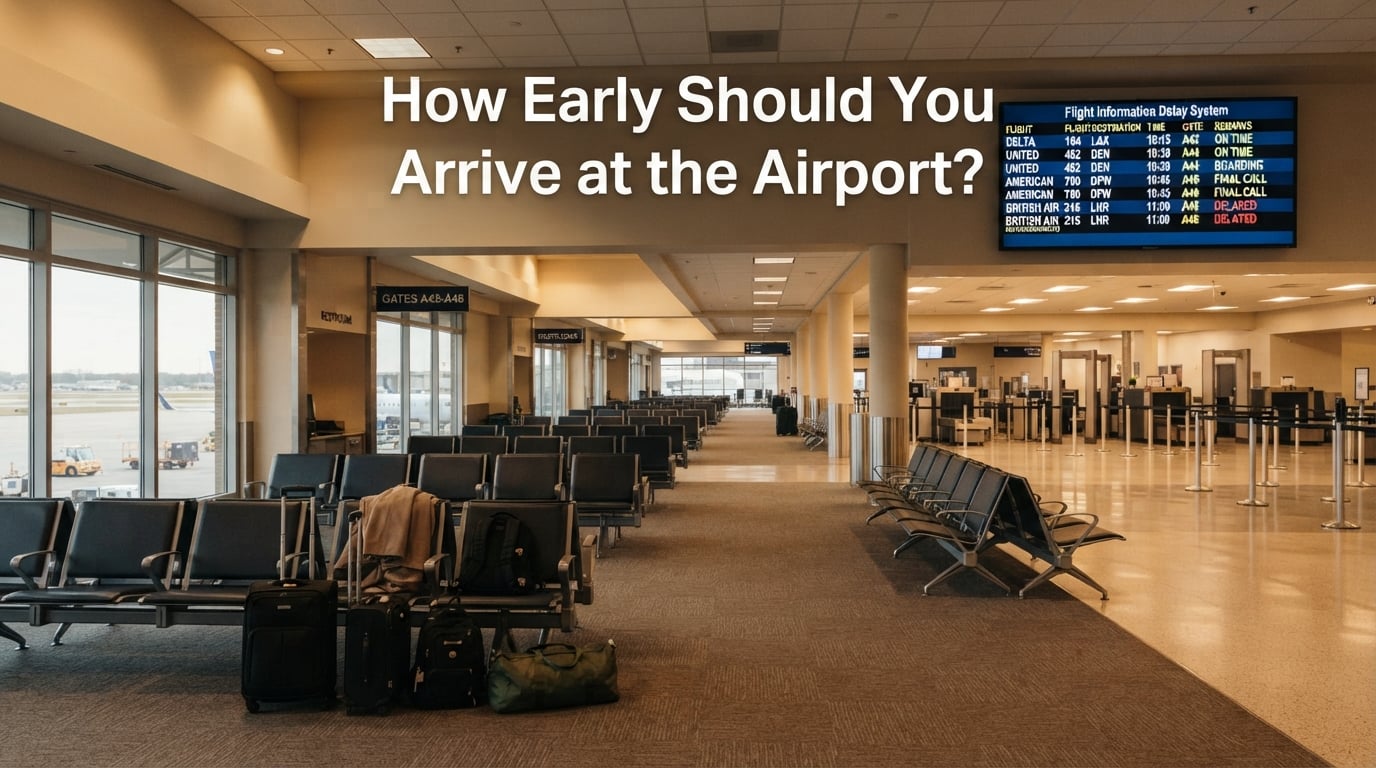
Figuring out how early should you arrive at the airport is one of the most common questions travelers face, and the answer depends on several moving parts. Get there too late and you risk missing your flight entirely. Show up too early and you are sitting around a terminal wasting time you could have spent sleeping, eating, or wrapping up work.
I have taken dozens of flights over the past few years, from tiny regional airports to massive international hubs, and the arrival timing question never stops coming up in conversations with friends and family. Everyone has a different rule of thumb, and honestly, some of the advice floating around online is outdated or just plain wrong.
This guide breaks down everything you need to know about airport arrival times for 2026. We will cover the official TSA guidelines, dig into the factors that actually change your timing, explain how TSA PreCheck and CLEAR shift the math, and address the specific situations that catch first-time flyers off guard. By the end, you will have a clear framework for deciding exactly when to leave for the airport, every single time.
Table of Contents
The Quick Answer: How Early Should You Arrive at the Airport?
Arrive at the airport 2 hours before a domestic flight and 3 hours before an international flight, according to the TSA and major airline guidelines. During peak travel periods like Thanksgiving, Christmas, and spring break, add an extra 30 to 60 minutes to those numbers.
These recommendations come directly from the TSA’s official guidance, which advises travelers to allow time for parking, airline check-in, obtaining a boarding pass, and going through the security screening process. American Airlines echoes this on their own check-in page: at least 2 hours within the U.S. and at least 3 hours for flights outside the U.S.
However, these are baseline recommendations, not hard rules for every situation. Frequent flyers with TSA PreCheck who only have a carry-on bag often arrive 60 to 90 minutes before domestic flights and cruise through with time to spare. The key is understanding which factors apply to your specific trip and adjusting accordingly.
Domestic Flights: How Early to Arrive
For domestic flights within the United States, the standard recommendation is to arrive 2 hours before your scheduled departure time. This gives you enough buffer to handle parking, check-in, security, and walking to your gate without any panic.
Here is how that 2-hour window typically breaks down. Plan on 20 to 30 minutes for parking and getting from the lot to the terminal via shuttle or on foot. Another 15 to 20 minutes for check-in and getting your boarding pass if you have not done so online. Security screening takes anywhere from 15 to 45 minutes depending on the airport and time of day. The remaining time covers walking to your gate, grabbing food, and being ready when boarding starts.
At smaller regional airports, you can often get away with arriving 90 minutes before a domestic flight. Lines are shorter, terminals are compact, and the whole process moves faster. At major hubs like Atlanta, Dallas-Fort Worth, or Denver during busy hours, the full 2 hours is genuinely necessary.
One thing to keep in mind is that your boarding time is not the same as your departure time. Airlines typically start boarding 30 to 45 minutes before departure, and the gate closes 15 to 20 minutes before take-off. If you arrive at the airport 2 hours early, you are really arriving about 2 hours and 30 minutes before the plane actually pushes back.
International Flights: How Early to Arrive
For international flights, arrive at the airport 3 hours before your scheduled departure. This is the recommendation from the TSA, the Department of Homeland Security, and virtually every major international airline operating out of U.S. airports.
International flights require extra time for several reasons. First, the check-in process is more involved, often requiring passport verification, visa checks, and sometimes additional documentation depending on your destination. Airlines also have earlier baggage cutoff times for international flights, typically 60 minutes before departure compared to 45 minutes for domestic.
Second, security screening for international flights can involve additional questioning or checks, especially for certain destinations. Some airports route international travelers through dedicated security lines that move more slowly than domestic ones.
Third, the gates for international flights are often farther from the main terminal area. At large airports, you might need to take an intra-airport train or walk a significant distance to reach your gate. Building in extra time accounts for this transit within the airport itself.
If you are flying internationally from a major gateway airport like JFK, LAX, or Miami during peak season, do not try to cut the 3-hour window short. The combination of heavy passenger volume and complex check-in requirements means lines can back up quickly, and airlines will not hesitate to deny boarding if you arrive past their cutoff.
Key Factors That Affect Your Airport Arrival Time
The 2-hour and 3-hour rules are starting points, but your actual ideal arrival time depends on several variables that can add or subtract significant minutes from your airport experience.
Airport Size and Busyness
The size of your airport is one of the biggest factors in how early you need to arrive. Large hub airports like Atlanta, Chicago O’Hare, Los Angeles International, and Dallas-Fort Worth handle tens of thousands of passengers daily. Security lines can stretch for what feels like miles, and walking from security to your gate can take 20 minutes or more at some of these airports.
Mid-sized airports like Nashville, Austin, or Las Vegas have seen massive passenger growth in recent years and now experience rush-hour bottlenecks that rival the biggest hubs. If you are flying from one of these rapidly growing airports, do not assume the old timing still applies.
Small regional airports are a different story. At airports like Billings, Montana or Bangor, Maine, you can often arrive 60 to 90 minutes before a domestic flight and have plenty of time. Security lines are minimal, gates are close, and the whole experience is lower-stress.
Time of Day and Day of Week
The time of your flight dramatically affects security wait times. Early morning flights, specifically departures between 5 AM and 8 AM, tend to have the longest security lines because that is when business travelers and connecting passengers flood the airport. If you have a 6 AM flight, plan to arrive at the full 2 hours even for domestic.
Midday flights between 10 AM and 2 PM typically see lighter traffic. Security lines are shorter, and the airport just feels less chaotic overall. If you are flying midday from a smaller airport with TSA PreCheck, you might be fine arriving 75 to 90 minutes early.
Friday afternoons and Sunday evenings are the busiest travel periods of the week. Monday mornings are also heavy with business travelers. Tuesday and Wednesday tend to be the quietest days, which means you can sometimes shave a few minutes off your arrival time.
Peak Travel Periods and Holidays
During major holidays, all the normal rules go out the window. Thanksgiving week, the days around Christmas and New Year, spring break periods, and major summer holidays see airport passenger volumes spike by 30 to 50 percent or more.
For holiday travel, add at least 30 to 60 minutes to the standard arrival recommendations. If you normally arrive 2 hours early for domestic, plan on 2.5 to 3 hours during peak holiday periods. For international flights during holidays, consider arriving 3.5 to 4 hours early.
The TSA publishes holiday travel tips each year, and their consistent message is to arrive early and be prepared. They also recommend checking wait times through the MyTSA app or the TSA’s website before you leave for the airport.
Checking Bags vs Carry-On Only
Whether you check bags has a significant impact on your arrival timing. If you are checking luggage, you need to factor in time for the bag drop line, and you need to arrive before the airline’s baggage cutoff time.
Most airlines have a baggage cutoff of 45 minutes before departure for domestic flights and 60 minutes for international. This means if you arrive 50 minutes before a domestic flight with a bag to check, you might already be too late even though the plane has not left yet.
If you are traveling with only a carry-on bag and have checked in online, you can skip the check-in counter entirely and head straight for security. This saves 10 to 20 minutes in many cases, which is why experienced travelers with TSA PreCheck can often arrive later and still make their flights comfortably.
Curbside check-in, available at many airports through skycap services, can speed things up if you are checking bags. Tipping the skycap a few dollars often gets you faster service, and some travelers swear by this approach to bypass the indoor check-in lines.
Traveling with Children or Large Groups
If you are flying with children, especially young children or infants, add at least 30 extra minutes to your arrival time. Strollers, car seats, extra bags, and the simple logistics of moving a family through an airport all take longer than traveling solo.
Large groups face similar challenges. Coordinating multiple people through check-in and security is slower than going alone, especially if not everyone has TSA PreCheck or if some group members are infrequent flyers unfamiliar with the security process.
The TSA does allow families with children under 12 to go through the standard security lane together, and children under 12 do not need to remove their shoes. Still, the process takes time, and keeping a group together through a busy airport is inherently slower.
TSA PreCheck and CLEAR
TSA PreCheck is the single biggest time-saver for domestic travelers in the United States. With PreCheck, you go through a dedicated security lane where you keep your shoes on, keep your laptop in your bag, and keep liquids and small electronics stowed. The line moves much faster, and many PreCheck travelers report arriving 60 to 90 minutes before domestic flights with no issues.
CLEAR takes things a step further by using biometric scanning to skip the initial ID check portion of the security line. CLEAR members go straight to the physical screening, which can save another 5 to 15 minutes depending on how busy the standard lines are.
The combination of TSA PreCheck and CLEAR is powerful. Travelers with both can often arrive 45 to 60 minutes before a domestic flight and walk through security in under 10 minutes. However, this only works if you have checked in online, have no bags to check, and are departing from an airport where PreCheck and CLEAR lanes are both open.
One important caveat: PreCheck lanes are not guaranteed to be open at every airport at every hour. Smaller airports may only operate PreCheck during peak hours, and some airports have limited CLEAR coverage. Always check before assuming you can arrive extra early.
Situations Where You Can Arrive Later
If you have TSA PreCheck, a carry-on bag only, a mobile boarding pass, and you are flying domestic from a familiar airport during off-peak hours, you can often arrive 75 to 90 minutes before departure and be perfectly fine. Many frequent flyers on Reddit’s travel forums report arriving just 45 to 60 minutes before boarding with PreCheck and never missing a flight.
The so-called “airport theory” that circulated on social media in 2026 suggests that travelers can arrive much later than the official 2-hour recommendation if they have PreCheck and no checked bags. There is truth to this for experienced travelers at familiar airports, but it carries real risk if anything goes wrong.
If your airport has a known short security line that day, or you are flying from a small regional airport midweek, you can trim your arrival time. Just remember that one traffic jam, one closed lane, or one slow family ahead of you in line can erase your buffer instantly.
The safest approach is to test shorter arrival times on low-stakes trips first. If you are flying home from a city you know well on a Tuesday afternoon with PreCheck and no bags, try arriving 90 minutes early and see how it feels. If it works smoothly, you have learned something useful for next time.
Situations Where You Need Extra Time
First-time flyers should always arrive at the full 2 hours for domestic flights and 3 hours for international. You do not yet know the layout of the airport, you might hit unexpected snags at check-in, and the security process itself can feel overwhelming if you are not familiar with the procedures.
Travelers who need REAL ID verification or have document questions should build in extra time as well. Starting in 2026, the REAL ID requirement is in full effect for domestic air travel, and if your ID does not meet the standard, you will face additional screening or potential denial at the checkpoint.
If you require accessibility assistance, are traveling with a service animal, or have medical equipment that needs special screening, plan to arrive 30 minutes earlier than the standard recommendation. The TSA has specific procedures for these situations, and while they are designed to be respectful and efficient, they do take additional time.
Large airports during peak season require extra time across the board. If you are departing from a major international hub during summer vacation season, the holidays, or spring break, the standard 2 hours for domestic might not be enough. Play it safe and arrive 2.5 to 3 hours early.
Anyone with international document checks, such as students on visas, travelers with expired passports being renewed, or those flying to destinations with additional entry requirements, should arrive 30 to 60 minutes earlier than the 3-hour international baseline.
Understanding Boarding vs Departure Time
One of the most common sources of confusion for travelers is the difference between boarding time and departure time. Your departure time is when the plane is scheduled to push back from the gate. Boarding typically starts 30 to 45 minutes before that time, and the boarding door closes 15 to 20 minutes before departure.
This means if your flight departs at 10 AM, boarding might start at 9:15 AM and the door closes at 9:40 AM. If you arrive at the gate at 9:45 AM, you have already missed your flight even though departure is still 15 minutes away.
Understanding this timeline is important because it affects your real buffer. When airlines say arrive 2 hours early, they mean 2 hours before departure. That means you have about 1 hour and 15 minutes from the time you walk into the terminal until boarding begins. If security takes 40 minutes, you have roughly 35 minutes of actual cushion.
This is why experienced travelers tend to be conservative with arrival times. The clock starts ticking the moment you park your car, and every minute spent in a line or walking through the terminal eats into your margin for error.
Tips for First-Time Flyers
If this is your first time flying, the airport can feel intimidating, and that is completely normal. The key to reducing anxiety is preparation, and that starts with arriving early enough that you never feel rushed.
For your first flight, arrive at the full 2 hours for domestic or 3 hours for international. Do not try to optimize your timing. Use the extra time to get familiar with the airport layout, find your gate, grab food, and get comfortable with the process.
Check in online 24 hours before your flight so you have your boarding pass on your phone. Take a photo of your parking spot so you can find your car when you return. Wear slip-on shoes because you will need to remove them at security unless you have PreCheck.
At the security checkpoint, have your ID and boarding pass ready before you reach the agent. Follow the instructions of the TSA officers and do not be afraid to ask questions if you are unsure what to do. They deal with first-time flyers every single day.
Once you are past security, check the departure boards to confirm your gate assignment. Gates can change, so verify again when you arrive at the gate area. Sit down, take a breath, and relax. You have done the hard part, and now you just wait for boarding to begin.
If you start to feel anxious about whether you will make your flight, remember that the airport arrival time recommendations are designed to give you a comfortable buffer. Arriving early is not a sign of inexperience. It is a sign that you take your travel plans seriously and do not want to gamble with something as important as catching your flight.
FAQ
Do I really need to arrive 2 hours before a flight?
Is 1.5 hours enough before a flight?
Do I really need to go to the airport 3 hours early?
What is the 45 minute rule at the airport?
Conclusion
Knowing how early should you arrive at the airport comes down to understanding your specific situation and applying the right buffer. The TSA guideline of 2 hours for domestic and 3 hours for international flights is a solid baseline that works for most travelers most of the time.
Adjust from there based on the factors we covered. TSA PreCheck, carry-on only, and a familiar small airport mean you can trim your arrival time. Checking bags, traveling during holidays, or flying from a massive hub mean you should add time.
The bottom line is that arriving a little early costs you some time at the airport, but arriving too late can cost you an entire trip. When in doubt, give yourself the extra 30 minutes. You will board your flight calmly, and that peace of mind is worth far more than the time you would have saved by cutting it close.