
Electric heat is the one heating system where the thermostat is the most dangerous part of the purchase. A baseboard, fan-forced or in-wall heater runs on line voltage, which means the thermostat has to switch 120V or 240V of household current directly instead of sending a low-voltage signal to a furnace. Most smart thermostats on the market, including Google Nest and ecobee models, run on a 24V control circuit and will never switch that load. This roundup of the best programmable thermostats for electric heat covers ten models that will, split into smart WiFi units, non-smart programmable units, and floor and ceiling radiant models.
Our best overall pick is the Mysa Smart Thermostat V2 for Electric Baseboard Heaters. It handles 120V and 240V baseboards up to 3800W, works with Alexa, Google Assistant and Apple HomeKit without a separate hub, and keeps its schedule in an app you can change from a phone. If you want to see how the category fits together first, our smart thermostat energy savings guide covers the scheduling habits that pay off most with resistive heat.
One structural fact shapes everything else. Every heated room is its own zone with its own thermostat, because line voltage is not carried down a shared control bus the way it is in a central system. A three-bedroom house with baseboards in six rooms needs six thermostats. That is the main reason buyers stall on this purchase, and it is why we rated install requirements and outage behavior as heavily as app quality.
Table of Contents
Before You Buy: A 60-Second Compatibility Check
Run through these five questions before you add anything to a cart. If any answer is unclear, the part number stamped on your heater’s nameplate will settle it in seconds.
What voltage is the heater? Most 120V units are fan-forced in-wall heaters and small convector units. 240V units are the classic baseboard. You cannot use a 240V-only thermostat on a 120V circuit.
How many watts does the nameplate list? Divide watts by volts to get amps, then compare that number with the thermostat’s amp rating. A 1500W heater at 240V draws about 6.25A, so a 14.6A thermostat handles up to roughly 3500W at 240V.
How many wires are in the junction box? Two wires means a simple mechanical-style swap. Three or four wires opens the door to schedules and smart features. Smart WiFi models almost always need four wires including a neutral.
Is the circuit double-pole or single-pole? A single-pole switch leaves one live leg on the heater at all times, which is a real safety argument for a double-pole line-voltage thermostat on 240V baseboards.
Is the load a relay or contactor instead of a direct element? Very large commercial loads and older installations sometimes sit behind a relay. Most residential line-voltage thermostats require a minimum load of 2A and cannot drive a relay at all.
If the box has only two wires and you want app control, the honest answer is that you need an electrician to run a neutral, not a different thermostat. Buyers on Home Assistant community threads about baseboard control converge on the same order of operations: confirm the wire count first, then choose the model.
Top 3 Picks for Programmable Thermostats for Electric Heat in 2026
The three models below cover the widest range of real installations. The Mysa leads for smart control, the Honeywell TL8230A1003 leads for proven reliability, and the Honeywell RLV4305A1000 wins on simple installs.

Mysa Smart Thermostat V2
- 120V-240V up to 3800W
- WiFi app with scheduling
- Alexa Google HomeKit
- Humidity and energy tracking
Honeywell TL8230A1003 7-Day
- 7-day schedule
- four periods per day
- Silent switching
- Backlit display

Honeywell RLV4305A1000 5-2 Day
- 240V up to 3500W
- TRIAC silent switching
- Two-wire install
- Four periods per day
All 10 Programmable Thermostats for Electric Heat Compared in 2026
Every model below switches line voltage directly. Voltage, load rating and wiring needs are the three columns worth reading twice, because they decide whether a unit fits your box at all.
| Product | Specifications | Action |
|---|---|---|
| Mysa Smart Thermostat V2 for Baseboards |
|
Check Latest Price |
| Honeywell TL8230A1003 7-Day Programmable |
|
Check Latest Price |
| Honeywell RLV4305A1000 5-2 Day |
|
Check Latest Price |
 Aube by Honeywell TH106 7-Day Aube by Honeywell TH106 7-Day |
|
Check Latest Price |
 LUX ELV4 Programmable Line Voltage LUX ELV4 Programmable Line Voltage |
|
Check Latest Price |
 meross MTS200 Smart Line Voltage meross MTS200 Smart Line Voltage |
|
Check Latest Price |
 KALOR TECH AC603H WiFi Thermostat KALOR TECH AC603H WiFi Thermostat |
|
Check Latest Price |
 Honeywell TH115-AF-GA/U Radiant Honeywell TH115-AF-GA/U Radiant |
|
Check Latest Price |
 SASWELL SAS968FHL-7 Floor Heat SASWELL SAS968FHL-7 Floor Heat |
|
Check Latest Price |
 QuietWarmth THERMPRO Radiant Thermostat QuietWarmth THERMPRO Radiant Thermostat |
|
Check Latest Price |
1. Mysa Smart Thermostat V2 for Electric Baseboard Heaters: Best Overall Smart Choice
Mysa Smart Thermostat V2 for Electric Baseboard Heaters | No Subscription | Humidity Sensor + Touchscreen | WiFi Programmable | Scheduling | Geofencing | HomeKit, Alexa, Google | 120V-240V
120V-240V line voltage
Up to 3800W at 240V
3.5 inch touchscreen
2.4 GHz WiFi
Pros
- Guided in-app wiring walkthrough
- Granular scheduling and multi-room zoning
- Real-time energy and cost tracking
- Humidity sensing
- Works with Alexa Google Assistant and HomeKit
Cons
- Requires four wires including a neutral
- 2.4 GHz WiFi only
- Geofencing can miss away mode
This is the unit I recommend first for most households with electric baseboard heat. It covers the full 120V to 240V range, manages multiple rooms from one app, and reports what each heater actually cost to run. The touchscreen reads clearly from across a room, and the display dims itself when nobody is nearby.
Setup is where it earns its place. The app walks you through identifying wires, naming rooms and building a schedule, and long-time owners consistently credit that guided flow for a first-time install that went smoothly. Scheduling granularity is genuinely finer than the four-period-per-day models below, which matters when a bedroom needs to drop six degrees while the rest of the house stays warm.
The energy and cost graphs are the feature I use most. Because baseboard heat is 100 percent resistive, every hour the element runs shows up directly on your bill, and this unit makes that visible room by room. A Home Assistant community discussion about baseboard control put it plainly: among owners comparing options there, the recurring lean was toward Mysa.
There is a real catch, and it is wiring. This model needs at least four wires including a neutral or a second live wire, so older two-wire installations are excluded no matter how good the app is. It also joins only 2.4 GHz networks, which on a dual-band router means enabling that band before setup.
What to check before you order
Confirm four wires in the junction box, then confirm your heater’s wattage sits under 1900W at 120V or 3800W at 240V. Look at your router and make sure the 2.4 GHz band is active and not isolated from other devices.
If you already run a mixed smart home, verify the platform you use is on the supported list. Alexa, Google Assistant and Apple HomeKit are all native, which means no gateway purchase and no per-room bridge to maintain.
Where it falls short
Adaptive display brightness has been reported as unreliable, sometimes leaving the screen lit overnight in a dark bedroom. Geofencing is the other soft spot, with owners reporting away mode does not always trigger on schedule, so treat it as a convenience rather than a control method.
Editing recurring schedules in the app is also less intuitive than the four-period systems, which will frustrate anyone who wants to change the same three time blocks every week.
2. Honeywell TL8230A1003 Electric Heat 7-Day Programmable: Most Proven Non-Smart Model
Honeywell TL8230A1003 Electric Heat Digital 7 Day Programmable Thermostat
240V line voltage
7 day schedule
Four periods per day
Backlit digital display
Pros
- Large backlit display readable in the dark
- Soundproofed switching with no relay click
- Early start reaches setpoint on time
- No batteries to maintain
- Holds room temperature within a degree
Cons
- No battery backup so programming can be lost in an outage
- Small unlit programming buttons
- Clear button sits where it gets pressed by accident
It is the most thoroughly proven line-voltage thermostat we evaluated, and it has the most owner history of any model in this group. Long-running owners describe the same results: an electrician installed it without drama, programming is intuitive once you learn the icon row, and the room holds temperature within a degree of setpoint. For anyone replacing a failed mechanical dial in a 240V baseboard room, it is the low-risk choice.
The electronic temperature control claims up to 10 percent additional savings on heating bills over a mechanical control, on top of the up-to-20 percent figure the seven-day schedule itself is designed to deliver. Those are manufacturer claims rather than measurements we took, but the direction matches what users report after a season of use.
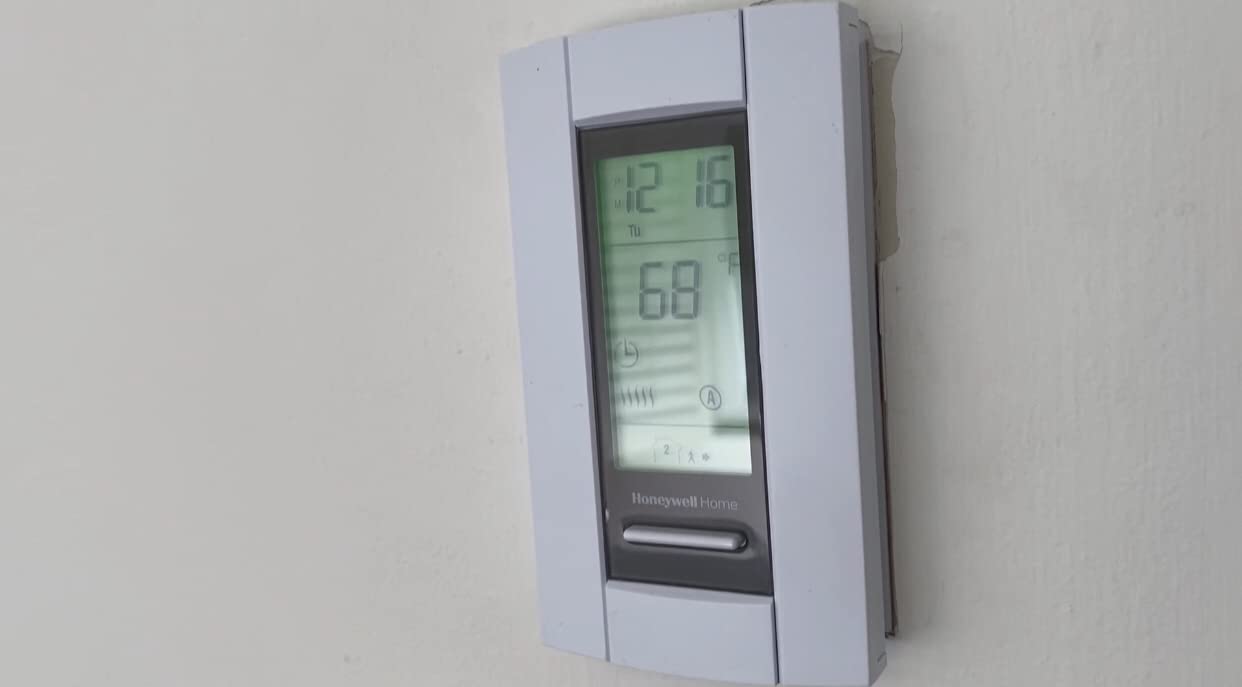
Two details make daily use easier than the price suggests. The soundproofed housing removes the familiar click of a bimetallic switch, and the early start function warms the room before your schedule says it should be comfortable, which is the difference between a cold bedroom at 6am and a warm one.
Programming runs to four time settings per day, with icons on the buttons instead of a menu to memorize. The instruction sheet is brief, so budget an hour for the first setup if you have never programmed a thermostat.
What to check before you order
This is a 240V unit, so it suits baseboards and other 240V electric heat rather than 120V fan-forced heaters. It runs on corded electric power with no batteries, which means the display and schedule depend on the circuit staying live.
Look at how many separate time blocks you actually need. Four per day covers most schedules. If you want a mid-afternoon nap drop, a weekend-only program, or a different pattern for winter weekdays, a full seven-day model gives you more room.
Where it falls short
There is no battery backup, so a power interruption can erase your programming. In a heating-only winter home that is a genuine annoyance, and it is the single most cited drawback among owners.
The programming buttons are small and are not backlit, which makes late-night adjustment harder. The clear button also shares space with other functions and gets pressed by accident often enough that users mention it repeatedly.
3. Honeywell Home RLV4305A1000 5-2 Day Programmable: Best Two-Wire Upgrade
Honeywell Home 5-2 Day Programmable Thermostat Electric Baseboard Heaters
240V up to 3500W
14.6A resistive max
2-wire non-polarized
TRIAC switching
Pros
- Two-wire install fits most existing boxes
- Silent TRIAC switching
- Accuracy within a fraction of a degree
- Four periods per day with separate weekday and weekend programs
Cons
- Only 5-2 day rather than full 7-day programming
- Requires a minimum 2A resistive load
- Cannot drive a relay or contactor
This is the model to buy when the junction box has two wires and you refuse to open a wall for a neutral. The non-polarized two-wire connection is the whole point: it drops into the wiring a mechanical bimetallic dial used before, which is exactly the r/DIY request pattern of wanting remote shutoff and timers without a rewiring project.
Control accuracy is the standout. The stated tolerance is plus or minus 0.27 F for baseboards and convectors, and TRIAC switching means there is no relay click at all, even in a quiet bedroom at night. The backlit display holds the schedule and instructions behind the front panel.
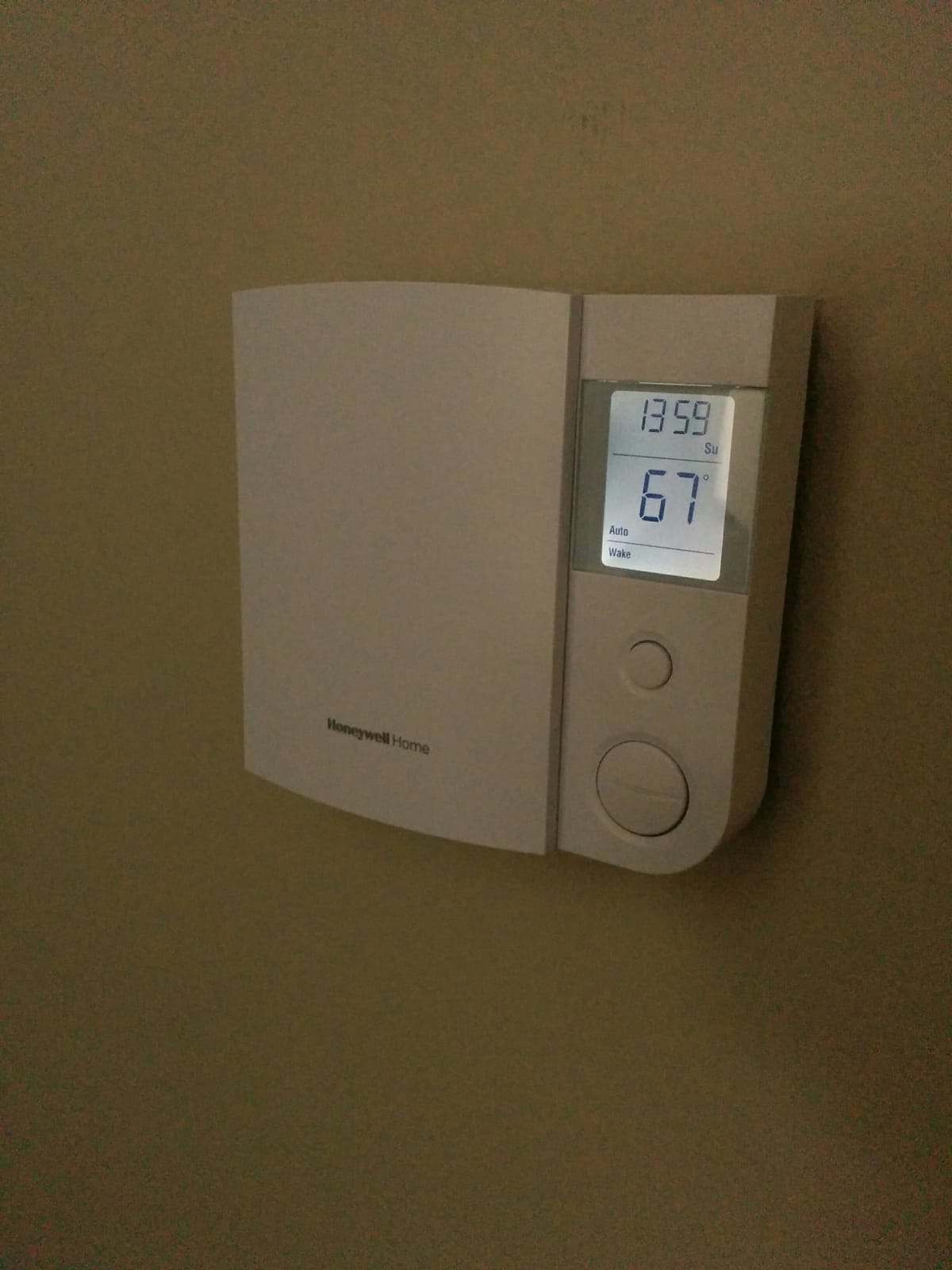
It handles up to 3500W at 240V with a 14.6A resistive maximum, which covers most single baseboard runs in a residential room. Four periods per day run through wake, leave, arrive and sleep, with separate weekday and weekend programs.
A temporary bypass temperature override is useful when guests are over, and the one-year limited warranty covers the parts most likely to fail. It is a digital box with no moving parts to wear out.
What to check before you order
Confirm two or three conductors and a 240V heater at or under 3500W. This is a residential line-voltage heating-only device; it is not for central systems, and it cannot be used on inductive contactor or relay loads.
Decide whether weekday and weekend programs are enough. If anyone in the house works from home on a shifted schedule, five programs will feel like a constraint after a few weeks.
Where it falls short
Five and two day programming is the obvious limitation. There is no way to give Monday a different pattern from Tuesday without shifting everything to the weekend program.
The 2A minimum resistive load rules out very small heaters, and the 14.6A ceiling rules out the largest 240V baseboards. Check the nameplate before buying, because exceeding either limit is a breaker-tripping situation rather than a preference.
4. Aube by Honeywell Home TH106: Best for Heaviest 240V Baseboard Loads
Aube by Honeywell Home TH106 Electric Heating 7-Day Programmable Thermostat
2000W at 120V
4000W at 240V
16.7A resistive
2-wire SPST
Pros
- Handles 4000W and 16.7A at 240V
- Battery-free backup holds the schedule
- 15-second duty cycles give tight control
- Two-wire install replaces old bimetallic controls
- Three year warranty
Cons
- No display backlight
- Two-wire design may not meet current code in some jurisdictions
- Programming takes practice
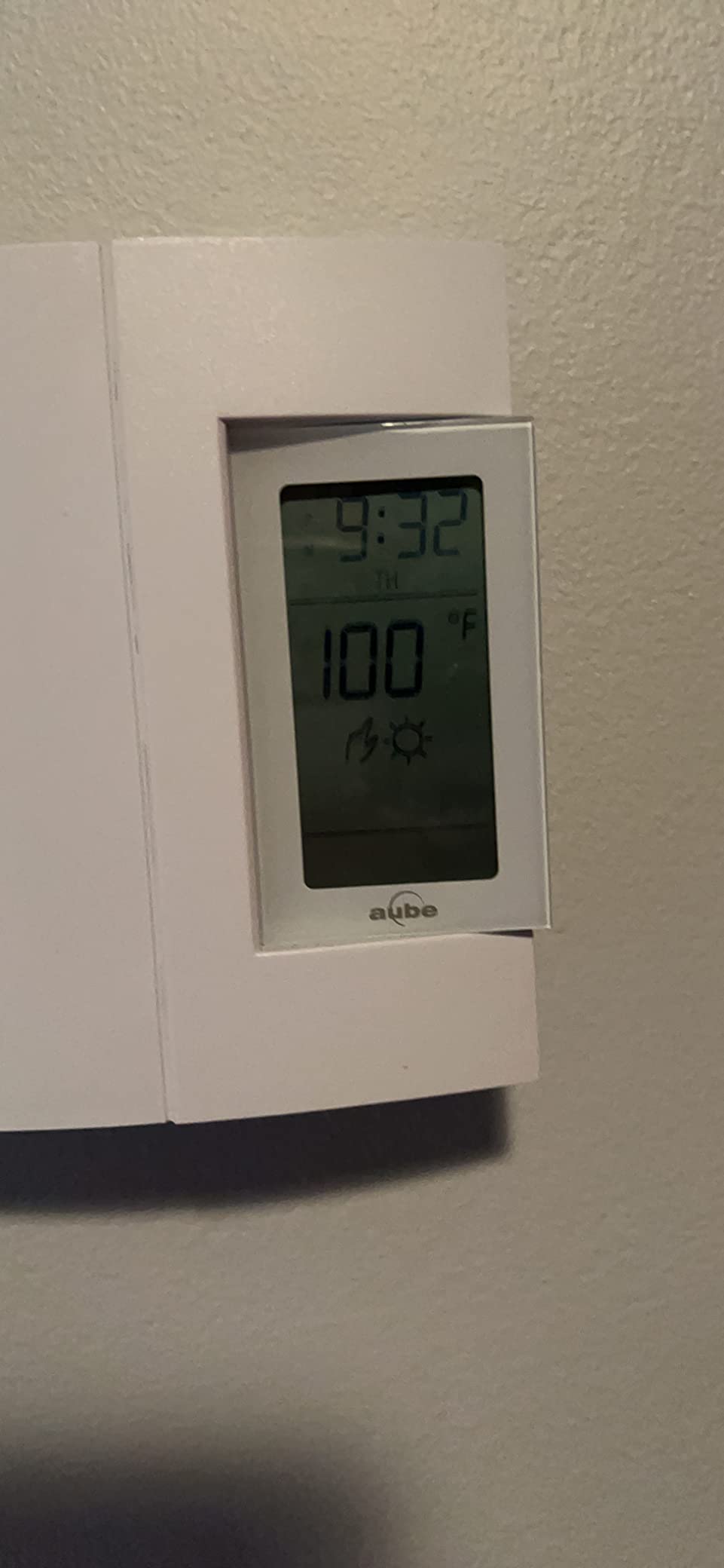
If your nameplate reads 4000W, most of the mid-range line-voltage thermostats are out. The TH106 is rated to 4000W and 16.7A at 240V and 2000W at 120V, which puts real headroom between its contact rating and the load of a full-length baseboard. Owners running long baseboards in cold rooms consistently report it holding setpoint without drama.
The battery-free backup is the sleeper feature. Because there is nothing to charge and nothing to lose, the schedule survives a power blip, which matters more than it sounds in a heating-only house where a brownout in January can wipe a hand-programmed week.
Temperature control uses 15-second duty cycles, and long-term owners describe the tightest control of any line-voltage unit they have owned, along with a comfort improvement they could feel over the old dial. TRIAC switching keeps it silent, with no audible click when the element cycles.
Comfort, economy and vacation presets give you quick starting points, and the ambient operating range of 0 C to 60 C suits unheated closets and cold-season rooms. The three-year warranty is among the longest in this roundup.
What to check before you order
Verify your heater is 240V and under 4000W, and that your circuit is a two-wire SPST arrangement. This unit is built for electric baseboard, convector and fan-forced heaters, plus radiant ceilings, but the 2A minimum load still rules out tiny heaters.
Check local electrical code before a two-wire install. Owners note that some jurisdictions now expect a neutral on new work, and the two-wire approach is where code questions arise.
Where it falls short
There is no backlight, a direct consequence of the two-wire design, so reading the display in a dark room means getting up and turning on a lamp. That is the most repeated complaint in reviews.
Programming takes practice, the printed instructions are limited, and the 2A minimum load means the unit cannot drive a relay or contactor for larger or multi-element installations.
5. LUX ELV4: Best for Fan-Forced Heaters with an Adjustable Swing
ELV4 Programmable Line Voltage Thermostat
120V and 240V AC
4 periods per day
Temporary override
Two AA batteries
Pros
- Works on both 120V and 240V systems
- Adjustable swing is useful for fan-forced wall heaters
- Accurate to about a degree
- Simple two-wire style installation
- Front-accessible batteries
Cons
- Audible relay click when switching
- No display backlight
- Two AA batteries needed for memory and operation
- Delicate front cover
The LUX ELV4 stands out for an adjustable swing setting, a control no other pick in this roundup offers. On a fan-forced in-wall heater that cycles with a short delay, a tighter swing keeps the room closer to the number on the display instead of overshooting between cycles. Installers mention it specifically as the reason this model ends up on fan-forced jobs.
It also covers both 120V and 240V in one unit, which removes a whole class of buying mistake for anyone unsure what their in-wall heater runs. Accuracy lands within about a degree, and the on-screen programming is about as simple as these get.
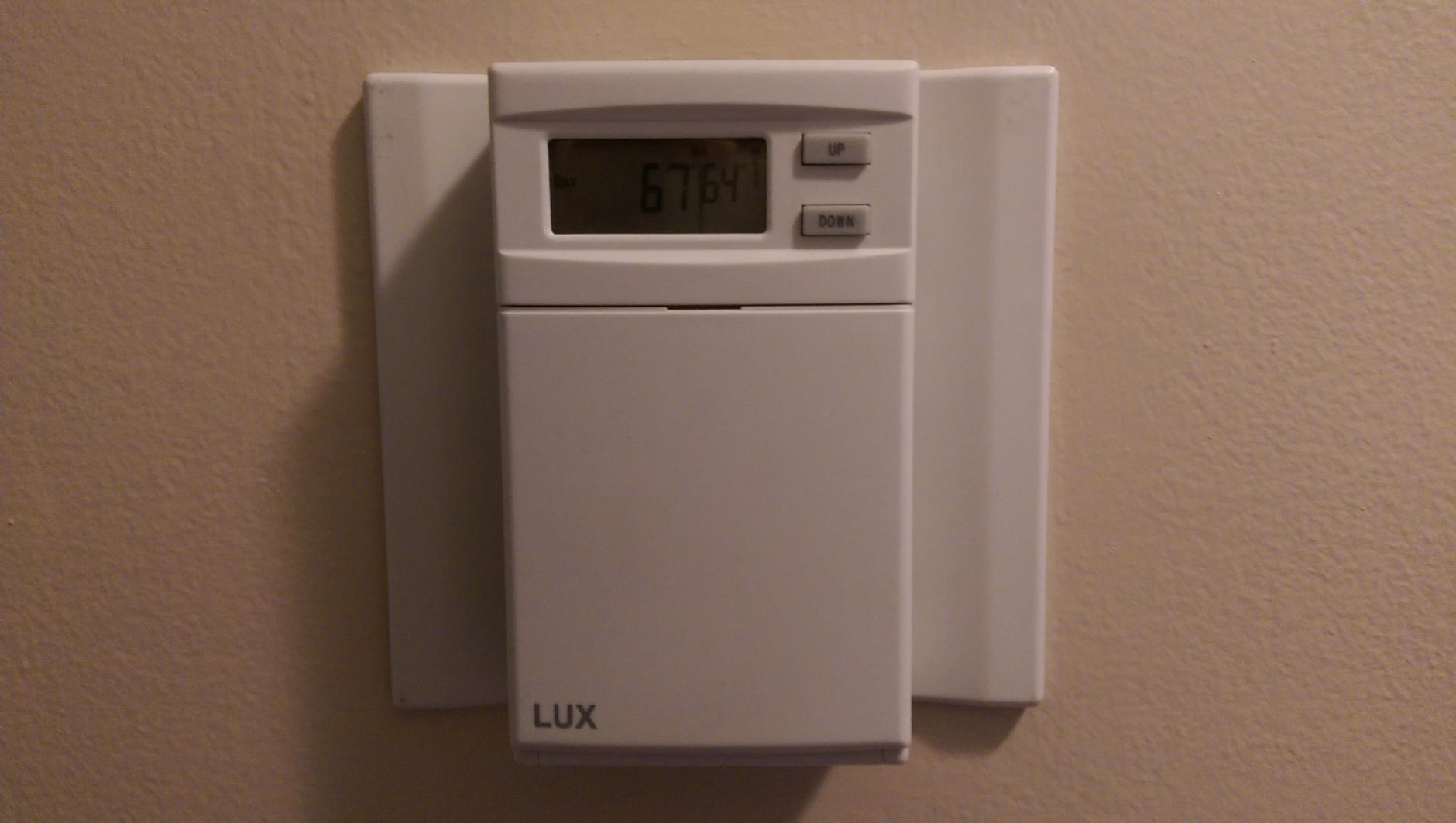
Four periods per day with separate weekday and weekend schedules covers a normal household routine, and a temporary override lets you bump heat for an hour without disturbing the program. A positive off switch and a low-battery indicator are both on the front, where you can see them.
Batteries are the weak point. Two AA cells power the memory and the relay operation, so a dead set of batteries means a dead thermostat in the middle of a cold snap. Several owners report the maker replacing a unit under warranty when one failed.
What to check before you order
Confirm your heater is 120V or 240V and that the load is a resistive element rather than a combination heater-and-fan appliance, which this unit is not rated for. The UL approval covers a one-year warranty on the unit.
Count how often you want to change the schedule. Five and two day programming means one weekday pattern and one weekend pattern, so shift workers should look at the seven-day models instead.
Where it falls short
The relay click is audible on every cycle, which is precisely what the TRIAC-based Honeywell models avoid. If your bedroom needs silence, this is not the unit.
There is no backlight, batteries must be replaced periodically, and the front cover is delicate enough that owners report cracking it when removing the unit for a battery change.
6. meross MTS200: Best for Apple Home, Alexa and Energy Reports
meross Smart Thermostat for Electric Baseboard and in-Wall Heaters Work with HomeKit, Alexa and Google Home, 120V-240V Wi-Fi Programmable Thermostat with Easy Install, Energy Saving, 4 Wires Needed
120V-240V up to 3840W
16A output
7x24 schedule
Internal energy meter
Pros
- In-app installation video makes wiring straightforward
- Energy monitoring with per-kWh cost tracking
- Works with Apple Home Alexa Google Home and SmartThings
- Open window detection
- Power-off memory
Cons
- Requires four wires including a neutral
- 2.4 GHz WiFi only
- First pairing often needs a reset
- No humidity sensor
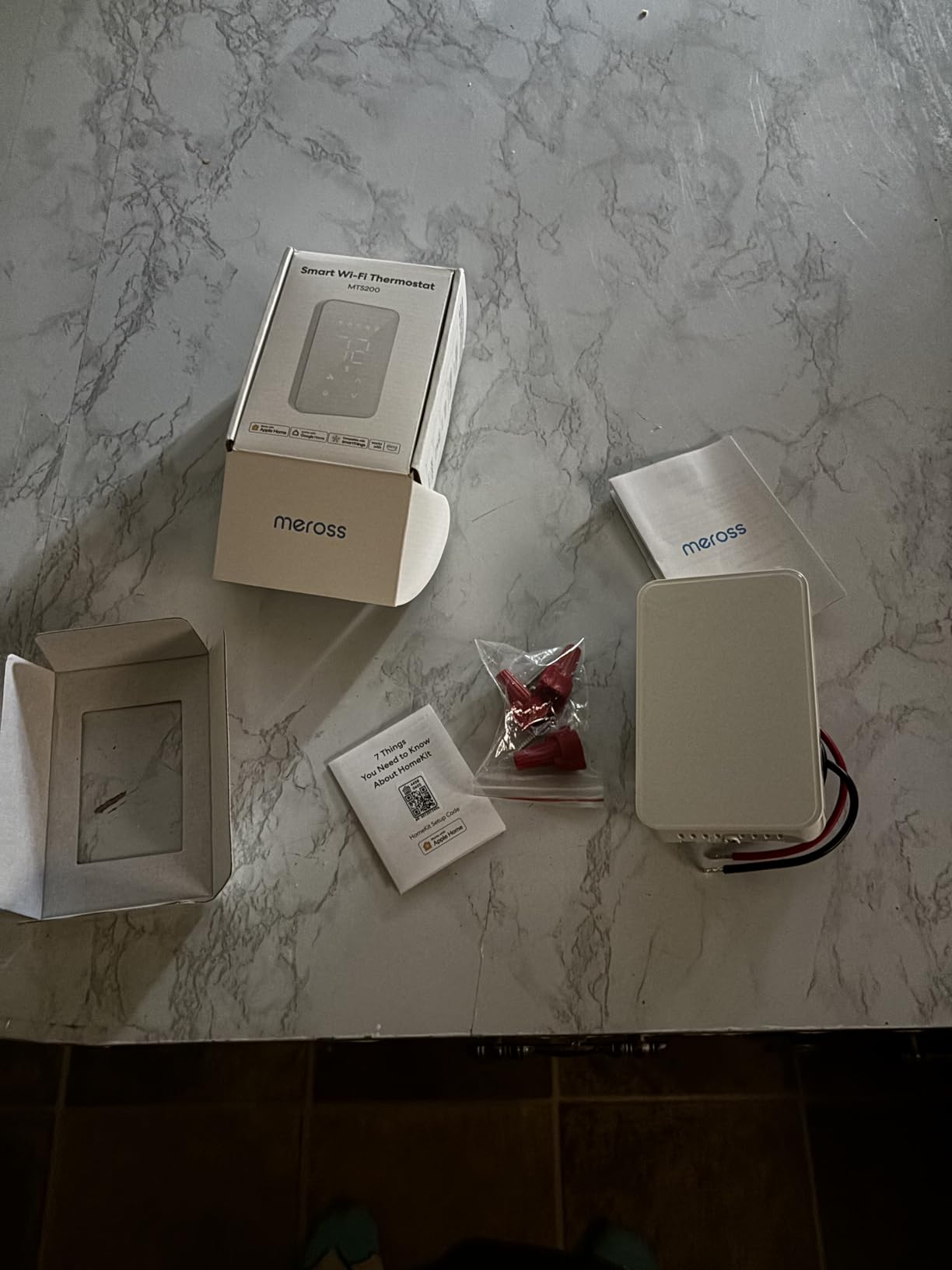
The meross MTS200 is a lower-cost route into smart line-voltage control. It handles 1920W at 120V and 3840W at 240V through a 16A output, covers baseboard, convector, fan-forced and in-ceiling radiant heat, and pairs with Apple Home, Alexa, Google Home and SmartThings. The internal electricity meter produces real-time and historical energy reports, which is the feature that separates it from a plain app on/off switch.
Install is guided by an in-app video walkthrough, and owners replacing aging baseboard thermostats consistently call the setup unusually clear. Temperature accuracy is 1 F across an adjustable 41 F to 95 F range, with a seven-day, 24-hour graphic schedule for finer control than the four-period budget models.
Open window detection pauses heating when it sees a sharp temperature drop, which matters in a drafty room with a frequently opened exterior door. Summer mode handles cooling control on the same circuit, and power-off memory restores your settings after an outage.
The unit is UL 60730 and CAN/CSA-E60730 listed, weighs 7.4 ounces and mounts on a standard wall box. For a rental or a secondary home, that combination of remote control and outage memory is genuinely useful.
What to check before you order
Count the wires first. Four wires including a neutral are required, so older two-wire baseboard boxes will not accept this unit. Then confirm your 2.4 GHz network is enabled and not separated from your other WiFi devices.
Verify the platform you actually use. Apple Home, Alexa, Google Home and SmartThings are listed, but a hub-based system that is not on that list will not see this thermostat.
Where it falls short
There is no humidity sensor on this model, so you lose the comfort data the Mysa provides, and some listing claims suggest underfloor heating support that owners do not confirm. Treat floor applications with caution.
First-unit pairing frequently fails until the device is reset, and the 2.4 GHz-only requirement can force a router change on a modern dual-band network.
7. KALOR TECH AC603H: Best for Smart Life and Tuya Setups
KALOR TECH Wi-Fi Smart Thermostat for Electric Baseboard Heaters, 120-240V Systems, Proprietary Wall Plate, LCD Fahrenheit Display, Compatible with Alexa, Google Home, Smart Life and Tuya App
120V-240V systems only
Fahrenheit LCD
App and voice control
Included wall plate
Pros
- Included custom wall plate fits standard boxes
- Alexa and Google Assistant control work well
- App setup and features are capable for the money
- Pigtails and large-print instructions included
Cons
- Small type on the printed instructions
- Reported temperature offset that does not always hold
- Front plate fits loosely
- Backlight times out while navigating menus
This unit runs on the Smart Life and Tuya platforms, which matters if your home already runs on that ecosystem. Alexa and Google Assistant voice control work without extra hardware, and scheduling can be done from the device or the app. A freeze protection mode guards a remote cabin or unheated space when nobody is there.
The included custom wall plate is sized to fit standard American and Canadian electrical boxes, and the package includes pigtail wires, screws and instructions, which removes the most common trip hazard during a swap. The LCD shows time, target temperature and WiFi status in Fahrenheit.
Owners generally like the appearance on the wall and the value for a 120V to 240V WiFi unit. The limitation is scope: it is for 120V to 240V systems only and is not compatible with 24V central heating or single-pole wiring, so check your box before buying.
The 2.4 GHz network is required for installation only, which is a smaller commitment than the models that need it permanently. Programming is available from the device itself as well as the app.
What to check before you order
Confirm a double-pole line-voltage circuit and check that your home already uses the Smart Life or Tuya app. If your automation runs on Home Assistant locally, this unit is a poor fit without a bridge you would have to source yourself.
Note the review base is small, which means the long-term reliability picture is thinner than the models with a thousand-plus ratings behind them.
Where it falls short
The most common negative theme is temperature accuracy. Owners report the readout running several degrees off, and the offset correction not always holding after a power cycle, which makes the display harder to trust for setpoint decisions.
The printed instructions are small type and barely mention 240V behavior, the front plate fits loosely and comes off too easily, and the display backlight times out quickly while you navigate the menu.
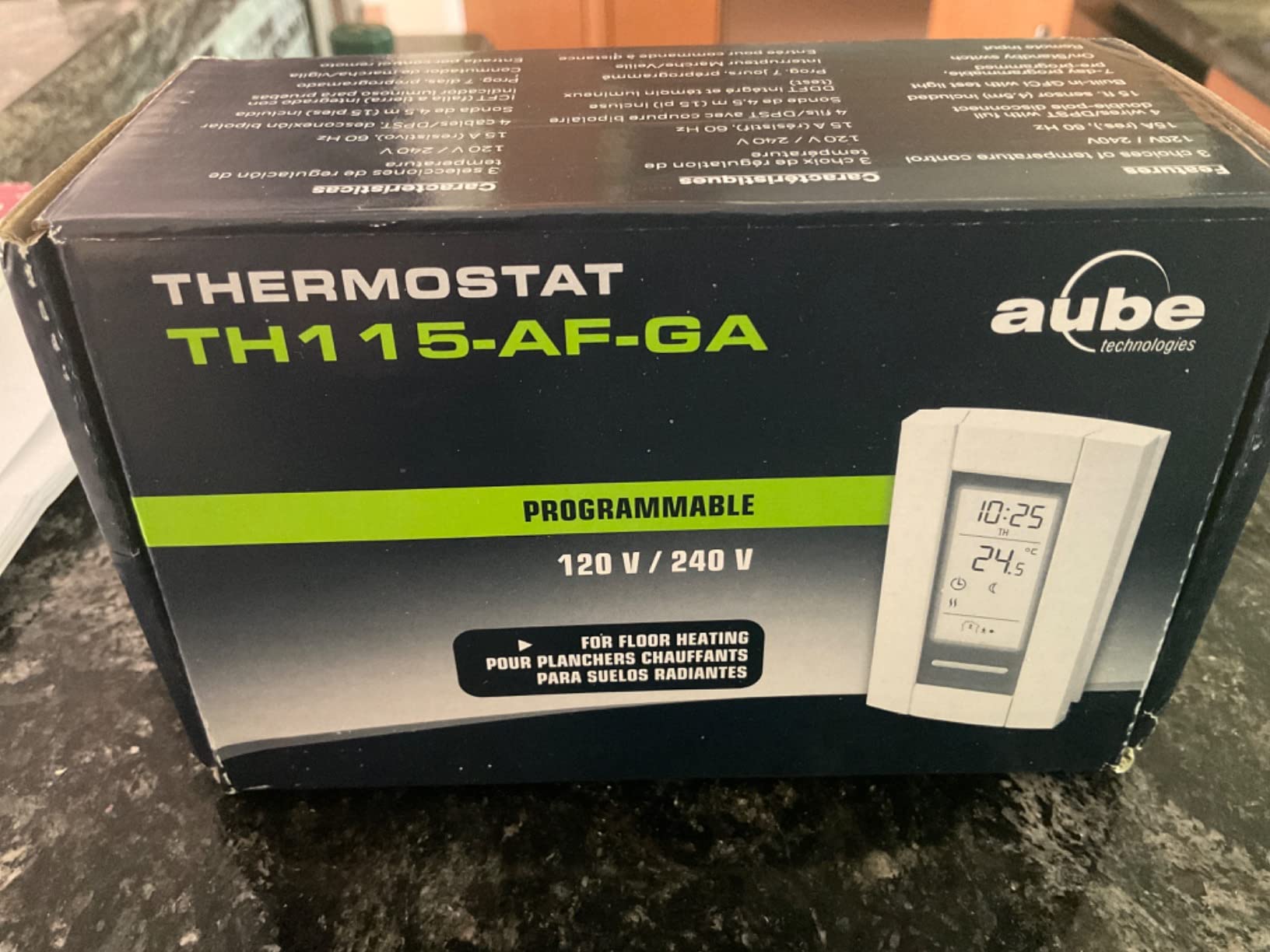
8. Honeywell TH115-AF-GA/U: Best for Radiant Ceilings and Floor Heat
Honeywell TH115-AF-GA/U Radiant Heating 120/240V Programmable Thermostat with Floor Sensor and GFCI
120V or 240V radiant
1.5 inch display
Floor or ambient sensing
Built-in GFCI
Pros
- Direct replacement for older radiant floor thermostats
- Bright backlit display
- Three sensing modes including a floor limit
- Simple intuitive programming
- Fixed a persistent GFCI tripping failure
Cons
- Relay life is limited and the unit is not serviceable
- Wiring labels disagree with the printed manual
- 24-hour clock mode shows Celsius only
- Some examples failed after six to seven years
Baseboard heat is not the only electric load, and this is the pick for radiant floors and radiant ceilings. It offers three control modes: ambient air temperature, floor temperature, or ambient with a floor temperature limit, and it works on 120V or 240V depending on how it is wired. The floor sensor is included, and a heat anticipator helps the schedule land closer to reality.
The built-in GFCI is a genuine safety addition for a floor system. Owners replacing older radiant thermostats report that it resolved a chronic GFCI tripping problem in their installation, and the bright backlit display is easy to read in a finished room.
Programming offers four events per day, and owners describe the process as simple and intuitive compared with the older radiant thermostats it replaces. The unit is UL and CSA listed, which matters when a local inspector looks at floor heating work.
Keep one documentation caveat in mind. The wiring labels printed on the unit itself do not always match the manual, so follow the manual and confirm the terminal assignments with a meter before energizing a floor circuit.
What to check before you order
Confirm you have a floor sensor in the mat or a compatible replacement, and verify the circuit voltage against your system. Radiant ceiling installations are a common use, and this model is described for both.
Check whether your installer needs a GFCI-protected circuit in the panel as well, since the built-in protection handles faults downstream but the panel breaker still matters.
Where it falls short
Durability is the main complaint. Owners report failures after roughly six to seven years of service, and because the relay is not a serviceable part, a failure usually means a replacement unit.
Setting the clock to the 24-hour format displays temperatures in Celsius only, which is an odd pairing for a North American installation, and examples are frequently branded Aube Technologies rather than Honeywell.
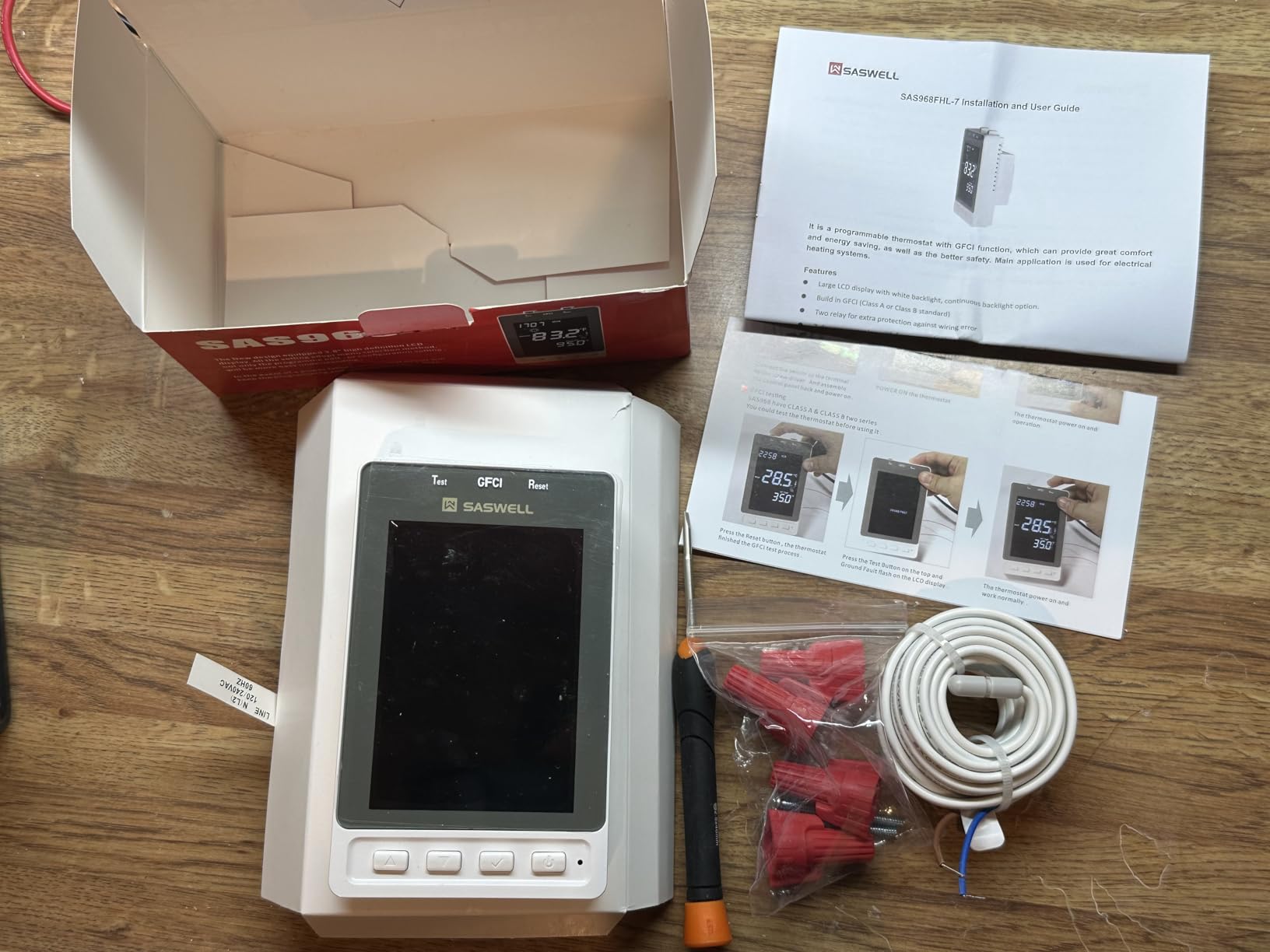
9. SASWELL SAS968FHL-7: Best for Non-Standard Floor Sensors
SASWELL Programmable Thermostat for Electric Floor Heating, Digital Thermostat for House, 120/240V 16A, Dual Mode, Built-in GFCI, Includes 10K NTC Sensor
120V and 240V floor heat
Maximum 16A
5+2 schedule
Built-in GFCI
Pros
- Works with both 120V and 240V floor circuits
- Accepts 10K 12K and 100K NTC sensors
- Built-in GFCI suits damp locations
- Floor temperature limit protects flooring
- 5+2 schedule with vacation mode
Cons
- Small review base with a high share of three-star ratings
- Setup takes some effort
- Interface and documentation details are thin
This is a niche pick with one genuinely useful advantage: sensor flexibility. It works with 10K, 12K and 100K NTC floor sensors, so it can adopt an existing radiant system whose probe is not the most common type instead of forcing a sensor replacement. It also handles both 120V and 240V floor heating circuits up to a 16A resistive load.
Control modes cover floor, room and dual sensing, and the built-in GFCI is a sensible addition in bathrooms and other damp locations where a floor mat is installed. Scheduling is a 5+2 split with separate weekday and weekend settings plus a vacation mode.
It is a touch-operated digital wall unit, and the feature coverage matches what a floor heating project needs. If you are working on residential or commercial floor heat and your probe type is unusual, this is one of the few options on the market that will accept it.
Being realistic about the evidence, the rating clusters at 4.1 with a high share of three-star reviews, and the review count is small. That means the feature set looks right on paper while long-term reliability data is thin.
What to check before you order
Confirm your floor sensor resistance value first, since the entire reason to choose this model is sensor compatibility. Then confirm the circuit is 120V or 240V and under a 16A resistive load.
Check that a touch interface suits the room. In a hallway or entry where hands are often cold or full, physical buttons are easier to hit.
Where it falls short
Setup takes effort according to buyer feedback, and documentation of the touch interface is limited, which can mean a longer install for a first-time floor heating project.
The small review base makes this a harder recommendation for a heating-only winter home than the established Honeywell models above. It is a feature-fit purchase, not a proven-endurance one.
10. QuietWarmth THERMPRO: Best for Larger Radiant Mat Areas
QuietWarmth Thermostat THERMPRO 7-Day Programmable Thermostat w/Built-in GFCI for Control of 120V or 240V Radiant Heat Includes Floor Sensor
120V and 240V radiant
Below 15A load
20A dedicated circuit
Floor sensor included
Pros
- Floor sensor and GFCI in one package
- Adaptive preheat calculates the ramp to setpoint
- Floor room or combined floor-limit control
- Handles 120V and 240V radiant systems
- Three year warranty
Cons
- Requires a dedicated 20A circuit with load under 15A
- Limited customer review volume
- Large mat areas can exceed the 15A limit
The THERMPRO is built around one idea that most floor thermostats ignore: knowing how long the floor takes to warm up. Its adaptive function calculates preheat time so the mat reaches the scheduled temperature at the scheduled moment, rather than arriving warm and then overshooting. For a slow-response radiant system, that is the difference between a comfortable floor and a cold morning.
It is a complete package, with the floor sensor and an integrated GFCI included, and it runs on either 120V or 240V radiant systems. The weekly schedule uses four events, Wake, Away, Home and Night, and control can be configured for floor temperature, room temperature, or room with a floor limit.
What to check before you order
This unit must sit on a dedicated 20A circuit, and the resistive load must stay under 15A. It supports up to 120 square feet of 120V mats or 240 square feet of 240V mats per thermostat, so larger areas need more than one unit.
It is CSA, ETL and UL listed with a three-year warranty, which is a solid sign for in-floor work that an inspector will look at.
Where it falls short
The dedicated circuit requirement is the significant one. If your radiant system is currently on a shared 15A circuit, this thermostat is not a drop-in replacement, and the electrical work falls outside a weekend swap.
Review volume is limited, so long-term reliability data is thin, and it costs more than a generic line-voltage thermostat. It is also primarily paired with QuietWarmth mats, which narrows who gets the most benefit.
Common Problems With Baseboard Heater Thermostats
Most baseboard thermostat complaints trace back to one of six failures. Here is what each one sounds like and what it usually means.
The room will not hold setpoint. A sticking bimetallic switch or a failed relay keeps the heater cycling past the target. A mechanical dial that has been in place for a decade is the usual culprit; replacing it with an electronic unit fixes this.
The display is blank or dead. On a two-wire model, this usually means the batteries are gone, as on the LUX ELV4. On a corded model it means the circuit is de-energized or the breaker has tripped.
The breaker trips when the heat kicks in. The thermostat’s amp rating is below the heater’s draw, or a relay is wired where a direct resistive load was expected. Check the nameplate watts against the contact rating before replacing anything.
The heater only runs when the dial is pushed well past the setpoint. That is a calibration failure, common on old mechanical controls. Digital models with a stated accuracy spec eliminate it.
The schedule is lost after a power outage. Some models have no backup at all, while models with battery-free backup or power-off memory restore the program. In a heating-only winter home, check this before buying.
The wrong thermostat was installed for the load. A 24V smart thermostat on a 240V baseboard will never work, and a single-pole unit on a double-pole circuit leaves one live leg energized on the heater at all times.
Worth noting that four of these six are compatibility problems, not defects. Running the 60-second check at the top of this article rules out most of them before a part is ordered. If a breaker keeps tripping on a correctly rated unit, that is an electrician conversation, not a thermostat shopping trip.
How to Choose a Programmable Thermostat for Electric Heat
Once compatibility is settled, four decisions narrow the list quickly.
Smart WiFi or fixed schedule. Smart models buy you remote shutoff, finer scheduling, energy reports and geofencing. Fixed-schedule models buy you reliability with no app to depend on. If the main goal is not forgetting to turn heat off before leaving, an app or timer is the entire decision, and a mid-range programmable unit does it. Our energy savings thermostat guide covers how much scheduling depth is actually worth paying for.
Hub required or not. Some ecosystems gate a thermostat behind a gateway purchase. Hub-free units such as the Mysa and the meross MTS200 talk to Alexa, Google Assistant or Apple HomeKit directly, which is why advanced users on Home Assistant community threads consistently favor them. If your automation is local-first, a hub-gated device is often the dealbreaker that ends the search.
Single-pole or double-pole. A single-pole line-voltage thermostat switches one leg and leaves the other live on the heater. For 240V baseboards, a double-pole model disconnects both legs, which is the safer and often code-required choice.
How many zones you are covering. Each heated room needs its own thermostat, and most homeowners replace two to four at a time. Plan for a room count rather than a device count, and check whether any rooms need a second circuit before ordering.
Installation boundary: swapping a like-for-like line-voltage thermostat in an existing box is straightforward for anyone comfortable with basic wiring. Running a new neutral, converting a single-pole circuit to double-pole, or adding a dedicated 20A circuit for radiant floor heat is electrician work. Our electric heater buying guide covers the equipment side of those projects.
Frequently Asked Questions
Do baseboard heaters need a special thermostat?
Can you use a smart thermostat with electric baseboard heat?
What are the common problems with baseboard heater thermostats?
What is a good 240V thermostat for baseboard heat?
How many thermostats do I need for baseboard heat?
Do Nest or ecobee work with electric baseboard heaters?
Which Programmable Thermostat for Electric Heat Should You Buy?
Start with the wire count, not the brand. Four wires and a 240V baseboard, you want the Mysa Smart Thermostat V2 for app control, energy tracking and hub-free smart home support. Two wires, you want the Honeywell RLV4305A1000 for a clean 240V swap or the Honeywell TL8230A1003 if you want a full seven-day schedule. A 4000W baseboard, go straight to the Aube TH106 for the headroom and outage memory.
For floor or ceiling radiant heat, the Honeywell TH115-AF-GA/U handles most rooms with a floor sensor, and the QuietWarmth THERMPRO earns its place when you can dedicate a 20A circuit to larger mat areas. Whichever you choose, this guide to the best electric appliance upgrades for your home can help you plan the rest of the electrical work the room needs.
Check the compatibility list in the first few hundred words of this article before you buy, and the odds of a return drop to almost nothing.