
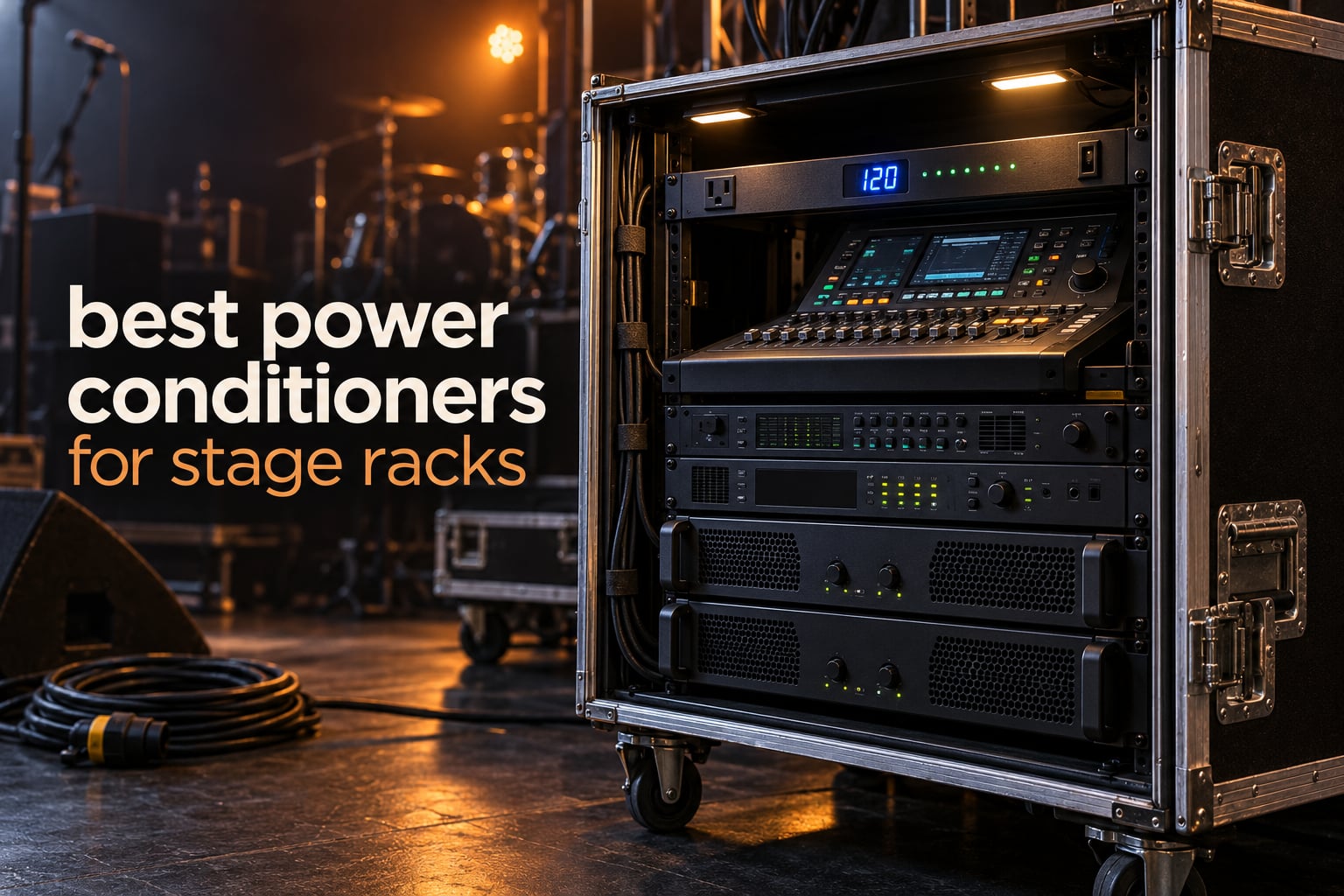
If you only fit one unit in the rack, the Furman PL-8C Classic is the safest choice for most stage racks, with 15 amps, nine outlets in isolated banks and two retractable rack lights. For racks that need amps to come up last, the Monoprice 15 amp three-zone sequencer is the pick. Amp-heavy racks want the MICNAUX 20A unit. That is the short answer, and the ten reviews below explain why each one earned its place.
Stage power is the noisiest power a rig will ever see. Generators, LED dimmers, dimmer boards and backline amps sharing the same circuit all inject noise and voltage events into the same conductors your console, DSP and amplifiers are hanging off. Long cable runs from the stage box make it worse. A rack mount power conditioner sits between the venue wall and everything else, clamping transients, filtering EMI and RFI, and in many cases sequencing outlets so nothing thumps.
We spent 2026 reading spec sheets, owner reviews and forum threads from touring engineers, church techs and system techs, then narrowed a crowded category down to ten units that genuinely fit a 19-inch case. Nothing here needs a bench. Every pick is 1U, rated for North American mains, and has enough documentation to justify putting your show on it. If you are also building out the stage, our picks for stage lighting systems for live bands and keyboard stands for stage performers cover the rest of the package.
Table of Contents
What Is the Best Rack Power Conditioner?
The best rack power conditioner for most stage racks is the Furman PL-8C Classic: 15 amps, nine outlets across isolated banks, SMP/LiFT/EVS protection and two pull-out LED rack lights in a single 1U. Racks that need sequencing should look at the Monoprice 15A three-zone unit instead, and amplifier-heavy backline racks need the 20A MICNAUX sequencer.
Top 3 Power Conditioners for Stage Racks in 2026
These three cover the majority of real racks: a general-purpose touring unit, a sequencing unit for a full signal chain, and a high-current unit for amp backline.

All 10 Stage Rack Conditioners at a Glance
Every unit below is a single rack unit with North American mains. The table covers the whole list so you can size it against your rack before reading the detail.
| Product | Specifications | Action |
|---|---|---|
| Furman PL-8C Classic |
|
Check Latest Price |
 Monoprice 15A 3-Zone Sequencer Monoprice 15A 3-Zone Sequencer |
|
Check Latest Price |
| Black Lion Audio PG-X |
|
Check Latest Price |
 MICNAUX 20A Sequencer MICNAUX 20A Sequencer |
|
Check Latest Price |
 STABCL ST-368 STABCL ST-368 |
|
Check Latest Price |
 SENWOSI SW-Epsilon SENWOSI SW-Epsilon |
|
Check Latest Price |
 Pyle PCO875 Sequencer Pyle PCO875 Sequencer |
|
Check Latest Price |
 FULODE FL-1000 FULODE FL-1000 |
|
Check Latest Price |
 Pyle PCO850.5 Pyle PCO850.5 |
|
Check Latest Price |
 WAudio W-3800 WAudio W-3800 |
|
Check Latest Price |
1. Furman PL-8C Classic 15A Power Conditioner for Touring Racks
Furman PL-8C Classic 15A Power Conditioner, 9 Outlets & LED Rack Lights
15A 15 amps
9 outlets in isolated banks
Dual retractable LED rack lights
1U rackmount
Pros
- SMP/LiFT/EVS protection in a 1U body
- Two dimmable pull-out rack lights for dark stages
- Isolated outlet banks separate digital from analog gear
- Magnetic resettable breaker
- 5-yr limited warranty
Cons
- No integrated sequencer
- Heaviest unit here at 8 lb
The PL-8C is the unit I put in a rack first when nothing else is specified. It has been the reference 1U conditioner in pro audio for years, and the reason is simple: it protects well, it filters well, and the two retractable lights are worth more on a dark stage than most people expect before they carry a case into a club at two in the morning.
Nine outlets sit across two isolated rear banks plus one front convenience outlet. That separation is the part that matters acoustically: digital gear like a DSP or a wireless receiver goes on one bank, analog outboard on the other, and the switching transients stay contained. The 15 amp rating with a magnetic resettable breaker covers a FOH rack with a console, DSP, wireless rack and monitor controller without breaking a sweat.
Protection is the SMP/LiFT/EVS stack, which combines series multi-stage protection, linear filtering and extreme voltage shutdown. In plain terms it clamps surges, filters line noise and cuts out rather than passing through voltage it considers unsafe. The enclosure is stainless steel and the whole thing weighs 8 lb with a 10 ft cord, which is a lot of mass for 1U but exactly what you want on a case that gets loaded in every night.
How the PL-8C handles amps and backline
It does not sequence. Every outlet comes up at once when you hit the switch, so a power amp in the same rack as a sensitive console will still produce a thump on power-up unless you sequence it downstream with a separate unit. Plenty of engineers accept that and use a wall switch during load-in.
If thumps are the issue, run the PL-8C for the console and DSP and put a sequencing unit ahead of the amplifier rack instead. That is also why it pairs well with the Monoprice unit below.
Where it falls short on a touring rig
Eight pounds is a lot of mass for a single 1U slot, so it eats into your case weight budget more than the alternatives. There is no USB charging, no remote trigger port and no LCD voltage readout, so you are checking supply health by ear or by a separate meter.
It is also the priciest unit here, and at 363 reviews it carries one of the larger review bases in the group, which tells you plenty of people agree with the choice.
2. Monoprice 15A Power Conditioner and Sequencer for Full Signal Chains
Monoprice 15 Amp Power Conditioner and Sequencer – 8 Outlets, 3 Zones, 1U Rack Mount, Black – Stage Right
15A 15 amps
8 outlets across 3 sequential zones
Sequential on and reverse off
1U rack mount
Pros
- Removes amp and speaker thumps on power-up and shutdown
- Three well-separated zones sequence a whole signal chain
- Runs silent with no added hum
- Metal build with a solid front-panel button
Cons
- No relay port for an external remote
- Final zone carries only two outlets
This is the pick when your problem is thumps. It is a 15 amp conditioner and sequencer with eight outlets split across three zones, and it powers up in sequence and shuts down in reverse, which means amps come up last and go off first without you thinking about it.
That ordering matters more than most buyers realise. A power amplifier dumping its rail capacitance into a passive crossover at switch-on is the single most common cause of the crack at the start of a show. Three zones let you put DSP and console on the first, wireless and outboard on the second, amplifiers on the third.
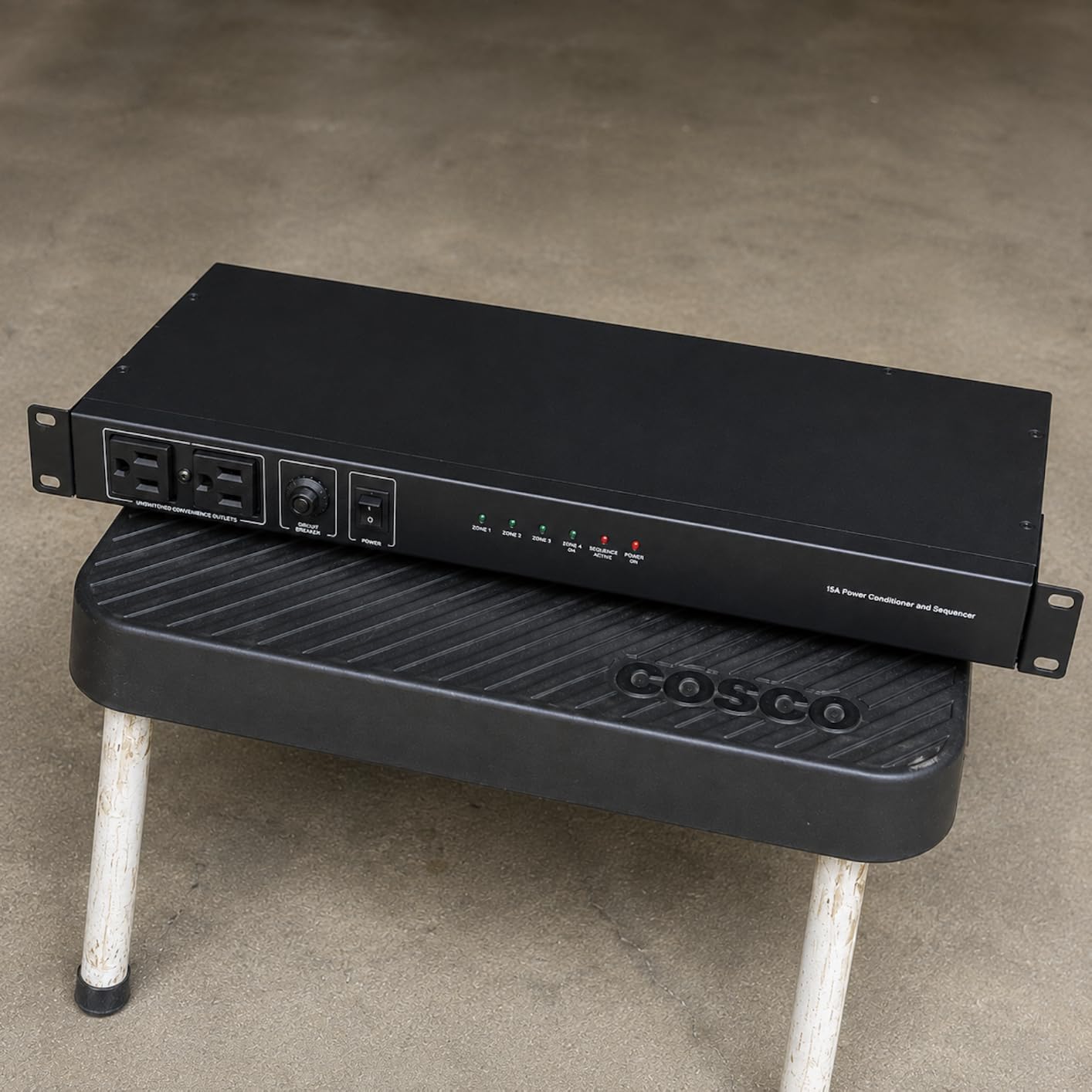
The church and small-install owners dominate the reviews, and the recurring note is that it replaces far more expensive units for basic sequencing while adding no hum of its own. At 66 reviews and 4.7 stars, that is a solid record for a 1U metal chassis that weighs 7 lb.
Zone layout and where amps should land
Check your zone count before you plan the rack. The last zone only carries two outlets, so a three-amp backline will not fit entirely in the amplifier zone and one amp ends up on an earlier zone.
Plan for that by counting amps per zone first, then filling the front of the chain. If you need more than two amps in the final stage, the MICNAUX unit further down gives you eight individually switched rear outlets instead of a fixed zone map.
What you give up compared with a full conditioner
There is no remote trigger port, which matters in locked PA cabinets where you want to power a rack from a wall panel outside the cage. Front outlets are unswitched with no dedicated switch, and the outer case hardware is described as rough by owners.
Filtering here is solid but not the multi-stage filtering you get from a dedicated filtration-first conditioner. If your venue has genuinely dirty power and you want the strongest noise rejection, look at the Black Lion Audio unit instead.
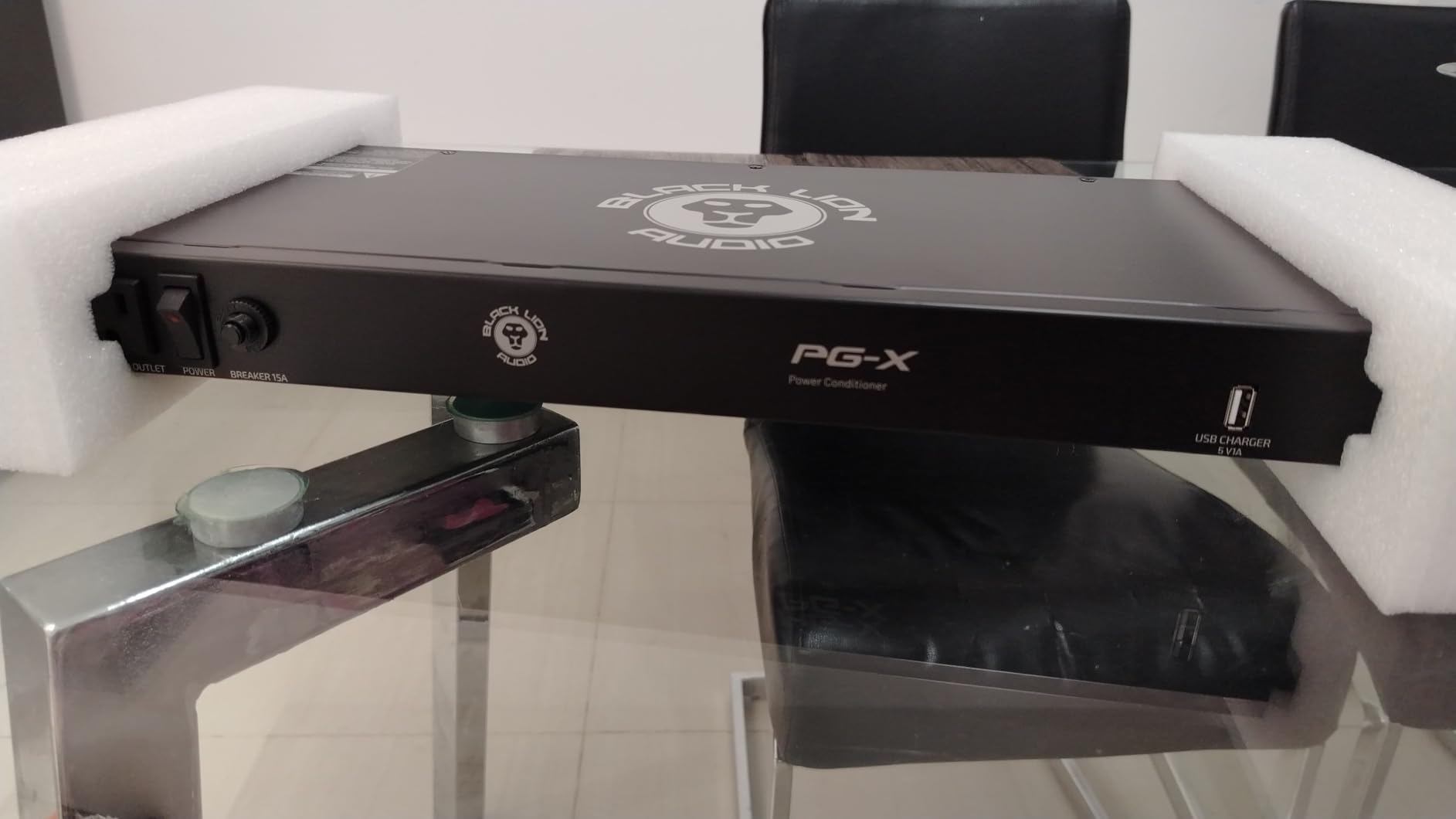
3. Black Lion Audio PG-X Rackmount Power Conditioner for Noisy Circuits
Black Lion Audio PG-X Rackmount Power Conditioner
PG-90 filtering with Panasonic Wima capacitors
8 rear outlets plus 1 front
Stainless steel, 7.7 lb
Pros
- PG-90 filtering measurably reduces 60Hz hum
- Handles high-current loads such as two Crown XTi2002 amplifiers
- Extra rear outlet spacing for bulky AC adapters
- Stainless steel construction
Cons
- No sequencing
- Front USB port reported non-functional on some units
- Small 29-review base
The PG-X is the filtration-first pick. It uses PG-90 filtering built around Panasonic Wima film capacitors, and owners running it in mobile live rigs and studios report the 60Hz hum simply disappearing from their monitors rather than being reduced a little.
Nine outlets total: eight on the rear and one on the front. Rear spacing is generous, which matters more than it sounds when you are trying to fit wall wart power supplies behind a rack instead of hanging them off the sides.
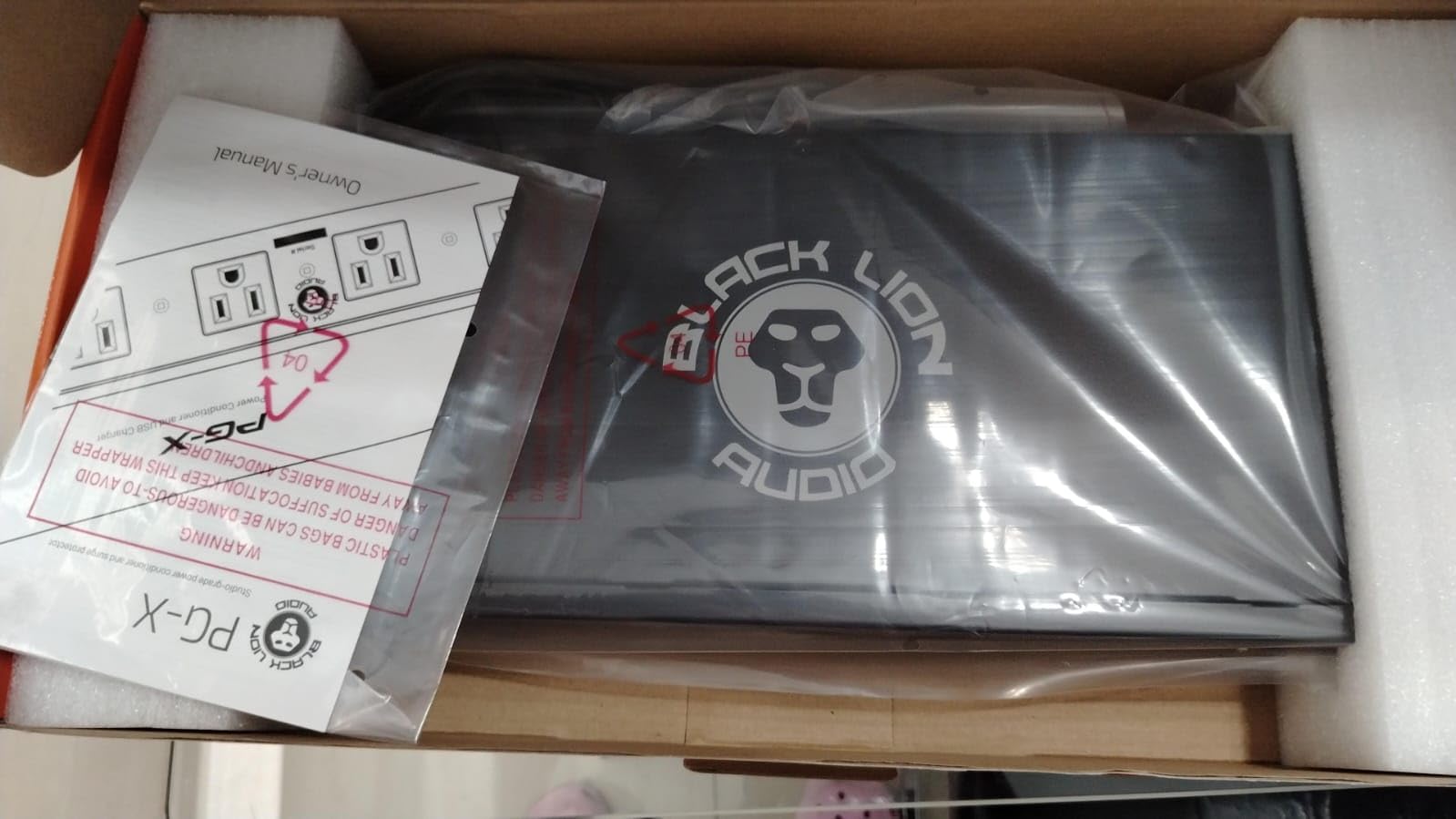
The stainless steel chassis weighs 7.7 lb and carries a 2-year warranty. One owner reports it handling two Crown XTi2002 amplifiers without complaint, which is a useful data point because those are among the hungriest amp loads you will ever put in a rack.
When PG-90 filtering earns its rack space
If your venue runs backline, LED dimmers and console off the same circuit, filtering capacity is worth more than outlet count. Long dimmer cable runs are the classic source of nasty buzz, and the units that lean hardest on film capacitor filtering are the ones that pull that buzz down.
The trade-off is that all nine outlets are live the moment you hit the switch. For a rack where hum is the enemy and sequencing is not, that is the right way round.
Weaknesses to plan around
The most repeated complaint is a front USB port that does not charge on some units, so do not plan your phone charging around it. The 29-review base is also the second thinnest in this roundup, which limits how much long-term field history you are buying.
There is no sequencer and no voltage metering, so you still cannot tell from the front panel whether the supply is healthy until something fails.
4. MICNAUX 20A Sequencer for High-Current Amp Racks
MICNAUX Rack Mount Power Conditioner 20A Sequencer for Audio Equipment, 10 Outlets 2000W Power Supply with 8 Independent Controls, Surge Protector, Voltage Display, External Switch
20A 20 amps and 2000W
8 switched rear outlets
2P surge and on/off sequencing
LCD voltage monitor
Pros
- Sequence order prevents loud speaker thumps on power-up
- 30A switching relays on a full-sized DIN-rail surge stage
- Voltage readings verified accurate against a bench meter
- Dry-contact remote trigger accepts a standard toggle
- Bypass mode for when the unit misbehaves
Cons
- LED indicators very bright with no dimming
- Universal sockets too closely spaced for UK three-pin plugs
This is the amp-rack answer. Twenty amps at 2000W with eight independently switched rear outlets means a backline of four or five amplifiers has room and headroom, and each amp gets its own switch and its own front-panel indicator.
Two always-on front outlets sit apart from the switched bank, which is exactly what you want for the DSP and any wireless receiver that should not lose power when you kill the amps.
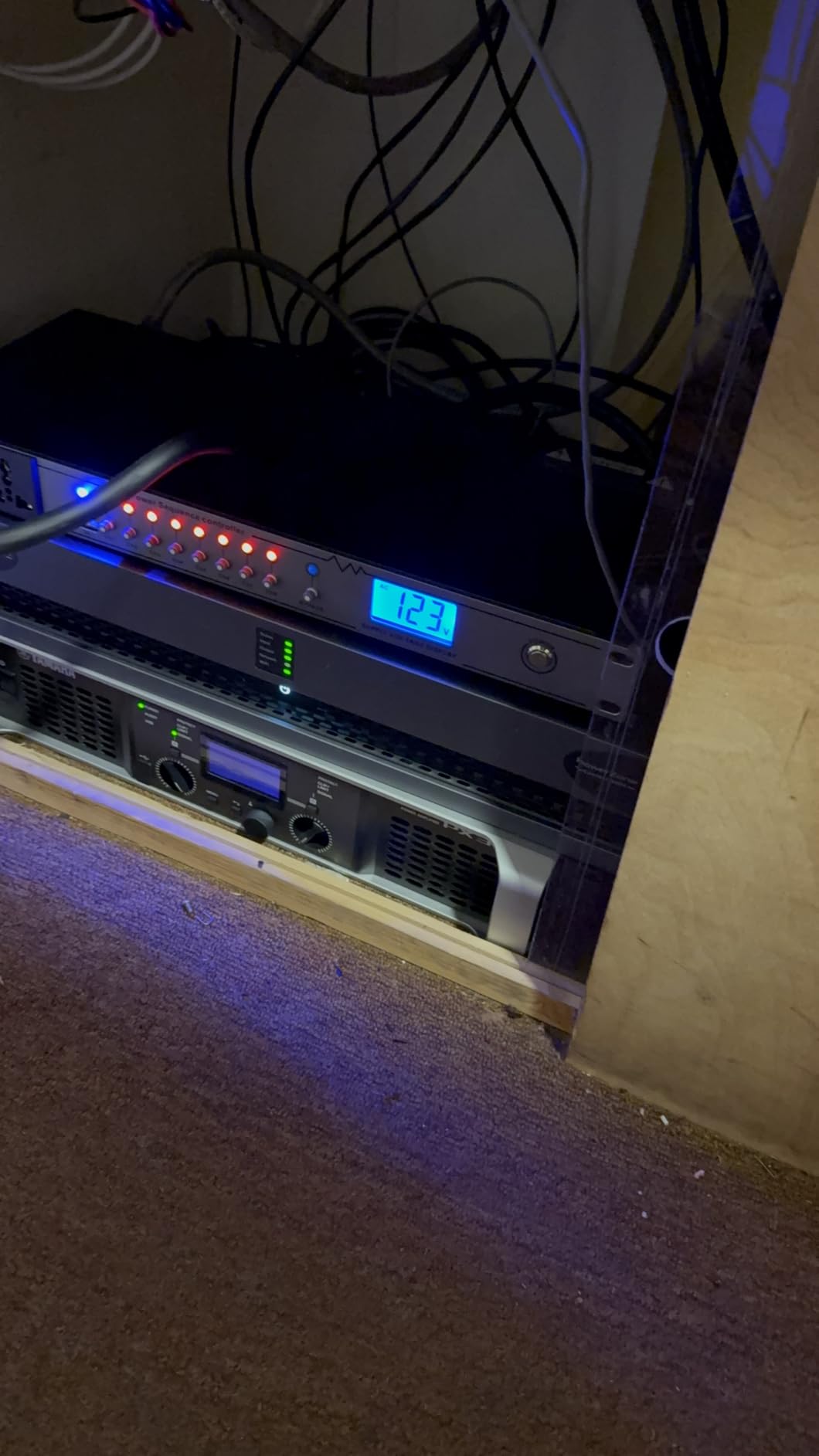
Inside, owners describe a full-sized DIN-rail surge protector with status windows and 30A switching relays, and one buyer verified the voltage readings against a bench multimeter. That internal build quality at this level of pricing is the reason US reviewers rate it so highly.
Remote triggering and bypass mode
The external dry-contact remote switch accepts a standard on/off toggle, which lets you sequence a locked amp rack from a wall panel or from a DSP relay output. Bypass mode passes power straight through, so if the unit ever misbehaves you are not locked out of your rack.
For a touring backline that is a genuinely useful pair of features, and neither is common at 1U.
What UK and European crews should check
US owners and UK owners disagree sharply about the universal receptacles. The sockets are spaced too closely for UK three-pin mains plugs, so this is a North American show-box unit unless your plugs are two-pin.
The other recurring complaint is that the LED indicators are extremely bright with no dimming option, which is unpleasant on a dark stage facing the FOH position.
5. STABCL ST-368 Power Conditioner and Sequencer for Modern Racks
STABCL Professional 10 Socket Power Conditioner/Surge Sequencer with USB and Type-C Charger.3300W Rack Mount Audio Power Supply Controller, Surge Protector, for Audio product, electronic equipment
3300W output
10A per channel, 30A max output
10 sockets with 8 rear plus 2 front
USB and Type-C charging, HD LCD monitor
Pros
- High per-channel current headroom at 10 amps
- USB and Type-C charging on the front panel
- HD LCD readout plus 8-channel LED status
- Aluminium alloy panel over a metal 1U chassis
Cons
- Sequence delay not user-adjustable
- Universal sockets may not suit high-power figures
The ST-368 is one of the newest listings in this group, and it is built around charging. Front-panel USB and Type-C ports sit alongside an HD LCD voltage monitor, which is the combination most current FOH and DJ racks actually want.
Output is rated at 3300W with 10 amps per channel and 30 amps maximum, feeding ten universal sockets: eight rear and two normally-open front. A one-key sequential master switch handles the ramp, with per-channel switches underneath for individual control.
The 1U chassis is metal with a high-strength aluminium alloy front panel and tips the scales at 8.63 lb. That weight is on the heavy side for 1U, so factor it into your case budget if you are already near a weight limit.
Charging and metering in a dark stage environment
The Type-C port matters more than it would in a studio. A wireless tech or a monitor engineer can top up a phone or tablet from the rack instead of hunting for a wall outlet, and the HD LCD gives a quick confirmation that the venue supply is behaving.
Eight-channel LED status indicators let you see at a glance which channel is up, which is genuinely useful during a fast line check.
Limits on a newer listing
Sequence delay is not user-adjustable, so slow-booting network gear in the rack may not get the gap it needs. Universal sockets can also confuse circuit testers and may not suit very high-power figures.
At 34 reviews the field history is still thin, and buyers cite the LCD and the USB-C charging as the main draws rather than the filtering.
6. SENWOSI SW-Epsilon Conditioner for Church and Worship Racks
SENWOSI SW-Epsilon 10 Socket Power Conditioner/Surge Sequencer USB Type-C/Type-A Charger
15A 15 amps and 1800W
10 outlets with 8 switched rear plus 2 unswitched front
RFI and EMI noise filtering
LCD voltmeter and USB Type-C or Type-A charger
Pros
- Holds a strong position in the Power Conditioners category
- External switch is easy to wire for remote control
- Ample outlet count for karaoke and DJ racks
- LCD voltage display for at-a-glance rack health
Cons
- Power cord is only about 2 ft
- Sequence delay appears short for slow-booting devices
- No amperage readout despite the LCD
Fixed-install racks have a different constraint from touring ones: you are not moving the case, and the wall outlet is wherever it is. The SW-Epsilon is popular with church and DJ racks for that reason, and it sits near the top of the category ranking for Power Conditioners.
Ten outlets, eight switched on the rear and two unswitched on the front, at 15 amps and 1800W across 100-240VAC. AC noise filtering handles both RFI and EMI, and a large LCD gives real-time voltage monitoring with an eight-channel LED status indicator on the rear.
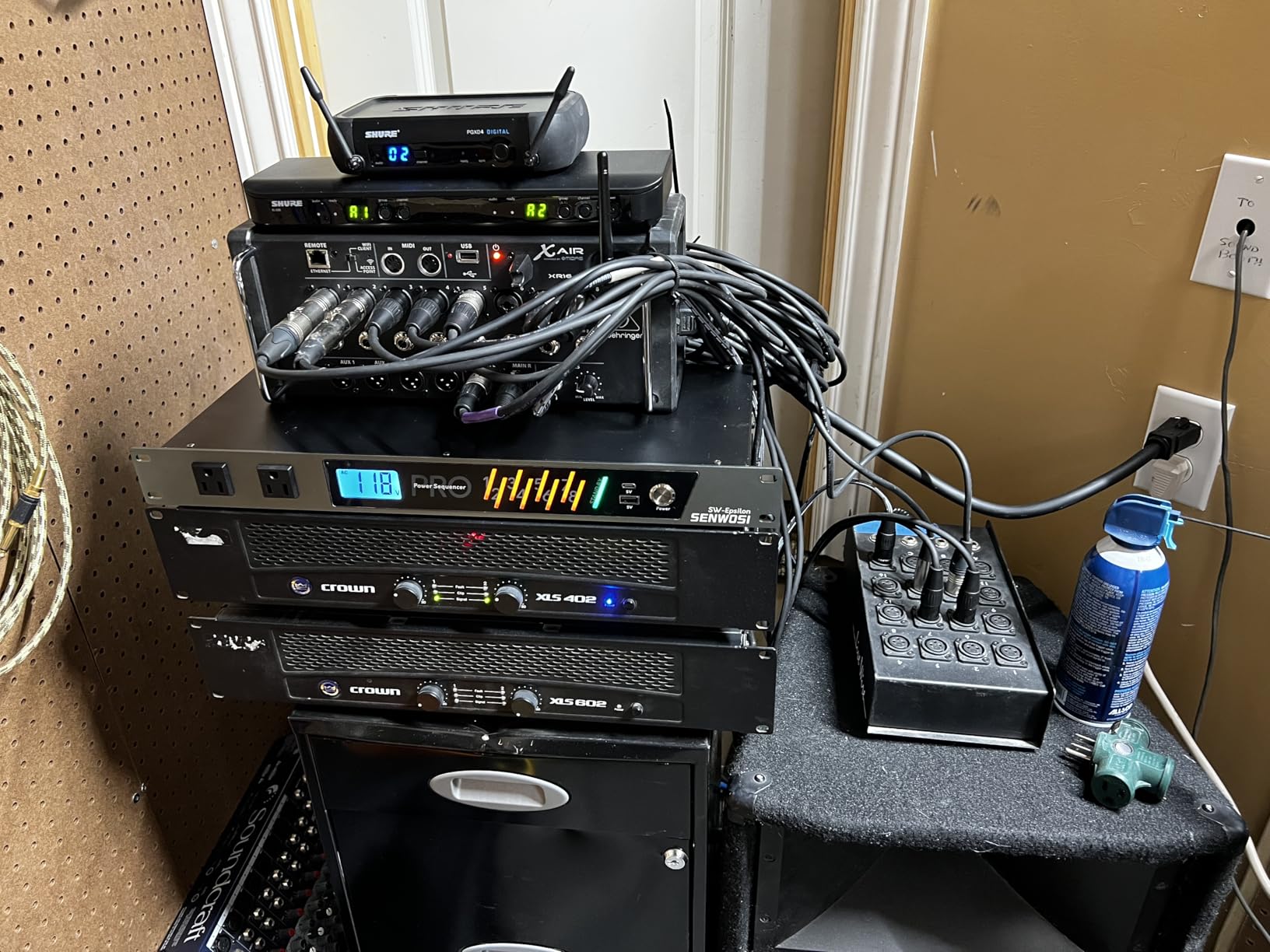
The metal case has an aluminium alloy front panel and the whole unit weighs 6.39 lb. At 96 reviews and 4.4 stars, the sentiment is consistently positive about build quality and value for church and karaoke racks.
Remote control and fixed-install wiring
The external switch is straightforward to wire for remote control, which is how this unit is normally used: one switch on the wall of the booth, the rack itself out of sight. The two unswitched front outlets let you keep a mixer or a media player live while you cycle everything else.
For a permanent install that behaviour is more useful than it is for a tour, where you would rather have every outlet switchable.
The cord and the timing
The power cord is only about 2 ft, which limits how far the rack can sit from the wall outlet. Plan your cable path before you commit, because you may need an extension that is itself a piece of unconditioned cable.
Several buyers also found the sequence delay too short for devices with long boot times, such as networked DSP. The 96-review record is solid, but those two complaints come up repeatedly.
7. Pyle PCO875 13A Sequencer for Budget-Conscious Stage Racks
Pyle 10 Outlet Power Sequencer Conditioner – 13 Amp 2000W Rack Mount Pro Audio Digital Power Supply Controller Regulator w/Voltage Readout, Surge Protector, for Home Theater Stage/Studio Use – PCO875
13A 13 amps and 2000W
10 outlets with 8 rear plus 2 front always-on
Digital LCD voltage readout
1U metal housing, 6 lb
Pros
- Ten outlets in a single 1U space with a front always-on pair
- Digital LCD voltage readout monitors rack power health
- 2000W and 13A suits full signal chains
- USB port for charging external devices
Cons
- One-button operation means no adjustable sequence delay
- Front USB charging output not fully documented
- Only a 1-year warranty
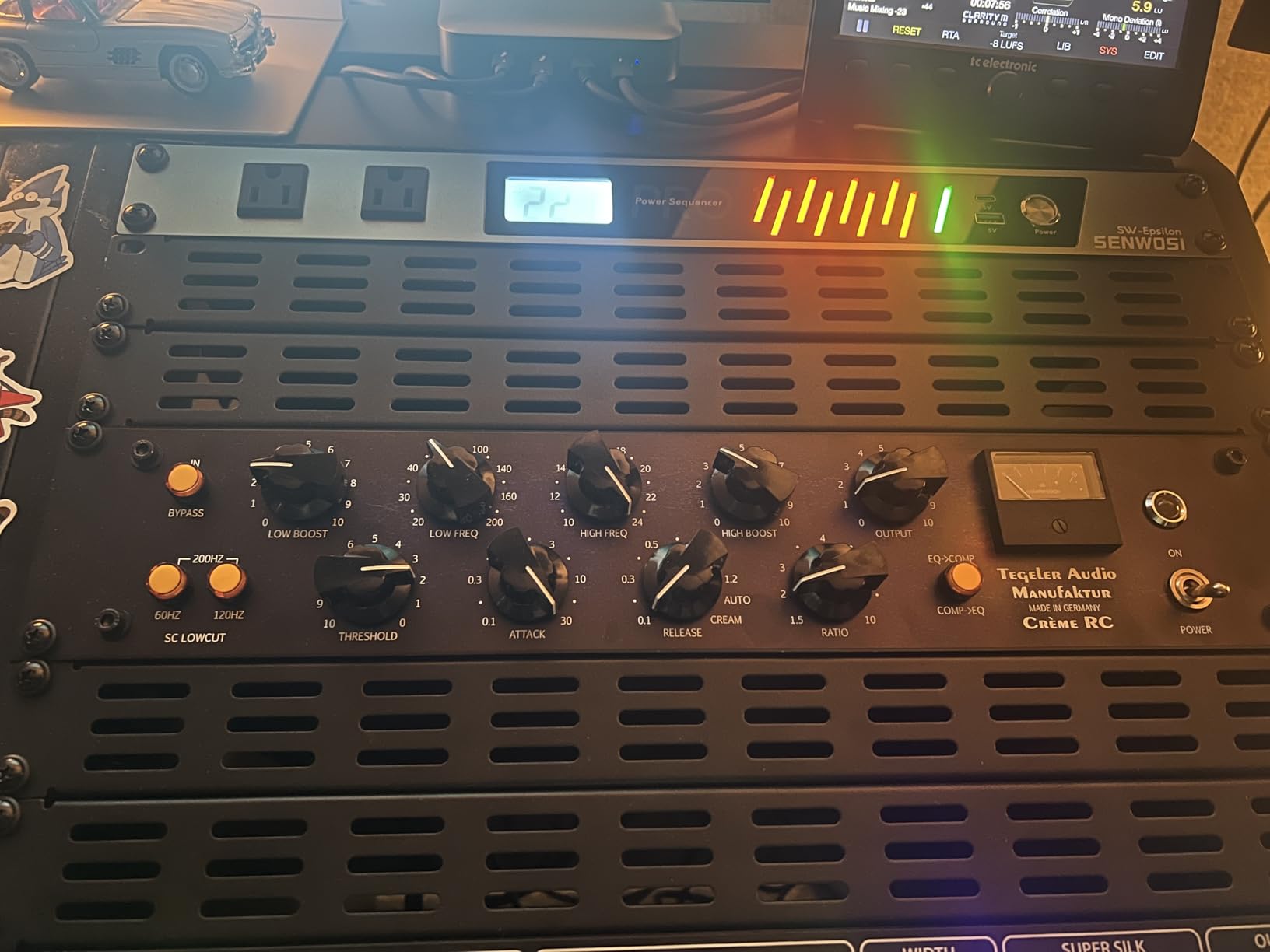
The PCO875 has the largest review base of any unit here at 418, and the rating sits at 4.4 with 76 percent of ratings at five stars. It is a 2000W, 13 amp sequencer with ten outlets, so you get sequencing and outlet count in one rack unit without paying for a premium brand badge.
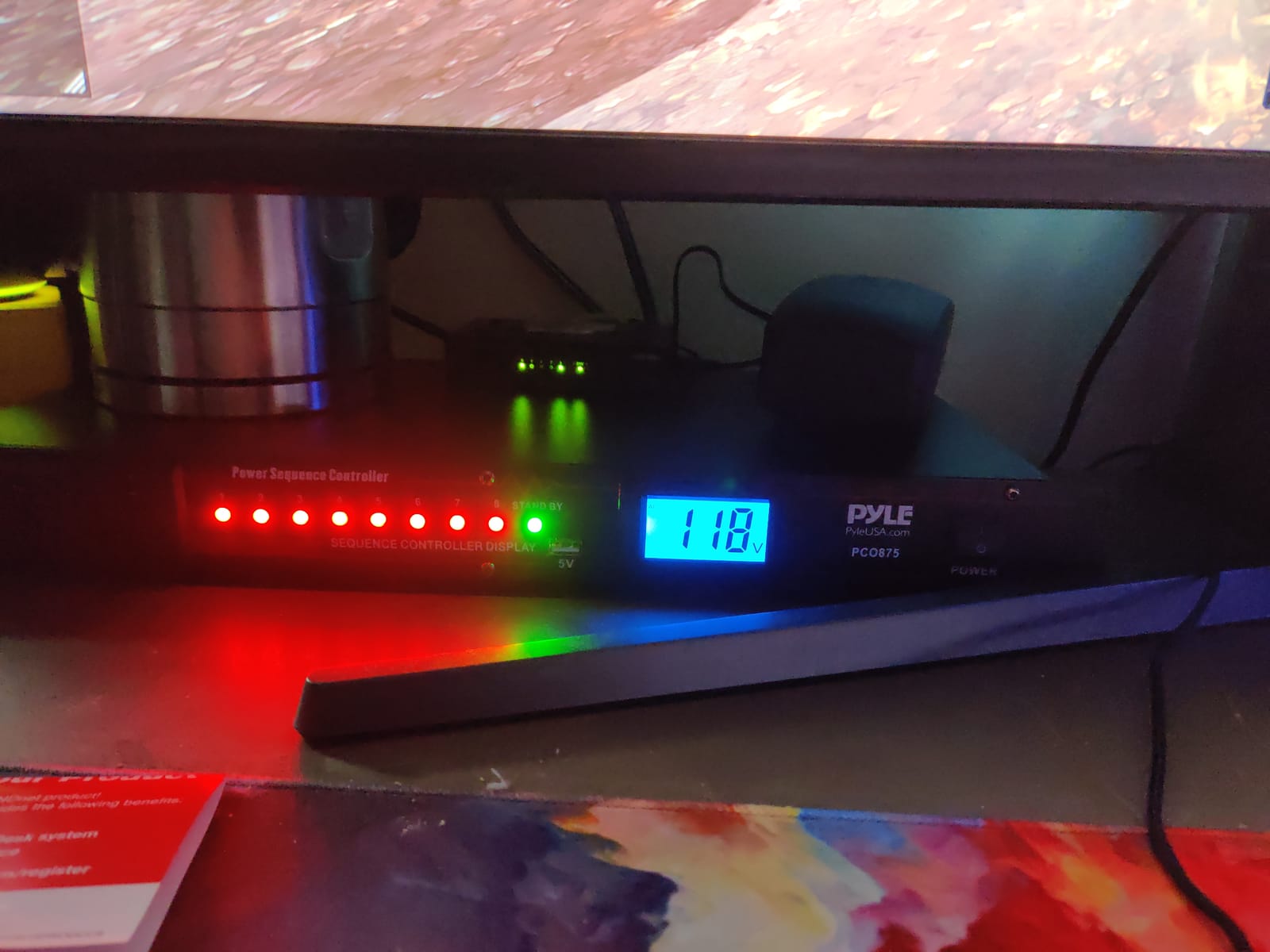
Eight outlets are on the rear and two always-on outlets sit on the front. One-button operation from the front panel handles the sequence, and there is a USB port for charging plus a digital LCD display showing voltage.
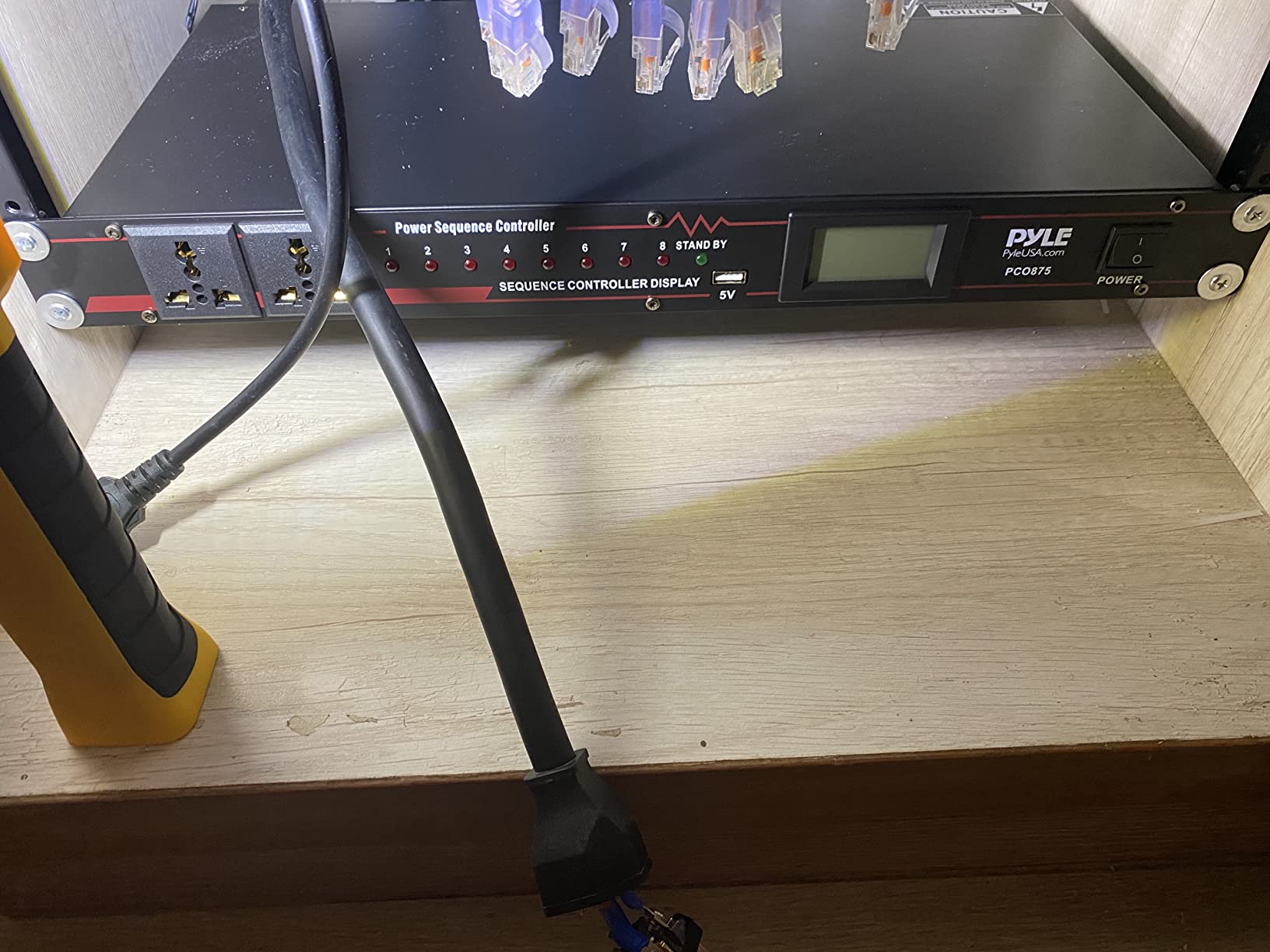
The housing is a single 1U metal chassis at 18.9 by 8.3 by 1.9 inches and 6 lb, with a one-year warranty. Pros in the forums dismiss budget power gear as cheap plastic, but the review volume here suggests this particular unit earns its place in a small rack.
When one-button sequencing is enough
If your signal chain powers up and down as a single block and you never need per-outlet control, one-button sequencing is genuinely adequate. The LCD readout lets you confirm supply voltage quickly, and the front always-on pair is useful for anything that should survive a power cycle.
The 2000W and 13 amp rating covers a FOH rack or a small backline without straining, as long as you are not doubling up amplifiers.
Where the compromise shows
Because it is one-button operation, the sequence delay is fixed and you cannot give slow-booting DSP more time before the amps come up. The front USB charging output is not specified in detail, so do not rely on it for a critical device.
The one-year warranty is the shortest here, which is the main reason to consider alternatives if your rack carries expensive gear.
8. FULODE FL-1000 Entry Sequencer for Fixed Racks
FULODE Power Conditioner Rack Mount for Audio Equipment DJ Power Sequencer
2000W output
10 sockets with 8 rear plus 2 front always-on
Large LCD real-time voltmeter
1U metal housing with aluminium panel
Pros
- Ten sockets plus a USB port in an affordable 1U unit
- LCD voltmeter confirms supply voltage quickly
- Aluminium panel and metal housing feel more substantial than the price suggests
- 2-year manufacturer warranty
Cons
- Lowest review base among the mainstream sequencers
- Average 4.2 stars signals some disappointment
- Universal receptacles may not accept high-draw figures
The FL-1000 is the simple answer for a permanent rack that never leaves the building. It is a 2000W sequence controller with ten sockets, eight on the rear and two always-on on the front, in a 1U metal housing with an aluminium front panel and a two-year warranty.
A large LCD gives real-time voltage monitoring, which is the feature most worth having in a church or theatre booth where nobody is thinking about power. There is a front USB power interface, and built-in surge overload protection covers the basics.
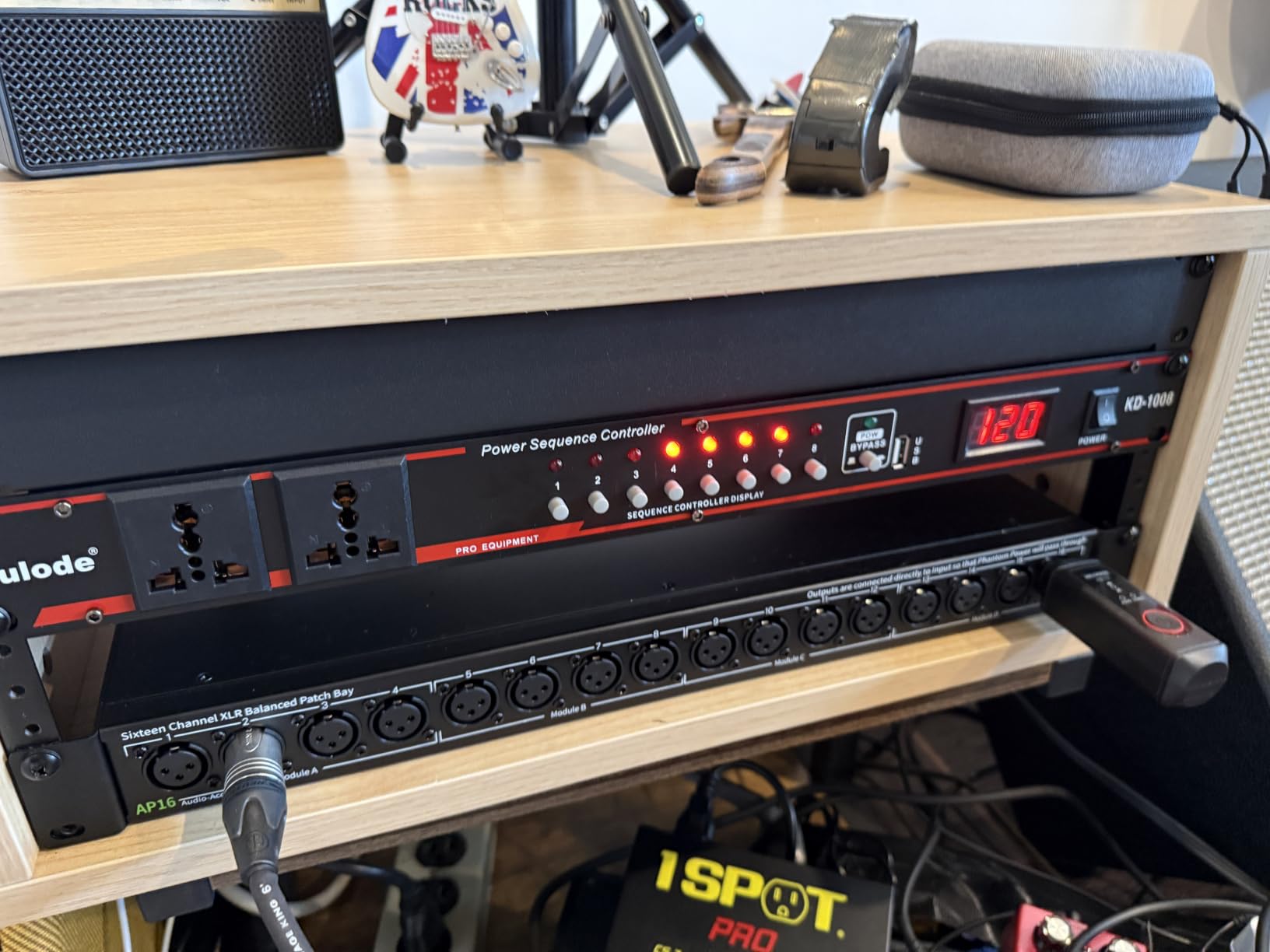
Feedback centres on the useful LCD and the outlet count, with some reservations about overall finish. At 39 reviews and 4.2 stars it sits lower in the ratings than the mainstream sequencers here, and 69 percent of ratings are at five stars.
When a fixed rack needs nothing more
If your amp rack is bolted into a booth and powered from a single clean circuit, ten sockets and a voltmeter cover most situations. The 1U form factor with an aluminium panel looks tidier next to pro gear than the plastic units people get used to.
The two-year warranty is longer than several better-reviewed units offer, which matters when the rack is not being serviced between shows.
Reasons to step up a tier
Universal receptacles may not accept high-draw figures reliably, and that is exactly the case where you least want a socket to fail mid-show. The 4.2 star average also points to some build or noise-filtering disappointment that owners mention directly.
If you are powering anything hungrier than a mixer and two amps, the higher-current units further down the list are the safer buy.
9. Pyle PCO850.5 Compact Conditioner for Small Signal Chains
Pyle 1U Rack Mount Power Conditioner – 7 Outlet Surge Protector
10A 10 amps
7 outlets with 6 rear plus 1 front convenience
Built-in RFI and EMI AC noise filter
Push-to-reset breaker, 1U aluminium panel
Pros
- Genuine 1U chassis with an aluminium front panel and steel body
- Push-to-reset breaker means no fuse changes
- Front convenience outlet plus six rear outlets
- Surge and spike protection included
Cons
- Lowest rating in the group at 4.1 stars
- Only 10A capacity limits headroom for multiple amps
- No sequencing
- metering or USB charging
- Only a 1-year warranty
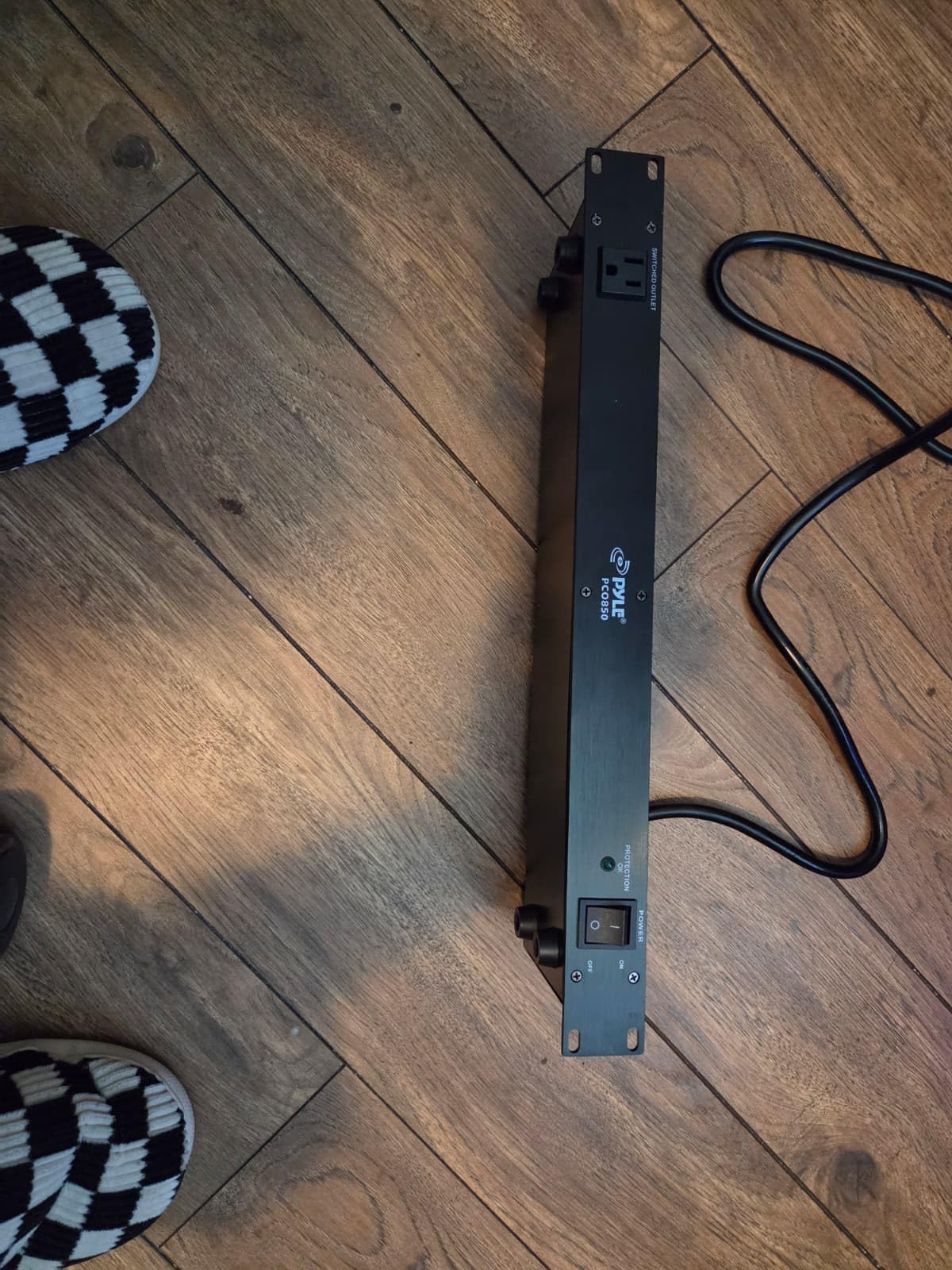
The PCO850.5 is the smallest scope in this roundup: seven outlets, six rear and one front convenience outlet, with a built-in AC noise filter for RFI and EMI plus surge and spike protection. If your signal chain is a mixer, a wireless receiver and a small amp, that is enough.
The 1U rack-mountable front panel is aluminium over a steel chassis in matte black, and the 10 amp push-to-reset breaker means nobody is changing a fuse in the dark between sets.
Where it struggles is capacity. Ten amps sounds generous until you add a second amplifier, at which point inrush on switch-on is a real concern and forum complaints about cheap 5 amp units tripping under amp inrush apply here in milder form.
What a 10 amp conditioner actually covers
Ten amps is fine for a small FOH position: console, wireless rack, a compact amp or two. It is not the number you want for a backline rack, where several amplifiers share a single 15 amp circuit in most venues.
There is no sequencing and no metering, so you get protection without the diagnostics or the clean power-up that a slightly bigger spend buys.
Reading the rating spread honestly
This is the widest spread in the group: 66 percent five-star but 19 percent one-star across 47 reviews, averaging 4.1 stars. That pattern usually means the unit is fine for what it claims and frustrating when you expect more.
It suits small signal chains where budget is the deciding factor. For anything you cannot swap out between shows, pick a higher-rated unit.
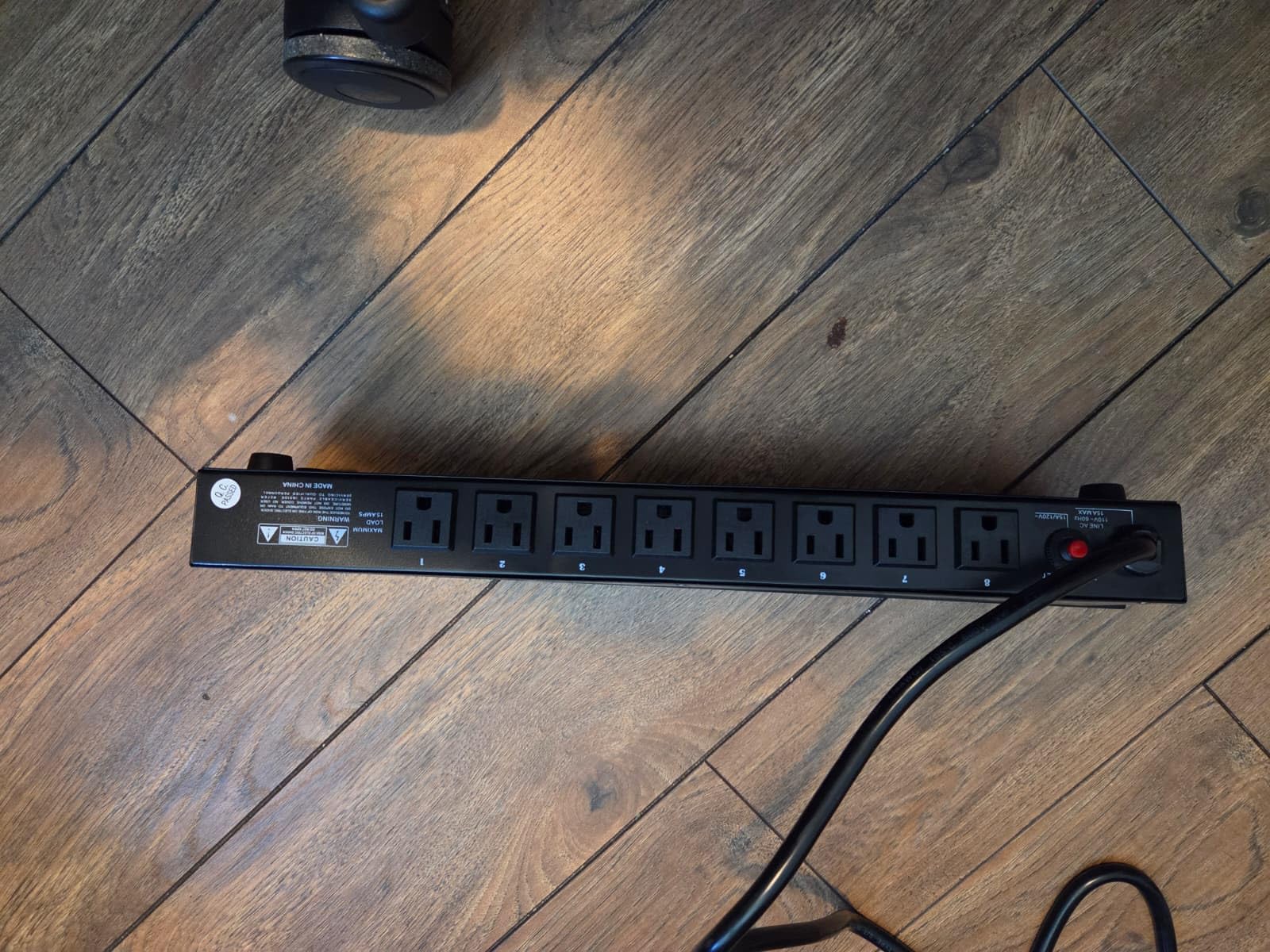
10. WAudio W-3800 Line Conditioner for Space-Constrained Racks
WAudio 1U Rackmount Power Conditioner AC Noise Filter Surge Protector
19 x 5.9 x 1.8 inch 1U chassis
6 rear outlets for cleaner cable management
AC noise filtering plus surge protection
4.1 lb all-metal body, rack screws included
Pros
- Noticeably reduces line noise and hum in DJ and hi-fi racks
- Light all-metal body at 4.1 lb
- Brushed aluminium front panel is well finished
- Includes power cord and rack screws
- Phase detect indication and rear reset button
Cons
- No sequencing
- Only six rear outlets
- Universal sockets raise grounding concerns in European markets
- Current capacity not documented
- No manual or specification sheet included
The W-3800 is a plain line conditioner with good metalwork. It is built for hi-fi, home theater, studio and AV racks that need organised distribution and AC noise filtering, and the 19 by 5.9 by 1.8 inch chassis is a tight 1U body at 4.1 lb.
Six rear outlets keep cable management clean, and the front panel has a power switch with power and phase indicators. The rear carries a 100-240V AC 15A input label and a reset button, and the power cord and rack screws are included in the box.
Owners in dirty-power venues report cleaner audio. At 17 reviews this has the smallest base in the roundup and the most polarised split, with 43 percent five-star and 38 percent four-star.
Six outlets is a real constraint
Six rear outlets is the smallest outlet count here, which suits a compact AV or hi-fi rack but will not cover a signal chain plus an amp rack without a second strip. Plan the layout before you commit rather than after the case is built.
The absence of sequencing means every outlet powers up together, so any thump from an amplifier is unmanaged.
Check the documentation gap
European reviewers raise grounding concerns because universal receptacles can defeat earth continuity for Schuko plugs, and current capacity is not documented on the unit or in the listing. There is no manual or specification sheet in the box.
At 4.1 lb with a brushed aluminium faceplate it is pleasant to handle, which is more than most 1U plastic strips offer, but verify the current rating before you commit an amplifier rack to it.
How to Choose a Power Conditioner for a Stage Rack
Choosing well comes down to five things: what the box actually does, how many amps your rack pulls, where it sits in the case, the order things come up, and whether you expect a measurable audio change.
Conditioner, surge protector, UPS or voltage regulator?
A surge protector clamps voltage spikes and does nothing else. A power conditioner adds noise filtering and usually undervoltage handling on top of clamping. A voltage regulator actively corrects high and low supply voltage, which adds bulk and heat. A UPS keeps equipment running through an outage and is the wrong tool for a backline rack because you do not want amps drawing battery power.
For stage racks you want a conditioner. For a house or studio already conditioned upstream you want a surge protector, and this whole category is overkill for that situation.
How many amps does your stage rack need?
Add up the current draw of everything in the rack, then add inrush headroom. Amplifiers are the problem: they draw a large spike at switch-on that lasts a fraction of a second, and a marginal unit will trip on it.
Five amp units are for a small signal chain with no power amps. Fifteen amp units cover a typical FOH rack or a small backline. Twenty amp units handle a rack of larger amplifiers. Thirty to forty amp units exist for full amp racks and multiple circuits, and no such unit made this list, so if you need that class you are shopping outside the 1U single-circuit category.
For a 12U FOH rack with a console, DSP, wireless rack and monitor controller, fifteen amps is comfortable. For a backline of four mid-size amplifiers, go to twenty amps and check what the venue circuit allows.
Should the conditioner go at the top or the bottom of the rack?
GearSpace users keep conditioners at the very top or very bottom, and the sensible default is the top, unless you need that space for something else. If you add a conditioning device later in the chain, it filters noise from upstream, which means top placement does the most work.
The practical counterargument is weight. Eight-pound units at the top of a road case are a real handling consideration, which is a good argument for a lighter unit near the bottom if your case is already heavy.
The correct power-up and power-down order
Power the conditioner itself first. Then come up in signal order: DSP, then console and wireless, then outboard and monitors, then amplifiers last. On the way down, reverse it: amplifiers off first, then everything upstream, then the conditioner.
That order keeps the rail dump from amps out of your tweeters and keeps the sensitive digital gear alive while the noisiest devices are switching.
Does a conditioner actually improve sound?
This is genuinely disputed, and we will not pretend otherwise. Enthusiasts on Audionirvana and Audiogon split hard on whether filtration is measurable, with some preferring IsoTek on the argument that devices impart a sonic signature either way. Others on Audioshark see benefit because gear in the rack itself produces line noise.
The honest position: buy a conditioner for protection and for handling noise your own rack generates, not on the promise of a transparent upgrade. If your backline is on the same circuit as your LED dimmers, filtering has a real mechanical effect on buzz. In a clean room with a quiet rack, you may measure nothing at all.
Handling generators, LED dimmers and shared circuits
Generators produce the dirtiest power a rig will meet, and LED dimmers on the same circuit as your backline are the single most common cause of nasty buzz. Meter the stage power during load-in, as touring advice in TheGearPage threads suggests, before you decide anything about filtration.
Co-ordinating stage lighting is part of the same problem. Our stage lighting picks and gigging acoustic-electric guitars roundup cover the rest of the rig, but power planning still falls on the system tech.
Frequently Asked Questions
What is the best rack power conditioner?
For most stage racks the Furman PL-8C Classic is the best rack power conditioner: 15 amps, nine outlets across isolated banks, SMP/LiFT/EVS protection and two retractable LED rack lights in a single 1U. Choose the Monoprice 15A three-zone unit when sequencing is the priority, and the MICNAUX 20A when an amp backline needs higher current and individual switching.
Do power conditioners improve sound quality?
It depends on what you are filtering. In a dirty venue with LED dimmers or backline sharing the circuit, a conditioner can measurably pull buzz down. In a clean room with a quiet rack, enthusiasts on Audionirvana and Audiogon split on whether filtration changes anything audible at all. Buy for protection and for noise your own gear generates, not on the promise of transparent sound.
Is there a difference between a surge protector and a power conditioner?
Yes. A surge protector only clamps voltage spikes. A power conditioner adds EMI and RFI filtering, usually undervoltage handling, and in many cases outlet sequencing so amplifiers ramp up last and shut down first. A voltage regulator actively corrects high and low supply voltage but adds bulk and heat. A UPS keeps gear running through an outage and is the wrong choice for an amp backline.
How big a power conditioner do I need for my stage rack?
Sum the current draw of everything in the rack and add headroom for amplifier inrush. Five amp units suit a small signal chain with no power amps, fifteen amps covers a typical FOH rack or small backline, and twenty amps handles a rack of larger amplifiers. Thirty to forty amp units exist for full amp racks but sit outside the single-circuit 1U category covered here.
Should a power conditioner be at the top or bottom of the rack?
The top is the sensible default, because a conditioning device placed early in the chain filters noise from everything downstream of it. GearSpace users keep conditioners at the very top or very bottom for this reason. The practical counterargument is weight: an 8 lb unit at the top of a road case is a real handling consideration, so a lighter unit near the bottom can make sense.
What is the best power conditioner for audiophiles or a home theater system?
Audiophile and home theater needs differ from stage-rack needs, and the priorities invert. Listening rooms care more about filtration purity than about sequencing, half-width form factors and touring weight. This roundup is built for live PA and touring racks, so for a listening room a dedicated line conditioner with strong filtering, such as the Black Lion Audio PG-X covered above, is the closer fit.
The Right Conditioner for Your Stage Rack in 2026
The Furman PL-8C Classic remains the pick for most racks in 2026, because 15 amps, nine outlets in isolated banks and two pull-out rack lights in 1U is a combination nothing else here matches. It is the safest single unit to put in a touring case and trust.
When sequencing drives the decision, take the Monoprice 15A three-zone unit. When the rack is mostly amplifiers, the MICNAUX 20A with eight individually switched outlets and a dry-contact trigger is the one. For the worst buzz in a dirty venue, the Black Lion Audio PG-X filters hardest.
Whichever you choose, size it against real rack draw, add inrush headroom, and power it on first and off last. That habit is worth more than any single brand.