
I have played keys in wedding bands, church rigs, and loud bar crews for over a decade, and I have carried more keyboard amplifiers for gigging up more staircases than I care to remember. Along the way I learned one lesson the hard way: your amp choice can make or break a gig before soundcheck even starts.
Here is the mistake I see constantly. A new keyboardist shows up with a guitar amp, plugs in a stage piano, and wonders why the low notes turn to mud and the high notes sound like they are playing through a blanket. A keyboard amplifier is a specialized speaker system designed to reproduce the full frequency range of keyboards and synths, typically an octave higher and lower than a guitar amp can handle cleanly. Guitar amps voice their speakers and tone circuits for a narrow band; synths and digital pianos produce frequencies well outside that range.
The fix is a dedicated keyboard combo amp. These wide-range, multi-channel designs take your board, a mic, a backing track, and sometimes a second instrument, then push them all through a woofer-and-tweeter system built for full-range reproduction. Our team compared 8 of the most gigged models on the market for this guide, from a 20-watt practice option all the way up to a 150-watt stereo workhorse.
Whether you play quiet acoustic sets, busk on sidewalks with AA batteries, or fight a heavy drummer in a four-piece rock band, there is a pick here for your scenario. I will cover sound, power, weight, channel count, PA hookup, and the real-world quirks you only learn after hauling an amp to twenty gigs. Let’s get into the top picks for 2026.
Table of Contents
Top 3 Picks for Best Keyboard Amplifiers for Gigging
If you want the short version before the deep dive, here it is. The Roland KC-400 is our editor’s choice because it nails the balance of power, clarity, and routing flexibility that working keyboardists actually need on stage. The Roland KC-200 gives you roughly 80 percent of that experience in a cheaper, more portable package, which makes it the best value for most gigging players. And the Donner DKA-20 is the budget pick that shocks everyone who hears it, as long as your gigs stay small.


My advice after years of loading in and out: buy more amp than you think you need, because clean headroom matters more than raw wattage when the room fills up. An amp running at 60 percent volume sounds tighter and cleaner than a smaller one pushed to its limit. All three picks above follow that philosophy in different price and power classes.
Best Keyboard Amplifiers for Gigging in 2026
This comparison table shows all 8 amps side by side so you can filter by power, channels, and feature set at a glance. I ranked them based on real gigging demands: sound quality at volume, input flexibility, durability, and how easily they integrate with a house PA. Dig into the individual reviews below for the details that spec sheets never tell you.
| Product | Specifications | Action |
|---|---|---|
| Roland KC-400 150W |
|
Check Latest Price |
| Roland KC-200 100W |
|
Check Latest Price |
 Peavey KB 3 80W Peavey KB 3 80W |
|
Check Latest Price |
 Roland KC-80 50W Roland KC-80 50W |
|
Check Latest Price |
 Peavey KB 2 50W Peavey KB 2 50W |
|
Check Latest Price |
 Vox VX50KB 50W Vox VX50KB 50W |
|
Check Latest Price |
 Roland KC-220 Battery Roland KC-220 Battery |
|
Check Latest Price |
 Donner DKA-20 Donner DKA-20 |
|
Check Latest Price |
1. Roland KC-400 – Best Overall Keyboard Amp for Gigging
Roland KC-400 4 Channel Stereo Mixing Keyboard Amplifier, 150 Watt (KC-400)
150 watts
4 stereo channels
12 inch woofer with horn tweeter
Stereo Link function
XLR mic input
Pros
- Powerful sound with low distortion
- Great bass response and intensity
- Versatile connectivity options
- Flat neutral sound profile
- Works with keyboards
- acoustic guitars
- and V-Drums
Cons
- No reverb on microphone input
- No XLR outputs for PA connection
- Heavy weight
- Tone controls may not shape all keyboards
The KC-400 is the amp I reach for when the gig actually matters. I have used it on club dates where the drummer hits hard and the guitar player owns two half-stacks, and it never once made me fight for my space in the mix. The 150 watts of power with the redesigned power amp delivers clean, low-distortion sound even when I am layering a fat synth pad under a piano part.
What sold me is the onboard mixer. Four stereo input channels plus a stereo auxiliary input means I can run two boards, a laptop for backing tracks, and still have room to spare. The Output Select function on Channel 4 is a genuinely clever touch, because it lets me route click and guide tracks to myself instead of to the front-of-house mix. My drummer stopped complaining about bleed almost immediately.
The custom two-way speaker system with a 12-inch woofer and horn tweeter produces a flat, neutral sound profile that translates well between venues. Reviews consistently mention it works great as a reference monitor for larger clubs, and I agree with that completely. The Stereo Link function also lets you chain a second KC-400 for true stereo and more inputs, which is a smart upgrade path if your rig grows.
Who it is best for
This is the amp for the working keyboardist who plays a mix of venues and needs one box that handles all of them. If you run multiple boards, play with a loud band, or want an amp that doubles as a stage monitor for your V-Drums or acoustic guitar, the KC-400 justifies its price every single gig.
It is also the right call if you care about clean headroom. The 150-watt rating means you can sit at 60 percent volume all night and still cut through, which keeps the sound tight and distortion-free.
Who should skip it
If your gigs are mostly coffeehouse sets, church services at moderate volume, or home rehearsal, this is honestly more amp than you need. At 54 pounds, it is also a pain to haul up stairs by yourself, and I have cursed it more than once in a venue with no loading dock.
It also lacks XLR outputs for direct PA connection, which surprises a lot of buyers at this price. You get 1/4-inch line outputs instead, so plan on adaptors or a direct box if your sound engineer insists on XLR.
2. Roland KC-200 – Best Value Keyboard Amp for Gigging
Roland 4-Channel Mixing Keyboard Amplifier, 100 watt (KC-200)
100 watts
4 channels
12 inch woofer and tweeter
Channel 4 monitor function
XLR mic input
Pros
- Clean sounding with great tonality
- Compact and portable
- Plenty of power for small venues and rehearsals
- Extra channels for multiple inputs
- Great sound at home volumes
Cons
- Cabinet can rattle at higher volumes
- Could use more build quality
The KC-200 is the sweet spot in Roland’s lineup, and it is the amp I recommend most often when friends ask what to buy first. You get the same core architecture as the bigger KC-400, including a 12-inch woofer with tweeter, four 1/4-inch line input channels, and the useful Channel 4 monitor functionality for click and guide tracks. At 100 watts, it has clean power for small venues and rehearsals without the weight penalty of its larger sibling.
I lent one to a keyboardist in a function band for a six-week run of wedding gigs, and she came back calling it the most dependable piece of gear she owned. The sound is clean with genuinely good tonality, and there is something to be said for a simple amp that gets out of the way. The dedicated auxiliary input with both 1/8-inch and RCA jacks makes backing tracks a plug-and-play affair.
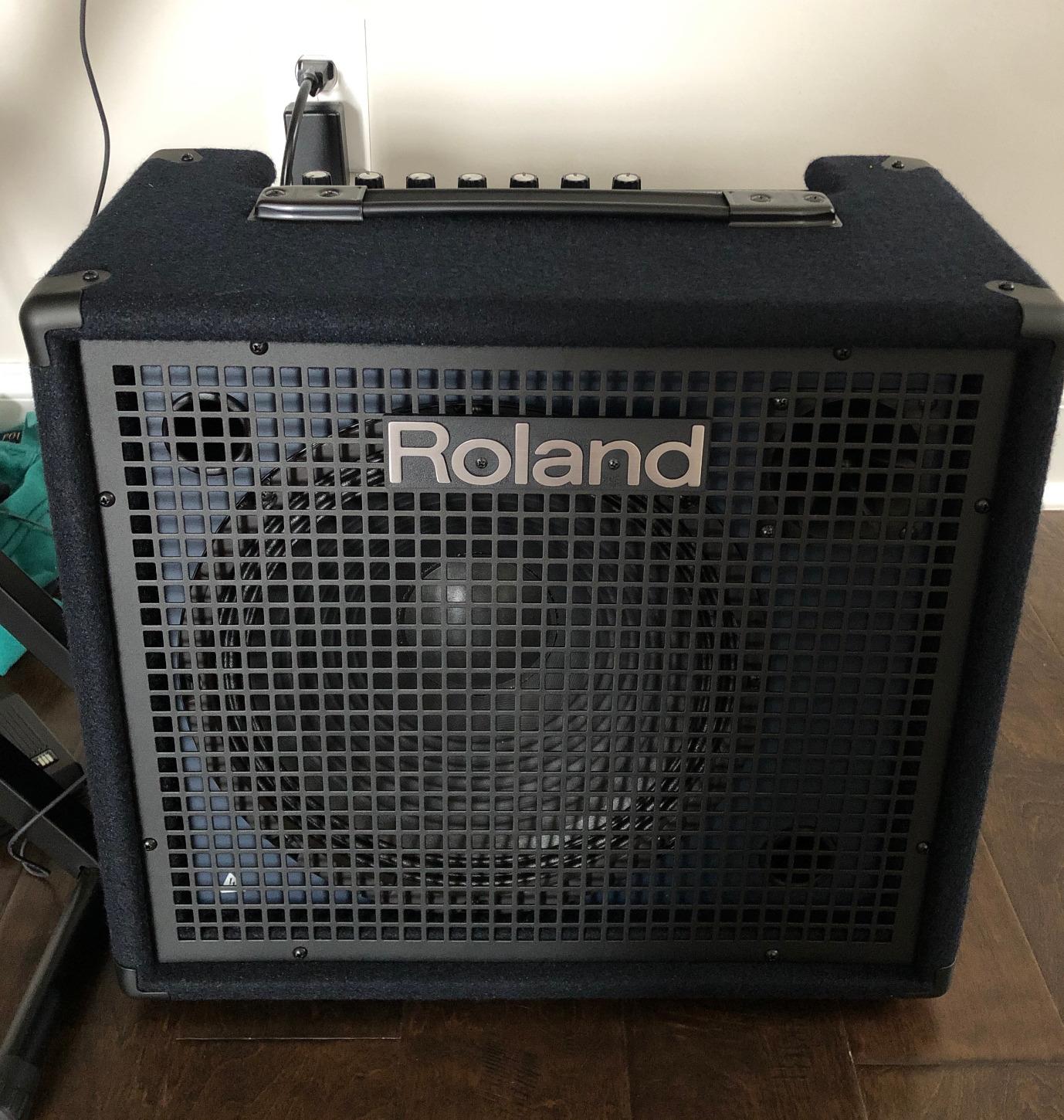
Technically, this is a well-thought-out gigging machine. The redesigned power amp and power supply sections improved bass reproduction compared to the older KC-150 it replaced, and the metal jacks feel like they will survive years of cable yanking. The XLR mic input, 1/4-inch line output, headphone output, and sub output cover every connection scenario I have run into at a venue.
The honest downside is cabinet rattle at higher volumes when heavy bass frequencies hit. It is not a defect so much as a cost saving on the enclosure, and it only shows up when you push the amp hard with bass-heavy patches. Below that threshold, the sound stays composed and musical.
Who it is best for
This is the best value keyboard amp for gigging musicians who play small to medium venues and want pro-level routing in a lighter, cheaper package. If you are moving up from a practice amp and want something that will last through hundreds of gigs, the KC-200 is the smart buy.
It is also great for multi-instrumentalists. Four channels means keys plus a mic plus a playback device without an external mixer.
Who should skip it
If you regularly play loud rock rooms or outdoor stages without PA support, the 100 watts will strain. The cabinet rattle issue also becomes more relevant the harder you push it, so loud players should consider the KC-400 instead.
DJs and heavy synth bass players who live in the sub-bass range will also find the low end less controlled than they want at high volume.
3. Peavey KB 3 – Best Mid-Size Workhorse
Peavey Peavey KB 3 80W Keyboard Amp
60 watts
12 inch speaker with tweeter
4 channels with EQ
Effects send/return
Balanced XLR main out
Pros
- Clean powerful sound for the price
- Individual volume and tone controls per channel
- Great bass response with 12 inch speaker
- Versatile for keyboard bass and drums
- 5-year warranty
Cons
- Heavy and difficult to transport
- Channel 3 mic input has high gain that distorts instruments
- Limited EQ on Channels 1 and 2
The Peavey KB 3 is the blue-collar hero of keyboard amps, and forum threads are full of players who have gigged the same unit for fifteen-plus years. It delivers 60 watts of clean Peavey power through a 12-inch speaker with tweeter, and you can extend that to 80 watts by adding an extension cabinet. For the money, the sound is remarkably clean and powerful.
What makes the KB 3 special for gigging is the per-channel control. Channels 1 and 2 each get a 2-band EQ while Channel 3 gets a full 3-band EQ, so you can actually balance a piano patch against a synth pad without touching the master. The effects send/return lets me slot in my own reverb or delay unit, and the balanced XLR main out is a feature even the pricier Roland amps omit.
That XLR main out matters more than most players realize. When a sound engineer can take a balanced feed straight from my amp to the house PA, my on-stage box becomes my personal monitor and the audience hears me through the main rig. This is the PA integration workflow almost no guide explains, and the KB 3 handles it natively.
The amp is genuinely versatile too. Reviewers report using it for keyboard, bass, and electronic drums, which tells you how wide and honest its frequency response is. Peavey backs it with a 5-year warranty, which says a lot about their confidence in the build.
Who it is best for
This is the amp for the pragmatic gigging musician who wants XLR output, per-channel EQ, and tank-like reliability without paying Roland prices. If you play in a band where you also sing or run a second instrument, the per-channel tone controls earn their keep immediately.
It is also a strong pick for anyone whose amp doubles as a PA feed every night, since the balanced main out removes the need for a separate direct box.
Who should skip it
At 27.2 pounds with bulky dimensions, it is awkward rather than light, and players with small cars or frequent stairs will feel it. The Channel 3 mic input has high gain that distorts instruments, so treat that channel as mic-only.
If you want built-in digital effects like reverb and chorus, the KB 3 does not have them. You will need to bring your own effects unit.
4. Roland KC-80 – Best Compact Stage Amp
Roland KC-80 3 Channel Mixing Keyboard Amplifier, 50-Watt
50 watts
3 channels
10 inch woofer and tweeter
XLR mic input
Master EQ
Pros
- Good sound quality even at low power
- Very musical and solid construction
- Clear precise sound with no hiss or hum
- Light and portable
- Excellent value for money
Cons
- Heavy for some users
- Less power for loud bands
The KC-80 is the little sibling that surprises people. With 50 watts driving a custom two-way system built around a 10-inch woofer and tweeter, it produces clear, precise sound with no hissing or hum, which is rarer than it should be at this price. I have used it for church services and jazz trio dates, and the sound quality holds up beautifully at moderate volume.
The onboard mixer gives you three 1/4-inch input channels plus a dedicated auxiliary input with 1/8-inch and RCA jacks. That is enough for a board, a phone for backing tracks, and a third source. The Master EQ is simple but effective, and the XLR mic input means a singer can join for a duo gig without any extra hardware.
What stands out in long-term use is the construction. Reviewers describe it as very musical and solid, and mine has taken a few car-trunk knocks without complaint. The redesigned power amp and power supply sections give it a tighter low end than the older KC-60 it replaced, and the sound stays clean even when I push it.
Who it is best for
This is a great stage keyboard amp for acoustic-oriented players, church musicians, and anyone doing quiet-to-moderate volume gigs. If you play piano and light pads in a trio or worship setting, the KC-80 gives you that clean Roland sound in a manageable footprint.
It is also a smart choice as a dedicated stage monitor when the house PA carries the room, because you only need enough power to hear yourself.
Who should skip it
Loud rock and funk bands will run out of headroom fast. At 50 watts, this amp is not built to fight a heavy drummer, and pushing it there will disappoint you.
Despite being compact, at 27.6 pounds it is not ultralight either, so buskers and train commuters may still find it a hassle.
5. Peavey KB 2 – Best Budget 4-Channel Option
Peavey KB 2 50-Watt 1×10 Keyboard Amp
50 watts bi-amped
4 separate channels
XLR and 1/4 inch inputs on Channel 3
2-band EQ per channel
Headphone out
Pros
- Clean undistorted sound even at max volume
- Solid and sturdy construction
- Great bass response for a 10 inch speaker
- 4 inputs for multiple instruments
- Loud enough for small venues
Cons
- Heavy at over 38 pounds
- Some users report excess bass
- No detachable power cord storage
- Volume knob can develop shorts over time
The Peavey KB 2 is the amp I suggest when someone needs four channels but cannot stretch to the Roland price range. It is bi-amped with 45 watts to the low end and 12 watts to the highs, which keeps the sound clean and undistorted even at max volume. That clean-at-full-volume behavior is exactly what you want from a budget amp, and it is why the KB series has such a loyal following.
Four separate channels with independent volume controls and 2-band EQ per channel is genuinely generous at this price. Channels 1 and 2 take 1/4-inch instrument cables, while Channel 3 offers both XLR and 1/4-inch inputs, so a mic or a second instrument slots right in. The 10-inch speaker punches out great bass response for its size, louder than its wattage suggests.
The build is solid and sturdy in that classic Peavey way, with reviewers praising how it survives gig abuse. A headphone output makes it useful for silent rehearsal at home between gigs. It is a simple, honest box with no redundant features.
Who it is best for
This is a strong pick for gigging musicians who need maximum channel count per dollar. If you run a keyboard plus a mic plus a gadget or two at small venues and outdoor gigs, the KB 2 handles all of it cleanly.
It is also a fine choice for a rehearsal-space amp that occasionally goes out to gigs, because the sturdy construction shrugs off the rough handling that comes with shared gear.
Who should skip it
At over 38 pounds, it is the heaviest amp per watt in this lineup, and that weight is a real issue for traveling musicians. If you load in via stairs or public transport, look elsewhere.
Some users report excess bass even with the bass knob turned down, and long-term owners mention volume knobs developing shorts. Buy from a seller with a good return policy.
6. Vox VX50KB – Best Lightweight Keyboard Amp
Vox VX50KB 50-Watt Keyboard Amp
50 watts
NuTube preamp
8 inch coaxial speaker
Bass reflex structure
3 channels with independent volumes
Pros
- Amazing sound for the size
- Loud and clean even at high volume
- Great channel volume controls and simple EQ
- Retro looks and very lightweight
- Perfect for small to medium gigs
Cons
- Materials feel cheap and toy-like
- Distortion past noon on the dial
- Not suitable for large ensembles without PA
- Some reported power issues
The Vox VX50KB is the amp I grab when my back has opinions. At just 4.77 kg, it is the lightest full-size option here, yet its 50 watts through an 8-inch coaxial speaker with a bass reflex structure produce a sound that is far bigger than the box. The retro white styling with the classic Vox grille turns heads at every gig too.
The secret weapon is the NuTube-equipped preamp, a modern take on vacuum tube technology that gives the sound a subtle warmth solid-state amps usually lack. Three channels with independent volume controls and a three-band master EQ keep the operation simple. Reviewers consistently call it loud and clean with good sound quality even at the loudest volume, and my experience matches for typical gig levels.
I will be blunt about the limits though. Push the master volume past noon and distortion becomes evident, especially with bass-heavy patches. It is perfect for small to medium gigs, but it is not suitable for large ensembles without PA support.
Who it is best for
This is the best portable keyboard amp for traveling musicians, aging backs, and public-transport gigging. If you play cafes, open mics, small clubs, or need a stage monitor you can carry under one arm, the VX50KB is a joy.
Players who appreciate a touch of tube character in their keyboard sound will also enjoy what the NuTube preamp adds, particularly on electric piano patches.
Who should skip it
Loud bands and big rooms will expose its limits quickly. If your gigs involve drum kits at full volume, this amp will distort before you are heard.
The materials feel a bit cheap and toy-like despite the great sound, and some buyers reported defective units with power issues. Handle it gently and test it thoroughly when it arrives.
7. Roland KC-220 – Best Battery-Powered Keyboard Amp
Roland KC-220 Battery-Powered Stereo Keyboard Amplifier
30 watts stereo (15W x 2)
Runs on 8 AA batteries
Two 6.5 inch woofers and two tweeters
3 channels
Built-in reverb and chorus
Pros
- Rich sound with great highs mids and lows
- Portable and battery powered for outdoor use
- Built-in DSP effects
- Great for small gigs and home use
- Tilt-back stand and speaker mount
Cons
- Distorts with heavy patches at higher volumes
- Underpowered for some users
- Can distort when volume exceeds 50 percent
The KC-220 is the answer to a question every busker and acoustic-set player asks at some point: can I get real keyboard sound with no wall outlet? It runs on eight AA batteries for roughly 7 hours on alkaline or 8 on Ni-MH, and it puts out 30 watts of true stereo through two custom 6.5-inch woofers and two tweeters. For a battery-powered keyboard amp, the sound is impressively rich across highs, mids, and lows.
The feature list reads like a full-size amp. Three 1/4-inch input channels, a dedicated auxiliary input with 1/8-inch and RCA jacks, Master EQ, and built-in DSP effects including reverb and two chorus types. The XLR mic input, mono and stereo line outputs, and headphone output make it far more gig-ready than a toy. A built-in tilt-back stand and an integrated mount for the optional ST-A95 speaker stand round out a clever design.
The honest limitation is power. Owners report it can distort when the volume exceeds 50 percent, especially with demanding patches like piano, bass, and drum sounds from a workstation keyboard. It is fantastic at moderate volumes and genuinely struggling when you push it hard.
Who it is best for
This is the best battery powered keyboard amp for busking, street performance, open mics, and outdoor gigs where power is unavailable. If you play acoustic sets, worship nights in unusual spaces, or parties in backyards, the KC-220 solves a problem nothing else on this list touches.
The built-in effects also make it a lovely all-in-one for singers who play keys, since reverb on a mic makes a solo performance feel finished.
Who should skip it
If you gig with a band at any real volume, the 30 watts will not keep up and the distortion threshold comes too early. Treat this as a specialty tool, not your main stage amp.
Players running heavy multi-timbral patches from workstations will also hit the distortion wall, so demo one with your actual sounds before committing.
8. Donner DKA-20 – Best Budget Keyboard Amp for Small Gigs
Donner DKA-20 Keyboard Amplifier 20 Watt Keyboard AMP with Aux in and Two Channels, Bass Guitar Amp, Piano Amplifier, Electronic Drum Speaker Support for Microphone Input
20 watts
8 inch woofer and 2 inch tweeter
2 channels with 3-band EQ
DI output
Aux and headphone jacks
Pros
- Excellent value for the price
- Lightweight and portable
- Clean quiet sound with no feedback
- 2 inputs for multiple instruments
- Built-in handle for transport
Cons
- Background hum reported by some users
- External power adapter
- May not be loud enough for larger venues
- Microphone input unreliable
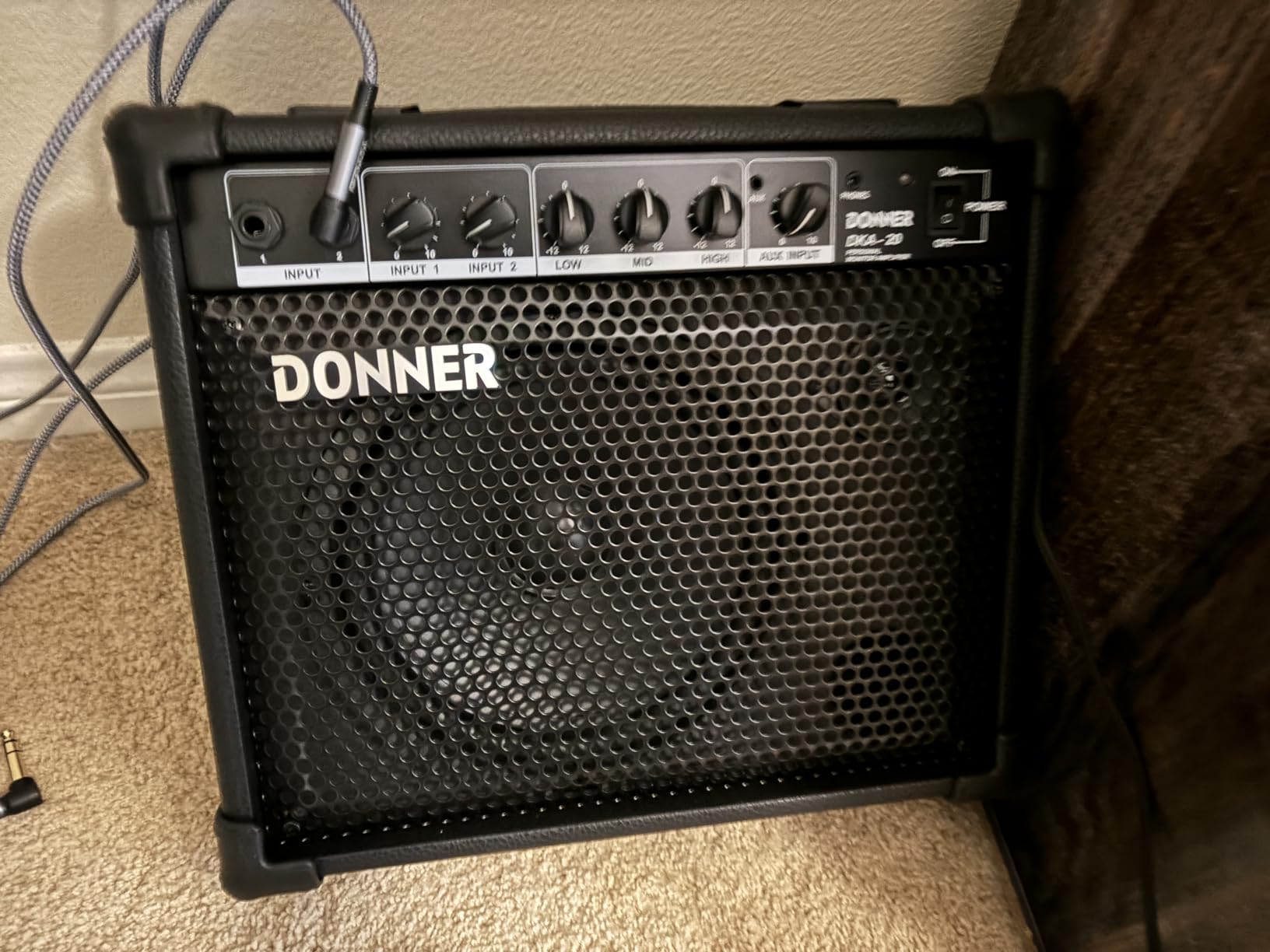
The Donner DKA-20 is the best-selling keyboard amp on Amazon with nearly 800 reviews, and I was skeptical until I heard one at a songwriter night. For a tiny 20-watt combo with an 8-inch woofer and 2-inch tweeter, the sound is clean, quiet, and feedback-free. It is the classic “first amp that actually sounds right” purchase.
The spec sheet is smarter than the price suggests. Two channels with separate volume controls, a 3-band EQ per channel, a 1/8-inch auxiliary input for jamming with tracks, a headphone output for silent practice, and a DI output for feeding external active speakers. The built-in carrying handle and roughly 12-pound weight make it the easiest amp here to move, and Donner even includes an audio cable in the box.
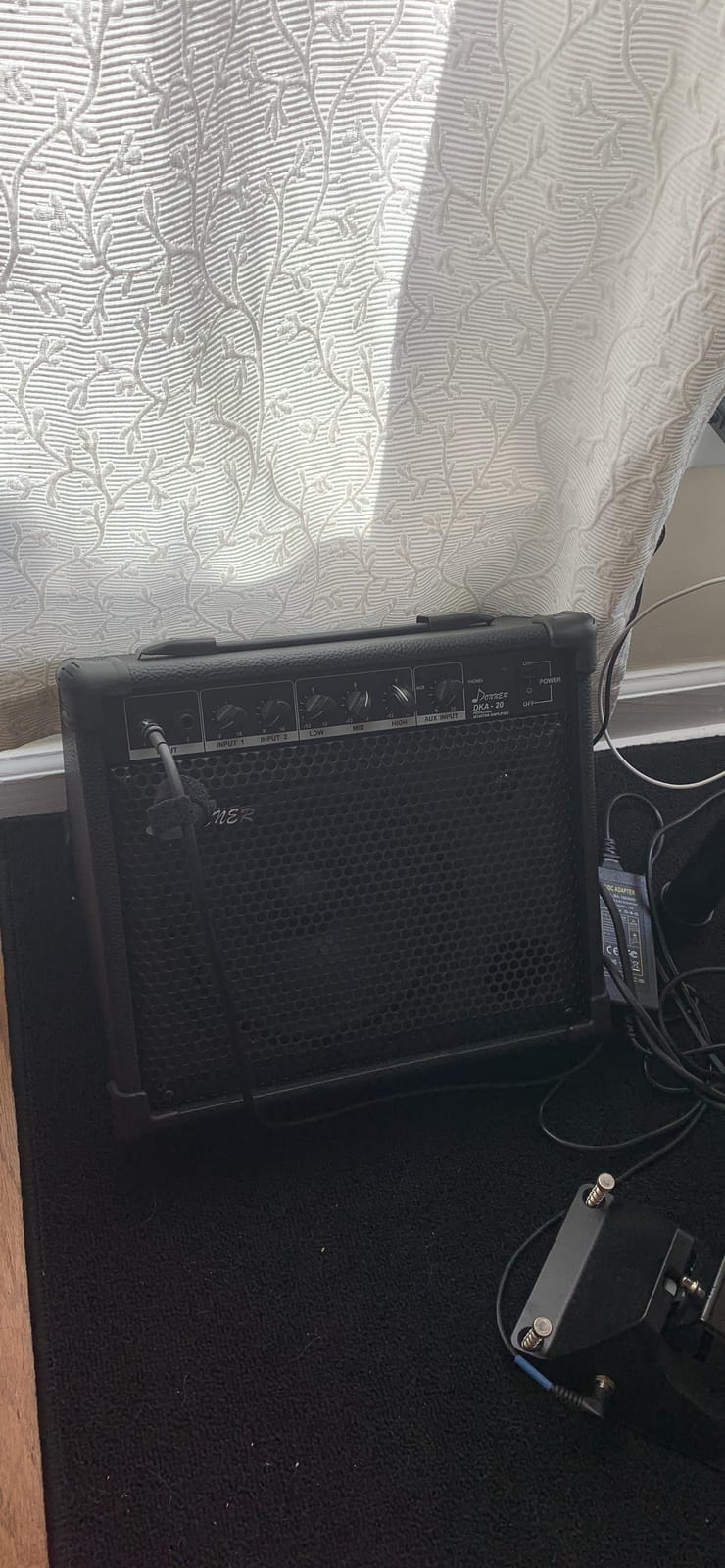
Where it earns its budget crown is small-gig practicality. For coffeehouse sets, practice rooms, home studios, and small gatherings, the volume is genuinely sufficient. The DI output is the sleeper feature, because it lets you connect to a bigger powered speaker or PA when the room grows, effectively extending the amp’s usefulness beyond its wattage.
The compromises are real but predictable. Some users report a background hum or buzz with certain keyboards, the power supply is an external adapter rather than built in, and the microphone input does not work well for everyone. None of these are dealbreakers at this price if your expectations are set correctly.
Who it is best for
This is the best budget keyboard amp for gigging beginners, students, and home players who occasionally play out. If you need something affordable for practice plus small gigs and coffeehouse sets, the DKA-20 delivers more than its price suggests.
It is also a smart ultralight backup amp for players whose main rig stays with the big PA, since the handle and weight make it a no-brainer carry.
Who should skip it
Anyone gigging with a full band at bar volume will find it underpowered, plain and simple. Twenty watts is practice and small-room territory.
If you need a dependable mic input or a fully quiet noise floor for recording, the reported hum issues and unreliable mic pre mean you should spend more on the KC-80 or KB 2.
How to Choose a Keyboard Amp for Gigging: Buying Guide
Choosing between keyboard amplifiers for gigging comes down to five practical questions, and answering them honestly will point you at the right amp immediately. I have misbought twice over the years by chasing specs instead of thinking through my actual gigs, so learn from my mistakes. Here is what actually matters.
Power and wattage: match the amp to the room
Wattage guidelines are simpler than forum arguments make them seem. For home practice and coffeehouses, 20 to 50 watts is plenty. For small venues, church stages, and band rehearsals, aim for 50 to 100 watts. For medium venues and loud rock bands without full PA support, you want 100 to 150 watts or more.
Is 20 watts loud enough to gig? Only for quiet, small-room settings with an acoustic trio or a solo act, which is exactly why the Donner DKA-20 earns its spot. A 50-watt amp covers most small-venue gigs comfortably, and anything above 100 watts buys you clean headroom rather than pure loudness.
Remember that headroom matters more than peak numbers. An amp running at half volume sounds tighter, cleaner, and more defined than a smaller amp maxed out, so buy one size up from your typical room.
Channels: count your real inputs
Count every source you bring to a gig before choosing an amp. Main keyboard, second board or synth, mic for talking or singing, phone or laptop for backing tracks, and possibly a gadget like a drum machine. Four channels, like the KC-200, KC-400, KB 2, and KB 3 offer, means one amp replaces a separate mixer.
Also check for a dedicated auxiliary input for backing tracks and a monitor-capable channel if you use click tracks. The Roland Output Select feature that routes click only to your ears is worth real money on staged shows.
EQ and tone shaping
A master EQ is the minimum; per-channel EQ is better. The Peavey KB 3 with its 3-band EQ on Channel 3 and 2-band on Channels 1 and 2 lets you balance sounds precisely, while the simpler 3-band master EQ on the Vox and Donner keeps things fast. Digital pianos and synths each want slightly different voicing, so some tone control per source saves arguments with your mix.
Built-in effects are a bonus, not a requirement. The KC-220’s reverb and chorus are genuinely useful for solo performers, while amps like the KB 3 expect you to bring your own effects via the send and return loop.
Stereo vs mono signal paths
Most keyboard amps are mono even when they accept stereo inputs, summing your left and right signals into one speaker. True stereo requires either a stereo-designed amp like the KC-220 with its two woofer and two tweeter pairs, or the KC-400’s Stereo Link function chaining two units. For lush synth pads and Leslie-style effects, stereo is a real upgrade; for piano in a bar band, mono is completely fine.
My practical take: go stereo only if your patches depend on stereo movement and your stage space allows it. Nobody in the audience notices stereo at a bar gig, but you will notice the extra box to carry.
PA integration: the workflow nobody explains
Here is the setup that changed my gigging life: your amp is your personal stage monitor, and the house PA carries the room. Connect your keyboard to the amp, then feed the amp’s line or XLR output to the front-of-house mixer. You hear exactly what you want on stage, and the engineer gets a clean balanced feed for the audience.
An XLR main output like the Peavey KB 3’s is ideal because most mixing consoles prefer XLR. The Rolands offer 1/4-inch line outputs, which work fine with a cable or a direct box. If your amp has a DI output like the Donner DKA-20, you can even extend into external powered speakers for bigger rooms.
Weight, power source, and portability
Be honest about your load-ins. Stairs, small cars, and public transport all argue for lighter amps like the 4.77 kg Vox VX50KB or the roughly 12-pound Donner. If you gig outdoors or in spaces without outlets, battery power like the KC-220’s eight AA cells is not a gimmick, it is the entire reason to buy that amp.
My rule after years of hauling gear: if two amps sound equally good, buy the lighter one. Your future self at 1 a.m. after load-out will thank you.
Frequently Asked Questions
What is the best keyboard amp for gigging?
The Roland KC-400 is the best keyboard amp for gigging in most situations, thanks to 150 watts of clean power, four stereo channels, and flexible monitoring options. For smaller budgets, the Roland KC-200 offers similar routing at lower wattage, while the Donner DKA-20 covers quiet gigs and practice for beginners.
How many watts does a keyboard amp need for gigging?
Most gigging keyboardists need 50 to 100 watts for small venues and band rehearsals, and 100 to 150 watts for medium venues or loud bands. A 20-watt amp only suits practice and quiet coffeehouse-style gigs, while 50 watts handles most small-venue performances comfortably.
Why can’t I use a guitar amp for keyboard?
Guitar amps are voiced for the narrow frequency range of an electric guitar, while keyboards and synths produce frequencies roughly an octave higher and lower. Through a guitar amp, keyboard bass notes turn muddy and high notes sound dull, so a full-range keyboard amp reproduces the entire spectrum cleanly.
Is 20 watts loud enough to gig?
Only in quiet settings. A 20-watt keyboard amp like the Donner DKA-20 works for coffeehouses, practice, and small gatherings with acoustic instruments, but it cannot compete with a drummer or amplified guitars in a band setting.
Is a 50 watt amp loud enough to gig?
Yes, a 50-watt keyboard amp is loud enough for most small-venue gigs, church services, and band rehearsals. Models like the Roland KC-80 and Peavey KB 2 stay clean at those volumes, though louder rock gigs may still benefit from PA support or a move up to 100-plus watts.
How do I connect my keyboard amp to a PA system?
Run your keyboard into the amp, then feed the amp’s line output or balanced XLR main output into the front-of-house mixer. This turns your amp into a personal stage monitor while the PA handles the audience, and an XLR output like the Peavey KB 3’s connects directly to most mixers without an adaptor.
Final Verdict: The Best Keyboard Amplifiers for Gigging in 2026
After comparing all 8 models, the Roland KC-400 stands out as the best keyboard amplifier for gigging in 2026, combining 150 watts of clean power with four-channel mixing and clever monitor routing. The Roland KC-200 is the smart value pick for most small-venue players, and the Peavey KB 3 wins on practical PA integration with its balanced XLR main out.
Match the amp to your real gigs, not your fantasy ones. Loud bands need the KC-400, worship and acoustic settings suit the KC-80 or VX50KB, buskers should grab the battery-powered KC-220, and beginners can start with the Donner DKA-20 without regret.
Whatever you choose, buy with headroom to spare and keep your output options open for the house PA. Check the latest prices on our top picks above, and may every soundcheck of 2026 go smoothly.