
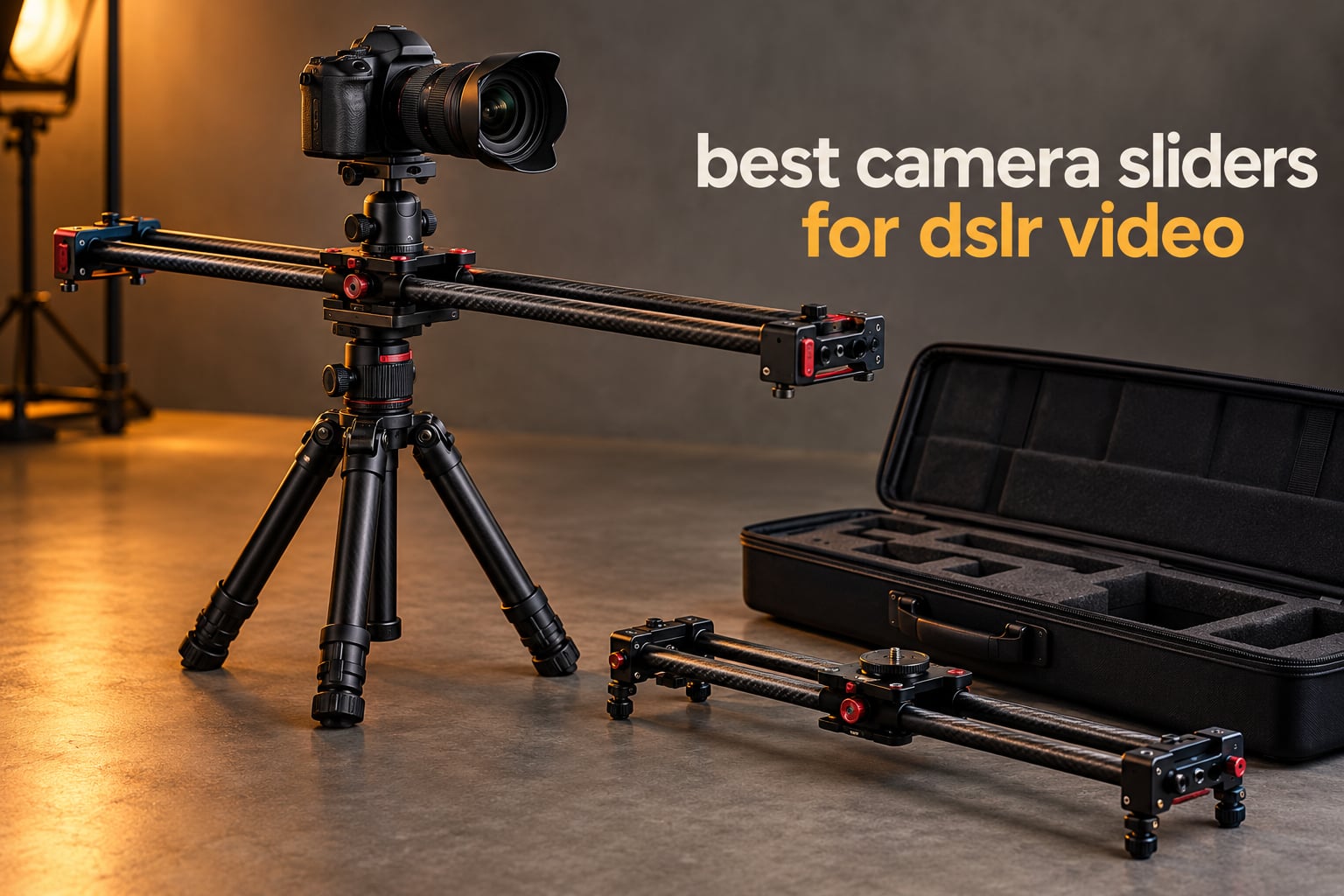
The best camera sliders for DSLR video are the ones that hold their line under a real rig and still glide without a catch after a full afternoon of use. Our shortlist covers ten of them, from a three-wheel dolly you can palm in one hand to a 48-inch motorized carbon fiber rail with programmable start and end points.
Most DSLR shooters do not need a cinema dolly track. They need a way to add parallax to a talking-head B-roll shot, slide a product across a table, or move toward a wide view without walking the tripod across the floor. That is a much shorter list of requirements, and it is the list we used to sort everything here.
We also leaned on what buyers actually report after living with a unit. A spec sheet tells you a slider holds 11 pounds; it does not tell you the carriage develops play, that the app will not pair with your phone, or that the motor cannot hold a line on a downward angle. Those details decided several of the picks below.
Every slider here is judged against the same four things: how smooth the travel stays in real conditions, whether the load rating leaves headroom for a DSLR plus a lens, how the move is controlled, and what happens to your audio while it runs. If you are still choosing a body, our beginner DSLR picks pair well with the compact options in this guide. We also cover the wider range of movement gear in our camera slider roundup for video production.
Table of Contents
What Is a Camera Slider?
A camera slider is a rigid rail that carries your camera on a carriage to produce smooth dolly, push-in, reveal and parallax shots. A manual slider is pushed by hand, so you control speed and direction frame by frame. A motorized slider runs a built-in motor along programmed paths, giving you repeatable, hands-free moves.
That single distinction matters more than any other spec. It decides whether the shot adapts to the performance in front of the lens or repeats identically every take.
Top 3 Camera Sliders for DSLR Video in 2026

NEEWER DL100 3-Wheel Dolly
- Wireless remote with 3 speeds
- 180 degree adjustable wheel
- 6.6 lb capacity
- 1800mAh battery up to 6 hours

Zecti 24 Inch Carbon Fiber Slider
- Double carbon fiber rail
- Four precision bearings
- 654g build with carrying bag
- Bubble level and adjustable legs
GVM 48 Inch Motorized Slider
- 48 inch carbon fiber rail
- Programmable speed dwell and loop
- Tracking time lapse and panorama
- 6 shutter cables included
Best Camera Sliders for DSLR Video in 2026: Quick Overview
| Product | Specifications | Action |
|---|---|---|
| NEEWER DL100 3-Wheel Wireless Dolly |
|
Check Latest Price |
| Zecti 24 Inch Carbon Fiber Slider |
|
Check Latest Price |
| GVM 48 Inch Motorized Slider |
|
Check Latest Price |
 VidPro SK-22 Skater Dolly VidPro SK-22 Skater Dolly |
|
Check Latest Price |
 GVM 27 Inch Motorized Slider GVM 27 Inch Motorized Slider |
|
Check Latest Price |
 StudioFX 40 Inch Ball Bearing Slider StudioFX 40 Inch Ball Bearing Slider |
|
Check Latest Price |
 NEEWER ER1 47 Inch App Slider NEEWER ER1 47 Inch App Slider |
|
Check Latest Price |
 NEEWER CS1M 16 Inch Slider NEEWER CS1M 16 Inch Slider |
|
Check Latest Price |
 Accsoon Toprig S60 Motorized Slider Accsoon Toprig S60 Motorized Slider |
|
Check Latest Price |
 GVM 31 Inch Wireless Slider GVM 31 Inch Wireless Slider |
|
Check Latest Price |
How We Picked These Sliders
We ranked these on four things, in this order. First, smoothness under load, because a slider that rattles or catches is worse than no slider. Second, real payload headroom, which we measured by comparing each rated load against a DSLR body with a mid-weight zoom attached. Third, control options, whether that means a hand, a wired controller, or an app. Fourth, what happens to your audio, since a ticking motor ruins an interview take just as thoroughly as a bad rail.
We gave extra weight to units that kept their smoothness after repeated passes rather than only on a clean floor. Buyers consistently report a break-in difference on bearing-based rails, and that is worth knowing before you buy rather than after. We also read the one-star reviews closely, because recurring complaints there tell you far more than the average rating does.
Two products earned a spot despite middling ratings because their failure modes are honest and known. One has a documented app pairing problem on certain Android phones, and one cannot hold its programmed line on a downward angle. You can plan around both. You cannot plan around a carriage that develops play after a month of use.
1. NEEWER DL100 3-Wheel Dolly – Best Overall for DSLR Video
NEEWER 3 Wheels Wireless Video Camera Dolly, 3 Speed Motorized Slider
Rating 4.4 from 1011 reviews
6.6 lb max load
1.1 lb unit weight
3 speeds at up to 3.0 cm per second
Pros
- Packs down to 5.31 inches and weighs 1.1 pounds
- Wireless remote handles start stop direction and speed
- Convertible one-quarter and three-eighths mount takes phones DSLRs and action cams
- Built in 1800mAh battery runs up to 6 hours
Cons
- Motor noise reaches on-camera audio
- Less reliable on inclines or uneven ground with a heavy rig
- Can tip with a heavy ball head mounted on top
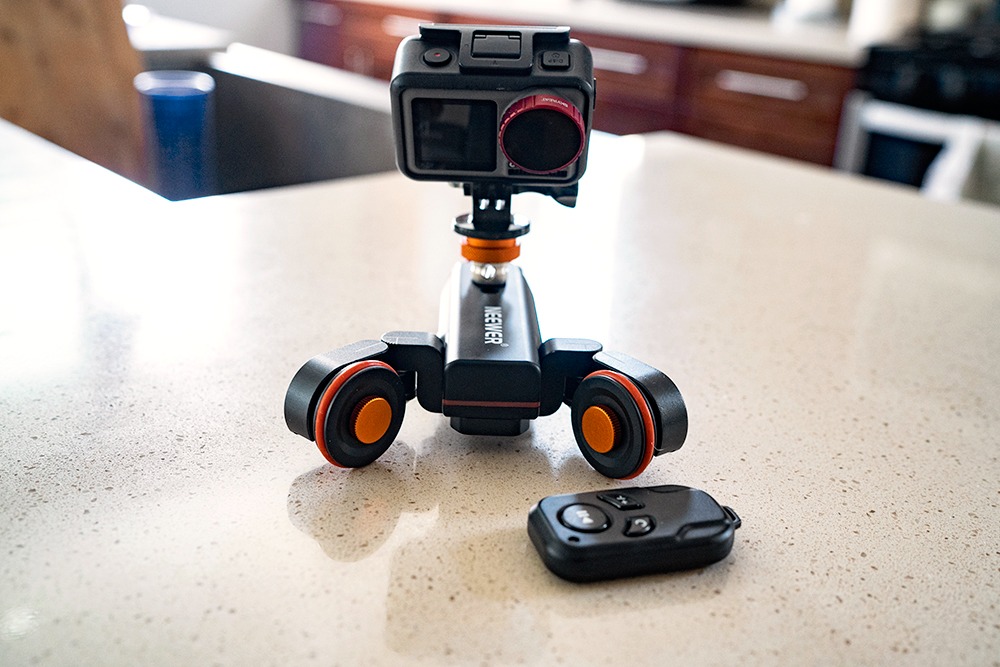
The DL100 is not a rail, and that is exactly why it works so often. It is a three-wheel rolling dolly that a battery and a small motor push along the floor, and for a DSLR shooter who wants parallax in a B-roll shot without carrying a track, it does the job with very little commitment. We used it for tabletop sweeps and short push-ins on a talking-head setup, and both read as genuine camera movement rather than a locked-off frame.
Build quality surprised us for the size. The chassis is rigid, the remote responds without hunting, and the fold-down size means it lives in a camera bag between shoots instead of on a shelf. The three speeds top out at 3.0 cm per second, which is quick enough for a reveal across a desk.
The wheel angle adjusts through 180 degrees, so you can dial a straight run, a shallow arc, or a curve around a subject. Buyers find that adjustment is trial and error rather than click-stopped, and the speed setting resets after a power cycle, so give yourself a minute to dial it in rather than doing it between takes.
Where it falls down is audio and terrain. The motor is audible, and on an interview-style shot with a shotgun mic close by you will hear it. It also wants a flat, smooth floor. On carpet, a slope, or anything uneven, the payload rating stops being the real limit and the surface becomes the limit instead.
What this DSLR slider gets right
A body with a modest zoom on top sits well within its 6.6 lb rating, and the convertible mount means you do not need an adapter to move between a DSLR and a phone. Reviewers report the build holding up well past that payload, so the margin is generous for a typical kit.
For solo creators, the wireless remote is the feature that earns its place. You set the framing, start the move from your hand, and step out of shot. Nothing else at this tier gives you a repeatable push-in without a second pair of hands.
Where it will disappoint you
Buy it for controlled indoor work, not for a location where the ground changes. Buy it if your audio plan is separate from the camera. If you need a still frame that drifts absolutely nowhere, a rolling wheel will never match a bolted rail, and reviewers do mention residual vibration even on a perfectly flat surface.
It also tips. A heavy ball head stacked above the mount raises the centre of gravity enough that vertical orientations and full ball heads are where accidents happen. Keep the head light or mount the camera directly.
2. Zecti 24 Inch Carbon Fiber Slider – Best Value Manual Rail
Zecti Camera Slider 24″/60 cm Adjustable Carbon Fiber Camera Dolly Track
Rating 4.4 from 556 reviews
24 inch rail,60 cm
4.4 lb max load
654g unit weight
Pros
- Double carbon fiber rail and four bearings give a quiet
- even glide
- 654g weight disappears into a backpack
- Carriage carries multiple one-quarter and three-eighths holes
- Removable adjustable legs and bubble level handle uneven ground
Cons
- Rough or noisy travel when carriage screws are tightened too far
- Short 24 inch rail limits longer moves
- 4.4 lb rating constrains heavier body and lens combinations
This is the rail we recommend to anyone moving from a locked tripod to their first slider. The double carbon fiber rail and four precision bearings produce consistently quiet manual travel at this level, and the carriage stays stable when you lock a ball head on top. For a short parallax push across a table or a step toward a speaker, it is hard to beat.
At 654g the whole thing basically disappears into a bag, and the included scratch-resistant case means it is not the thing that gets forgotten when the rest of the kit gets packed. The removable adjustable legs with their bubble level are a genuine help on carpet and slightly uneven indoor floors.
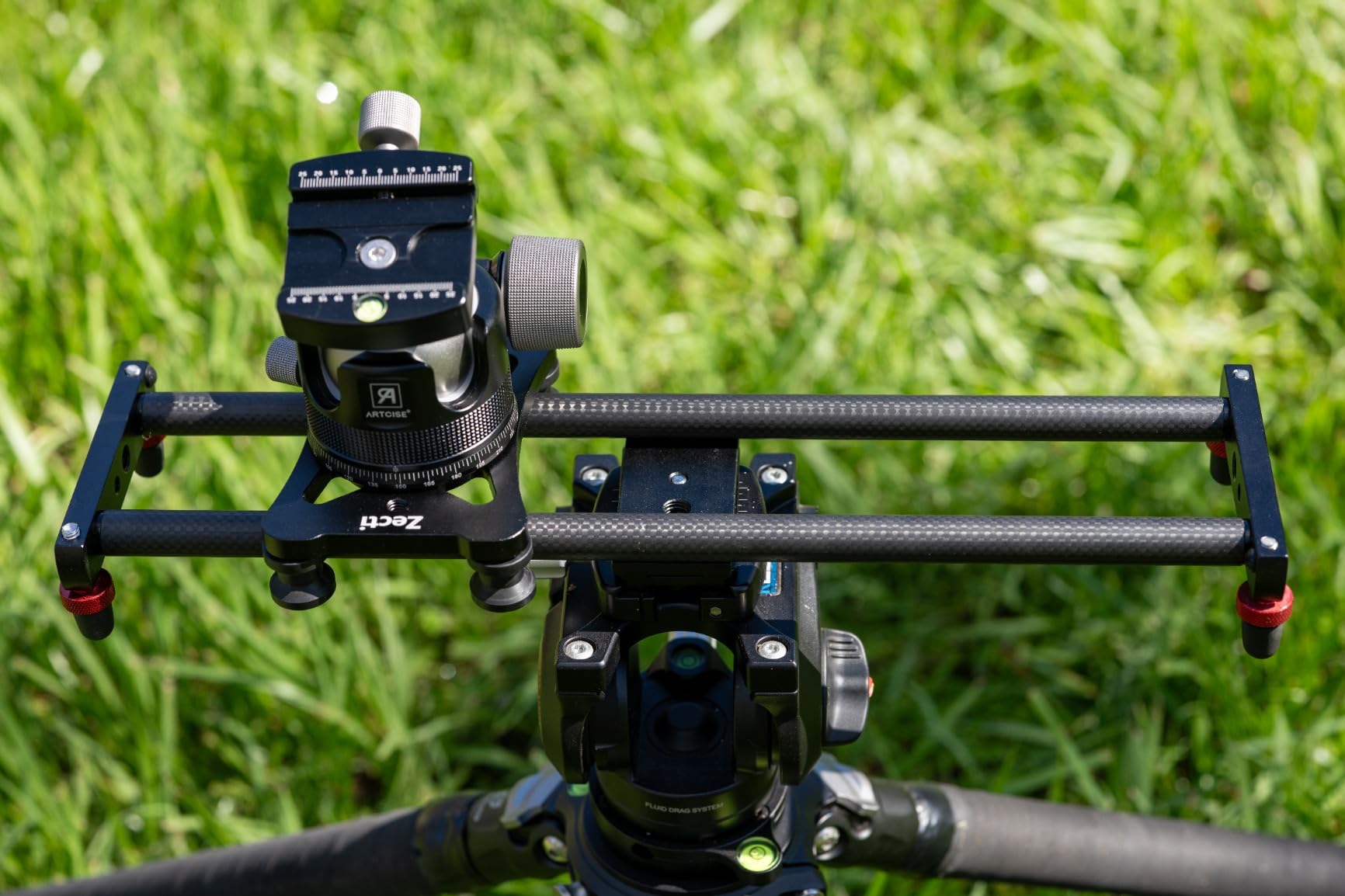
The single most useful thing about this carriage is the pattern of mounting holes at the centre and both ends. You can mount the ball head over the centre for a smooth push, or at the end for a reveal that starts on your subject. Buyers consistently mention how much that flexibility matters once you start planning shots around the hardware.
There is one setup mistake that shows up repeatedly in the reviews. If the carriage screws are tightened hard, the travel turns rough and noisy. Loosen them slightly and the glide returns to smooth. It is a two-minute fix, but only if you know to look for it.
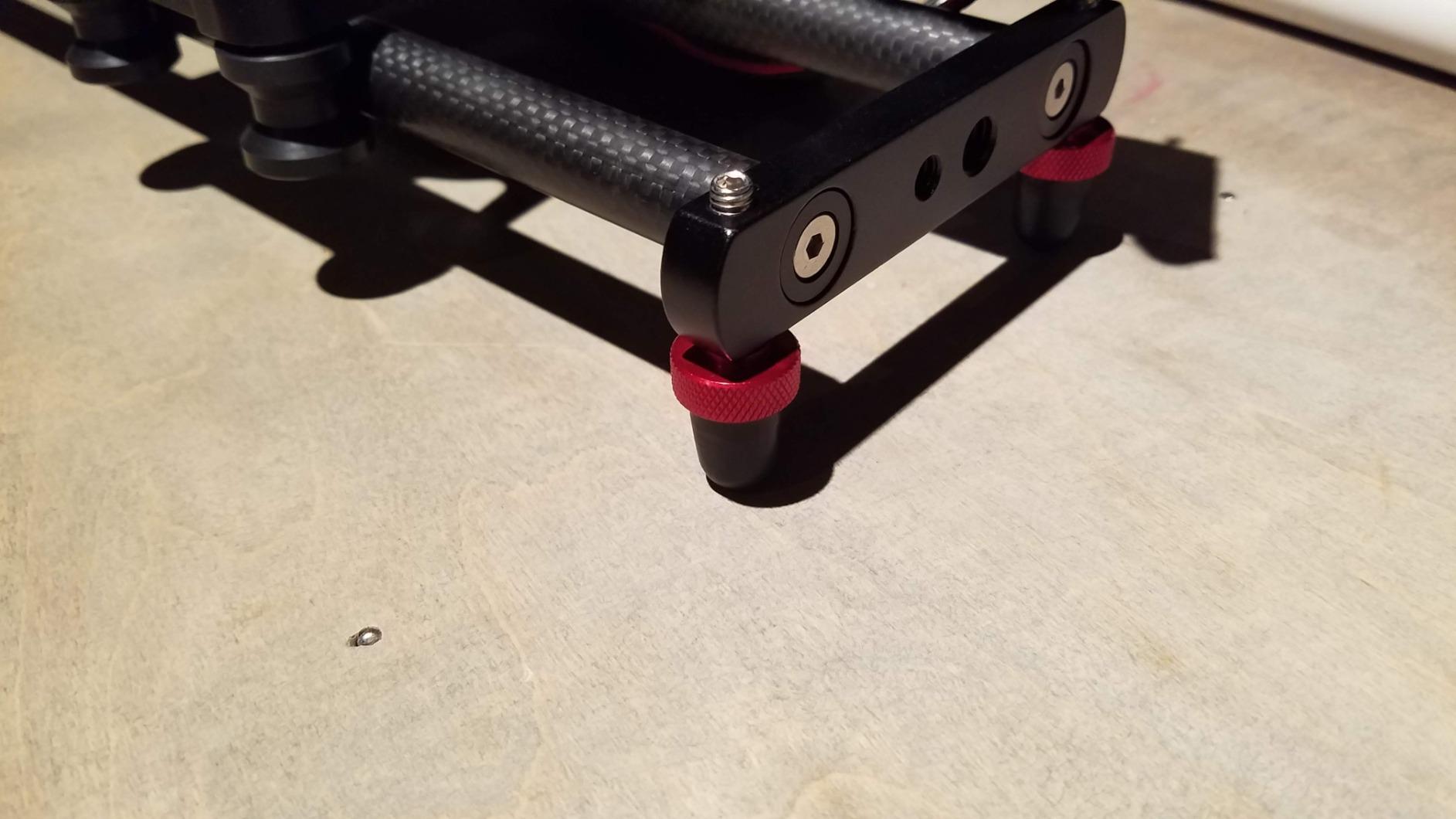
What this DSLR slider gets right
It runs quietly enough that you can record on-camera audio in the same take. There is no motor and no rumble, which makes this a better choice than any powered rail when the shot includes dialogue.
The footprint suits short, controlled moves. A 24 inch rail gives you a compact tabletop slide or a gentle push-in on a wide lens. It is a working tool for close moves, not a big sweeping one.
Where it will disappoint you
The 4.4 lb rating is the real constraint. A full-frame body with a fast zoom can sit close to that ceiling, and any cage or monitor pushes past it. If your rig runs heavy, the 40 inch manual rail and the 48 inch motorized one are built for that load.
Anyone planning long tracking shots or a big reveal should look at a longer rail instead. A 24 inch rail cannot generate the distance those shots need, no matter how good the glide is.
3. GVM 48 Inch Motorized Slider – Best for Long Programmable Moves
GVM Great Video Maker Camera Motorized Slider,48″/120CM,Automatic Round Trip,Time Lapse,Panoramic Shooting,Video Capture,Slider Smooth and Stable,with Battery
Rating 4.3 from 290 reviews
48 inch carbon fiber rail
5 kg max load
11.8 lb unit weight
Pros
- Long carbon fiber rail gives generous travel for tracking and reveal shots
- Controller programs speed dwell interval stop time and loop
- Quiet motorized travel with a manual mode as backup
- Includes battery charger controller and 6 shutter cables
Cons
- Heavy at 11.8 lb
- Unsupported rail end causes visible wobble without a tripod
- Cabling for shutter release adds setup time
When a shot needs to happen the same way on the fifth take as it did on the first, this is the rail. The controller sets start and end points, motor torque, speed from 1 to 100 percent, interval, stop time, photo count and auto loop, so a time-lapse sequence or a repeating interview push can be set once and left alone. The 120 degree panorama mode extends the sweep past the carriage width.
Travel is the headline. A 48 inch carbon fiber rail with a 5 kg rating can carry a full-size body and a long zoom and still have movement left to give. It suits a room, a hall, or an exterior where you want the camera to cover real ground.
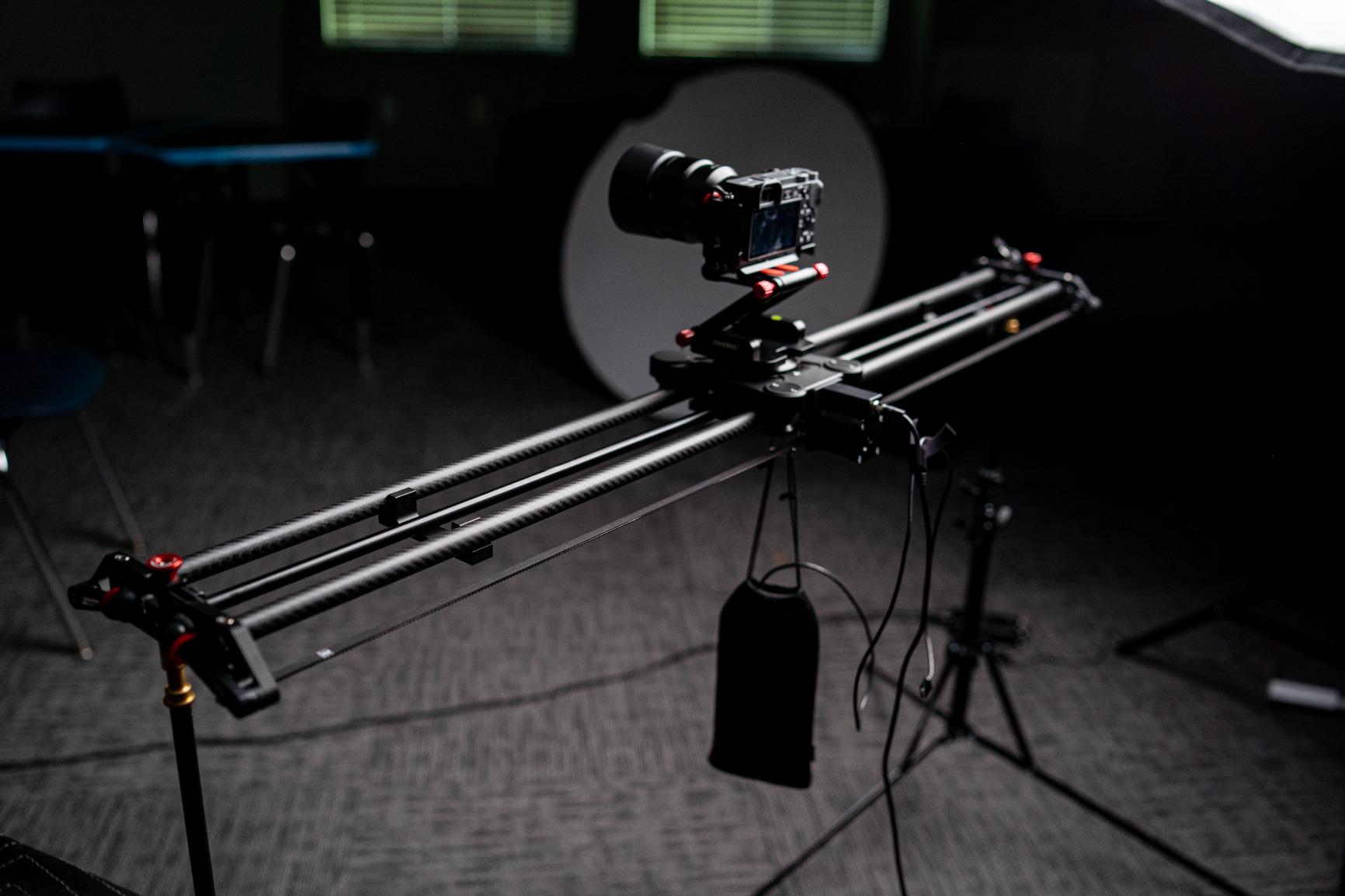
Reviewers describe the motor as smooth and quiet, and buyers appreciate that a manual mode is available when a programmed move is not what the shot needs. The adjustable feet level the track on uneven ground, and the bag and full cable set mean you are not hunting for spares the night before a shoot.
The weight is the honest drawback. At 11.8 lb this is a two-person carry for most people, and it is firmly a location-and-studio tool rather than a run-and-gun one. Mounting matters just as much. Without a tripod supporting the rail, the unsupported span can wobble visibly in the finished frame.
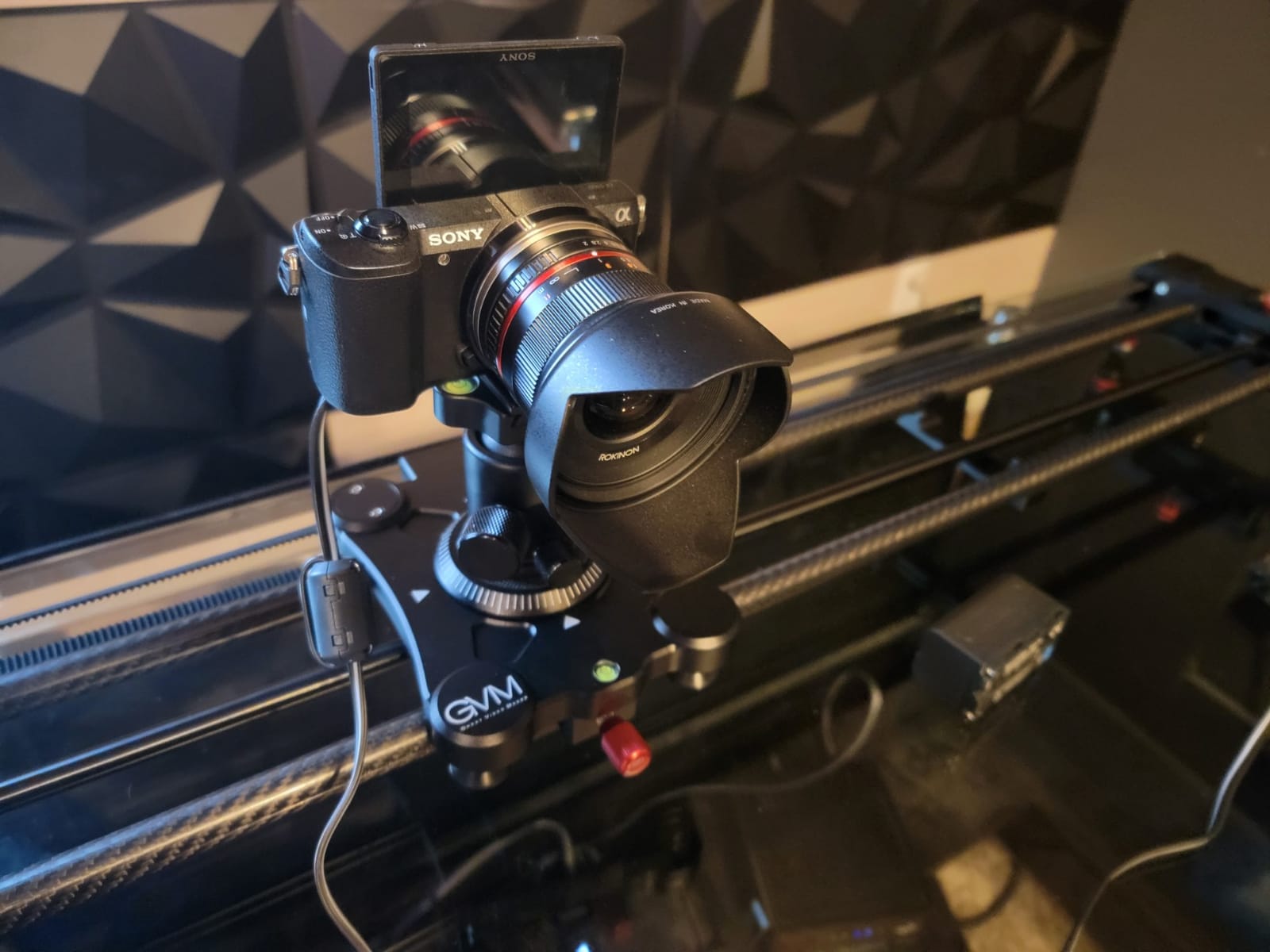
What this DSLR slider gets right
Repeatability is the reason to spend here. If your client wants the same push three times with different dialogue, you program it once. That is a capability no manual rail in this list can match, and it is why the 6 included shutter release cables matter more than the count suggests.
It also scales to a heavier rig than most of the field. The 5 kg rating leaves headroom for a body, a zoom, a small monitor and a top handle without pushing into the danger zone where the rail complains.
Where it will disappoint you
Skip it if your work is travel. Nobody is carrying an 11.8 lb rail onto a train, and a reviewer who bought it for run-and-gun work came back disappointed. It also adds a control layer between you and the camera, so a simple B-roll sweep becomes a setup task.
Budget for support hardware before you commit. A tripod under each end is what keeps the span honest, and skipping that support is the most common reason buyers report wobble. Our shotgun microphone picks cover the audio side once the moves land cleanly.
4. VidPro SK-22 Skater Dolly – Best for Low-Level Tracking and Pans
Vidpro SK-22 Professional Skater Dolly – Rolling Slider for DLSR Cameras & Camcorders Ideal for Low-Level Shooting & Panning 25 Lbs Capacity Smooth Rubber Wheels 7 Mounting Points & Extendable Handle
Rating 4.2 from 322 reviews
25 lb max load
2 lb unit weight
7 one-quarter-20 mounting points
Pros
- 25 lb capacity far beyond most rolling dollies at this size
- CNC machined aluminum chassis and stainless steel bearings
- Angle markers make curved and circular paths repeatable
- 27 inch extendable handle and magic arm add framing options
Cons
- Rolling wheels are less consistent than a rail over distance
- Needs a flat smooth floor for clean tracking
- No motorized or app controlled moves
The SK-22 solves a problem the rail sliders cannot: very low shots. With a magic arm and an extendable handle, you can put a camera a few centimetres off the ground and follow a walking subject, or hold the body above the dollies and pan across a wider arc. That is a different shot from anything on a track.
The payload is the surprise. At 25 lb it will take a serious rig, more than several rails here, and the CNC-machined aluminum chassis feels like it will survive being thrown in a van. Seven threaded mounting points give you room to reposition the arm without re-rigging the whole thing.
Angle position markers on the axle are a quietly clever touch. You set a curve or a full circular path, mark the angle, and the next take follows the same route. Reviewers who use it for product spins and reveal circles say that repeatability is what makes the tool worth owning.
Be realistic about the mechanics. Wheels on a floor will always be less consistent than bearings on a rail, particularly over distance, and a bump in a carpet seam is a bump in your shot. The feedback is that the rolling action is workable rather than beautifully smooth, which is a fair description of every skater dolly at this price.
What this DSLR slider gets right
It has the highest load rating in this roundup and it is easy to carry at two pounds. A heavy DSLR body, a large zoom and a monitor on top of a magic arm still sits comfortably within range, which is not true of most rolling systems.
It also needs no rail, no support tripod, and no batteries. On a flat studio floor you can be moving in a couple of minutes, and the circular paths open up shot ideas a straight push never will.
Where it will disappoint you
Do not expect a long, glass-smooth tracking shot. The further it travels, the more the floor dictates the result, and a smooth laminate floor is doing as much work as the dolly.
It is also a manual tool with no motor and no app, so there is no repeatability beyond what you set with the axle markers. If you need programmed moves that fire while you are out of frame, this is the wrong category.
5. GVM 27 Inch Motorized Slider – Most Versatile for a Powered Rail
GVM Camera Slider, 27” Aluminum Alloy Motorized Slider with Time-Lapse, Video Shooting and Round Trip Shooting, Track Dolly Rail for Most DSLR Cameras for Interview Photography
Rating 4.2 from 212 reviews
27 inch aluminum rail
2.5 kg max load
2.36 kg unit weight
Pros
- Motorized travel is smooth and stable for a mid-length rail
- Round trip time lapse and video modes cover common moves
- Adjustable feet and bubble level simplify balancing
- Works with DSLRs video cameras phones and ball heads
Cons
- 2.5 kg rating is modest for a pro body with a long lens
- Aluminum rail is heavier than carbon fiber rivals
- Wired controller only with no app or wireless control
This is a straightforward route into a powered rail that still feels like a proper dolly move, and for interview and general video work the results are dependable. The 27 inch aluminum track runs tracking passes, time lapse sequences and automatic round trips, and the motorized carriage holds a consistent line at both ends of the travel.
The feet and bubble level do more work here than you would expect. On a table or a slightly uneven floor, being able to level the rail without shimming is the difference between a level horizon and a visible tilt, and it takes seconds to set.
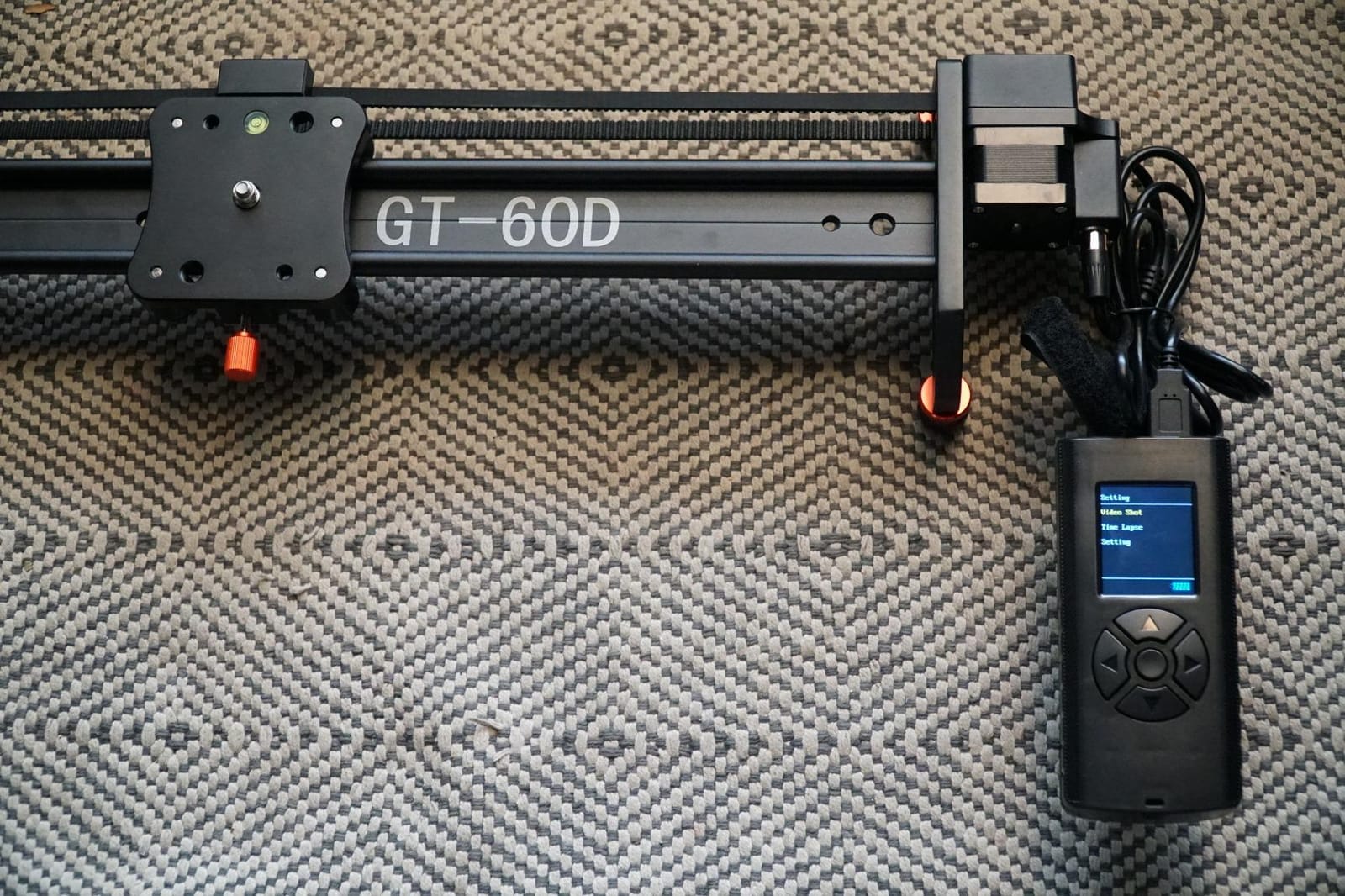
It also handles the mounting angles that come up constantly in real work. The screw holes on both sides and the centre let you shoot vertical, horizontal or at 45 degrees, and a ball head on top turns it into a slow drift rather than a fixed pass. Buyers using it for interview B-roll report that the round trip mode is the one they reach for most.
The two limits are physical. The 2.5 kg rating suits a mid-size body with a standard zoom, but a full-frame pro body with a telephoto will push it, and aluminum at 2.36 kg is heavier than the carbon fiber alternatives. The wired controller is also a real downgrade from app control. You are tethered to the rail.
What this DSLR slider gets right
A programmed move means you can step out of frame and still capture a clean push-in. For a solo creator filming themselves, that is the whole reason to buy a motor at all, and this rail does it without a phone app to learn.
The 27 inch length is a genuine sweet spot for a small studio or a home office. It packs down small enough to be a permanent part of a kit rather than a specialist piece of equipment, and the bag is included.
Where it will disappoint you
The 2.5 kg rating suits a mid-size body with a standard zoom and little else. A full-frame pro body with a telephoto leaves no headroom, and once you are near the ceiling the smoothness that buyers praise at lighter payloads becomes harder to predict. If your total lands close to 2.5 kg, choose a higher-rated rail instead.
Anyone who wants to start and stop the move from a phone will be disappointed. There is no wireless or app option, and the controller cable has to reach the camera, which adds a genuine tangle risk on a longer track.
6. StudioFX 40 Inch Ball Bearing Slider – Best for Long Manual Travel
StudioFX 40″ Ball Bearing Pro DSLR Camera Slider Dolly Track Video Stabilizer
Rating 4.0 from 186 reviews
40 inch rail
15 lb max load
Ball bearing slide with tension knob
Pros
- Long 40 inch rail gives ample travel for wide moves
- 15 lb load handles a full frame body and lens
- Carrying case included and legs detach for fast breakdown
- Screw down legs and bubble level aid accurate setup
Cons
- Bumpy travel out of the box without a break-in period
- Carriage plate can wobble and introduce jitter
- Feet grip poorly on smooth surfaces and wear over time
The StudioFX 40 is the manual option for a shoot that needs real distance. A 40 inch rail gives you enough travel for a genuine tracking pass or a slow push across a room, and the 15 lb rating is comfortably above a full-frame body with a zoom, so you are not constantly checking the load.
It arrives needing work. Buyers are clear that the bearings can feel bumpy or catch in places straight out of the box, and that a break-in period of slow back-and-forth passes plus a bearing tension adjustment is part of the ownership experience. Once it is dialed in, the reports describe it as smooth enough for many productions.
Construction is solid metal rather than the plastic used on the cheapest rails, and the legs detach for breakdown, with a bubble level on each for accuracy. The included case is a genuine bonus for a 40 inch rail, which is otherwise an awkward object to carry unprotected.
There are durability caveats worth knowing. The carriage plate can develop wobble that shows up as jitter, the rubber feet grip poorly on a smooth floor and can slip, and outdoors the track collects grit fast enough that owners find they are cleaning it with compressed air between sessions.
What this DSLR slider gets right
Length is the win. Where a 24 inch rail gives you a gesture, 40 inches gives you a move with a beginning and an end, and the difference is obvious on any shot wider than a tabletop.
Manual means fully manual, with no motor noise anywhere near your audio. For a shot where someone is speaking, that silence is worth more than any programmed move. Both mounting screw sizes are included, so head changes take seconds.
Where it will disappoint you
Skip it if you need a rail that works perfectly on the first take after unpacking. The break-in and adjustment are not a flaw so much as a fact of this design, but they cost you time on a tight schedule.
Also weigh the maintenance. Outdoors, expect to clean the track more often, and the feet are the component most likely to disappoint over time. A short travel rail in good condition will serve you better than a long one you are constantly maintaining.
7. NEEWER ER1 47 Inch App Slider – Best for App-Controlled Motion
NEEWER 47.2″/120cm Motorized Camera Slider, DSLR Carbon Fiber Dolly Rail Slider with App Control, 4400mAh F750 Battery for Time Lapse Photography, Supports Video Mode, NOT Include Charger, ER1
Rating 4.7 from 64 reviews
47.2 inch carbon fiber rail
11 lb horizontal and 5.5 lb at 45 degrees
2.5 kg unit weight
Pros
- Silent stepper motor keeps noise out of recorded audio
- Long 120cm carbon fiber rail in a 2.5 kg package
- App control covers manual video and time lapse with speed and interval control
- Sells strongly in the Camera Sliders category
Cons
- Charger and 2.4G remote are not included
- Load drops to 5.5 lb at a 45 degree tilt
- Slight shake appears in macro work
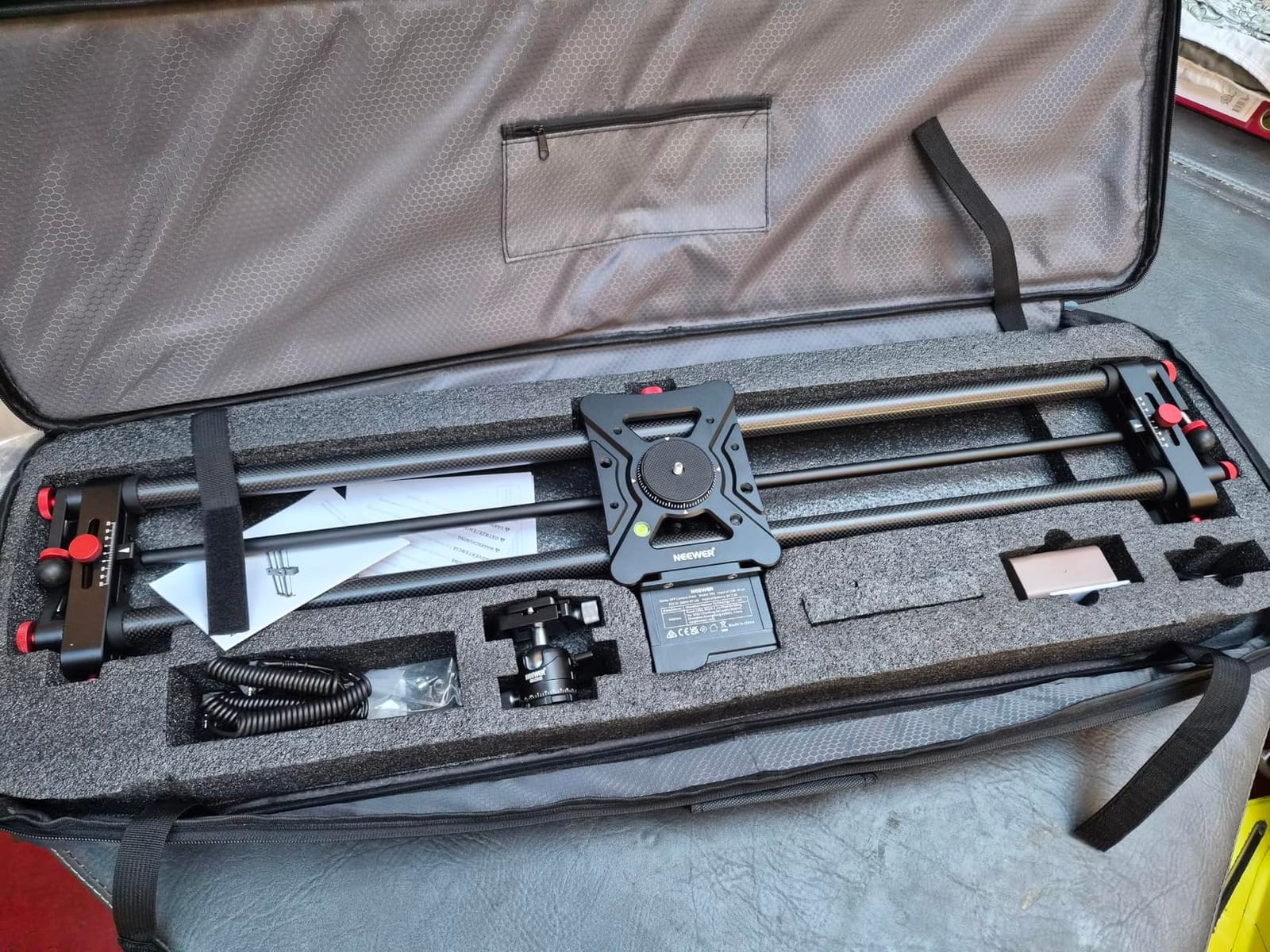
The ER1 is the one that most directly answers the question of whether app control is worth paying more for. Manual, video and time lapse modes all run from the phone, with adjustable speed, interval and exposure, plus optional 2.4G remote control if you would rather not touch a screen mid-take. It folds to 12 inches, so it travels better than its rail length suggests.
The stepper motor is one of the quietest drives in this roundup, and that is not a small thing. For interview and talking-head work where the audio comes from the camera, silence from the rail means you do not have to plan the motorized move around a noisy take.
Load ratings are stated honestly here, which we appreciate. Eleven pounds horizontal and 5.5 lb at 45 degrees is exactly the pattern most manufacturers bury, and knowing the angled figure before you angle the rail saves a dropped shot. Four roller bearings with anti-shake balance keep the carriage settled, and both one-quarter and three-eighths tripod threads are present.
Two practical notes. The 4400mAh NP-F750 battery is included but the charger is not, and the 2.4G remote is an extra, so plan for that before a trip. Buyers also report a small amount of shake in macro work, which makes sense on a rail this long at close subject distances.
What this DSLR slider gets right
App control frees the operator. Set the move, start it, step out of frame, and the shot repeats identically. For a solo creator, that is the feature that converts a slider from a B-roll tool into a second camera operator.
A long carbon fiber rail in a 2.5 kg package is a strong balance. You get 120cm of movement in something you can genuinely carry on location rather than a two-person job.
Where it will disappoint you
Angled work halves your usable payload. If your planned move runs at 45 degrees, treat 5.5 lb as the ceiling rather than a theoretical limit, and a long telephoto will not clear it.
It is also a smaller-reviewed product than most of this list, so treat the strong 4.7 rating as encouraging rather than settled. If you shoot macro close to the rail, the reported shake is worth weighing against a shorter unit.
8. NEEWER CS1M 16 Inch Slider – Best for Travel
NEEWER 16in/40cm Carbon Fiber Camera Slider with 360° Ball Head/Phone Clamp/Action Camera Mount, Dolly Rail Track with 4 Bearings & Adjustable Legs, Compatible with GoPro Insta360 iPhone Android, CS1M
Rating 4.2 from 64 reviews
16 inch rail,40 cm
4.4 lb horizontal and 2.2 lb at 45 degrees
615g unit weight
Pros
- Very smooth and near silent sliding on four high precision bearings
- 615g weight packs into any camera bag
- 360 degree ball head plus phone clamp and action cam mount
- Adjustable 360 degree legs with bubble level handle uneven ground
Cons
- Only about 12 inches of actual travel on a 16 inch rail
- New units can arrive misaligned with machining debris
- Some drag makes very slow even passes harder
The CS1M is the one we would put in a carry-on. At 615g with a padded bag, it adds almost nothing to a travel kit, and the build quality at that weight is genuinely good. The four high precision bearings give smooth, near silent manual travel, and the side tension knob lets you adjust it.
What sets it apart is the mounting package. A 360 degree ball head with a 90 degree tilt and a U-shaped notch, a phone clamp for a 2.2 to 3.4 inch device with an extra thread and cold shoe, and an action camera adapter all come in the box. That is a lot of versatility for a compact rail.
The legs extend through 360 degrees from 2 to 5 cm, so you can level the rail on uneven ground without a separate riser, and the bubble level takes the guesswork out. There are one-quarter and three-eighths mounts at the bottom and both ends, which means tabletop, tripod and vertical use all work out of the box.
Be clear about the travel. A 16 inch rail gives you roughly 12 inches of carriage movement, which is a short push rather than a long one. It suits tabletop and close-focus work, not a wide tracking pass. Some buyers also report that a new unit can arrive with the carriage misaligned and machining debris in the bearings, so check it before your first real shoot.
What this DSLR slider gets right
It is one of the easiest units here to carry as an always-on piece of kit, at 615g. Reviewers praise the portability as much as the glide, and for a travel filmmaker or a run-and-gun shooter, having a slider in the bag changes how many moving shots a shoot can produce.
Silent manual travel means no audio compromise at all, and the included ball head means you are not buying a second accessory to make it usable. For lighter mirrorless bodies the load rating is comfortable.
Where it will disappoint you
A heavier DSLR body plus a lens will not sit well with a 4.4 lb horizontal rating that halves to 2.2 lb at an angle. If your kit is heavy, this is not the tool and no amount of care will change the rating.
There is also some drag on the rails that makes very slow, even passes harder than they should be. That is fine for short moves and frustrating for a long one, which is another way of saying the travel limit is the real constraint here.
9. Accsoon Toprig S60 Motorized Slider – Best for Quiet Motorized Moves
Accsoon Toprig S60 Motorized Camera Slider Camera Dolly Rail Slider Button/APP Control, Speed Adjust/Time-Lapse/120° Panoramic/Loop Mode, Compatible with Gopro DSLR Phone for Photography (24inch)
Rating 4.6 from 35 reviews
24 inch rail,60 cm
16.73 inch travel
4 kg horizontal and 2.5 kg vertical
Pros
- Brushless motor runs under 30dB for clean recorded audio
- 12 second power-on auto calibration
- 4.96 lb unit with 16.73 inch of travel
- App and button control with time lapse loop and A-B points
Cons
- Motor lacks strength for a downward tilt and the camera runs forward
- Short 16.73 inch travel limits the shot range
- Batteries cables support arms and ball head are not included
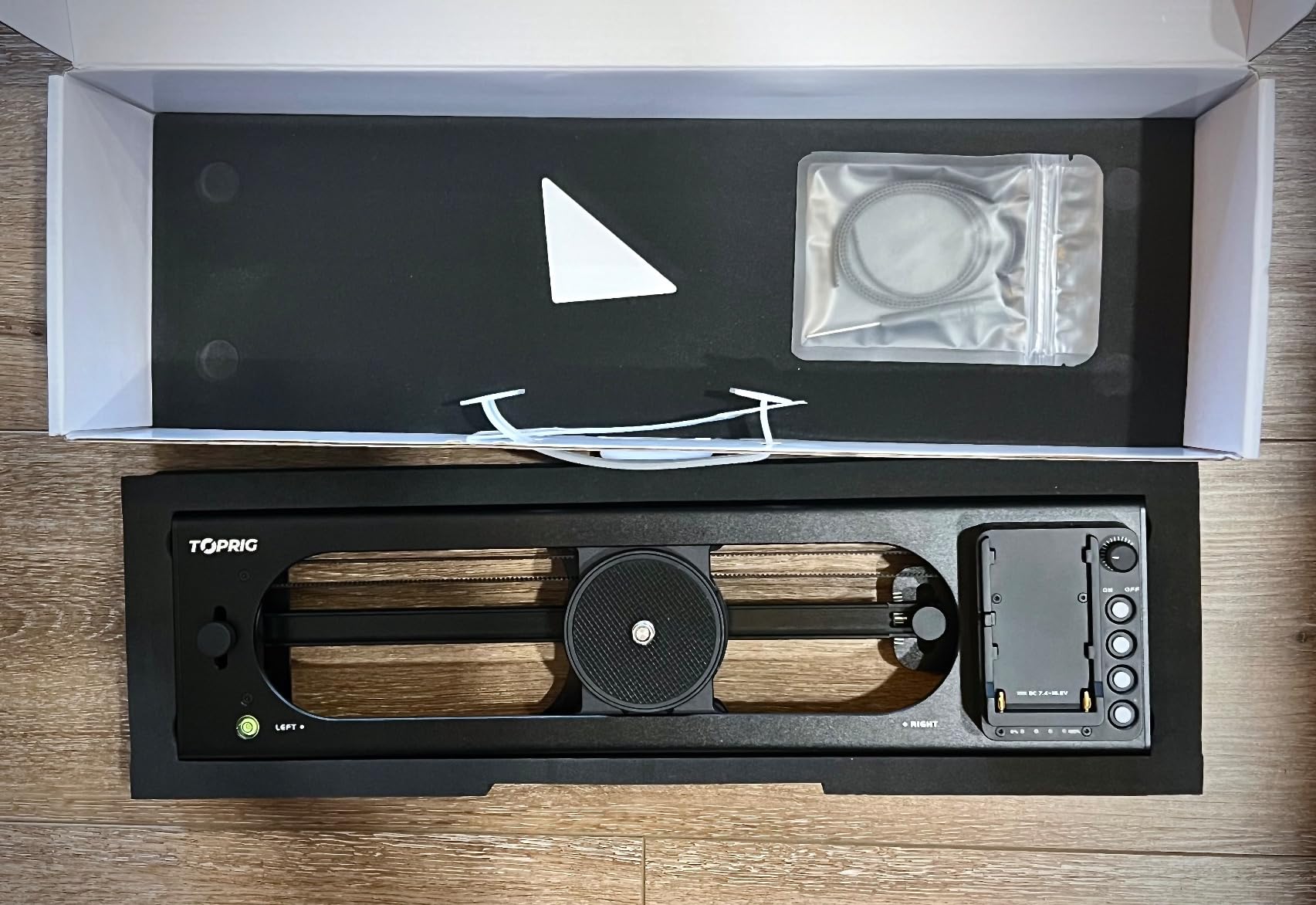
The S60 has a brushless motor rated under 30dB, which is a real specification rather than a marketing phrase. If your motorized move shares a take with dialogue, that number matters more than almost anything else on the list. The 12 second auto calibration on power-up also means less time kneeling next to the rail before a take.
Control is a mix of the practical and the programmable. A button panel with a speed knob handles the simple cases, while Bluetooth app control over iOS and Android covers time lapse, loop mode and A-B point programming for the shots you want to repeat. Specially for a solo creator, running the slider from a phone beats a tethered controller.
Power is flexible. An NP-F550 battery is not included but is supported, as are the larger F750 and F970 packs, and there is a 7.4 to 16.8V DC input for a field power solution. The universal one-quarter-20 mount keeps head changes simple.
The weakness buyers mention most is motor strength on an angle. On even a slight downward tilt, the camera can run forward rather than hold the programmed line, so keep the rail level or set it as a slight rise. Note also that batteries, cables, support arms and a ball head are all sold separately, so the support kit is a second purchase.
What this DSLR slider gets right
It handles a real rig without straining. A 4 kg horizontal rating leaves plenty of room for a full-frame body with a zoom and a top handle, which is more headroom than several of the compact motorized rails here offer.
Portability is the other strength. At 4.96 lb with a storage bag, a spare belt and a hexagon wrench in the box, this is a motorized slider you can genuinely move between locations rather than a fixture in a studio.
Where it will disappoint you
If your shot needs the camera to travel slightly downhill, this is the wrong tool. The documented behavior is a forward run rather than a controlled descent, and that can ruin an otherwise good take.
The 16.73 inch travel is also short. It is fine for a controlled push on a desk or a slow rise, and not enough for a room-scale reveal. Count the support accessories into your plan before deciding, since the ball head and arms are not in the box.
10. GVM 31 Inch Wireless Slider – Best for Six-in-One Motor Modes
GVM Motorized Camera Slider,31″ Wireless Carbon Fiber Dolly Rail Camera Slider with APP Control, Motorized Time Lapse and Video Shot Follow Focus Shot and 120 Degree Panoramic Shooting
Rating 3.9 from 65 reviews
31 inch carbon fiber rail
4.5 kg max load
4.5 kg unit weight
Pros
- Six shooting modes in one motorized unit
- Programmable speed dwell distance pause and photo count
- Wireless app control replaces a hardwired controller
- Carries a full frame body with a standard zoom
Cons
- App can fail to pair on some Android devices
- Small shake at the direction change
- Audible motor ticking and belt bumpiness reported on some units
This 31 inch GVM unit is the most flexible model in this list on paper, and it earns a place here for a specific reason. It combines tracking, panoramic, time lapse and video capture with free start and end points in a single 31 inch carbon fiber rail, and the program covers speed, dwell time, sliding distance, pause time and picture count. That is more control than most of the roundup offers.
Wireless app control is the meaningful upgrade over a cabled controller. Six shutter release cables and an extension cable are included, so the common DSLR and mirrorless bodies are covered out of the box, and the adjustable legs on both sides level the rail on uneven ground.
Owners with a working example describe the movement as smooth, exact and responsive, and report that it supports a full-frame body such as a Canon R7 with a Sigma 18-35 mounted. The padded carrying case is a good inclusion at this length, and the setup is quick enough for a location day.
This one carries the lowest average rating in the group, and the reasons are specific enough to plan around. App compatibility is the first thing to check: some Android phones will not install or pair the app, which leaves the rail difficult to use. Buyers also report a small shake at the direction change, audible motor ticking on sensitive microphones, and belt sag or bumpiness reported even after cleaning.
What this DSLR slider gets right
It offers the broadest set of shooting modes in this roundup. If you move between tracking passes, panoramas and time lapses, having all of them programmed on one rail saves you from repurchasing or re-rigging between formats.
Free start and end points mean you can use a fraction of the rail for a short move rather than fighting a full-length travel every time. That flexibility is what makes a 31 inch rail behave like a longer one.
Where it will disappoint you
Test the app on your own phone before you commit, particularly if you shoot on Android. A rail that will not pair is a rail that sits in a case, and that risk is not worth taking for a shoot you cannot afford to miss.
Quality control is also inconsistent enough that you should expect to inspect the belt and check for a shake at the direction change on day one. If you record audio on the camera, the ticking is audible, so separate your audio or keep the motor out of those takes. If you shoot multi-camera or need switching as well as movement, our video switcher picks cover the rest of the chain.
Manual vs Motorized: Which One You Actually Need
Start with the shot. A manual slider is right when the subject is a person, when the movement needs to respond to a performance, and when you are recording audio on the camera. A motorized slider is right when the shot must be identical across several takes, when you are alone and cannot operate and perform at once, or when you are running time lapses.
The second question is weight. A motorized unit carries a battery, a motor and often a controller, so for the same rail length you get less travel than a manual setup. If you already own a long manual rail and a decent ball head, adding a motor is often more useful than replacing the rail.
Think about how often you shoot. A manual rail you practice with regularly will outperform an expensive motorized unit left in a case. The recurring concern from experienced shooters is that a costly slider becomes a shelf ornament, and that is a budgeting argument as much as a technical one.
One more practical point. If you rent, rent the motorized option for a specific shoot that needs a programmed move. Buying one to cover two jobs a year is hard to justify, and renting removes the trial completely.
Buying Guide: Travel Length, Load Capacity and Rail Material
Travel length is not the same as rail length
The number on the box is rail length, and the number that matters for your shot is travel, the distance the carriage can actually cover between the end stops. A 16 inch rail can give you around 12 inches of carriage movement, while the 40 and 48 inch rails give you a genuinely long pass. A marketing figure for rail length tells you nothing about the shot on its own.
Focal length matters as much as distance. A wide lens on a short rail produces more apparent movement per inch than a telephoto on the same rail, because the field of view compresses the background shift. Practitioners on cinematography.com argue that a minimum of around four feet is needed for a proper push-in, which matches the pattern here: the 16 inch option is a gesture tool, and the 40 and 48 inch options are movement tools. The Accsoon S60 is the clearest example in this roundup of why the two numbers matter: it lists a 24 inch rail and 16.73 inch of travel, so nearly a third of the length is carriage and end hardware.
Do the payload math before you buy
Add your body, your lens, the ball head, any monitor or top handle, and then stay under roughly 70 percent of the rated figure. Angled mounting reduces the rating sharply, and every motorized unit here states the angled number alongside the horizontal one. The NEEWER ER1 drops from 11 lb to 5.5 lb at 45 degrees, and the CS1M drops from 4.4 lb to 2.2 lb.
A mid-size body with a standard zoom usually lands between 4 and 6 lb with a ball head, which is why the higher-capacity rails suit pro bodies. Check the angled figure for your intended move, not the headline figure, and leave room for what you will add later.
Carbon fiber or aluminum
Carbon fiber rails weigh less and hold their shape better, which matters for a long span angled toward the ground. Aluminum rails are heavier but cheaper and often more rigid at short lengths. The GVM 27 inch aluminum unit is a good example of the trade: it works well, and it costs you carry weight compared with the carbon fiber alternatives.
Feet, mounting and support gear
A slider that rocks is worse than a locked tripod. Look for adjustable or screw-down feet and a bubble level, and for a long rail, plan on a tripod supporting the far end. Several buyers on dvinfo.net describe mounting a mid-length slider on a locked tripod head to get real camera height, which is the cheapest way to add distance to a short rail.
Turn off in-body image stabilization before any slider move. IBIS is tuned to hold a frame still, so fighting a slow dolly pass produces visible warping and jitter at the edges of the frame. Use tripod or electronic stabilization on the body instead, and shoot at 24 fps or above with a shutter angle that avoids flicker.
Budget the support gear honestly. A rail plus two tripods, a ball head, an extra battery and cables is what a complete working kit costs, and several products here leave the box without a charger, a remote or a head. Buying the rail first and discovering the gaps mid-shoot is the most common regret we hear about.
How to Move a Camera Slider Smoothly by Hand
Manual movement is a skill, and it is a learnable one. The single most common question from new slider owners is not about gear, so here is the sequence that works.
Lock your elbows against your body or the tripod, and move from your core rather than your arms. Arms will fatigue and start to shake within a few takes, and a tired arm shakes at the start and the stop of the move, which is exactly where the viewer is looking.
Start at 60 to 70 percent of the rail for your first attempts, and finish the move with the camera already stopped. Build up to the full length only once short passes feel even. A partial pass done smoothly beats a full pass done badly every time.
Go slower than feels natural. Most beginners move too fast, and speed hides nothing. Push at roughly the pace of a slow exhale and let the finish carry a beat of stillness.
Clean the rail between takes and check the tension knob. Grit under the carriage is the number one cause of a bumpy pass, and on a new bearing rail a short break-in of slow passes makes a real difference.
Finally, lock the tripod heads before you move. The smoothest manual pass we have filmed still produced a wobble at the end because a fluid head was not tightened down fully. Confirm the end stops are set and the head is locked, then roll.
Frequently Asked Questions
What is the best slider for video and filmmaking?
Which motorized camera slider is the best?
What are the different types of camera sliders?
How do I move a camera slider smoothly by hand?
How much weight can a camera slider hold?
Can I make a DIY camera slider myself?
Why does my slider footage look warped or jittery?
Final Verdict: The Best Camera Sliders for DSLR Video
The NEEWER DL100 is the best camera slider for DSLR video for most people, because it is the one that will actually get used. It is small, quiet enough for a B-roll pass, remote operated, and it adds parallax to a shot without a rail in the frame. If your work demands silent manual travel, move up to the Zecti 24 inch carbon fiber slider, and if a move has to repeat identically across takes, the GVM 48 inch motorized rail is the tool that earns its weight.
Before any of them goes in the bag, turn off IBIS, lock the tripod heads, and check your payload with the ball head attached rather than the body alone. Those three steps prevent more ruined shots than the model choice ever will. This roundup was updated for 2026, and the picks are current as of that review.