
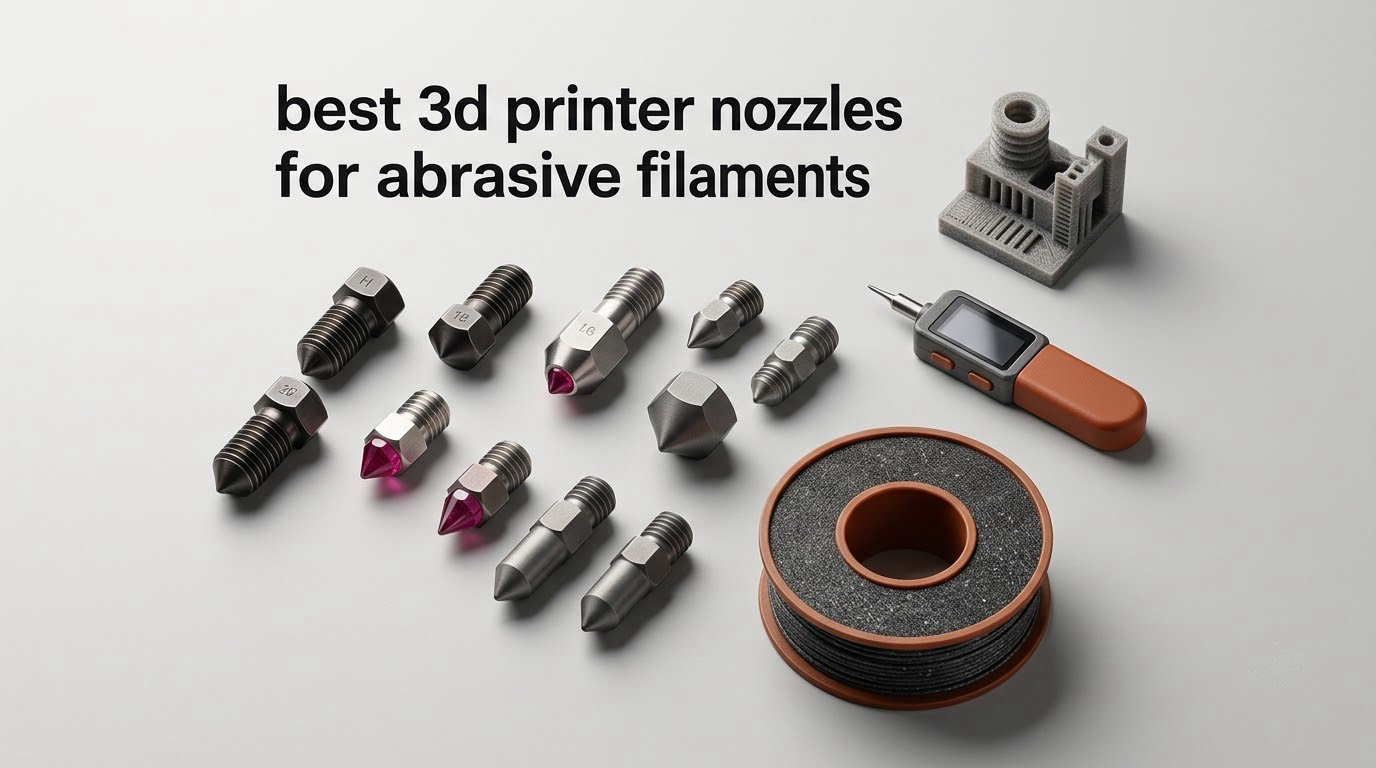
Abrasive filaments need a nozzle harder than brass. Carbon fiber, glass fiber, wood, metal and ceramic fills carry particles that work like sandpaper against a soft brass orifice, re-boring it wider until your real nozzle diameter drifts above the value your slicer assumes and every part comes out wrong. The material ladder runs from brass through stainless steel, hardened steel, tungsten carbide, ruby and sapphire, up to polycrystalline diamond, and picking the wrong rung is why people end up tearing a hotend apart mid-print for the third time in a week.
That is the honest answer for the best 3d printer nozzles for abrasive filaments: if you print carbon fiber nylon, glass-filled nylon or wood-filled PLA regularly, you want at least a hardened steel tip, and if those composites are a constant part of your workflow you want tungsten carbide. Both beat brass by a wide margin, and the gap between them is where most of the money and most of the arguments sit.
We built this guide around the material data each manufacturer publishes, the thread standards that actually fit printers, and the failure reports owners actually post, since no one in this niche is running published lab wear tests. That means the lifespan figures below are estimates drawn from community reports and material properties, not numbers we generated on a bench. Where the community contradicts the manufacturer, we say so rather than repeating the marketing line.
If you are still choosing a printer for composite work, our beginner printer roundup covers the machines that pair well with these tips.
Table of Contents
Top 3 Abrasive Filament Nozzles in 2026
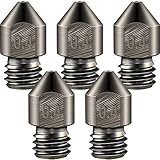
Mudder Hardened Steel MK8 5-Pack
- Hardened tool steel
- MK8 thread
- 0.4mm orifice
- Five tips per pack
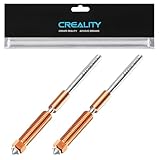
Creality K1 SE Hardened 0.4mm
- Copper alloy and hardened steel
- Titanium heat break
- 0.4mm
- Quick-swap mount
All 10 Abrasive Filament Nozzles at a Glance
| Product | Specifications | Action |
|---|---|---|
| Mudder Hardened Steel MK8 5-Pack |
|
Check Latest Price |
 POLISI3D Hardened Steel M6 4-Pack POLISI3D Hardened Steel M6 4-Pack |
|
Check Latest Price |
| Micro-Swiss A2 Hardened Tool Steel 0.6mm |
|
Check Latest Price |
 FlashForge Adventurer 5M Pro 0.6mm FlashForge Adventurer 5M Pro 0.6mm |
|
Check Latest Price |
| Creality K1 SE Hardened 0.4mm |
|
Check Latest Price |
 Diamondback MK8 Polycrystalline Diamond 0.4mm Diamondback MK8 Polycrystalline Diamond 0.4mm |
|
Check Latest Price |
 Dawnblade Tungsten Carbide MK8 0.4mm Dawnblade Tungsten Carbide MK8 0.4mm |
|
Check Latest Price |
 DUROZZLE Ruby 0.6mm for Creality K2 DUROZZLE Ruby 0.6mm for Creality K2 |
|
Check Latest Price |
 E3D ObXidian for Prusa MK4 and XL E3D ObXidian for Prusa MK4 and XL |
|
Check Latest Price |
 E3D Revo ObXidian 0.40mm E3D Revo ObXidian 0.40mm |
|
Check Latest Price |
1. Mudder Hardened Steel MK8 5-Pack – The One With 2000 Owners Behind It
Mudder 5 Pcs Hardened Steel Nozzles 0.4mm Mk8 3D Printer Nozzles
Hardened tool steel
MK8 thread
0.4mm orifice
Five tips per pack
Pros
- Handles thousands of grams of carbon-PLA blend and glow filament
- Bore gauged accurate with no burrs under magnification
- Low cost per nozzle for a hardened tip
- Direct MK8 fit for Ender CR-10 and Prusa i3
Cons
- Only two wrench flats so a socket will not seat
- Occasional reports of clogging and uneven extrusion
- Not machined flat on all sides
This is the nozzle we run when the question is simply what should I buy. It carries the largest verified owner base of anything in this roundup at more than 2000 ratings, and that number matters more than any spec sheet here because wear claims are the one thing a nozzle listing cannot prove.
The construction is straightforward: hardened tool steel, a 0.4 mm orifice, an MK8 thread for the Creality Ender and CR-series hotends as well as the Prusa i3 and Anet A8, and a bore the manufacturer rates to under 0.02 mm extrusion diameter error with a smooth burr-free inner wall. Reviewers with magnifiers report the bore matching spec, which is the single best predictor of whether an abrasive tip will hold calibration.
What owners actually report is thousands of grams of carbon-PLA blend and glow filament through the same tip without visible wear, and steady extrusion across mixed jobs. The tip sits in the sweet spot of the material ladder: hard enough to survive fiber, still cheap enough to treat as a consumable, which is the entire argument for buying hardened steel in a multi-pack.
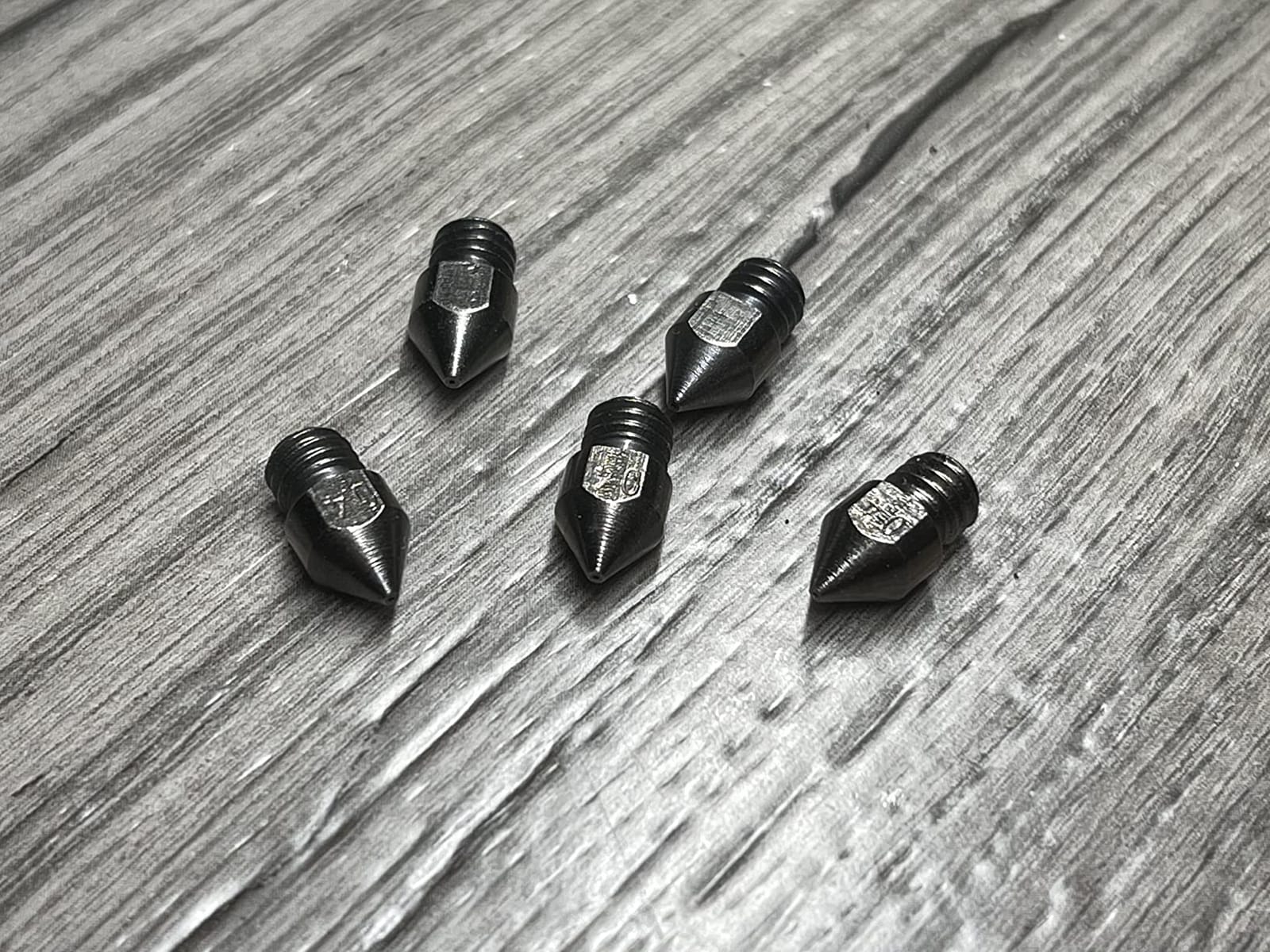
The engineering detail that matters most is the smooth, burr-free inner bore. Abrasive particles ream a rough-walled orifice faster because they catch on the machining marks, so bore finish is what separates a hardened nozzle that lasts from one that widens in a month. This one holds round and true in the reports we read.
The compromises are all mechanical rather than material. Only two wrench flats are machined instead of a full hex, so a socket will not seat and you are back to careful wrench work, and some units are not flat on all sides, which matters because a nozzle screwed in crooked sits uneven on the heat break. There is also a small tail of clogging complaints and a rare report of hot filament leaking at the joint after fitting.
What it handles well
Glow-in-the-dark filament, wood-filled PLA and carbon-fiber PLA blends, which is the middle tier of abrasiveness rather than the severe tier. Carbon fiber nylon and glass-filled nylon are within reach but will consume tips faster than these materials will.
The five-tip pack is the real reason to pick this over a single nozzle. Abrasive nozzles are consumables, and having spares on the shelf means you swap in seconds instead of ordering.
Where it falls short
If carbon fiber nylon or PA6-GF is your daily material, hardened steel is the entry tier rather than the destination, and you will go through tips regularly at this price. Tungsten carbide is the honest answer for that workload.
It is also strictly MK8. On a V6, MK8-to-V6 adapters exist and are widely used, but the seat height and heat break geometry are not identical, so budget for a small reprint of the first layers if you are adapting.
2. POLISI3D Hardened Steel M6 4-Pack – Four Sizes in One Box
4pcs Hardened Steel Nozzles M6 Nozzle 0.25/0.4/0.5/0.6mm Compatible with 1.75mm V6 Hotend Prusa I3 MK3S Anycubic Mega S Vyper 3D Printing PEI PEEK or Carbon Fiber Filament (1×0.25+1×0.4+1×0.5+1×0.6)
CNC hardened steel
M6 V6 thread
0.25/0.4/0.5/0.6mm
Four tips
Pros
- Four orifice sizes cover most layer heights
- Runs carbon fiber nylon PETG and PLA cleanly
- Sits at roughly factory seat height on Prusa machines
Cons
- Sizes marked by dots not printed numerals
- Slightly shorter than factory nozzles so Z offset needs checking
- One buyer found rust inside the bore
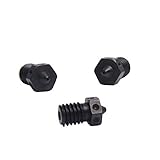
Most people who outgrow a brass tip do not need a better nozzle, they need a second size. This pack gives you 0.25, 0.4, 0.5 and 0.6 mm hardened tips on an M6 thread, which covers E3D V6 hotends, the Prusa i3 MK3S, Anycubic Mega S and Vyper, and most of the Repap fleet built on the same standard.
Each tip is CNC machined from hardened steel and the size is indicated by dot counts around the base, which is the old-school convention rather than the stamped numerals newer nozzles use. That matters more than it sounds because when you are pulling a hot nozzle apart mid-job, counting dots in poor light is a step you would rather skip.
Across roughly 500 ratings with about 76 percent five-star, owners use this as a durable brass replacement for carbon fiber and glass fiber filament, and they report the same seat height as factory tips on Prusa and Lulzbot machines, so no Z offset recalibration is usually needed. Roughly 4.4 out of 5 across just over 500 ratings.
The two details that decide whether this saves you money are consistency between the four tips and how accurately they were machined. If the bore tolerance is loose you will chase extrusion variation for weeks thinking it is the filament, and CNC machining plus a stated 0.02 mm-class tolerance is the reason this pack holds its reviews at 4.4 rather than lower.
Two real caveats surfaced. Some nozzles run a little shorter than factory tips, which shows up as a Z offset adjustment on the first print, and one reviewer found rust inside the bore, which points to inconsistent hardness between production runs. One buyer also received only three nozzles plus scrap.
What it handles well
PLA, PETG and standard composites on the V6 platform, plus carbon fiber filament at 0.4 mm and above. For PEI and PEEK at sensible temperatures the hardened body is an improvement on brass, though these filaments punish every material eventually.
The 0.25 mm tip is genuinely useful for carbon fiber PLA detail work, which is the most abrasive material you will ever feed a small orifice. At 0.6 mm you get the clogging resistance that abrasive jobs actually need.
Where it falls short
Four sizes means four chances for one of them to be the weak link, and quality control is looser than a boutique machining house offers. If you print one material at one size on a serious machine, a single precision nozzle is a better buy than four approximate ones.
It also does nothing for severe abrasives. Glass-filled nylon and carbon fiber nylon will eat these tips faster than you expect, and nothing in a hardened steel body prevents that.
3. Micro-Swiss A2 Hardened Tool Steel 0.6 mm – Machined and Plated in the USA
Microswiss Plated A2 Hardened Tool Steel Nozzle RepRap – M6 Thread 1.75mm Filament (.6mm)
A2 hardened tool steel
TwinClad XT plating
0.6mm
M6 thread
Pros
- TwinClad XT plating adds release properties that cut build-up
- Made in the USA by Micro Swiss
- Also produced in 0.4mm 0.6mm and 0.8mm
Cons
- Sold as a single nozzle so spares are bought separately
- The plating is harder to clean than a bare hardened tip
Micro Swiss makes this one in the United States from A2 hardened tool steel with TwinClad XT plating, and the plating is the interesting part. A release plating means filament does not stick to the outside of the tip the way it does on bare hardened steel, which keeps the melt zone free of the carbonized build-up that causes most clogs on fiber material.
The 0.6 mm orifice is a deliberate choice for abrasive work rather than a general-purpose size. Larger holes mean more melt capacity and fewer chances for a fiber bundle to wedge at the entrance, and at 0.6 mm this nozzle also suits PETG and standard plastics when you want one tip that does everything.
Fit is M6 on E3D 1.75 mm V5 and V6 hotends plus the Prusa i3, and the same tip exists in 0.4, 0.6 and 0.8 mm. Reviewers rate it 4.5 out of 5 from about 233 ratings, with a loyal owner base that comes back for the second tip in a different size.
What it handles well
Glass-filled nylon, carbon fiber nylon and metal-infused PLA, run at 0.6 mm where fiber has room to move. The plating earns its keep on anything that leaves build-up around the tip, so PETG and ABS jobs stop needing a manual wipe between prints.
It is the pick here for anyone who wants a single abrasive-capable nozzle for a V6 hotend and does not want to track four different bodies.
Where it falls short
It is one nozzle. Since abrasive tips are consumables, that means buying each spare individually, and single-nozzle purchases are exactly how people end up printing a critical job with no replacement on hand.
The plating is also a liability when cleaning. Non-abrasive methods only, because a brass brush or an acupuncture needle will strip the surface layer and leave you with a bare hardened tip that builds up like any other.
4. FlashForge Adventurer 5M Pro 0.6 mm – Built for Speed, Not Just Wear
FLASHFORGE Adventurer 5M Pro Nozzle, 0.6mm Hardened, 280℃ High Flow 32mm³/s for Stable High-Speed Printing, Compatible with Adventurer 5M Hotend, Perfect for High-Strength Filaments
Hardened steel
0.6mm orifice
32 cubic mm per second
280C rated
Pros
- Tool-free removal in about three seconds
- Handles several kilograms of PA6-CF and PLA-CF
- Keeps dimensional precision on high-speed prints
Cons
- Some tips wear out after a couple of months
- One report of shattering against the build plate
- Reported clogging traced to wet filament not the tip
Most hardened nozzles are a wear upgrade on an otherwise ordinary hotend. This one is a different kind of part: hardened steel in a high-flow design rated at 32 cubic mm per second, which is what makes it viable on the Adventurer 5M Pro at the speeds that machine runs.
The other numbers matter too. It is rated to 280C, it reaches 200C in roughly 35 seconds, and the tool-free quick removal takes about three seconds, which matters enormously when a clog means a partial teardown of a hotend that is still hot enough to hurt you. The same series is offered in 0.25, 0.4, 0.6 and 0.8 mm, and the manufacturer states the 0.6 and 0.8 sizes are built for abrasive carbon fiber filament.
Owners report pushing several kilograms of PA6-CF and PLA-CF through it without visible wear and keeping dimensional precision on fast prints, rating it 4.3 out of 5 from around 193 ratings.
The flow rating is where this tip separates itself from a generic hardened steel nozzle. Abrasive material expands, jams and chars when the melt zone cannot keep up with the feed rate, so a nozzle that delivers 32 cubic mm per second clears fiber faster than a standard tip and gives itself less time to cook. If you are printing composite at high speed this is the difference between clean extrudate and a clog every few hours.
The failure reports are worth reading too. Several owners describe tips dying after a couple of months of regular printing, and one describes the nozzle shattering against the build plate and damaging the extruder, which is a hard-material problem rather than a wear problem.
What it handles well
High-speed PLA-CF and PA6-CF, where melt capacity is the limiting factor and a standard orifice struggles to keep fiber moving. The 0.8 mm version is the better choice than 0.6 mm for this, because more bore means fewer opportunities for fiber to bridge.
Fast recovery also helps with heat creep on long prints, since the tip gets back to temperature quickly after the cold end does its job.
Where it falls short
It only fits the Adventurer 5M series hotend. There is no V6 or MK8 version, so anyone outside that platform is looking at the wrong product entirely, and the all-metal quick-swap mount is not a standard thread.
It is also a consumable at a higher price than generic hardened tips, and a shattered tip damages the extruder rather than just the nozzle, so treat it with the same care as a tungsten carbide tip.
5. Creality K1 SE Hardened 0.4 mm – The Best Rated Tip in the Group
Creality K1 SE Nozzles, Upgrade K1C Unicorn 3D Printer Nozzles Kit, Original Ender 3 V3 SE Hardened Steel Nozzle for Creality K2 SE/K1/K1 Max/Ender 3 V3/3 V3 Plus/3 V3 KE 3D Printers (0.4mm 2PCS)
Copper alloy and hardened steel
Titanium heat break
0.4mm
Two tips
Pros
- Highest average rating in the roundup at 4.7 out of 5
- Titanium heat break cuts heat creep
- Quick swap is all metal and ships with thermal compound
Cons
- Fits Creality quick-swap mounts and nothing else
- Owners report around six months of service in normal use
This tip scores 4.7 out of 5 across about 165 ratings, with 85 percent five-star, and it earns that with a different approach to the problem. Instead of a hardened steel body, it pairs a copper alloy with hardened steel as a bimetallic tip, which puts copper’s conductivity where heat transfer matters and steel’s hardness at the orifice.
The other structural choice is the titanium alloy heat break, and that is what stops heat creep during long composite prints. Creality claims flow up to 30 cubic mm per second at 240C supporting 600 mm/s printing, and lists PLA, ABS, PETG, TPU, PP, PC, PLA-CF, PA-CF and PET-CF as supported materials.
Fit covers a wide slice of the Creality range: the K2 SE, K1 SE, K1C, K1, K1 Max and the Ender 3 V3, V3 Plus, V3 KE and V3 SE. Two nozzles come in the pack and thermal compound is included for the install, which is a small detail that saves a support.
What it handles well
Everything on a Creality quick-swap mount, in every material the machine supports. Owners consistently mention an easy exact fit, clean printing from the box, and the absence of the burnt-plastic smell that copper-alloy tips can produce, plus parts that need very little cleanup afterwards.
Because the heat break is titanium, long PET-CF and PA-CF jobs on a heated bed hold their temperature better than a steel-bracket setup would.
Where it falls short
Fitment is the limit. The Nextruder-style quick-swap mount is Creality-specific and not a V6, MK8 or Volcano thread, so this is not a general purchase even though the machine list looks long.
Owners report roughly six months of service in normal use, which is normal for a consumable but worth knowing if you assumed this was a permanent upgrade. The other caveat is the price, which sits above generic hardened tips for a specific platform.
6. Diamondback MK8 Polycrystalline Diamond 0.4 mm – The Top of the Material Ladder
Diamondback MK8 Compatible 3D Printer Nozzle, Diamond Tip, 0.4mm
Solid polycrystalline diamond
0.4mm orifice
MK8 thread
300C rating
Pros
- Solid PCD tip rather than a thin coating
- Handles standard and abrasive filament on one nozzle
- Claimed 2 to 8 times the tool life of tungsten carbide
- Nine orifice options including high-temperature variants
Cons
- Costs far more than hardened steel or tungsten carbide
- Keep operating temperature under 300C
- Requires following printer and filament maker specs
Every other tip in this roundup is a metal body with a hard insert or a plated surface. This one has a solid polycrystalline diamond tip, which is thousands of tiny diamond crystals joined by diamond-to-diamond bonds, so the wear surface is not a coating that can be scratched through. It is rated to 4.5 out of 5 from about 158 ratings.
The practical argument for PCD is that it removes the compromise every other nozzle makes. You can print plain PLA and ABS alongside carbon fiber, copper and iron filled filaments on the same tip, and the manufacturer claims 2 to 8 times the tool life of tungsten carbide and other hard metals. That is a diamond-specific claim rather than a test result, but the direction is supported by how far diamond sits above carbide on the hardness scale.
Construction details worth noting: high thermal conductivity moves heat from the hotend into the filament rather than away from it, the tip is rated to 300C, and orifices run from 0.2 mm to 1.0 mm including high-temperature variants. The fit is MK8 on 1.75 mm filament.
What it handles well
The severe end of the abrasive spectrum: metal-filled filaments, ceramic-filled filaments and the toughest composites, where copper and iron fill will destroy a carbide tip in a matter of weeks. For those materials a diamond tip is the only sensible answer, not a nicer one.
Having a single nozzle that covers both standard plastics and severe composites removes the swap, the second heat break, and the temperature recalibration that comes with changing tip material.
Where it falls short
The cost is the first thing you will notice, and it puts this tip out of reach if you are printing composites occasionally. Nobody should buy this for PLA-CF.
Two operational limits are real. Operating temperature should stay under 300C, which rules out some high-temperature engineering polymers for continuous running, and the manufacturer is explicit that you need to follow printer and filament specifications, because a tip this hard is easy to damage with pliers and there is no cheap replacement when it chips.
7. Dawnblade Tungsten Carbide MK8 0.4 mm – What the Community Actually Recommends
Tungsten Carbide MK8 Nozzle 0.4mm/1.75mm, Wear Resistant for 3D Printer
Tungsten carbide
9 Mohs hardness
130 W per m K
550C rating
Pros
- Thermal conductivity of 130 W per m K against 26 for hardened steel
- 9 Mohs hardness comparable to ruby
- Low expansion of 4.5 holds up on long hot jobs
Cons
- Sold as a single nozzle with no spares
- Brittle and can crack if knocked against a hard surface
- Listing gives the thread as M6 while marketing it as MK8
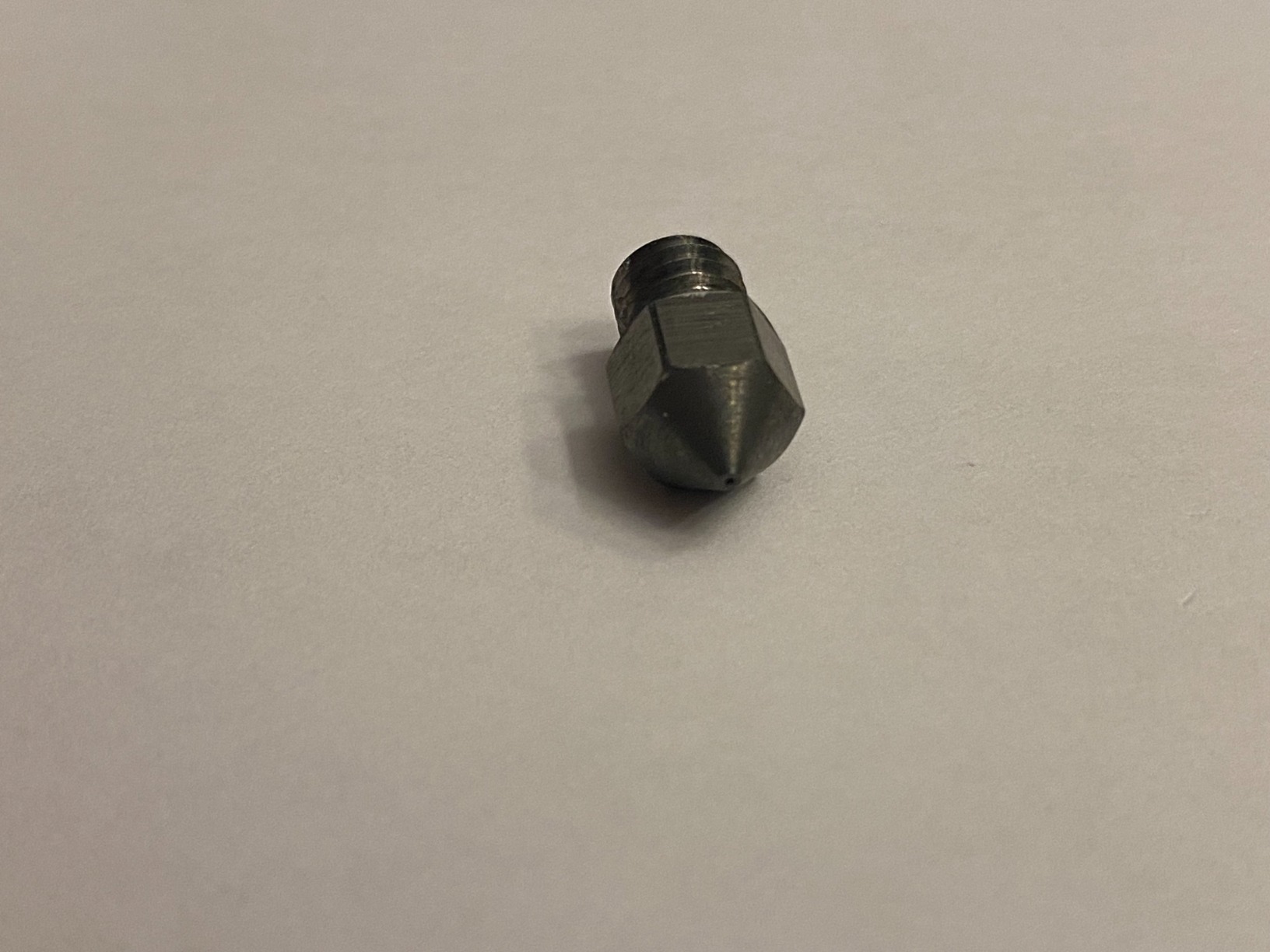
This is the material the forum consensus keeps pointing at, and the numbers explain why. Tungsten carbide measures 9 Mohs hardness, comparable to ruby, is rated to 550C, and conducts heat at 130 W per m K against 45 for ruby and only 26 for hardened steel. On r/prusa3d the recurring advice is blunt: the answer is not hardened steel but tungsten carbide, because carbide is both harder and a better conductor.
Those two properties together are what make carbide the community default for serious abrasive work. The higher hardness means the orifice holds its diameter, and the higher conductivity means the melt zone stays hot enough to keep fiber moving instead of cooking the nozzle from the inside.
The thermal expansion figure of 4.5 micrometres per metre per degree, against 16.7 for a copper-plated nozzle, is why people run carbide on long high-temperature jobs and large molds. Reviewers rate this tip 4.3 out of 5 from about 81 ratings, with the finish listed as nickel and the fit as MK8 Ender and CR-series hotends plus the CR-10 all-metal, Prusa i3 and Anet A8.
The single most useful thing about this tip is that it removes the temperature problem that makes hardened steel annoying. Because carbide conducts heat three to five times better than hardened steel, you can often run the same profile you used on brass, which is exactly what forum users report after switching from steel.
The hardness number is the other half of the story. At 9 Mohs, the orifice resists re-boring from fiber in a way no steel tip can match, and that means the extrusion width your slicer assumes stays true across a whole spool rather than drifting over a few hundred grams.
What it handles well
Carbon fiber nylon, PA6-GF, PET-CF and the harder composites where steel tips start wearing visibly. If your weekly filament use includes fiber-filled nylon, this is the material the forum consensus actually recommends.
Long prints above 240C, because the low expansion coefficient holds geometry steady and the conductivity keeps the melt zone consistent across a large part.
Where it falls short
It is brittle, and brittle tips do not survive being knocked. A carbide tip that catches the edge of a build plate or takes a wrench slip can crack outright, so no pliers and no overtightening, which is a real risk on a cheap single-nozzle purchase.
It is also one nozzle with no spares, and the listing is internally inconsistent, giving the thread type as M6 while marketing the part as an MK8 fit. Confirm your mount before ordering.
8. DUROZZLE Ruby 0.6 mm for Creality K2 – Hardest Tip You Can Drop In
DUROZZLE Quick-Swap Ruby Nozzle 0.6mm for Creality K2 Plus/ K2/ K2 Pro/Creality Hi Combo 3D Printers, Hardened & Abrasion Resistant for Precision Additive Manufacturing
Genuine ruby tip
0.6mm orifice
Creality K2 quick-swap
Funnel bore
Pros
- Genuine ruby is the hardest common nozzle material for abrasion
- Polished funnel-shaped bore limits dead corners where fiber collects
- All-metal integrated quick-swap design
Cons
- Brittle and will not tolerate impact against hard surfaces
- Ratings rest on a thin review base of about 46
- Fitment limited to the Creality K2 family
Ruby is the tip material that predates carbide as an abrasive solution and remains the hardest thing in this list. This one uses a genuine ruby tip rather than a synthetic substitute, cut and polished into a funnel-shaped internal bore, fitted to the Creality K2 Plus, K2, K2 Pro and Hi Combo quick-swap mount as an all-metal integrated nozzle and heat break.
The funnel geometry is not styling. Square bores have dead corners where fiber collects and carbonizes, and those collections are the actual cause of most so-called clogging on composite prints. A polished taper gives particles nowhere to sit, which is why ruby tips were originally developed for boron carbide and why they are still used on metal-filled filaments.
It is rated for carbon fiber, glass-infused and metal-filled filaments while still handling ordinary PLA, ABS and nylon, so it is a single-tip solution for a printer that does multiple materials. Ratings sit at 4.4 out of 5, though from only about 46 ratings, which is the thinnest evidence base in this roundup.
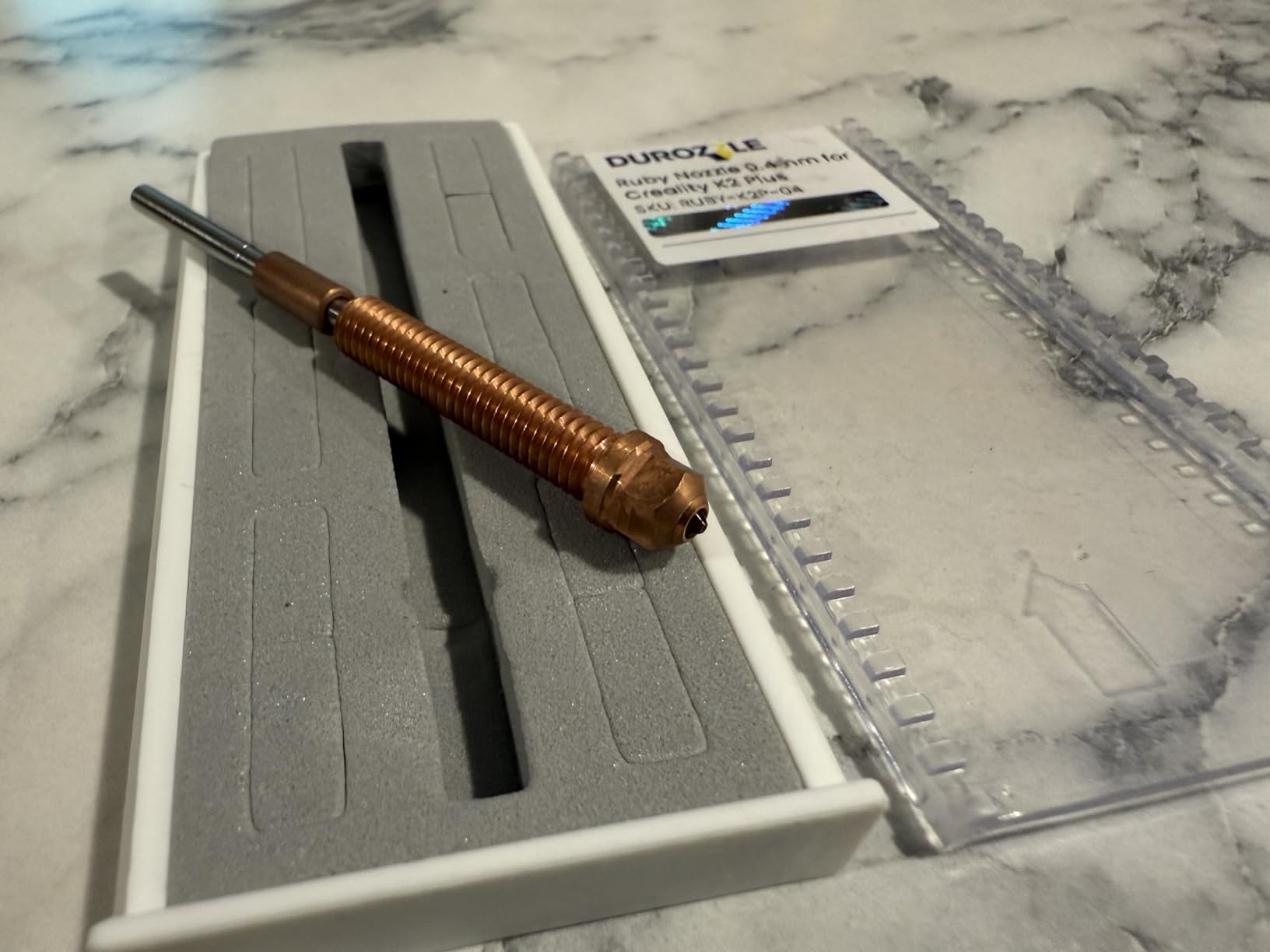
Ruby on the Mohs scale sits above tungsten carbide, so for pure abrasion resistance it is the harder option here, and it matters most on metal-filled filaments where iron and copper particles would wear a steel or carbide tip quickly. For carbon fiber nylon alone, carbide is usually the more practical pick because it is far less fragile.
The 0.6 mm orifice is a sensible abrasive diameter. More bore means more melt capacity and a lower chance of a fiber bundle wedging at the entrance, and at 0.6 mm you still get surface finish good enough for functional parts.
What it handles well
Metal-filled and ceramic-filled filaments, which are the worst case for any nozzle. The hardened abrasive resistance is the whole point at this material level.
Printers where build-up is the recurring problem, because the polished bore and the harder tip surface both reduce the sticky build-up that turns into a clog.
Where it falls short
It fits the Creality K2 family quick-swap mount only, so it is a narrow purchase regardless of the material tier.
Ruby’s weakness is impact, and it has almost none. A drop onto a hard bench or a slip of a wrench can crack the tip, and with a thin evidence base and a restricted platform, that is more risk than most readers need. Forum testers have also reported ruby tips cracking within 20 to 30 hours of use, so durability is not the reason to choose this material.
9. E3D ObXidian for Prusa MK4 and XL – The OEM Answer With a Real Dispute Attached
E3D Prusa ObXidian MK4/XL Nozzle – 1 pcs – 0.4mm
Tool steel insert with E3DLC coating
0.4mm orifice
Nextruder on MK4 and XL
Pros
- E3DLC coating cuts plastic build-up around the tip markedly
- All-metal filament path suits the Nextruder design
- Tool steel insert gives far more wear resistance than plain hardened steel
Cons
- Costs well above generic hardened steel nozzles
- Compatible only with the Prusa MK4 and XL Nextruder hotends
- Lowest review count in the roundup at about 38
ObXidian is a tool steel insert with an E3DLC non-stick coating, sold as the abrasive-capable tip for the Nextruder on the MK4 and XL. The argument for it is straightforward: E3D describes wear resistance as orders of magnitude above its own other nozzles, and the coating’s job is to cut the plastic build-up around the tip that turns into a clog on fiber material.
It is also the OEM route for Prusa owners, which matters because a Nextruder hotend and a third-party nozzle are not always a clean pairing. The all-metal filament path through the Nextruder design is part of what makes this nozzle work, and it comes as a single 0.4 mm tip rated at 4.3 out of 5 from about 38 ratings.
Now the part most roundups skip. Prusa’s own help article carries a dissenting comment from a user who reports losing many ObXidian nozzles printing glass fiber or carbon fiber material, arguing they suit PLA and PETG rather than demanding composites, and another reader who has read that the high-flow ObXidian variants clog badly on abrasive material. Both complaints sit unaddressed under a manufacturer page that lists the nozzle as suitable for abrasives.
Our reading is that the coating is doing two jobs badly on severe material. The same low-adhesion surface that prevents build-up is what people report collecting PETG-CF blobs, and a coating that fails leaves a tool steel insert that is more wear-resistant than plain hardened steel but not in the carbide class. Treat this as a good tip for filled plastics on a Prusa, not as a universal composite answer.
What it handles well
Prusa MK4 and XL owners who want an OEM-matched abrasive-capable nozzle without adapters. The Nextruder path is properly supported and the coating keeps ordinary filled plastics clean between prints.
PLA and PETG jobs on the same machine, which is where the coating behaves exactly as advertised and where the complaint thread has not applied.
Where it falls short
It is priced well above generic hardened steel nozzles for a single tip, and you get one, so spares are another purchase every time one wears out.
Fit is restricted to the MK4 and XL Nextruder hotends, and on glass fiber and carbon fiber nylon specifically, the documented clogging complaints mean you should keep a plain hardened or carbide tip nearby rather than committing to this one as your only abrasive option.
10. E3D Revo ObXidian 0.40 mm – Convenient, and the Weakest Rated in the Set
E3D Revo Rapid Change Nozzles – 0.40mm – ObXidian (RC-NOZZLE-OBX-0400-AS-SPK)
Tool steel with E3DLC coating
0.40mm orifice
E3D Revo rapid change
Pros
- Cold changes in seconds when paired with a Revo hotend
- Removes the nozzle leaks owners get with older hotend designs
- Coating visibly reduces filament adhesion
Cons
- A tool is still needed so it is not fully tool-free
- Several reports of nozzles snapping at the threads
- One owner saw the coating fail and blob with PETG-CF
This is the same ObXidian tool steel with E3DLC coating, cut for the E3D Revo rapid change hotend. That hotend is the reason to look at it at all: the nozzle can be swapped cold in under 30 seconds without dismantling the hotend, which is transformative when every abrasive print ends in a clog and you need a bigger orifice immediately.
Owners who have already moved to a Revo hotend rate the system well for what it is. Cold changes in a few seconds, no nozzle leaks like older hotend designs produced, and a coating that visibly cuts filament adhesion. It comes as a single 0.40 mm nozzle with part number RC-NOZZLE-OBX-0400-AS-SPK.
It is also the lowest-rated product here at 4.0 out of 5 across about 49 ratings, with 14 percent one-star reviews, and the durability complaints are specific rather than vague. Several owners report nozzles shearing at the threads or snapping mid-print, one reports accelerated wear and a fading black coating, and one had the coating fail badly enough to accumulate PETG-CF blobs on the tip.
Our reading matches the MK4 and XL version in the section above. Revo makes an abrasive nozzle genuinely easy to change, which is a real operational win, but the coating remains the weak point on severe material and this tip does not out-wear a hardened or carbide alternative.
What it handles well
Rapid tip swaps on a Revo hotend, which is the strongest argument for it. Going from 0.4 mm to 0.6 mm between a normal job and an abrasive job takes seconds rather than a teardown.
Filled plastics where the coating’s low-adhesion property helps, and any workflow where losing a nozzle mid-print costs more than the tip itself.
Where it falls short
It is not actually tool-free. A tool is still needed to remove the nozzle, which undercuts the main reason to own a rapid change hotend and is the most common complaint from owners who expected the Revo promise to apply here.
It also ships as a single nozzle, so you have no spare on hand the first time one wears out. Keeping a hardened steel tip as a backup means you are not ordering during a failed job.
At 4.0 out of 5 it is the weakest product in this roundup, and the failure mode is a snapped thread rather than gradual wear. If your Revo printer prints severe composites regularly, buy hardened steel or carbide tips as the Revo-compatible option and keep the coating tips for filled plastics.
How to Tell When a Nozzle Is Worn Out
A worn nozzle does not announce itself. It fails silently by widening, which is why people spend days re-tuning a profile that was never the problem. Here is the order we would check things, cheapest first.
1. Run a single-line extrusion width test. Print a 100 mm line at your usual flow and measure it with calipers. If it is coming out consistently wider than your slicer predicts, the orifice is no longer the diameter you think it is.
2. Print a dimensional test and measure holes and pins. Under-extruded holes and rounded pins are the classic symptom of an enlarged orifice, because less material is being laid down per unit of commanded length.
3. Look at the tip under magnification. Scoring, an oval or flattened orifice, and a visibly ragged inner wall are all wear. A healthy orifice is round and clean.
4. Watch for flow inconsistency rather than clogs. Sandpaper sound during extrusion, thin first layers that do not match later ones, and visible gaps between infill lines all point at a bore that has changed shape.
5. Check the buildup history. If you have been cleaning a heavily built-up tip with needles, you may have introduced damage that mimics wear, so rule that out before replacing.
Nozzle Materials Ranked by Abrasion Resistance
From least to most resistant, the material ladder looks like this, and every step up costs you money and thermal performance:
1. Brass. The default on most printers. One frequently cited figure in this niche is that as little as 200 grams of abrasive filament can ruin a brass nozzle, which sounds extreme until you have had a 0.4 mm orifice wear visibly inside a single spool.
2. Stainless steel. A downgrade for abrasives, not an upgrade. The top-ranked written reference in this category reports needing roughly plus 20C just to print PLA with one, and still failing to bond layers, which is why experienced users prefer to wear out brass rather than fight stainless.
3. Hardened steel. The practical default for composites. Handles carbon fiber PLA, wood-filled PLA, glow-in-the-dark filament and glass-filled nylon well, and costs little enough to treat as a consumable in a multi-pack.
4. Tungsten carbide. The community consensus upgrade for serious work. At 9 Mohs and 130 W per m K, it beats hardened steel on wear and on heat transfer at once, which is why forum advice repeatedly says the answer is carbide rather than steel.
5. Ruby and sapphire. Harder than carbide on the Mohs scale, and the classic abrasive tip, but brittle to impact. Forum testing has reported ruby tips cracking within 20 to 30 hours, so hardness here does not equal durability.
6. Polycrystalline diamond. Thousands of diamond crystals bonded together in a solid tip rather than a coating, claimed at 2 to 8 times the tool life of tungsten carbide. The right answer for metal-filled and ceramic-filled filament, and the wrong answer for almost everything else.
One more severity point that surprises people: filament severity is not binary. Prusa support staff have confirmed that glow-in-the-dark and even white filaments are more abrasive than PLA or PETG and merit a hardened nozzle, while PLA Wood is somewhat more abrasive than PLA and can damage a brass nozzle. If you see a filament described as merely decorative, it may still be wearing your tip.
Which Thread and Printer Does Your Nozzle Fit
Buying the wrong thread is the single most common mistake in this category, and it is completely avoidable. These are the standards that matter:
1. M6 / V6. The most common thread in the hobby. Fits E3D V5 and V6 hotends, the Prusa i3 MK3S and MK4 with an adapter, Anycubic Mega S and Vyper, and most RepRap builds.
2. MK8. Used on Creality Ender 2, 3, 3 Pro and 5, the CR-10 all-metal hotend, the Anet A8 and the Prusa i3. A larger thread than V6 with a different seat height, so M6 and MK8 tips are not interchangeable without care.
3. Quick-swap mounts. Creality’s Nextruder-style mount on the K1, K1 Max, K1C and Ender 3 V3 line, FlashForge’s Adventurer 5M mount, and the Creality K2 family mount. These are not threads at all, so no adapter exists for them.
4. E3D Revo. A rapid change nozzle that threads into a Revo hotend and is designed for cold swapping rather than for standard hotend blocks.
If your hotend takes an M6 tip and your printer ships with MK8, adapters exist and work well, but check the seat height before you print anything you care about, because an adapter can change your Z offset by a few tenths of a millimeter. If you are stuck on a connected printer mid-job, our guide on why a printer says offline when connected is a different problem entirely.
What Size Nozzle to Use With Abrasive Filament
Larger is better, and the rule is simple: every step up in orifice size reduces clogging risk because fiber has more room to move. The practical matrix looks like this.
0.25 mm. Workable for carbon fiber PLA on a hardened tip, which is genuinely useful for detail. Avoid it for carbon fiber nylon, glass-filled nylon or metal-filled material; the particles are simply larger than the channel can pass cleanly.
0.4 mm. The default abrasive size and the most widely available. Handles PLA-CF and light glass-filled blends on a hardened steel tip, and carbon fiber nylon on tungsten carbide.
0.6 mm. The recommendation for serious composite work. More melt capacity, far fewer clogs, and the first size where glass-filled nylon and carbon fiber nylon become routine rather than careful. This is the diameter most of our top picks ship in.
0.8 mm and above. For high-speed printing and heavy composites where melt capacity is the limiting factor. Only worth it if your printer can push enough volume through it, otherwise you will simply under-extrude.
If your problem is specifically that a 0.2 mm nozzle keeps clogging on composite, there is no cleaning method that fixes this. It is an incompatibility, not a blockage, and the only answer is a larger orifice.
Hardened Nozzles Need About 10C More Heat
Yes, expect to raise your temperatures by roughly 10C when you move from brass to hardened steel. Steel conducts heat less effectively than brass, so the melt zone inside the nozzle runs cooler at the same set temperature, and you compensate with a higher setpoint. The reference testing in this category found about plus 10C for hardened steel and about plus 20C for a low-grade stainless nozzle.
Run a temperature tower after every nozzle material change rather than guessing. The procedure is to slice a short model with each layer at a different temperature, print it, then pick the layer where the walls are clean and the overhangs are not stringy. That single number is your new baseline for that nozzle.
The exception is tungsten carbide, which conducts heat better than hardened steel and can let you run the same profile you used on brass. And high-flow designs change the calculation again, because melt capacity is no longer the constraint once you have 30 cubic mm per second of headroom.
What a Hardened Nozzle Does Not Fix
This section prevents more wasted money than any product recommendation on this page, because a lot of print failures blamed on the nozzle are caused by something else entirely.
Moisture. Nylon, PETG and TPU absorb water from the air, and wet filament foams and pops in the melt zone. That looks exactly like clogging. No nozzle material fixes undried filament, and some hard nozzles with polished bores make it worse by giving bubbles nowhere to sit.
Enclosure and chamber temperature. Nylon-CF needs a heated chamber to avoid warping and layer splitting. A hardened nozzle does nothing for a part that delaminates mid-bed.
Part orientation and wall strategy. Thin walls at sharp corners fail because of geometry, not because of the orifice. If your problem appears only on one specific feature of one specific part, it is a slicer setting.
Speed and cooling. Overriding cooling on fiber-filled material helps layer bonding for reasons that have nothing to do with wear. If your print looks better when you disable the fan, that is your answer.
As one experienced voice in the category put it, dedicated abrasive nozzles are not a good general-purpose nozzle. If you print a couple of abrasive spools a year, keep a brass nozzle on the machine and swap in a hardened steel tip for the composite job. Swapping material permanently means re-tuning temperatures on every ordinary print, which is a worse trade than the small cost of a spare tip.
Cleaning Without Ruining the Tip
Abrasive-capable tips are damaged by exactly the cleaning methods people reach for first, so the rules are worth learning before you need them.
No brass brushes. The wire in a brass brush is harder than hardened steel plating in some cases and will strip the release coating off an ObXidian, TwinClad XT or similar surface, leaving you with a bare tip that builds up like any other.
No acupuncture needles. Same problem, different tool. A needle that feels like the right fix for a partial clog is a scratch tool aimed at the one surface you cannot afford to damage.
No cold pulls on WS2-coated or E3DLC-coated tips. When a coating adheres poorly, a cold pull tears the coating off rather than removing the plastic, and you end up with a partially stripped tip that behaves worse than a bare one.
What does work: a non-abrasive cloth on the outside of the hotend, a cleaning filament or a brass wire brush used gently and only on uncoated hardened steel, and a proper nozzle-change teardown with the hotend cooled fully. Pulling a tip while it is still hot is also how people crack carbide and ruby tips, so give it time.
When you install any abrasive-rated nozzle, tighten it to a defined torque rather than by feel. Over-tightening is the most commonly reported way people damage tips, and a small torque wrench is cheaper than a diamond nozzle.
Frequently Asked Questions
What is the lifespan of a 3D printer nozzle?
Ranked by wear life against abrasive filament: brass wears out fastest, often within a few hundred grams of carbon fiber material. Stainless steel is barely better and needs more heat. Hardened steel handles carbon fiber PLA, wood-filled PLA, glow-in-the-dark and glass-filled nylon for many kilograms. Tungsten carbide lasts several times longer than hardened steel on carbon fiber nylon. Ruby is harder still but can crack under impact. Polycrystalline diamond lasts longest of all. These are estimates from material properties and community reports, not lab test results.
How often should a nozzle be replaced?
It depends on the material and the nozzle. On plain PLA and PETG a brass nozzle lasts a year or more. On carbon fiber PLA and wood-filled PLA, expect to replace a hardened steel tip every few months. On carbon fiber nylon and glass-filled nylon, hardened steel may only last weeks, while a tungsten carbide tip should last far longer. Replace immediately if you see scoring on the orifice, inconsistent extrusion width or a nozzle that clogs repeatedly on the same filament.
Why does my filament keep clogging the nozzle?
Abrasive particles pack into the melt zone and char, and low melt temperature or wet filament makes it worse. Four fixes cover almost every case: fit a hardened or carbide nozzle, raise the temperature and run a temperature tower, dry the filament properly before printing, and increase the orifice size to 0.6 mm or 0.8 mm. Cleaning a nozzle that is too soft or too small only delays the next clog.
Is tungsten carbide really better than hardened steel?
Yes, for serious abrasive work it is better on both axes at once. Tungsten carbide measures 9 Mohs hardness against roughly 60 Rockwell for hardened tool steel, and it conducts heat at about 130 W per m K against 26 for hardened steel, so it resists wear and keeps the melt zone hotter. Hardened steel remains the better choice when you print composites occasionally, because carbide costs more and is brittle if knocked.
Do hardened nozzles need a higher temperature?
Yes, roughly 10C higher than brass for the same melt behaviour, because steel conducts heat less effectively than brass. Low-grade stainless nozzles have needed closer to 20C more in published temperature tower testing. Run a temperature tower after every nozzle material change to set your new baseline rather than guessing. Tungsten carbide is the exception, since its higher conductivity often lets you keep your original brass profile.
The Bottom Line on Abrasive Filament Nozzles
Our pick across the best 3d printer nozzles for abrasive filaments is the Mudder hardened steel MK8 5-pack, because it has the largest verified owner base in the group and the multi-pack format matches how abrasive nozzles are actually consumed. If carbon fiber nylon is your daily material rather than an occasional job, move up to the tungsten carbide option, and if you run metal-filled filament, the polycrystalline diamond tip is the only sensible destination.
Keep brass on the machine for ordinary prints, swap tips for composites, run a temperature tower when you change, and spend the money on spares. Our resin printer roundup covers the other half of the hobby if you are working on miniatures alongside your composite parts.