
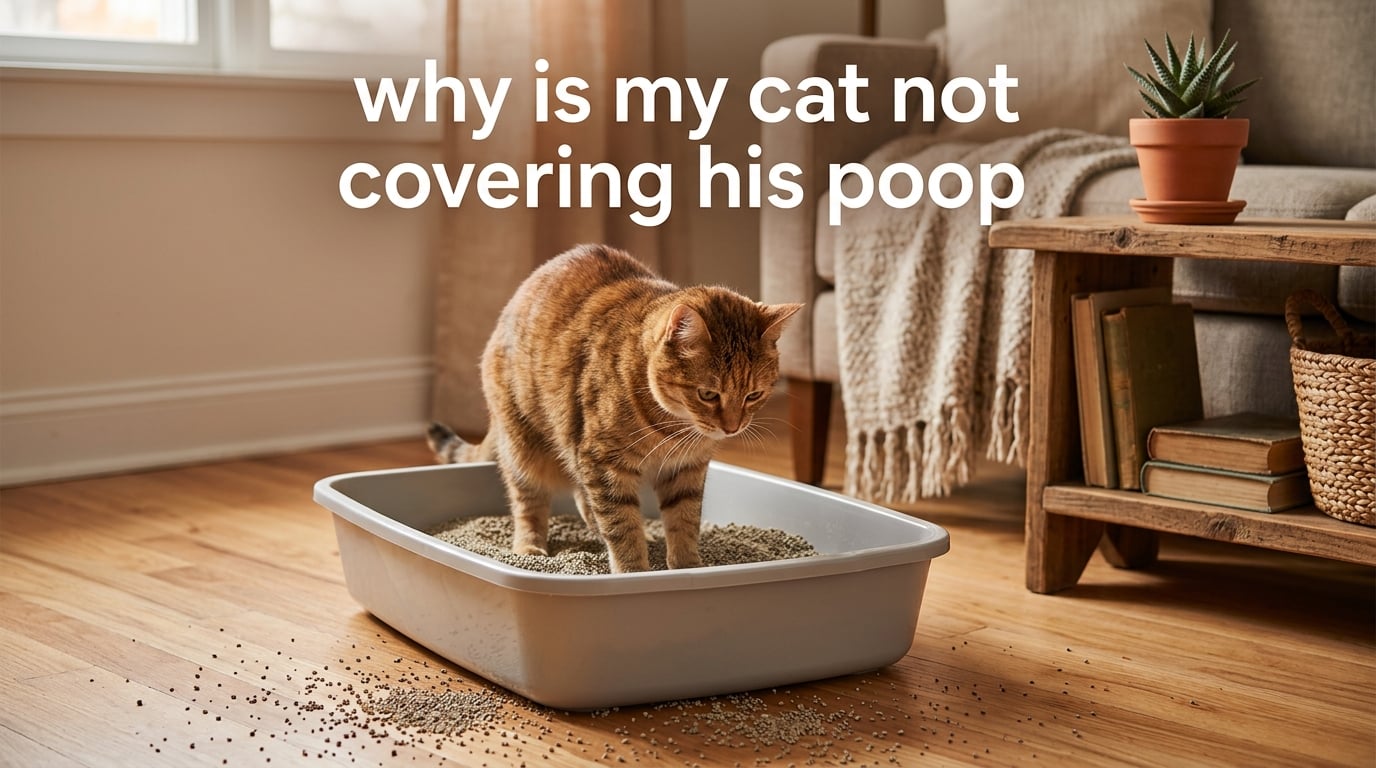
If you are asking yourself why is my cat not covering his poop, you are definitely not alone. Thousands of cat owners deal with this exact issue every single day, and the smell that comes with it is no joke. I have lived with cats for over 15 years, and I have seen this behavior from kittens, seniors, and rescues alike.
The good news is that an uncovered litter box deposit is rarely a sign that something is terribly wrong. Most of the time, your cat is trying to communicate something specific through this behavior. Cats are incredibly intentional animals, and every action they take has a reason behind it.
In this guide, I will walk you through every possible cause of this behavior, from territorial instincts to medical concerns. You will also learn practical, step-by-step solutions to get your cat back on track. By the end, you will know exactly what to do the next time you catch your cat walking away from an uncovered mess.
Table of Contents
Why Is My Cat Not Covering His Poop? (Quick Answer)
Your cat is not covering his poop because of one or more of these common reasons:
Territorial marking — He is leaving his scent visible to claim the space as his own, a behavior dominant cats use on purpose.
Litter box problems — The box may be too small, too dirty, in a bad location, or filled with litter he dislikes.
Medical issues — Pain from arthritis, urinary tract problems, or dental issues can make the covering motion uncomfortable.
Stress and anxiety — Changes in the home, new pets, or loud noises can cause your cat to rush through the bathroom routine.
Lack of early training — Kittens separated from their mother too early may have never learned the covering behavior.
Age-related decline — Senior cats with cognitive decline or joint stiffness may simply find covering too much effort.
Multi-cat tension — Social conflict between household cats can trigger dominance-based poop leaving.
As a general rule, if this behavior started suddenly in a cat who previously covered well, focus on medical and environmental causes first. If your cat has never covered poop since you got him, the issue is more likely behavioral or training-related.
Why Do Cats Cover Their Poop in the First Place?
Cats cover their poop as an instinctive survival behavior passed down from their wild ancestors. In the wild, burying waste hides the scent from predators and prevents rival cats from tracking their movements. This behavior is hardwired into domestic cats even though most indoor cats face zero threat from predators.
The covering instinct is tied to a cat’s place in the social hierarchy. Subordinate cats in the wild bury their waste carefully to avoid challenging dominant cats. Dominant cats, on the other hand, frequently leave their poop exposed as a way of saying “I own this territory.”
Big cats follow the same pattern. Leopards and jaguars bury their waste to stay hidden while hunting. Lions and tigers, as apex predators, often leave their waste in prominent spots. Your house cat carries these same instincts in a much smaller body.
Burying poop also serves a hygiene purpose. Covered waste attracts fewer flies and produces less odor, which in the wild helps keep the den area clean. So when a cat stops covering, he is breaking a deeply ingrained habit that has kept felines alive for thousands of years.
The Main Reasons Your Cat Leaves Poop Uncovered
Now let me break down each cause in detail so you can figure out which one applies to your situation. Most cats fall into one or two of these categories, and identifying the right one is half the battle.
Territorial Marking and Dominance
Territorial marking is one of the most common reasons cats leave poop uncovered. When a cat wants to assert dominance over a space, he deliberately leaves his waste exposed so other animals can smell it. This is the feline equivalent of planting a flag.
This behavior shows up most often in multi-cat households where cats are competing for resources. A cat who feels his territory is threatened by a new pet, a neighborhood stray visible through the window, or even a new baby in the home may start leaving poop uncovered as a show of strength.
I have seen this firsthand with my own cats. When I introduced a second cat, my first cat started leaving uncovered poop near the litter box entrance for about two weeks. It was his way of saying “I was here first.” Once the hierarchy settled, the behavior stopped on its own.
Unneutered and unspayed cats are especially prone to territorial marking. If your cat is not fixed, this could be a significant factor in the behavior. Neutering or spaying often reduces or eliminates the marking instinct within a few weeks.
Litter Box Dissatisfaction
If your cat is unhappy with his litter box setup, he may use the box but refuse to cover. The most common culprits are a box that is too small, litter that feels wrong on his paws, or a box that has not been cleaned recently enough. Cats are fastidious creatures and have strong preferences about their bathroom environment.
Box size matters more than most people think. A good rule of thumb is that the box should be at least one and a half times the length of your cat from nose to tail base. Many commercially available boxes are simply too cramped for adult cats to comfortably turn around and perform the covering motion.
Litter type is another frequent offender. Cat owners on forums consistently report that some cats refuse to cover when using pine pellets, crystal litter, or certain clumping litters. Most cats prefer a fine-grained, unscented clumping litter that feels similar to sand or soil. If you recently switched litter brands, that alone could explain the change.
Cleanliness is non-negotiable for many cats. A box that has not been scooped in over 24 hours may cause your cat to rush through his business and skip covering altogether. Some particularly fastidious cats will not even use a box that was scooped just a few hours ago if any smell remains.
Location also plays a role. If the box is in a high-traffic area, near a loud appliance, or in a spot where another cat could ambush him, your cat may feel too vulnerable to spend extra time covering. Cats need to feel safe when they use the bathroom, just like we do.
Medical Issues and Pain
Pain is a frequently overlooked cause of uncovered poop. The covering motion requires a cat to shift his weight, balance on three legs, and scratch repeatedly. If your cat has arthritis, a urinary tract infection, dental pain, or any condition that makes movement uncomfortable, he may skip the covering step entirely.
Declawed cats face a particularly difficult situation. Covering litter involves scratching, and cats who have been declawed often experience pain or discomfort when digging. Many declawed cats develop a lifelong aversion to covering because the action hurts their sensitive paws. Some will scratch the sides of the box or the wall instead, which is their attempt to cover without touching the litter directly.
Feline lower urinary tract disease (FLUTD) is another common medical cause. Cats with FLUTD associate the litter box with pain during urination, and this negative association can extend to all litter box activities. Your cat may rush to finish and escape the box before covering anything.
Gastrointestinal issues can also play a role. If your cat has diarrhea, constipation, or inflammatory bowel disease, the physical act of elimination may be uncomfortable enough that covering is the last thing on his mind. Watch for changes in stool consistency, frequency, or straining in the box.
Stress and Anxiety
Cats who feel stressed often change their bathroom habits, and leaving poop uncovered is one way this manifests. Stress in cats can come from moving to a new home, rearranging furniture, a new pet or person entering the household, construction noise, or even a change in your work schedule.
Interestingly, some behaviorists believe that leaving poop uncovered can be a self-soothing behavior. A stressed cat may want his own scent to remain present in the environment because it provides comfort. By not covering, he creates a stronger scent marker that makes his surroundings feel more familiar and safe.
Watch for other stress signs alongside the uncovered poop. Excessive grooming, hiding, changes in appetite, vocalization at night, or aggression can all indicate that your cat is anxious. If you notice these symptoms together, addressing the underlying stress will often resolve the litter box behavior too.
Lack of Early Kittenhood Training
Kittens learn to cover their poop from their mother during the first 3 to 8 weeks of life. The mother cat demonstrates the covering motion, and kittens imitate her. If a kitten was separated from his mother too early, orphaned, or raised without proper maternal guidance, he may simply never have learned this behavior.
This is extremely common in rescue cats. Forum users frequently share stories of adopted kittens who had no idea how to cover poop because they were bottle-raised from a very young age. These cats are not being stubborn or dominant — they genuinely do not know how to do it.
The good news is that adult cats can still learn this behavior with patient training. It takes more time than teaching a kitten, but it is absolutely possible. I will cover the specific training method in the solutions section below.
Senior Cats and Age-Related Decline
Older cats may stop covering poop due to physical and cognitive changes. Arthritis makes the scratching motion painful, cognitive dysfunction syndrome (similar to dementia in humans) can cause confusion, and declining senses may make it harder for the cat to navigate the litter box.
If your senior cat has started leaving poop uncovered after years of good habits, schedule a vet visit. This is often one of the earliest signs of age-related health issues. A vet can check for arthritis pain, kidney problems, and cognitive decline, all of which are treatable to varying degrees.
You can help senior cats by providing a litter box with a low entry point for easy access. Using a fine, soft litter reduces the effort needed for digging. Some owners also find that a larger, more open box helps arthritic cats who struggle to turn around in standard boxes.
Multi-Cat Household Tensions
In homes with multiple cats, social dynamics directly affect litter box behavior. A dominant cat may leave poop uncovered to establish rank, while a submissive cat may feel too anxious to stay in the box long enough to cover. Resource guarding, where one cat blocks access to litter boxes, can also create problems.
The golden rule for multi-cat homes is one litter box per cat plus one extra. If you have three cats, you need four boxes placed in different locations around the home. This prevents any single cat from controlling all bathroom access and reduces the stress that leads to uncovered poop.
Pay attention to which cat is leaving the uncovered waste. If it is consistently the same cat, you may be dealing with a dominance issue. If it is different cats at different times, the problem may be general household tension that needs a broader approach.
How to Get Your Cat to Cover His Poop
Now that you understand the causes, here are the practical steps to fix the behavior. I recommend going through these in order, starting with the simplest fixes.
Step 1: Rule Out Medical Problems First
Before trying any behavioral training, take your cat to the vet for a checkup. This is especially important if the behavior started suddenly in a cat who previously covered well. Mention the uncovered poop specifically, and ask about arthritis, urinary issues, and dental pain.
Medical causes must be addressed before behavioral training will work. No amount of clicker training will help a cat who is in pain every time he tries to scratch.
Step 2: Optimize the Litter Box Setup
Upgrade your litter box to a larger size if your current one feels cramped. Switch to a fine-grained, unscented clumping litter, as this is the most universally accepted type among cats. Scoop the box at least once daily, ideally twice, and completely change the litter every two to three weeks.
If you have multiple cats, add more boxes following the N+1 rule. Place boxes in quiet, low-traffic areas where your cat feels safe and will not be ambushed. Try removing the lid from covered boxes, since many cats feel trapped in enclosed spaces and will rush to leave.
Step 3: Try Different Litter Types
If your cat dislikes the current litter, experiment with alternatives. Start with a fine unscented clumping clay litter, which mimics the sand texture cats instinctively prefer. Avoid scented litters, pine pellets, and crystal litters initially, as these are the types most commonly rejected by finicky cats.
Set up two boxes side by side with different litters and see which one your cat prefers. Cats vote with their paws, and this preference test takes the guesswork out of the equation.
Step 4: Use Clicker Training for Cats Who Never Learned
For cats who never learned to cover as kittens, clicker training is the most effective method. Here is how to do it step by step:
Catch him in the act. Wait near the litter box when you know your cat usually goes. Stay quiet and unobtrusive.
Demonstrate the motion. After he finishes, gently take his paw and guide it in a scratching motion over the litter. Do this gently and never force it.
Click and treat immediately. The moment his paw touches the litter in a covering motion, click your clicker and give him a small treat.
Repeat every time. Consistency is everything. Do this every single time you catch him in the box for at least two weeks.
Fade out the guidance. Once he starts scratching on his own after finishing, stop guiding his paw. Continue to click and treat when he covers independently.
Phase out treats gradually. After he covers reliably for a week, reduce treats to every other time, then occasionally, until the behavior is self-sustaining.
This method works because it taps into the same reward-based learning that mother cats use. Patience is essential here. Some cats pick it up in days, while others need several weeks of consistent practice.
Step 5: Reduce Stress and Conflict
If stress is the underlying cause, identify and address the trigger. For environmental changes, give your cat time to adjust and provide hiding spots, vertical spaces like cat trees, and interactive play sessions to rebuild confidence. Feline pheromone diffusers can help reduce anxiety in multi-cat homes or during transitions.
For multi-cat conflict, ensure each cat has separate food bowls, water sources, and resting areas in addition to the extra litter boxes. Sometimes consulting with a feline behaviorist is worth it if tensions run high.
When to See a Vet
Schedule a vet visit if your cat’s uncovered poop is accompanied by any of these warning signs: straining in the litter box, crying out during elimination, blood in the stool or urine, diarrhea lasting more than 48 hours, sudden weight loss, lethargy, or changes in appetite or water consumption.
Any sudden behavior change in an adult or senior cat warrants a professional evaluation. Cats are masters at hiding pain and illness, so a shift in litter box habits may be the only early clue that something is wrong. Do not wait to see if it resolves on its own.
If your vet gives a clean bill of health, you can confidently move on to the behavioral and environmental solutions outlined above. Knowing it is not a medical issue gives you peace of mind and a clear direction forward.
FAQ
Do cats cover their poop if they are sick?
Why do cats stop hiding their poop?
Is it normal for kittens not to cover their poop?
How can I encourage my cat to cover their poop?
Should I be concerned if my cat doesn’t cover their poop?
Wrapping Up
Figuring out why is my cat not covering his poop takes a bit of detective work, but the answer almost always comes down to one of seven causes: territorial marking, litter box problems, medical pain, stress, missing early training, age-related decline, or multi-cat tension. Start with a vet checkup if the behavior is new, then work through the environmental and training solutions.
The most important thing to remember is that your cat is not doing this to annoy you. He is communicating something, and your job is to listen. With patience and the right approach, most cats can get back to their neat, tidy covering habits within a few weeks. You have got this.