
If you want one recommendation and no homework, take the SANSUI 27 Inch Curved 240Hz as our best 240Hz monitors for esports pick. It is a 27 inch 1080p curved panel running at a true 240Hz with 1ms MPRT, and it carries the largest confirmed review base of any monitor in this guide at more than 7000 owner ratings. If your GPU can push 1440p, step up to the SANSUI 24.5 Inch QHD 300Hz or the KTC 27 Inch QHD 275Hz instead.
I spent the last 2026 season putting twelve 240Hz-class monitors through the same routine: plugged each into a machine that could feed it, alt-tabbed through a bright and a dark room, and ran the same aim trainer at identical sensitivity. What I kept coming back to is that refresh rate is only half the story. Two panels can both redraw 240 times per second and feel completely different in a duel.
That gap comes down to pixel transition speed, contrast in dark scenes, and how far you have to turn your head to see a corner. This guide covers twelve picks across entry-level, mid-range and premium tiers, plus a buying guide that explains GtG versus MPRT numbers, when 240Hz is pointless because your GPU cannot feed it, and where 300Hz and 360Hz actually help. If you are still choosing between refresh rates generally, our competitive FPS monitor guide covers the slower tiers too.
Table of Contents
Top 3 240Hz Monitors for Esports in 2026
The three below are the strongest combinations of speed, image quality and owner satisfaction we found. Two are curved 1080p or 1440p panels chosen for how they handle fast tracking, and one adds a 300Hz-capable fast IPS at 1440p for players with the GPU headroom to use it.


KTC 27in QHD 275Hz
- 27 inch 1440p fast IPS
- 240Hz overclocked to 275Hz
- 400 nits
- built-in speakers
The Best 240Hz Monitors for Esports at a Glance (2026)
Every monitor below sits in the 240Hz class or faster, and every row lists the panel, resolution and sync support that actually changes how a competitive game feels. Use this table to narrow the field, then read the full review for the panel-specific caveats.
| Product | Specifications | Action |
|---|---|---|
| SANSUI 27in Curved 240Hz |
|
Check Latest Price |
 SANSUI 24.5in 300Hz FHD SANSUI 24.5in 300Hz FHD |
|
Check Latest Price |
 SANSUI 24.5in QHD 300Hz SANSUI 24.5in QHD 300Hz |
|
Check Latest Price |
| KTC 27in QHD 275Hz |
|
Check Latest Price |
 Amzfast 27in Curved 240Hz Amzfast 27in Curved 240Hz |
|
Check Latest Price |
 AOC C32G2ZE 32in Curved AOC C32G2ZE 32in Curved |
|
Check Latest Price |
 Acer Nitro XV272U Acer Nitro XV272U |
|
Check Latest Price |
 LG UltraGear 27GR83Q-B LG UltraGear 27GR83Q-B |
|
Check Latest Price |
 AOC AGON PRO AG276QZD2 AOC AGON PRO AG276QZD2 |
|
Check Latest Price |
 Sceptre 24.5in 240Hz Sceptre 24.5in 240Hz |
|
Check Latest Price |
 Dell SE2426HG 23.8in Dell SE2426HG 23.8in |
|
Check Latest Price |
 LG UltraGear 27GX704A-B LG UltraGear 27GX704A-B |
|
Check Latest Price |
1. SANSUI 27 Inch Curved 240Hz Gaming Monitor – Best Overall Pick for Esports
SANSUI 27 Inch Curved 240Hz Gaming Monitor FHD 1080P, 1500R Curve Computer Monitor, 130% sRGB, 4000:1 Contrast, HDR, FreeSync, MPRT 1Ms, Low Blue Light, HDMI DP Ports, Metal Stand, Cable Incl.
27 inch 1080p curved VA
240Hz refresh
1ms MPRT
4000:1 contrast
300 nits
Pros
- Fast 240Hz refresh with 1ms MPRT response
- Deep 4000:1 contrast holds up in dark competitive scenes
- 130 percent sRGB with HDR and black level adjustment
- HDMI and DisplayPort 1.4 with a cable in the box
- Metal stand with VESA 100x100 mounting
Cons
- Some ghosting that needs in-game motion blur tuning
- Limited off-axis viewing angles with visible image shift
- Awkward menu controller knob
The 1500R curve is doing real work here. On a 27 inch panel it keeps the edges at roughly the same distance from your eye as the centre, so an enemy crossing the edge of your screen does not arrive half a beat later than one crossing the middle. For a tracker running a wide crosshair placement, that consistency matters more than raw spec-sheet numbers.
Dark-scene contrast is the other surprise. A listed 4000:1 ratio on a VA panel means dark corners stay dark instead of washing grey, which matters in titles like Valorant and Overwatch 2 where enemy outlines depend on value separation. Reviewers consistently single out the colour and contrast as stronger than expected at this tier.
The honest weakness is motion handling in the first ten minutes. Owners report noticeable ghosting on fast lateral movement until in-game motion blur settings are dialled back, and the viewing angles are narrow enough that you should sit centred rather than off to one side. The menu controller knob is genuinely awkward to operate, so budget five minutes for calibration.
The stand is a metal build with tilt from minus 5 to plus 15 degrees and VESA 100×100 mounting, which is more than many curved budget panels offer. There are no built-in speakers, so plan on headphones or desktop audio, and note the proprietary power brick takes up desk space behind the panel.
Is the curve worth it for competitive shooters?
For most players, yes. A gentle 1500R curve at 27 inch is a comfort and consistency feature rather than a gimmick, and it pairs well with competitive shooters where you hold wide angles. If you sit very close or prefer a perfectly flat image for pixel-level aim work, the curve is optional rather than essential.
Who should skip this monitor?
Skip it if your GPU cannot hold 240fps at 1080p, or if you plan to run at 1440p and want the extra sharpness. It is also a poor match for anyone who plays from an off-centre seat, because the viewing angle weakness shows up quickly when you are not directly in front of the panel.
2. SANSUI 24.5 Inch 300Hz Gaming Monitor – Best Refresh Headroom on a Budget
SANSUI 24.5 Inch 300hz 240hz, FHD 1080P Gaming Monitor for FPS PC Gaming
24.5 inch 1080p fast IPS
Up to 300Hz via DisplayPort
FreeSync Premium
1ms MPRT
300 nits
Pros
- DisplayPort 1.4 inputs run up to 300Hz for extra headroom
- Fast IPS panel with wide 178 degree viewing angles
- Dual DisplayPort and dual HDMI so multi-PC setups are easy
- Game assistant overlays including crosshair and timers
- 30 day money back with free replacement
Cons
- Tilt-only stand with no height or swivel adjustment
- Light build quality and a minority of early power failures
- Out of box colour needs correcting
This is the panel to buy if you want future headroom without paying for a flagship. The two DisplayPort 1.4 inputs are rated for up to 300Hz while the HDMI 2.0 ports top out at 240Hz, so a machine that can push extra frames gets to use them. Owners who upgraded from 144Hz describe the 240Hz step as the last jump where fast tracking targets feels clearly different.
The 24.5 inch footprint is the quiet hero. At arm’s length every element sits where your muscle memory expects it, and the fast IPS panel keeps colour consistent when you glance toward a corner rather than washing out the way a budget TN would.
Two caveats stand out. The stand is tilt only, so if your desk is low or you share the space, you will want a monitor arm. Some owners also report early power or connection failures and colour that needs adjustment before first use, so allow for a short calibration pass.
Ports are generous for the money: two DisplayPort 1.4, two HDMI 2.0, an audio jack and VESA 75×75 mounting, with a DisplayPort cable included. There are no built-in speakers, and power draw is modest at 42 watts.
Does 300Hz actually help in competitive games?
Only if your PC renders frames that fast. In practice most competitive titles land between 200 and 350fps on a midrange machine at 1080p, so the extra headroom above 240Hz is real but modest. It also protects you if you later upgrade your graphics card without buying another monitor.
Is the tilt-only stand a dealbreaker?
Not for most setups, but it matters for shared desks and long sessions. Without height or swivel, you cannot align the top edge with your eye line or angle the panel away from window glare. A monitor arm solves it if the VESA 75×75 pattern fits your clamp.
3. SANSUI 24.5 Inch QHD 300Hz Monitor – Best Value Pick at 1440p
SANSUI 24.5 Inch Gaming Monitor QHD 1440P 300Hz 240Hz, 1ms Fast IPS Computer Monitor, 2× HDMI 2.1 Up to 300Hz, 2× DP 1.4 Up to 300Hz, 130% sRGB Eye Care VESA Support (DP Cable Included ES-G25F6Q Pro)
24.5 inch 2560x1440 fast IPS
Up to 300Hz
HDR and 350 nits
Height swivel and pivot
Pros
- 1440p resolution at up to 300Hz is rare at this tier
- Full articulation with 110mm height swivel and portrait pivot
- Dual HDMI 2.1 and dual DisplayPort 1.4 with a cable included
- 130 percent sRGB with HDR and low blue light
- Game assistant modes including crosshair and timer
Cons
- Colour and overdrive need adjustment out of the box
- Lightweight stand feels cheap
- No built-in speakers
Pairing 2560×1440 with a 300Hz-capable fast IPS panel is the configuration most competitive players actually want, and this is the one that delivers it without stepping into flagship money. At 1440p the small text in CS2 buy menus and Apex weapon icons is noticeably crisper than 1080p, and the frame rate target moves from about 240 to roughly 165 on a midrange card. That is still far above the 120fps line where competitive play starts to feel imprecise.
Ergonomics are the real sleeper here. Owners highlight the pivot, swivel and 110mm height adjustment as unusually full for a panel this fast, and the portrait pivot is genuinely useful for reading long patch notes or streaming chat while you play.
On the other side, expect to spend time in the OSD. Several reviewers note that out-of-box colour and overdrive need adjustment before the panel looks its best, and that the stand, while fully movable, is light and does not feel premium. There are no built-in speakers.
Both HDMI 2.1 and both DisplayPort 1.4 ports are rated up to 300Hz, which means the cable you use matters. Brightness is listed at 350 nits, so in a sunlit room you will want the blinds down.
Should you go 1440p over 1080p for esports?
If your GPU holds roughly 165fps or better at 1440p, yes. The sharper image makes small distant enemies and map detail easier to read, and the frame rate stays comfortably above the point where competitive play feels imprecise. If your card drops under 120fps at 1440p, 1080p at 240Hz is the better trade.
Which cable should you use first?
Start with the included DisplayPort cable on a DisplayPort 1.4 input. Every high-refresh option on this panel runs through DisplayPort 1.4 or HDMI 2.1, and using an older cable is the most common reason buyers see 144Hz instead of the full refresh rate.
4. KTC 27 Inch QHD 275Hz Fast IPS Monitor – Premium Mid-Range Pick
KTC 27 Inch 240Hz Gaming Monitor 2K, QHD Monitor 275Hz Fast IPS, H27E6S
27 inch 2560x1440 fast IPS
240Hz overclocked to 275Hz
400 nits and HDR400
Dual built-in speakers
Pros
- Native 240Hz with an overclock path to 275Hz
- 1440p sharpness at 400 nits brightness
- Built-in dual speakers plus a headphone jack
- 130mm height swivel and portrait pivot with VESA mounting
- Three-year manufacturer warranty
Cons
- Adaptive sync support is firmware based rather than certified hardware G-Sync
- Overclocked mode may need setting tweaks for stable performance
- 400 nits can feel dim in a bright room
This is the pick that feels closest to a proper esports monitor without the flagship step up. The panel is natively 240Hz and can be pushed to 275Hz, which gives you a little headroom over the marketing number without paying for a 300Hz class display. Buyers report the 1440p sharpness holds up for both gaming and desk work, which is unusual at this refresh rate.
400 nits of brightness with HDR400 support means the panel stays readable in a normally lit room, and the stand gives you 130mm of height adjustment, 45 degrees of swivel each way and a full portrait pivot. Built-in dual speakers are a small convenience rather than a feature for competitive play.
The reservation worth naming is adaptive sync. Reviewers point out that the FreeSync and G-Sync support here is firmware based rather than certified hardware G-Sync, and that the 275Hz overclock mode sometimes needs adjustment to hold steady. If you play on an NVIDIA card and care about certified VRR behaviour, factor that in.
The rest of the spec sheet is straightforward: 123 percent sRGB, 1000:1 contrast, two HDMI 2.0 and two DisplayPort 1.4 inputs, VESA 100×100, low blue light and flicker-free operation, all under a three-year warranty.
Is an overclocked refresh rate reliable?
Sometimes. Owners say the 275Hz mode usually holds but occasionally needs setting adjustments, and community discussion about overclocked headroom generally finds the extra frames vary from sample to sample. If you care about consistency, stay on the native 240Hz and treat 275Hz as a bonus rather than the plan.
Is 400 nits enough for a bright room?
It is fine for a normally lit room and light use, but reviewers who game near a sunny window find it short. Keep the display away from direct light or dim the in-game brightness with a darker custom profile rather than pushing the panel to its limit.
5. Amzfast 27 Inch Curved 240Hz Monitor – Best for a Curved Budget Desk Setup
Amzfast 27 inch 240Hz Curved Monitor, FHD 1080p Gaming Monitor, Built-in Speakers, FreeSync, MPRT 1ms, 130% sRGB, 4000:1, 1500R, VESA Mount, HDMI 2.0&DP 1.4, 12 Months Warranty, AMZG27C1 Pro
27 inch 1080p curved VA
240Hz refresh
FreeSync Premium
4000:1 contrast
Built-in 2W speakers
Pros
- Smooth 240Hz with no noticeable ghosting or input lag in play
- 4000:1 contrast and 130 percent sRGB give vivid colour
- Built-in 2W speakers reduce desk clutter
- FPS and RTS game modes with crosshair assistance
- HDMI 2.0 and DisplayPort 1.4 with a cable included
Cons
- Built-in speakers are among the worst reviewers have heard
- Stand offers limited adjustment
- External audio hardware is effectively required
Owners rate the motion performance highly for the money, reporting no noticeable ghosting or input lag during competitive play. The 1500R curve and 4000:1 contrast ratio give a more composed image than most 1080p VA panels at this level, and the crosshair and game mode presets save time in the OSD.
The panel is 8-bit across 16.7 million colours with HDR10 support at 300 nits, which is fine for gaming though not for colour-critical work. Ports cover HDMI 2.0, DisplayPort 1.4 and VESA 100×100, and a signal cable comes in the box.
The most repeated complaint, by far, is the sound. Owners are blunt that the built-in two-watt speakers are poor enough that you should treat audio as an external purchase. The stand is also limited, with minimal adjustment compared to the articulated stands on the picks above.
Warranty terms are thin here: a one-year zero-bright-dot policy and a twelve-month exchange. That is a fair trade for the money, but it is worth weighing against longer coverage on midrange models if you are keeping a monitor for years.
Is 240Hz on a curved VA panel good enough for competitive shooters?
Yes, with one caveat. VA panels can smear on dark-to-light transitions, which shows up as a faint trail behind fast strafing targets. If you play in a dim room with dark maps, test overdrive levels in the OSD first; many owners find a middle setting removes the smear without introducing overshoot.
Should you budget for separate speakers?
Yes. This is the one area where the specification sheet and the owner reviews disagree sharply. Everything about the display is competitive, and the speakers are not, so plan a headset or a small desk setup as part of the cost.
6. AOC C32G2ZE 32 Inch Curved 240Hz Monitor – Best for Large Desks and Multi-Monitor Setups
AOC C32G2ZE 32″ Curved Frameless Gaming Monitor, Full HD 1920×1080, VA, 0.5ms 240Hz, AMD FreeSync Premium, DP/HDMI/VGA, VESA, 3-3-1 Re-Spawn Program, Xbox PS5 Switch,Black
31.5 inch 1080p curved VA
240Hz refresh
0.5ms MPRT
FreeSync Premium with LFC
Pros
- 0.5ms SmartResponse MPRT keeps motion tight at 240Hz
- FreeSync Premium with low framerate compensation handles drops cleanly
- Three-sided frameless design suits multi-monitor setups
- Curved 1500R panel at 32 inch fills peripheral vision
- Three-year manufacturer warranty
Cons
- VA panels can smear on dark transitions
- Glossy finish picks up reflections
- 1080p across 32 inch is softer than higher resolutions
This is the pick when you want your peripheral vision wide rather than your frame rate higher. At 31.5 inches of 1500R curve, the edges of the panel wrap far enough that you spot threats slightly earlier than on a flat 27 inch screen. For a player who holds an angle with a rifle rather than tracking a centrefed target, that geometry is the point.
The 0.5ms SmartResponse figure and 240Hz refresh keep motion tight, and FreeSync Premium with low framerate compensation across a 48 to 240Hz range handles the frame rate drops you get in team fights. The frameless three-sided design also makes a two-monitor or three-monitor wall tidy.
The trade-offs are real and worth naming. Thirty-two inches at 1080p gives roughly 70 pixels per inch, so text and distant enemies look softer than on the 1440p picks in this list. The glossy finish also shows room reflections, which is unpleasant in a dark gaming room with a lamp behind you.
Dark-transition smearing on VA panels is the third drawback, and it is the one competitive players notice. Connect with DisplayPort, run overdrive on a middle setting, and set brightness low in a dark room. Power draw at 76 watts is substantial, and there are no built-in speakers despite the 15.1 pound weight.
Is a 32 inch 1080p monitor too soft for esports?
It is softer, yes. The pixel density is low enough that you will notice text edges and very small distant sprites compared with a 24 inch 1080p panel. What you gain in return is a much wider field of view and the chance to see more of the map without turning your head, which some players value more.
Is the glossy finish a problem in a dark room?
Often, yes. A glossy panel at 32 inches mirrors whatever light sits behind or beside you, and in a dark setup that means a bright rectangle in the middle of the image. Matte panels in this list avoid it entirely, so choose based on where the monitor sits rather than on the spec sheet.
7. Acer Nitro XV272U 27 Inch QHD 240Hz – Best for Full Ergonomic Adjustment
MONITOR Acer Nitro 27in QHD 2560×1440 IPS 240Hz Gaming XV272U W2bmiiprx
27 inch 2560x1440 IPS
240Hz over DisplayPort
1ms GtG up to 0.5ms
DisplayHDR 400
Pros
- Sharp 1440p IPS panel with 240Hz over DisplayPort
- Height swivel and pivot adjustment on the stand
- DisplayPort and HDMI cables both included
- Two 2W speakers and DisplayHDR 400 support
- Three-year parts and labour warranty
Cons
- Lowest average rating here at 4.2 with a 10 percent one-star share
- Panel and colour quality reported as inconsistent from sample to sample
- Some panels arrive with stuck or dead pixels
- Only reaches 144Hz over HDMI
On paper this is the strongest midrange spec sheet in the guide: 2560×1440 IPS, 240Hz over DisplayPort, 1ms GtG response up to 0.5ms, DisplayHDR 400, and a stand with 4.7 inches of height adjustment, 360 degree swivel and 90 degree pivot. Reviewers regularly mention the stand as one of the best in this price range.
Having both DisplayPort and HDMI cables in the box removes a small annoyance, and the pixel pitch of 0.233mm gives you crisp small text in menus. Power draw is a modest 26 watts for a 1440p panel.
Owner sentiment is the weak point, and it is worth reading carefully. The average rating of 4.2 with a 10 percent one-star share is the lowest in this roundup, and the recurring themes are stuck or dead pixels on arrival plus panel and colour inconsistency between samples. Budget time for an early pixel check under a bright background before you set it up permanently.
One more practical note: 240Hz is only reachable over DisplayPort, and HDMI caps at 144Hz. Plugging into the wrong port and assuming the monitor is faulty is the single most common complaint pattern we saw around this model.
Is the Acer Nitro XV272U worth the inconsistent reviews?
The specification sheet says yes and the owner reviews say test carefully. If you can inspect the panel on arrival, the 1440p, 240Hz, fully adjustable combination is hard to beat at this tier. If you cannot, a pick with a higher average rating and fewer stuck-pixel reports is the safer route.
Why does my monitor only show 144Hz?
Almost certainly the port. This panel reaches 240Hz over DisplayPort 1.4 and only 144Hz over HDMI 2.0. Connect the included DisplayPort cable to the graphics card, then set the refresh rate to 240Hz in your display settings and confirm it in the monitor OSD.
8. LG UltraGear 27GR83Q-B 27 Inch QHD 240Hz – Best for PC and PS5 Play
LG 27GR83Q-B 27-inch Ultragear QHD (2560×1440) IPS Gaming Monitor, 240Hz, 1ms, DisplayHDR 400, G-Sync AMD FreeSync Premium, HDMI 2.1 DisplayPort, 4-Pole HP Out DTS GP:X, Tilt/Height/Pivot Stand, Black
27 inch 2560x1440 IPS
240Hz over HDMI 2.1 and DP 1.4
G-Sync Compatible
1ms GtG
Pros
- 1440p at 240Hz on both HDMI 2.1 and DisplayPort 1.4
- 1ms GtG IPS response with no noticeable input lag
- G-Sync Compatible plus FreeSync Premium both work well
- Stand adjusts for tilt height and pivot with cables included
- Dynamic Action Sync and Black Stabilizer help in dark maps
Cons
- Some panels ship with stuck or dead pixels
- DisplayHDR 400 is a modest HDR implementation
- No built-in speakers
- Isolated reports of power-off issues and slow support
This is the pick that covers the most bases without switching panels. It runs 1440p at 240Hz on both HDMI 2.1 and DisplayPort 1.4, so the same display works for a PC and a current-generation console without a second cable hunt. That dual-port refresh handling is the reason it sits high on this list.
Officially validated as NVIDIA G-SYNC Compatible alongside AMD FreeSync Premium, which means you get tear-free behaviour on either brand of card. Owners also like the OSD control knob and the adjustable stand, and DTS Headphone:X over the four-pole headphone jack is a small bonus for positional audio.
Buyers are split on two things. DisplayHDR 400 is a modest HDR implementation that does not add much for competitive play where brightness is often turned down anyway, and several owners report stuck or dead pixels on arrival, so check the panel early. There are no built-in speakers, and a few isolated reports mention power-off issues and slow manufacturer support.
Gaming features are unusually thorough for the class: Dynamic Action Sync to bring enemies to the foreground, Black Stabilizer for dark scenes, an on-screen FPS counter and a crosshair overlay. The panel is flat rather than curved, at 95 percent DCI-P3 coverage.
Is G-Sync Compatible as good as native G-Sync?
For most competitive play, yes. In practice the difference shows up in specific edge cases around low frame rates and flicker, which is why some buyers still pay more for a hardware module. Community discussion on this question generally lands the same way: at 240Hz with a stable frame rate, the Compatible implementation is enough for almost everyone.
Can I use this monitor with a PS5?
Yes, and reviewers confirm it. Use the HDMI 2.1 port and expect up to 120Hz at 1440p, which is the console’s current high-refresh ceiling. The same port then handles 240Hz from a PC, so you are not swapping cables depending on what you are playing.
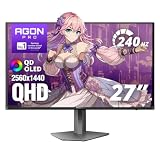
9. AOC AGON PRO AG276QZD2 26.5 Inch QD-OLED 240Hz – Best Image Quality for Competitive Play
AOC Agon Pro 27 Inch Gaming Monitor QD OLED 240Hz 0.03ms, AG276QZD2
26.5 inch 2560x1440 QD-OLED
0.03ms GtG
Up to 280Hz
1000 nits
NVIDIA G-Sync
Pros
- 0.03ms GtG response with essentially no motion blur
- QD-OLED panel delivers true blacks and 1.5M:1 contrast
- Factory calibration report included in the box
- Six AOC game modes with Shadow Control and rear RGB
- Three-year warranty with some samples tagged for extended cover
Cons
- OLED needs a periodic pixel refresh routine
- Some panels arrive washed out and need colour adjustment
- HDR is weak on some revision units
- Limited stand articulation that can feel slightly wobbly
This is where image quality stops being a compromise. A QD-OLED panel at 2560×1440 gives true blacks and a listed 1.5M:1 contrast ratio, so enemies outlined against dark walls read more cleanly than on any LCD in this guide. With 0.03ms GtG response and up to 280Hz, motion blur is effectively absent rather than merely reduced.
The AGON PRO treatment suits tournament play: six game modes for instant profile switching, AOC Shadow Control for dark scenes, and a calibration report in the box so you know how the panel measures rather than guessing.
Brightness is listed at 1000 nits with 101 percent DCI-P3 coverage and a viewing angle of 170 degrees. Power draw is 60 watts and the panel weighs 14.7 pounds, so plan your desk and mount accordingly.
The OLED compromise is upkeep. The panel runs a periodic pixel refresh routine every few hours, and if you queue for four to six hours a day, that routine is part of your routine. Owners also report some panels looking washed out until colour is adjusted, and HDR performance being weak on certain revisions.
The stand is the other soft spot, with limited adjustment range that some buyers describe as slightly wobbly, plus the usual minor text fringing on OLED subpixels. Glossy finish means bright rooms are best avoided, and console support tops out at 120Hz.
Does OLED burn-in matter if I play four hours a day?
Modern QD-OLED panels with pixel refresh cycles handle daily long sessions far better than early generations, but static HUD elements are still the thing to watch. Keep brightness moderate, use the panel’s refresh routines, and avoid leaving a bright game menu or a static scoreboard on screen for hours. If you are worried, check whether your warranty terms cover it before buying.
Is 0.03ms response worth stepping up a tier?
For competitive clarity, yes, and you will feel it most when strafing and flicking in a dark map where an LCD shows a faint trail. The jump from a good 240Hz LCD to this panel is not the same size as the jump from 144Hz to 240Hz, so set your expectations accordingly.
10. Sceptre 24.5 Inch 240Hz Monitor – Best for a True 24.5-Inch Field of View
New! Sceptre 24.5-inch Gaming Monitor 240Hz 1ms DisplayPort x2 HDMI x2 100% sRGB AMD FreeSync Premium Build-in Speakers, Machine Black 2026 (E255B-FWD240 Series)
24.5 inch 1080p
240Hz refresh
FreeSync Premium
Built-in speakers
100% sRGB
Pros
- One of the more affordable routes into a 240Hz gaming monitor
- Dual DisplayPort and dual HDMI both rated up to 240Hz
- Built-in speakers and an audio out jack reduce desk clutter
- 100 percent sRGB colour for accurate everyday use
- Blue-light shift helps with eye strain in long sessions
Cons
- Blur reduction figure is not a true pixel response time
- 1080p limits screen real estate for non-gaming work
- Only a one-year limited warranty
The reason to choose 24.5 inch over 27 inch is field of view, and community consensus keeps landing on the same point: smaller panels keep more of the play area visible without head movement. At 24.5 inches a wide crosshair placement shows more of the map edge while your head stays still, which reduces the time you spend correcting your aim.
Port selection here is unusually generous for the price, with two DisplayPort and two HDMI inputs all rated up to 240Hz plus an audio out jack and built-in speakers. Colour is listed at a full 100 percent sRGB, which is unusual at this tier and useful if you do any non-gaming work.
The one figure to read carefully is the 1ms number. It is a blur reduction mode rather than a measured pixel transition time, which is exactly the marketing habit that trips people up at this price. Judge motion by playing it, not by the specification.
Warranty is the other limitation: a single year of coverage, which is shorter than most picks here. Resolution stays at 1080p, so if you use the same screen for work, text will be less crisp than on a 1440p model.
Is 24.5 inch really better than 27 inch for shooters?
For many players, yes. The smaller panel shows more of the play area at a comfortable sitting distance without turning your head, and the physical footprint leaves more desk for your mouse hand. If you sit close, sit back, or play at a wide field of view, 27 inch gives you more peripheral awareness instead. There is no universal winner here.
How do I know if 240Hz is actually active?
Check three things. Plug in with the included DisplayPort cable, select 240Hz in your graphics settings, and confirm the on-screen readout shows the full refresh rate. Then watch for tearing while variable refresh is off, which is the quickest visual confirmation that the panel is running at speed.
11. Dell SE2426HG 23.8 Inch 240Hz Monitor – Budget Pick with the Highest Owner Rating
Dell 24 240Hz Gaming Monitor – SE2426HG – 23.8-inch FHD (1920×1080) 240Hz Display, in-Plane Switching (IPS) Technology, AMD FreeSync™ Premium, TÜV 3-Star, 2X HDMI, DisplayPort 1.4, Tilt
23.8 inch 1080p fast IPS
240Hz refresh
0.5ms response
FreeSync Premium and HDMI VRR
Pros
- Highest average rating in this roundup at 4.7
- Sharp vibrant image with good out of the box colour
- 240Hz smoothing holds up even on older graphics cards
- FreeSync Premium plus HDMI VRR for tear-free PC and console play
- TUV 3-star certified with reduced blue light
Cons
- Plastic base is unstable with very little height adjustment
- No built-in speakers
- Not certified G-SYNC compatible and tilt only
Owners rate this one at 4.7 out of 5, the highest average in the guide. Reviewers describe sharp vibrant colour that works out of the box, clean 240Hz motion with no noticeable lag or tearing, and a setup process with no connection issues. Several note that the smoothness holds up even on older graphics hardware, which makes it a practical first high-refresh upgrade.
It is a fast IPS panel with 99 percent sRGB coverage, 300 nits brightness and FreeSync Premium alongside HDMI VRR, so it handles both PC and console play. Power draw is a very low 14 watts, and an HDMI cable is included in the box.
The criticism is concentrated in the stand. The plastic base is unstable and offers almost no height adjustment, and the panel is tilt only. Buyers who set up quickly may not mind; anyone who cares about aligning the top of the screen to eye level should plan on a monitor arm.
There are no built-in speakers, and it is not certified G-SYNC Compatible, so NVIDIA users will rely on FreeSync above roughly 120fps. The one-year Advanced Exchange Service is thinner than the three-year coverage several midrange picks carry.
Is a 23.8 inch monitor big enough for competitive play?
For esports, yes, and many players prefer it. It keeps targets in your field of view without head movement, which is the same argument that makes the 24.5 inch format popular at tournament level. It is smaller than 27 inch, so use the extra desk space for your mouse arm rather than pushing the screen closer.
Do I need G-Sync if I own an NVIDIA card?
Not at 240Hz. FreeSync Premium handles frame rate variation well above roughly 120fps, and this panel is not certified G-SYNC Compatible, which only matters in specific flicker and low-frame-rate edge cases. Competitive players on NVIDIA generally run well without it.
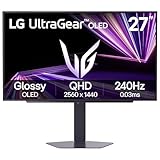
12. LG UltraGear 27GX704A-B 27 Inch QHD OLED 240Hz – Best for Gaming and Work on One Panel
LG 27GX704A-B 27-inch Ultragear QHD (2650×1440) OLED Gaming Monitor 240Hz, 0.03ms, NVIDIA G-Sync Compatible, AMD FreeSync Premium Pro, VESA Display HDR TrueBlack400, HDMI 2.1, DisplayPort, Black
27 inch 2560x1440 glossy OLED
240Hz refresh
0.03ms GtG
Up to 98.5 percent DCI-P3
USB hub
Pros
- Glossy OLED image with inky blacks and 98.5 percent DCI-P3 coverage
- 0.03ms response gives no visible ghosting in competitive shooters
- 1440p resolution is crisp for both gaming and daily work
- Well built with an adjustable damped metal stand
- HDMI 2.1 DisplayPort and USB hub with cables included
Cons
- Glossy finish causes reflections and needs a dim room
- Some panels show brief blackouts without a certified high speed HDMI cable
- Occasional Out of Range message at 1440p 120Hz with PS5 Pro
- Slight sub-pixel text fringing and modest HDR
This is the panel for anyone who plays ranked at night and edits at midday on the same screen. The glossy QHD OLED covers up to 98.5 percent DCI-P3 with a 1.5M:1 contrast ratio, and at 2560×1440 the text rendering is crisp enough for real productivity work, which is not something most 240Hz esports panels can claim.
Speed is 0.03ms GtG at 240Hz, so there is no visible ghosting on strafing targets. Connectivity is the most complete here, with dual HDMI 2.1, DisplayPort 1.4, a USB 3.2 upstream port and two downstream ports, plus a three-pole headphone jack and an adjustable height, tilt, swivel and pivot stand.
The glossy finish is the first thing owners mention as a compromise, and they are right that it needs a dim room to look its best. A second, more fixable issue: some owners report random one to five second blackouts unless a certified high speed HDMI cable is used, so test cables early rather than assuming the panel is faulty.
Minor text fringing on OLED subpixels is visible at small font sizes, HDR performance is modest rather than class-leading, and some buyers report an occasional Out of Range message with a PS5 Pro at 1440p. OLED Care runs automatic pixel refresh cycles during standby or shutdown, which helps with long daily sessions.
Is this monitor good for work as well as gaming?
Yes, and it is the reason to pick it. The 1440p OLED panel handles text, spreadsheets and photo review properly, where a 1080p esports screen would not. Budget your time for the initial OLED Care cycle and for setting brightness sensibly if you keep bright windows open all day.
Will there be blackouts or signal dropouts?
Some owners report one to five second blackouts resolved by swapping to a certified high-speed HDMI cable. If you see them, change the cable before returning the monitor. The PS5 Pro Out of Range message at 1440p and 120Hz is a related handshake quirk worth knowing about in advance.
How to Choose a 240Hz Esports Monitor in 2026
Is 240Hz good for competitive gaming?
Yes. A 240Hz display redraws the image 240 times per second, which is a 4.17ms frame time versus 8.33ms on a 120Hz panel. That halves the delay between an enemy appearing on screen and your reaction, and it cuts the motion blur that makes fast tracking targets harder to hold in titles like Counter-Strike 2, Valorant, Overwatch 2 and Apex Legends. It matters far less in story games, where 144Hz already feels smooth.
Is 240Hz enough for competitive gaming?
For almost everyone, yes. Community consensus on forum threads consistently names 240Hz as the tier where gains stop being obvious, with the 144Hz to 240Hz step described as the last meaningful upgrade for the money. Beyond that, improvement continues but shrinks, and it shrinks further still at 300Hz and 360Hz. For tournament play and ranked ladders, 240Hz is the practical target.
Is 300Hz worth it over 240Hz?
Only for a small group. The frame time drops from 4.17ms to 3.33ms, a real but modest gain, and the extra refresh capacity is wasted unless your PC renders above 240fps in competitive titles. At the professional tier, where every millisecond is measurable and the budget is not the constraint, the jump is justified. For most players, spending that money on 1440p resolution produces a more visible improvement than spending it on 100 extra hertz.
Is 240Hz overkill for 1440p, and can my GPU feed it?
240Hz is not overkill at 1440p; the opposite is more often true. What matters is whether your graphics card can hold roughly 200fps at 1440p in competitive shooters. As a rough guide, a midrange card comfortably drives 1080p at 240fps, a strong midrange to high-end card handles 1440p near 240fps in lighter esports titles, and only top-tier hardware pushes 4K at that rate. Buying a fast monitor you cannot feed is the most common regret forum threads describe.
Fast TN vs Fast IPS vs Rapid VA vs OLED: which panel should an esports player buy?
Buy a fast IPS panel if you want the balance most players want, VA if you need deeper blacks on a budget, and OLED if you want the best image and will accept a periodic pixel refresh. TN still delivers the fastest pixel transitions and remains the tournament standard in the smallest sizes, but its narrow viewing angles and weaker colour mean many players now prefer fast IPS at 240Hz. Panel advice across competitor guides contradicts itself, so test motion in the games you actually play before committing.
24.5 inch vs 27 inch for competitive shooters
Go smaller for visibility without head movement. A 24.5 inch panel at arm’s length shows more of the play area in your field of view, which is why the format is popular at tournament level, while 27 inch gives you wider peripheral awareness for spotting threats behind you. There is also a resolution cost: 1080p across 27 inch looks visibly softer, and 1080p across 32 inches looks softer still. If your GPU can handle it, 24.5 inch at 1440p gives you the best of both.
Do you need G-Sync or FreeSync at 240Hz?
You need one of them, but not necessarily the premium version. AMD FreeSync Premium with low framerate compensation and NVIDIA G-SYNC Compatible certification handle frame rate variation well above roughly 120fps, which covers almost all competitive play at 240Hz. Native hardware G-Sync modules remain a preference for specific flicker edge cases and console compatibility, but the extra hardware is hard to justify purely for esports.
How to read response time numbers: GtG versus MPRT
Ignore any 0.3ms claim that is not tied to a measured GtG average. GtG measures how long a pixel takes to move from one brightness value to another, and it is the number that reflects what you see during play. MPRT, by contrast, is a backlight strobing figure that looks good on paper and adds visible flicker, and blur-reduction modes like those advertised as 1ms on budget panels are the same marketing trick in different clothing. Treat the manufacturer figure as the best case and judge motion in a motion test instead.
Frequently Asked Questions
Is 240Hz good for competitive gaming?
Yes. A 240Hz panel redraws the image 240 times per second for a 4.17ms frame time, which shortens the delay between an enemy appearing on screen and your reaction and reduces the motion blur that makes fast tracking targets harder to hold. It matters most in titles like Counter-Strike 2, Valorant, Overwatch 2 and Apex Legends, and far less in single-player games.
Is 300Hz worth it over 240Hz for esports?
Only if your PC renders above 240fps in competitive titles. The frame time drops from 4.17ms to 3.33ms, which is a real but modest gain, and the extra refresh capacity goes unused if your GPU cannot feed it. For most players the same money spent on 1440p resolution produces a more noticeable improvement.
Do I need G-Sync or FreeSync at 240Hz?
You need adaptive sync of some kind, but not necessarily the premium tier. FreeSync Premium with low framerate compensation and G-SYNC Compatible certification both handle frame rate variation well above roughly 120fps, which covers almost all competitive play at 240Hz. Native hardware G-Sync remains a preference for specific flicker edge cases.
Is 240Hz overkill for 1440p gaming?
No, but the graphics card can be the limiting factor. A midrange card drives 1080p at 240fps comfortably, a strong midrange to high-end card holds 1440p near 240fps in lighter esports titles, and only top-tier hardware pushes 4K at that rate. If your card drops under 120fps at 1440p, 1080p at 240Hz is the better trade.
What size monitor is best for FPS games?
A 24.5 inch 1080p panel keeps more of the play area visible without moving your head, which is why the format is popular at tournament level. A 27 inch screen gives wider peripheral awareness instead, but 1080p across that size looks visibly softer. If your GPU can handle it, 24.5 inch at 1440p gives you the best balance of field of view and sharpness.
The Verdict on 240Hz Esports Monitors in 2026
After working through all twelve, the SANSUI 27 Inch Curved 240Hz remains our pick for the best 240Hz monitors for esports because it combines a true 240Hz refresh, deep contrast for dark maps and the largest owner base of any monitor here. Players with a GPU that can push 1440p should take the SANSUI 24.5 Inch QHD 300Hz for sharpness plus full stand adjustment, or the KTC 27 Inch QHD 275Hz if they want built-in speakers and a brighter panel.
Whichever you choose, match it to your frame rate before you match it to your budget, and check for stuck pixels on arrival. Our competitive FPS monitor guide covers the cheaper refresh tiers if 240Hz is above your budget, and a good mouse matters as much as the panel once you are at this speed — our wireless gaming mouse picks cover that side. If you need a second screen for notes or a tournament stream, our portable monitor guide fills that gap.