
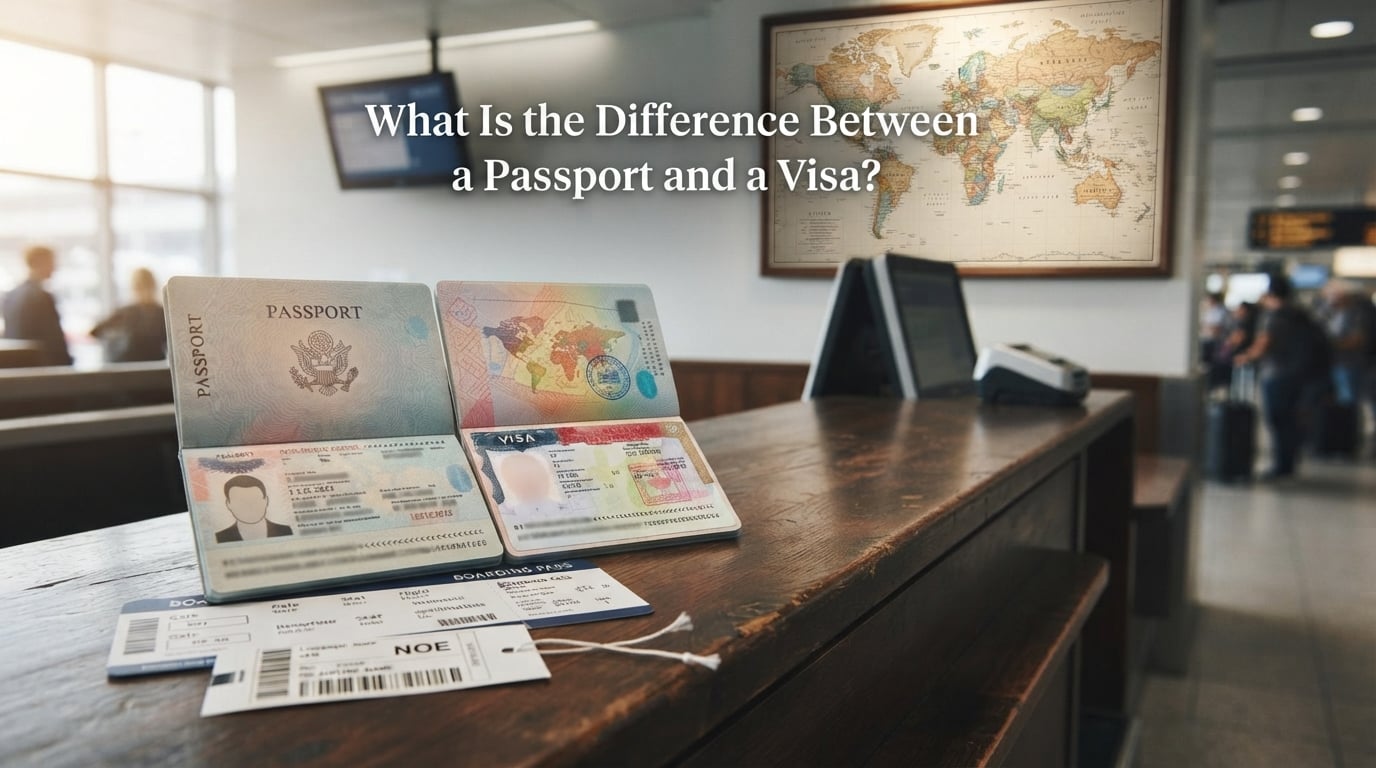
The difference between a passport and a visa is simple once you separate identity from permission. A passport is the government-issued ID from your own country that proves who you are and your citizenship; a visa is permission from a foreign country to enter for a stated reason and period.
For many international trips, you need a passport and may also need a visa. That distinction matters because arriving with a valid passport does not automatically mean a destination must admit you.
This guide explains what each document does, who issues it, when it is required, and how to check the rules without guessing. Entry requirements change, so use this as a clear starting point and confirm the details with the destination government’s official immigration, embassy, or consulate information before travel.
Table of Contents
The difference between a passport and a visa is identity versus entry permission
A passport identifies the traveler to foreign authorities and connects that traveler to a country of citizenship or nationality. A visa is a travel authorization issued by the country the traveler wants to visit, often tied to a purpose such as tourism, study, work, business, or transit.
- Passport: proves identity and citizenship for international travel.
- Visa: gives a foreign national permission to seek entry for a defined purpose.
- Passport validity: concerns whether your travel document is still acceptable.
- Visa validity: concerns when and how the destination’s authorization may be used.
A quick comparison makes the distinction easier to remember
| Question | Passport | Visa |
|---|---|---|
| What is it? | An official international travel document and proof of identity and citizenship. | Authorization from a foreign country for a particular visit or immigration purpose. |
| Who issues it? | Your government or national passport authority. | The government of the destination country, often through its embassy or consulate. |
| Who normally needs it? | People traveling internationally, subject to the route and nationality rules. | Visitors whose nationality, purpose, or planned stay triggers a destination requirement. |
| What does it do? | Lets authorities identify you and confirm your nationality. | Lets you request admission under stated conditions; it is not a promise of entry. |
| How is it presented? | Usually as a passport book; some countries also issue limited-use passport cards. | As a physical endorsement, a separate document, or an electronic record. |
| What controls its length? | The issuing country’s passport rules and the document expiration date. | The visa category, entries allowed, dates, and destination immigration rules. |
Think of the passport as the answer to “Who are you and where are you from?” Think of a visa as the destination’s answer to “May you come for this reason, under these conditions?” That short rule addresses the confusion travelers often raise in travel forums.
A passport is your home country’s proof of identity and citizenship
A passport is an official travel document issued by a national government to its citizens or nationals. It usually contains the holder’s name, photograph, date of birth, nationality, passport number, signature or signature field, issuing authority, and expiration date.
Modern passports commonly use a machine-readable zone and may contain an electronic chip with biometric information. Border officials use those features to confirm identity and document integrity, but the passport itself does not grant a right to enter every other country.
For an international flight, a passport book is normally the document carriers and border authorities expect. A passport card is not simply a smaller passport book: where available, it has narrower rules and may not be accepted for international air travel.
A passport book is usually the practical document for air travel
If a country offers both a book and a card, check the card’s permitted travel modes and borders before relying on it. A traveler can have a valid passport card and still need a passport book for the intended flight or destination.
Governments may also issue official or diplomatic passports for government-related travel. Those categories do not mean the holder can ignore a destination’s entry rules; visa requirements can still apply, and official travel may follow different procedures.
A passport is also useful after arrival because hotels, banks, carriers, and local authorities may need formal identification. Keep the original secure, carry it only when necessary, and retain a separate record of the passport number and emergency contact details.
A visa is a destination country’s conditional permission to enter
A visa is an authorization given by the country you want to visit to a foreign traveler. It can permit the holder to travel to a border or port of entry and ask to enter for a limited purpose, such as tourism, visiting family, attending business meetings, studying, working, or passing through in transit.
The destination country controls visa requirements. Its immigration authority may process the application directly, while an embassy or consulate handles applications or interviews abroad.
A visa may appear as a sticker or stamp inside the passport, but not all visas look like that. Many governments now issue an electronic travel authorization or electronic visa linked to the passport number, so the traveler may have an approval notice rather than a physical endorsement.
A visa category states the reason and limits for the visit
A tourist visa is generally for tourism or a short personal visit. A student visa is connected to study, while a work visa is connected to employment or another approved work activity.
Business, transit, immigrant, and crew categories are also common. The permitted activities depend on the visa’s terms and local law, so a visitor should not assume that a tourist authorization permits paid work, school enrollment, or a longer stay.
Even an approved visa does not remove border inspection. Immigration officials can review the passport, visa, trip details, proof of onward travel, address, funds, or other required documents and then decide whether to admit the traveler.
You need a passport for international travel and a visa only when the destination requires one
The basic sequence is straightforward: get a passport from your country, then check the destination’s rules for your nationality and trip. If the destination requires a visa, apply through its official process before departure unless that country explicitly provides a different option.
For example, two travelers flying to the same city can face different visa requirements because they hold passports from different countries. The same traveler can also face different rules for a vacation, a university program, a job, or a short airport connection.
The passport and visa work together at a border. The passport identifies the traveler, while the visa or visa exemption tells officials that the traveler may be considered for entry under the relevant category.
A passport alone is enough only when the destination permits visa-free entry for your trip
Visa-free does not mean document-free. You still need a qualifying, valid passport and may need to meet rules about return travel, accommodation, funds, travel history, health documentation, or the length and purpose of the visit.
A destination can also require a traveler to register online before departure even when it does not require a traditional visa. Read the official wording carefully rather than calling every digital approval a “visa,” because the application process and permitted stay can differ.
Visa-free travel, electronic authorization, arrival visas, and advance visas are different
Visa-free travel means the destination lets eligible travelers enter without obtaining a visa in advance, usually for a limited visitor stay. Eligibility commonly depends on the passport held, so the term is not a universal benefit for every traveler.
An electronic travel authorization is usually an online pre-travel approval connected to the passport. It may be faster or simpler than a conventional visa process, but it is still a requirement when the destination says it is required.
A visa on arrival is issued or completed at the airport, land crossing, or seaport after the traveler reaches the destination. It is not the same as visa-free travel, because the traveler must still qualify, present the requested documents, and complete the arrival process.
An advance visa must be approved before you travel
When a destination requires a visa in advance, do not board a flight assuming the border can sort it out. Airlines check travel documents before boarding, and they may refuse carriage when their records show that a required authorization is missing.
Some travelers use “visa” to mean every entry formality, while others use it only for a physical endorsement. The safer approach is to identify the exact requirement: no prior authorization, electronic authorization, visa on arrival, or visa issued before travel.
A passport’s “strength” refers broadly to the number of destinations a holder can visit without arranging a traditional visa beforehand. It can make trip planning easier, but it does not change the need to follow each destination’s current conditions.
Visa validity and permitted stay are separate limits
A frequent source of trouble is mixing up visa validity with the allowed duration of stay. Visa validity is the date range during which you may use the visa to travel to a port of entry; permitted stay is the time immigration allows after admission.
A visa might allow one entry or multiple entries. Its validity period can be longer than a single visit, yet each arrival can still have a separate maximum stay determined by the visa terms or the immigration officer’s admission record.
Your admission record controls how long you may remain after entry
Look for the document, stamp, digital record, or other official notice that states the admitted-until date and status. Staying beyond that limit can cause immigration problems even if a visa sticker appears to have a later expiration date.
Passport validity creates a separate check. A visa can be valid while the passport holding it expires, is damaged, or no longer has the validity the destination expects, so review both documents rather than focusing on one date.
Transit needs deserve the same care. A connection that stays inside an airport may still require a transit visa or other authorization for some nationalities, routes, or airports, while another connection may not.
Check the destination’s official instructions before you book travel
Visa requirements are specific to the passport you hold, the destination, the purpose of the visit, the planned length of stay, and sometimes the transit route. The following process keeps the decision clear without trying to memorize country lists that may change.
- Identify the passport you will use. Confirm its expiration date, condition, and available blank pages if the destination still issues physical endorsements.
- Check the destination government’s official immigration, embassy, or consulate site. Search for entry rules for your nationality and the reason for your trip.
- Check every transit point. Include connections, airport changes, overnight stops, and any leg where you must collect and recheck baggage.
- Find the exact category. Tourism, business, study, work, immigration, and transit can have different entry permission rules.
- Read the timing and document list. Note whether approval must arrive before travel and whether you need photographs, proof of accommodation, onward travel, financial evidence, an invitation, or other items.
- Keep proof of approval available. Save official electronic confirmation in a form you can access if an airline or border officer asks for it.
Government immigration websites, the destination’s embassy, and its consulate are the strongest sources for current instructions. An airline’s travel-document tool can be a useful additional check, but the destination government has the final rule.
Official government websites are safer than lookalike visa services
Search results can include private companies that charge to complete a form or appear to be official. Before entering passport details, inspect the government domain, compare the address with the embassy’s official site, and read whether the service is a government application or a third-party helper.
Be cautious with websites that promise guaranteed approval, demand rushed action, or hide who operates the service. If the process is unclear, contact the relevant embassy or consulate using contact information published on its official website.
Keep copies of confirmations, but do not share your passport number, scans, or visa records casually. These documents contain sensitive personal information and deserve the same care as other high-value identity records.
Common passport and visa questions have simple answers
Do I need a visa if I have a passport?
What countries are visa free?
Is your passport the same as a visa?
How long is a visa valid?
The difference between a passport and a visa comes down to identity and permission
A passport is your government-issued proof of identity and citizenship for international travel. A visa is a destination country’s permission for a particular visit, and it may be required even when your passport is current.
Before an international trip, check your passport’s condition and validity, identify every destination and transit point, and confirm the exact entry requirements with the relevant official government source. That short preparation can prevent a problem before you reach the airport or border.