
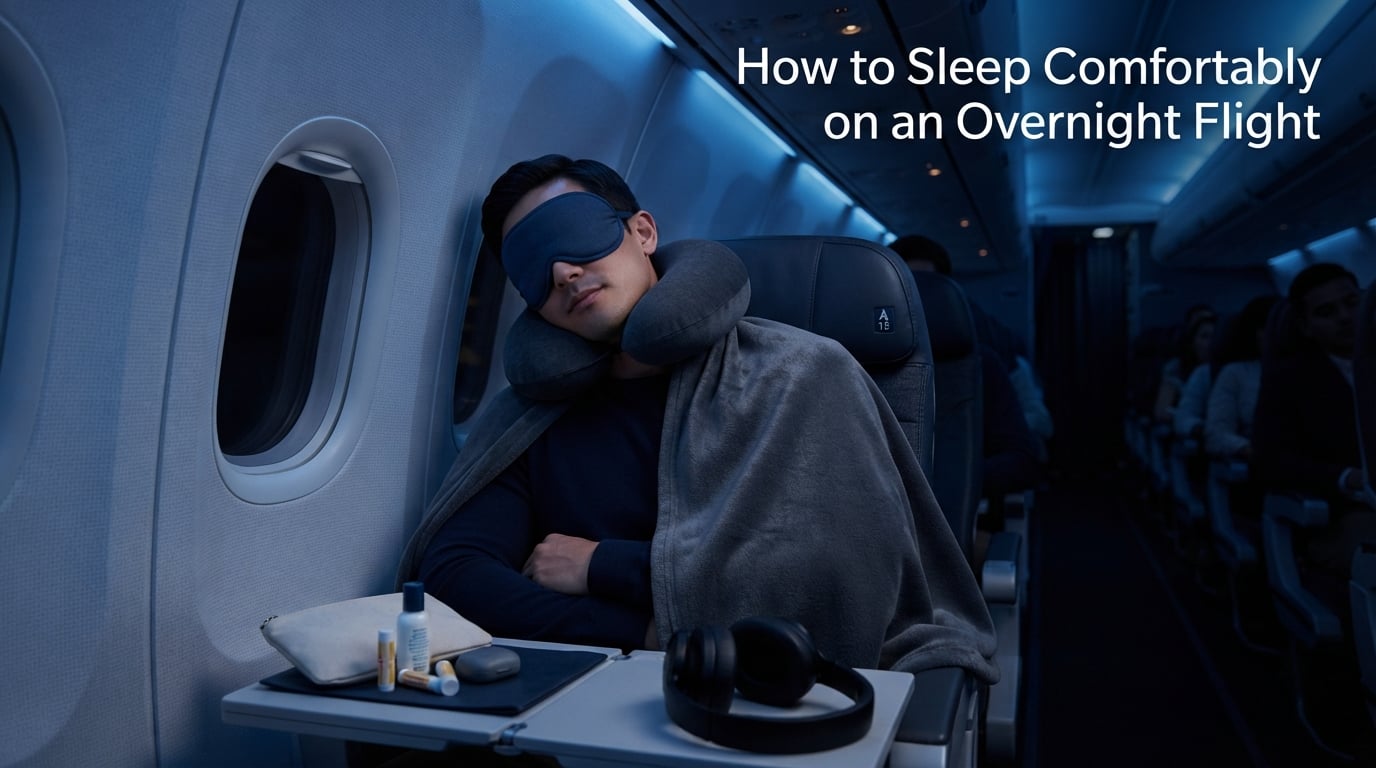
You settle into your seat, the cabin lights dim, and three hours later you are still staring at the ceiling panel above you. If you have ever wondered how to sleep comfortably on an overnight flight, you are far from alone. Millions of travelers struggle with this exact problem every single day.
I have taken dozens of long-haul flights over the years, ranging from 6-hour red-eyes to 15-hour international hauls in economy. Along the way, I have tested every trick, hack, and piece of gear promising better in-flight sleep. Some worked brilliantly, and others were a complete waste of time.
This guide brings together everything I have learned, combined with insights from sleep experts, frequent flyers, and travel forums. You will find practical strategies you can use on your next overnight flight, whether you are flying economy or business, crossing two time zones or ten.
The goal is simple. By the end of this article, you will have a complete system for falling asleep faster, staying asleep longer, and arriving at your destination feeling rested instead of wrecked.
Table of Contents
Why Sleeping on a Plane Is So Difficult
Before we get into solutions, it helps to understand the problem. Airplane cabins are essentially engineered to keep you awake. Once you know what you are fighting against, you can address each factor directly.
Cabin Pressure and Oxygen Levels
When a plane cruises at 35,000 feet, the cabin is pressurized to an equivalent altitude of about 6,000 to 8,000 feet. This means the air is thinner and contains less oxygen than what you breathe at sea level. Your body works harder to oxygenate your blood, which can leave you feeling fatigued but paradoxically make it harder to fall into deep sleep.
Lower oxygen levels can also trigger mild discomfort and restlessness. Some travelers report feeling slightly short of breath, which keeps them in a lighter sleep stage rather than reaching restorative REM sleep.
Dry Cabin Air and Dehydration
Airplane cabin humidity typically sits between 10 and 20 percent. For comparison, a comfortable indoor humidity level is around 40 to 60 percent. This extremely dry air pulls moisture from your body rapidly, leading to dry throat, irritated nasal passages, and dehydration.
Dehydration is a major sleep disruptor. Even mild dehydration can cause headaches, muscle cramps, and a general feeling of discomfort that makes sleep nearly impossible. This is why hydration strategy is one of the most important factors for in-flight rest.
Noise and Light Pollution
Airplanes are loud. The constant engine hum, cabin announcements, crying babies, and passenger conversations create a sound environment that your brain cannot easily tune out. Even if you do manage to fall asleep, sudden noises will jolt you awake repeatedly.
Light is another problem. Cabin lighting, reading lights from nearby passengers, and the glow of seatback screens all signal to your brain that it is not time to sleep. Even small amounts of light can suppress melatonin production, the hormone responsible for regulating your sleep cycle.
Upright Seat Limitations
Economy seats recline only a few inches and offer limited legroom. Sleeping upright puts pressure on your lower back, strains your neck, and restricts blood flow in your legs. The human body is simply not designed to sleep sitting up.
Without proper support, your head tends to drop forward or roll to the side, causing you to wake up repeatedly throughout the flight. This is why neck support and body positioning matter so much.
Circadian Rhythm Disruption
Your body has an internal clock that regulates sleep and wake cycles based on light exposure and routine. When you fly across time zones, especially on an overnight flight, you are asking your body to sleep at a time it considers abnormal. This mismatch between your biological clock and the schedule you are trying to follow is a core driver of jet lag.
How to Sleep Comfortably on an Overnight Flight: Pre-Flight Preparation
The secret to great in-flight sleep starts days before you ever set foot on the plane. What you do in the 48 to 72 hours before your flight can make or break your ability to rest in the air.
Adjust Your Sleep Schedule in Advance
If you are flying east, start going to bed 30 to 60 minutes earlier each night for three to four days before your flight. If you are flying west, shift your bedtime later by the same amount. This gradual adjustment helps your circadian rhythm begin adapting to your destination time zone before you even arrive.
This technique is especially effective for flights crossing five or more time zones. Even a partial adjustment before departure can significantly reduce jet lag severity and help you sleep better during the flight itself.
Follow the 10 5 3 2 1 Rule for Sleep
Many travelers use the 10 5 3 2 1 rule as a pre-flight wind-down framework. While originally a general sleep hygiene concept, it adapts well to travel preparation. Here is how it works for overnight flights.
10 hours before sleep: Stop drinking caffeine. This gives your body enough time to process stimulants so they do not interfere with sleep onset.
5 hours before sleep: Finish any heavy or large meals. Eating a large meal too close to sleep time can cause discomfort and acid reflux, especially when you are sitting upright.
3 hours before sleep: Wrap up intense exercise. Light stretching is fine, but vigorous workouts raise your heart rate and body temperature, both of which interfere with falling asleep.
2 hours before sleep: Stop working and handling stressful tasks. Give your mind time to transition from active mode to relaxation mode.
1 hour before sleep: Put away screens and bright lights. This is when you put on blue light blocking glasses, dim your environment, and start your wind-down routine.
What to Do the Day of Your Flight
On the day of your flight, focus on setting yourself up for sleep success. Get some moderate exercise, ideally outdoors, to help regulate your circadian rhythm through natural light exposure. Eat light, easily digestible meals throughout the day. Heavy foods can make you uncomfortable during the flight.
Begin hydrating early. Start drinking extra water the moment you wake up on travel day. Aim for at least 16 ounces of water per hour for the three hours before boarding. This front-loaded hydration strategy gives you a buffer against the dehydrating cabin environment.
Many frequent travelers on Reddit and travel forums swear by staying up extra late the night before an overnight flight. The idea is to build up enough sleep debt that your body has no choice but to crash on the plane. This can work, but be careful not to push yourself into exhaustion, which can actually make it harder to sleep due to elevated cortisol levels.
Choose the Right Seat
Seat selection is arguably the single most important decision you make for in-flight sleep. The window seat is universally recommended by experienced travelers and sleep experts alike. It gives you a surface to lean against, control over your window shade, and you will not be disturbed by other passengers climbing over you to reach the aisle.
Avoid middle seats at all costs if sleep is your priority. You have nothing to lean on, you are sandwiched between two strangers, and you have zero control over your environment. Aisle seats are a reasonable second choice after window seats, especially if you have long legs, but you will be disturbed by aisle traffic and cart movements.
If budget allows, consider paying for a seat with extra recline or upgraded legroom. Bulkhead seats offer more legroom but require you to store overhead bins during takeoff and landing. Exit row seats provide legroom but often have armrests that do not raise, limiting your sleeping positions.
Use tools like SeatGuru to check seat maps and reviews for your specific aircraft. Some seats have limited recline due to the row behind them, while others are positioned near galley noise or lavatory traffic.
Essential Sleep Gear for Overnight Flights
The right accessories can transform a miserable overnight flight into a genuinely restful experience. You do not need to spend a fortune, but a few key items are worth their weight in gold.
Eye Mask: Your First Line of Defense
A good eye mask blocks out all the light pollution in the cabin, from overhead lighting to neighboring screens. Look for a mask with a contoured 3D design that does not press directly against your eyelids. This allows for natural REM sleep eye movement and prevents the claustrophobic feeling some flat masks cause.
Silk masks are comfortable but often let light in around the edges. Memory foam masks with adjustable straps provide the best blackout effect. Some travelers even use weighted eye masks filled with glass beads, which apply gentle pressure that research suggests can promote relaxation.
Noise Canceling Headphones vs Earplugs
Noise canceling headphones are consistently rated as essential, not optional, by frequent flyers on forums like Reddit. Active noise cancellation technology does an impressive job of reducing the low-frequency engine drone that permeates the cabin. This constant background noise is one of the biggest sleep disruptors on long flights.
Over-ear noise canceling headphones generally perform better than earbuds for sleep, though they can be bulky. If comfort is a concern, a popular hybrid approach is wearing noise canceling earbuds underneath a standard headband or pillow. This combination blocks noise while keeping your ears comfortable when you rest your head.
For budget-conscious travelers, foam earplugs are remarkably effective when inserted correctly. They cost almost nothing and can reduce noise by 30+ decibels. The downside is they block all noise, which some people find disorienting. They also do not address the low-frequency engine rumble as well as active noise cancellation.
Neck Pillow: Types and Alternatives
The classic U-shaped neck pillow is the most recognized travel accessory, but not all are created equal. Memory foam versions offer better support than inflatable ones. Look for pillows with a clasp or snap in the front to keep them securely positioned, and a chin extension to prevent your head from dropping forward.
The Trtl pillow, sometimes called a turtle pillow, has gained enormous popularity as a neck pillow alternative. It uses a structured internal frame wrapped in soft fleece that supports your head from the side. It takes up less space than a traditional pillow and many travelers report significantly less neck pain.
If you do not have a neck pillow, you can improvise. Roll up a sweater or scarf and place it behind your neck. A small pillow or folded blanket under your chin can also prevent the dreaded head bob that wakes so many travelers.
Compression Socks
Compression socks improve blood circulation in your legs during long periods of sitting. This reduces swelling, discomfort, and the risk of deep vein thrombosis. When your legs feel comfortable, you are far less likely to toss and turn trying to find a position that relieves that heavy, achy feeling.
Look for graduated compression socks with 15 to 20 mmHg pressure for general travel use. They should feel snug but not painfully tight. Put them on before boarding so they are already working by the time you sit down.
The Foot Hammock: An Underrated Game-Changer
One accessory that almost no mainstream articles mention but that travelers rave about is the foot hammock, also called a foot sling or foot rest. This simple device attaches to your tray table and creates a suspended platform for your feet. It elevates your legs slightly, reducing lower back pressure and making it much easier to find a comfortable resting position.
Full-time travelers who fly constantly on platforms like Away Lands describe foot slings as life-changing, especially for side sleepers and anyone dealing with lower back pain. The slight elevation mimics a more natural sleeping position and takes pressure off your tailbone.
Foot hammocks are lightweight, pack down to almost nothing, and cost very little. If you struggle with leg and back discomfort on long flights, this might be the single most impactful accessory you can add to your travel kit.
Clothing and Comfort: Dressing for Sleep Success
What you wear on your overnight flight has a direct impact on how well you sleep. The right clothing choices can make the difference between arriving refreshed and arriving exhausted.
Layer for Temperature Changes
Airplane cabin temperatures fluctuate dramatically during a flight. During boarding and meal service, the cabin tends to be warmer. Once the lights dim and you are trying to sleep, the temperature often drops several degrees. Dressing in layers lets you adapt to these changes without disrupting your sleep.
Start with a soft, breathable base layer like a cotton t-shirt. Add a light sweater or hoodie that you can easily remove if you get warm. A blanket scarf or shawl doubles as a shoulder covering and an extra blanket when cabin temperatures drop.
Avoid tight waistbands, belts, and restrictive clothing. Your body naturally swells slightly during flights due to changes in cabin pressure, and tight clothing will become increasingly uncomfortable over the course of a long flight.
Footwear Strategy
Wear slip-on shoes that you can easily remove once seated. Compression socks or warm, cozy socks keep your feet comfortable and help maintain circulation. Some travelers bring a pair of soft slippers or thick socks specifically for sleeping during the flight.
Never walk barefoot in an airplane cabin. The floors are far from clean, and the lavatory areas in particular are surfaces you do not want to touch with bare skin. Always have something on your feet when you leave your seat.
Lumbar Support Hacks
Economy seats are notorious for poor lumbar support. The gap between your lower back and the seat can cause pain that makes sleep impossible. Roll up a jacket, blanket, or small travel pillow and place it behind your lower back to maintain the natural curve of your spine.
A small inflatable back cushion is another excellent option. It packs flat when deflated and provides targeted support exactly where you need it. Combined with a slight recline and a neck pillow, lumbar support can transform an economy seat into a surprisingly comfortable sleeping surface.
Creating a Sleep Sanctuary at Your Seat
The concept of a sleep sanctuary, popularized by sleep experts, applies just as much to an airplane seat as it does to your bedroom. The goal is to control every sensory input you can to create an environment that signals sleep to your brain.
Start by organizing your space. Stow everything you do not need for sleep in the overhead bin. Keep only your essentials within reach: water, eye mask, headphones, neck pillow, and any sleep aids you plan to use. A clean, uncluttered tray table and seat area reduce visual stress and help you feel more settled.
During the Flight: Your Step-by-Step Sleep Routine
Having a repeatable routine is what separates travelers who sleep well from those who do not. Here is a proven sequence of steps to follow once you board your overnight flight.
Step 1: Set Up Your Space Immediately
As soon as you sit down, organize your area. Stow your carry-on in the overhead bin so you have maximum legroom. Set out your sleep accessories where you can reach them easily. Adjust your air vent to a comfortable flow, not pointing directly at your face.
Take out your blanket and pillow right away if the airline provides them. Cabin supplies run out fast, and you do not want to be caught without one when everyone else settles in for the night.
Step 2: Hydrate Before You Sleep
Drink at least 8 ounces of water for every hour you plan to be on the flight, as recommended by multiple travel health experts. Front-load your water intake during the first few hours so you are not waking up thirsty in the middle of the night. Once you are ready to sleep, reduce intake so you are not constantly getting up to use the lavatory.
Step 3: Eat Light and Early
If the airline serves a meal, eat it soon after takeoff rather than right before you plan to sleep. Choose lighter options when possible. Heavy, greasy, or spicy foods sit in your stomach longer and cause discomfort when you try to sleep in a reclined position.
Avoid large meals within two hours of when you want to fall asleep. If you are hungry later in the flight, opt for a light snack like crackers, fruit, or a small sandwich.
Step 4: Put On Your Sleep Gear
About 30 minutes before you want to fall asleep, start your in-flight sleep routine. Remove your shoes and put on warm socks. Put in your earplugs or noise canceling headphones. Position your neck pillow.
Apply any relaxation topicals you enjoy, such as lavender essential oil on your wrists or temples. Lavender has been shown in studies to promote relaxation and improve sleep quality. Slip on your eye mask and adjust it for complete light blockage.
Step 5: Choose Your Best Sleep Position
In economy, your sleeping position options are limited but not hopeless. The most effective position for most people is a slight recline with a pillow behind the lower back and a neck pillow supporting the head. Lean toward the window if you have one, letting the wall support the side of your head.
If you are in an aisle seat, lean toward the aisle-side armrest and use your neck pillow to fill the gap between your head and shoulder. Avoid leaning onto your tray table when possible, as the forward bending position can cause significant neck and back strain.
Side sleepers can try angling their body slightly toward the window, using a pillow between their knees to align the spine. A foot hammock helps here by giving you something to rest your feet against in a more natural position.
Step 6: Use Relaxation Techniques
Once you are physically set up, calm your mind with a relaxation technique. The 4-7-8 breathing method works well on planes. Inhale through your nose for 4 counts, hold for 7 counts, and exhale through your mouth for 8 counts. Repeat this cycle four times to lower your heart rate and signal to your body that it is time to sleep.
Sleep podcasts are another excellent tool. Shows like Get Sleepy, Sleep With Me, and Nothing Much Happens are specifically designed to help you drift off through calm, meandering storytelling. Download several episodes before your flight so you do not need to rely on in-flight Wi-Fi.
Progressive muscle relaxation is a technique where you systematically tense and then release each muscle group in your body, starting from your toes and working up to your face. This releases physical tension you may not even realize you are holding and is especially helpful for anxious flyers.
What to Drink (and What to Avoid)
Your beverage choices on an overnight flight have a bigger impact on your sleep quality than you might expect. Knowing what helps and what hurts can be the difference between rest and restlessness.
Water: Your Best Friend at Altitude
Drink water consistently throughout the flight. The extremely dry cabin air pulls moisture from your body faster than you might expect, and dehydration is one of the top sleep disruptors at altitude. Aim for at least 8 ounces per hour, and do not wait until you feel thirsty to start drinking.
Bring your own refillable water bottle through security and fill it before boarding. Many travelers also bring electrolyte packets to add to their water, which helps with absorption and replaces minerals lost to the dry cabin environment.
Caffeine: Know the Cutoff
Caffeine has a half-life of roughly five to six hours, meaning if you drink a cup of coffee at 2 PM, half of that caffeine is still in your system at 8 PM. For an overnight flight, cut off all caffeine at least 8 hours before you want to sleep. This includes coffee, most teas, energy drinks, and many sodas.
Alcohol: The False Sleep Friend
This is one of the most important tips in this entire guide. Many travelers drink alcohol on flights because it helps them feel drowsy and fall asleep initially. But alcohol fundamentally disrupts sleep architecture, particularly REM sleep. You may fall asleep faster, but your sleep will be lighter, more fragmented, and less restorative.
Multiple sleep experts and travel health professionals strongly advise against using alcohol as a sleep aid on flights. The dehydrating effects of alcohol are also compounded by the already dry cabin air, making you feel worse overall. Combine that with the fact that alcohol’s sedative effects are stronger at altitude, and you have a recipe for poor sleep and a rough arrival.
Natural Sleep Aids vs Prescription Medication
Many travelers consider taking something to help them sleep on overnight flights. The options range from natural supplements to prescription medications, and each comes with important considerations.
Melatonin is the most popular natural option. It is a hormone your body naturally produces to regulate sleep, and taking a small dose (0.5 to 3 mg) about 30 minutes before you want to sleep can help signal to your body that it is time to rest. Melatonin is especially useful for time zone adjustment and is generally considered safe for occasional use. Start with the lowest dose, as higher doses can cause grogginess.
Prescription sleep aids like Ambien or zolpidem are used by some travelers, but medical professionals generally advise caution. These medications can cause significant side effects, including grogginess, confusion, and even amnesia in rare cases. The effects can be amplified at altitude and in combination with dehydration. Never take a prescription sleep aid for the first time on a flight. If you plan to use one, talk to your doctor well before your trip and try it at home first.
Herbal options like valerian root, chamomile tea, and magnesium supplements are gentler alternatives that work well for many travelers. They are less likely to cause morning grogginess and have fewer side effects. Lavender aromatherapy, applied topically or inhaled, is another natural option with research supporting its relaxation benefits.
Sleeping on a Plane with Anxiety
For many travelers, the biggest barrier to in-flight sleep is not physical discomfort but anxiety. Fear of flying, claustrophobia, and general travel stress can keep your nervous system in overdrive, making sleep feel impossible no matter how tired you are.
Acknowledge and Address the Anxiety
The first step is recognizing that flight anxiety is incredibly common and nothing to be ashamed of. An anxious brain interprets the cabin environment as a threat, keeping cortisol and adrenaline elevated. These stress hormones are the direct enemies of sleep.
Addressing the anxiety directly is more effective than trying to force sleep while your body is in fight-or-flight mode. Cognitive behavioral techniques, such as challenging irrational thoughts about flying safety, can help reframe your experience.
Practical Anxiety Reduction Techniques
Breathing exercises are your most accessible tool. Box breathing, where you inhale for 4 counts, hold for 4, exhale for 4, and hold for 4, activates your parasympathetic nervous system and calms the stress response. Practice this for five minutes before you try to sleep.
Distraction can also be powerful. Listen to a familiar, comforting podcast or audiobook. Choose something you have already heard before, as the predictability is soothing without being mentally stimulating. Avoid thrillers, news, or anything that raises your heart rate.
Some travelers find that having a comfort object from home helps. A familiar scarf, a favorite pillowcase, or a travel blanket that smells like home can create a small sense of safety in an unfamiliar environment. It sounds simple, but the psychological effect is real.
If your anxiety is severe, consider speaking with your doctor before your flight. They may recommend a mild anti-anxiety medication or suggest strategies tailored to your specific situation. Never combine anti-anxiety medication with alcohol, and always test any medication at home before taking it on a flight.
Common Mistakes That Ruin In-Flight Sleep
Even experienced travelers fall into these traps. Avoid these common mistakes and your in-flight sleep quality will improve dramatically.
Using Screens Right Before Sleep
The blue light from phones, tablets, and seatback screens suppresses melatonin production and tricks your brain into thinking it is daytime. Stop using all screens at least 30 minutes before you want to sleep. If you must use a device, enable blue light filtering or wear blue light blocking glasses.
Overlooking the Power of Routine
Your brain craves routine. If you do the same sequence of actions before sleep at home, try to replicate as much of that routine as possible on the plane. Brush your teeth, wash your face, read for a few minutes, then close your eyes. The familiarity triggers your brain’s sleep response.
Expecting Too Much Too Soon
Do not put pressure on yourself to fall asleep the moment you sit down. That pressure creates anxiety, which prevents sleep. Accept that you might only sleep for a few hours total on an overnight flight, and that is perfectly okay. Any rest is better than no rest.
Ignoring Your Body’s Signals
If you have been trying to sleep for an hour with no success, do not force it. Get up, stretch your legs, use the lavatory, and reset. Sometimes a brief change of position and a few minutes of movement is enough to break the cycle of restlessness and let sleep come more naturally when you return to your seat.
FAQ
What is the 10 5 3 2 1 rule for sleep?
What can I use instead of a neck pillow on a plane?
How to survive a 12 hour flight in economy?
How to cope with an overnight flight?
Wrapping Up: Your System for Better In-Flight Sleep
Learning how to sleep comfortably on an overnight flight is not about finding one magic trick. It is about building a complete system that addresses every factor working against you, from cabin noise and light to dehydration and poor seat ergonomics.
The travelers who sleep best on planes are the ones who prepare in advance, invest in a few key accessories, and follow a consistent routine every time they fly. Start with the basics: a window seat, an eye mask, noise canceling headphones, and a neck pillow. Add hydration strategy and a wind-down routine. Then layer in the extras like a foot hammock, compression socks, and relaxation techniques as you refine your personal system.
Your next overnight flight does not have to be a miserable, sleepless endurance test. With the right preparation and gear, you can genuinely rest in the air and arrive at your destination feeling ready to enjoy your trip. Safe travels, and sleep well.