
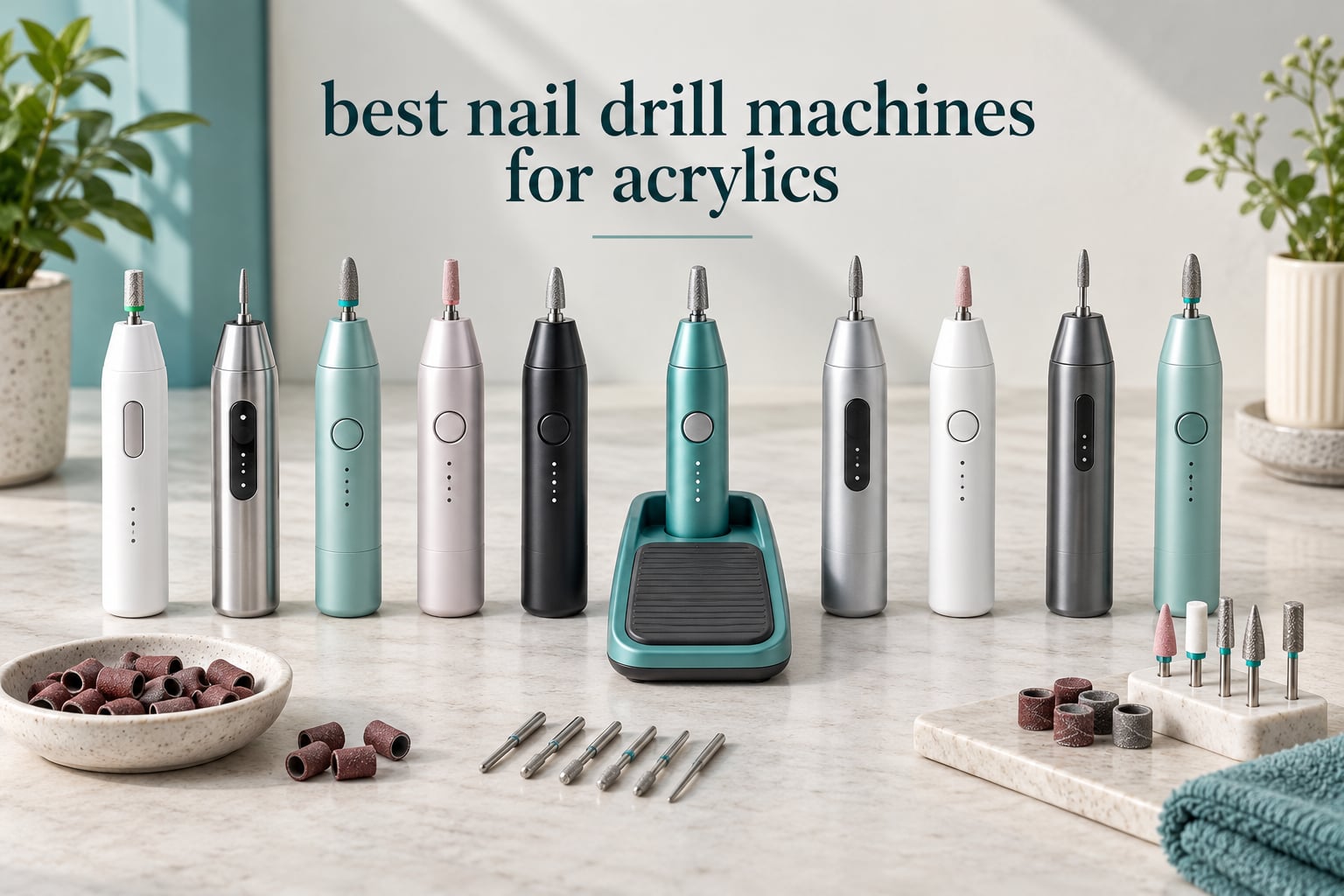
A nail drill machine — also called an e-file or electric nail file — is a handheld rotary tool with a small motor that spins a bit at a controlled speed, usually somewhere between 20,000 and 45,000 RPM. It files, shapes and removes acrylic, gel and dip powder without the brute force of a hand file, and that is the entire reason serious at-home users and working techs buy one. Acrylic is far harder than a natural nail, and taking off a full set by hand takes so long that most people thin or stress the natural nail in the process. A drill does the same job in a fraction of the time with far more control.
Below is our list of the best nail drill machines for acrylics, covering everything from small cordless pens for a home table to a 60W desktop unit with a charging base. We compared all ten across motor output, rated speed, torque under load, battery runtime, noise, handpiece weight, bit compatibility and the complaints that show up most often in reviews. Specifications quoted in each section are manufacturer-stated unless we say otherwise; ratings and review counts are the live figures on the product pages.
Two things are worth knowing before you read the picks. First, the headline RPM number matters far less than most listings suggest — a 45,000 RPM machine that stalls in thick product is worse than a 30,000 RPM machine that keeps turning. Second, the bit you load does more to change the result than the machine does, which is why we added a full bit guide and a speed-per-task reference below. If you have never used a drill before, read the safety section first. Burning a groove in your own nail plate is the one failure that actually hurts.
Table of Contents
Top 3 Nail Drill Picks for Acrylics in 2026

Makartt 60W E-File Drill
- 60W coreless motor to 35000 RPM
- Up to 14 hours cordless
- Stepless control with LCD RPM readout

JEWHITENY SG717 45000 RPM
- 0-45000 RPM with LCD readout
- 6 bits and 6 sanding bands
- Back clip and folding stand
MOCOWIND 35000 RPM Drill
- 3600mAh battery
- 8-10 hours per charge
- Aluminum handpiece
- 7 bits plus 6 bands
Our top three cover three different needs. The Makartt has the most torque and the most reviews in this group, so it earns the Editor’s Choice for anyone who files a lot of product. The JEWHITENY gives you the widest speed range and a display for a fraction of the money. The MOCOWIND is the cheapest way into a drill that will not embarrass you on your first full set.
Quick Overview: All 10 Nail Drill Machines Compared
| Product | Specifications | Action |
|---|---|---|
| Makartt Professional 60W E-File |
|
Check Latest Price |
| JEWHITENY SG717 45000 RPM |
|
Check Latest Price |
| MOCOWIND 35000 RPM |
|
Check Latest Price |
 SAVILAND 40000 RPM SAVILAND 40000 RPM |
|
Check Latest Price |
 AZ GOGO 30000 RPM AZ GOGO 30000 RPM |
|
Check Latest Price |
 MelodySusie SC320I Foot Pedal MelodySusie SC320I Foot Pedal |
|
Check Latest Price |
 Lavinda 35000 RPM Cordless Lavinda 35000 RPM Cordless |
|
Check Latest Price |
 MelodySusie Clip-On MM400C MelodySusie Clip-On MM400C |
|
Check Latest Price |
 Tiandirenhe 45000 RPM Kit Tiandirenhe 45000 RPM Kit |
|
Check Latest Price |
 ORFASTAR 45000 RPM Kit ORFASTAR 45000 RPM Kit |
|
Check Latest Price |
1. Makartt Professional 60W E-File — Best Overall Nail Drill for Acrylics
Makartt Professional Nail Drill for Nail Techs: 35000RPM E-File, Black
60W coreless motor to 35000 RPM
2500mAh, up to 14 hours cordless
Stepless control with LCD RPM readout
Pros
- Strong 60W motor with smooth steady filing
- Stepless speed plus forward/reverse and pause
- Up to 14 hours of cordless runtime
- Charging base and handpiece holder included
- UL FCC CE and RoHS certified
Cons
- Included accessory set is only 6 bits and 6 sanding bands
- Heavier cordless battery pack than slim pen drills
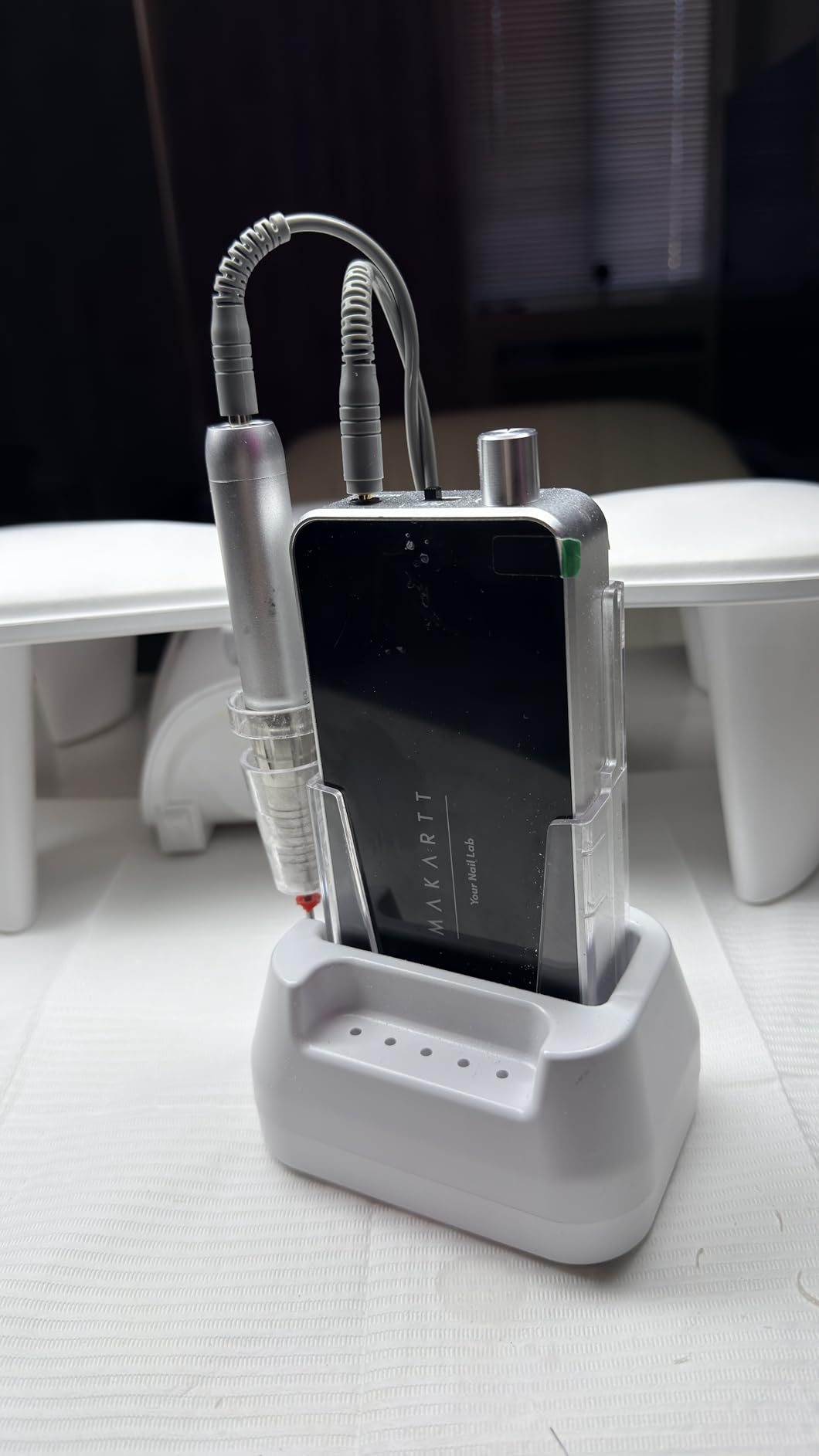
The Makartt is the one we keep coming back to. Its 60W coreless motor is the highest wattage published among the specifications for this group, and you can feel the difference the moment the bit touches a thick apex — the handpiece keeps turning instead of balking and stalling. That is the single most important trait in a drill you will use for removal, and it is where plenty of cheaper pens fall down. More than ten thousand reviews sit behind this listing, which makes it the best-evidenced pick here rather than a speculative one.
Battery life is the other standout. The 2500mAh pack runs up to 14 hours cordless per charge, so a full day of appointments does not mean charging between clients. Stepless speed control with a pause button lets you creep down to filing speed mid-stroke without stopping to hunt through numbered presets, and the LCD shows live RPM and remaining battery rather than a guess.
It also ships as a desktop setup. The charging base holds the handpiece upright when you are not filing, and the handpiece holder keeps it from rolling off a towel. It is UL, FCC, CE and RoHS certified, and at 1.87 pounds it stays portable if you want to take it to a client’s house instead of working from a fixed desk.
What to check before you buy it
The included accessory set is small: 6 drill bits and 6 sanding bands. That covers a first session, but anyone filing full sets regularly will replace the metal bits within a few months. Budget for a separate bit order early rather than treating the box as a permanent supply.
The other thing to know is weight. The battery pack is chunkier than a slim pen-style drill, and if you are doing pedicure work on someone moving around, the balance takes a little getting used to. The motor is coreless rather than brushless, so expect this to be a long-term machine you keep on a desk rather than one you carry constantly.
Who it suits and who should pass
Choose this if you remove acrylic often, run a home studio, or file several full sets a week. The torque headroom means thick product and hardened apexes come down fast without the bit bogging down and generating heat.
Pass if you are buying your first drill and doing one manicure a month. A simpler pen will do the same job for that frequency, and the extra weight and size here are not something you will appreciate. This one rewards frequency.
2. JEWHITENY SG717 45000 RPM — Best Budget Nail Drill for Acrylics
JEWHITENY Portable Nail Drill SG717 Electric Nail File,45000RPM Professional Rechargeable Nail E-File Machine for Acrylic Gel Nails,Remove Nail Gel Polish(Purple)
Adjustable 0-45000 RPM
Visual LCD for speed and battery
6 bits and 6 sanding bands
Pros
- Widest speed range at a low entry cost
- Display shows speed direction and battery
- Simple one-knob controls a beginner can use
- Compact cordless body with stand and back clip
- Good balance for home acrylic and gel work
Cons
- Included bit shapes may not suit every technique
- Not rated for heavy continuous salon use
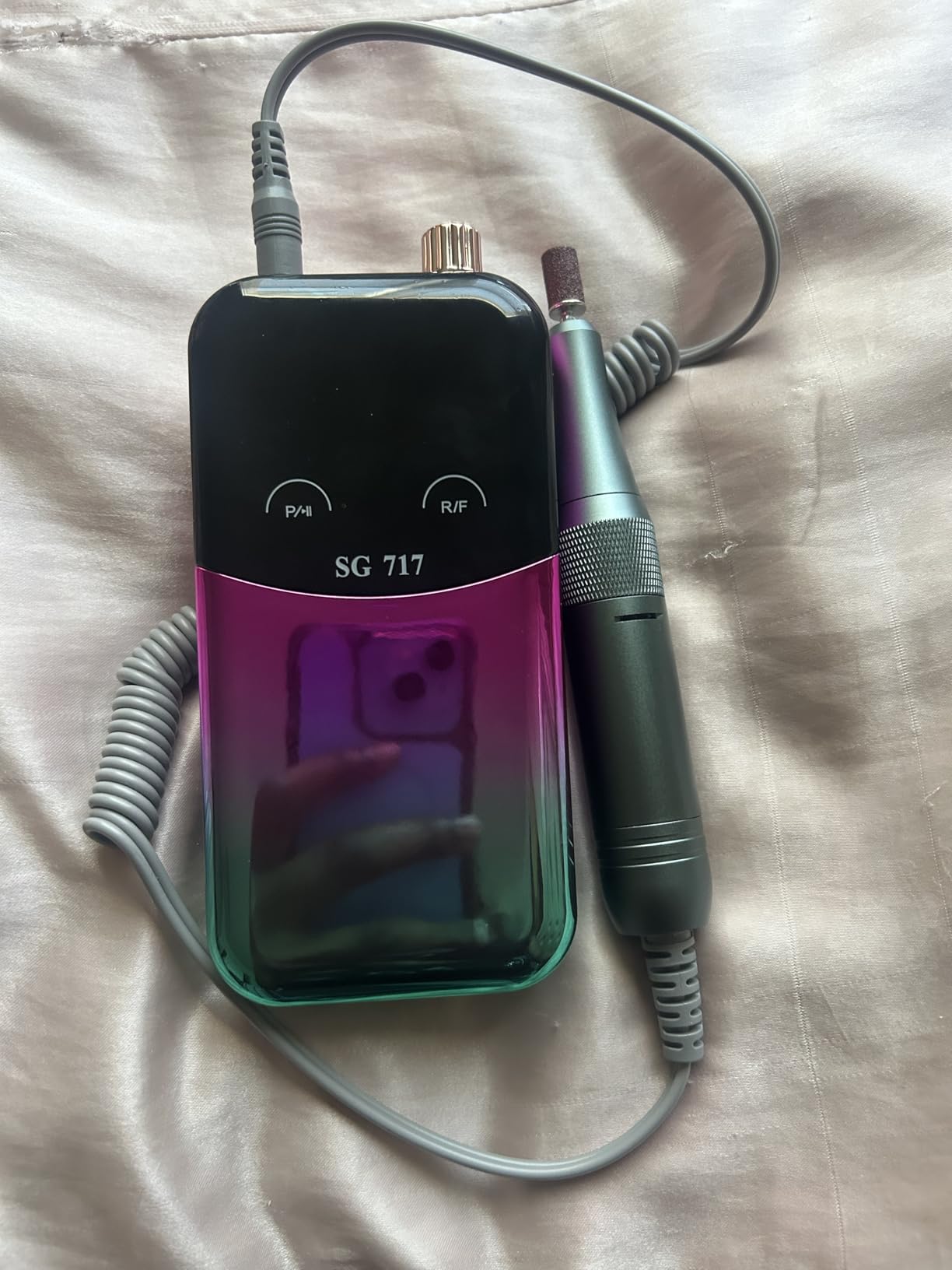
For most home users this is the drill that makes the most sense. It covers the full 0 to 45,000 RPM range, so you can creep along a natural nail at 8,000 RPM and then take a full set down at 35,000 RPM on the same machine, and the LCD panel shows speed, rotation direction and battery level at a glance. That display is unusual at this price and genuinely useful when you are learning what speed feels like.
It is also among the lightest bodies in this group at 1.06 pounds, which matters more than it sounds for a tool you hold at arm’s length. A back clip and an integrated stand mean you can set it down mid-session without hunting for a surface, and the detachable bit holder keeps the spare bits from disappearing into a drawer.
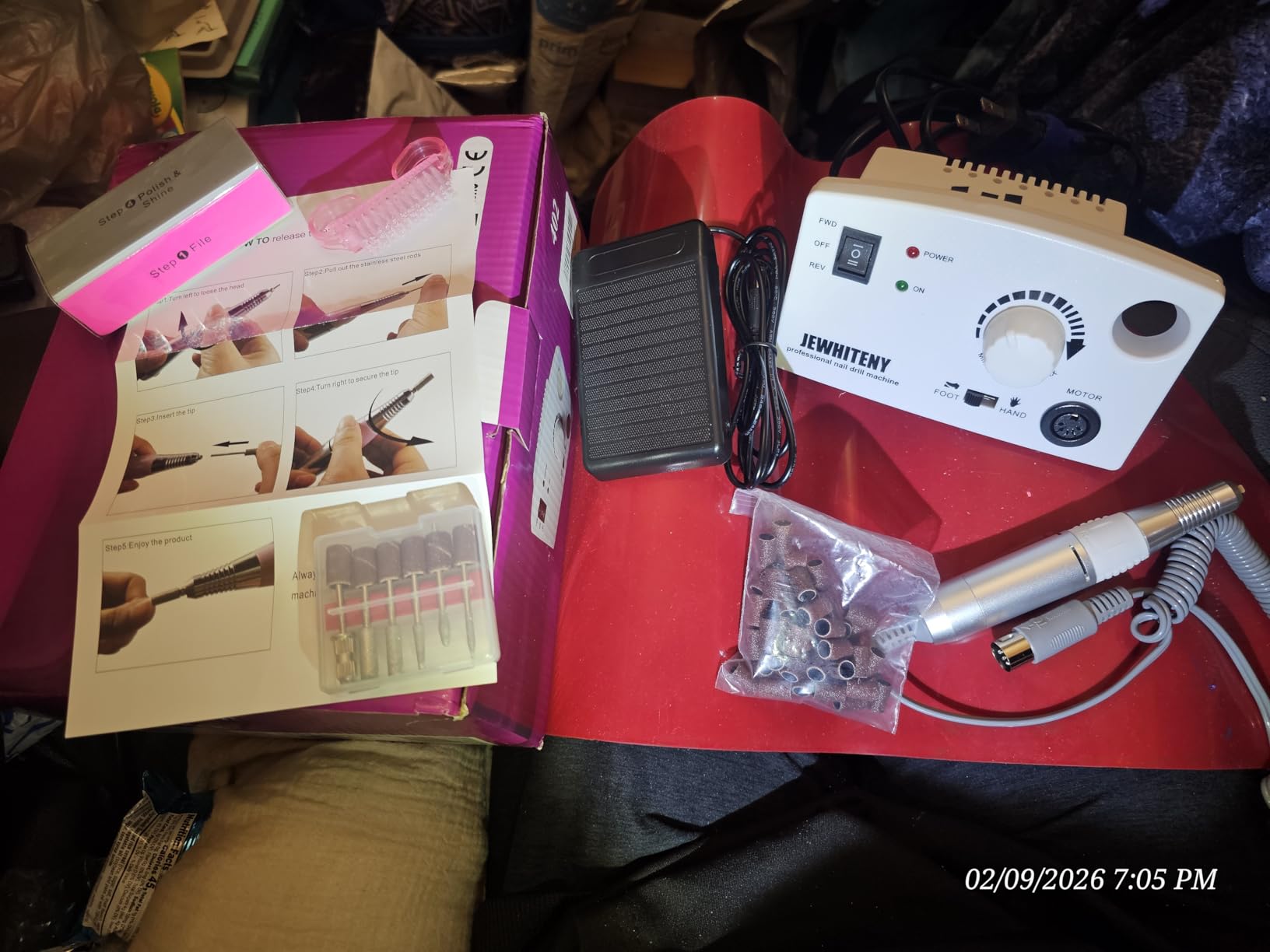
Reviews of this model are almost uniformly about two things: the speed range with simple knob control, and how quickly a new user can pick it up. Home users doing occasional gel and acrylic removal rate it highly for exactly that reason. There is no learning curve between unboxing and your first file.
What to check before you buy it
The bit kit is functional rather than excellent. Six bits and six sanding bands will get you through refinement and shaping, but if you plan to take off thick full sets regularly you will want to order tungsten carbide barrel bits separately within a few months.
Also note this is not built for continuous daily salon work. The listing is honest about that, and the reviews reflect it — a lot of owners describe it as a periodic home tool rather than an all-day machine. If you are filing six or more sets a day, the motor and battery here will not be the limiting factor that your hands will be.
Who it suits and who should pass
This suits a beginner or a home user doing a set every week or two, and it also works well as a travel drill for a kit bag. The wide speed range means you are not buying a tool that can only do one job.
Pass if you are a working tech on a strict budget who needs something to survive years of daily use. Look at the Makartt or MelodySusie options instead. Otherwise, the value here is very hard to argue with.
3. MOCOWIND 35000 RPM — Best Value Nail Drill for Acrylics
MOCOWIND Portable Nail Drill Professional 35000 RPM, Electric Nail E File
Up to 35000 RPM
3600mAh battery, 8-10 hours of use
Aluminum alloy handpiece
Pros
- Smooth power for gel and acrylic removal
- Lightweight and comfortable in long sessions
- Twist-lock bit changes are very fast
- Long runtime across many manicures
- Runs with low heat noise and vibration
Cons
- Battery reported dying after about a year by some owners
- Slow to start at the very lowest speed settings
- A few reports of the wireless function failing early
MOCOWIND is the pick if you want a real drill without spending much. The 35,000 RPM ceiling is enough for full acrylic removal, and reviewers consistently describe the filing as smooth rather than chattery, with an aluminum alloy handpiece that stays cool and quiet. The body is only 6.3 by 2.8 by 1 inch, so it disappears into a hand and stays out of the way during shaping work.
Battery figures are good for the class. The 3600mAh cell takes about three hours to charge and gives 8 to 10 hours of use, which covers a heavy day of home appointments with room to spare. Twist-lock bit changes are fast, and the LCD with forward and reverse rotation means you can switch direction for your filing hand without swapping hands on the bit.
One-touch controls do most of the work, and the 7 bits and 6 sanding bands included are enough to learn on. Home users and working techs alike tend to describe it as a step up from the very cheap pens, which is exactly where the money goes in this drill — the motor and the metal handpiece.
What to check before you buy it
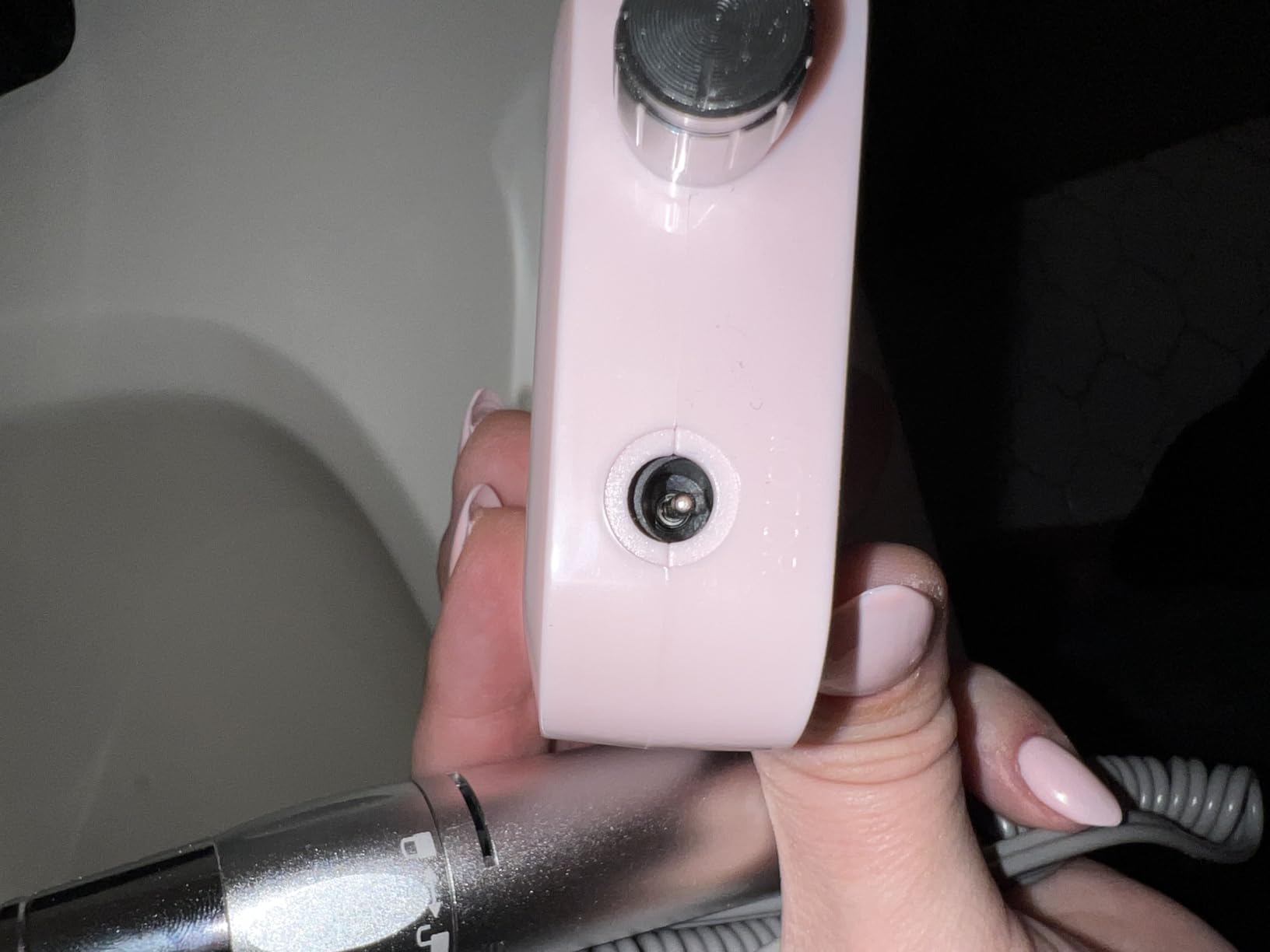
Durability is the recurring theme in the reviews, and it is worth being blunt about. A number of owners report the battery degrading after roughly a year of regular use, and a smaller number report the unit cutting out or the wireless function failing. If you are filing daily, treat this as a two-to-three year purchase rather than a forever machine.
There are also a few reports of the drill not starting properly at the lowest speed settings. That is a minor annoyance for removal work, but if you rely on very low speeds for cuticle cleanup you should check your unit early and keep a second bit option ready.
Who it suits and who should pass
Best for a student, a beginner tech, or a home user who files a set every week or two and wants real torque without a big invoice. The accessory count is better than most at this level too.
Pass if you need something for a full salon day five days a week. The long-term battery reports make that a poor fit, however good the first six months feel.
4. SAVILAND 40000 RPM — Best for Fast Acrylic Removal
SAVILAND Nail Drill Professional 40000RPM 30S Fast Removal for Acrylic Nail
40000 RPM top speed
4000mAh for 7-8 hours of use
38-piece bit and sanding band set
Pros
- Quiet motor that keeps power under resistance
- Starts at 1 RPM for slow controlled work
- 7 to 8 hours of continuous runtime
- Large complete bit and sanding band set
- Light handpiece that fits in the palm
Cons
- Included bits may not suit every shape preference
- One report of a charging cable failing
- Shortened battery endurance after about a year
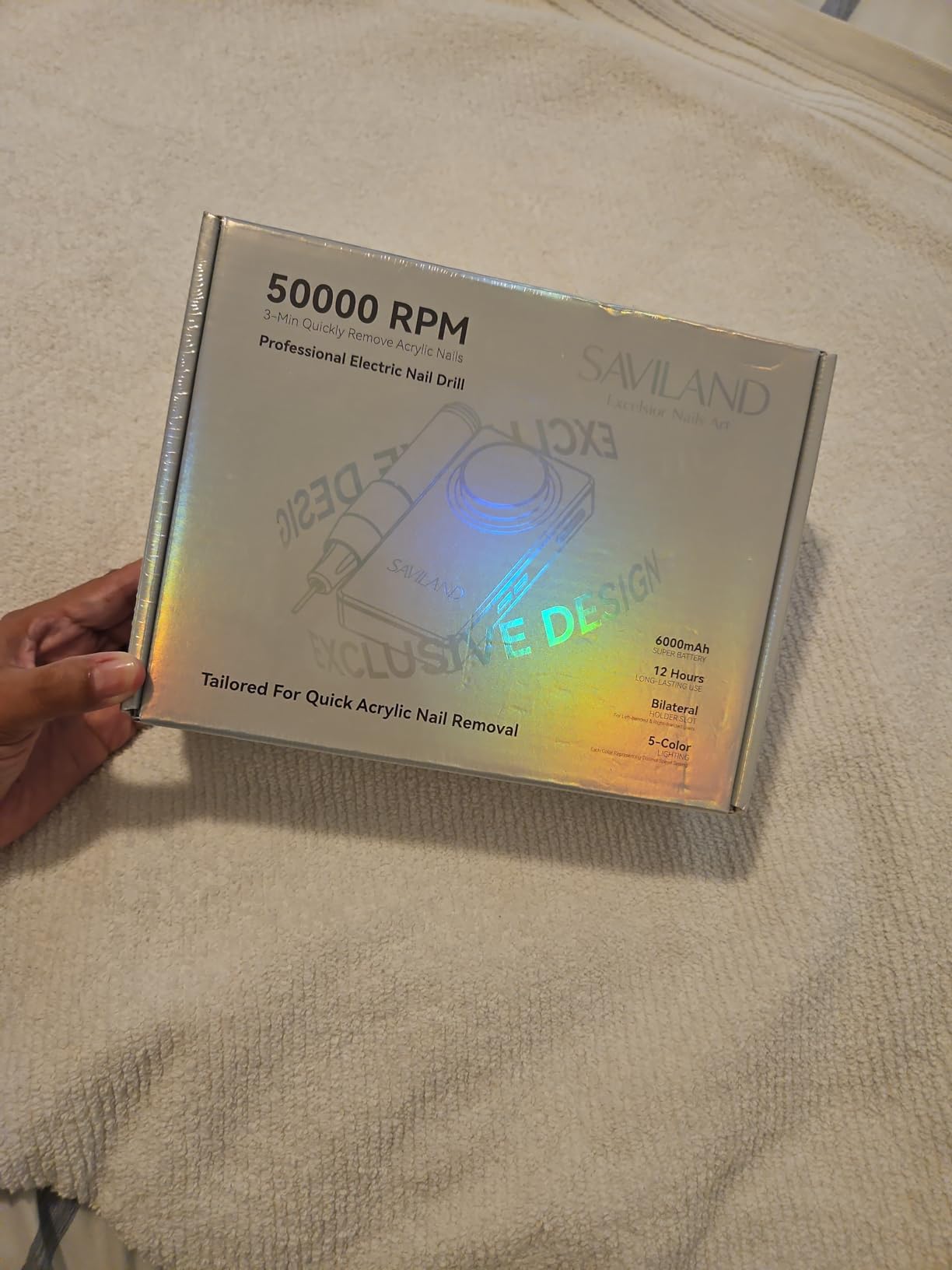
The SAVILAND is built around one job: getting product off fast. The 4000mAh battery delivers 7 to 8 hours of continuous use, the handpiece weighs just over a pound, and the motor is quiet enough that you can hear conversation over it. What reviewers like most is that it starts at 1 RPM, so you can ease onto a nail at a crawl and ramp up once you are oriented, instead of jolting into full speed.
The bit bundle is the biggest in the cordless group: 38 pieces, including 6 metal bits, a ceramic corn bit, 5 polishing bits and 26 sanding bands. For someone building a first full set or refining work, that is genuinely enough to start and to finish. The hexagonal HD display shows speed and battery without guesswork.
Where it wins over the cheaper pens is steadiness under load. Files that stall when they hit a dense apex force you to lift, reposition and start again, which wastes time and generates heat. This one keeps turning, and that is why it earns the fast-removal badge.
What to check before you buy it
Battery wear appears in reviews here too, with some owners reporting shortened endurance after about a year. The charging cable is the other weak point, with at least one reported failure — plan to keep a spare USB cable rather than hunting for a proprietary one.
The included bit shapes are a matter of taste. With 26 sanding bands you will have plenty of grit variation, but heavy removal wants a large carbide barrel, and you may still want to order that separately if you mostly take off thick sets.
Who it suits and who should pass
Ideal for anyone doing frequent removals, including infill changes and rebalancing between appointments. The 1 RPM start and long runtime make it forgiving on a first attempt.
Pass if you mostly apply and refine rather than remove, or if a metallic finish and a wide body are not what you want in your kit. This one is deliberately styled and practical rather than compact.
5. AZ GOGO 30000 RPM — Best Compact Nail Drill for Travel
Nail Drill Machine, AZ GOGO 30000RPM Professional Rechargeable Portable Electric Efile Nail Drill for Acrylic Gel Nails, Manicure/Pedicure, Polishing, Cuticle – Salon or Home Use(White)
0-30000 RPM with forward and reverse
2.5 hour recharge, 6-8 hours of use
Four-level battery display
Pros
- Smooth quiet run with only slight vibration
- Small enough to carry and hang from a belt hook
- Four-step battery indicator is easy to read
- Locking chuck holds the bit secure at speed
- Aluminum handpiece dissipates heat well
Cons
- 30000 RPM ceiling is lower than most rivals here
- Handpiece vents must be kept clear of dust or they block
The AZ GOGO is one of the most compact machines here, and the manufacturer says the body is smaller than an iPhone 6 Plus. For mobile work or a bag that already has too much in it, that matters. It also has a belt hook and a carry pouch, so you can keep it on your hip between appointments rather than digging through a case.
Operation is quiet with only slight vibration, and the four-level battery display at 25, 50, 75 and 100 percent is unusually honest. You can see at a glance whether you have enough charge for a full set, which removes the mid-service dying moment that catches people out most often. A full recharge takes 2.5 hours and gives 6 to 8 hours of continuous work.
The locking chuck is a detail worth crediting. It holds the grinding head firm at speed, which means the bit does not creep and wobble mid-stroke on a lateral surface. The aluminum handpiece handles heat well, and the build is CE certified, which is a reasonable baseline for a tool that gets handled this closely to skin.
What to check before you buy it
The 30,000 RPM ceiling is the real trade-off. It is plenty for shaping, fills, refinement and most removals, but when you hit a very dense apex on a full set, the higher-ceiling machines here will move faster with less pressure on your hand.
There is one maintenance habit you need to adopt: keep dust out of the ventilation holes. Filings pack into the vents of a portable drill quickly, and once airflow drops the handpiece runs warmer. A brush or a puff of air every few appointments fixes it, but skip it and you will notice the heat before you notice anything else.
Who it suits and who should pass
Good for a mobile tech, a student doing sets between lectures, or anyone who needs a drill that fits in a jacket pocket. It is a solid all-rounder for shaping and prep work at home too.
Pass if your priority is the fastest possible removal of thick product or long daily salon hours. The 30,000 RPM limit makes it a compromise rather than a specialist.
6. MelodySusie SC320I — Best Nail Drill with Foot Pedal Control
MelodySusie Foot Pedal Nail Drill SC320I with Bit & Handpiece Storage
0-30000 RPM with foot pedal control
Aluminum alloy handpiece, low heat
Works with all 3/32 inch bits
Pros
- Foot pedal is faster than reaching for on and off controls
- Quiet and thorough filing users call salon grade
- Handpiece stores inside the base to save desk space
- Integrated bit holder keeps bits within reach
- Works well for pedicure work
Cons
- Cord at the handpiece connection is a common failure point
- Some handpieces stop working after a few months
- Replacement handpieces are hard to find
Everything on the search results is a pen you hold. This is the other option: a desk machine you control with a foot pedal, which is how a lot of professional setups actually work. Once you get used to it, the pedal changes how you work — you can start and stop without breaking your filing hand’s position, and both hands stay free to steady the finger.
The base holds the handpiece and the bit holder, so the whole thing is one compact object on a table. The speed dial runs 0 to 30,000 RPM with dedicated forward and reverse buttons, and the aluminum alloy handpiece stays cool with low noise and vibration. The twist-lock chuck takes any standard 3/32 inch bit, and the box includes 6 bits and 56 sanding bands — by far the largest sanding band supply in this roundup.
Manufacturers publish recommended speed bands for this model, and they are worth reading before you start: about 8,000 to 12,000 RPM for natural nail prep, above 15,000 for sanding bands, above 25,000 for gel removal, and up to 35,000 for shortening. Those numbers are a good free reference for every other drill in this list too.

What to check before you buy it
The dominant complaint is the handpiece cord. Several owners report intermittent or total handpiece failure after a few months, and replacement handpieces for this model are not easy to source. That is a real risk on a desk machine, because the cord sits in exactly the place where it gets tugged every session.
It is also one of the heaviest units here at 2.47 pounds, which is fine on a desk and wrong for a mobile kit. And at 0 to 30,000 RPM it sits in the middle of the group, not at the top.
Who it suits and who should pass
Best for a home studio setup or a fixed salon station where both hands are busy, and for pedicure work where a pen would be awkward. The 56 sanding bands also make it the best value if you refine a lot of dip powder and gel color.
Pass if you move between clients and need something that goes in a pocket. This is furniture, not equipment.
7. Lavinda 35000 RPM — Best Quiet Nail Drill for Acrylics
Lavinda Electric Nail Drill Cordless Nail Efile for Acrylic Gel Nail, Black
Second generation coreless motor to 35000 RPM
Cordless rechargeable design
6 3/32 inch bits included
Pros
- Very quiet with almost no vibration at 35000 RPM
- Holds charge through multiple full appointments
- Slim light handpiece reduces hand fatigue
- Pause and forward reverse both work reliably
- Bits fit firmly without loosening
Cons
- Some have failed prematurely despite the pro positioning
- A minority report glitchy starts after a few uses
If noise is the thing that stops you drilling — a shared flat, a small treatment room, someone sleeping nearby — the Lavinda is the one to look at. Reviewers describe it as virtually vibration-free even at the full 35,000 RPM, and the slim, light handpiece is the kind that stays comfortable through a long day without the ache that sets in from heavier pens.
The second-generation coreless motor is paired with a smart self-protection chip that raises an overload warning and an E2 error code rather than letting the motor burn out. That is a real feature on a 35,000 RPM tool, because sustained overload is what kills these motors. Controls are deliberately beginner-friendly, and the kit includes 6 good 3/32 inch bits that fit firmly without loosening mid-file.
Experienced techs and beginners both rate it highly, and one recurring comment is worth repeating: Lavinda’s support has replaced units for buyers whose drills failed. That kind of after-sales response matters more in this category than most buyers realise, because the failure mode is always the same — the motor or battery gives out, and a replacement handpiece is often unavailable.
What to check before you buy it
Durability is the split point. Most reviews praise longevity, but a smaller group report units dying or behaving oddly after only a handful of sessions. Nothing in the range has a perfect record, and this one is on the better half of that distribution while still having room to surprise you.
At 2.18 pounds it is also one of the heavier bodies here, and the package dimensions suggest a cordless design that is not as slim as the smallest pens. If pocketability is your priority, look at the AZ GOGO instead.
Who it suits and who should pass
Best for full-day salon work in a space where noise and vibration are a genuine problem, and for anyone with hand fatigue issues after long sessions. The 35,000 RPM ceiling handles removal work as well as anything except the 40,000 and 45,000 RPM machines.
Pass if your priority is the highest possible speed number or the smallest possible body. Neither is the reason to buy this one.
8. MelodySusie Clip-On MM400C — Best for Mobile Nail Techs
MelodySusie Clip-On Cordless Nail Drill 35,000 RPM MM400C for Nail Tech
35000 RPM coreless motor at 400 gf-cm
Dual-cell 4000mAh, over 15 hours
Clip-on waist attachment
Pros
- Lightweight and quiet enough for a full working day
- Clip-on design frees both hands and eases carrying
- Charges with a phone charger
- Dual-cell battery covers multiple days
- LED shows speed direction and power
Cons
- Handpiece can run warm during extended sessions
- A few have failed or gotten noisy within a couple of months
- Battery gauge has been reported to drop suddenly under load
The clip-on waist attachment is the whole idea here. The motor body sits on your belt or pocket and the handpiece is pen-shaped, so both hands stay free to carry a kit, open a case or steady a client’s finger. For a tech driving between appointments, that changes the day more than any spec on the list.
Underneath, the numbers are strong: a 35,000 RPM coreless metal motor rated at 400 gf-cm of torque, a dual-cell 4000mAh battery that runs for more than 15 hours, and stepless speed control with forward and reverse on an LED display. Fifteen hours means several appointments on one charge, and it charges off a phone charger, so one cable covers the drill and your phone.
Techs tend to rate this as a genuine step up from entry-level pen drills, and the quiet, low-vibration motor gets called out often. Customer service on warranty issues is also mentioned favourably, which again matters more in this category than the listing pages suggest.
What to check before you buy it
Heat in the handpiece on long jobs is the most common note, even though the listing describes low-heat operation. On a long removal with a large barrel bit, expect to feel warmth through the pen barrel and give it a rest periodically. It is manageable, but it is real.
There are also a few reports of units failing or becoming noisy within a couple of months, and of the battery gauge dropping suddenly under load. Test the gauge early so you learn what it does before you are mid-appointment.
Who it suits and who should pass
Ideal for mobile technicians, students carrying a kit between locations, and anyone who works in a space where a desktop machine is not an option. The runtime alone makes it a strong daily tool.
Pass if you work from a fixed desk and want maximum power. The Makartt has more torque and a steadier foot; this one trades a little of that for the freedom of the clip-on format.
9. Tiandirenhe 45000 RPM — Best Accessory Bundle
Professional Nail Drill Kit 45000RPM, Portable Electric Nail File with 13 Bits & 56pcs Sanding Bands,LED Screen,Ultra-Silent, Rechargeable Nail Drills Machine for Acrylic Nails Gel Polishing (White)
45000 RPM with a cooling ventilated handpiece
13 bits plus 56 sanding bands
8-10 hours on a 2-3 hour charge
Pros
- 45000 RPM with a cooling handpiece that stays comfortable
- Very large bundle of 13 bits and 56 sanding bands
- 8 to 10 hours of runtime on a fast charge
- Lightweight anti-slip grip with minimal vibration
- Belt clip with a base that doubles as a charging hub
Cons
- Relatively new listing with a small review base
- Handpiece is tethered by a lead to the base
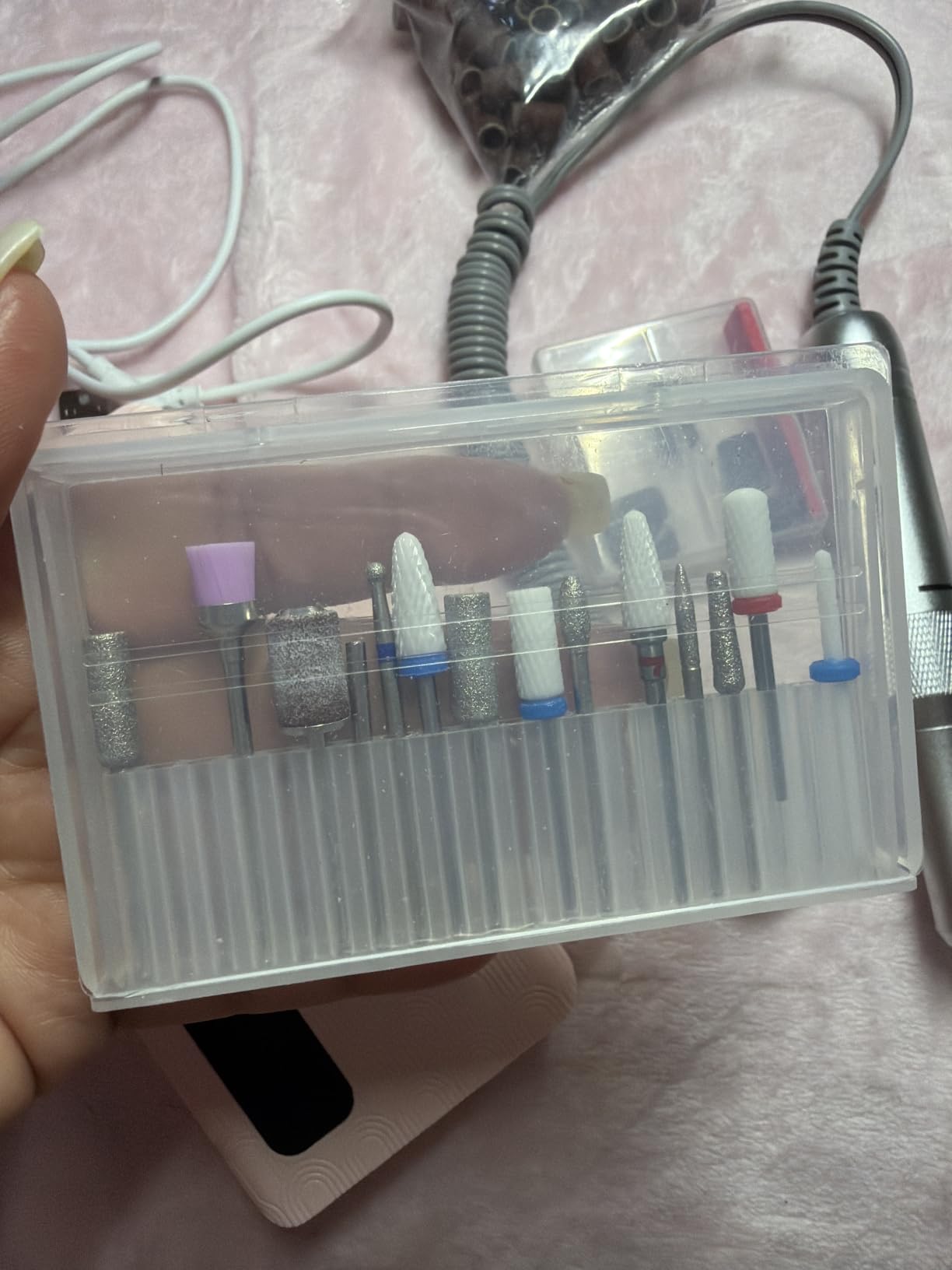
The headline number here is the bundle. Thirteen metal, carbide and ceramic bits plus 56 sanding bands is more than any other machine in this roundup, and for a first-time buyer it removes the most common early frustration, which is not having the right bit when you need it. Between the carbide, ceramic and metal options you can cover shaping, refinement, cuticle work and removal without a second order.
The 45,000 RPM motor is paired with an advanced cooling design and a ventilated aluminum alloy handpiece, which is the direct answer to the heat complaints that appear on other picks. Runtime is 8 to 10 hours on a 2 to 3 hour charge, and a 360-degree rotating handle with forward and reverse modes lets you reorient the handpiece without twisting your wrist into an awkward angle.
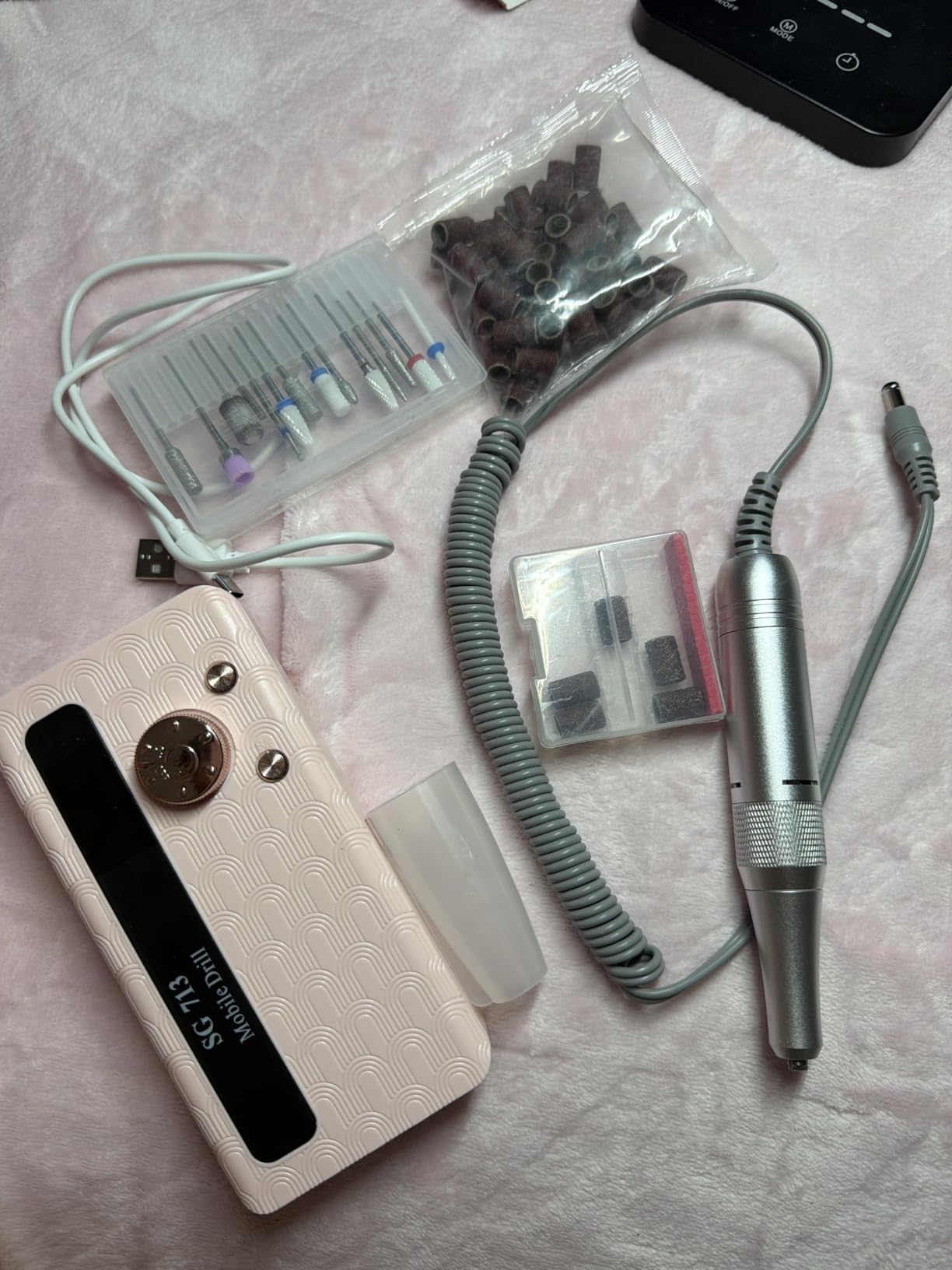
It also has a twist-lock chuck, a belt clip and a detachable base that doubles as a charging hub, so the whole thing is one tidy object. Owners describe the grip as anti-slip and light, and the cooling-focused handpiece as staying comfortable on long jobs.
What to check before you buy it
Review volume is the caveat. Two hundred reviews is a thin base compared with the ten-thousand-plus listings elsewhere here, so treat the 4.7 average as encouraging rather than proven. We are seeing good reports, but we have less history to lean on.
The handpiece is tethered to the base by a lead, so it is not a single cordless pen. That is fine on a table and awkward in a bag, and it is the same category of risk as the MelodySusie foot pedal cord, just a shorter one. If you want something you can carry loose, choose a true all-in-one pen.
Who it suits and who should pass
Best for a beginner who wants everything in one box, or for anyone who has a drill but keeps running out of the right bit. The cooling handpiece also makes it a good choice for long removal sessions.
Pass if buying a lightly reviewed listing makes you nervous, or if you need something specifically designed for carrying between clients with no tether.
10. ORFASTAR 45000 RPM — Best for First-Time Nail Drill Buyers
Nail Drill Professional, 45000 RPM Rechargeable Electric Nail File Kit for Acrylic & Gel Nails, Portable Manicure Pedicure Tool for DIY Home or Salon, with 11 Nail Drill Bits & Sanding Band Set
45000 RPM aluminum alloy motor
4-6 hours on a 3 hour charge
Smart LCD with speed and battery
Pros
- Very quiet with minimal vibration at full speed
- Locking mechanism stops bits sliding out
- Cordless base with side storage and belt clip
- Enough bits and bands included for acrylic work
Cons
- Handpiece is tethered by a coiled cable to the base
- Instruction sheet is sparse or missing
- Some stop intermittently at higher loads
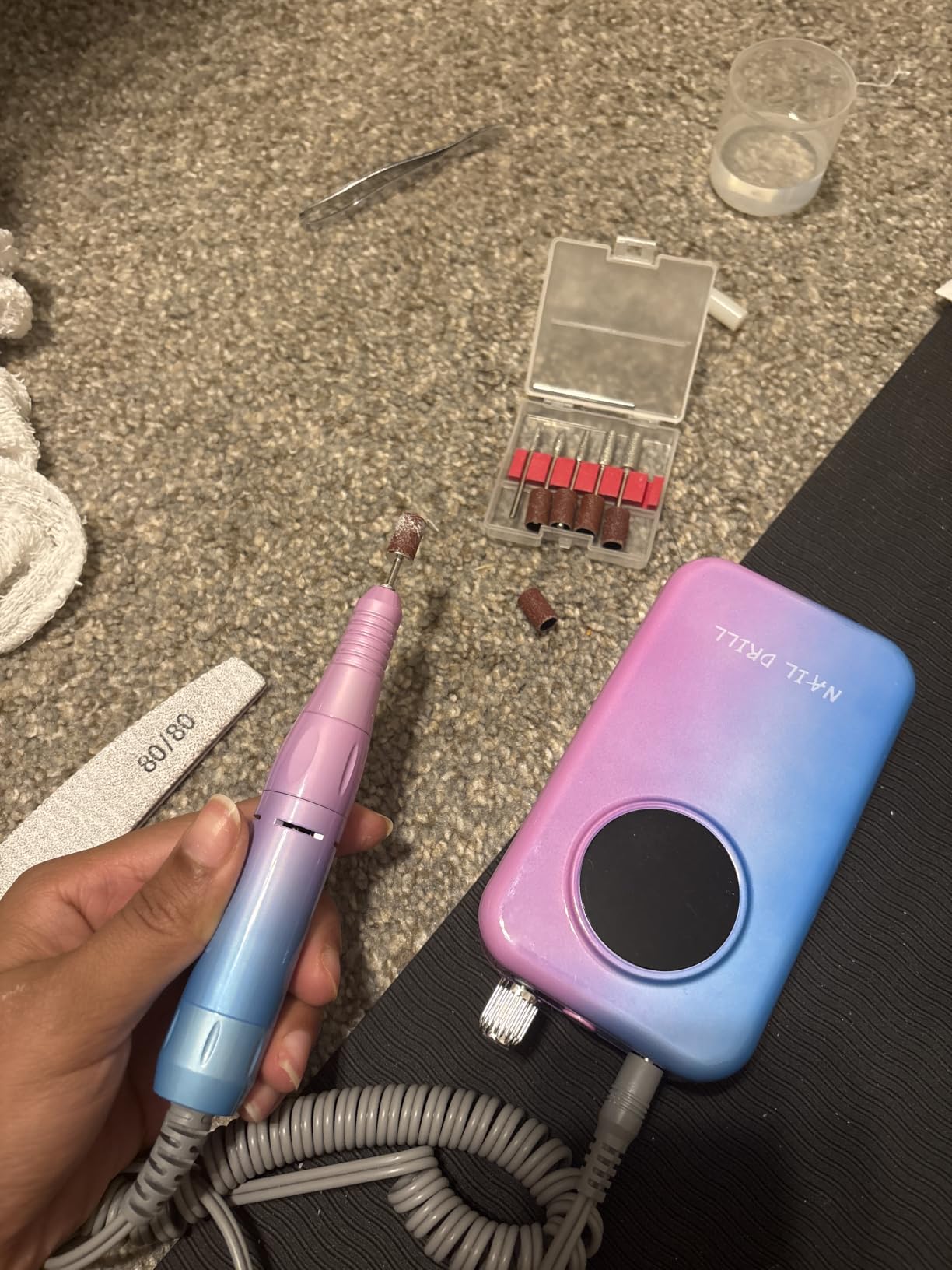
The ORFASTAR is the pick for someone opening the box on a Sunday afternoon with a full set in front of them and no idea where to start. Reviewers frequently describe it as a genuine upgrade from a hardware-store rotary tool, which is exactly the jump most first-timers need: enough torque to cut down thick acrylic, a wide stepless speed range to learn on, and a locking bit holder that stops the bit sliding out mid-stroke.
It is quiet, with minimal vibration even at full speed, and the ventilation system is designed to keep heat down during long passes. The smart LCD shows speed, rotation direction and remaining battery, and the 45000 RPM motor gives you plenty of headroom above what most acrylic work actually needs.
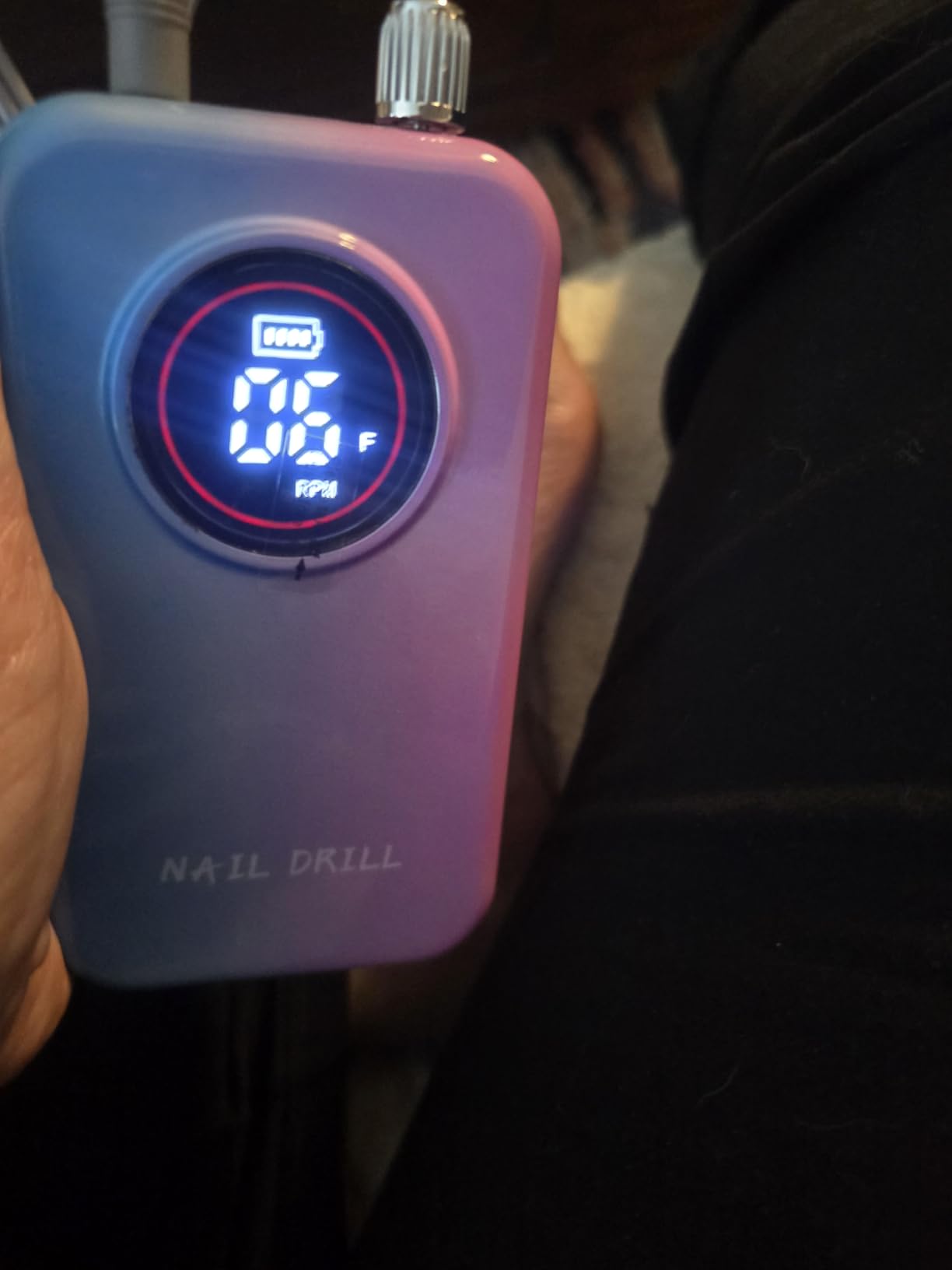
For organisation, the cordless base has a side storage holder and a belt clip, so bits have a home and the drill can travel. The 11-piece bit and sanding band kit is enough to do a full set from prep through refinement to cleanup.
What to check before you buy it
Documentation is thin. Owners report sparse or missing instruction sheets, so you will be learning the controls from the display and from experience. Plan on the first session being slower than it needs to be.
There is also a coiled cable tethering the handpiece to the base, and a few reports of the unit stopping intermittently under heavy load. At 264 reviews the sample is still small, so treat the strong rating as encouraging rather than settled.
Who it suits and who should pass
Good for a first drill, a home user doing a set every week, and anyone who wants a 45,000 RPM ceiling with quiet operation without moving up to a bigger machine. The ventilated handle makes long sessions more comfortable.
Pass if you are filing full sets professionally every day, where the intermittent stop reports and the thin review base argue for something with a longer track record.
How to Choose a Nail Drill for Acrylics
Match the speed to the task, not to the listing. Maximum RPM is the number brands shout about, and it is the least useful number on the page. What matters is whether the motor keeps turning under load at a working speed. A drill that stalls in a dense apex forces you to lift, reposition and restart, and every restart generates more heat than a smooth pass. The 60W coreless motor in the Makartt is the clearest example in this group of buying power over headline speed.
Per-task speed bands are the practical framework:
Natural nail prep and cuticle work: 8,000 to 12,000 RPM
Filling, apex smoothing and shaping: 15,000 to 25,000 RPM
Refining the surface of a set: 20,000 to 30,000 RPM with a sanding band
Taking off full acrylic: 30,000 to 40,000 RPM with a carbide or ceramic barrel
Shortening or heavy cuticle cleanup: up to the machine’s ceiling, briefly
Is 35,000 RPM good for a nail drill? For acrylic removal, yes — that is squarely in the band you want. Anything below 30,000 RPM will still work, it just takes longer and asks more of your hand. Anything above 40,000 RPM gives you headroom and very little else.
Pick the form factor that matches your working day. Almost everything on the search results is a cordless pen, and it is the right answer for most people: light, portable, and the handpiece goes straight in a kit bag. A clip-on design like the MelodySusie MM400C keeps the motor on your belt and both hands free, which is worth real money if you drive between clients. A desktop or dock design like the Makartt or the foot-pedal MelodySusie SC320I is more stable and easier to run for hours, but it is furniture. If you move, buy portable. If you sit, buy desktop.
Torque beats top speed, and a coreless motor beats a weak brushed one. Torque is what keeps the bit from stalling. The MelodySusie MM400C publishes 400 gf-cm, which is a useful number to compare against, while the Makartt’s 60W rating is the most powerful in this set. Any of these will comfortably handle acrylic; the ones at 30,000 RPM will just ask you to be more patient on thick product.
Battery runtime should cover your longest day with margin. The spread here is wide: the MOCOWIND gives 8 to 10 hours, the SAVILAND 7 to 8, the AZ GOGO 6 to 8, while the Makartt and MelodySusie clip-on quote 14 and 15-plus hours respectively. For a mobile tech, anything under six hours is a constraint. Note also that a AAA-battery style pack and a lithium-ion pack are not the same thing, and the charge time matters as much as the runtime.
Check noise, vibration and heat before anything else. A drill you can barely hear changes how long you are willing to use it. The Lavinda and the ORFASTAR are the quietest in this group, and the Makartt and MOCOWIND are explicitly designed around low vibration and heat dissipation. If you are working in a shared space, put this above RPM in your decision.
Confirm bit compatibility. The standard shank is 3/32 inch, and most drills in this list use a twist-lock chuck that takes it. The MelodySusie SC320I and the Lavinda both state 3/32 inch explicitly, which means you can use the same bit kit across machines. That matters if you own more than one, or if you are building a kit gradually.
Upgrade in the right order. If you are starting with a cheaper drill, the first thing to buy is not a second drill. It is a proper set of tungsten carbide and ceramic bits. The second thing is a set of sanding bands in several grits. The third, only if you have moved up to daily work, is a machine with more torque and a longer warranty. If you also work on other projects at the same bench, our notes on cordless drill combo kits for DIY and benchtop drill presses for hobbyists cover the fixed-station side of a home workshop, and our picks for dog nail grinders for large dogs apply the same motor-and-bit logic to a completely different kind of nail. This is the same order we would recommend in all three cases: accessories first, more power second.
Which Drill Bits for Acrylics
Bit choice changes your results more than the machine does. A good drill with bad bits will stall, generate heat and give you a bad set; a modest drill with the right carbide barrel will cut acrylic quickly and cleanly. Here is what to buy.
By material. Tungsten carbide is the workhorse for removal — hard, durable and it holds its edge on dense product. Carbide is a cheaper general-purpose option that works for shaping and light removal. Ceramic stays cooler and is gentler on the natural nail, which makes it a good choice for prep and refinement. Diamond bits are for natural nail work and hard surfaces rather than bulk acrylic removal.
By shape. Barrel bits are the standard large cylinder for removal and shaping the apex. Flame bits and football bits taper, so they blend product into the nail line without a flat edge. Cone and corn bits work around the cuticle and for cleaning under the free edge. Flame-shaped carbide bits are the most common single upgrade a home user makes. Sanding bands slip onto a mandrel and are for smoothing and refining rather than bulk removal.
By grit. Grit numbers on sanding bands run from coarse to fine, and you change grit during a single service. Coarse for shaping and taking down bulk, medium for blending the apex, fine for the surface finish before polish. A single-grit kit is the most common beginner mistake, because it forces you to change technique to suit the abrasive you have.
Swap them on a schedule, not a crisis. A worn bit generates far more heat than a fresh one at the same speed, because dull teeth drag instead of cut. That is the real reason drills get hot on a client’s nail. Replace carbide bits when the edges look rounded, and change sanding bands within a few appointments of heavy use.
Keep spares in the kit. Bits break and bands tear mid-service more often than people expect. Most of the machines here ship with a bit holder or base storage for exactly this reason, and the two largest kits in this roundup — 13 bits and 56 bands on the Tiandirenhe, 6 bits and 56 bands on the MelodySusie SC320I — are the ones that come closest to covering a full service from the box.
Safety: Using a Nail Drill Without Burning the Natural Nail
Nail drills are not bad for your nails. They are dangerous only in one specific way: friction heat. Hold a spinning bit in one spot and the acrylic gets hot, then the natural nail underneath gets hot, and you have a burn plus a thin, sensitive nail plate that takes months to recover. Every technique below exists to stop that happening.
Keep the bit moving and lift it off. The single most important habit is sweeping the bit across the product and lifting it away every few seconds. Do not park it and let it grind. If you are removing a thick apex, work in short passes and check the temperature of the nail with a light touch between passes.
Let the speed do the work, not pressure. Pushing harder on a stalled bit is what produces heat spikes. Drop the speed if the bit is bogging down, or step up to a heavier bit or a machine with more torque so the material comes away without force. Pressure on a nail drill should be light and intermittent.
Lower speed near the natural nail. Natural nail plate is much softer than acrylic. Drop into the 8,000 to 12,000 RPM band for prep and cuticle work, and keep the bit away from the plate when you are refining. This is where a drill with forward and reverse rotation helps too, because you can set the direction that works for your filing hand.
Do not use a dirty or dull bit. A clogged bit drags, generates heat and can fling filing dust. Clean bits between services, replace them on a schedule, and never push a bit through product that is meant for a coarser grit.
Control the dust. Filing acrylic produces fine dust that stays in the air and settles on everything in the room. This is the concern home users raise most and the one most product pages ignore. Work near an open window or under a vent, use a mask if you are doing a lot of removals, and clear filings from the handpiece vents regularly — a blocked vent is the fastest route to an overheating handpiece.
Practice on tips first. Buy a pack of practice nails and take a full set off three or four times before you try it on your own hand. Start at low speed, make long sweeping passes, and keep a scraper or file nearby in case you would rather stop and let the product soak.
Know when to stop. If the nail is warm to the touch, stop and wait. If you see a dark, translucent patch on the plate, that is heat damage and it needs time, not more filing. Being told plainly when a tool is the wrong one is more useful than being encouraged to push through.
Frequently Asked Questions
What is the best nail drill for acrylic nails?
What RPM should I use my nail drill at?
Is 35,000 RPM good for a nail drill?
What are the best nail drill bits for acrylic nails?
Can a nail drill damage your natural nails?
Why does my nail drill get hot?
How do you use a nail drill for beginners?
Is a cordless nail drill strong enough for acrylic?
Final Verdict: Which Nail Drill Should You Buy
If you file thick acrylic often and want one machine that will last, the Makartt Professional 60W E-File is our pick. The torque headroom, 14-hour runtime and charging base handle removal, shaping and refinement without the stalling and battery anxiety that the cheaper pens bring.
If you are a home user doing a set every week or two, the JEWHITENY SG717 gives you the widest speed range and a display at a fraction of the cost, and the MOCOWIND is the cheapest credible way into a drill with real torque. For a first drill specifically, the ORFASTAR or the Tiandirenhe both arrive with enough bits that you will not need a second order to finish a full set.
If you work between clients, the MelodySusie Clip-On MM400C frees both hands and runs past 15 hours on a charge. If you are at a fixed station, the MelodySusie SC320I foot pedal is a genuinely different way to work, and the Lavinda is the quietest option in the group.
Whichever you choose, buy a proper set of tungsten carbide and ceramic bits in your first month, and use the per-task speed bands above rather than running everything at maximum. That combination does more for your results than any extra thousand RPM would. We earn a commission from qualifying purchases, which does not change the ranking.