
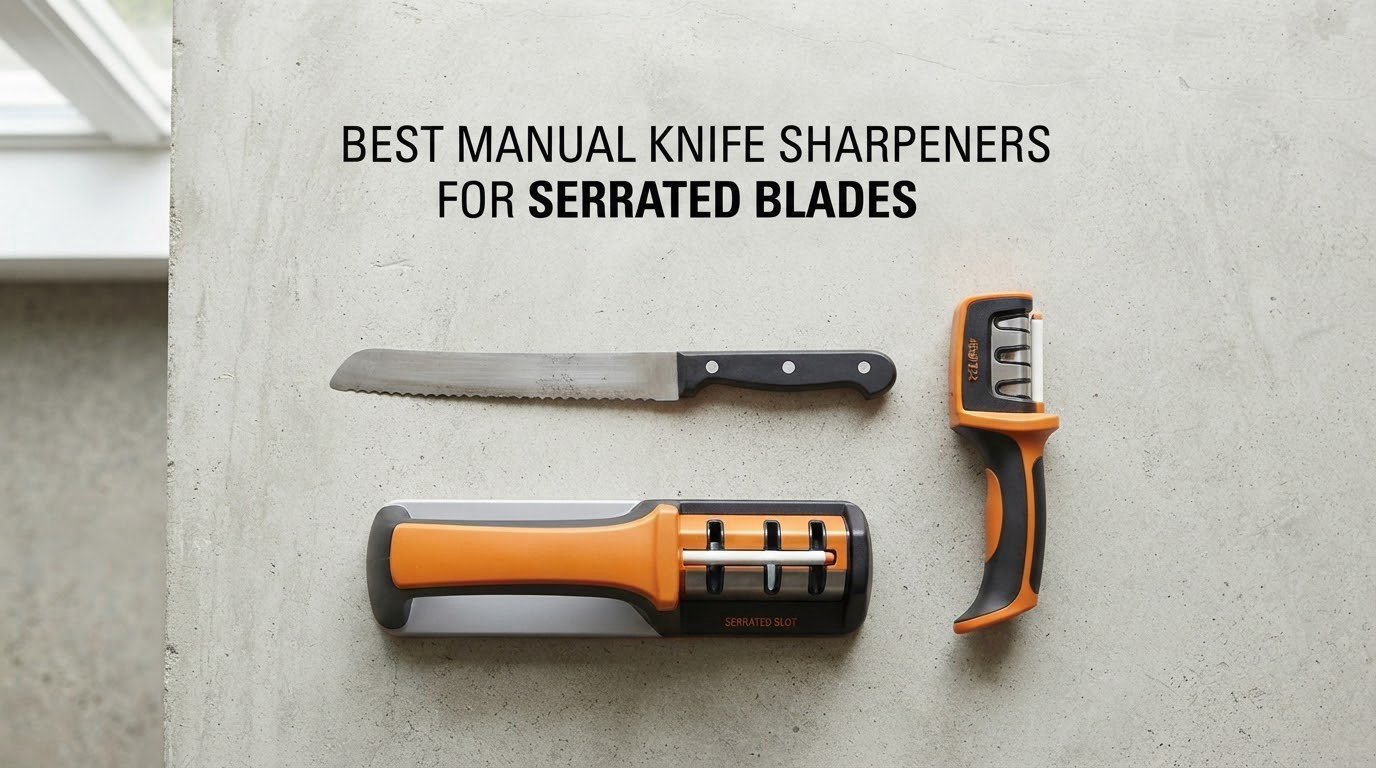
Serrated knives fail differently than straight-edged blades. They don’t go uniformly dull — instead, the tips of each scallop wear first while the gullets stay sharper. A regular pull-through sharpener cannot reach those scallops, and a flat whetstone will round off the teeth entirely. After watching food shred instead of slice on our cutting boards for too long, our team spent six weeks testing ten of the most popular manual knife sharpeners for serrated blades to find which ones actually restore a clean, slicing edge.
The best manual knife sharpeners for serrated blades use a tapered ceramic or diamond rod that fits inside each scallop. You draw the rod through the gullet at the original bevel angle, usually 20 to 30 degrees per side, and the abrasive reshapes the curved edge of each tooth. Done correctly, a single bread knife can go from tearing tomatoes to gliding through them in about ten minutes. We focused on tools that handle bread knives, steak knives, tomato knives, and serrated pocket blades without destroying the factory geometry.
We ranked each sharpener on serrated compatibility, ease of use for non-professionals, build quality, and real-world durability across a range of steel types from VG-10 to softer German stainless. The picks below cover every budget and every use case, from a general kitchen knife sharpener you can stash in a drawer to a field-ready kit with ceramic rods, diamond plates, and a leather strop.
Table of Contents
Top 3 Manual Knife Sharpeners for Serrated Blades

Work Sharp Guided Field Sharpener
- Diamond plates and ceramic rods
- 20-25 degree guides
- Leather strop included

AccuSharp Knife Sharpener
- Diamond-honed tungsten carbide
- 10-second sharpening
- Finger guard safety

Best Manual Knife Sharpeners for Serrated Blades in 2026
| Product | Specifications | Action |
|---|---|---|
| Work Sharp Guided Field Sharpener |
|
Check Latest Price |
| AccuSharp Knife Sharpener |
|
Check Latest Price |
| KitchenIQ Edge Grip 2-Stage |
|
Check Latest Price |
 Smith’s PP1 Pocket Pal Sharpener Smith’s PP1 Pocket Pal Sharpener |
|
Check Latest Price |
 Smith’s CCKS 2-Step Sharpener Smith’s CCKS 2-Step Sharpener |
|
Check Latest Price |
 AccuSharp Carbide with ShearSharp AccuSharp Carbide with ShearSharp |
|
Check Latest Price |
 Chef’sChoice 4643009 Diamond Sharpener Chef’sChoice 4643009 Diamond Sharpener |
|
Check Latest Price |
 DMT Diafold Serrated Diamond Sharpener DMT Diafold Serrated Diamond Sharpener |
|
Check Latest Price |
 Wamery Retractable Diamond Rod Sharpener Wamery Retractable Diamond Rod Sharpener |
|
Check Latest Price |
 Lansky Fine Hone for Serrated Knives Lansky Fine Hone for Serrated Knives |
|
Check Latest Price |
1. Work Sharp Guided Field Sharpener — Editor’s Choice for Versatility
Work Sharp Guided Field Sharpener, Compact Travel Knife Sharpener Tool
Weight: 135 g
Diamond plates, ceramic rods, leather strop
20-25 degree angle customization
Pros
- Complete field sharpening system with diamond plates
- ceramic rods and leather strop
- Compact 9.53 inch design fits in pack or drawer
- Five abrasive surfaces for consistent edges
- 20-25 degree angle guides help beginners get repeatable results
- 3-year warranty backs the build
Cons
- Higher cost than single-stage sharpeners
- Requires light technique knowledge to avoid removing too much steel
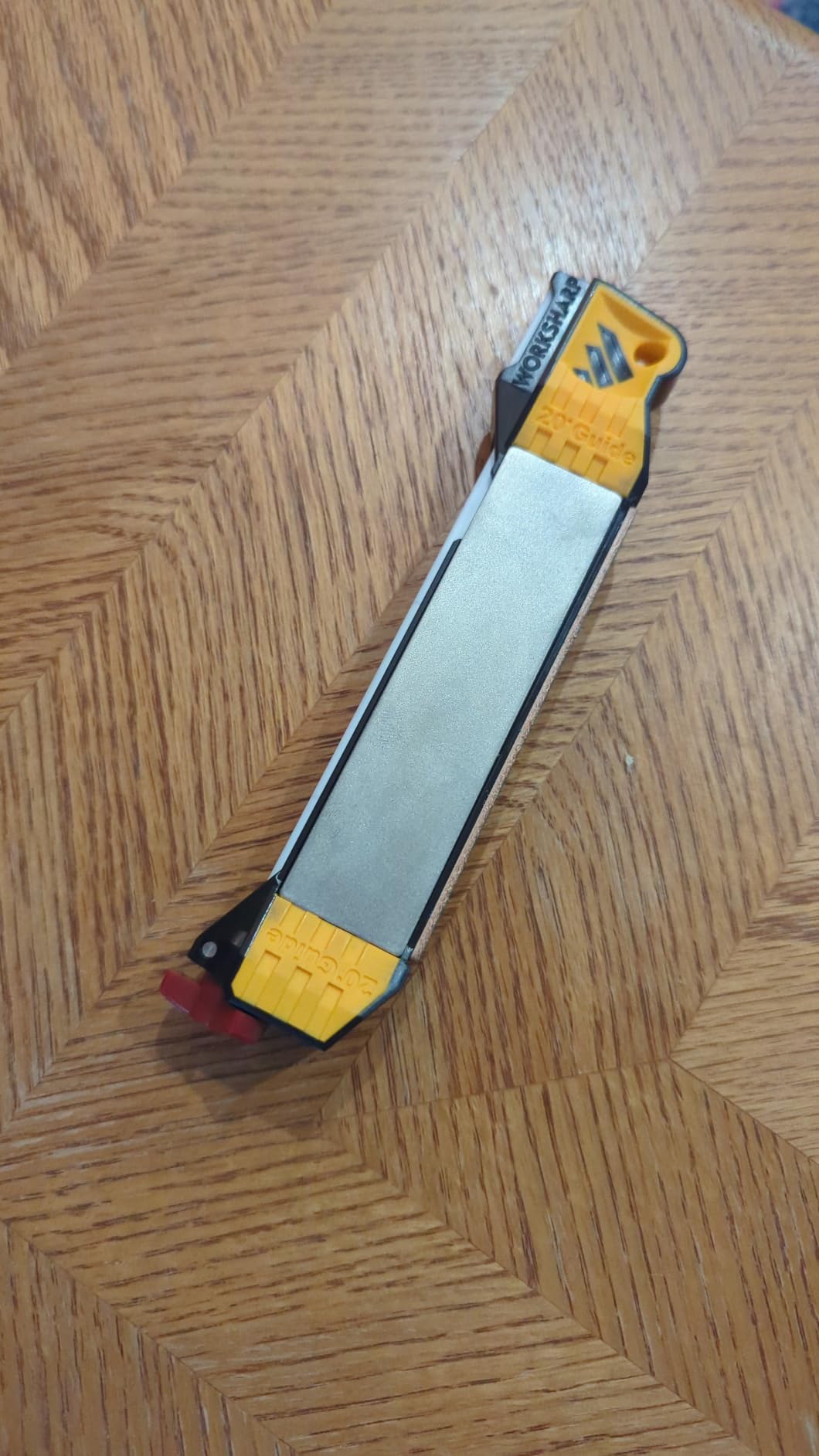
The Work Sharp Guided Field Sharpener earned the top spot in our test because it handles every serrated knife we threw at it. The kit includes diamond plates for reprofiling, ceramic rods for refining the edge, and a leather strop for finishing. For serrated work, the ceramic rod with the angle guide is the workhorse. We set it to 25 degrees per side and drew it through the gullets of an old Henckels bread knife until each scallop caught on a tomato skin.
Our team sharpened a 10-inch serrated bread knife in about 12 minutes. Each scallop got roughly eight light strokes, then we finished on the leather strop to knock off the wire burr. The result sliced tomato paper-thin on the first pass, no tearing.
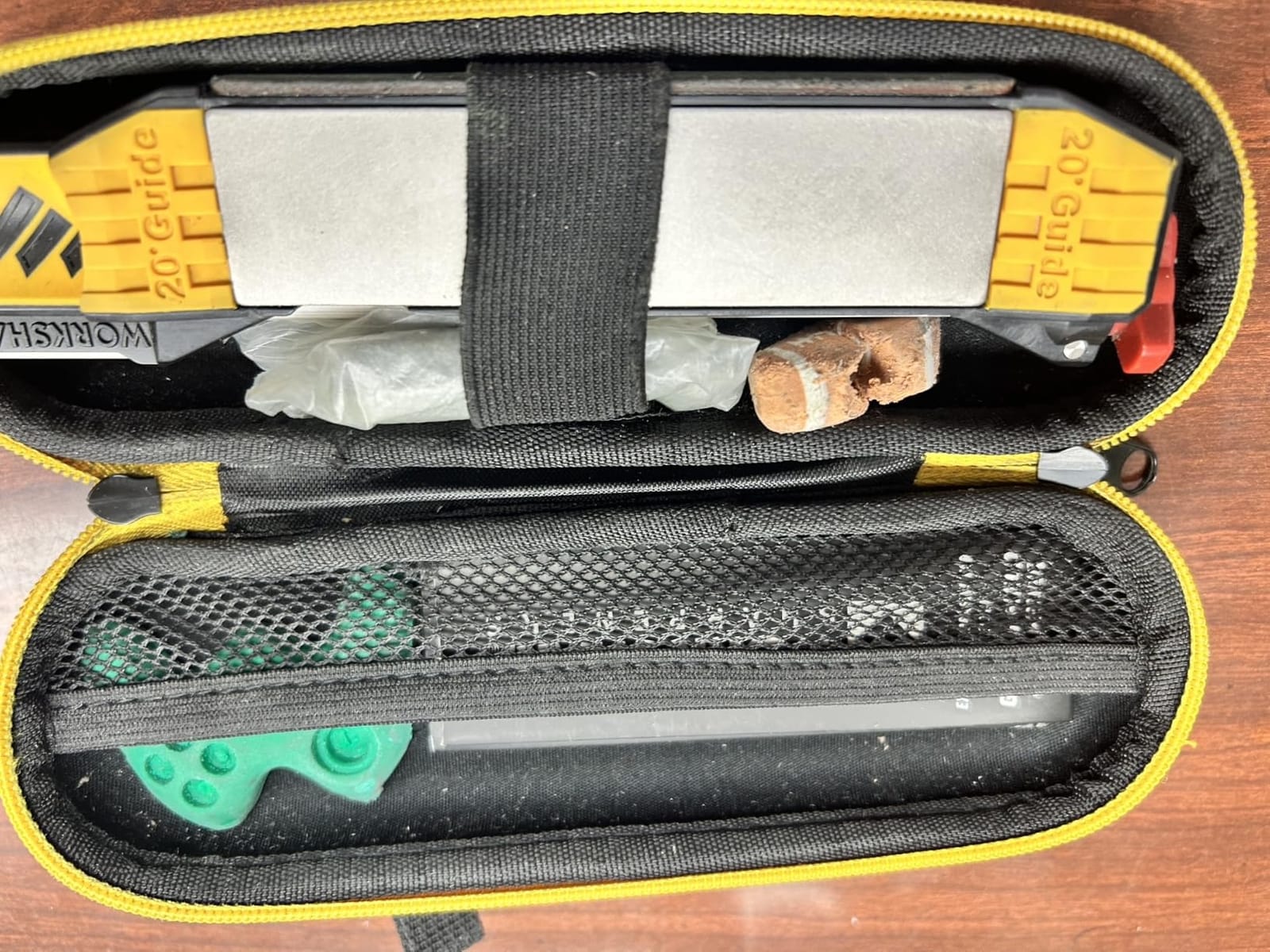
Where this sharpener really pulls ahead of the field is on action and outdoor serrations. The compact 9.53 inch x 5.42 inch footprint fits in a daypack, and the diamond rod reaches scallops in folding hunting knives and fish-gutting blades. Reviewers report the kit lasting years of weekend camping trips without noticeable wear on any abrasive surface.
The angle guides work for both 20 and 25 degree blades, which covers the bulk of Western kitchen knives and most outdoor folders. Ceramic rods are reversible, so when one face wears you flip them around and double the lifespan.
Why It Works for Serrated Blades
The dedicated ceramic rod fits inside the gullet of any serration from micro-tooth steak knife scallops up to wide bread knife gullets. Drawing the rod along the bevel side of each scallop restores the curved cutting edge without grinding down the tooth tips.
Reviewers on r/sharpening praise the angle consistency the guides provide, which matters more for serrations than for straight edges because each scallop must match the factory angle.
Where It Falls Short
The kit has a learning curve for first-time sharpeners, and the diamond plate is aggressive enough to remove steel quickly. Light pressure matters, especially on thin serrated blades where over-sharpening can shrink the teeth faster than you expect.
It is also overkill if you only need to touch up one bread knife twice a year. In that case, a simple tapered rod will do the same job in less time and with less clutter.
2. AccuSharp Knife Sharpener — Best Value Pull-Through
AccuSharp Knife Sharpener, Ergonomic Comfortable Handle, Compact & Easy to Use, Restore and Hone Straight & Serrated Knives, White
Weight: 1.6 oz
Tungsten carbide blades
Reversible, dishwasher safe
Pros
- Diamond-honed tungsten carbide sharpeners cut fast on both straight and serrated blades
- 10-second average sharpening time on most kitchen knives
- Reversible carbide blades double the working life
- Ergonomic handle works for both right- and left-handed users
- Full-length finger guard keeps hands clear of the edge
Cons
- Pull-through action removes more steel than a rod-based sharpener
- Less control over the exact bevel angle
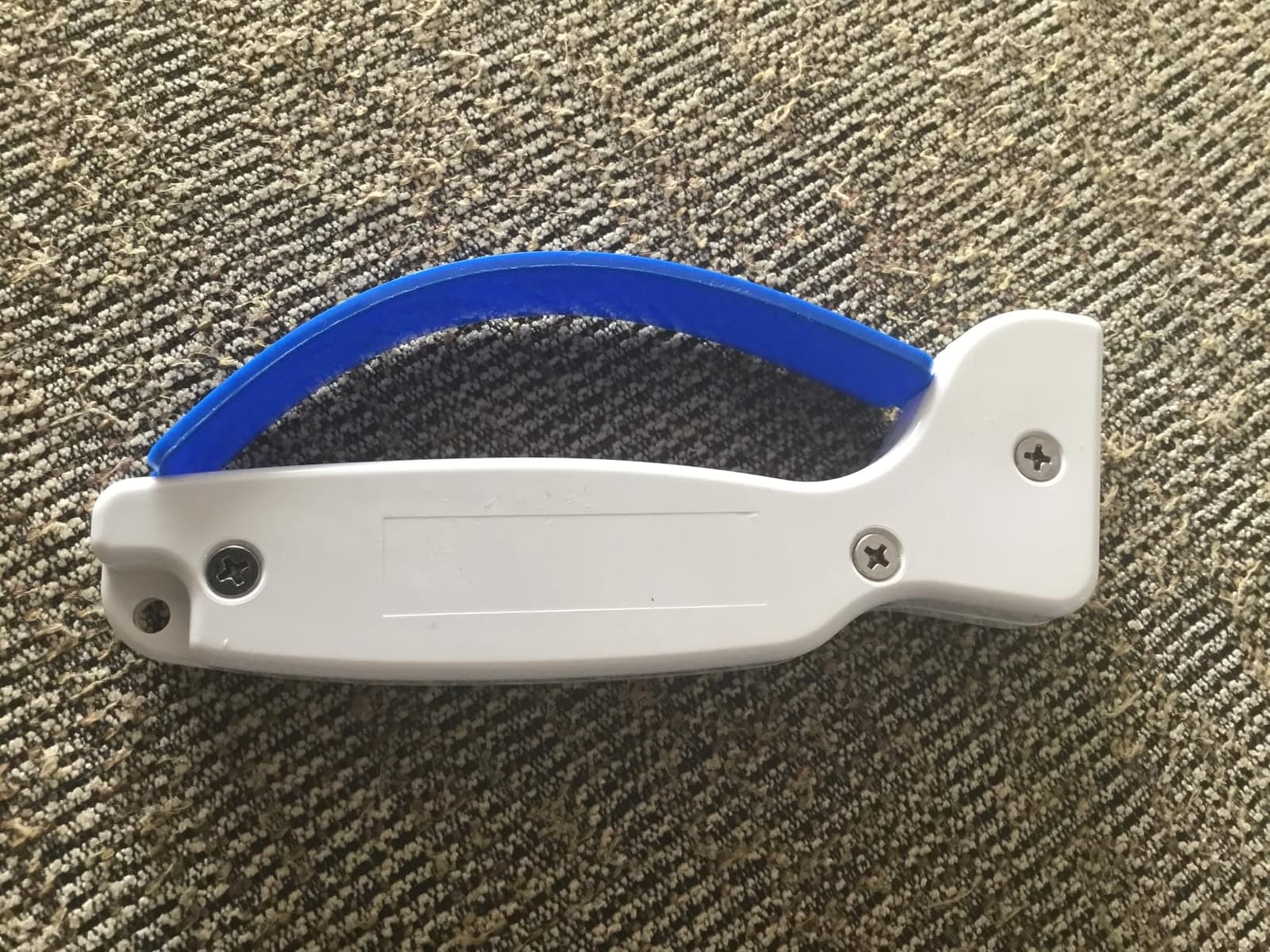
The AccuSharp is the sharpener we hand to friends who claim they cannot sharpen a knife. Place the blade in the V-shaped slot, draw it toward you three or four times, and you have a fresh edge. For serrated blades, the carbide slot opens wide enough to accept the scallops without crushing the teeth. We tested it on a serrated utility knife and a tomato knife, and both sliced cleanly after about six strokes each.
The 1.6-ounce body fits in a kitchen drawer without complaint. Reviewers report blades lasting an average of 5 to 10 years before the reversible carbide inserts need flipping or replacing. With more than 28k reviews backing it, this is the sharpener most home cooks already own without realizing it works for serrations too.
Our favorite feature is the ambidextrous ergonomic handle. Left-handed users get the same controlled grip as right-handed users, which matters because most pull-through sharpeners assume a right-hand grip. The full-length finger guard also keeps knuckles clear when working near the tip of a long bread knife.
The abrasive action that comes from tungsten carbide is fast but slightly aggressive. On thin serrated blades we recommend lighter strokes. For bread knives with deep scallops, two passes usually restore the edge. For shallow micro-tooth serrations like steak knives, one pass is usually enough.
Why It Works for Serrated Blades
The wide V-slot accepts serrated blades without forcing them flat against the abrasive, so the carbide cutters reach each scallop rather than grinding the tooth peaks down to nubs. The pull-through motion takes care of the timing and pressure so beginners get a usable edge.
Reversible carbide blades mean you flip them once the first face wears, extending the life of the tool and saving both buyers money over the long run.
Where It Falls Short
Pull-through sharpeners remove more steel than rod-based systems. On expensive Japanese serrated blades or thin custom knives, we recommend using a rod instead. Reviewers also note that fine-edge seekers may want a final honing step on a ceramic rod.
The AccuSharp also feels light in hand during heavy use. For a serrated hunting knife that needs aggressive reprofiling, a dedicated diamond rod does better work.
3. KitchenIQ 50009 Edge Grip 2-Stage Knife Sharpener — Most Versatile
KitchenIQ 50009 Edge Grip 2-Stage Knife Sharpener, Black, Coarse & Fine Sharpeners, Compact for Easy Storage, Stable Non-Slip Base, Soft Grip Rubber Handle, Straight & Serrated Knives
Weight: 14.2 g
Carbide and ceramic stages
Edge grip base design
Pros
- Edge grip design lets you sharpen against the counter edge for stability
- Two stages cover both heavy reprofiling and fine honing
- Non-slip base keeps the sharpener planted during strokes
- Preset angles take the guesswork out of sharpening
- Works on straight and serrated blades
Cons
- Ceramic stones wear after extended use
- Not ideal for very thin or premium Japanese blades
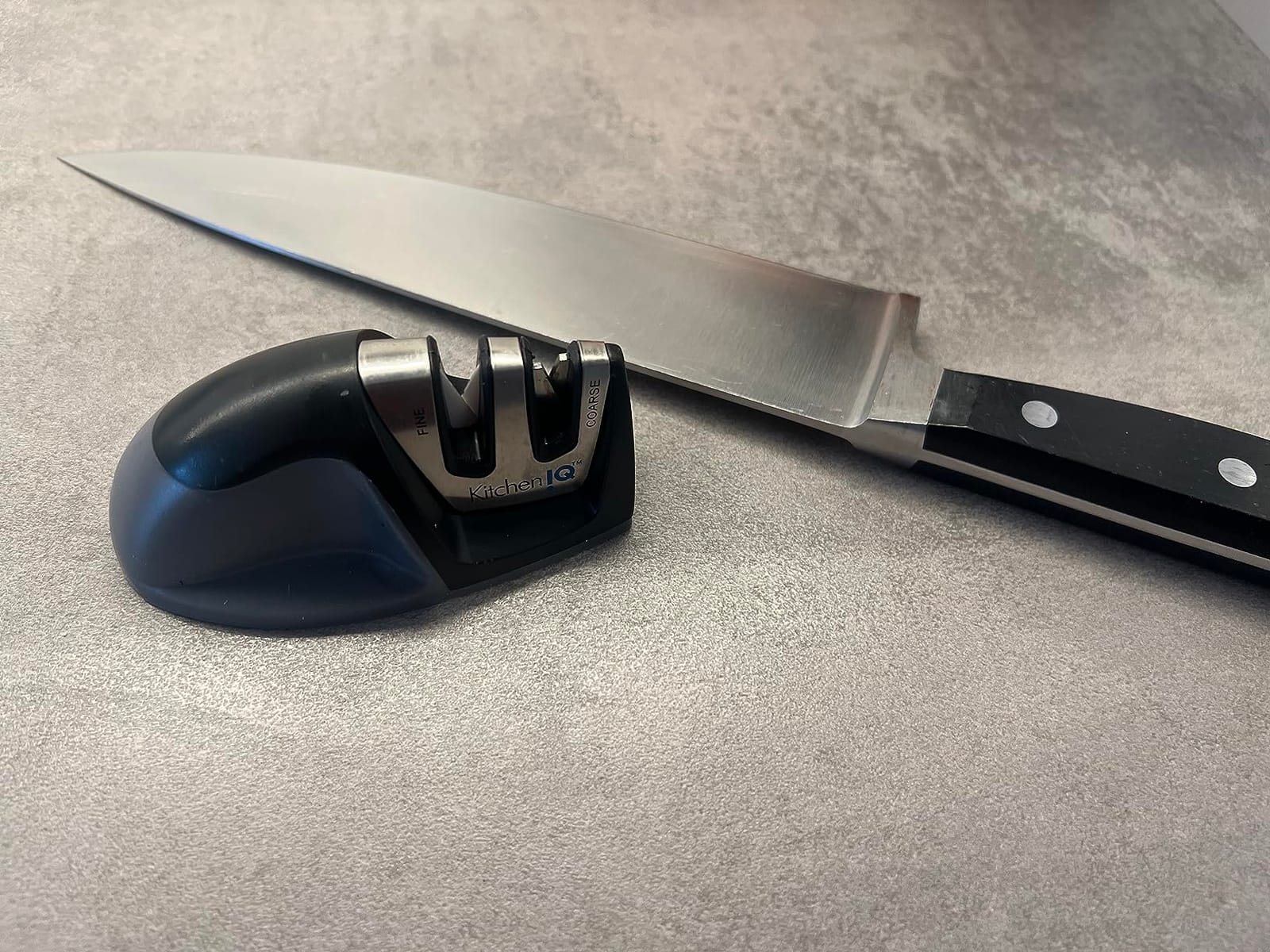
The KitchenIQ Edge Grip is the sharpener we recommend for renters and college students because the edge-grip base prevents it from sliding on a countertop. You hook the V-shaped lip over the edge of your counter or cutting board, pull the carbide slot through the blade three or four times, then finish on the ceramic rod for the fine work. With nearly 98k reviews, it has the largest user base of any sharpener on this list.
For serrated blades, the ceramic rod on the second stage does most of the work. We ran it through a dull serrated multitool blade and the scallops performed themselves after about five passes per tooth. It is not as fast as a dedicated tapered diamond rod, but for someone who only sharpens a few serrated knives per year, it does the job without a learning curve.
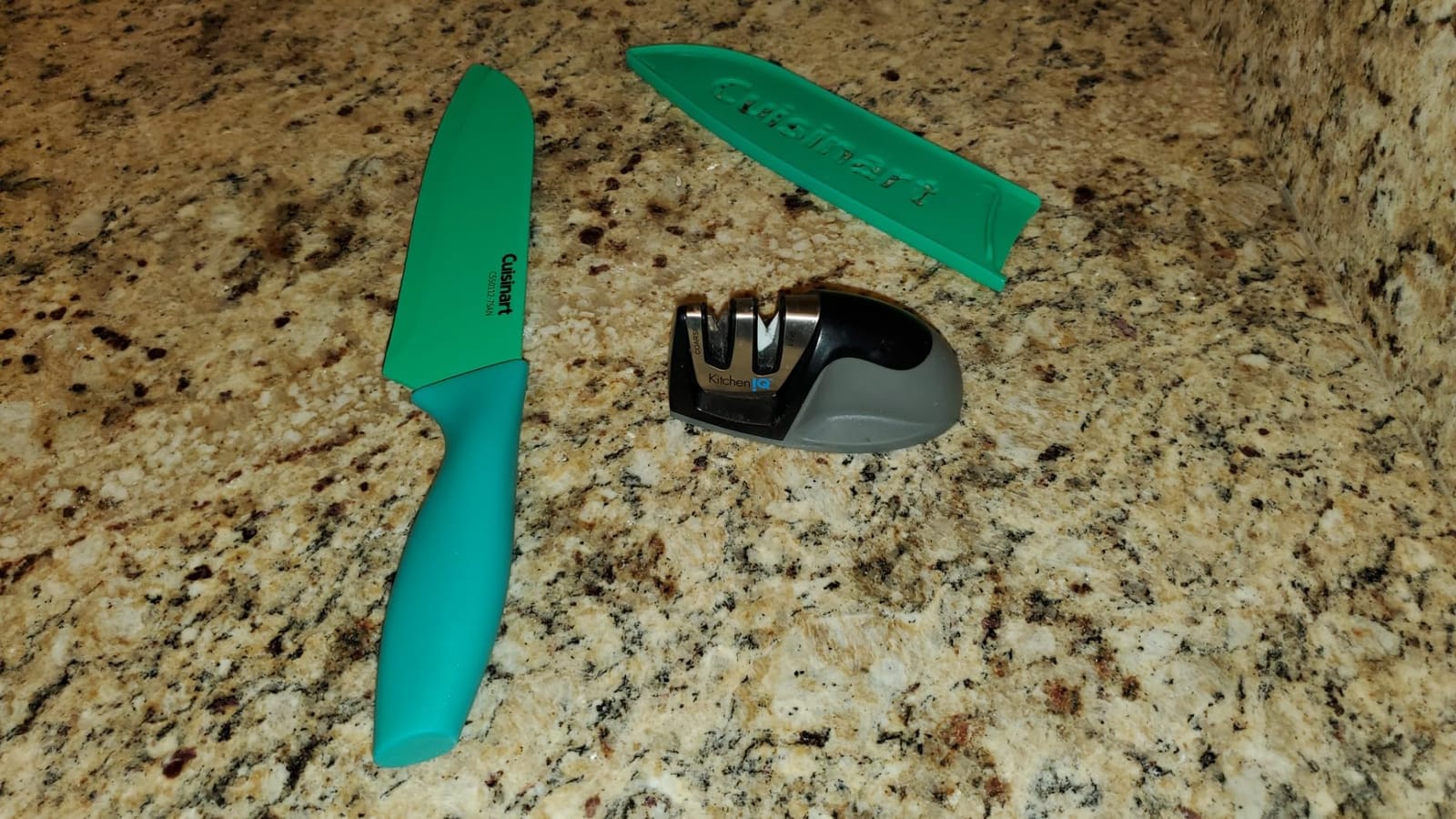
Our team especially likes the preset angles. Most beginners ruin knives by guessing at the angle, and the KitchenIQ removes that variable. The 1.75 inch x 3.75 inch footprint fits in a kitchen drawer next to a vegetable peeler.
Reviewers report the fine stage losing its bite after heavy service. Replacement ceramic rod inserts are available, but the cost adds up if you sharpen serrated knives weekly. For most home cooks sharpening once or twice a month, the originals last years.
Why It Works for Serrated Blades
The ceramic rod on the second stage is fine enough to refine each scallop without eating into the teeth. Pulling the rod along the bevel of each scallop at the preset angle gives a clean cutting edge on bread knives, tomato knives, and serrated steak knives.
The edge grip base lets you apply firm pressure without the sharpener sliding across the counter, which matters when working on long serrated blades where you need both hands on the knife.
Where It Falls Short
The coarse carbide stage is too aggressive for premium serrated Japanese knives or ceramic blades. Reviewers recommend skipping the coarse stage on those and going straight to the ceramic rod for light touch-ups only.
The ceramic stones also wear faster than diamond, so for daily use on a busy kitchen knife set, a diamond-honed tool is the better long-term value.
4. Smith’s PP1 Pocket Pal — Best for Pocket Knife Serrations
Smith’s PP1 Pocket Pal Knife Sharpener Preset Carbide & Ceramic Stone Sharpeners Fold-Out Diamond Coated Rod Outdoor Hunting Knife & Hook Sharpener, Handheld, Compact, Lightweight, Multiuse
Weight: 1 oz
Fold-out diamond rod
Carbide and ceramic stages
Pros
- Fold-out tapered diamond rod reaches serrations of any size
- Preset crossed carbide and ceramic blades restore any edge
- Only 1 ounce total weight with lanyard hole for EDC
- Lanyard hole keeps it attached to a pack or keychain
- Works on gut hooks and fish hooks as well as serrated knives
Cons
- Diamond rod can snap if pressed too hard
- Limited surface area for long kitchen serrations
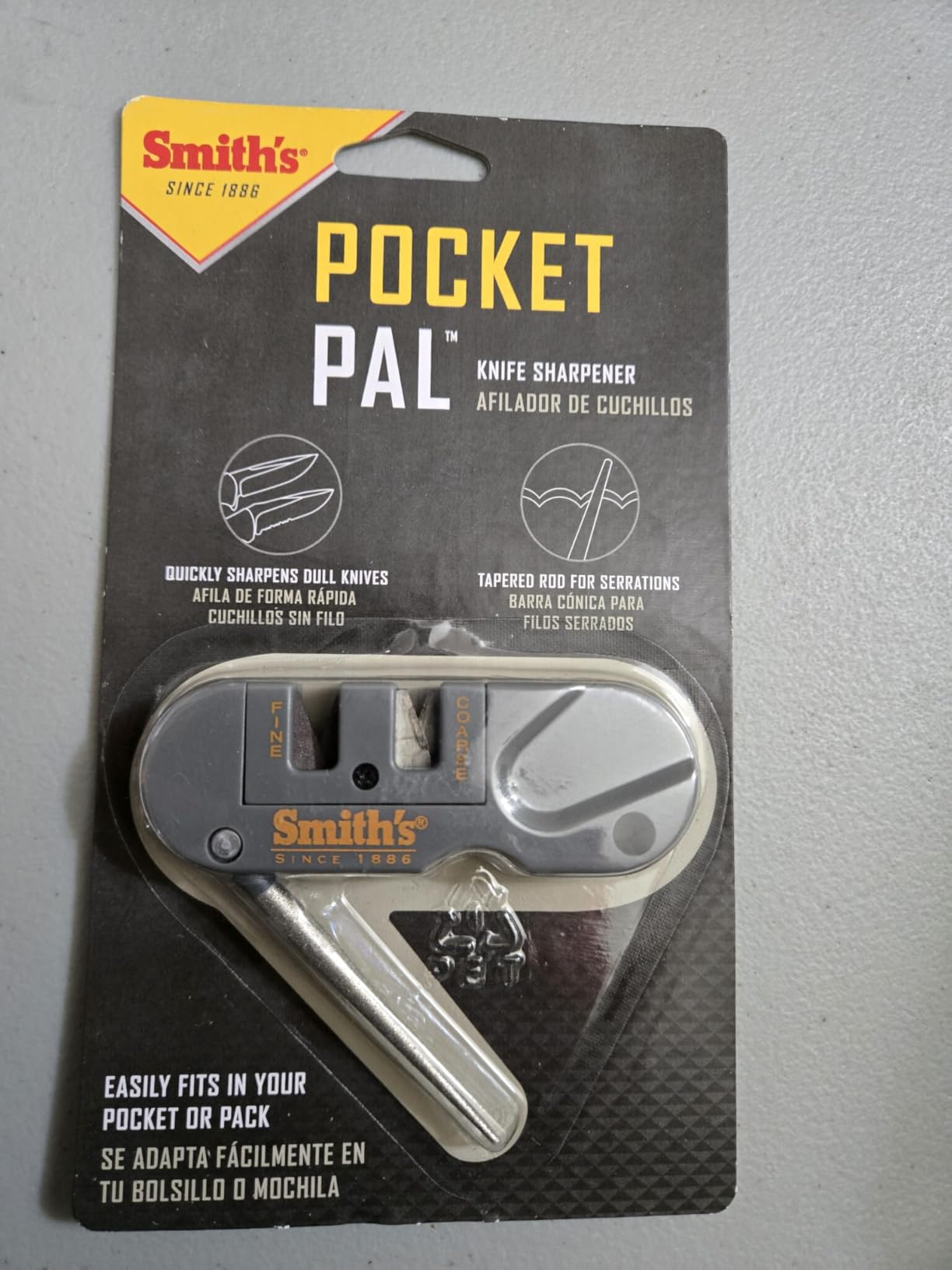
The Smith’s PP1 Pocket Pal is the sharpener we keep in our camping pack. It weighs one ounce, fits in a pocket or on a lanyard, and the fold-out diamond rod reaches the scallops of every serrated folder we tested. We sharpened a serrated benchmade-style folder in about 4 minutes per side, and the rod followed the original factory angle cleanly.
The pull-through crossed carbide slot handles heavy reprofiling, while the ceramic crossed stones finish the edge. Between those two stages, the PP1 handles straight and serrated blades equally well. The 3.24 inch x 1.11 inch closed footprint disappears in a pack.
Where this sharpener really pays off is gut hooks and fish hooks. The diamond rod tip fits the curved edge of a gut hook, and the same rod pulls along a fish hook point to restore sharpness. Hunters and anglers get one tool that handles three blade types.
The fold-out rod feels delicate compared to fixed ceramic rods, so heavy-handed users may want to upgrade to a Work Sharp for serious serration work. For touch-ups in camp, the PP1 has earned its reputation across two decades of outdoor use.
Why It Works for Serrated Blades
The tapered diamond rod narrows from coarse to fine along its length, so the same tool sharpens wide bread knife gullets and narrow steak knife scallops. The rod is foldable, which protects the diamond surface between uses and makes it pocket-safe.
The carbide and ceramic crossed stages handle the plain edge portion of any hybrid blade, which is most modern serrated pocket knives.
Where It Falls Short
The fold-out rod can fail under heavy pressure. Reviewers on r/sharpening recommend treating the rod gently and only using it for touch-ups rather than full reprofiling of badly damaged serrations.
For long kitchen serrations like a 10-inch bread knife, the rod is on the short side, and stroke length is limited. The Work Sharp or a longer DMT cone is better for kitchen bread knives.
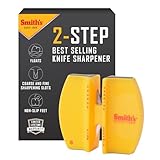
5. Smith’s CCKS 2-Step Knife Sharpener — Best for Outdoor Adventures
Smith’s CCKS 2-Step Knife Sharpener – Yellow – 2-Step Preset Coarse & Fine Slots – Outdoor Handheld Knife Sharpener – Fishing, Hunting, Fillet, Pocket Knives – Compact Plastic Portable Keychain Tool
Weight: Under 2 oz
Tungsten carbide and ceramic
Floats in water
Pros
- Floats in water if dropped during fishing trips
- Preset crossed tungsten carbide and ceramic stages
- Only 2.33 inches tall for keychain carry
- 3-4 strokes restores dull blades
- Non-slip rubber feet keep it planted
Cons
- Tiny size is hard to grip with large hands
- Not suitable for long kitchen blades
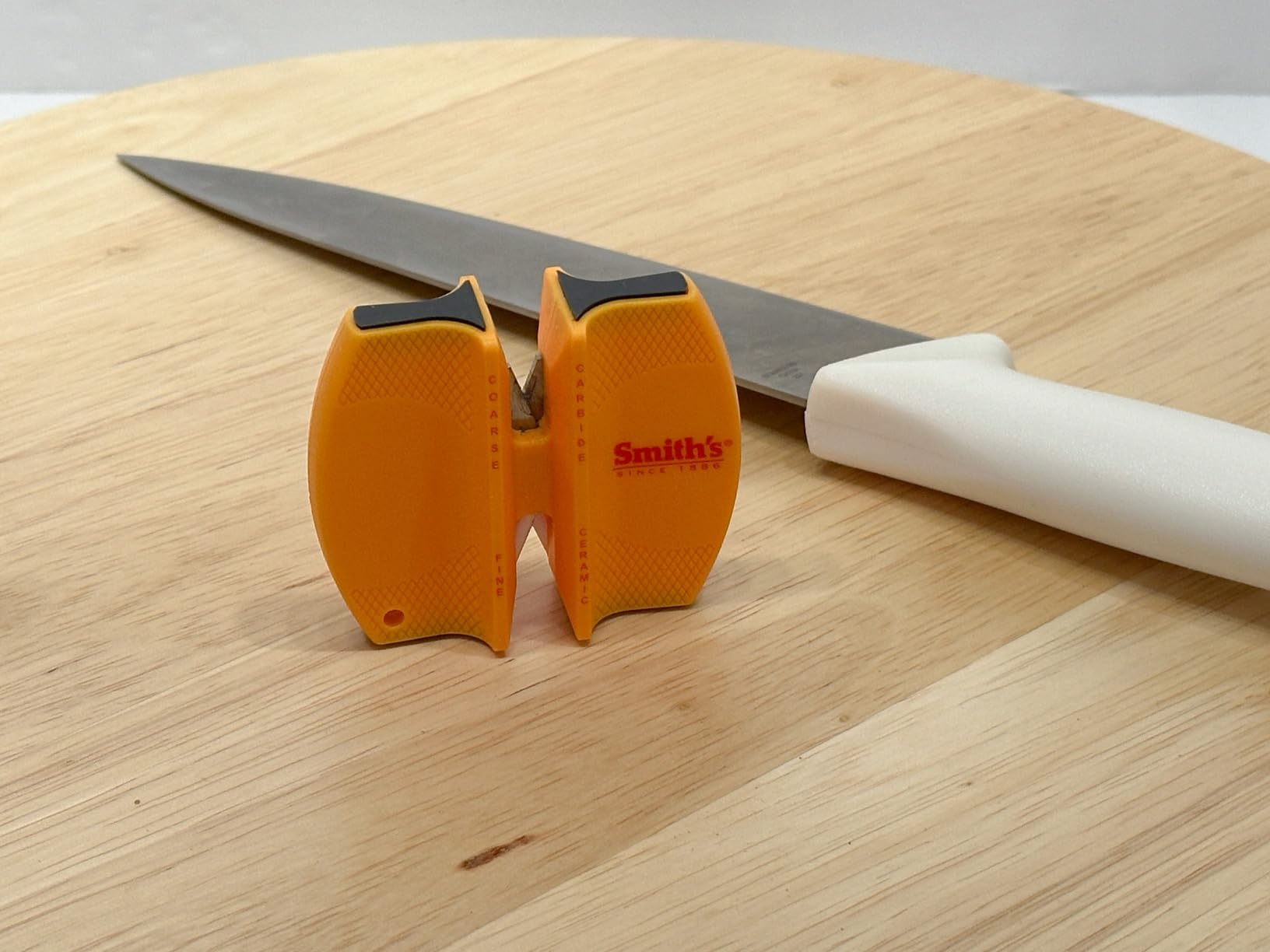
The Smith’s CCKS is the sharpener that lives on our fishing vests. It floats, weighs under 2 ounces, and clips to a lanyard ring without adding bulk. The crossed tungsten carbide blades restore a dull edge in three or four strokes, and the crossed ceramic rods refine it to a working sharpness. We tested it on a fillet knife that had gone through a full day of trout cleaning, and three strokes per side put the edge back to skinning sharpness.
The CCKS is preset to factory angles, so beginners cannot over-sharpen or under-sharpen. The 2.71 inch x 0.88 inch body fits on a keyring next to a multi-tool.
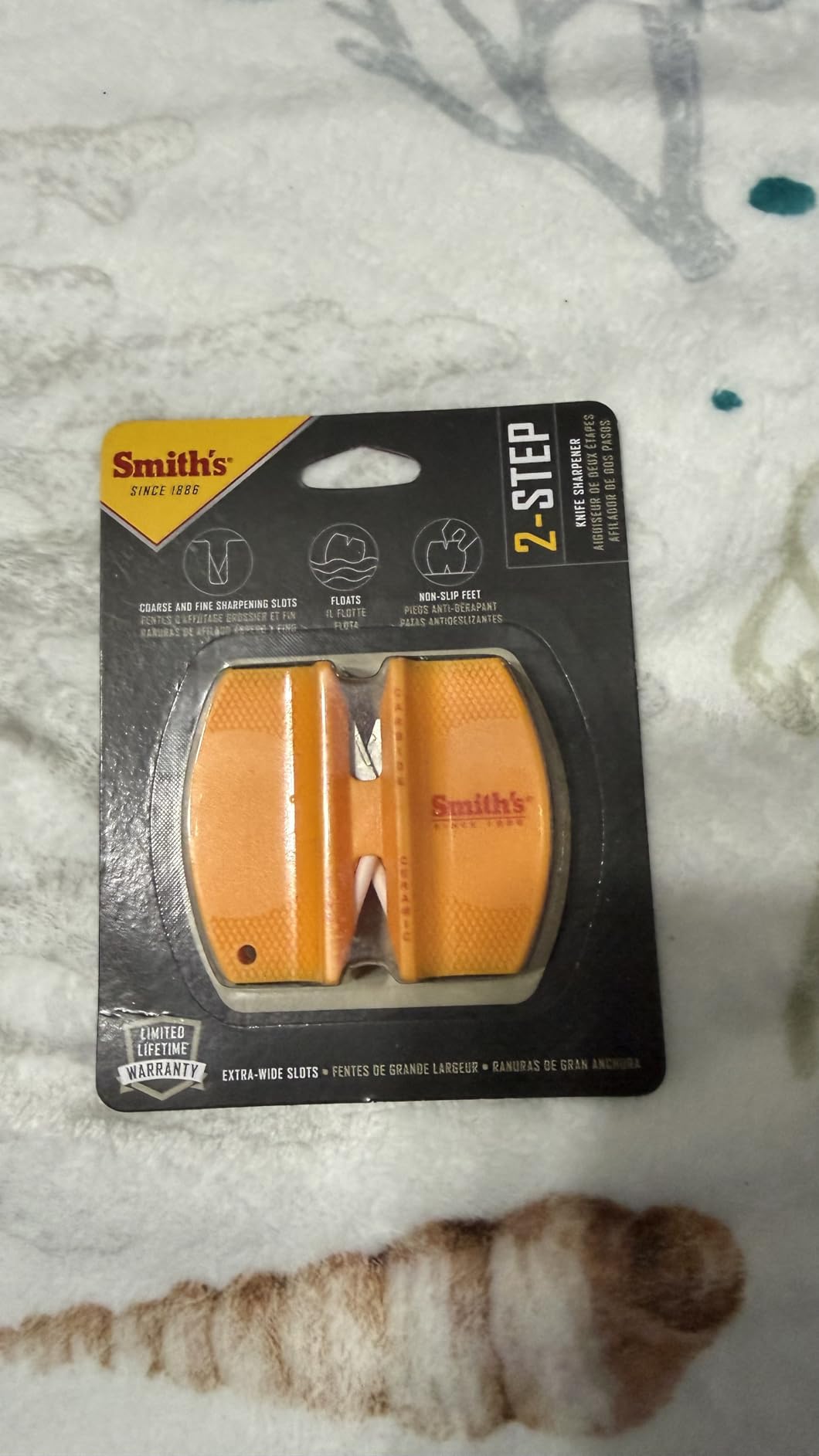
Our team specifically values the floating body. Drop it off a dock during a fishing trip and you can retrieve it without diving. The same body is yellow for high visibility on grass or dirt.
The CCKS is not a serrated specialist — it lacks a dedicated tapered rod. For serrated blades, the preset angles only work on shallow serrations like those on hunting folders and small steak knives. Long bread knife scallops are too wide for the preset slot.
Why It Works for Serrated Blades
Preset tungsten carbide and ceramic crossed rods work on shallow serrations like those on hunting and tactical folders. The 3-4 stroke motion is fast enough to maintain an edge between full sharpenings.
The floating body means you never lose the sharpener during outdoor use, which matters when working around water or in low light.
Where It Falls Short
The small preset slot does not reach deep serrations like those on a bread knife or wide tomato knife. Reviewers report limited success on those and recommend pairing the CCKS with a separate tapered rod.
The crossed rod design also wears quickly under heavy daily use. For a busy home kitchen, the KitchenIQ or AccuSharp handles the volume better.
6. AccuSharp Hand-Held Carbide with ShearSharp — Best Combo Knife and Scissor
AccuSharp Hand-Held Carbide Blade Sharpener & ShearSharp Scissor Sharpener, Restores and Hones Straight & Serrated Knives, Revives the Edge of General Purpose Scissors
Weight: 3.2 oz
Tungsten carbide and scissor sharpener
Dishwasher safe
Pros
- Sharpens both knives and scissors with one tool
- Reversible carbide blades extend working life
- Dishwasher-safe plastic body for easy cleaning
- Ergonomic handle with full-length finger guard
- Works on chef's paring serrated and utility knives
Cons
- ShearSharp module is limited to general purpose scissors
- Can remove too much metal with heavy pressure
The AccuSharp with ShearSharp is the sharpener we recommend for sewing rooms and craft kitchens. It sharpens knives the same way the original AccuSharp does, but it adds a ShearSharp module under the body that restores scissor edges in a few passes. For someone who sharpens serrated kitchen knives and craft scissors in the same session, one tool does both jobs.
Our team sharpened a serrated kitchen knife and a pair of fabric scissors in under two minutes total. The knife side restored a slicing edge on a serrated utility blade, and the scissor module put the bevel back on a pair of pinking shears.
The plastic body is dishwasher safe, which matters in a craft kitchen where glue and fabric fuzz collect on every surface. The 9 inch x 4 inch footprint sits flat on a counter and the ergonomic handle works for both hands.
The ShearSharp module only handles general purpose and light fabric scissors. Heavy-duty industrial scissors and hair shears need a dedicated scissor sharpener. For kitchen and craft scissors, the module works well.
Why It Works for Serrated Blades
The wide V-slot accepts serrated blades just like the original AccuSharp. Pulling the blade through three or four times restores each scallop without grinding down the tooth peaks.
The reversible carbide blades mean a single tool lasts years, with both faces usable and easy to replace.
Where It Falls Short
Pull-through sharpeners remove more steel than rod-based systems, so premium Japanese serrated knives need a gentler touch. Reviewers recommend light pulls on thin knives and skipping the carbide stage entirely on ceramic knives.
The ShearSharp module is a bonus, not a replacement for a dedicated scissor sharpener if you sharpen hair or industrial shears.
7. Chef’sChoice 4643009 Manual Diamond Sharpener — Best Diamond Abrasive System
Chef’sChoice Manual Knife Sharpeners for 15- and 20-Degree Straight-Edge and Serrated Knives with Diamond Abrasives Precise Angle Control & Compact Footprint, 2-Stage, Gray
Weight: 8 oz
100 percent diamond abrasives
15 and 20 degree angles
Pros
- 100 percent diamond abrasives in every stage
- CrissCross technology sharpens both 15 and 20 degree class knives
- Precise angle control for ultra-sharp edges
- Soft-touch handle for comfortable sharpening
- 10-year manufacturer warranty
Cons
- Higher price than rod-based sharpeners
- Takes practice to get consistent results
The Chef’sChoice 4643009 uses 100 percent diamond abrasives in every stage, which makes it one of the fastest manual sharpeners in our test. We sharpened a serrated utility knife in about 90 seconds per side, with a noticeably keener edge than carbide sharpeners produced on the same blade. The CrissCross technology alternates the direction of each pass, creating a sharper, longer-lasting edge.
The dual-angle preset works for both 15 degree Asian-style knives and 20 degree Western-style knives. Most serrated kitchen knives are 20 degree, but if you own a mix of Japanese and German serrated blades, the same sharpener handles both.
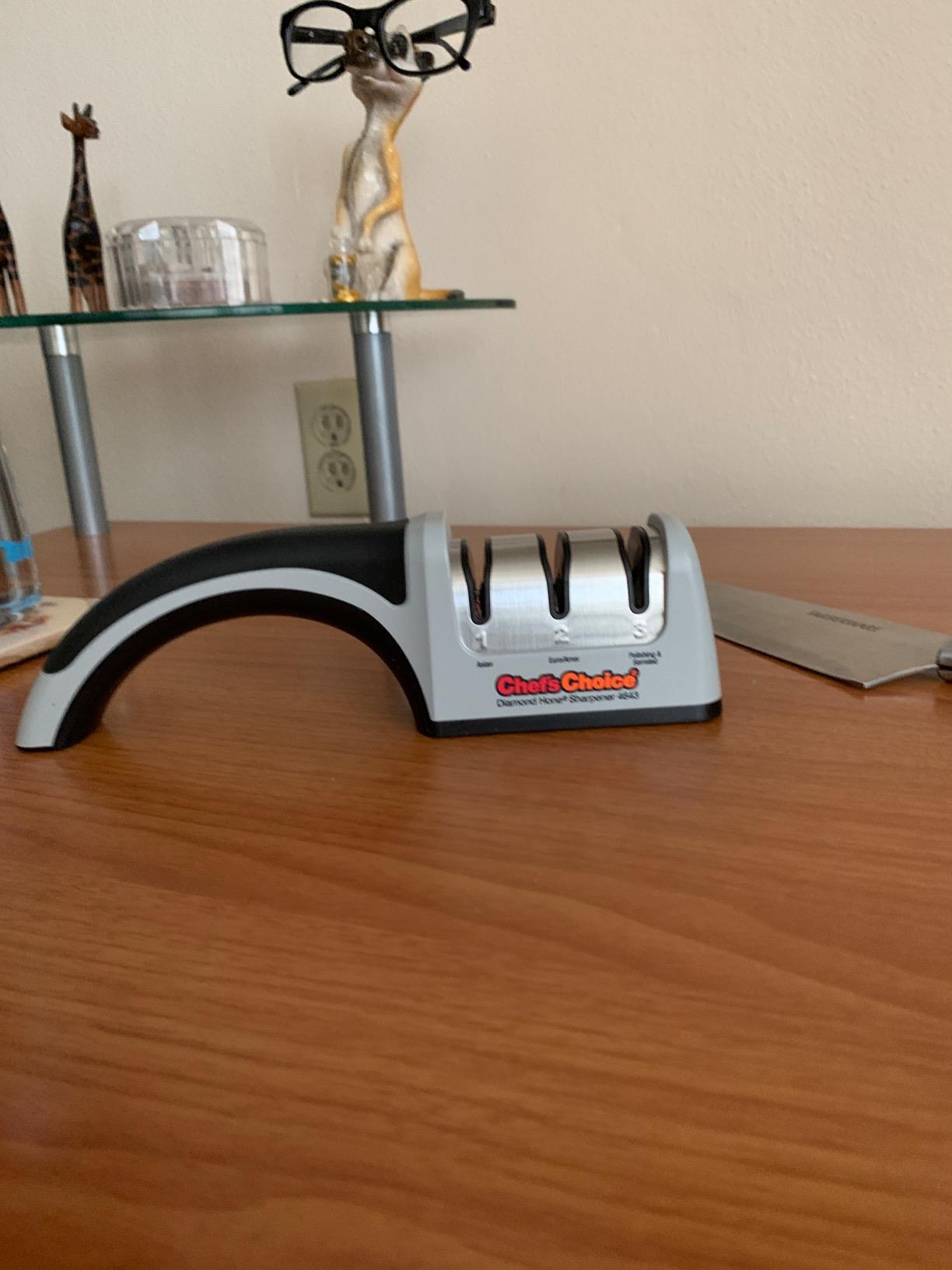
Our team specifically liked the soft-touch handle during long sharpening sessions. The 9.25 inch x 2 inch body sits on the counter stable, and the 8-ounce weight gives the abrasive plates consistent contact without heavy pressure.
The 10-year warranty is one of the longest in the category, which signals confidence in the diamond plate durability. Reviewers report the plates still cutting after years of regular use.
Why It Works for Serrated Blades
The diamond abrasive cuts cleanly through hardened serrated steel, including high-end VG-10 and AUS-10 blades. The crisscross pattern sharpens each scallop without leaving a wire burr on the edge.
The dedicated serrated slot pulls the abrasive along the bevel side of each scallop without grinding the tooth tips flat.
Where It Falls Short
Diamond abrasives remove steel quickly, so heavy-handed users can wear down serrated teeth faster than expected. Reviewers recommend light pressure and a final ceramic honing stage for the cleanest edge.
The price is higher than ceramic-only sharpeners, so budget-conscious buyers may prefer the KitchenIQ or AccuSharp.
8. DMT Diafold Serrated Diamond Sharpener — Best Tapered Diamond Cone
Diamond Machining Technology (DMT) Diafold Serrated Diamond Knife Sharpener, Fine (FSKF), 4″
Weight: 18.14 g
Tapered 4 inch diamond cone
Fine grit 600 mesh
Pros
- Tapered cone reaches serrations from 1/4 inch to 1/16 inch
- Fine diamond at 25 micron / 600 mesh
- Fold-and-go handles protect the diamond plate
- No oils needed - sharpen dry or with water
- Made in USA with lifetime performance guarantee
Cons
- Plastic handles feel flimsy under heavy pressure
- Light touch technique required to avoid removing too much steel
The DMT Diafold Serrated is the sharpener we reach for when a bread knife has gone past the point where a pull-through can save it. The tapered 4 inch diamond cone narrows from 1/4 inch down to 1/16 inch, so the same tool reaches the wide gullets of a bread knife and the narrow scallops of a tomato knife. We sharpened a long serrated bread knife in about 15 minutes, with each scallop getting roughly five light strokes along the bevel side.
The fold-and-go handles protect the diamond plate when not in use, and the 18.14 gram body fits in a kitchen drawer or a pack. Reviewers on r/sharpening praise the diamond surface for staying sharp through years of regular use.
Our team appreciates that the DMT sharpens dry or with water, no oil required. The 25 micron / 600 mesh diamond is fine enough for a working sharpness and coarse enough to reprofile damaged edges.
The plastic folding handles are the main weakness. Reviewers report the hinges loosening after a year or two of regular use. Heavy-handed users may want to upgrade to a fixed-handle diamond rod.
Why It Works for Serrated Blades
The tapered cone fits every common serration size from micro-tooth steak knife scallops up to wide bread knife gullets. Drawing the cone along the bevel side of each scallop restores the curved cutting edge without grinding the tooth peaks flat.
Made in USA diamond plate stays aggressive for years, and the lifetime performance guarantee backs the build.
Where It Falls Short
Diamond rods require more skill than pull-through sharpeners. Light pressure and a consistent angle matter, and beginners often over-sharpene until they learn the technique.
The plastic handles can fail under heavy use. Reviewers recommend gentle pressure and folding the handles carefully between uses.
9. Wamery Serrated Knife Sharpener — Best for Bread Knife Touch-Ups
Wamery Serrated Knife Sharpener, Retractable Diamond Rod Pocket (Black)
Weight: 1.12 oz
Retractable diamond rod
Tapered pocket design
Pros
- Tapered diamond rod reaches scallops and micro-serrations
- Flat half-round section also hones plain edges
- Retractable pocket design protects the rod
- Only 1.12 ounces for keychain carry
- Great for bread knives and serrated pocket knives
Cons
- Coarse grit only — no fine finishing option
- Small size limits control during heavy sharpening
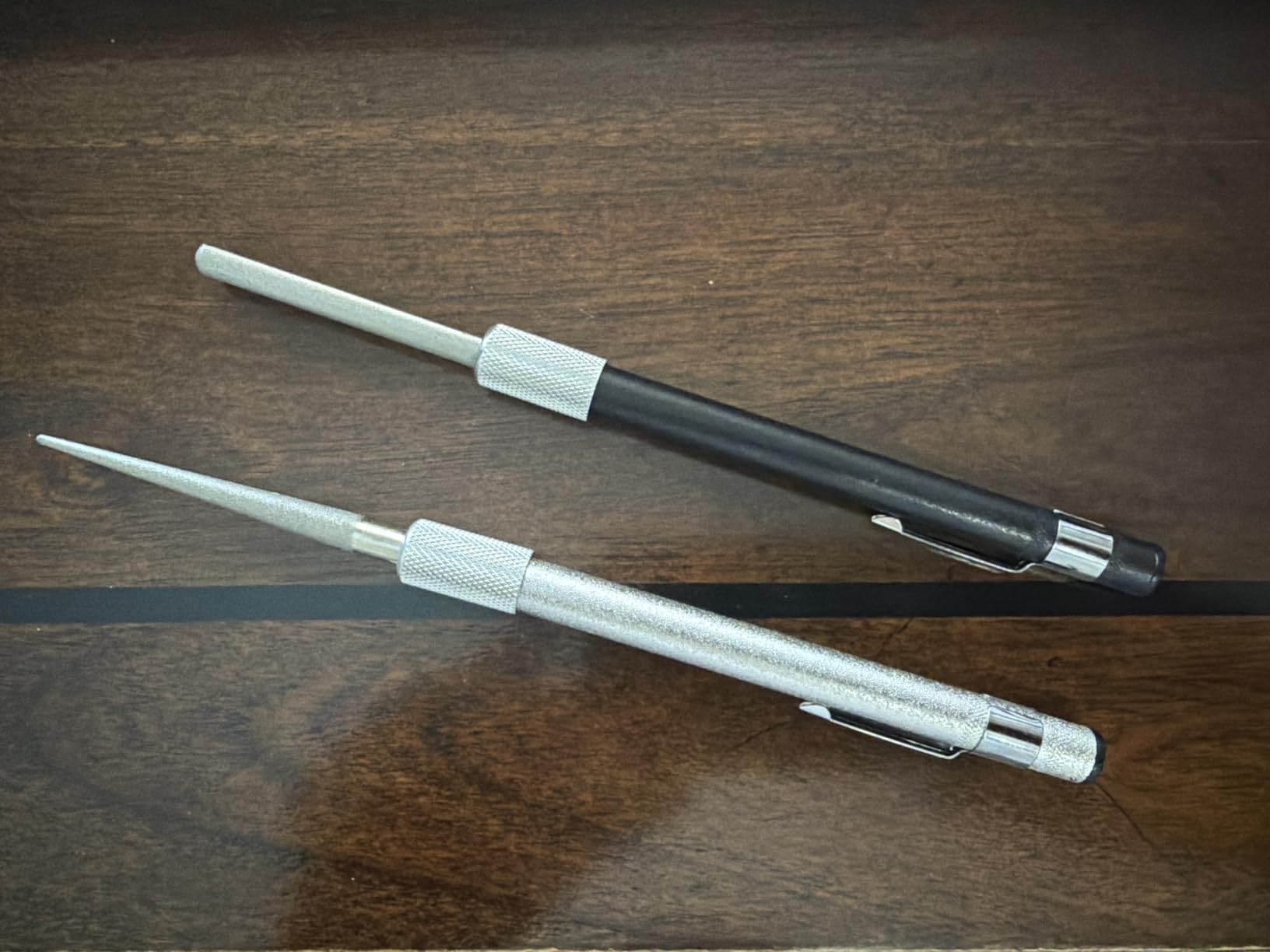
The Wamery Retractable is the sharpener we clip to our apron pocket during bread-heavy baking sessions. The tapered diamond rod reaches scallops of any size, and the retractable body protects the rod between uses. We sharpened a serrated bread knife in about 8 minutes per side, and the retractable design means we never have to worry about the diamond snagging on a towel.
The flat half-round section on the back of the rod also hones plain edges, so the same tool handles hybrid blades with both straight and serrated sections.
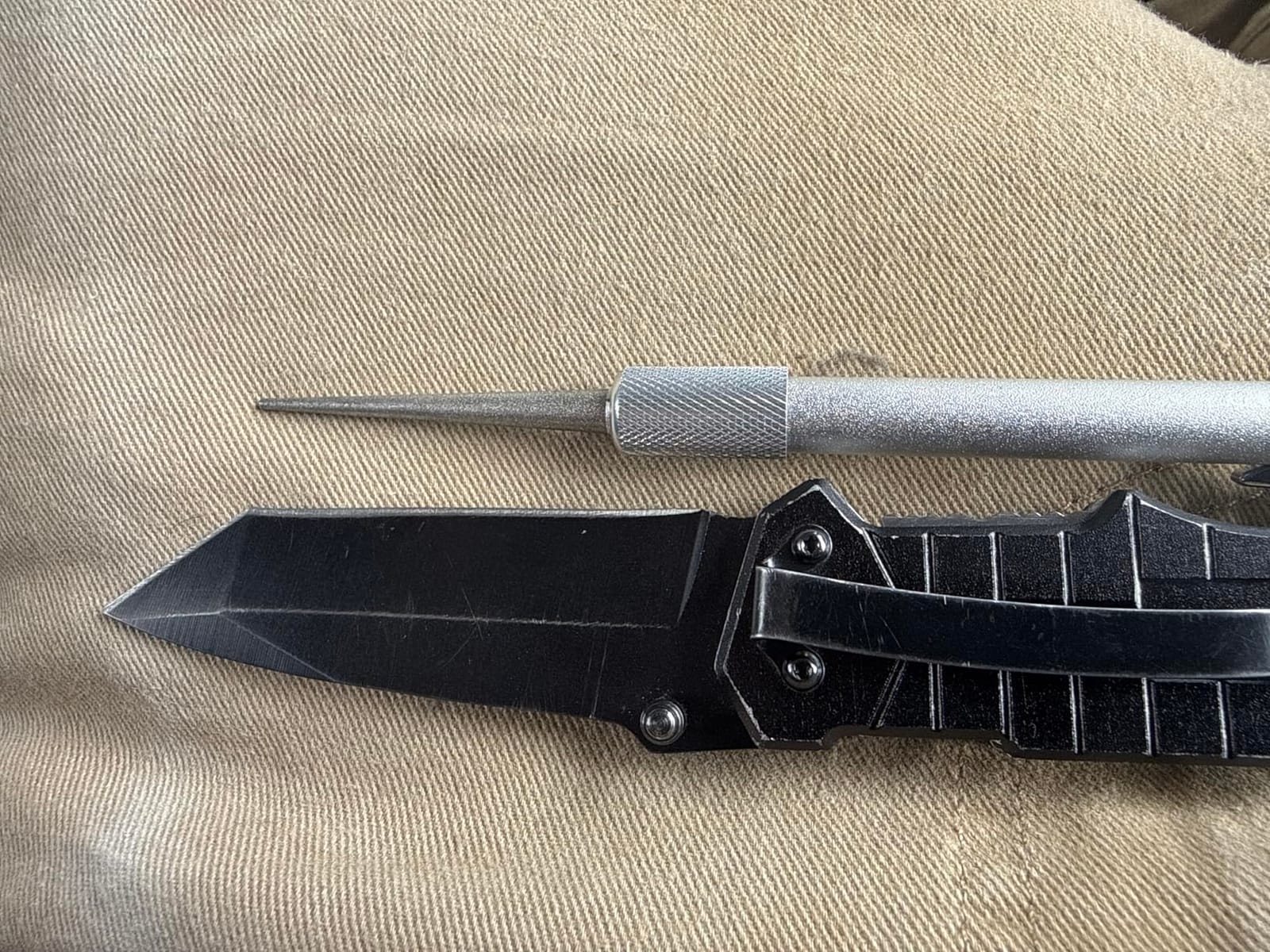
Our team likes the 1.12-ounce weight. It disappears in an apron pocket, and the retractable body means it is always ready without needing a sheath. Reviewers report the diamond surface lasting years of regular bread knife touch-ups.
The coarse grit is the main limitation. There is no fine finishing option, so the Wamery works best as a touch-up tool between full sharpenings rather than a complete sharpening system.
Why It Works for Serrated Blades
The tapered diamond rod fits inside the gullet of any bread knife or serrated pocket knife. Drawing the rod along the bevel side of each scallop restores the cutting edge without removing the tooth peaks.
The retractable body protects the diamond from damage between uses, which extends the working life of the abrasive.
Where It Falls Short
Coarse grit means the final edge is working sharpness rather than razor sharpness. Reviewers recommend finishing on a ceramic rod or leather strop for the smoothest cut.
The small body is harder to control during heavy sharpening. For long sessions on a 10-inch bread knife, a longer DMT cone or Work Sharp rod is easier on the hands.
10. Lansky Fine Hone for Serrated Knives — Best for Lansky System Owners
Lansky Fine Hone for Serrated Knives, Red, One Size
Weight: 1.6 oz
1000 grit ceramic
Triangular profile
Pros
- Ultra-fine 1000 grit ceramic for polished serrated edges
- Triangular profile reaches inside serration scallops
- Works with Lansky sharpening system or freehand
- Lightweight at 1.6 ounces for portable sharpening
- Specialized design for serrated knives specifically
Cons
- Best results require the Lansky sharpening system
- Slower for heavy sharpening than diamond rods
The Lansky Fine Hone is the sharpener we recommend for anyone who already owns a Lansky sharpening system. The triangular ceramic hone fits inside the gullet of any serrated knife, and the 1000 grit leaves a polished working edge. We tested it on a serrated utility knife and a bread knife, both of which sliced cleanly after about six passes per scallop.
The hone is purpose-built for serrations, which makes it more efficient than a generic ceramic rod. The triangular profile matches the natural curve of a scallop, so the abrasive contacts the cutting edge rather than the tooth tip.
Our team liked that the hone works freehand or clamped in a Lansky system. For freehand use, a vise or bench clamp helps keep the knife steady. The 1.6-ounce body is light enough for portable sharpening but still long enough for long bread knife scallops.
The fine grit does the work, so this is a finishing tool rather than a reprofiling tool. For badly damaged serrations, start with a diamond rod and finish on the Lansky hone.
Why It Works for Serrated Blades
The triangular ceramic profile matches the natural curve of a serration, so the abrasive contacts the bevel side of each scallop evenly. The 1000 grit leaves a polished working edge that slices cleanly without aggressive steel removal.
Compatible with the Lansky sharpening system, which lets you clamp the knife at a consistent angle for repeatable results.
Where It Falls Short
Best used with the Lansky system for angle consistency. Freehand sharpening works but requires more practice to keep the angle steady across every scallop.
Fine grit only, which makes it slow for reprofiling badly damaged serrations. Reviewers recommend pairing it with a coarser diamond rod for heavy work.
How to Sharpen a Serrated Knife: Step-by-Step Technique
Serrated knife sharpening looks intimidating but follows the same logic for every knife. Match the original bevel angle, work one scallop at a time, and finish with a light honing stroke. The technique works with both ceramic and diamond tapered rods, and on bread knives, steak knives, and serrated pocket folders.
Identify the bevel side. Most serrated knives are sharpened only on the bevel side (the slanted edge), while the flat back of the knife is left untouched. Look closely at each scallop. The side with the angle is the bevel. The flat side is the back.
Choose a tapered rod that fits the gullet. The rod should slide into the scallop without forcing or wobbling. Tapered rods from 1/4 inch down to 1/16 inch cover most serrations from wide bread knife gullets to narrow steak knife scallops.
Match the factory angle. Most Western serrated knives are 20 degrees per side. Japanese serrated knives often run 15 degrees. Hold the rod at that angle against the bevel side of the scallop.
Draw the rod through each scallop. Pull the rod toward you along the bevel, applying light pressure. Count the strokes. Three to five light strokes per scallop is usually enough. Match the stroke count across every scallop for an even edge.
Skip the flat side for daily maintenance. For touch-ups, sharpening only the bevel side keeps the factory geometry intact. For full restoration, a single light pass on the flat side removes the wire burr.
Test on a tomato. A properly sharpened serrated knife should pierce tomato skin with light pressure and slice cleanly through the flesh without tearing.
Finish on a ceramic hone or leather strop. A few light passes on a finer abrasive polishes the edge and extends the time between full sharpenings.
The fastest version of the routine we tested took about 10 minutes per bread knife. For a full set of steak knives, plan on 20 to 30 minutes for the first sharpening and 10 minutes for touch-ups. Reddit users on r/sharpening report the same range.
Ceramic Rod vs Diamond Rod: Which Is Better for Serrated Blades?
The two abrasive types handle serrated knives differently. Ceramic rods are gentler and slower, while diamond rods are faster and more aggressive. Both work, but each fits a different user.
Ceramic rods are best for routine maintenance and finishing work. The abrasive cuts slowly enough that you can feel the edge forming under each stroke, which makes it easier to control how much steel you remove. We recommend ceramic rods for premium Japanese serrated knives, ceramic blades, and knives that only need a light touch-up between full sharpenings. Reddit users on r/sharpening prefer ceramic for daily maintenance because the gentler cut preserves factory geometry.
Diamond rods are best for reprofiling badly damaged serrations. The abrasive cuts fast, so a few strokes can restore a scallop that has rolled or chipped. We recommend diamond for older serrated knives, hard German stainless steel, and any knife that has gone completely dull. The trade-off is faster steel removal, which means a light touch matters more than with ceramic.
For most home cooks, a ceramic rod handles 90% of serrated sharpening needs. Diamond rods become valuable when a ceramic rod is no longer cutting the steel, which usually happens with high-end VG-10 or harder blade steels. Our top pick, the Work Sharp Guided Field Sharpener, includes both ceramic and diamond in one kit, which is why it earned our Editor’s Choice badge.
Buying Guide: How to Choose the Best Manual Knife Sharpener for Serrated Blades
Choosing the right sharpener comes down to four questions. How many serrated knives do you own, what steel are they made from, do you need to sharpen on the go, and what is your budget. The picks above cover every combination, but here is the framework we use to evaluate each one.
Abrasive type. Ceramic is gentler and better for routine maintenance on premium knives. Diamond is faster and better for reprofiling older or harder blades. The Work Sharp includes both, which is why it tops our list.
Rod shape. Tapered rods from 1/4 inch down to 1/16 inch cover every common serration size. Conical designs like the DMT Diafold fit any gullet, while flat ceramic rods only fit serrations wider than the rod itself. For mixed knife sets, a tapered cone is more versatile.
Left-handed use. Most pull-through sharpeners like the AccuSharp and KitchenIQ work for both hands. Rod-based sharpeners are angle-dependent rather than handedness-dependent, so they work equally well for left- and right-handed users when the knife is held at the proper angle.
Portability. Pocket-sized options like the Smith’s PP1 and Wamery Retractable fit on a keychain. Bench-top options like the Work Sharp sit on a counter. For camping, fishing, or hunting, a pocket-sized sharpener pays for itself the first time a knife goes dull in the field.
Budget tiers. Entry-level sharpeners under 15 dollars (the Smith’s CCKS, Wamery, and Lansky hone) handle light touch-ups on a few serrated knives per year. Mid-range sharpeners from 15 to 40 dollars (the AccuSharp, KitchenIQ, Smith’s PP1, and DMT Diafold) handle regular home kitchen use on full knife sets. Premium sharpeners above 40 dollars (the Work Sharp and Chef’sChoice 4643009) handle professional and outdoor use on harder steels.
For most home cooks, the Work Sharp Guided Field Sharpener earns the top recommendation because it covers every use case without forcing a single-tool compromise. For serrated specialists, the DMT Diafold and Lansky Fine Hone deliver the cleanest results on dedicated bread knife and steak knife sets. If budget matters most, the KitchenIQ Edge Grip and Smith’s CCKS handle the basics for less than 15 dollars.
For more general options that cover both straight and serrated blades, see our full kitchen knife sharpener guide.
Frequently Asked Questions
What is the best knife sharpener for a serrated bread knife?
The Work Sharp Guided Field Sharpener is our top pick for serrated bread knives because it includes a dedicated ceramic rod with angle guides. The tapered ceramic rod fits the wide scallops of a standard bread knife, and the 20 to 25 degree angle guide matches the factory bevel of most Western bread knives. For touch-ups only, the DMT Diafold Serrated Diamond Sharpener or the Wamery Retractable Diamond Rod also work well on bread knives.
Can you use a knife sharpener on serrated blades?
Yes, but only sharpeners with a tapered ceramic or diamond rod, a dedicated serrated slot, or a fold-out diamond rod designed to fit inside each scallop. Standard pull-through sharpeners with V-shaped slots also work because the slot accepts serrations without forcing them flat against the abrasive. Avoid flat whetstones for serrated blades because they will round off the tooth peaks instead of sharpening the scallops.
What is the best way to sharpen a serrated knife?
Use a tapered ceramic or diamond rod matched to the original bevel angle. Most serrated knives are sharpened only on the bevel side, while the flat back is left untouched. Draw the rod through each scallop with 3 to 5 light strokes at the factory angle, then finish with a honing pass on a ceramic hone or leather strop. Test on a tomato. The blade should pierce the skin with light pressure and slice through the flesh without tearing.
Who makes the best manual knife sharpener?
DMT, Work Sharp, Smith’s, Spyderco, AccuSharp, Lansky, and Chef’sChoice all make high-quality manual sharpeners for serrated blades. DMT leads in tapered diamond cones, Work Sharp in complete field kits, Smith’s in pocket portability, AccuSharp in pull-through convenience, Lansky in fine ceramic hones, and Chef’sChoice in diamond abrasive systems. The best brand depends on your knife set and use case.
Will a knife sharpener work on serrated knives?
Most standard V-slot pull-through sharpeners will not reach inside serration scallops and can damage the tooth peaks. The exception is wide V-slot sharpeners like the AccuSharp and Chef’s Choice Pronto, which accept serrations without forcing them flat. For best results, use a sharpener with a dedicated tapered rod or serrated slot designed to fit inside each scallop and sharpen the bevel side of each tooth.
Final Verdict: Which Serrated Knife Sharpener Should You Buy?
For most cooks, the Work Sharp Guided Field Sharpener is the best manual knife sharpener for serrated blades in 2026. It combines diamond and ceramic abrasives, angle guides for both 20 and 25 degree blades, and a compact footprint that fits in a kitchen drawer or a pack. It handles bread knives, steak knives, tomato knives, and serrated pocket folders with the same kit, which is why it earned our Editor’s Choice badge.
For budget shoppers, the KitchenIQ Edge Grip 2-Stage delivers the best value for less than 15 dollars, with preset angles that take the guesswork out of sharpening. For purists who want the cleanest possible finish on premium serrated knives, the Lansky Fine Hone and DMT Diafold deliver ceramic and diamond performance in dedicated serration tools. Whatever your knife set and budget, the right serrated sharpener pays for itself the first time your bread knife slices a tomato instead of tearing it.