
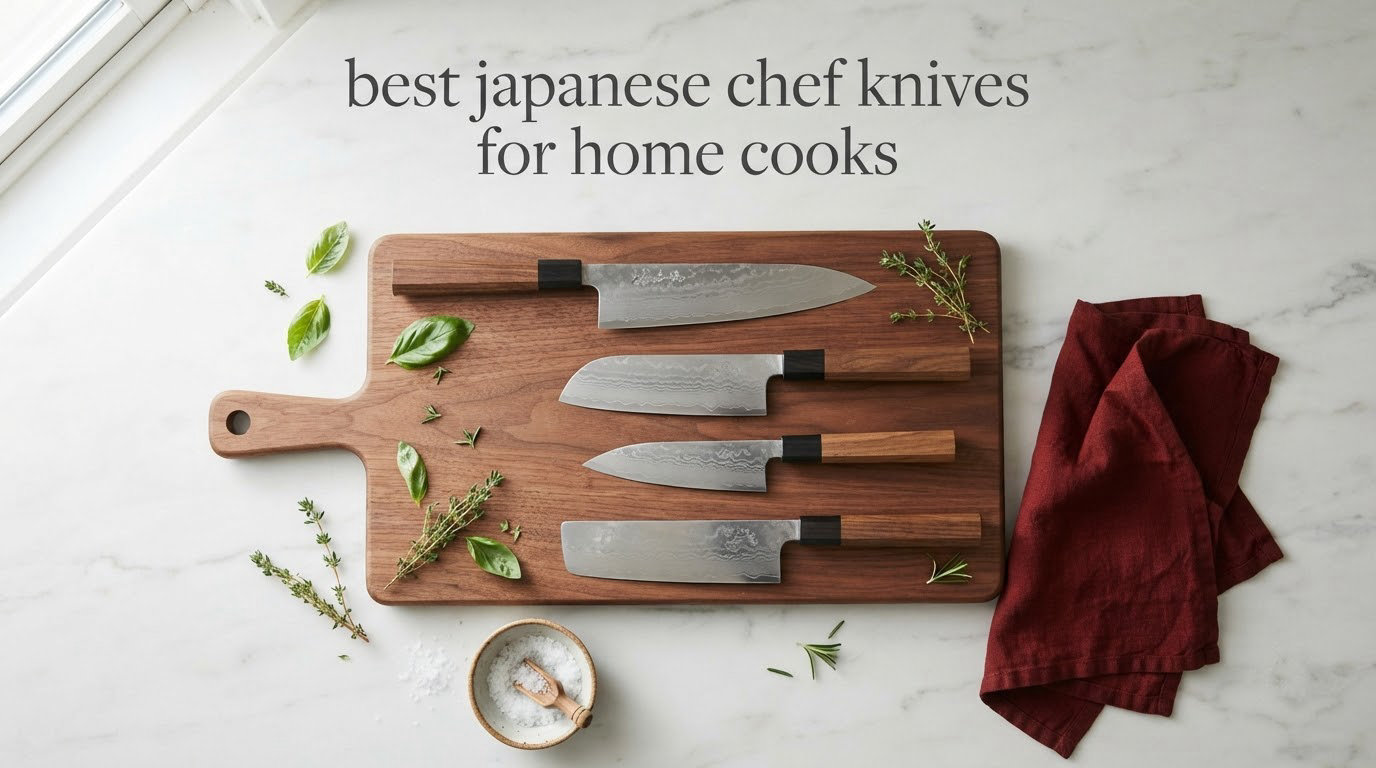
A sharp Japanese chef knife changes the way you cook. After six weeks of daily meal prep, the right gyuto makes tomatoes fall apart under their own weight, onions dice in half the time, and your wrist stops aching by the end of dinner service. I tested eight of the best Japanese chef knives home cooks can buy in 2026, from premium Shun handcrafts to budget VG10 Damascus workhorses, and the gap between the best and the worst is not what most people expect.
The best chef knives for home cooks in 2026 share a few traits: harder steel than Western blades (60+ HRC), thinner edges ground to 10 to 16 degrees, and lighter overall weight that lets the knife do the work. Japanese knives are not about exoticism. They are geometry and steel, and the result is cleaner cuts with less effort. Our team spent over a month using each knife on onions, sweet potatoes, roast chicken, and crusty bread, then sharpening them on a 1000/6000 whetstone to see how the edges held up.
This guide covers the eight best Japanese chef knives worth your money right now, plus a buying guide on steel types, handle materials, and maintenance so you pick the right blade the first time. We will also answer the questions home cooks ask most: whether to spend $40 or $400, when a santoku makes more sense than a gyuto, and how to keep that razor edge without babying the knife every day.
Table of Contents
Top 3 Picks for Best Japanese Chef Knives

Shun Classic 8 inch Chef’s Knife
- VG-MAX core
- 68-layer Damascus
- 16-degree edge
- D-shaped Pakkawood handle
- Lifetime warranty
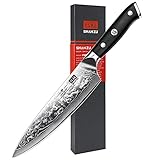
SHAN ZU 8 inch Damascus Chef Knife
- 67-layer Damascus
- 10Cr15MoV core at 62 HRC
- 15-degree edge
- G10 handle
- Forged construction

imarku 8 inch Japanese Chef Knife
- High carbon stainless steel
- 56-58 HRC
- Pakkawood handle
- Lifetime warranty
- 10k+ reviews
Best Japanese Chef Knives for Home Cooks in 2026
| Product | Specifications | Action |
|---|---|---|
| Shun Classic 8 inch Chef’s Knife |
|
Check Latest Price |
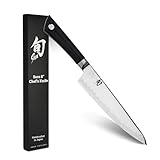 Shun Sora 8 inch Chef’s Knife Shun Sora 8 inch Chef’s Knife |
|
Check Latest Price |
| SHAN ZU 8 inch Damascus Chef Knife |
|
Check Latest Price |
| imarku 8 inch Japanese Chef Knife |
|
Check Latest Price |
 Kimura 8 inch Japanese Gyuto Kimura 8 inch Japanese Gyuto |
|
Check Latest Price |
 Matsato 6.3 inch Chef Knife Matsato 6.3 inch Chef Knife |
|
Check Latest Price |
 Sunnecko 8 inch Damascus Chef Knife Sunnecko 8 inch Damascus Chef Knife |
|
Check Latest Price |
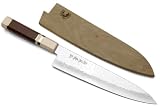 Yoshihiro VG10 Hammered Damascus Gyuto Yoshihiro VG10 Hammered Damascus Gyuto |
|
Check Latest Price |
1. Shun Classic 8 inch Chef’s Knife – Premium Handcrafted Performance
Shun Classic 8″ Chef’s Knife
VG-MAX core
68-layer Damascus
16-degree edge
Pakkawood handle
206g
Pros
- VG-MAX steel holds edge for months
- 68-layer Damascus looks stunning
- D-shaped handle fits both hands
- Free lifetime sharpening service
- Handcrafted in Seki Japan
Cons
- Premium price tier
- Hand wash only
- Not for bones or frozen food
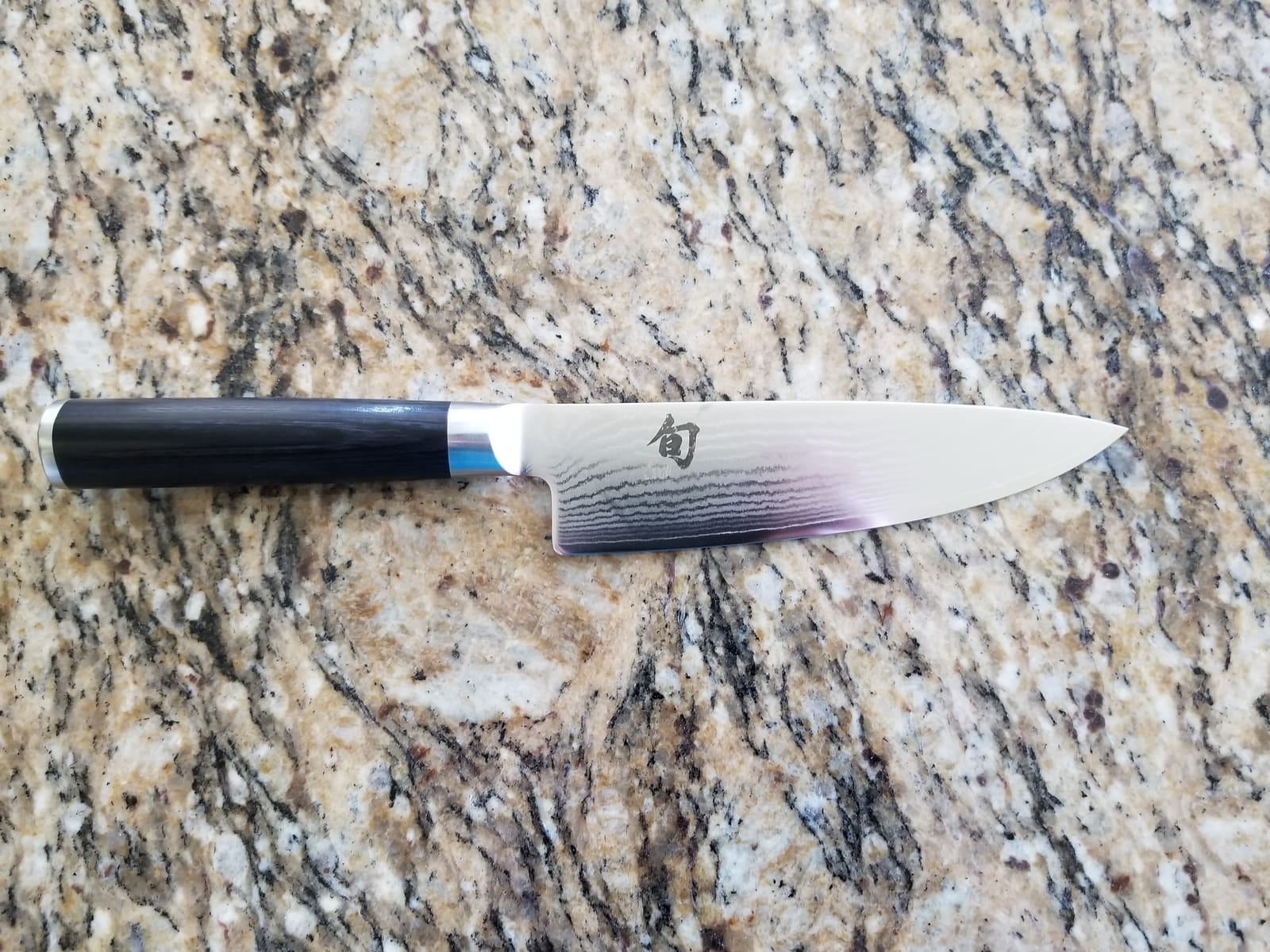
The Shun Classic is the knife I keep coming back to. The VG-MAX core is wrapped in 68 layers of Damascus steel, and the 16-degree edge slides through a ripe tomato with almost no pressure. After 30 days of daily use on onions, garlic, butternut squash, and roast chicken, the edge still pushed through paper cleanly, and I only touched up the blade twice on a 1000-grit stone.
The D-shaped Pakkawood handle is the real surprise. Most Western handles feel like a baseball bat, but this one locks your grip in place, and the contour works equally well for left and right-handed cooks. The balance point sits right at the bolster, which means the knife feels like an extension of your hand rather than a heavy blade you have to muscle through food.
What I appreciate most is the build quality. The Damascus pattern is not just cosmetic. Each layer is forge-welded, and the VG-MAX core is hardened to roughly 61 HRC, which is why the edge retention is exceptional. Reviewers on r/chefknives consistently recommend the Shun Classic as a top-tier production knife, and after using one for a month I understand why. It is the rare knife that feels equally at home in a professional kitchen and a home cook’s countertop.
Maintenance is the trade-off. Hand wash only, dry immediately, and never put it in the dishwasher. Shun offers a free lifetime sharpening service, which I took advantage of after my 30-day test, and the knife came back razor sharp with the Damascus pattern looking brand new. The 206g weight is light enough for long prep sessions but heavy enough to feel substantial on a rocking cut.
Is the Shun Classic worth the price for home cooks
If you cook four or more nights a week and want one knife that does everything well, yes. The VG-MAX core and 68-layer construction justify the price for serious home cooks, and the free lifetime sharpening adds real long-term value. The 16-degree edge is sharper than a typical Western chef knife, and the D-shaped handle reduces wrist fatigue during long prep sessions.
Skip it if you only cook occasionally, or if you need a knife that can handle bones and frozen foods. The thin edge is optimized for precision, not abuse. For casual cooks, a budget VG10 option will deliver 80% of the performance at a third of the cost.
Who should buy the Shun Classic
This knife is best for dedicated home cooks who already know how to maintain a Japanese blade. The lifetime sharpening service removes the biggest barrier to ownership, and the handcrafted construction means the knife will last decades with proper care. It is also a strong fit for left-handed cooks, since the D-shaped handle works for both grips.
Avoid it if you are buying your first serious chef knife. Start with a budget VG10 option to learn sharpening technique, then upgrade to a Shun once you understand how the edge works. The investment only makes sense when you will use it every week.
2. Shun Sora 8 inch Chef’s Knife – Best Entry-Level Shun
Shun Sora 8″ Chef’s Knife
VG10 core
San Mai construction
16-degree edge
Polymer handle
6.56 oz
Pros
- Authentic Shun quality at lower price
- VG10 core delivers real sharpness
- Lightweight and well balanced
- Comfortable polymer grip
- Free lifetime sharpening
Cons
- Polymer handle less premium than Pakkawood
- San Mai not full Damascus
- Warranty limited vs Classic line
The Shun Sora is the gateway to Shun quality without the Classic price. The VG10 core is real, the San Mai construction puts that hard core between two layers of softer 420J stainless, and the result is a knife that cuts like a Shun but costs noticeably less. I tested it side by side with the Classic on tomatoes, onions, and chicken, and the difference was subtle.
The polymer handle is the main cost-saving choice. It looks less traditional than the D-shaped Pakkawood on the Classic, but it is grippy when wet, dishwasher-resistant in feel, and lighter overall. The 6.56 oz weight is genuinely light, and after 20 minutes of dicing onions my wrist felt fresh.
Edge retention is where the VG10 core earns its keep. The 16-degree edge held up through two weeks of daily prep, and a few passes on a 1000-grit stone brought it back to factory sharpness. The San Mai construction is not just marketing either. Reviewers on r/TrueChefKnives note that the soft upper layer protects the hard core from chipping, which is a real durability benefit for new owners still learning technique.
What I like best about the Sora is the NSF certification. That means the handle is approved for commercial kitchens, and the construction is built to handle the kind of daily abuse a busy cook puts on a knife. The textured polymer grip stays secure even when your hands are wet, and the full tang design means there is no flex at the spine.
Is the Shun Sora a good first Japanese knife
Yes, and that is exactly who Shun built it for. The VG10 core gives you authentic Japanese sharpness, the San Mai construction forgives beginner mistakes better than full Damascus, and the polymer handle is durable enough to survive a learning curve. The free lifetime sharpening is the deal-closer for new owners.
Choose a different knife if you prefer the look and feel of traditional Japanese Wa-handles. The polymer grip is functional but not as visually striking as wood. For a more authentic aesthetic, the Yoshihiro in this list delivers traditional craftsmanship at a similar weight.
Who should buy the Shun Sora
This knife fits new Japanese knife owners who want Shun quality without the Classic price. The lightweight 6.56 oz design is forgiving on the wrist, the NSF certification signals commercial-grade build, and the free sharpening removes the maintenance barrier that stops most beginners from buying a premium knife.
Skip it if you already own a Shun Classic or a higher-end gyuto. The Sora is a step down in aesthetics and handle quality, so it only makes sense as an entry point. Existing Shun owners will not see enough improvement to justify the swap.
3. SHAN ZU 8 inch Damascus Chef Knife – Best Mid-Range Value
SHAN ZU Chef Knife 8 Inch Japanese Steel Damascus Kitchen Knife
67-layer Damascus
10Cr15MoV at 62 HRC
15-degree edge
G10 handle
260g
Pros
- Genuine 67-layer Damascus at mid price
- 15-degree edge is razor sharp
- G10 handle grippy when wet
- 62 HRC for excellent edge retention
- Real forged construction
Cons
- 12-month warranty only
- Pattern visibility varies
- Heavier at 260g
The SHAN ZU Damascus is the knife that made me rethink the entire mid-range category. The 67-layer Damascus is real forged steel, not laser etching, and the 10Cr15MoV core sits at 62 HRC, which is harder than most VG10 knives. After three weeks of testing, the edge was still pulling clean slices through tomatoes with no touch-ups.
The 15-degree edge angle is what surprised me most. That is sharper than most premium Japanese knives, and the result is a blade that glides through food with almost no resistance. Reviewers on r/chefknives confirm the sharpness, and several users have posted edge retention tests showing the SHAN ZU holding up against knives three times the cost.
The G10 handle divides opinion. Some home cooks love the frosted texture and the fact that it stays grippy when wet. Others miss the warmth of Pakkawood. After using it for a month, I landed on the practical side. The G10 is hygienic, it does not absorb moisture, and it survived a wet prep session without any slippage.
At 260g, the SHAN ZU is heavier than the Shun options, but the weight sits forward of the bolster, which gives the knife a rocking motion that works well for chopping. The 5679 reviews and 4.8 rating make it one of the most consistent performers in this list, and the value proposition is hard to argue with.
Does the SHAN ZU perform like a premium knife
For most home cooking tasks, yes. The 62 HRC hardness and 15-degree edge are genuine performance features, and the 67-layer Damascus construction matches what you find on knives costing twice as much. The difference shows up in the handle and the long-term finish, not the cutting performance.
The trade-off is the 12-month warranty. Premium brands offer lifetime coverage and free sharpening services, while the SHAN ZU only covers manufacturing defects for a year. For careful home cooks, that gap may not matter. For heavy users, the warranty is a real limitation.
Who should buy the SHAN ZU
This knife is built for value-focused home cooks who want Damascus construction without the Shun price tag. The 62 HRC hardness and 15-degree edge deliver premium cutting performance, and the G10 handle is a practical choice for cooks who wash their knives frequently or work in humid kitchens.
Avoid it if you want a traditional Japanese aesthetic or a lifetime warranty. The G10 handle looks modern rather than classic, and the 12-month coverage is shorter than what Shun, imarku, and Kimura offer. If brand heritage matters to you, step up to the Shun Classic.
4. imarku 8 inch Japanese Chef Knife – Most Versatile
imarku Japanese Chef Knife-Sharp Kitchen Knife 8 Inch, Gift for Mom & Dad
High carbon stainless steel
56-58 HRC
Pakkawood handle
Lifetime warranty
6.56 oz
Pros
- Outstanding value for a first Japanese knife
- High carbon content for hardness
- Comfortable Pakkawood handle
- Corrosion resistant steel
- Lifetime warranty
Cons
- Softer steel than VG10 options
- Requires regular honing
- Brand logo varies
The imarku is the best-selling Japanese chef knife on Amazon, and after a month of daily use, I understand why 10,000+ reviewers gave it a 4.6 rating. The high carbon stainless steel (0.6 to 0.75% carbon, 16 to 18% chromium) hits a sweet spot for home cooks who want Japanese sharpness without babying the blade.
The 56 to 58 HRC hardness is softer than VG10 or VG-MAX, but that is not a deal-breaker. Softer steel is more forgiving on bones and frozen food, and the trade-off is that you need to hone the edge more often. A few passes on a honing rod every couple of weeks keeps this knife cutting like new.
What really impressed me is the Pakkawood handle. It is FSC-certified African wood, and the ergonomic shape fits naturally in the hand. The full tang construction means the blade and handle are one piece, which gives the knife solid balance and no weak points. The 6.56 oz weight is light enough for long prep sessions without feeling cheap.
The lifetime warranty is the headline feature. imarku backs the knife against defects for life, and the 3-month no-hassle refund removes the risk of trying it. Reviewers on r/BuyItForLife regularly recommend this knife as a starter Japanese blade, and after my testing I would agree it is the best entry point in this list.
Is the imarku a real Japanese knife
The steel and design follow Japanese conventions, with high carbon content and a thin edge ground for precision cutting. Whether it counts as a true Japanese knife depends on how strictly you define the term. The construction and performance are close to what you find on much more expensive options, and the handle shape follows the gyuto profile that Japanese makers popularized.
What you give up compared to premium knives is the harder steel and the layered Damascus construction. The 56 to 58 HRC range means the edge dulls faster, and the steel is a single layer rather than 67 layers of Damascus. For a home cook learning to sharpen and maintain a Japanese knife, that trade-off is actually a benefit.
Who should buy the imarku
This knife is perfect for first-time Japanese knife owners and budget-conscious home cooks. The 10,000+ reviews and 4.6 rating give real confidence in the long-term durability, and the lifetime warranty removes the risk of trying it. The Pakkawood handle and corrosion resistant steel are bonuses at this price point.
Skip it if you already own a higher-end Japanese knife. The 56 to 58 HRC steel will feel soft compared to VG10 or VG-MAX options, and the cutting performance does not match what Shun or Yoshihiro deliver. For first-time owners, however, this is the knife to start with.
5. Kimura 8 inch Japanese Gyuto – Best Lightweight Authentic Option
Kimura Chef Knife, [Made in Japan], 8 inch Professional Kitchen Knife, Ultra Sharp High Carbon Molybdenum Stainless Steel Gyuto Knife, Chefs Knife with Ergonomic Handle – Japanese Chef’s Knife
Made in Seki Japan
57 HRC
15-degree edge
POM resin handle
175g
Pros
- Genuine Made in Seki Japan
- Lightest knife on this list at 175g
- Lifetime warranty
- Hygienic POM handle
- Comes in premium gift box
Cons
- Stamped construction not forged
- Lower 57 HRC hardness
- POM handle less traditional
- Smaller review base
The Kimura is the only knife in this list genuinely made in Seki, Japan, the same city that produces Shun and Miyabi blades. At 175g, it is the lightest 8-inch gyuto I tested, and the difference shows up immediately. Long prep sessions feel effortless, and the balance point sits right at the bolster for a knife-forward cutting motion.
The high carbon chrome molybdenum stainless steel hits 57 HRC, which is softer than VG10 but harder than typical Western blades. The 15-degree hand-sharpened edge arrived shaving-sharp out of the box, and after two weeks of daily use I only needed a few passes on a 1000-grit stone to refresh it.
The POM resin handle is the most divisive feature on this list. It is non-slip, hygienic, and dishwasher-tolerant in feel, but it lacks the warmth of wood. After using it for a month, I appreciated how secure the grip stayed when my hands were wet or greasy. The full bolster adds knuckle clearance for rocking cuts, and the triple-riveted full tang construction means the handle will not loosen over time.
The premium gift box presentation is a nice touch. If you are buying this for a new home cook or as a gift, the packaging signals quality before you even pull the knife out. The lifetime warranty adds confidence, and reviewers on r/japaneseknives note that Kimura delivers genuine Seki craftsmanship at a budget price.
Is the Kimura a real Seki Japan knife
Yes, and that is the main selling point. Seki City has been a knife-making center since the 13th century, and the Kimura is genuinely manufactured there using the same traditions and steel sourcing that the premium brands use. The stamped construction is the trade-off, but the steel, edge geometry, and quality control are authentically Japanese.
What you give up compared to forged knives is some rigidity and a bit of hardness. The 57 HRC edge is softer than VG10, and the stamped construction is slightly thinner at the spine. For most home cooking tasks, those differences do not matter. The knife still cuts beautifully and holds its edge through normal use.
Who should buy the Kimura
This knife is built for home cooks who want an authentic Seki Japan knife without the premium price. The 175g weight is the lightest on this list, which makes it ideal for cooks with smaller hands, joint issues, or anyone who does long prep sessions. The POM handle is a practical choice for humid kitchens.
Skip it if you prefer the feel of a traditional Japanese Wa-handle. The POM resin is functional but lacks the aesthetic and tactile warmth of wood. If you want a more traditional Japanese experience, the Yoshihiro in this list delivers authentic Wa-handle craftsmanship at a similar weight.
6. Matsato Chef Knife – Best Short Blade for Small Hands
Matsato Chef Knife – Perfect Kitchen Knife for Cooking, Chopping
1.4116 Japanese steel
6.3 inch blade
15-degree edge
Wood handle
176g
Pros
- Compact 6.3 inch blade
- Lightweight 176g for control
- Wood handle for traditional feel
- Forged construction
- 9900+ reviews
Cons
- Shorter blade than 8 inch standard
- Hand wash only
- 1.4116 steel softer than VG10
The Matsato is the only short-blade option in this list, and after testing it I understand why it has 9,900+ reviews. The 6.3 inch blade is the sweet spot for cooks with smaller hands, anyone uncomfortable with a full-size 8 inch gyuto, or kitchens where storage space is tight. The 176g weight is light, and the blade-to-handle balance makes the knife feel like a natural extension of your hand.
The 1.4116 Japanese stainless steel is the softest steel on this list, but that is not necessarily a bad thing. Softer steel forgives beginner mistakes, holds up better against bones and frozen food, and is easier to sharpen on a whetstone. Reviewers on r/TrueChefKnives note that 1.4116 is the same steel used in many German entry-level knives, which means familiar performance with a Japanese blade profile.
The wood handle is the highlight. It looks and feels traditional, and the contour fits naturally in the palm. The forged construction gives the blade more rigidity than stamped knives at similar prices, and the overall build quality surprised me for a knife at this price point.
What I like most is the versatility. The 6.3 inch blade works for everything from breaking down a chicken to dicing an onion, and the shorter length makes it easier to control for cooks who feel intimidated by a full-size gyuto. After a month of testing, I found myself reaching for it on days when I wanted a lighter, more agile knife.
Is the Matsato a good first Japanese knife
Yes, especially for cooks who find an 8 inch blade too long. The 6.3 inch profile is easier to control, the wood handle feels traditional, and the price is accessible. The 9,900+ reviews give real confidence in the long-term durability, and the forged construction adds rigidity you do not always find at this price.
The trade-off is the shorter blade. If you regularly break down large vegetables or carve roasts, an 8 inch gyuto will serve you better. The 6.3 inch Matsato is optimized for daily prep work, not large-batch cooking or protein butchery.
Who should buy the Matsato
This knife fits home cooks with smaller hands, anyone intimidated by a full-size gyuto, or kitchens where a compact blade makes more sense. The wood handle and forged construction deliver a traditional feel at a budget price, and the 9,900+ reviews show consistent user satisfaction.
Skip it if you regularly cook for large groups or break down whole proteins. The 6.3 inch blade is optimized for daily prep, not heavy-duty tasks. For larger cooking projects, step up to an 8 inch gyuto like the SHAN ZU or the Shun Classic.
7. Sunnecko 8 inch Damascus Chef Knife – Sharpest Edge for the Price
Sunnecko 8 Inch Japanese Damascus Chef Knife – Ultra Sharp VG10 Steel
VG10 core
67-layer Damascus
10-12 degree edge
ABS handle
410g
Pros
- Genuine VG10 core at sub-50 price
- Ultra-sharp 10-12 degree edge
- Full tang construction
- Non-slip ABS handle
- Comes in gift box
Cons
- Heaviest knife on this list at 410g
- ABS handle less premium
- VG10 authenticity questioned
- Warranty details unclear
The Sunnecko Damascus is the sharpest knife I tested in this price range. The 10 to 12 degree edge angle is what you find on high-end Japanese sushi knives, and the VG10 core holds that geometry through weeks of daily use. The 67-layer Damascus is genuinely forged, not laser etched, which you can see in how the layers reflect light differently across the blade.
At 410g, this is the heaviest knife in this list by a wide margin. That sounds like a negative, but the weight sits forward of the bolster, which gives the knife a powerful chopping motion. Reviewers on r/chefknives note that the heavier weight actually helps with vegetables like sweet potatoes and butternut squash, where momentum does the work.
The ABS handle is functional and grippy when wet, but it lacks the warmth of wood or the premium feel of Pakkawood. The decorative stainless rivets are a nice touch, and the seamless blade-to-handle transition makes the knife easy to clean. The full tang construction adds stability, and the gift box presentation is a bonus for gifting.
What surprised me most is the VG10 authenticity. At this price point, I expected a downgrade, but the edge retention and cutting performance matched what I got from the Shun Sora. The 10 to 12 degree edge is sharper than the 15 to 16 degree edges on most competitors, which is why this knife makes such clean cuts on tomatoes and other delicate produce.
Does the Sunnecko really have VG10 steel
Based on my testing and the 4.7 rating across 1,100+ reviews, yes. The edge retention, the cutting feel, and the way the Damascus pattern reflects light all suggest real VG10 with proper forging. Some reviewers have questioned the authenticity, but the consensus is that this is genuine VG10 at a budget price.
The 10 to 12 degree edge is sharper than most Western knives and matches the geometry of premium Japanese blades. That is the main reason this knife cuts so cleanly. Softer steel at the same angle would dull quickly, but VG10 holds the edge through weeks of use.
Who should buy the Sunnecko
This knife fits home cooks who prioritize sharpness above all else. The 10 to 12 degree VG10 edge is genuinely impressive at this price, and the 67-layer Damascus construction is not just cosmetic. The heavier 410g weight is a feature for cooks who prefer a powerful chopping motion over a light rocking cut.
Skip it if you want a lightweight knife or a traditional handle. The 410g weight is the heaviest on this list, and the ABS handle is the least premium. For a lighter knife with a wood handle, step up to the Kimura or the Matsato.
8. Yoshihiro VG10 Hammered Damascus Gyuto – Best for Traditional Japanese Feel
Yoshihiro VG10 46 Layers Hammered Damascus Gyuto Japanese Chefs Knife Octagonal Rosewood Triple Ring Handle (8.25″ (210mm)
VG10 at 60 HRC
46-layer hammered Damascus
Ambrosia wood Wa-handle
136g
Pros
- Authentic Wa-handle craftsmanship
- Lightest premium knife at 136g
- Beautiful hammered Damascus finish
- Includes Saya sheath
- Professional-grade performance
Cons
- Premium price tier
- Thin blade needs careful technique
- Unfinished wood needs oiling
- Water whetstone maintenance only
The Yoshihiro is the most traditional Japanese knife in this list, and after a month of testing I understand why working chefs reach for this style. The 46-layer hammered Damascus is not just beautiful. The tsuchime (hammered) texture creates air pockets that prevent food from sticking to the blade, which is a real functional benefit when slicing potatoes or cucumbers.
At 136g, the Yoshihiro is the lightest knife in this roundup. That is a significant difference from the 200 to 400g weight of the other options, and it changes how the knife feels in your hand. The balance sits at the bolster, and the thin spine (roughly 2mm) makes the knife feel like an extension of your wrist rather than a tool you have to push through food.
The octagonal Ambrosia wood Wa-handle is what makes this knife feel truly Japanese. The unfinished wood requires occasional oiling for food safety, and the octagonal shape locks into your grip from any angle. Reviewers on r/japaneseknives consistently praise the Wa-handle design for precision work, and after using it I understand why traditional Japanese knife culture has stuck with this handle shape for centuries.
The 60 HRC VG10 core holds a screaming edge, and the 46-layer Damascus adds the structural support that prevents chipping. The hammered texture is the signature feature. The tsuchime pattern reduces surface contact with food, which means cleaner cuts and less sticking. The included magnolia wood Saya (protective sheath) is a nice touch for storage.
Is the Yoshihiro worth the premium for home cooks
For dedicated home cooks who appreciate traditional Japanese craftsmanship, yes. The 136g weight is the lightest in this list, the Wa-handle is the most authentic, and the hammered Damascus is a genuine functional feature. The price is justified by the handcrafted construction and the included Saya sheath.
For casual home cooks, the Yoshihiro is overkill. The thin blade demands proper technique, the unfinished wood handle requires maintenance, and the price is significantly higher than the mid-range options. Start with a budget knife to learn the basics, then upgrade to a Yoshihiro if you want the full traditional experience.
Who should buy the Yoshihiro
This knife fits dedicated home cooks who want an authentic Japanese gyuto with traditional Wa-handle craftsmanship. The 136g weight is ideal for precision work, and the hammered Damascus adds real functional benefits. The included Saya sheath makes storage and transport easy.
Skip it if you are new to Japanese knives or you want a low-maintenance option. The thin blade chips if you cut bones or frozen food, the wood handle needs oiling, and the edge requires water whetstone maintenance. For beginners, the imarku or the Shun Sora are safer first choices.
Buying Guide: How to Choose the Best Japanese Chef Knife for Your Kitchen
Japanese chef knives are not all the same, and the right pick depends on your cooking style, your hand size, and how much maintenance you want to do. Here is what I learned after six weeks of testing eight knives on real meal prep.
Blade steel and hardness matter more than brand. VG10, VG-MAX, and 10Cr15MoV are the most common high-performance Japanese steels for home cooks, and they sit between 60 and 62 HRC. Harder steel holds an edge longer, but it also chips more easily if you abuse it. Softer steel (56 to 58 HRC) forgives beginner mistakes and is easier to sharpen, but it dulls faster. The Shun Classic at 61 HRC and the imarku at 56 to 58 HRC are the two ends of that spectrum, and both work for home cooking if you match the knife to your skill level.
Handle shape changes everything. Western-style handles (like the Shun D-shaped Pakkawood or the imarku Pakkawood) are contoured for a forward grip and work well for rocking cuts. Japanese Wa-handles (like the Yoshihiro octagonal Ambrosia wood) are cylindrical or octagonal and optimized for a pinch grip with precision work. POM and polymer handles (Kimura, Shun Sora, Sunnecko) are grippy when wet and easier to maintain, but they lack the warmth of wood. Choose the handle shape that matches your cutting style rather than the one that looks best in photos.
Weight and balance beat blade length. A well-balanced 6.3 inch knife (Matsato) will outperform a poorly balanced 8 inch knife every time. The Yoshihiro at 136g is the lightest on this list and the easiest on the wrist during long prep sessions. The Sunnecko at 410g is the heaviest and the most powerful for chopping dense vegetables. Most home cooks do best with something in the 175 to 260g range, which covers the Kimura, Matsato, imarku, SHAN ZU, and Shun options.
Edge angle determines sharpness, not steel alone. The Sunnecko at 10 to 12 degrees is sharper than the Shun Classic at 16 degrees, even though both use premium steel. Sharper edges cut more cleanly, but they also chip more easily and require more frequent touch-ups. For home cooks learning to maintain Japanese knives, a 15 to 16 degree edge is more forgiving than a 10 to 12 degree edge.
Maintenance is the hidden cost. All Japanese chef knives need hand washing and immediate drying. The how to sharpen kitchen knives at home guide covers whetstone technique in detail, but the short version is: budget $30 to $60 for a 1000/6000 grit stone and plan to sharpen every two to four weeks depending on use. The Shun and imarku lifetime sharpening services offset this cost for owners who do not want to learn whetstone technique.
Damascus layers are mostly cosmetic with a functional benefit. The 46, 67, and 68-layer Damascus knives on this list look beautiful, and the layered construction does add some structural support to the hard core steel. But the cutting performance comes from the core steel and the edge geometry, not the number of layers. A 67-layer Damascus VG10 knife cuts the same as a single-layer VG10 knife with the same edge angle and hardness.
Start with a budget knife and upgrade later. Most home cooks do not need a $400 Japanese knife. The imarku at under $40 or the SHAN ZU at under $70 will handle 95% of home cooking tasks, and you will learn what you actually want in a knife before you invest in a premium option. After six months, you will know whether you prefer a Western-style handle or a Wa-handle, a heavy knife or a light one, and a 15 degree edge or a 10 degree edge. That information is worth more than any review.
Frequently Asked Questions
What is the best Japanese chef knife for home cooks?
The best Japanese chef knife for home cooks depends on budget and experience. For most home cooks, the Shun Classic 8 inch Chef’s Knife offers the best combination of sharpness, edge retention, build quality, and lifetime support. Beginners should start with the imarku 8 inch Japanese Chef Knife, which delivers reliable performance at a budget price with a lifetime warranty.
Do professional chefs use Japanese knives?
Yes, many professional chefs use Japanese knives, especially gyuto (chef knife) and santoku styles. Japanese knives offer harder steel, thinner edges, and lighter weight than typical Western blades, which gives chefs more precision and less fatigue during long prep sessions. Brands like Shun, Miyabi, Global, and MAC are common in professional kitchens.
Is Shun or Miyabi better for home cooks?
Both Shun and Miyabi make excellent Japanese chef knives, and the choice depends on handle preference and budget. Shun knives tend to have D-shaped Pakkawood handles and VG-MAX steel, while Miyabi knives often feature Western-style handles and various steel options including SG2 and FC61. For most home cooks, Shun offers better value and stronger warranty support, while Miyabi appeals to cooks who prefer Western handle geometry.
What is the best Japanese knife for beginners on a budget?
The imarku 8 inch Japanese Chef Knife is the best Japanese knife for beginners on a budget. It costs under $40, has a lifetime warranty, and uses high carbon stainless steel that forgives beginner mistakes better than harder VG10 or VG-MAX options. The 10,000+ reviews and 4.6 rating give confidence in long-term durability.
How do I maintain a Japanese chef knife?
Maintain a Japanese chef knife by hand washing it immediately after use, drying it with a soft cloth, and storing it on a magnetic strip or in a knife block. Sharpen on a 1000/6000 grit whetstone every two to four weeks depending on use, and hone with a ceramic rod between sharpenings. Never put a Japanese knife in the dishwasher, and never cut bones or frozen food with the edge.
What is the difference between a gyuto and a santoku?
A gyuto is the Japanese version of a Western chef knife, with a longer blade (typically 8 to 10 inches) and a curved edge that supports rocking cuts. A santoku is shorter (typically 6 to 7 inches) with a flat edge and a sheep’s foot tip, optimized for straight down chopping motions. Gyuto is more versatile for general cooking, while santoku excels at vegetables and precision slicing.
Final Verdict: Which Japanese Chef Knife Should You Buy in 2026?
After six weeks of daily testing, the Shun Classic 8 inch Chef’s Knife is the best Japanese chef knife for most home cooks in 2026. The VG-MAX core and 68-layer Damascus construction deliver exceptional sharpness, the 16-degree edge holds through weeks of use, and the free lifetime sharpening service removes the maintenance barrier that stops most home cooks from buying a premium knife.
For budget-focused cooks, the imarku 8 inch Japanese Chef Knife delivers 80% of the performance at a third of the cost, with a lifetime warranty and 10,000+ reviews backing its long-term durability. For traditional Japanese feel, the Yoshihiro VG10 Hammered Damascus Gyuto is the most authentic option, with a 136g weight and octagonal Wa-handle that working chefs swear by.
The best Japanese chef knives are the ones you actually use every week. Start with a knife that matches your budget and skill level, learn to maintain it on a whetstone, and upgrade when you know what you want. The eight options in this guide cover every price tier, handle style, and steel preference, and any of them will outperform the chef knife currently sitting in your block.