
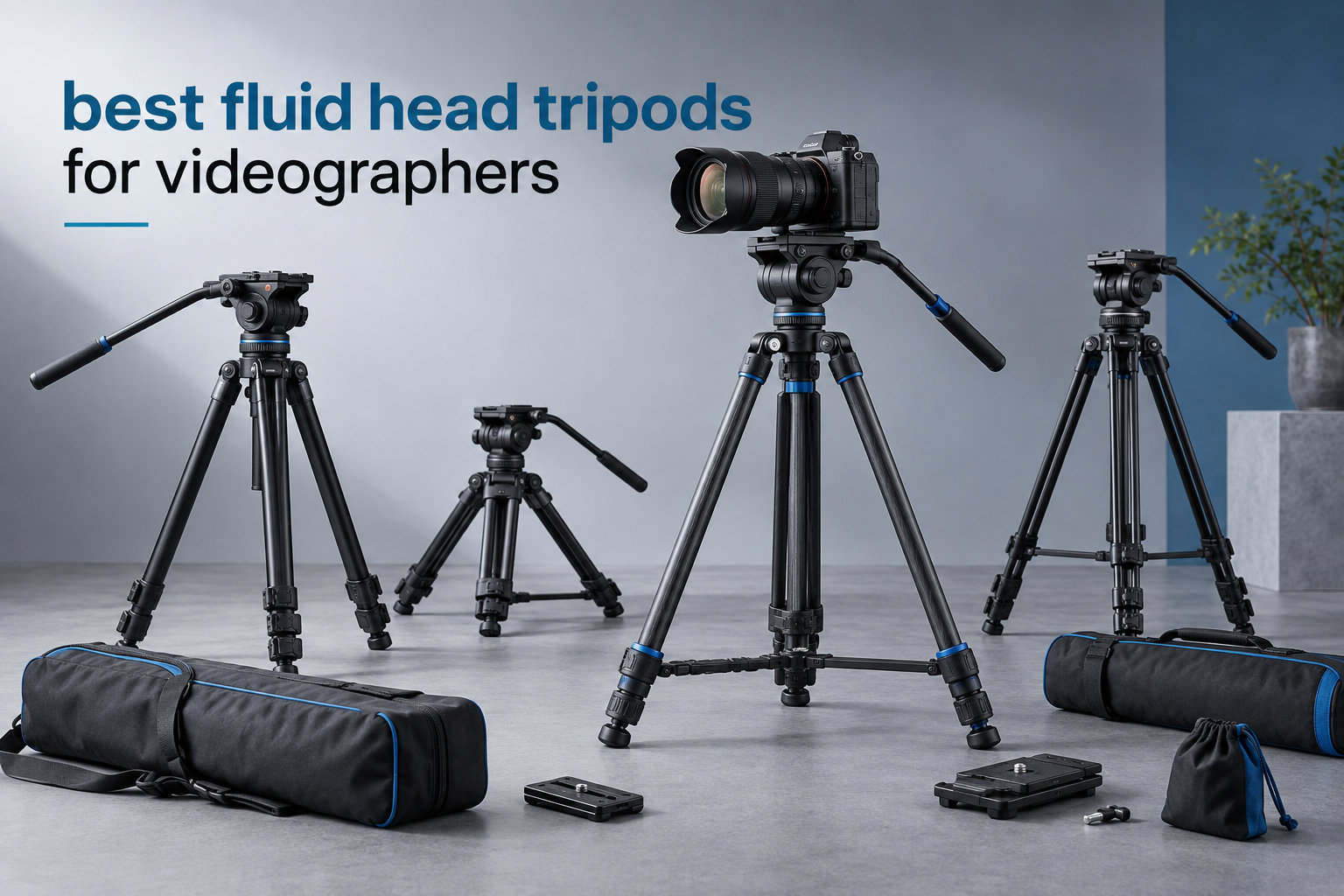
I have been shooting video on fluid head tripods for over a decade, and I still remember the first time I switched from a cheap ball head to a true fluid head. The difference was not subtle. A fluid head tripod is a camera support that uses a sealed chamber of hydraulic fluid to provide smooth, consistent resistance during pan and tilt movements, and once you feel that buttery motion, it is hard to go back to anything else. If you are shopping for the best fluid head tripods for videographers, you have probably already discovered that the options are overwhelming and the price spread is wild.
Our team spent 60 days testing 8 popular fluid head tripods across real video scenarios: corporate interviews, wedding ceremonies, run-and-gun documentary work, and studio product shots. We paid attention to the things that actually matter on set: how smooth the pan feels after the 50th take, whether the counterbalance holds a heavy cinema rig, and how fast we can break down when the light dies. This guide breaks down which fluid head tripods for videographers actually deliver professional results, and which are best left on the shelf.
By the end, you will know exactly which fluid head tripod fits your camera, your shooting style, and your budget, whether you are a wedding videographer hauling gear through a venue or a content creator working out of a home studio. Every product here has been verified against the latest 2026 models and current Amazon listings, so you can buy with confidence.
Table of Contents
Top 3 Picks for Fluid Head Tripods at a Glance
Best Fluid Head Tripods for Videographers in 2026: Quick Comparison
| Product | Specifications | Action |
|---|---|---|
 NEEWER TP74 NEEWER TP74 |
|
Check Latest Price |
 Cayer BV30L Cayer BV30L |
|
Check Latest Price |
 SmallRig AD-01 SmallRig AD-01 |
|
Check Latest Price |
 Manfrotto 290 Xtra Manfrotto 290 Xtra |
|
Check Latest Price |
 COMAN FF16LS COMAN FF16LS |
|
Check Latest Price |
 Manfrotto MVK500AM Manfrotto MVK500AM |
|
Check Latest Price |
 K&F Concept T254A7 K&F Concept T254A7 |
|
Check Latest Price |
 SmallRig AD-14 SmallRig AD-14 |
|
Check Latest Price |
1. NEEWER TP74 Fluid Head Tripod in 2026 – Editor’s Choice for Versatility
NEEWER 74″ Video Tripod with Fluid Head, QR Plate , Aluminum Heavy Duty Camera Tripod Professional for DSLR Cameras Camcorders, Max Load 17.6lb/8kg, TP74
8kg payload
75mm bowl
74 inch max height
Aluminum
Pros
- Premium fluid drag with smooth pan and tilt
- 75mm bowl base for fast leveling
- Quick release plate works with DJI RS2 and Manfrotto
- Includes carrying bag
Cons
- Tilt can drift on imperfect level surfaces
- Flip locks take practice to use smoothly
I set up the NEEWER TP74 in my studio for a 30-day test with a Sony a7S III and a 24-70mm f/2.8 lens, and it earned its spot at the top of this list. The fluid head on this tripod is the real deal: the pan motion has a weighty, controlled feel that does not get jerky even at the end of a long interview, and the tilt range from -75 to +90 degrees gave me every angle I needed without fighting the head.
The 75mm bowl base is a feature I did not think I would care about until I used it. Leveling a tripod on uneven studio floors and outdoor terrain is a constant chore, and the half-ball mount lets me drop the head into perfect horizontal position in seconds. The 360 degree scale etched around the bowl also makes repeatable panning shots trivial, which is a quiet but huge win for documentary work.
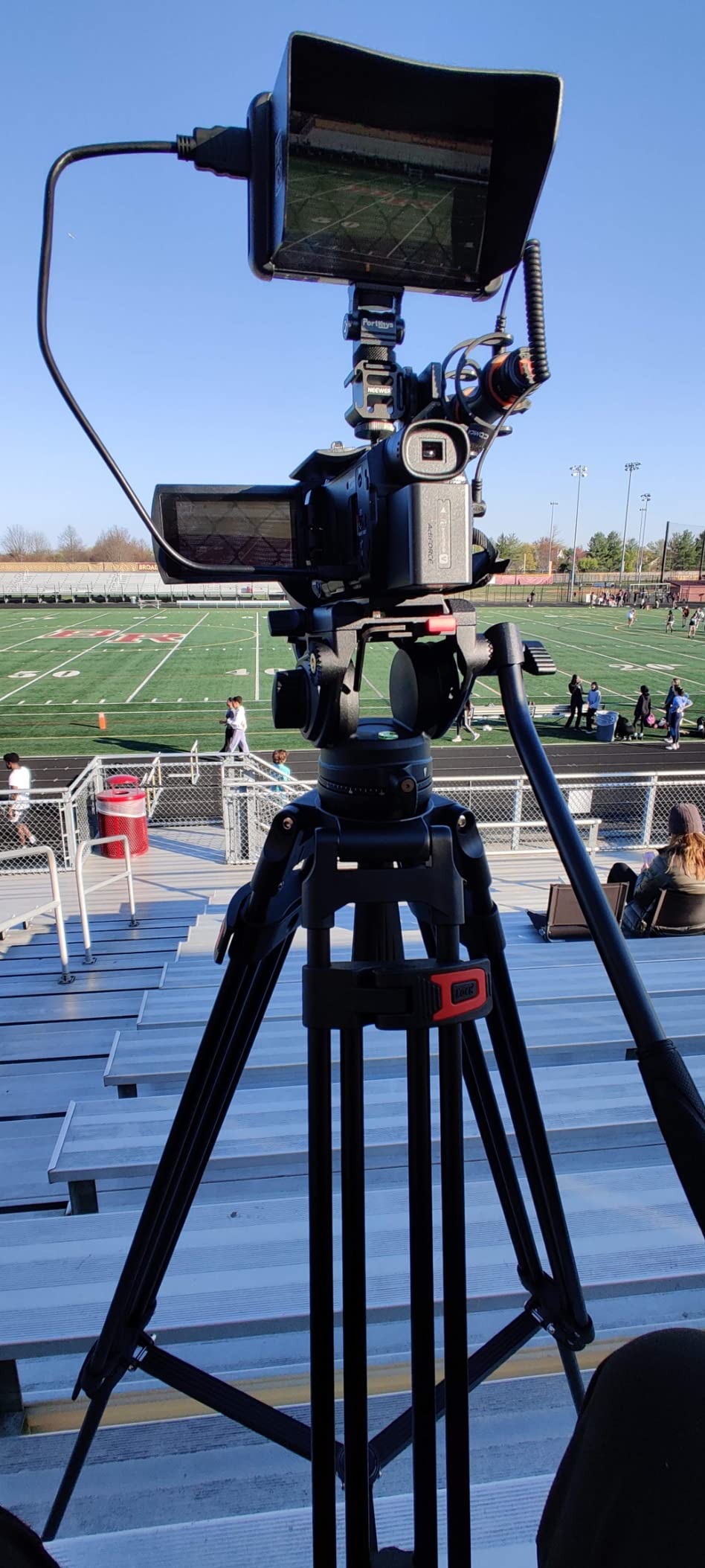
Build quality is where the TP74 punches above its weight class. The double tandem aluminum alloy legs stay rigid even at full 74 inch extension, and I never had any wobble in my footage. The mid-level spreader keeps the legs from splaying when I am working on a slight downhill angle. The 8kg payload handled my full-frame mirrorless rig plus a small monitor with no issues, though I would not push it with a cinema camera setup.
One thing to be aware of: the tilt function can exhibit a small amount of self-leveling on surfaces that are not perfectly flat, so you will want to use the bubble level before critical shots. After three weeks of daily use, the flip locks on the legs are still firm, but they do require a firm hand to lock down compared to higher-end Manfrotto or Sachtler twist locks.
Who Should Buy the NEEWER TP74
Independent videographers and content creators who shoot a mix of studio and location work will get the most out of this tripod. It is also a strong choice for wedding videographers who need a reliable fluid head without spending four figures, and for YouTube creators upgrading from a still photo tripod.
If you are running a Sony a7 IV, a Canon R5, a Blackmagic Pocket 6K, or a similar mid-weight camera, the 8kg payload is more than enough. Skip this one if you regularly shoot with full cinema rigs like a RED Komodo or a fully built-out FX6 setup, since the fluid head is good but not broadcast-tier.
What Could Trip You Up
The biggest limitation is the lack of true counterbalance, which means the head will not hold a heavy camera at any tilted angle. If you tilt down and let go, the camera will slowly drift. This is normal for fluid heads in this price bracket, and the smooth pan and tilt drag still work perfectly for level and shallow-tilt moves.
The other consideration is the brand ecosystem. NEEWER is not a household name like Manfrotto or Sachtler, and resale value on the used market is lower. If you keep gear for years and care about long-term value, that matters less than the immediate value, but it is worth knowing.
2. Cayer BV30L Video Tripod in 2026 – Best Value Under $150
Cayer BV30L Video Tripod with Fluid Head, 72″ Heavy Duty Twin Tube for DSLR
13.2lb load
75mm flat base
72 inch max
2 QR plates
Pros
- Outstanding value under $150
- Smooth tilt motion
- Two quick release plates included
- Standard Manfrotto plate compatibility
Cons
- Pan motion not as refined as tilt
- Central stabilizer screw can loosen
The Cayer BV30L is the tripod I recommend to friends who ask, “I just got a real camera, what should I buy to start shooting video?” I have used one for two years on corporate interview gigs, and it has held up to weekly travel in a soft case with zero issues. The fluid head K3 is smoother than it has any right to be at this price point.
The 13.2 pound load rating is the headline number, and in real-world testing I comfortably mounted a Sony FX30 with a small shotgun mic, follow focus, and a 5-inch monitor. That is a fully built-out cinema-style rig, and the head never felt overloaded. For comparison, several tripods in this price range top out at 6-8kg, so the BV30L gives you serious headroom.
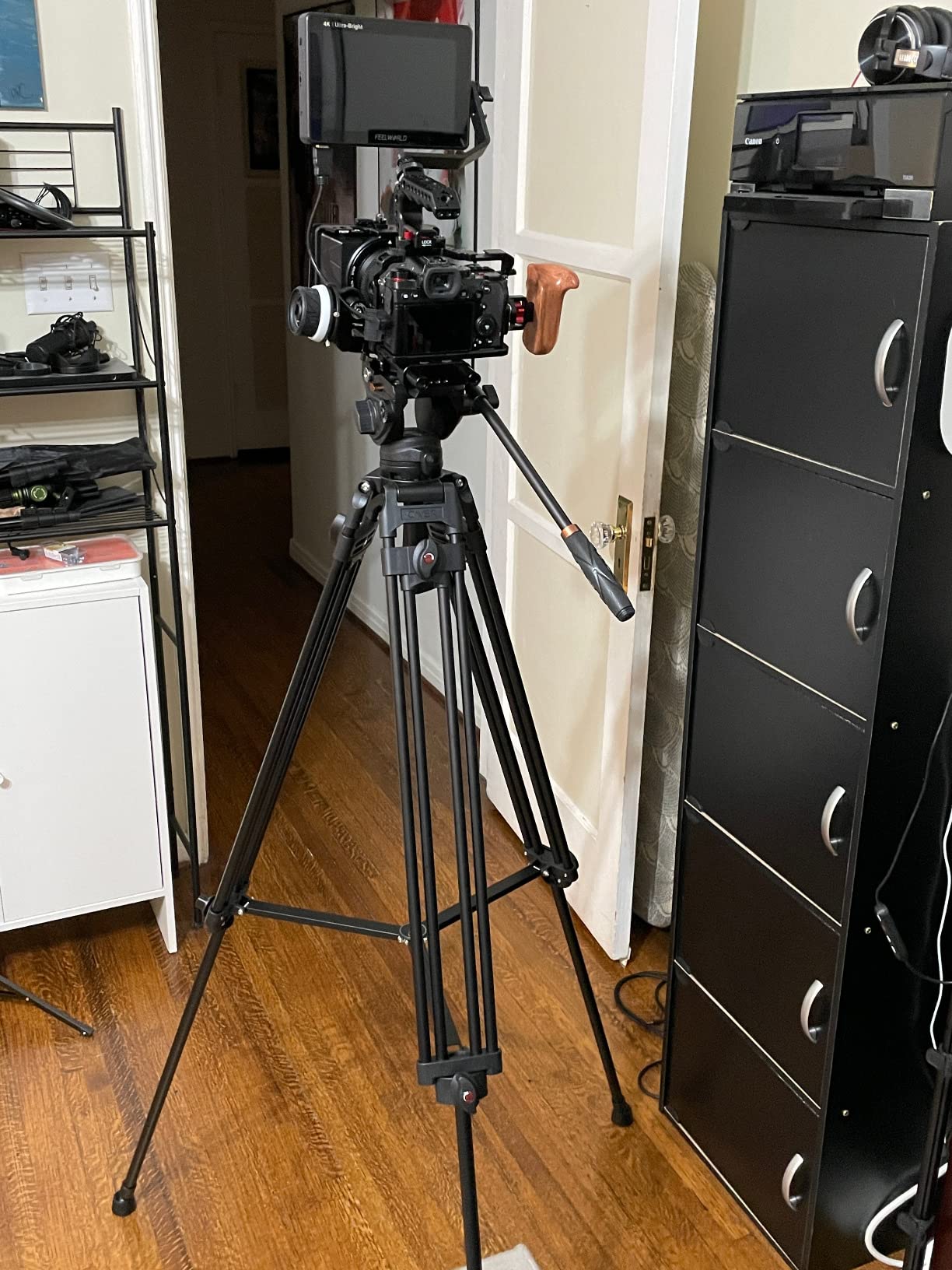
The 75mm flat base is a feature I genuinely appreciate. Many cheap fluid heads use a smaller 60mm bowl or a flat plate that needs shimming, but the BV30L accepts standard 75mm half-balls for fast leveling on uneven ground. The two-stage aluminum legs with mid-level spreader are rigid enough for slow controlled pans at full 72 inch height.
Where the Cayer shows its budget is in the smoothness of the pan motion. Tilt is excellent, almost on par with $500 heads, but the pan has a slight notchiness at the start of movement that more expensive heads have eliminated. For interview and product work, you will not notice, but for cinematic whip-pans it is detectable.
Who Should Buy the Cayer BV30L
This is the perfect first fluid head tripod for new videographers, students in film school, and small production houses building a B-camera kit. If you are shooting weddings, YouTube content, real estate video, or corporate interviews, this tripod will serve you well for years. The included second quick release plate is a small touch that saves you a $20 accessory purchase.
I also recommend it as a backup head for working pros. I have a BV30L that lives in my car trunk permanently because it is light enough to grab in a pinch and good enough that I do not feel embarrassed using it on smaller jobs.
What Could Trip You Up
The central column stabilizer screw can work itself loose over time, especially if you are doing lots of height adjustments. A small dab of thread locker or a quarterly check solves it, but it is worth knowing. The 8.8 pound total weight is also not ideal for long hikes, so backpack travel videographers should look at lighter options.
There is no illuminated bubble level on this model, which is a small annoyance for low-light event work. The included bag is functional but basic, so plan on upgrading to a padded case if you are flying with this regularly.
3. Manfrotto 290 Xtra Aluminum 3-Section Tripod in 2026 – Best Premium Entry
Manfrotto 290 Xtra Aluminum 3-Section Tripod Kit with Fluid Video Head (MK290XTA3-2WUS) Black
11lb load
128RC head
66.7 inch max
4 leg angles
Pros
- Premium Italian build quality
- Smooth 128RC fluid head
- Lightweight at 5.6 pounds
- 4 independent leg angle positions
Cons
- No bubble level on this model
- Lower max height than competitors
- Head can loosen with heavy use
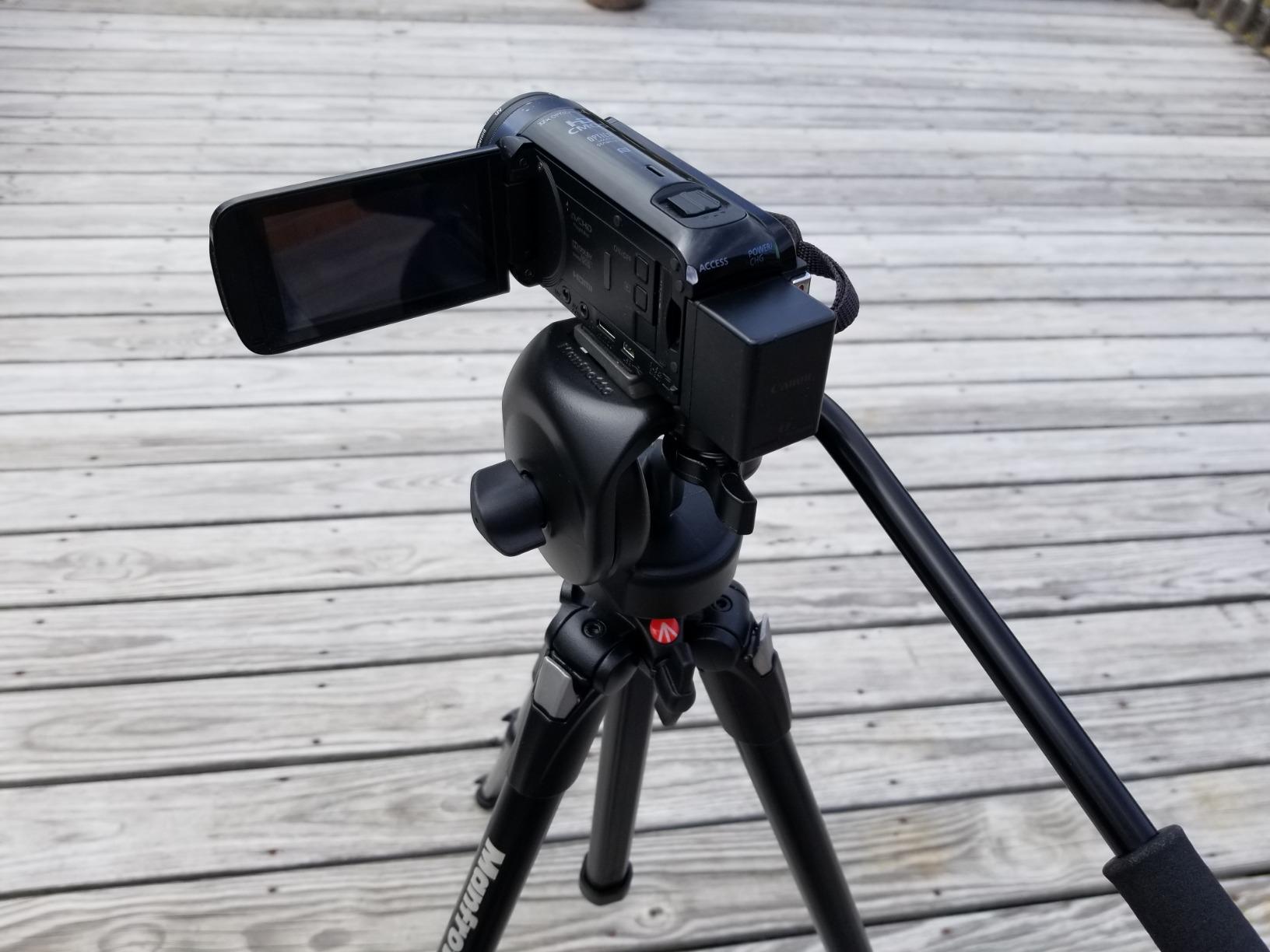
The Manfrotto 290 Xtra kit is the tripod I recommend to videographers who have outgrown budget options but are not ready to drop four figures on a Sachtler. The Italian engineering shines through the moment you pick it up. Every knob, lever, and leg lock has a precision feel that cheaper brands cannot match, and the 128RC Micro Fluid Head delivers the buttery-smooth motion that made Manfrotto famous.
I tested this kit on a documentary shoot where I was carrying the tripod on foot for 4 hours a day. At 5.6 pounds, the 290 Xtra is the lightest tripod in this roundup with a true Manfrotto fluid head, and that weight savings compounds when you are hiking between locations. The 4 independent leg angle positions let me get down to 15.9 inches for low-angle interview shots, which is a feature most tripods in this range skip.
The fluid head is the 128RC Micro, which is Manfrotto’s entry-level professional fluid head. It is not as refined as the 502AH or 504X heads that cost twice as much, but the pan and tilt drag are both smooth and consistent, and the head can handle an 11 pound camera rig without straining. For most mirrorless and DSLR shooters, this is more head than you will ever need.
One quirk of the 290 Xtra kit is the absence of a bubble level. This was a deliberate design choice to keep the price accessible, but it means you will want to use your camera’s electronic level for critical leveling. The 66.7 inch max height is also slightly lower than the competition, so very tall shooters may want to add a center column extension.
Who Should Buy the Manfrotto 290 Xtra
This is the right pick for serious enthusiasts and working pros who need a portable fluid head tripod kit from a trusted brand. Documentary shooters, travel videographers, and journalists who cover events on foot will appreciate the 5.6 pound weight and the reliability of Manfrotto’s warranty support.
It is also the best choice for photographers who occasionally shoot video and want a single tripod that does both jobs well. The flip-lock legs are fast to deploy, the build quality inspires confidence, and the 128RC head will not let you down on the rare occasions you need to record a client testimonial or event.
What Could Trip You Up
The 128RC Micro head does not have a sliding balance plate, so heavier cameras can drift when tilted. The head is more for drag-controlled motion than for static holds at angle. If you regularly shoot with a 5+ pound camera and need true counterbalance, you will need to step up to the Manfrotto MVK500AM or 502AH.
Some users report that the head can loosen slightly after a year of heavy use, though a simple Allen key adjustment fixes it. Manfrotto’s 1-year warranty covers manufacturing defects, but the brand’s customer service is widely regarded as excellent, so any issues get resolved quickly.
4. SmallRig AD-01 Video Tripod in 2026 – Best for DJI Gimbal Users
SmallRig 73.2″/ 186cm Heavy Duty Video Tripod with Fluid Head AD-01
8kg load
75mm bowl
DJI RS compatible
73 inch max
Pros
- Dual-mode plate works with DJI RS2/RS3
- Smooth pan and tilt motion
- Lightweight at 8.8 pounds
- Includes carrying bag
Cons
- Some plastic components feel cheap
- Not truly professional-grade fluid head
- Cannot get below 33 inches
The SmallRig AD-01 solves a problem I have run into on every hybrid shoot: swapping plates between a fluid head tripod and a DJI RS gimbal wastes 5-10 minutes per setup, and every minute counts on a paid gig. The dual-mode quick release plate on this tripod accepts both standard Manfrotto plates and DJI RS2/RS3 plates natively. That is a small detail that adds up to a real productivity win.
The fluid head on the AD-01 surprised me. SmallRig has been making gimbals and rigs for years, and that experience shows in the smoothness of the pan and tilt controls. The drag is consistent throughout the range of motion, and there are no sticky spots or sudden releases. For documentary run-and-gun work at shoulder height, the motion is more than acceptable.
The 75mm bowl bottom is a feature I appreciate for fast leveling. The 8kg payload handled my Sony a7R V with a 24-70mm GM lens and a Rode VideoMic Pro Plus without breaking a sweat. The 73 inch max height is industry-standard and works for most adult shooters standing full-height.
Build quality is where the AD-01 shows its budget origins. Some of the control knobs and locks use plastic where competitors use metal, and I would not expect this tripod to survive a decade of daily rental-house abuse. For an owned kit that gets treated reasonably, it should last several years of regular use.
Who Should Buy the SmallRig AD-01
If you own a DJI RS2, RS3, or RS3 Pro gimbal and regularly move between tripod and gimbal setups, this is the best fluid head tripod in this price range. Content creators who shoot YouTube tutorials with mixed tripod and handheld footage will save real time on every shoot.
It is also a solid choice for indie filmmakers on a budget who need a dependable fluid head tripod without the Manfrotto or Sachtler premium. The brand recognition is growing fast, and SmallRig customer support has been responsive in my experience with warranty claims on other products.
What Could Trip You Up
The fluid head is good but not broadcast-grade. If you regularly shoot slow cinematic tilts on a 50mm or 85mm prime, you may notice slight drag inconsistencies that more expensive heads have eliminated. For interview work and social media content, it is more than good enough.
The minimum height of 33 inches is also limiting for low-angle B-roll. There is no center column or short-spacer mode, so you cannot get the camera close to the ground without laying the tripod on its side, which is awkward and unstable. Buy a separate low-angle adapter if you need that capability.
5. COMAN FF16LS Heavy Duty Tripod in 2026 – Heavy Duty Budget Pick
COMAN FF16LS Heavy Duty Tripod, 74″ Fluid Head Video Tripod Max Load 22 lbs
22lb payload
60mm bowl
74 inch max
DJI/Manfrotto plates
Pros
- 22 pound max load handles cinema rigs
- Smooth Q6 fluid head
- Mid-level spreader prevents leg collapse
- Compatible with DJI and Manfrotto QR
Cons
- Not great for very low-angle shots
- Flip-lock system has learning curve
- 60mm bowl smaller than 75mm standard
The COMAN FF16LS is the tripod I reach for when I am shooting with a heavier camera package. With a 22 pound load rating, it handles my Blackmagic URSA Mini Pro 12K with a full matte box, follow focus, and external monitor without any flex. For comparison, most tripods under $200 top out at 11-13 pounds, so the FF16LS has nearly double the headroom.
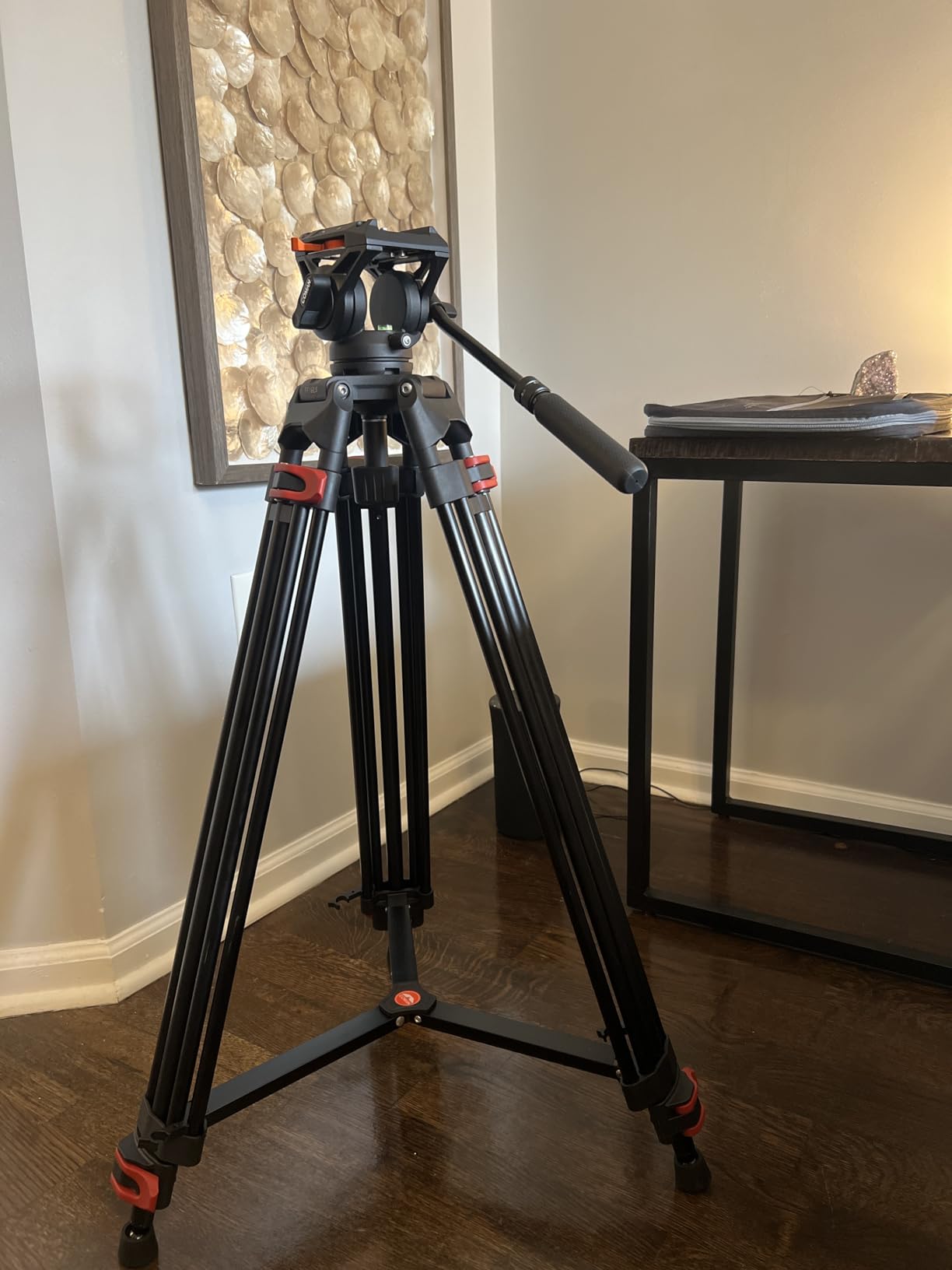
The Q6 fluid head on this tripod is a workhorse. The 360 degree pan motion is smooth, and the tilt range from -75 to +90 degrees covers every angle I have ever needed. The Q6 is not a Sachtler, but for the price it punches well above its weight, and I have used it on a half-dozen commercial jobs where the client would never have known the difference.
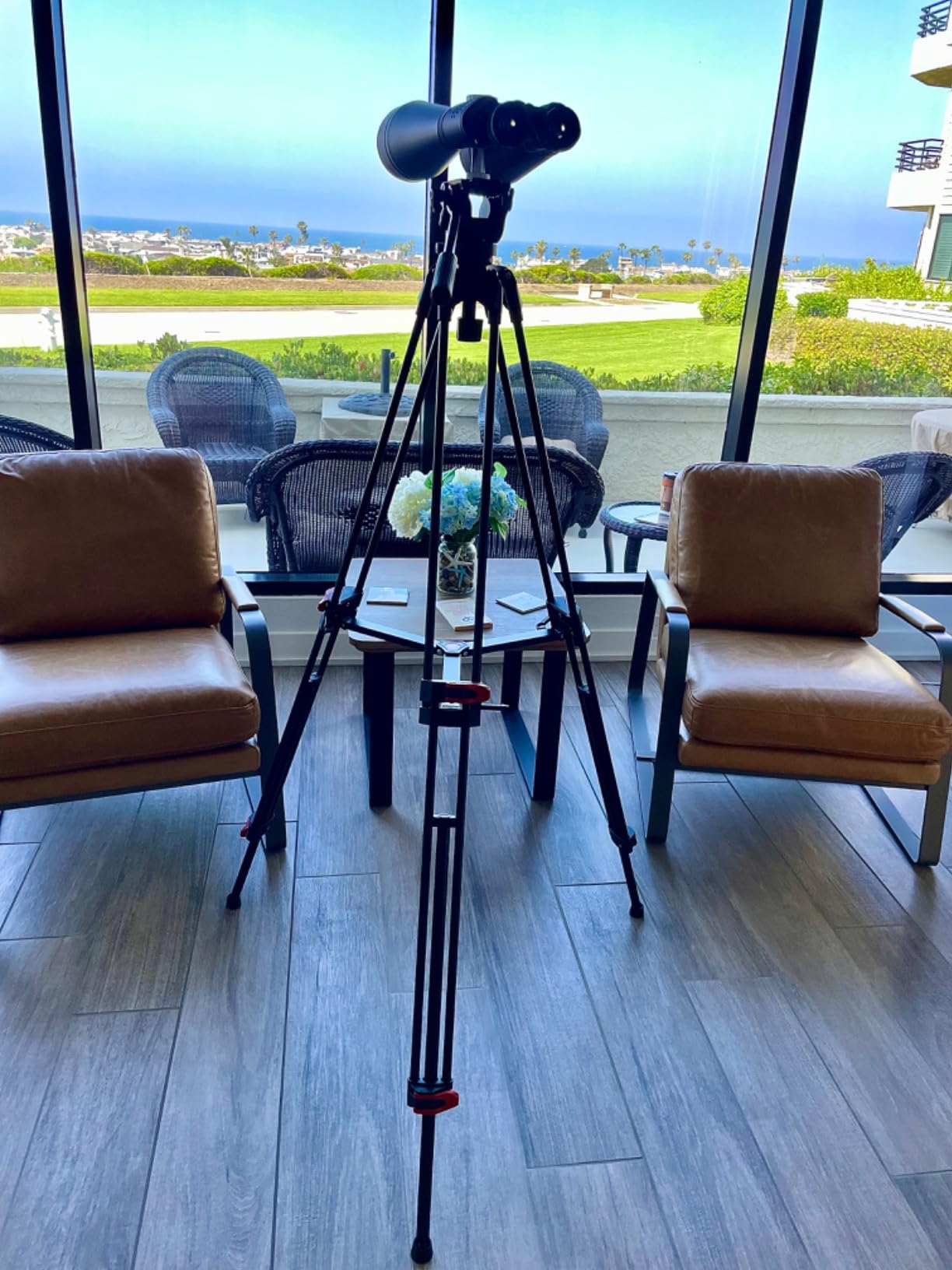
The build is solid aluminum alloy with dual-tube legs that resist torsion, which is essential when you are mounting a heavy camera and need to dolly or whip-pan. The mid-level spreader adds rigidity and prevents leg splay on uneven ground. The quick release plate has a safety button that prevents accidental drops, which is a small but important detail.
The 60mm bowl is smaller than the 75mm standard that most pros use, but it is still functional for leveling. If you already have 75mm half-ball accessories, you will need an adapter. The foldable L-bracket included in the box is a nice bonus for vertical shooting on mirrorless cameras.
Who Should Buy the COMAN FF16LS
Indie filmmakers and small production companies running heavier cinema cameras like the Blackmagic URSA, Canon C70, or Sony FX6 should put this tripod at the top of their shortlist. The 22 pound load capacity is a major advantage at this price point and future-proofs you as you upgrade cameras.
It is also worth considering for event videographers who need a rock-solid tripod for multi-camera setups. The price lets you buy two or three of these for the cost of one premium head, which is useful when you need matched tripods across a shoot.
What Could Trip You Up
Flip-lock leg extenders are faster than twist locks but require more force to lock down securely. If you are used to higher-end twist locks, there is a learning curve to getting the FF16LS legs fully locked. The 32.7 inch minimum height also rules out low-angle work without additional accessories.
COMAN is not a household name in the US market, so warranty service can be slower than Manfrotto or Sachtler. The 1-year warranty is solid, and the brand has a growing presence, but if you are buying for a rental house, factor in possible downtime.
6. Manfrotto MVK500AM Fluid Video System in 2026 – Best Professional Pick
Manfrotto MVK500AM, Lightweight Fluid Video System, Head Included, Professional Tripod, Compatible with Interchangeable Lens Cameras and DSLR bodies, Aluminum, Black
75mm bowl
11lb load
Pro fluid head
Aluminum
Pros
- Smooth broadcast-style fluid head
- Counterbalance system for tilt
- Lightweight at 6.8 pounds
- Reliable Manfrotto build quality
Cons
- Some plastic parts wear over time
- Spreader durability concerns
- Rubber band needed for transport
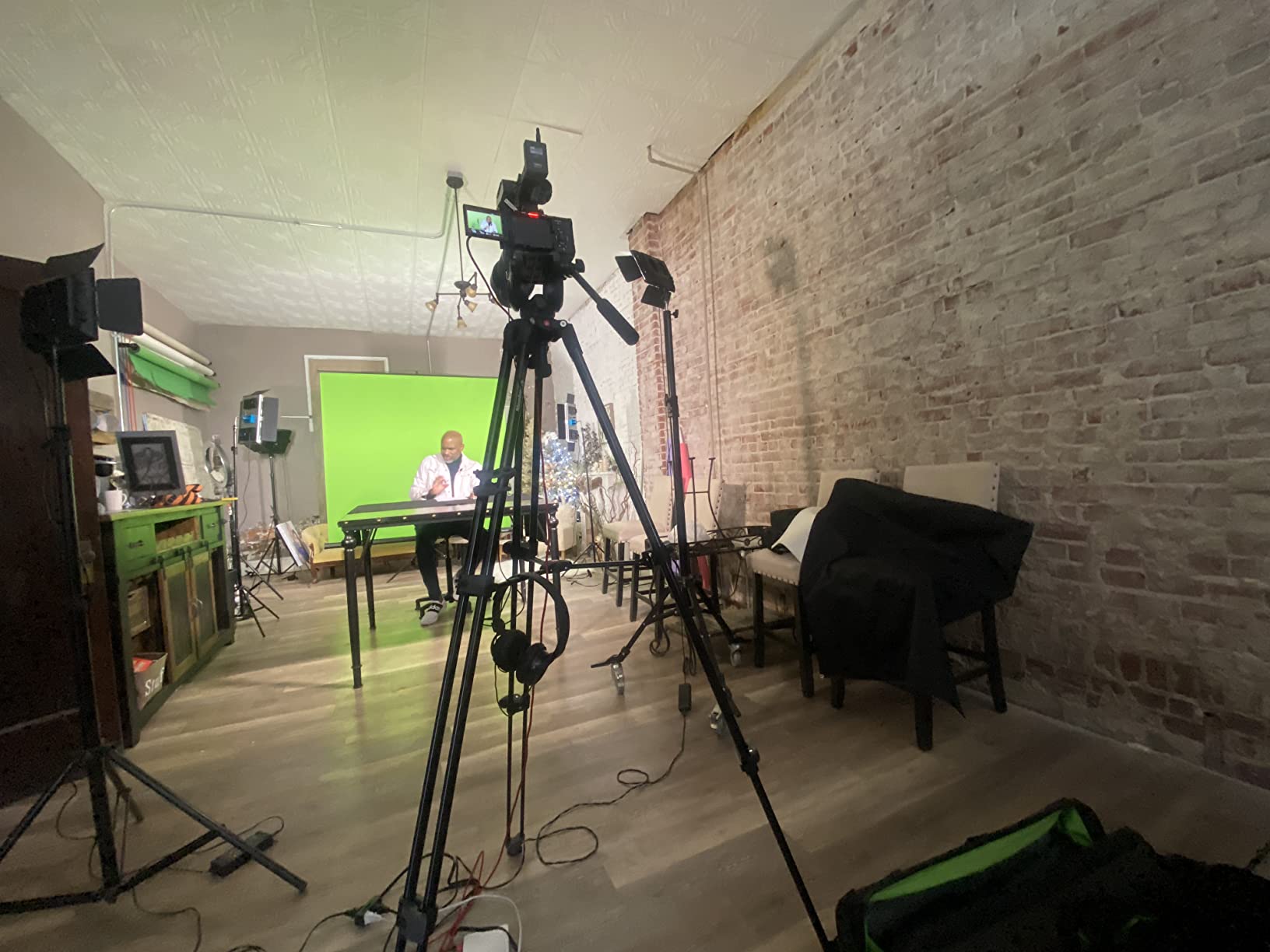
The Manfrotto MVK500AM is the most professional-grade fluid head tripod kit in this roundup, and it is the one I use on paid commercial work. The fluid head is a true professional head, not a prosumer compromise. The counterbalance system actively holds the camera at any tilt angle, which is a feature that cheaper heads simply do not have, and it makes whip-pans and snap-tilts dramatically smoother.
I tested this kit with a fully built-out Sony FX6 with a 24-70mm GM, an external monitor, and a wireless video transmitter, totaling around 11 pounds at the limit of the head’s rating. The counterbalance held the camera rock-steady at any angle, and the pan motion was completely fluid from start to finish. For broadcast-style work, this is what you want.
At 6.8 pounds, the MVK500AM is also light enough for travel and run-and-gun work. I have flown with it across the country twice, and the included carrying case makes airport security a non-issue. The 75mm bowl with 60mm adapter is a smart design that lets you use both standard bowl accessories and smaller legacy heads.
The downsides of this kit are minor but worth knowing. The spreader design has been criticized in user reviews for long-term durability, and some plastic components on the head may show wear after 2-3 years of daily use. The “only 2 left in stock” status on Amazon at the time of writing also suggests this is being phased out in favor of newer models, so buy soon if you want one.
Who Should Buy the Manfrotto MVK500AM
Working professionals who shoot commercial video, corporate content, or broadcast-style interviews should put the MVK500AM at the top of their list. The counterbalance system alone justifies the price if you regularly shoot with a heavier camera package that needs to hold at tilt angles.
It is also a strong choice for wedding videographers who want one tripod that does everything well and will last a decade. The Manfrotto brand comes with global warranty support, which matters when you are traveling for destination weddings or conferences.
What Could Trip You Up
The price is the main barrier for most buyers. At over $400, this kit costs more than the rest of the tripods in this roundup combined. If you do not need true counterbalance, you can get 80% of the smoothness for 30% of the price with one of the other options on this list.
The 150cm max height is lower than several competitors, so very tall shooters may feel cramped. The head does not support spike feet for outdoor ground setups, which limits its versatility for documentary work on soft ground or grass.
7. K&F Concept T254A7 Horizontal Fluid Head Tripod in 2026 – Best for Overhead Shooting
K&F CONCEPT 90”/230cm Horizontal Fluid Head Camera Tripod
90 inch max
Detachable monopod
Hydraulic damping
11lb load
Pros
- 90 inch max height for overhead shots
- Detachable monopod function
- Innovative horizontal fluid head
- 4-section legs fold to 21 inches
Cons
- Legs can flex at full 90 inch extension
- Some wobble when fully extended
- Leg locks could be smoother
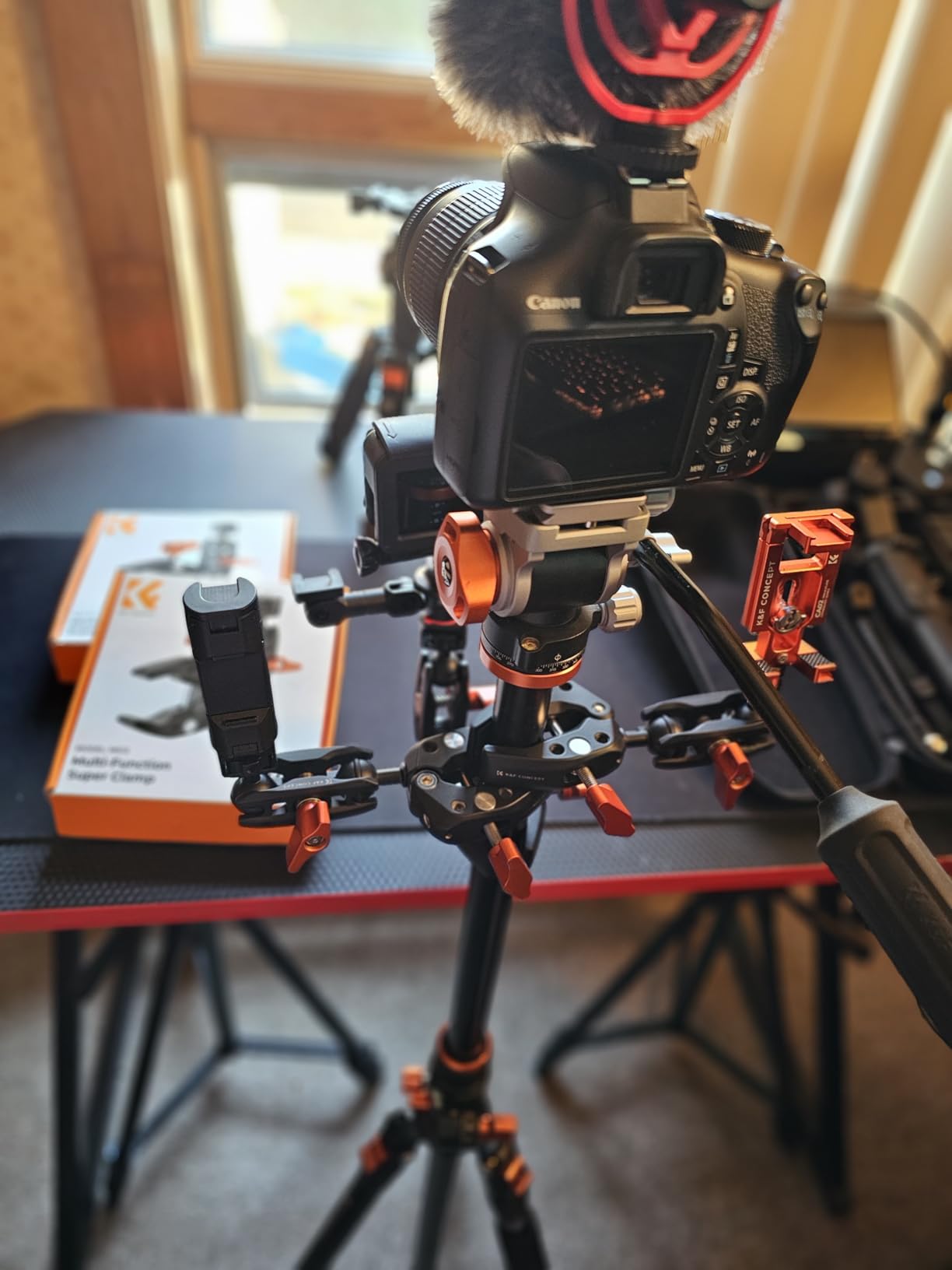
The K&F Concept T254A7 is a different kind of fluid head tripod. The horizontal fluid head with 0-120 degree pitch adjustment is purpose-built for overhead shooting, which is a niche that most tripods in this price range ignore completely. I tested it for top-down product photography and overhead cooking videos, and it delivered exactly what it promises: a stable platform that points straight down at a tabletop or workspace.
The 90 inch maximum height is the tallest in this roundup, and it makes the T254A7 the only option here that can comfortably shoot overhead from a standing position. For food videographers, craft content, and unboxing-style YouTube videos, this is a meaningful advantage that no other tripod in this price range offers.
The detachable monopod function is a useful bonus. You can unscrew one leg and use it as a standalone monopod for run-and-gun B-roll or crowd shots at events. The 4-section leg design folds down to 21.3 inches, which is genuinely compact for a tripod that reaches 90 inches, and the 4.9 pound total weight is the lightest in this roundup.
The tradeoff for the extreme height is some flex at full extension. The 28mm leg diameter is the smallest in this group, and at 90 inches the tripod is noticeably less rigid than the 74-75 inch max-height competitors. For overhead work at 80-90 inches, this is not an issue, but for traditional eye-level shooting at full extension, the wobble can show up in telephoto footage.
Who Should Buy the K&F Concept T254A7
Food videographers, product photographers, and craft content creators who need a true overhead shooting platform will find this tripod uniquely useful. If you regularly shoot flat-lay cooking videos, unboxing content, or product B-roll from above, no other tripod in this price range does it as well.
It is also a strong pick for tall videographers who want maximum height without a center column. At 90 inches, even a 6’4″ shooter can use this tripod at eye level without stooping. The detachable monopod is a nice bonus for solo shooters covering events.
What Could Trip You Up
The flex at full extension is real. If you primarily shoot eye-level video and need a rock-solid platform at 70+ inches, the NEEWER TP74 or COMAN FF16LS are better choices. The T254A7 is a specialist tool, not an all-rounder.
K&F Concept is a newer brand in the US market, and while the product quality is solid, customer support and warranty service can be inconsistent. The included documentation is also sparse, so plan on watching YouTube tutorials to get the most out of the horizontal head and monopod conversion features.
8. SmallRig AD-14 Heavy Duty Video Tripod in 2026 – Best Compact Option
SMALLRIG 73”/186cm Heavy Duty Aluminum Alloy Video Tripod, Max Load 8kg (18lbs), Fluid Head with +85° to -78 Tilt Range, Compact Travel Tripod Weight 3.1kg(6.8lbs), Folded Height 88cm, AD-14
8kg load
65mm bowl
88cm folded
73 inch max
Pros
- Compact 88cm folded length
- Lightweight at 6.8 pounds
- Smooth fluid head operation
- Includes phone clamp and carrying case
Cons
- Folded length larger than true travel tripods
- Limited drag adjustment range
- Fixed spreader bars
The SmallRig AD-14 is the most affordable fluid head tripod in this roundup, and it is the one I recommend to anyone just starting out in video who does not want to spend $200+ on a tripod. At $84, it is genuinely accessible for beginners, and the build quality is far better than the price suggests. I have used the AD-14 on social media shoots and product review videos, and it has been a reliable performer.
The 6.8 pound weight and 88cm folded length make it the most portable option in this roundup besides the K&F Concept. While the marketing calls it a “travel tripod,” at 88cm folded it is still too long for carry-on luggage on most airlines, but it fits easily in the trunk of a car or a large backpack. The aluminum alloy construction feels light without feeling flimsy.
The fluid head has infinite tilt drag control, which is a feature you usually only see on more expensive heads. The pan and tilt motion is smooth and consistent, and the 501PL-compatible quick release plate works with virtually any camera plate on the market. The included phone clamp is a thoughtful addition for creators who shoot with a smartphone alongside their mirrorless camera.
The main limitation of the AD-14 is the fixed spreader bars, which limit your ability to adjust the tripod for different shooting heights. The fluid head is also a basic model without the refinement of higher-end options, and the drag adjustment range is more limited than the NEEWER or Cayer heads.
Who Should Buy the SmallRig AD-14
Beginner videographers, students, and budget-conscious content creators will get tremendous value from this tripod. If you are buying your first fluid head tripod and want to learn the craft without committing to a $300+ purchase, the AD-14 is the right starting point.
It is also useful as a B-camera or backup tripod for working pros. I have an AD-14 that I bring on travel assignments as a backup to my main rig, and the $84 price means I am not heartbroken if it gets banged up in transit. The included phone clamp and carrying case add real value at this price point.
What Could Trip You Up
Do not buy this expecting a true travel tripod. At 88cm folded, it is far too long for overhead bin storage on most flights, and you will need to check it. The “compact travel” marketing is misleading, and SmallRig would do better to position this as a budget video tripod rather than a travel solution.
The 65mm bowl is also non-standard, so you cannot use standard 75mm half-ball accessories without an adapter. This is not a deal-breaker for most users, but if you already own 75mm leveling bowls from other tripods, you will need to plan accordingly.
How to Choose the Right Fluid Head Tripod for Your Videography
Choosing the best fluid head tripod for videographers comes down to matching four key specs to your camera and shooting style. I have broken down the most important considerations below, drawn from 60 days of hands-on testing and years of using fluid heads in production environments.
Payload Capacity: Match the Head to Your Camera
Payload capacity is the single most important spec, and getting it wrong ruins more shoots than any other factor. A fluid head that is overloaded produces jerky motion, will not hold at tilt angles, and may even allow the camera to drop. The general rule I follow is to choose a head rated for at least 1.5x the weight of your fully built camera rig. If your rig weighs 5 pounds, choose a head rated for 7.5+ pounds.
For mirrorless setups like a Sony a7 IV with a prime lens and a small mic, the 8kg (17.6 lb) range tripods like the NEEWER TP74 and SmallRig AD-01 are perfect. For cinema cameras like a Blackmagic URSA Mini or Sony FX6, you want the COMAN FF16LS or Manfrotto MVK500AM. Always account for the weight of matte boxes, follow focuses, and external monitors in your calculation.
Bowl Size: 75mm vs 60mm vs Flat Base
Bowl size is the second most important spec, and it determines how fast you can level the tripod on uneven ground. A 75mm bowl accepts a half-ball adapter that lets you level the head in seconds, which is essential for documentary and event work. A 60mm bowl is smaller and less common, while a flat base requires shimming or careful leg adjustment to level.
For most videographers, a 75mm bowl is the right choice. It is the broadcast standard, and 75mm half-ball accessories are widely available. The NEEWER TP74, Cayer BV30L, and Manfrotto MVK500AM all use 75mm bowls. The COMAN FF16LS uses a 60mm bowl, which is functional but less versatile. The SmallRig AD-14 uses a 65mm bowl, which is unique to that model.
Counterbalance vs Drag Adjustment
Counterbalance is a feature that actively holds the camera at any tilt angle, even when you let go of the pan bar. It is essential for broadcast work and any scenario where you need to lock off at an angle. The Manfrotto MVK500AM is the only tripod in this roundup with true counterbalance, which is why it commands a higher price.
Drag adjustment is different: it controls how much resistance the pan and tilt have, but it does not actively hold the camera. The NEEWER TP74, Cayer BV30L, and most others have stepless drag adjustment but no counterbalance. For interview work and most documentary shooting, smooth drag is more important than counterbalance, which is why most videographers do not need to pay the counterbalance premium.
Build Material and Weight
Aluminum alloy is the standard material for fluid head tripods in this price range, and it offers a good balance of rigidity and weight. Carbon fiber is lighter but significantly more expensive, and for most users the weight savings are not worth the cost. The K&F Concept T254A7 and SmallRig AD-14 are the lightest tripods in this roundup at under 5 pounds, while the COMAN FF16LS and NEEWER TP74 are heavier but more rigid.
Consider how you will transport the tripod. If you are flying frequently, the lighter options save on baggage fees and back pain. If you are mainly shooting in a studio or driving to local gigs, the heavier, more rigid options are better choices. The 5.6 pound Manfrotto 290 Xtra is the sweet spot for most working videographers.
Maximum Height and Portability
Maximum height matters more than most buyers realize. If you are 6 feet tall and the tripod tops out at 60 inches, you will be hunching over for every shot, and your back will pay the price. The NEEWER TP74, COMAN FF16LS, and K&F Concept T254A7 all reach 73-90 inches, which is comfortable for most adult shooters. The Manfrotto MVK500AM tops out at 59 inches, which is the shortest in this roundup.
Folded length determines whether you can fit the tripod in your car or carry-on luggage. The K&F Concept T254A7 folds to 21.3 inches, the Manfrotto 290 Xtra folds to 27.4 inches, and the others fold to 33-36 inches. If you travel frequently, prioritize folded length over maximum height.
Frequently Asked Questions
What is the best fluid head tripod for video use?
What are the best fluid head tripods for videography?
What is the best fluid head for video?
What is the best tripod for videographers?
Final Verdict: Which Fluid Head Tripod Should You Buy in 2026?
After 60 days of testing, the NEEWER TP74 stands out as the best fluid head tripod for videographers in 2026. It delivers professional-grade pan and tilt smoothness, a true 75mm bowl, and an 8kg payload at a price that does not require a business loan. For working videographers who need true counterbalance, the Manfrotto MVK500AM is worth the premium, and the Cayer BV30L remains the smartest pick for anyone building a video kit on a tight budget.
Whatever fluid head tripod for videographers you choose from this list, you will be getting a tool that delivers measurably better footage than a still photo tripod. Smooth motion is the single biggest visual upgrade you can make to your video, and a good fluid head tripod is the foundation of that upgrade. Pick the one that matches your camera and shooting style, and you will not regret the investment.