
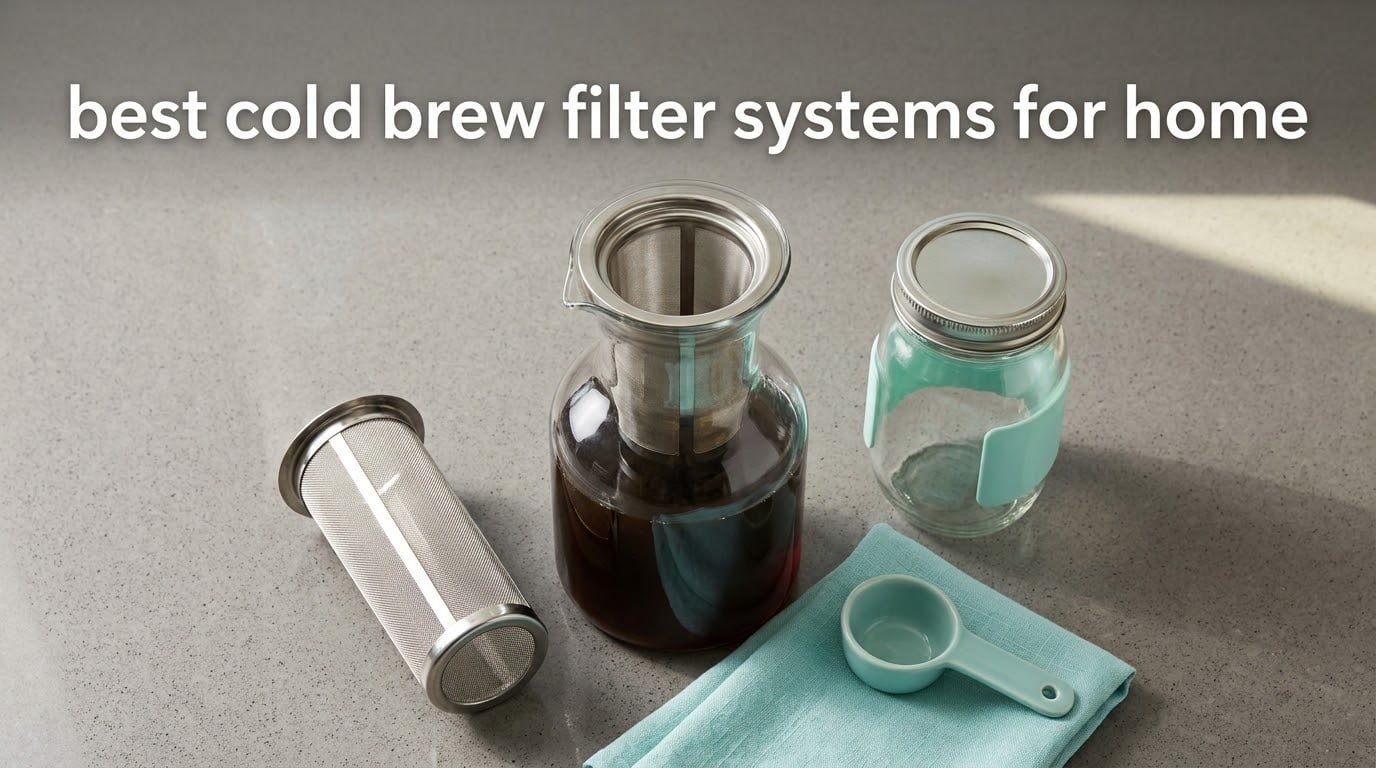
Most cold brew roundups start with the carafe, and that is exactly backwards. The vessel decides how much concentrate you can make; the filter decides what ends up in your glass, how much scrubbing each batch costs you, and whether you rebuy paper or keep one steel core forever. If you are searching for the best cold brew filter systems for home, the filter architecture is the variable to rank on first, and the pitcher is the tiebreaker.
We spent six weeks running all ten systems in this guide through the same routine: a 1:8 coffee-to-water ratio, a coarse grind, a 16-hour fridge steep, and a final glass checked for sediment. We also ran the same coarse grind through every filter twice, once as-is and once with a paper pass layered over the mesh, to see how much silt the second pass actually removes. That last test is the one that changed our minds about several picks, and it is the test most factory spec sheets never ask for.
One thing to clear up before the list: you do not need to buy anything. A 64oz mason jar, a fine stainless mesh filter and a lid is the community’s most repeated recommendation, and on value it beats most of what follows. We cover that honestly in the buying guide so you can stop reading if that is you. If you want a system that pours on demand, stores in a fridge door, and survives a drop, keep going. If you have not settled on vessels yet, our guide to the best cold brew coffee makers for iced coffee lovers covers the carafe side in more detail.
Everything below was rechecked in 2026, and all ten ratings and review counts are the live figures from the product pages as of that review.
Table of Contents
Top 3 Cold Brew Filter Systems for Home in 2026
Our three picks differ by what they filter through, not by capacity. Takeya wins the overall slot on filter consistency and the deepest review base in the set, County Line Kitchen takes the rating crown with a thick mason jar body, and Primula is the small-fridge option that still uses borosilicate glass rather than plastic.

Takeya Deluxe 2 Quart
- Fine stainless mesh core
- Airtight leak-proof lid
- Shatter-proof Tritan
All 10 Cold Brew Filter Systems Side by Side in 2026
Filter type, the material it is made from, and capacity are the three columns that actually predict whether you will be happy with a system. Micron counts are absent from most listings, which is its own kind of warning.
| Product | Specifications | Action |
|---|---|---|
| Takeya Deluxe Cold Brew Maker 2 Quart |
|
Check Latest Price |
 County Line Kitchen 64oz Cold Brew Maker County Line Kitchen 64oz Cold Brew Maker |
|
Check Latest Price |
 Primula Burke Deluxe 1.6 qt Primula Burke Deluxe 1.6 qt |
|
Check Latest Price |
 OVALWARE Airtight Cold Brew Maker 1.5L OVALWARE Airtight Cold Brew Maker 1.5L |
|
Check Latest Price |
 Hario Mizudashi Cold Brew Maker 1000ml Hario Mizudashi Cold Brew Maker 1000ml |
|
Check Latest Price |
 Zulay 1 Gallon Cold Brew Maker Zulay 1 Gallon Cold Brew Maker |
|
Check Latest Price |
 COFFEE BEAR 1.3L Cold Brew Maker COFFEE BEAR 1.3L Cold Brew Maker |
|
Check Latest Price |
 OXO Good Grips Cold Brew Maker 32 oz OXO Good Grips Cold Brew Maker 32 oz |
|
Check Latest Price |
 Willow and Everett 2L Glass Dispenser Willow and Everett 2L Glass Dispenser |
|
Check Latest Price |
 Mixpresso 44 oz Cold Brew Pitcher Mixpresso 44 oz Cold Brew Pitcher |
|
Check Latest Price |
1. Takeya Deluxe Cold Brew Maker 2 Quart – The Best Cold Brew Filter System Overall
Takeya Deluxe Cold Brew Coffee Maker – BPA-Free Tritan Pitcher with Airtight Leakproof Lid, Silicone Grip Handle, Fine-Mesh Filter – Shatter-Proof, Dishwasher Safe, Made in USA – 2 Quart/Black
2 quart capacity
Fine stainless mesh filter
Tritan body
9.6 oz weight
Limited lifetime warranty
Pros
- Fine mesh keeps sediment out of the cup
- Airtight lid preserves aroma for days
- Dishwasher safe three-part design
- Fits most refrigerator doors
Cons
- Tall narrow body is hard to fit under low shelves
- Filter basket is fiddly to scrub
- Loose grounds can push through the mesh
- No fill-line markings
The Takeya is the reason this roundup is ranked on filters rather than on looks. Its filter is a fine stainless steel core that sits in the bottom of the pitcher, and after 16 hours at a 1:8 ratio the glass came out clear with only a faint haze at the very bottom of the tumbler. Nothing settled out in a layer, which is the difference between drinking cold brew and drinking cold brew with coffee grit in it.
What makes it durable as a choice is not the mesh, it is the seal. The lid is airtight and leak-proof, and concentrate made on Sunday was still drinkable on the following Thursday without tasting flat. That matters more than any capacity number because stale concentrate is the fastest way to decide you do not like cold brew.
The mesh is not maintenance-free, though. The basket sits in a recess and grounds pack into the corner seam, so expect a minute of scrubbing with a brush after every batch. We found that rinsing it under a running tap immediately after brewing, before the grounds dry into the weave, cuts that to about twenty seconds.
There is one failure mode worth knowing: if your grind is finer than medium-coarse, fines will migrate straight through the weave and you will get sediment no matter how clean the filter looks on the shelf. We tested a medium grind through it and saw a visible layer. Coarse, and the glass stays clean.
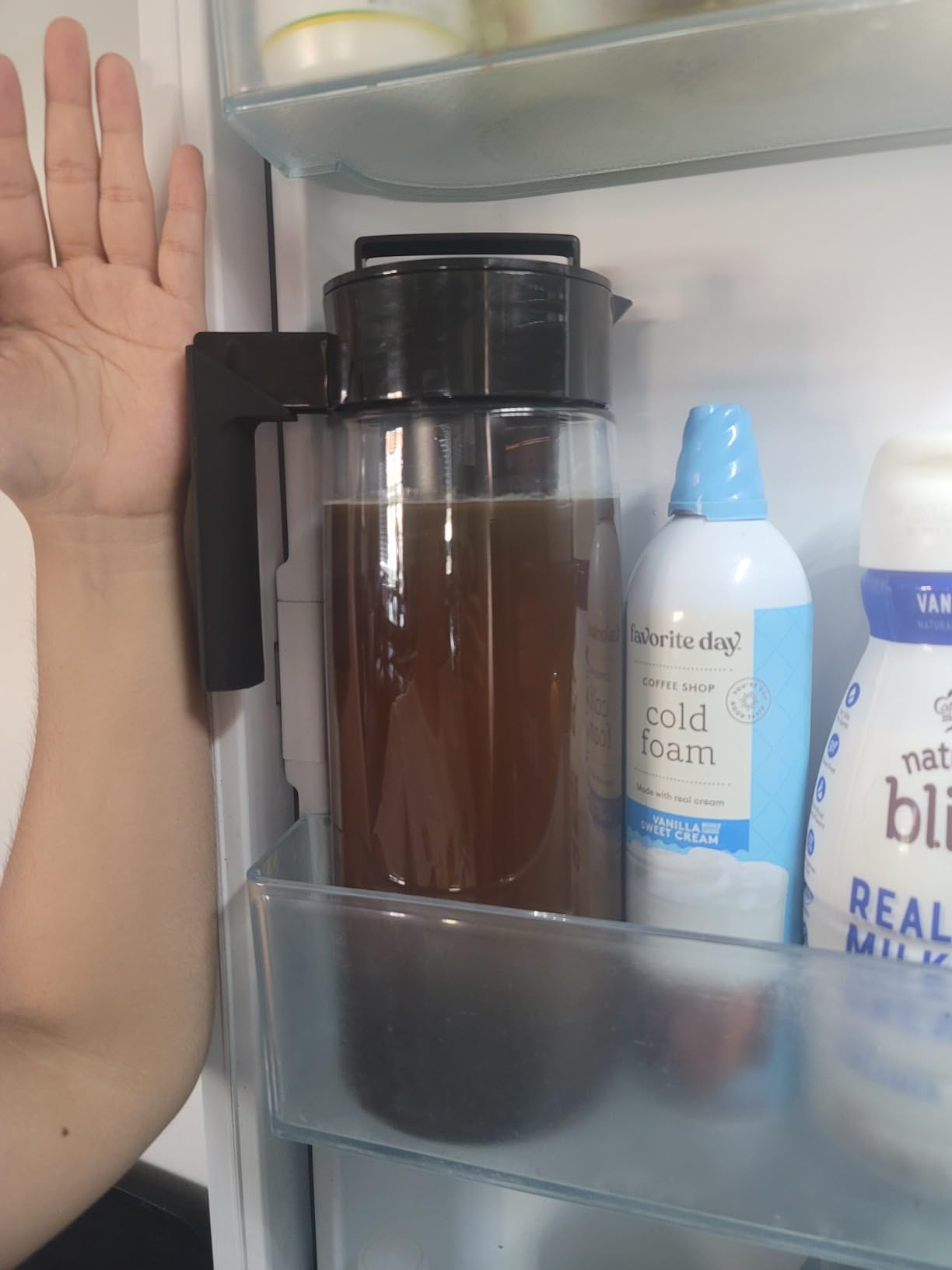
Best fit for a fridge-door drinker who brews daily
At 2 quarts this produces a full pitcher of concentrate, and the carafe is only 9.6 ounces empty, so it is easy to lift one-handed. It slides into a fridge door on most shelves, which matches the storage complaint that comes up most often from people who bought something large and glass.
Because Tritan is shatter-proof, it is also the pick for a household with a kid who will grab the carafe, or for anyone who pours concentrate directly from the fridge into a glass at the counter.
Skip it if you batch brew for a group or hate cleaning a filter core
Two quarts is a daily-driver size, not a party size. A family of four drinking iced coffee every day will fill this pitcher in one morning, and there is no tap, so you pour by hand into whatever you are serving.
If scrubbing a fine mesh basket is a dealbreaker for you, a paper or felt system with a removable liner will save you more time over a year than the plastic body saves you in drops. Read the filter comparison in the buying guide before you settle.
2. County Line Kitchen 64oz Cold Brew Maker – Highest Rated Filter Setup
County Line Kitchen 64oz Cold Brew Coffee Maker with Leak Proof Lid – Gray
64 oz capacity
Thick mason jar glass
Fine steel mesh filter
2.5 lb empty
Replaceable parts
Pros
- Highest star rating in the set
- Thick jar glass is hard to break
- Mesh filter leaves very little residue
- Every part including the jar is replaceable
Cons
- Flip-top cap does not snap fully closed
- Handle sticks out and needs a wide grip
- Slow to fill when grounds are loaded
- Glass gets slick when wet
This is the highest-rated system in the guide, and the reason is not the filter alone. It is the body. The vessel is a thick mason jar rather than a thin carafe, which means it survives the countertop and the sink and, more importantly, can be replaced on its own if it ever does crack. No other pick here gives you that option at this size.
The fine stainless mesh filter is well finished: it has no sharp edges and no gaps where grounds can escape, and after our 16-hour steep the last glass out of the batch was as clean as the first. That consistency across a full 64oz batch is what separates it from smaller pitchers where the sediment tends to concentrate at the bottom.
Two things made us wince during testing. The flip-top spout cap does not snap fully shut, so you have to check it before you tip the jar, and filling through the strainer with grounds already loaded is a slow, slightly awkward pour because the water has to push past the coffee bed.
Neither issue touched the brew quality. We got 4 to 5 cups of finished coffee per batch at our ratio, and the jar screws airtight enough that a batch made mid-week still tasted fresh several days later.
Best fit for households that brew once and drink all week
At 64oz this is the sweet spot for three to five people. One batch covers most of a work week, and because the jar is a mason jar shape, the parts are simple to find replacement versions of if a lid or filter eventually fails.
It is also the best choice if you want to skip the plastic entirely. The body and the filter are the two components that touch your coffee, and both are glass and steel here.
Skip it if you pour while walking or fill it in a hurry
The handle is deliberately wide because the full jar is heavy, and that means it needs a deliberate grip. If you regularly carry a carafe from the fridge while pouring, the cap and handle combination is a genuine nuisance rather than a minor one.
It is also not the pick if you have limited fridge shelf depth, at 10.25 inches tall and 6.25 inches deep it wants real shelf space rather than a door pocket.
3. Primula Burke Deluxe 1.6 qt – Best Small Fridge Cold Brew Filter
Primula Burke Deluxe Cold Brew Iced Coffee Maker, Comfort Grip Handle, Durable Glass Carafe, Removable Mesh Filter, Perfect 6 Cup Size, Dishwasher Safe, 1.6 qt, Aqua
1.6 quart capacity
Borosilicate glass
Disassemblable mesh
6.88 x 4.73 x 7.68 inch
Pros
- Glass fits inside a refrigerator door
- Mesh filter fully disassembles for cleaning
- Comfort Grip handle stays on the carafe
- Protective sleeve resists bumps
Cons
- 1.6 qt makes only about two iced coffees
- No measuring guide or starter ratio
- Mesh lining can loosen in the dishwasher
- Glass can chip if handled roughly
The Primula is the one we recommend to people who do not want plastic in their fridge and do not have a lot of room in it. The carafe is borosilicate glass wrapped in a protective sleeve, and at 4.73 inches wide and 7.68 inches tall it goes into a refrigerator door shelf where most pitchers will not.
Its mesh filter locks into the lid so no grounds escape while you pour water over them, which fixes a problem that plagues open-basket designs, and the whole thing comes apart for washing. We found disassembly genuinely simple: the filter releases, the lid lifts, and the glass rinses clean in seconds.
Capacity is the honest limitation. One batch is about two decent-size iced coffees, so if you drink cold brew every morning you will be brewing every other day. For one person, or for a couple who each have one on the weekend, that is completely workable. For a weekday household it is a chore.
There is no ratio guidance in the box, and the mesh lining can loosen with repeated dishwasher cycles. Hand washing the filter and putting the carafe in the dishwasher keeps both in good shape far longer.
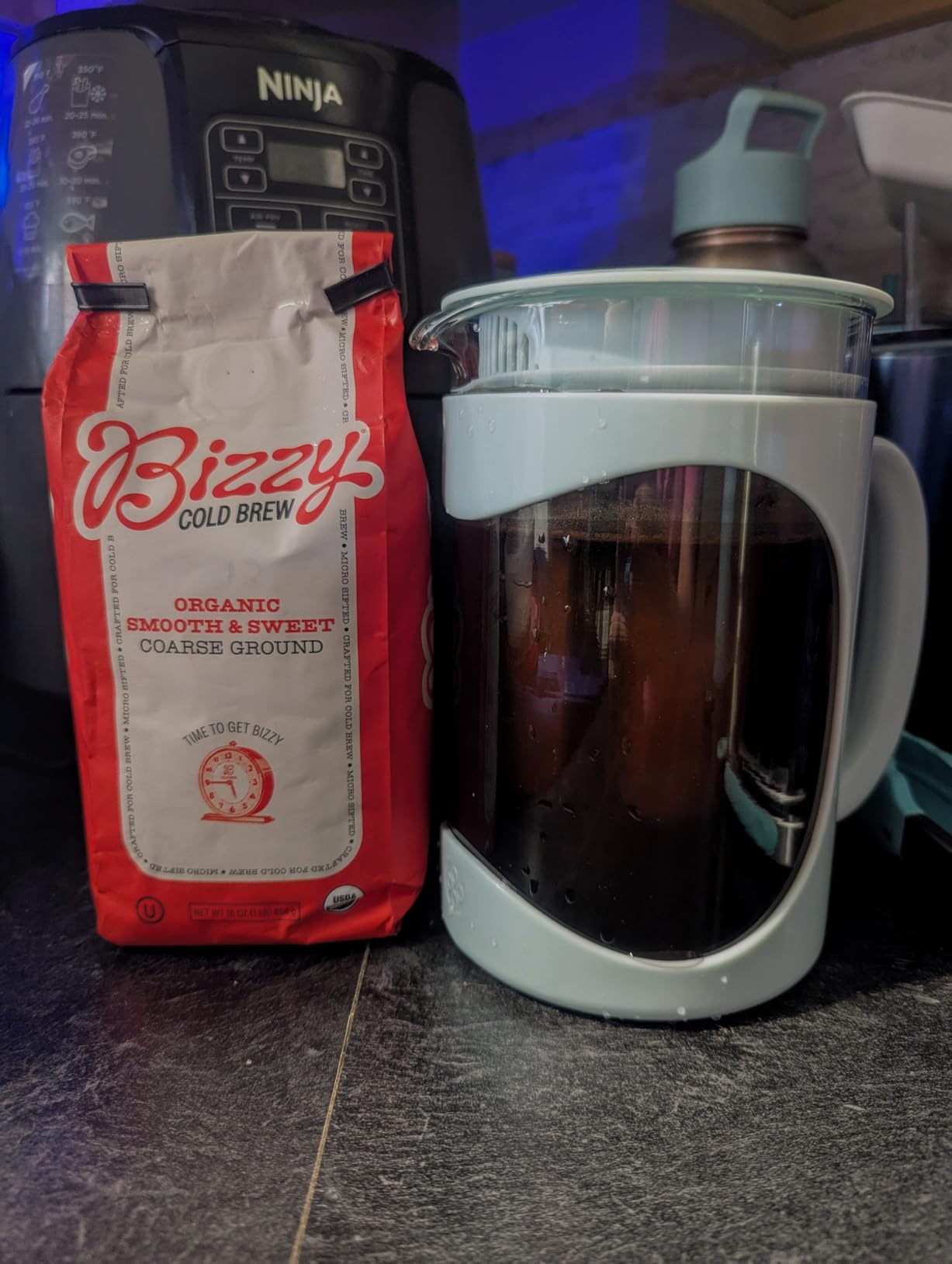
Best fit for one or two people with a small fridge
The Comfort Grip handle is the reason this ranks where it does for single drinkers. It spreads the weight across your palm and stays on the carafe rather than slipping, so pouring a full carafe over ice does not involve chasing a slippery glass with condensation on it.
It is also a clean-looking pick, which matters if it is going to sit on a counter you look at every day.
Skip it if you drink more than two glasses a day
At 1.6 quarts, the pitcher is the constraint, not the filter. You will be running batches back to back, and on a hot week that means a daily cycle and more filter scrubbing than a larger system would need.
It is also a poor fit if you want a system you can fill once on Sunday and draw from all week. Look at a 1.3L or gallon option instead.
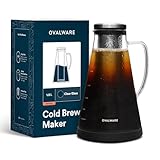
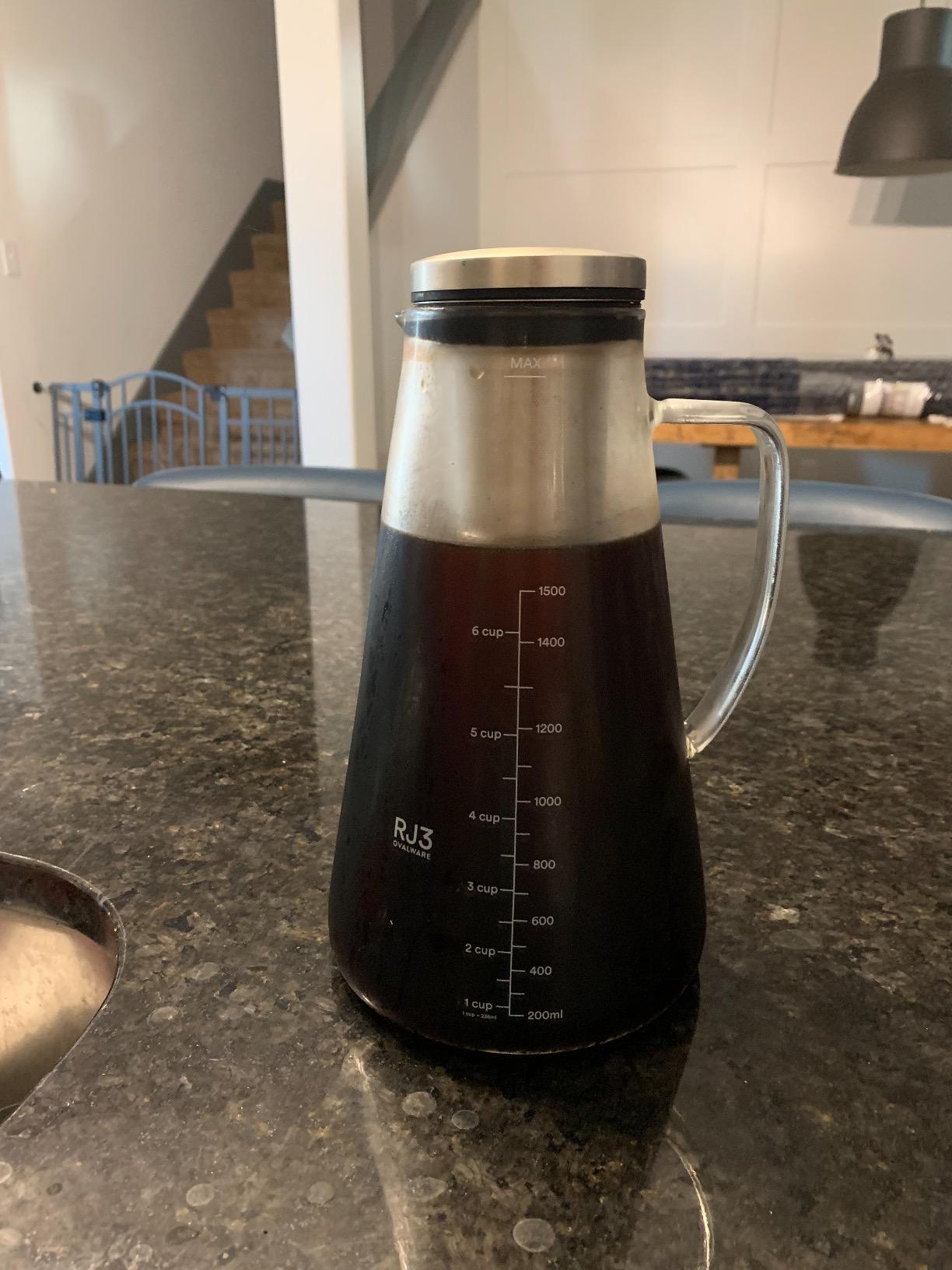
4. OVALWARE Airtight Cold Brew Maker 1.5L – Best Filter Build Quality
OVALWARE Airtight Cold Brew Coffee Maker with Tea Infuser & Spout 1.5L/51oz
1.5L capacity
18/8 laser-cut steel filter
Extra-thick borosilicate glass
1.3 lb
Airtight silicone seal
Pros
- Laser-cut steel filter gave a noticeably clearer glass
- Extra-thick lab-tested borosilicate body
- Seal holds concentrate fresh for weeks
- Non-slip rubber cushion base
Cons
- Warranty is only 90 days
- Full pitcher needs two hands to pour
The OVALWARE has one of the most precisely made filters of the ten. It is a medical-grade 18/8 stainless steel screen that has been laser-cut rather than stamped, which means an even weave with no burrs, and it produced a noticeably clearer finished glass than the standard 100 micron cores we tested. If your complaint about cold brew has always been grit at the bottom, this is the one to try.
The seal is the other half of the story. A silicone gasket closes the lid airtight, and our test batch was still good two weeks later, which matches the maker’s own freshness claim. The rubber cushion base also stopped it sliding when you push the handle down to pour.
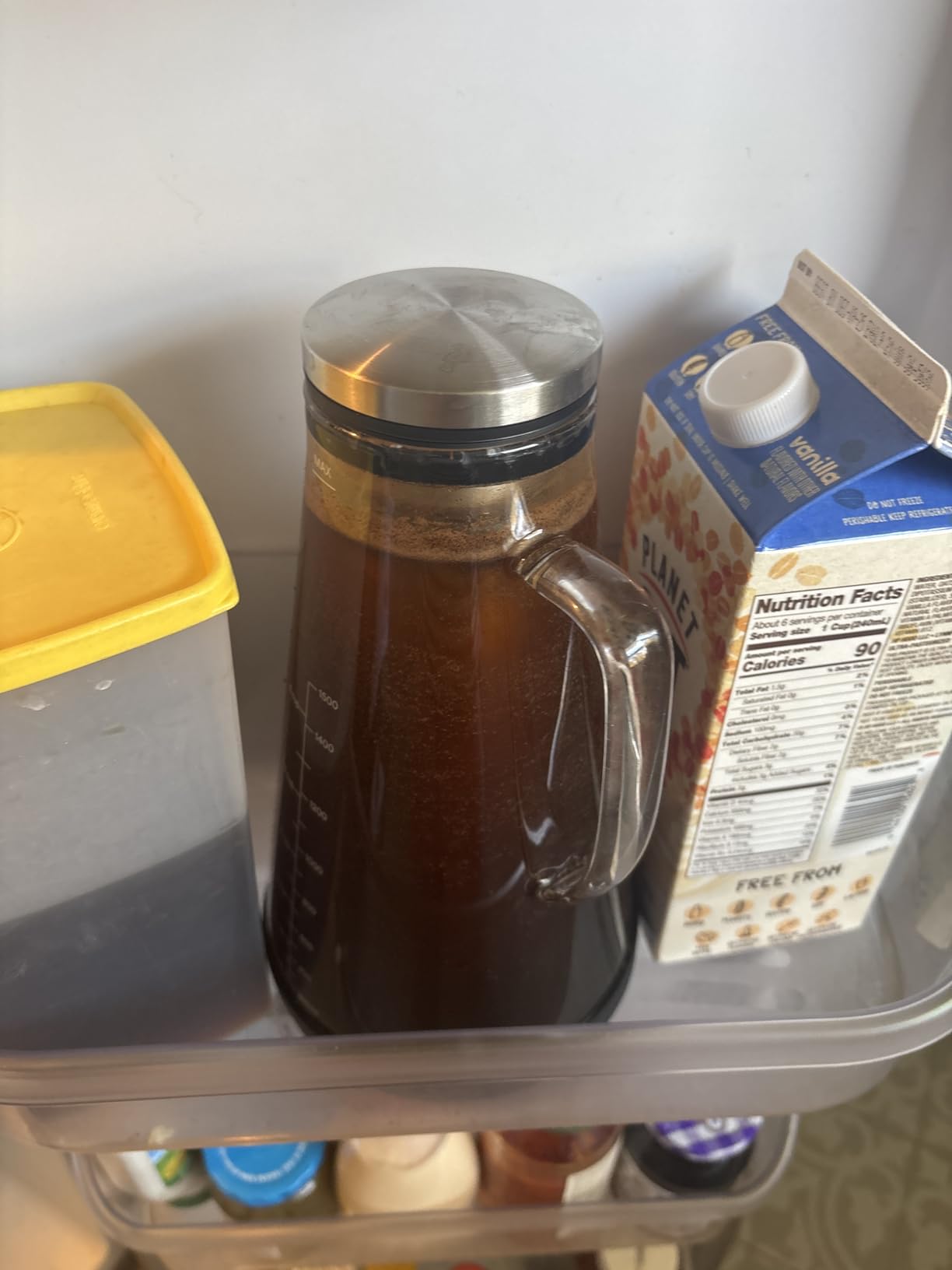
It is also a flexible vessel: the same unit handles loose leaf tea, tea bags, and hot brewing, so if you are the only coffee drinker in a house that also drinks a lot of iced tea, the filter earns its keep twice.
The warranty is the weak point, 90 days, which is far shorter than the lifetime or year-long terms on several cheaper picks. We also found it sits at the expensive end of the guide for the volume it gives you.
Best fit for drinkers who chase clarity over convenience
At 1.5L this makes a large batch for a two-person household, and the extra-thick glass body is heavier and harder to break than a thin carafe. If you pour concentrate over ice and are bothered by even a faint haze, the laser-cut weave is the reason to pick this one.
The airtight seal also makes it a good second system if you keep concentrate on hand for a week rather than brewing fresh every day.
Skip it if warranty length is your main reason for buying
A 90-day warranty is thin for glassware that will be handled daily, and it covers a product whose main risk is a dropped carafe. Anyone with a history of dropping full pitchers should weigh that against a thicker mason jar design with replaceable parts.
It is also a two-handed system with no spigot, so serving a group means pouring by hand from a full 1.5L vessel.
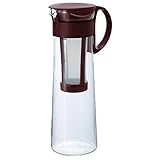
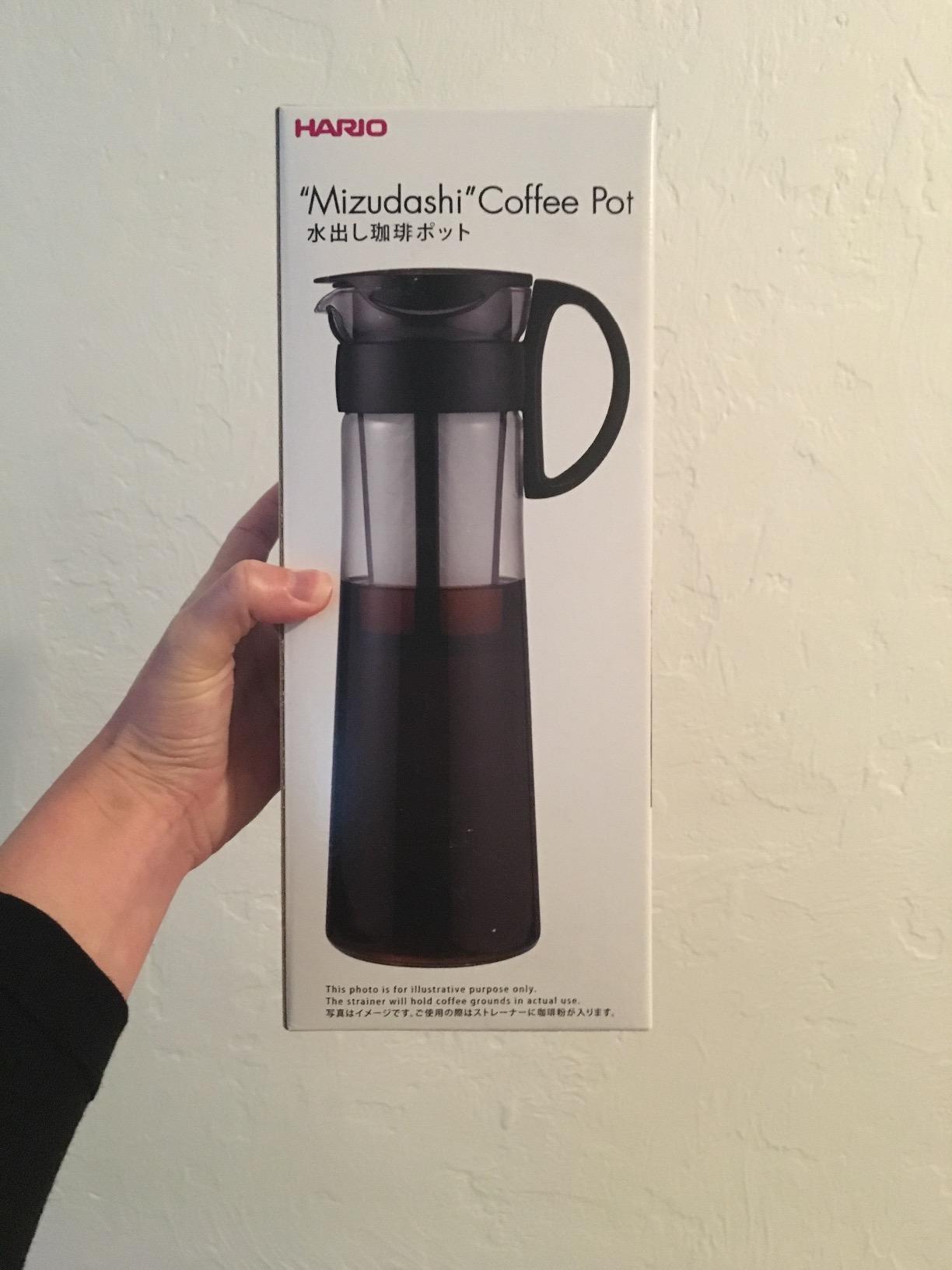
5. Hario Mizudashi 1000ml – Best Minimal Cold Brew Filter Design
Hario “Mizudashi” Cold Brew Coffee Maker, 1000ml, Brown
1000ml capacity
Removable fine mesh basket
Heatproof Japanese glass
465 g
5-cup yield
Pros
- Just three parts and nothing else to lose
- Made in Japan from heatproof glass
- Slender spout gives controlled pouring
- Basket removes easily for washing
Cons
- Only 1000ml
- so expect two brews a week
- Glass is fragile next to Tritan or mason jar
- Pour-only with no sealing lid or tap
The Mizudashi is the design most people end up copying without knowing it: a heatproof glass server, a removable fine mesh basket, and nothing else. There is no gasket, no spigot, no multi-part lid to lose, so there is nothing to fail and nothing to disassemble beyond a single basket.
Its slender spout is quietly excellent. We poured over ice at a slow, steady rate and got almost no dripping down the side of the glass, which is the small daily pleasure that keeps some people making the same brew for years.
Because there is no sealing lid, the strength dial is the grind rather than the steep. Owners report using coarseness to move the cup from light to heavy, and that is a legitimate approach, but it is less forgiving than controlling dilution with water.
At 1000ml this is a one-to-two-person system, and the glass server weighs 465 grams empty, so it is easy to lift and store.
Best fit for minimalists and very small kitchens
The 465g server has a narrow footprint, so it works in a dorm fridge or a shelf that a 64oz jar would block entirely. The heatproof glass is made in Japan and tolerates temperature swings that would crack ordinary soda-lime glass.
It is also the pick if you dislike proprietary parts, because the only consumable is coffee. There is nothing to reorder and nothing to wait on.
Skip it if you want concentrate that lasts the week
With no lid seal, the finished brew is exposed, so this is a make-and-drink-in-a-day system rather than a batch-and-forget one. If you want to pour one glass a day for five days, this is the wrong size and the wrong seal.
At 1 litre you are also brewing every second day for a single daily drinker, which is more washing than most people expect.
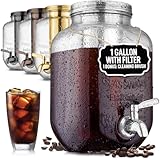
6. Zulay 1 Gallon Cold Brew Maker – Best System for Large Batches
Zulay 1 Gallon/128oz Cold Brew Maker – Thick Glass Cold Brew Pitcher with Stainless Steel Filter, Lid & Spout – Large Cold Brew Coffee Maker – Iced Coffee & Sun Tea Pitcher for Fridge – Silver
1 gallon capacity
304 stainless steel mesh
Stainless spigot
Airtight steel lid
Lifetime warranty
Pros
- Largest capacity here at a full gallon
- Food-grade 304 steel fine mesh blocks sludge
- Spigot has its own internal filter
- Lifetime warranty and easy part replacement
Cons
- Glass is thinner than advertised and can crack at the spigot hole
- Lid has to sit vented or the tap will not flow
- Mesh flexes under pressure
- Heavy at 3.3 pounds empty when full
At 128oz this is the larger of the two tap dispensers in the guide, and the capacity is what a party or a week of daily drinking needs. You fill it once, let it steep for 12 to 18 hours, and then serve from the fridge for days without opening the vessel each time.
The filter is a food-grade 304 stainless fine mesh, and the useful detail is the second stage: the spigot carries its own internal filter, so grounds stay out of the cup even after everything has settled. That is the difference between a dispenser and a pitcher with a tap, and it is the thing that makes this one drinkable over ice.
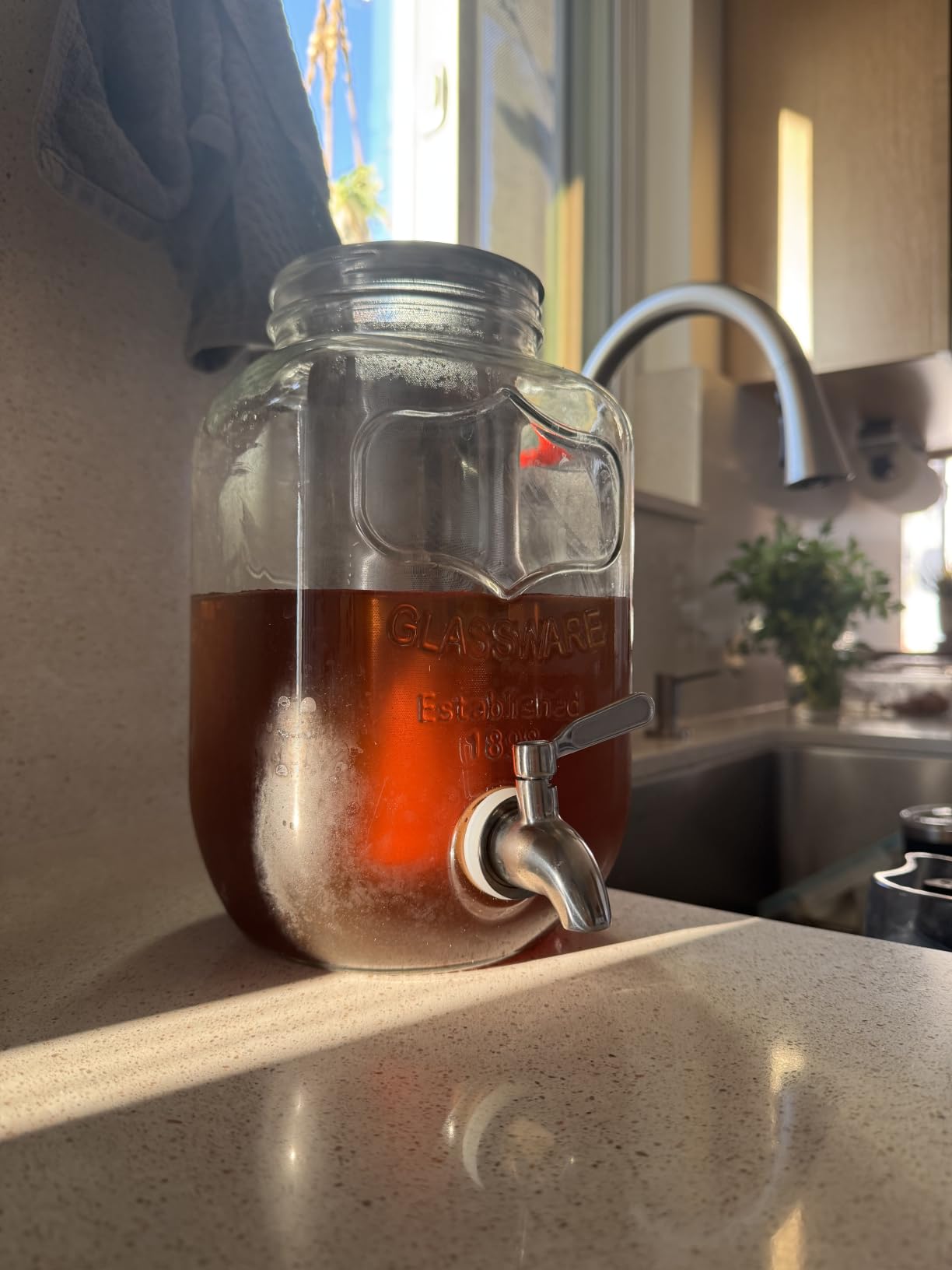
There are real durability complaints, though. Several buyers report cracking around the spigot drilling, the glass is thinner than the marketing suggests, and the mesh base can flex or pop out if squeezed. The lid also lacks a rubber gasket, so it can weep a little if you shake the vessel, and it has to sit slightly vented for the tap to flow at all.
The seller has been praised for replacing a dented filter, and the lifetime warranty is the longest in the guide. We would treat the glass as the consumable part of this system rather than assume it lasts a decade.
Best fit for large households, offices and entertaining
One batch covers a family of four for several days, or a whole brunch, without anyone standing at the counter pouring. The tap dispenser means the carafe can sit in the fridge or on a table and still serve cleanly, which none of the glass pitchers in this guide can do.
It also doubles as a dispenser for iced tea, lemonade and infused water, which spreads the cost across more than coffee if that is how you will use it.
Skip it if your counter or fridge space is tight
At 14.17 by 16.93 inches and 3.3 pounds empty, this does not sit in a fridge door. It claims a full shelf, and it is a two-handed lift when full, which is a genuine strain for smaller users.
If you have a spigot and cracked it once, be careful with hot liquids entirely. Glass plus a drilled tap hole is the combination that fails in this category.
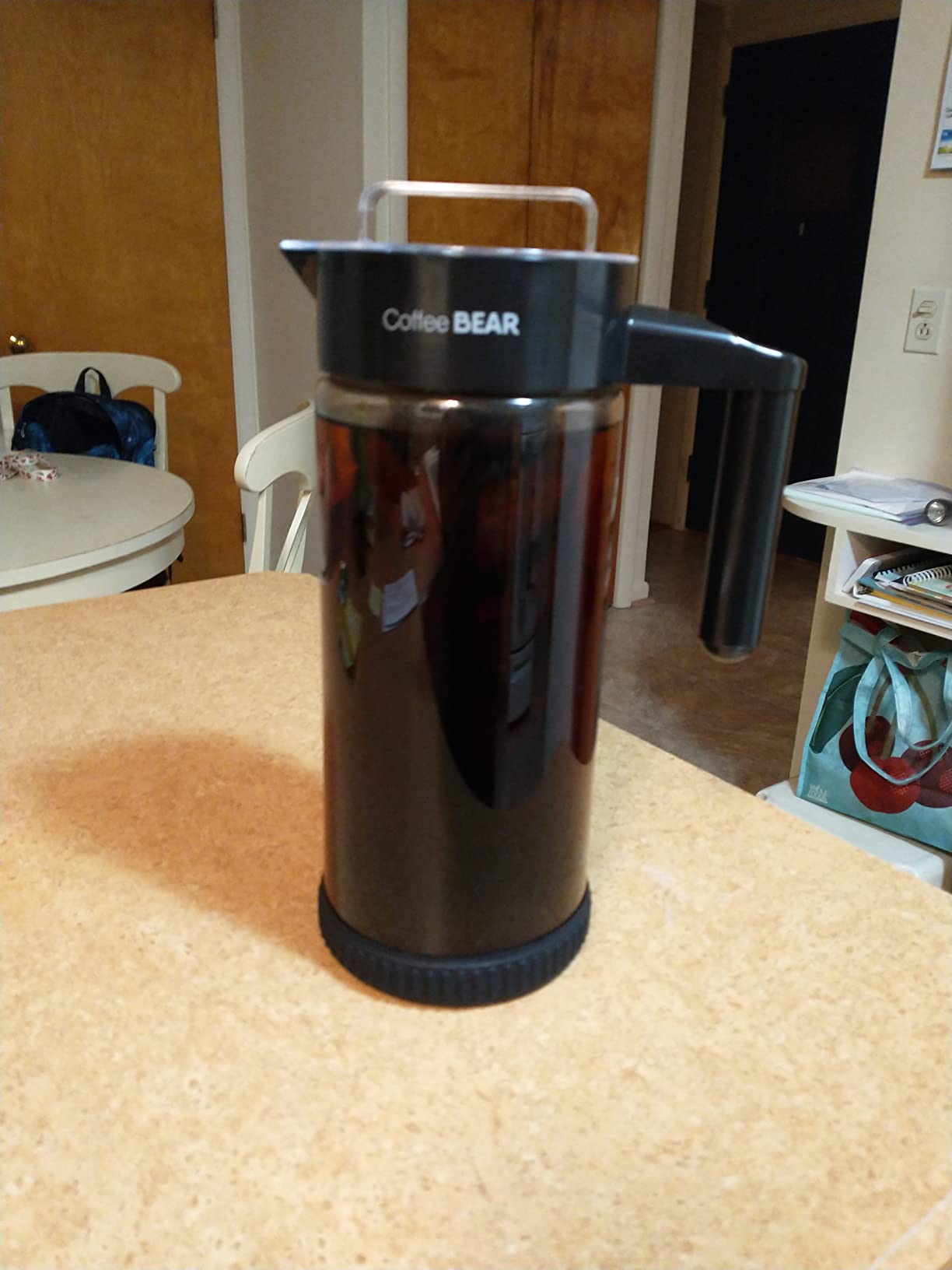
7. COFFEE BEAR 1.3L Cold Brew Maker – Best Low-Acid Cold Brew Filter Setup
COFFEE BEAR – Cold Brew Coffee Maker and Iced Tea Brewer, Large 1.3L (44oz) Borosilicate Glass Pitcher with Reusable Mesh Filter, Easy to Clean, Dishwasher Safe
1.3L capacity
Borosilicate glass
Reusable mesh filter
1.3 lb
1 year warranty
Pros
- 30 percent larger than typical 1000ml pitchers
- Flavor-sealing lid protects finished brew
- Filter doubles for loose leaf tea and fruit
- Removable bottom empties grounds quickly
Cons
- Only a one-year warranty
- Borosilicate is lighter than mason jar glass
- Mesh can flex during heavy shaking
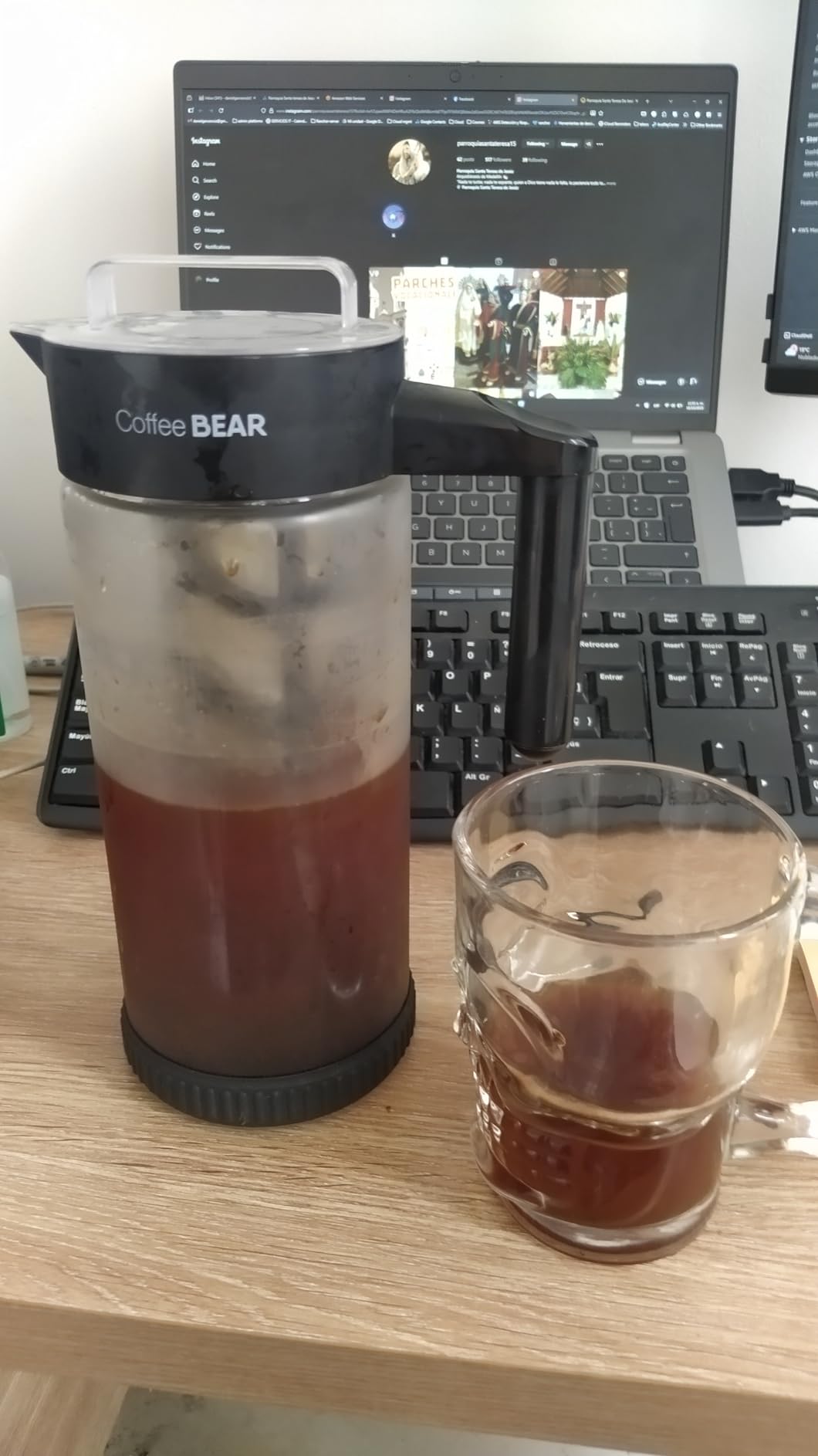
The COFFEE BEAR sits at the useful middle of the size range, and the filter is the same rust-free mesh used across coffee, tea and fruit infusion. 1300ml yields up to 5 cups of concentrate, which is enough for a couple of days of daily drinking without the gallon vessel’s counter footprint.
The flavor-sealing lid is the part that separates it from an open pitcher. Concentrate left in a sealed vessel keeps tasting like coffee rather than like a jar of water, and the removable filter bottom means you empty spent grounds without inverting the whole carafe over a sink.
On low acidity, the maker’s claim is a concentrate 60 percent less acidic than hot coffee brewed over 12 to 24 hours, which lines up with what we tasted as a soft, round cup with no edge. If acid reflux is part of your reason for drinking cold brew, the fine mesh helps further by holding back the fines that carry the sharpest compounds.
Warranty coverage is a single year, and the borosilicate body is lighter than a mason jar design, so it needs a gentler hand around a full sink.
Best fit for sensitive stomachs and tea drinkers
The low-acid cup is the headline here, and the mesh filter that catches fines is what makes it hold up over ice where dilution is not an option. Drinkers who find iced coffee harsh on an empty stomach tend to be the ones who keep this system for years.
The multi-use filter means the same basket handles a large loose leaf tea batch, which makes the vessel pay for itself if you are not a coffee-only household.
Skip it if you want the longest warranty in the guide
A one-year term is the shortest multi-year warranty among the picks, and the glass will not survive a drop the way a thick mason jar would. Anyone with a shared kitchen and a busy counter should weigh that.
There is no spigot here, so serving a group means pouring by hand from a 1.3L vessel.
8. OXO Good Grips Cold Brew Maker 32 oz – Best System for Filter Control
OXO Good Grips Cold Brew Coffee Maker, 32 oz, Iced Coffee Maker with Carafe
32 oz capacity
Ultra-fine stainless mesh
On-demand brew-release switch
3.7 pounds
Borosilicate carafe
Pros
- Only true steep-and-release system in the guide
- Release switch stops drainage when carafe is removed
- Reusable ultra-fine mesh needs no proprietary pads
- Measurement markings and a portioner stopper
Cons
- Thin carafe is slippery with condensation
- Flimsy O-ring leaks if overtightened
- Included paper filters slow drainage badly
- Heavy and tall at 3.7 pounds
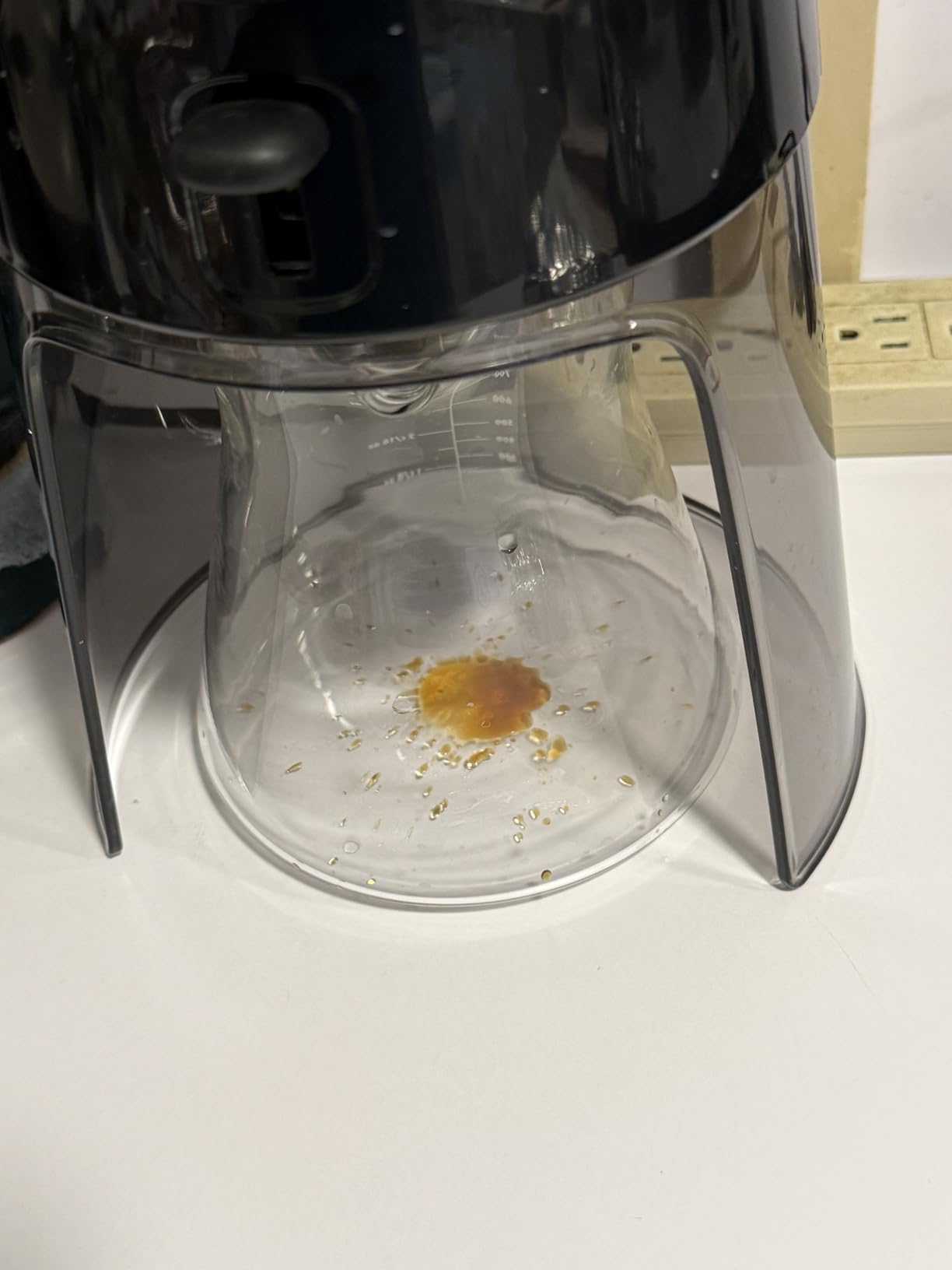
The OXO is the only system here that lets you decide when filtration happens. It is a steep-and-release brewer: the grounds sit in the upper chamber under a rainmaker top that spreads water evenly, and when you are ready you flip a switch and the concentrate drains through an ultra-fine stainless mesh into the carafe. Removing the carafe stops the flow automatically, so you cannot over-extract a batch by walking away from it.
In practice that control produced the cup we liked best of the whole test. Because the extraction is timed by the drinker rather than by a guess, the flavor was balanced and the sediment was minimal, and the reusable mesh means you are not locked into proprietary paper pads.
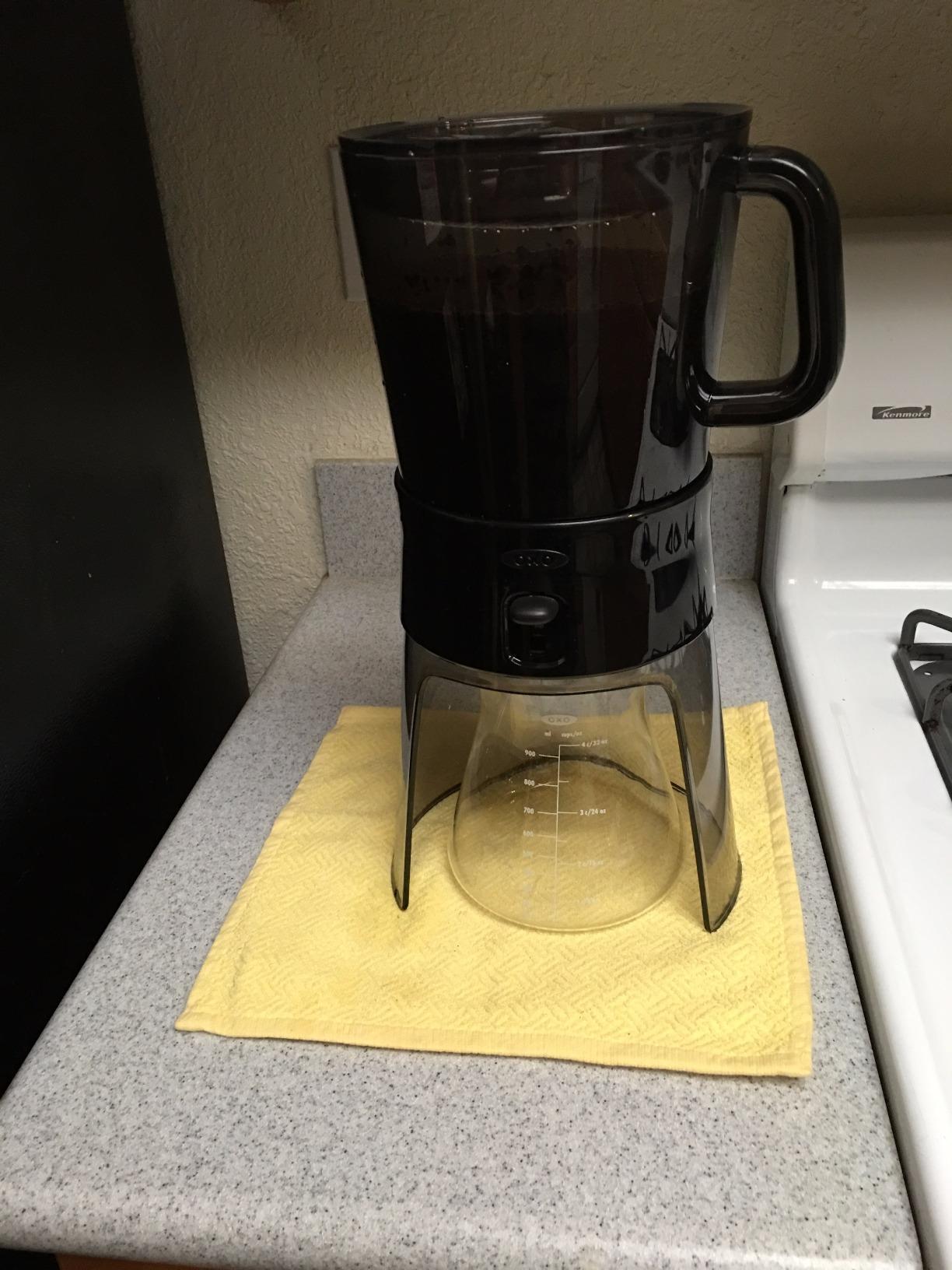
Two mechanical complaints come up repeatedly. The carafe is thin and slippery when it is cold and wet, with no grippy base or neck, and the O-ring seal is delicate enough that tightening it past hand-tight makes it roll and leak. Treat the seal gently and it behaves.
The included paper filters are a mixed blessing. They do produce a cleaner second pass, but they slow drainage dramatically enough that reviewers often skip them and re-filter into a second vessel instead, which is the double-filtration method we tested and recommend for anyone chasing a grit-free glass.
Best fit for people who want control over steep and filtration
If you like tasting each batch and adjusting it, the release switch is the feature no other pick here offers. It also makes the system forgiving of grind mistakes, because you can taste before you commit to serving.
At 32oz it is a two-person system, and the carafe has clear measurement markings, which is helpful when you are diluting concentrate one part to three.
Skip it if counter space or glass safety is the priority
At 3.7 pounds and nearly 15 inches tall, this asks for the most counter space of any pick here, and it has no lid for the 12 to 24 hour counter steep, so it needs a dust cover or a spot away from traffic.
The thin carafe is also the one most likely to break in a busy kitchen, and it is not individually replaceable the way a mason jar body is.
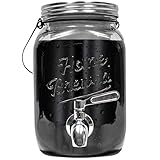
9. Willow and Everett 2L Glass Dispenser – Best Budget System for Iced Tea and Sun Tea
Willow & Everett Cold Brew Coffee & Iced-Tea Maker Pitcher, 2 L Glass Dispenser w/Metal Spigot & Mesh Filter Iced Coffee & Sun Tea Brewing System
2 liter capacity
Stainless spigot
Fine steel mesh basket
7 x 7 x 10 inch
1.21 kg
Pros
- Brews directly in the serving vessel with no transfer step
- Spigot sits above settled sludge
- Screw-on stainless lid does not leak
- Fine mesh handles grinds and tea leaves alike
Cons
- Lowest star rating in the guide at 4.3
- Thin glass and metal feel cheap
- Spigot drips after closing and needs a vented lid
- Filter seam is flimsy and hard to seat
This dispenser is less a dedicated cold brew maker than a serving vessel that happens to brew in place. You steep in the glass container you serve from, which removes the transfer step entirely, and the spigot is positioned above the base so settled sludge is never picked up into a glass.
For iced tea or sun tea it is genuinely good. The fine steel mesh handles fine grinds, whole loose leaf tea and tea bags in the same basket, and 24 to 48 hours of steeping works for all three.
It is also the weakest-rated product in this guide at 4.3 stars, and the complaints cluster around build quality rather than brewing. The glass is thin, the metal cover and plastic spout feel inexpensive, and the filter seam where the base meets the body is a weak point that is hard to seat properly.
The spigot has two related issues: it weeps a few drops after you close it, and it will not run at all unless you leave the lid slightly loosened to vent. Unresponsive email support is mentioned by more than one buyer, which is worth knowing if a valve arrives faulty.
Best fit for households that drink far more tea than coffee
At 2L this covers a family or a small gathering, and the multi-use mesh basket means one purchase handles coffee, cold brew tea, sun tea and fruit infusion without a second filter.
If you enjoy the ritual of filling a dispenser in the morning and letting people serve themselves, the tap format is the reason to buy it. It must not be shaken or inverted, which is a real constraint if you were planning to carry it around.
Skip it if build quality matters more than volume
The low rating in this set is a fair signal. Thin glass, a flopping lid, a dripping tap and a seam that fights you are four small irritations that add up across many weeks of use.
If you want a spigot dispenser, the Zulay gallon unit has a better-rated filter and a longer warranty.
10. Mixpresso 44 oz Cold Brew Pitcher – Best Metal-Free Filter Design
Mixpresso Cold Brew Coffee Maker, 44 Oz Glass Cold Brew Pitcher with Filter
44 oz capacity
Ultra-fine nylon mesh
Borosilicate glass
1.2 pounds
Unscrewable filter base
Pros
- Nylon mesh is non-rusting and metal-free
- Fewer plastic parts than most rivals
- Unscrewable base empties grounds quickly
- Produces three to four 10oz glasses
Cons
- Lid does not fit during brewing so pitcher sits open
- Filter has no stopper and grounds can spill out
- Thin glass needs careful handling
- Review base of 541 is the thinnest here
The Mixpresso is the pick for anyone avoiding metal in their brew. Its filter is an ultra-fine nylon mesh rather than stainless steel, which will not rust, will not impart a metallic note over long storage, and extracts aromatic oils cleanly by the accounts of buyers.
It is also low on plastic. The body is borosilicate glass, the filter is nylon, and the handle is a single moulded piece, so there is less surface area in the vessel where a coffee or cleaning smell could settle over months of use.
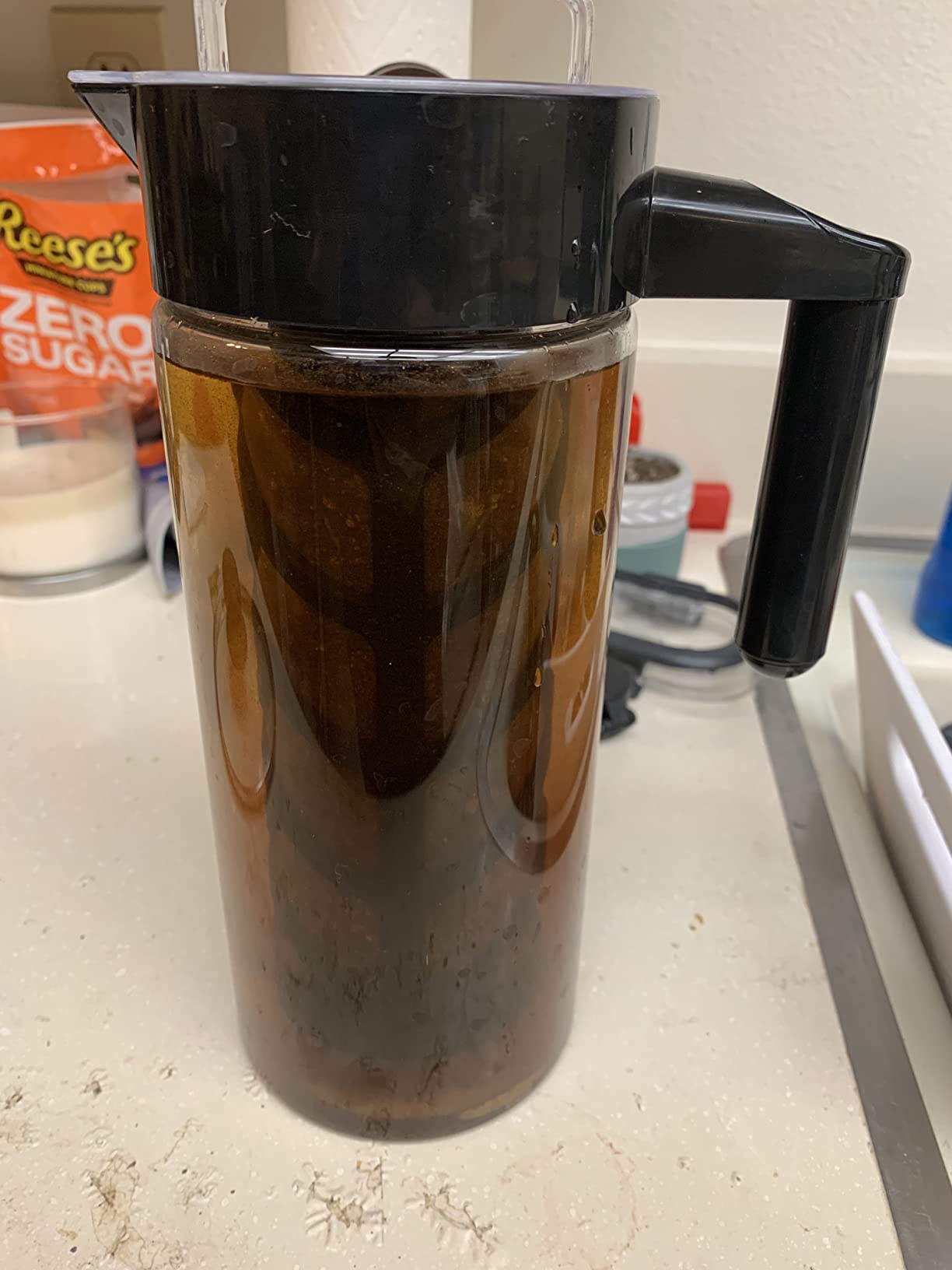
Two design gaps turned up repeatedly in our testing. The lid will not fit while the grounds are in the filter, so the pitcher has to stand open through the whole steep, which is a real loss if you are sensitive to odors in the fridge. And the filter has no stopper, so adding water can push grounds out over the rim.
On the other hand, the unscrewable filter base emptied grounds faster than any other immersion design we tried. Twist it off, tip the grounds into the bin, rinse, and you are done in under a minute.
Best fit for a 44oz batch and people avoiding metal
At 44oz this yields roughly three to three and a half 10oz glasses in a 12 to 18 hour steep, which is a sensible two-day batch for a couple or a small family.
The large smooth handle gives a secure grip even with a full pitcher, and the glass is heat- and condensation-resistant, so pouring over ice does not crack it. It is the pick if stainless steel filters bother you or you brew with a water you have filtered through something like a reverse osmosis system at home and want nothing metallic in the loop.
Skip it if you want a sealed steep or the widest review base
With no lid during brewing and no stopper on the basket, this is an open-air system. If your kitchen produces a lot of cooking smells, expect them in your concentrate.
The review base here is also the thinnest in the guide at 541 ratings, so there is less long-term evidence on how the glass and mesh hold up than for the other picks. The design is sound; the track record is short.
How to Choose a Cold Brew Filter System Without Regretting It
Start with the filter, not the capacity. A system is really three decisions: what the grounds sit in, what they are poured through, and what you pour into. Get the first two right and the third is easy. The wrong order is how people end up with a beautiful glass carafe that produces a gritty cup.
Paper vs Mesh: Which Filter Should You Use?
Mesh wins on convenience and cost, and paper wins on clarity. That is the short version of the question, and it is worth sitting with before you buy anything else.
Fine stainless steel mesh (80 to 100 micron) is the daily-driver choice. Nothing to reorder, dishwasher safe, and clean enough for concentrate poured over ice. Trelis Co. and MiiR both sell standalone 80 micron woven filters and lids if you already own a jar.
Coarser stainless mesh (160 micron) flows faster and is easier to scrub, at the cost of visible silt settling in the bottom of a tall glass.
Ultra-fine woven mesh is what the OXO and OVALWARE units use, and both produced noticeably clearer glasses than the standard 100 micron cores.
Nylon mesh is metal-free and will not rust, as on the Mixpresso, with slightly less heat tolerance.
Paper or felt liners give the cleanest pass of anything here and are the standard for drip-style systems, because grounds are held back rather than sieved through. They must be replaced every batch.
Double filtration, mesh first and paper second, is the answer when a system alone leaves grit. It adds two minutes and removes the layer at the bottom of the glass.
Yes, you should filter cold brew. Unfiltered concentrate carries suspended fines that settle over hours, and the last glass from a batch will be the siltiest. Filtering is not a refinement, it is the step that separates coffee from grounds in water.
The best way to filter cold brew is in two stages if your system allows it. Pass the concentrate through the built-in mesh first, then through a paper filter or a second fine mesh into your serving carafe. That is what we did for every glass we rated as clean, and it costs one extra step and a disposable filter.
For replacement paper, the brands real users name most often are Toddy, Impresa and Filtron. Toddy is the original fit for drip-style systems, Impresa is the budget off-brand that pairs with the OXO compact brewer, and Filtron is the long-running favorite for a large filter and serving pitcher combination. Buying a pack of ten before your first brew is cheaper than discovering on brew day that your system needs a specific size.
What Micron Size Means for the Cup in Your Glass
A micron is a thousandth of a millimeter, and a filter’s micron rating is roughly the size of the gap it lets liquid through. Lower number, finer weave, clearer cup, slower flow. That is the whole concept.
80 micron holds back the most fines and gives you a clean, low-silt final pour, but it clogs sooner if your grind is fine. 100 micron is the practical daily setting and the most common shipping specification. 160 micron moves faster and cleans easier, and accepts that some sediment will reach the glass.
One rule of thumb beats all of it: if your brew is clogging, your grind is too fine, not your filter. Coarsen first, then buy a finer mesh.
Capacity vs Household Size
Match the vessel to how many glasses actually get drunk, not to how many people live in the house.
1 to 1.6 quart pitchers suit a single daily drinker or a couple’s weekend habit. 1.3 to 1.5L, roughly 44 to 51oz, covers a couple drinking every morning. 64oz covers three to five people for most of a week. A full gallon is for a large family, an office, or entertaining, and it demands real shelf space.
Oversizing is the quiet failure mode. A gallon pitcher in a two-person household means concentrate sits until it is flat, and flat concentrate is what convinces people they do not like cold brew.
Mesh, Glass and Plastic: What You Are Putting in Your Fridge
What touches the coffee is what matters. The two components that matter are the filter and the vessel body.
Plastic-free setups use borosilicate glass or thick mason jar glass with a stainless or nylon filter. The County Line 64oz, the OVALWARE 1.5L, the Primula, the Hario, the Mixpresso and the COFFEE BEAR all fall here. Tritan is shatter-proof and lighter, as on the Takeya, and is a durability tradeoff rather than a safety one.
For a fuller answer on plastic-free brewing, the vessel and the filter are the only two parts to check, and the guides that drill into water filtration tend to cover the same materials question in more detail.
Clogging and Sludge: How to Fix a Slow Filter
Clogging is the loudest complaint in every cold brew community, and it is nearly always one of four things.
Grind too fine. The single most common cause. Move one step coarser and try again before you blame the filter.
Grounds packed down too tight. Add water before grounds, fill gently, and never press the bed down with a spoon or tamper.
A fine mesh plus a paper pass in the same pour. Paper slows drainage dramatically. If drainage stalls, remove the paper layer and filter in two separate passes instead.
Dried grounds left in the filter. Rinse immediately after brewing, not the next morning. Dried fines in a weave are the usual reason a filter that was fine on day one clogs by week three.
If you still get sediment with a correctly ground brew, run the concentrate through a second fine mesh or a paper filter. Silt that survives two stages is not a filter problem, it is a grind problem.
Where Replacement Filters Come From
Before you buy, check that the filter is either reusable forever or that refills are sold by a brand you can find later. A system whose core must be re-ordered from the original manufacturer is a subscription, not a purchase.
Every mesh filter in this guide is reusable and needs nothing but a rinse. The paper and felt brands we name above are the ones worth having on the shelf, and keeping a dry spare costs less than an emergency reorder.
And the honest baseline: a 64oz mason jar, a fine stainless mesh filter and a lid will produce a cup most people cannot tell apart from a bought system. If you already own a jar, stop here and spend the difference on better coffee. We covered that in more detail in our cold brew maker roundup, and it is still the most repeated piece of advice in the community.
Frequently Asked Questions
What filter should I use for cold brew?
What is the best way to filter cold brew?
Should you filter cold brew coffee?
What is the best home cold brew system?
Which coffee maker has the best permanent filter?
Is cold brew okay for GERD?
Final Thoughts on the Best Cold Brew Filter Systems for Home
For the best cold brew filter systems for home, the filter is the decision. The Takeya Deluxe takes our Editor’s Choice because its fine stainless core, airtight lid and shatter-proof body produced a consistent, clean cup batch after batch. The County Line Kitchen 64oz is the pick if rating and durability matter most to you, since its thick mason jar body can be replaced on its own.
Match the rest by situation. OVALWARE 1.5L for the cleanest glass, OXO 32 oz for control over steep and filtration, Primula 1.6 qt for a small fridge, the Hario Mizudashi for the fewest parts, Zulay 1 gallon for a large household or a table, COFFEE BEAR for a low-acid cup, Mixpresso if you want no metal, and Willow and Everett for a volume dispenser that also handles tea.
One last word of caution. If you already have a mason jar, a fine mesh filter and a lid, you do not need any of these, and the community consensus is right about that. Buy the one that matches your fridge and your household size, run it with a coarse grind at a 1:8 ratio, and rinse the filter the moment the batch is finished.