
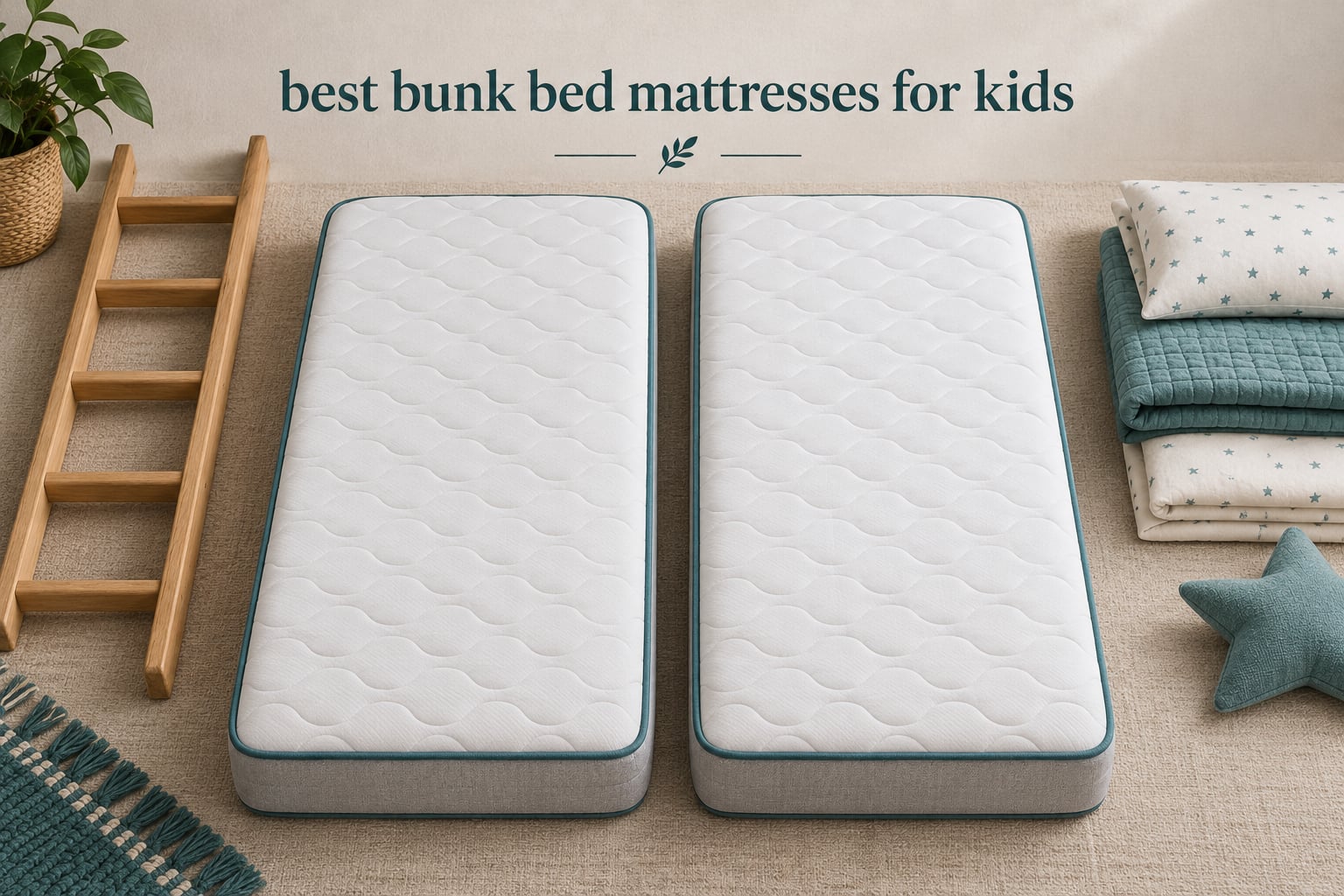
The best bunk bed mattresses for kids are 6 to 8 inches thick, medium-firm, and made with CertiPUR-US or GREENGUARD Gold certified foam. That thickness range matters because a top-bunk mattress that sits too high can rise above the guardrail, and federal guidance expects the rail to stand at least 5 inches above the mattress surface. Get it wrong and the fix is a new mattress, not a thicker comforter.
Everything in this roundup is a genuine low-profile option that a bunk or loft frame can actually accept. I compared ten mattresses that all measure 6 inches thick, which is the sweet spot: tall enough to feel supportive under a child’s hip and shoulder, short enough to preserve guardrail clearance and headroom on the top bunk. Nine of the ten are medium or medium-firm, one is plush, and two use a coil core for kids who dislike the sinking feeling of foam.
Short answer to the question parents ask most: for bunk beds, use a 6-inch twin or twin XL memory foam or hybrid mattress with a medium-firm feel, a washable cover, and a 10-year warranty. Buy two for a full bunk set, and skip anything thicker than 8 inches unless your bed maker specifically approves it. If you have not bought the frame yet, our guide to the best bunk beds for kids rooms covers which frames accept which mattress sizes.
Table of Contents
Bunk Bed Mattress Buying Checklist
Run through these seven points before you buy anything. They cover every complaint that shows up in parent reviews of kids’ mattresses.
Thickness: 5 to 8 inches. Most frames need 6 inches to clear the guardrail line on a top bunk. Above 8 inches you lose clearance and headroom.
Firmness: medium to medium-firm. Around 6 out of 10 on a firmness scale. Soft mattresses let a child’s midsection sink and curve the spine.
Certification: CertiPUR-US or GREENGUARD Gold. These mean the foam was tested for volatile organic compounds and emissions, which matters in a small shared bedroom.
Size: twin, twin XL or full, matched to the frame. Twin measures 38 by 75 inches, twin XL 38 by 80, full 54 by 75.
Washable or removable cover. Potty training spills and bedwetting are not edge cases. Spot-clean-only covers turn accidents into permanent stains.
Weight: check the frame capacity. Mattress weight plus occupant weight should stay under the number printed on the bunk bed frame.
Edge support. Bottom-bunk kids sit on the edge to tie shoes. Thin single-layer foam collapses first there.
Top 3 Bunk Bed Mattresses for Kids in 2026
The three below are the picks I would buy first if a family asked me to outfit one bunk bed today. The Linenspa takes the top slot on the strength of its review volume and coil durability, the Lucid is the balanced all-round buy, and the FDW covers the washable-cover budget case that most parents ask about first.


FDW 6 Inch Twin Mattress
- Machine washable cover
- 6 inch gel foam
- 1000 lb capacity
- 72 hour expansion
Quick Overview: Every Mattress in This Roundup in 2026
All ten mattresses measure 6 inches thick and carry at least a 3-year manufacturer warranty. The table below lists the construction, feel, and best fit for each one so you can narrow the field before reading the full reviews.
| Product | Specifications | Action |
|---|---|---|
| Linenspa 6 Inch Twin XL |
|
Check Latest Price |
| LUCID 6 Inch Gel Memory Foam |
|
Check Latest Price |
 EGOHOME 6 Inch Twin Mattress EGOHOME 6 Inch Twin Mattress |
|
Check Latest Price |
| FDW 6 Inch Twin Mattress |
|
Check Latest Price |
 Novilla 6 Inch Twin Mattress Novilla 6 Inch Twin Mattress |
|
Check Latest Price |
 Zinus 6 Inch Hybrid Zinus 6 Inch Hybrid |
|
Check Latest Price |
 LIFEMENT 6 Inch Twin Mattress LIFEMENT 6 Inch Twin Mattress |
|
Check Latest Price |
 MLILY 6 Inch Twin Mattress MLILY 6 Inch Twin Mattress |
|
Check Latest Price |
 Amazon Basics 6 Inch Twin Amazon Basics 6 Inch Twin |
|
Check Latest Price |
 COOL GEL 6 Inch Twin XL COOL GEL 6 Inch Twin XL |
|
Check Latest Price |
How We Picked Bunk Bed Mattresses
Every mattress here had to clear one hard filter: a 6-inch profile that keeps a top bunk below the guardrail line. After that I scored each one on the things that actually break down in kids’ rooms.
Guardrail math. I compared stated item thickness against the 5-inch rail clearance rule and flagged anything that would eat headroom on a top bunk.
Construction and feel. Foam, hybrid and innerspring builds were compared for edge support, motion isolation and whether the surface suits a child’s hip and shoulder.
Certifications and materials. CertiPUR-US, OEKO-TEX and fiberglass-free barriers were noted, since off-gassing matters most in a small shared room with a bunk ladder against the wall.
Warranty and review volume. A long warranty tells you the manufacturer expects the foam to hold its shape for a full childhood, and a high rating count tells you whether that expectation holds up in real rooms. Two picks also stand out for cleanability, which is where most kids’ mattresses lose.
1. Linenspa 6 Inch Memory Foam Mattress (Twin XL) – Best Overall with a Coil Core
Linenspa 6 Inch Memory Foam Mattress – Firm Feel – Twin XL
6 inch profile
Twin XL 80 x 39 inches
350 Bonnell coils
Firm feel
36.2 pounds
Pros
- Coil core holds shape for years
- Low profile fits top and bottom bunk
- Light enough to move between rooms
- Even support for back and stomach sleepers
- 10 year warranty
Cons
- Springier than foam so side sleepers get less contouring
- Pillow top can run warmer than gel foam
- Cover is not removable or washable
This is the mattress I keep coming back to. It carries a 4.4 average across roughly 196,000 ratings, which is the largest review base of anything in this roundup by a wide margin, and that volume is itself useful information. When a mattress has been bought and used hundreds of thousands of times in kids’ rooms, guest rooms and dorms, the failure modes are already documented.
The build is 350 Bonnell coils over about 5 inches of heavy-gauge tempered steel, topped with a deep foam layer under a quilted polyester pillow top. That coil core is the reason it outlasts pure foam in a bunk setting: kids sit on the edge of the bottom bunk every morning to put shoes on, and foam compresses there first. Springs push back.
At 36.2 pounds it is the heaviest mattress here, and at 80 by 39 inches it is a twin XL. That length suits an 80-inch bunk frame or a standard US twin XL mattress set. If your frame takes a 75-inch twin, this one will not fit without overhang, so check your frame’s interior length before you order.
The feel is firm, which suits back and stomach sleepers and most kids who spend their nights sprawled out. Side sleepers get less contouring than they would from a memory foam build, and the pillow top runs slightly warmer than a gel-infused surface in a room that stays warm.
Is the coil core worth it in a kids’ bunk?
Yes, when you have a bottom bunk. A child sitting on the mattress edge to tie shoes or climb down puts concentrated weight in one spot every single morning, and that is the fastest way to chew through a thin all-foam surface. The Bonnell spring base distributes that load across a wider area.
It also solves a problem parents rarely predict: a foam mattress on a bottom bunk can start to feel lumpy as the frame’s slats press up through a compressed surface. Springs hold their geometry longer.
When should you choose something else?
Skip it if your child sleeps on their side and complains about pressure at the shoulder or hip, since a springy surface gives less of that pressure relief. It is also the wrong shape if your bunk frame takes a 75-inch twin rather than a twin XL.
Also note the cover is fixed and spot-clean only. In a bed where bedwetting is still in progress, pair it with a waterproof mattress protector rather than trying to clean the cover itself.
2. LUCID 6 Inch Firm Gel Memory Foam Mattress (Twin XL) – Best Balanced All-Rounder
Lucid® 6″ Firm Gel Memory Foam Mattress – Bamboo Charcoal & Cooling Gel – Fiberglass Free – Bed in a Box – CertiPUR-US® Certified – Twin XL Size
6 inch profile
Twin XL 79 x 37.5 inches
18.8 pounds
Medium firm
CertiPUR-US
Pros
- Gel and charcoal infusion keeps sleep cool
- Lightest build here so top bunk loading is easy
- CertiPUR-US foam
- Minimal off-gassing
- Medium firm suits most positions
Cons
- Plush variants sink more than some sleepers like
- Cover can sit slightly off-center after expansion
- Memory foam can feel uneven after months
This is the pick I recommend when a family wants a memory foam feel without the heat that usually comes with it. The construction is 1 inch of ventilated gel and bamboo charcoal memory foam over 5 inches of supportive base foam, and the charcoal infusion is doing real work on odor in a room where two kids share a bunk.
It holds a 4.4 average from about 12,500 ratings, and reviewers repeatedly mention three things: back pain relief, cool sleeping temperature, and painless setup. The 18.8-pound weight is the lowest of any mattress in this roundup, which matters more than it sounds. On a top bunk you or your child will be lifting this mattress into a frame at ceiling height, and a lighter mattress is a safer one to wrestle into place.
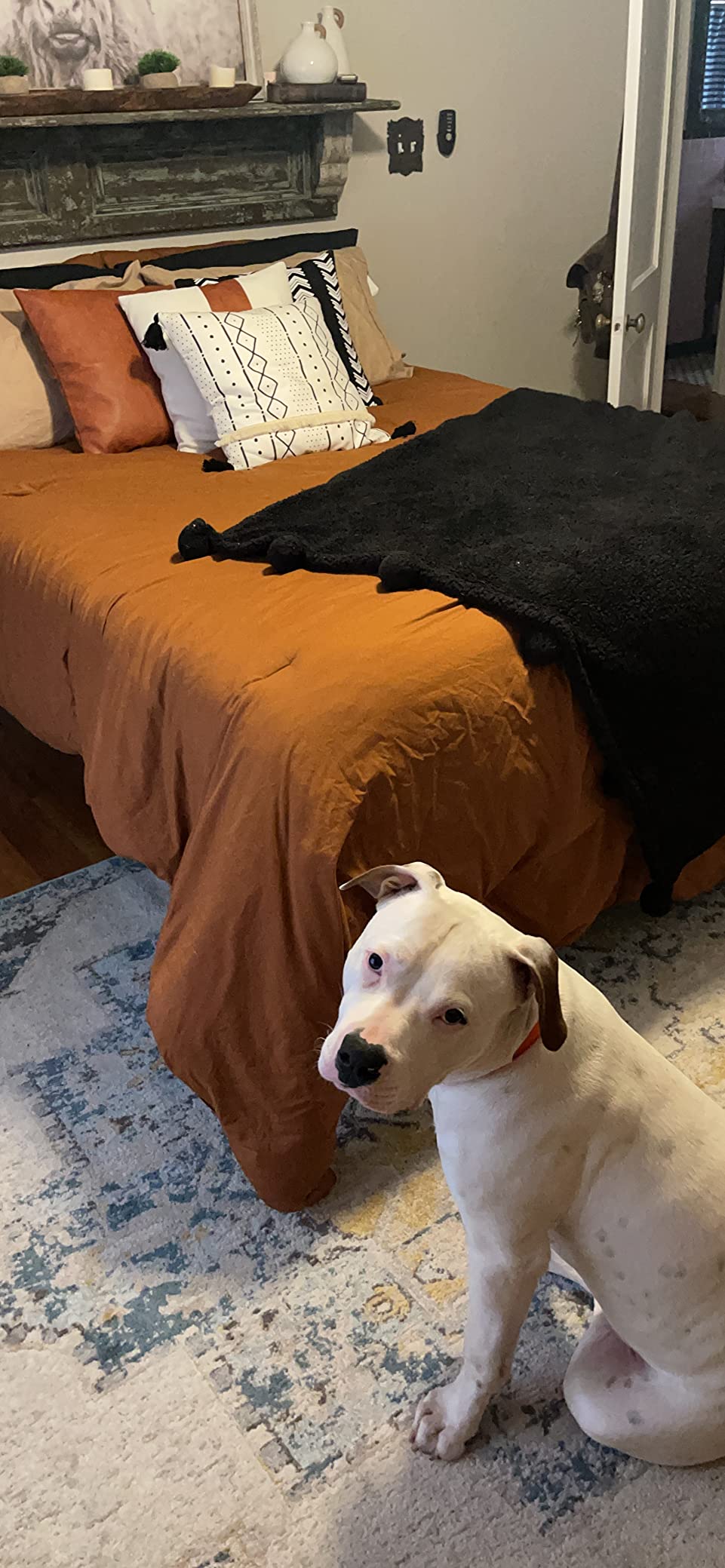
CertiPUR-US certification is the quiet selling point. In a small bedroom with limited ventilation, certified foam is the difference between a room that smells faintly of new plastic for two days and one that does not. Most owners report little to no odor at all.
It arrives compressed and rolled, and the maker asks for 24 to 48 hours of expansion time before you sleep on it. Plan the unboxing for a Saturday morning rather than the night before school.
How does it handle weight and edge use?
Reviewers point to solid edge support and motion isolation as the practical wins for a shared room. If a sibling below stirs and turns, the foam does not transmit the movement upward the way a coil unit can.
The base foam layer is dense enough that most children under about 130 pounds will not bottom out. Heavier side sleepers sometimes report sinking deeper than they expected, so pair this with the firmness guidance in the buying guide below.
What are the trade-offs?
The cover is polyester blend, spot-clean only, and there is no zip. That is the single biggest reason to keep a waterproof protector on this mattress even after the bedwetting years are over.
A small minority of owners report the cover settling slightly off-center after expansion, and some describe slight unevenness after many months of use. That is normal for bed-in-a-box memory foam, and it does not affect the guardrail math since the profile stays at 6 inches.
3. EGOHOME 6 Inch Twin Mattress for Kids – Best for Kids Who Run Warm
EGOHOME 6 Inch Twin Mattress for Kids, Memory Foam Mattress with Cooling Green Tea Gel, Relieve Pressure with Medium Firm Support, CertiPUR-US Certified, 75”L x 38”W, White
6 inch profile
Twin 75 x 38 inches
22 pounds
Medium firm
750 lb capacity
Pros
- Green tea gel and bubble-hole foam move air
- Medium firm support with good spinal alignment
- Quiet so the bunk below is not disturbed
- Firmness holds from 4C to 30C
- CertiPUR-US certified
Cons
- Plush top may feel soft for kids who want flat support
- Single layer foam gives less edge support
- 1-star ratings sit at 9 percent in this group
EGOHOME markets this one directly at kids, and the specification sheet backs that up rather than just asserting it. The memory foam uses a bubble-hole structure infused with green tea gel, which is designed to promote airflow through the foam instead of letting heat pool in the center of the mattress. For a child who kicks off the covers by 2am, that is the feature that matters.
The rating is 4.3 from roughly 12,400 ratings, and it currently sits at the very top of the Amazon Mattresses category. Parents in reviews consistently highlight the cooling, the quiet feel, and the medium-firm support that holds a child’s back in a straight line without feeling punishing.
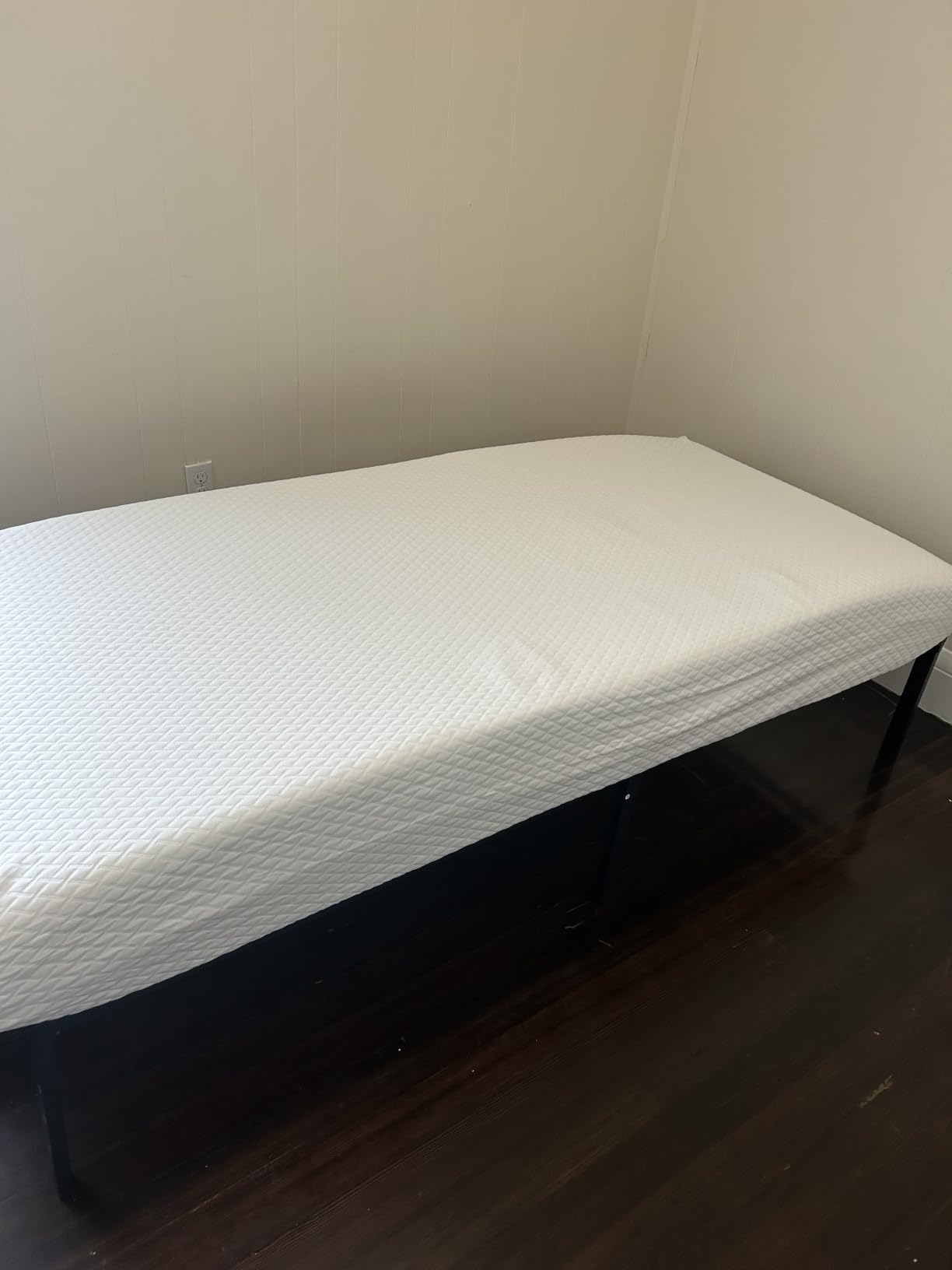
One detail almost no competitor mentions: the foam is rated to keep a consistent firmness between 4 and 30 degrees Celsius. That matters in an unheated bedroom in winter, where some memory foam gets noticeably harder and can feel unwelcoming on contact. This one is engineered not to change much.
Listed capacity is 750 pounds, so it will not be the limiting factor on a kids’ bunk. At 22 pounds and 75 by 38 inches it is a standard twin, which is the most common bunk mattress footprint in the country.
Who does the cooling actually help?
It helps in two situations. First, a child who sleeps hot or has night sweats, where the gel and bubble-hole foam pull heat away from the torso. Second, a bottom bunk in a warm upstairs room with limited airflow, where a mattress can sit several degrees warmer than the rest of the house.
The design also reduces transfer of movement, so a restless sleeper on the bottom bunk is less likely to disturb whoever is on the ladder side above.
Where the single layer shows its limits
This is a single-layer foam build, and that means less edge support than anything multi-layer in this roundup. A child who habitually sits on the mattress edge to tie shoes will feel the frame sooner than on the Linenspa coil model or the Lucid layered build.
About 9 percent of its ratings are one star, the highest single-star share among these picks. The recurring theme is that the top surface feels softer than expected. If your child prefers a flat, unfluffy sleep surface, move up to the MLILY or the LUCID instead.
4. FDW 6 Inch Twin Mattress – Best Budget Pick with a Machine Washable Cover
FDW | 6 Inch Twin Mattress | Medium Firm | Gel Memory Foam | White
6 inch profile
Twin, gel over base foam
Machine washable cover
1000 lb capacity
3 month warranty
Pros
- Only pick here with a machine washable cover
- Lowest cost in the roundup
- 1000 pound listed capacity
- Contouring relief for all positions
- Expands within 72 hours
Cons
- Weak edge support
- Thin for heavier sleepers
- Foam softens after a few weeks
- 3 month warranty is the shortest here
This is the one to buy if your child is not fully past bedwetting. It is the only mattress in this roundup with a removable, unzippable, machine washable cover, and in a kids’ room that single feature can be worth more than an extra inch of foam. You unzip the cover, throw it in the wash, and put it back. Nothing else here lets you do that.
Under the cover is 1 inch of gel memory foam over 5 inches of high-density base foam, in a twin at 6 inches thick. It holds a 4.3 average from about 7,400 ratings, and reviewers most often praise the washable cover, the gel infusion for airflow, and how easy it is to move between rooms.
The listed weight capacity of 1,000 pounds is the highest figure in this group, though treat that as a ceiling rather than a comfort guarantee. Six inches of foam is still six inches of foam. A 130-pound adult and a 150-pound adult sharing this mattress for a guest-bed weekend will feel the base.
The cover is the answer to the bedding problem too. Because the cover is fabric rather than a stretchy fitted surface, a standard twin fitted sheet grips it and stays put, which is not always true on thin foam mattresses where corners let go in the night.
Is the cheapest option here a reasonable choice?
For a bottom bunk, a top bunk with good rails, or a trundle in a guest room, yes. The foam is CertiPUR-US certified, the base layer is high-density rather than the ultra-light stuff you find at the very bottom of the market, and the reviews describe consistent support rather than a featherbed.
Families in parent forums repeatedly land on this price tier for a first kids’ bed that has to survive a school career. The math works because a washable cover removes the most common reason a kids’ mattress gets discarded early.
What are you giving up?
Three things, and they are real. Edge support is the weakest of any pick here, so a child sitting on the edge to put shoes on will feel the instability. The foam softens noticeably after a few weeks of daily use. And the manufacturer warranty is 3 months, which is dramatically shorter than the 10-year coverage on most picks in this roundup.
Some owners also report inconsistent foam density between mattresses, with a few noting thinner-than-expected foam. If you can, buy this one for the top bunk only if your child is a light sleeper under 100 pounds, and put a more supportive model on the bottom bunk where edge use happens most.
5. Novilla 6 Inch Twin Mattress with Gel Memory Foam – Best for Loft Beds and Slat Frames
Novilla Twin Mattress, 6 Inch Twin Bed Mattress with Gel Memory Foam
6 inch profile
Twin 75 x 38 inches
Four foam layers
About 21.6 pounds
10 year protection
Pros
- Thick enough that slats cannot be felt
- Four layers absorb vibration
- 30 percent more NanoGel runs cool
- CertiPUR-US foam and OEKO-TEX cover
- Absorbs odors and moisture
Cons
- Can measure slightly under 6 inches
- Firmness labeling feels vague to some
- Needs close to 72 hours to air out
A loft bed is a harder test than a bunk bed, because the mattress usually sits on slats with no box spring or foundation underneath. That is where a lot of thin mattresses fail immediately, because you feel every slat through the surface. The Novilla is the pick I trust most for slat frames, and reviewers specifically call out that the slats cannot be felt through it.
It uses four foam layers rather than two, with 30 percent more NanoGel in the comfort foam than the previous generation for heat absorption and airflow. The rating is 4.4 from about 5,100 ratings, and the most common compliments concern cooling performance and near-zero motion transfer.
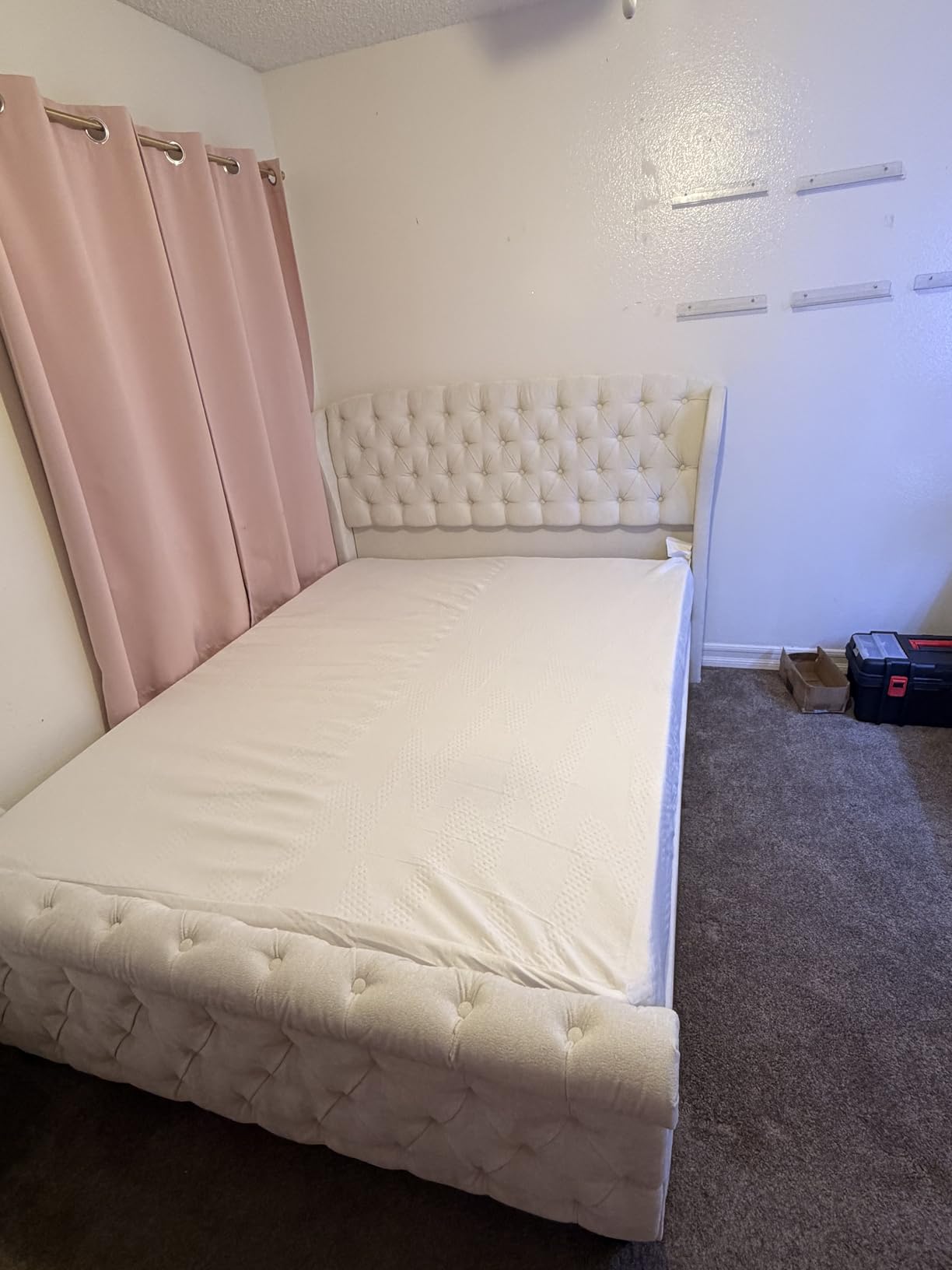
Motion isolation across four layers is genuinely useful in a shared room. If a sibling or a parent moves around on the other mattress, the Novilla absorbs more of it than a two-layer build, which is worth remembering when the bunk ladder faces the room rather than the wall.
The certification stack is the strongest in this roundup: CertiPUR-US foam plus an OEKO-TEX Standard 100 certified cover, backed by 10-year protection. It also absorbs odors and moisture, which keeps the surface drier through a humid summer.
Does it measure a true 6 inches?
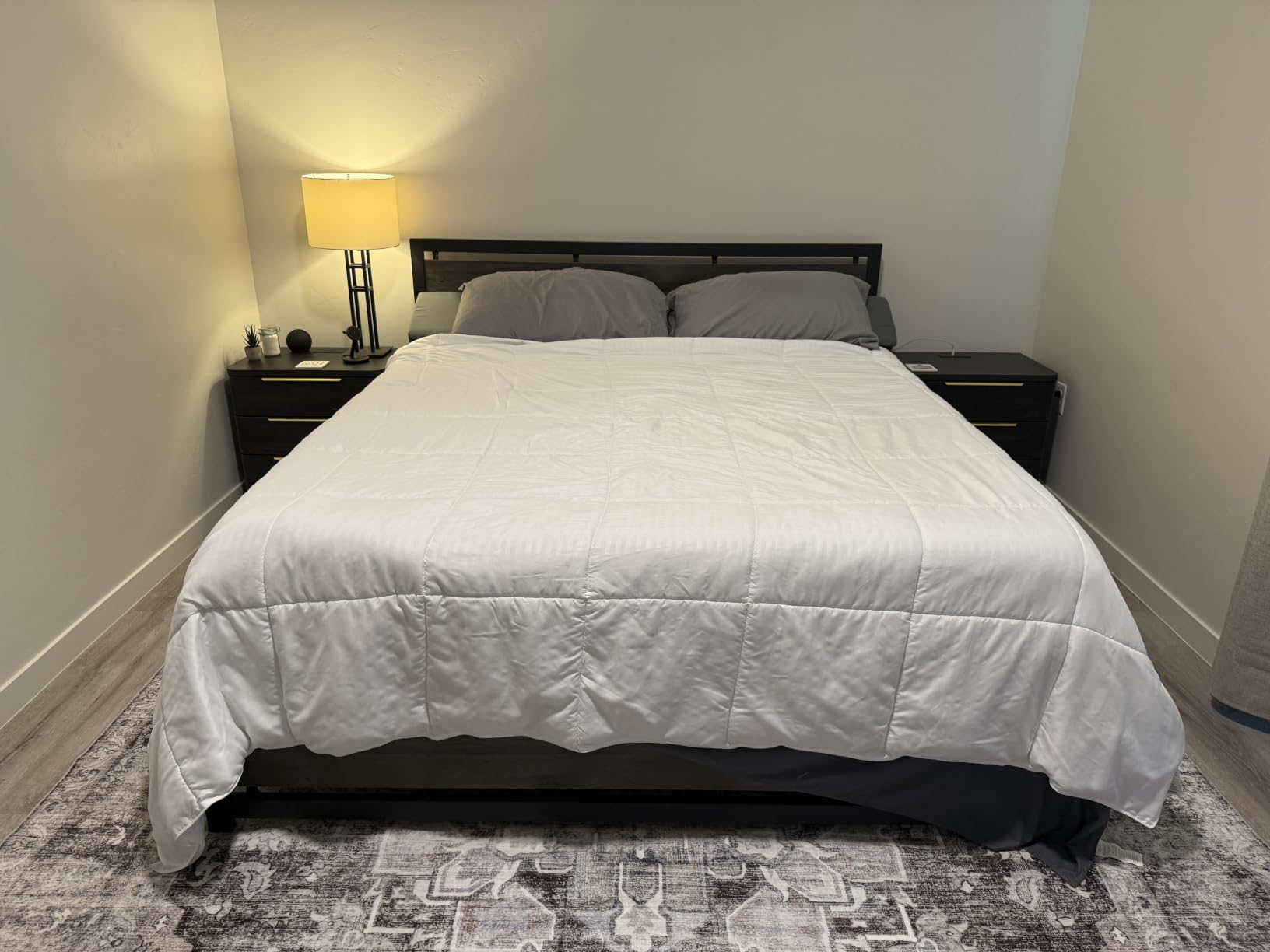
Close, but not always exactly. Some buyers report actual thickness measuring slightly under the stated 6 inches. This is normal for vacuum-compressed foam that has not finished expanding, and it is also worth measuring yourself if your guardrail clearance is tight. If your rail line is marginal, treat it as a 5.75-inch mattress and check the clearance on your specific frame.
The foam also needs close to the full 72 hours to air out and return to shape, which is longer than most of the picks here. Unbox it on a Friday and it should be ready by Monday.
Is it right for a heavier child?
The high-density layers hold spinal alignment well without the pit-forming sink that cheaper foam develops, so a child in the 130 to 200 pound range will do fine. Above that, a 6-inch profile starts to feel thin regardless of foam quality, and you would be better served by an 8-inch model in a frame with taller rails.
A few buyers also found the firmness labeling vague, describing the surface as softer than the medium label implied. Check the return window carefully if softness would disappoint you.
6. Zinus 6 Inch Twin Foam and Spring Hybrid Mattress – Best for Kids Who Hate a Soft Surface
Zinus 6 Inch Twin Foam and Spring Hybrid Mattress, Medium Firm Feel
6 inch profile
Twin 75 x 39 inches
Hybrid coil and foam
28.9 pounds
250 lb twin capacity
Pros
- Responsive springy feel without plush sink
- Holds up under larger body weights
- Minimal off-gassing reported
- CertiPUR-US and OEKO-TEX materials
- Ships in a smaller lower-carbon box
Cons
- Must never be flipped or coils are exposed
- Very springy for restless sleepers
- Twin capacity limited to 250 pounds
- Thin for daily full-time use
Some kids actively dislike memory foam. They call it mushy, they turn it over constantly, and they sleep better on something that pushes back. The Zinus hybrid is built for exactly that child: 350 interconnected heavy-gauge steel coils under a memory foam comfort layer, 6 inches thick, in a twin.
It rates 4.4 from about 2,600 ratings, and reviewers describe the balance in the same words over and over, supportive without feeling like a rock. Parents in budget mattress threads on r/MattressMod also point to the Zinus 6-inch foam and innerspring models as solid correctly sized options for kids’ bunks, and one commenter describes it as fitting the bunk bed frame perfectly.
Off-gassing gets almost no negative mention here, which surprises people who expect it from a bed-in-a-box. The box itself is smaller and lower-carbon than most, an odd detail to notice but a real one when you are hauling packaging out of a small bedroom.
It also comes in a 75 by 30 inch narrow twin, which is worth knowing if your loft bed or camper has a narrow deck. That dimension solves a fit problem no twin listing on this list addresses.
Why would you deliberately want a hybrid?
Three reasons. First, responsiveness: a child who changes position constantly gets lift rather than the slow sink of foam, which can reduce the tossing that wakes a sibling on the bunk below. Second, edge durability, since the coil core resists the collapse that all-foam surfaces show where a child sits. Third, airflow, because an open coil structure moves air through the mattress better than a solid foam slab.
If your child is around 100 to 150 pounds and complains that foam feels too soft, this hybrid is the most direct fix available at this thickness.
What is the hybrid catch?
Never flip it. A hybrid mattress is not flippable, and turning it over exposes the coils and permanently damages the comfort layer. Write it on the frame rail with a marker if you need to.
Second, the twin is rated to 250 pounds. That covers any child, but it means the twin is not the right pick for a bunk that doubles as a guest bed for an adult. Third, some restless sleepers find the bounce annoying rather than pleasant. And at 6 inches, the frame can still be felt through on some slat bases, so pair it with a bunkie board if that shows up.
7. LIFEMENT 6 Inch Twin Mattress for Kids – Best for Quiet Shared Bedrooms
LIFEMENT Twin Mattress for Kids, 6 Inch Twin Bed Mattress, Basic Graphite Cooling Memory Foam Mattress in a Box, Pressure Relief with Medium Firm Support, CertiPUR-US Certified, 75”L x 39”W
6 inch profile
Twin 75 x 39 inches
Three layer build
Medium firm
10 year warranty
Pros
- Graphite foam top layer runs cool
- Motion transition layer isolates movement
- Fiberglass free for kids rooms
- Highest five-star share in this group
- Cotton cover with CertiPUR-US and OEKO-TEX
Cons
- Thin so it suits lighter sleepers
- Plush top may feel too soft
- Cover is hand wash only
Noise is the quiet problem in a bunk room. When the bottom sleeper rolls over at 6am and the top sleeper has to be at school by 7, the mattress you choose matters as much as the frame. This LIFEMENT is built around that specific problem with a three-layer construction: a high-density base foam, a motion transition layer in the middle, and an open-cell graphite memory foam top.
That middle layer does the work. Reviews describe it as separating support, motion isolation and contouring so that a restless bedmate does not wake the child. It holds a 4.4 rating from about 1,240 ratings, with the highest share of five-star ratings of any pick in this group at 76 percent.
The graphite memory foam top improves airflow and pulls heat away from the body, which matters in a room where a bunk sits against a shared wall with no cross-ventilation. The outer cover is cotton, and the whole build is fiberglass free, a detail parents ask about for a child’s bedroom.
At 75 by 39 inches and 6 inches thick, it is a standard twin. The listing describes it as designed for kids’ bedrooms, bunk beds, trundles and daybeds, with a 10-year warranty, CertiPUR-US foam and an OEKO-TEX certified cover.
How much does the motion layer really matter?
On a shared bunk, quite a lot. Coils and thin foam transmit movement directly upward. A transition layer between the base and the comfort layer absorbs that energy before it reaches the sleeper above, which is why this build feels quieter than a two-layer foam mattress of the same thickness.
If your child sleeps on the top bunk directly over a sibling, this is the pick I would choose for them. If noise is not an issue in your room, the MLILY or the COOL GEL do the same job at similar thickness.
Who should pick something else?
Six inches suits lighter sleepers best, and heavier children can feel the frame through the surface. The top layer is described as plush, so a child who prefers a flat firm surface may find it soft.
Most important for bedwetting families: the cover is hand wash only. You cannot machine wash it, so use a waterproof protector over this mattress rather than under it.
8. MLILY 6 Inch Twin Mattress in a Box – Best for Fast Setup and Even Firmness
MLILY Twin Mattress in a Box, 6 inch Mattresses for Kids Bed Single Size Daybed Individual Bunk, Memory Foam Medium Firm
6 inch profile
Twin 75 x 38 inches
22 pounds
Firmness 6 to 7 of 10
750 lb capacity
Pros
- Highest average rating in this roundup
- Expands within about 2 hours
- Medium firm suits most body types
- CertiPUR-US foam with minimal off-gassing
- Fiberglass free cotton rib fabric barrier
Cons
- Thin profile for heavier sleepers
- Nylon cover is less breathable than knit
The MLILY carries a stated firmness of 6 to 7 out of 10, which makes it the easiest recommendation in this roundup to defend. Roughly 6 is medium-firm, the level pediatric sleep guidance generally points to for growing children, and it is the exact feel most parents describe wanting without knowing the term.
It holds a 4.5 average, tied for the highest rating here, from about 1,250 ratings, with 77 percent five-star ratings. Reviewers single out three things: the feel, the cooling gel, and the fact that it expands in about two hours rather than the 48 to 72 hours most foam mattresses ask for.
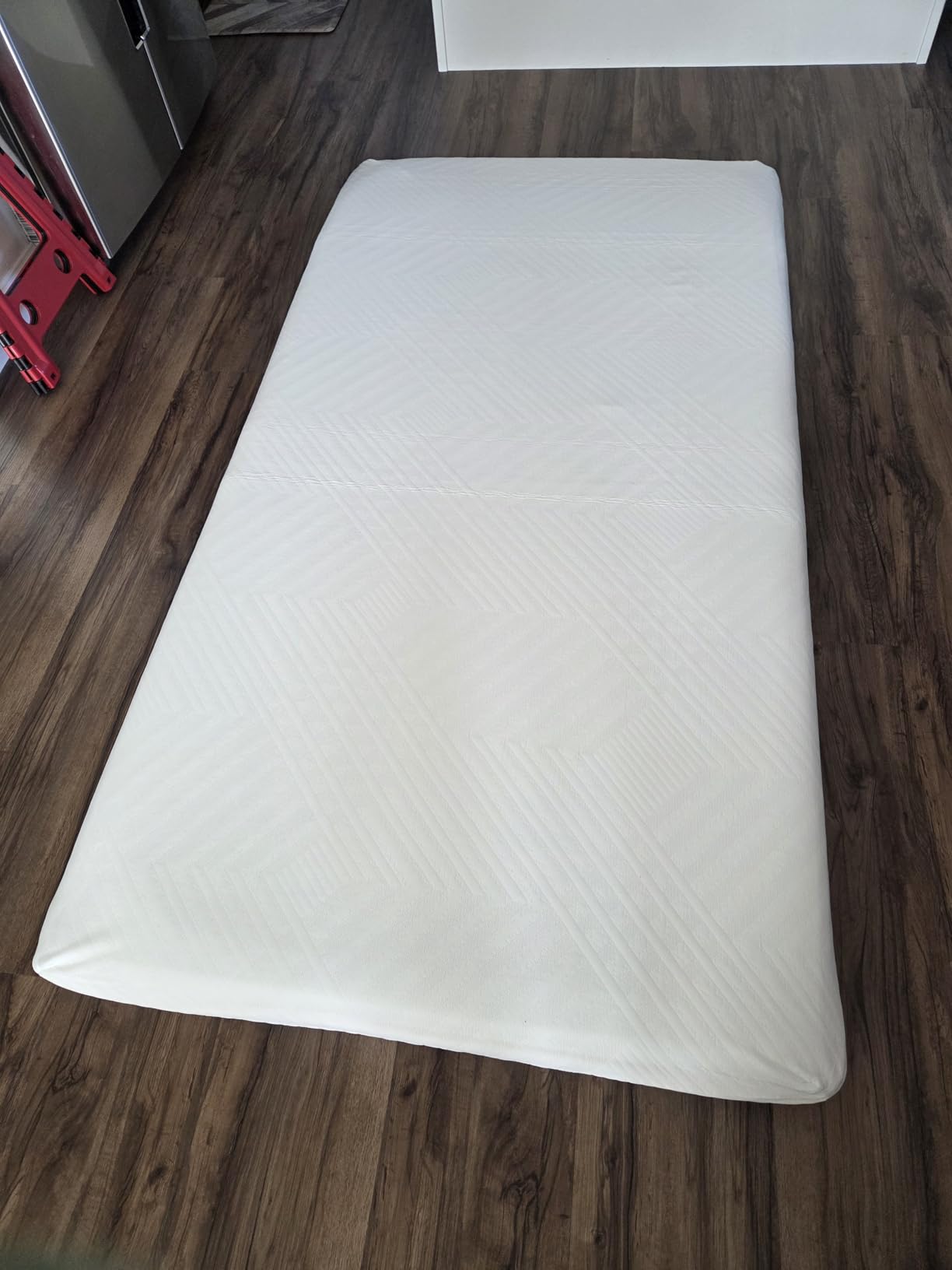
That two-hour expansion is the practical headline. If you are assembling a bunk on a Saturday afternoon, this is the one that is sleepable that night. More than 90 percent of orders are fulfilled by factories in the United States, and the foam carries CertiPUR-US certification with minimal off-gassing.
The inner fire barrier is a fiberglass-free rib fabric made of 92 percent cotton and 8 percent polyester, which is worth noting in a child’s room. Fiberglass barriers have drawn parent concern for years, and this build avoids them.
Why does the firmness number matter here?
Because it removes the guesswork. Almost every complaint in this roundup involves a child finding the surface softer or firmer than expected, and almost every marketing label is subjective. A published 6 to 7 out of 10 gives you something you can compare against the model you already own or against reviews of a competitor.
A child in the 130 to 200 pound range will find this the most comfortable of the twin foam options, because it is on the firmer side without being punishing.
What should you watch for?
Six inches is thin for heavier sleepers. A child over 200 pounds, or any adult using this bunk as a guest bed, will feel the base. In that case plan for a bunkie board and consider whether your frame has the rail clearance for an 8-inch mattress.
The nylon cover is also less breathable than a knitted fabric cover. In a hot room, expect more warmth than the LIFEMENT cotton cover or the Novilla quilted knit, even though the gel infusion offsets some of it.
9. Amazon Basics 6 Inch Memory Foam Mattress (Twin) – Best for Side Sleepers
Amazon Basics Memory Foam Mattress, Soft Plush Feel, Breathable, 6 Inch, Twin, White/Grey
6 inch profile
Twin 75 x 39 inches
Plush feel
18.9 pounds
3 layers
Pros
- Softest surface in the roundup for side sleepers
- Two inches of gel memory foam for pressure relief
- Removable zip-off knitted cover
- Wave middle layer improves airflow
- Light and easy to move in tight hallways
Cons
- Plush feel runs warmer
- Limited edge support
- Cover is spot clean only
Every other pick here is a firmer build, so this one earns its place by being different. The Amazon Basics uses 2 inches of gel memory foam over 4 inches of flex comfort support foam, giving the softest surface in the group. For a side sleeper child whose shoulder and hip press into the mattress, that softness is the whole point.
It rates 4.4 from about 8,100 ratings, and buyers describe cloud-like comfort, a breathable knitted cover, and heavy use in kids’ rooms and dorms. With thousands of ratings behind it, its failure modes are well documented too.
The wave-shaped support layer in the middle is there to open up airflow, and the cooling gel distributes body weight to reduce pressure at the shoulder, spine and hip. At 18.9 pounds it is one of the lighter mattresses here, which makes lifting it onto a top bunk manageable.
The cover is a premium knit with a bottom zipper that removes completely, even though the care instructions still call for spot cleaning rather than machine washing. Being able to unzip it makes cleaning far easier than a fixed cover, but plan on hand washing rather than a washing machine.
When is plush the right call?
When the child is a side sleeper, particularly a lighter one. Side sleeping concentrates pressure on the shoulder and hip, and a firmer surface pushes back against those points instead of letting the mattress wrap around them. A 6-inch medium-firm mattress is still workable, but a plush surface does more for pressure relief at the same thickness.
It is also the most forgiving pick for a child moving from a crib or toddler bed, where the transition to a flatter surface is often the hard part.
Where plush works against you
Three places. First, heat: plush foam traps warmth more than a firm gel surface, so a child who sleeps hot will be more comfortable on the COOL GEL or the EGOHOME. Second, edge support is limited at this thickness, so a child who sits on the edge will feel it. Third, a plush surface is a poor match for a bunk where the child is still growing quickly, because they will outgrow the comfort sooner.
And the profile is still 6 inches, so it does nothing for guardrail clearance. Softness and thickness are separate problems.
10. COOL GEL 6 Inch Memory Foam Mattress (Twin XL) – Best for Heavy Sleepers and Hot Rooms
COOL GEL 6 Inch Memory Foam Mattress, Twin XL, Kids Mattress
6 inch profile
Twin XL 80 x 39 inches
27 pounds
Medium feel
1000 lb capacity
Pros
- Open cell gel foam draws heat away
- Built specifically for bunk guardrail clearance
- Holds shape under heavier sleepers
- Lowest 1-star share in this group
- CertiPUR-US foam and fiberglass free barrier
Cons
- Corners can take longer to reach 6 inches
- Thin for adult side sleepers
- Heavier sleepers may feel the frame
This is the pick for a bunk that has to work for two very different sleepers, or for a child who is already on the heavier side. It carries a 4.5 average from about 7,400 ratings with the lowest one-star share of any pick here at roughly 3 percent, and reviewers repeatedly mention that it holds its shape under heavier bodies without bottoming out.
The construction is open-cell gel memory foam over a high-density base, described as medium firm, with a listed capacity of 1,000 pounds. It is made in the USA with CertiPUR-US certified foam and a fiberglass-free fire barrier. At 80 by 39 inches it is a twin XL, so it fits an 80-inch frame and leaves a 5-inch gap at the foot of a standard 75-inch twin deck.
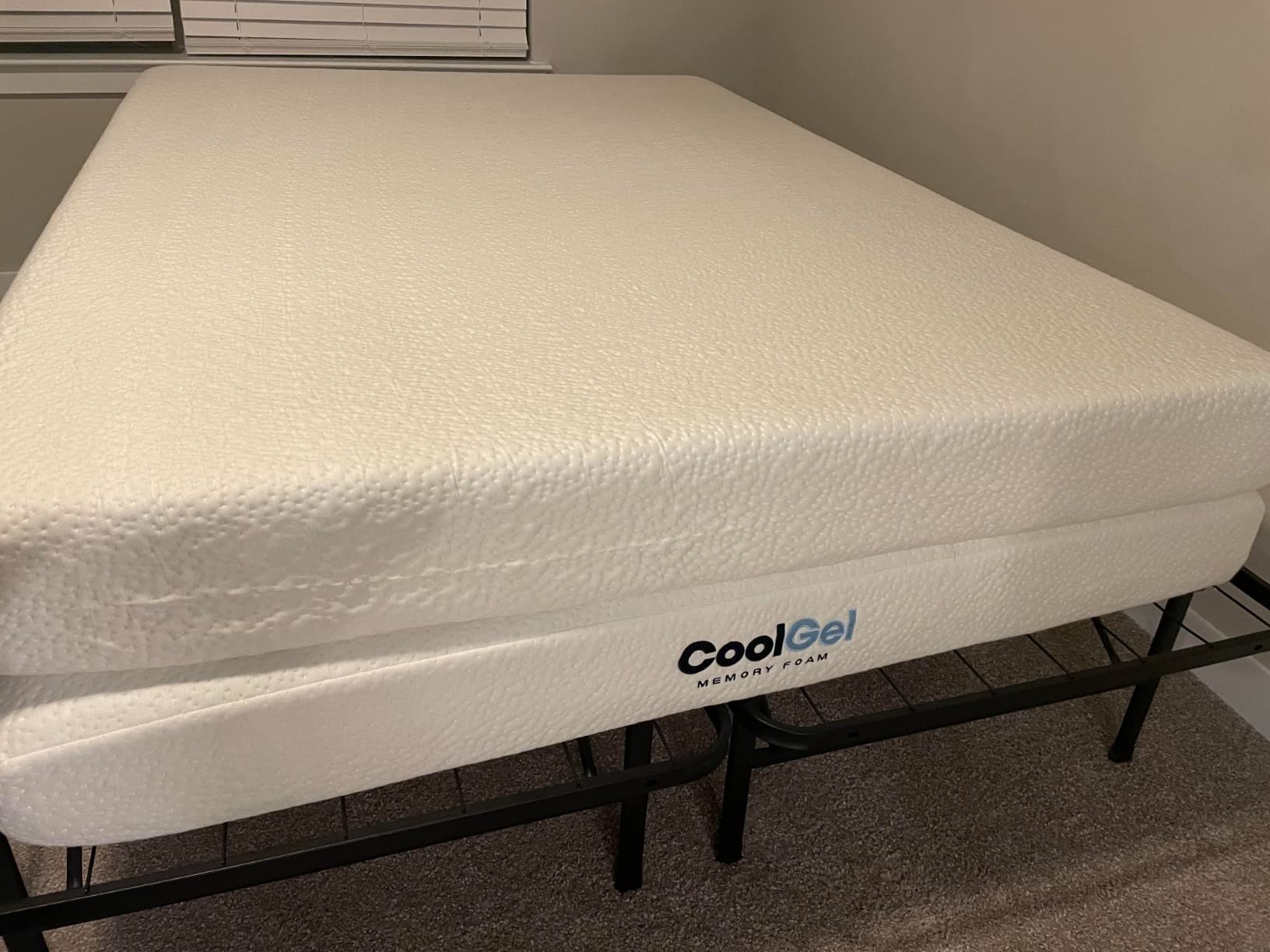
Cooling is the headline feature and reviewers back it up. Night sweats come up repeatedly as the problem it solved. The open-cell structure pulls heat away rather than sealing it in, which is why it performs better in a warm room than a closed-cell foam of the same price.
It is also the only pick here described by the manufacturer as designed around guardrail clearance on bunk beds, trundles and daybeds. That framing is exactly what a bunk shopper should be filtering for.
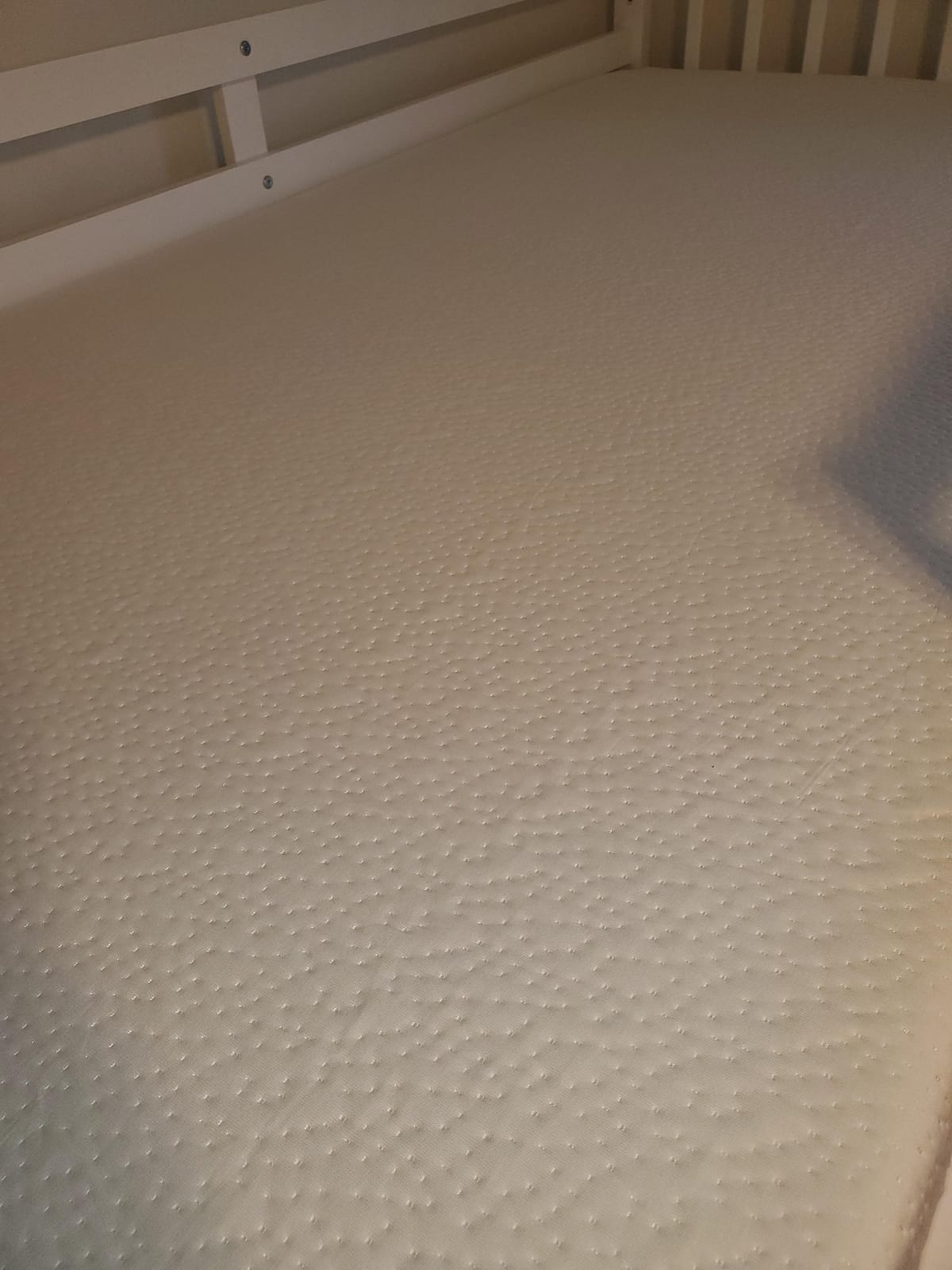
Can a 6-inch mattress handle a heavier child?
Better than most in this roundup, yes. The 1,000-pound listed capacity and the high-density base mean a child in the 200-pound range will not sink through. The Novilla and the Zinus hybrid also handle that weight, but the Zinus twin is capped at 250 pounds and the Novilla is thinner-feeling under load.
If your child is over 200 pounds and the mattress still feels thin, the real answer is height rather than a firmer foam. Check whether your frame has room for an 8-inch model before buying again.
What about the corners?
The most common complaint is that the corners of the vacuum-compressed mattress take longer to reach the full 6 inches. It needs up to 72 hours of expansion, and the corners are the last place to finish. Measure the rail clearance after a full three days rather than on day one.
Also note it is thin for adult side sleeping and heavier sleepers can still feel the frame through the surface. For a bunk doubling as a guest bed for an adult, this is not the mattress.
Bunk Bed Mattress Buying Guide
The buying decision for a bunk mattress comes down to four things in order: how thick it is, whether it fits the frame, how firm it feels, and whether you can clean it. Everything else is preference. Here is how each one actually resolves.
How thick should a bunk bed mattress be?
Aim for 6 inches, and stay under 8 inches. Five inches is the bare minimum many budget frames accept, and 6 inches gives a child enough support layer under the hip without pushing the mattress surface up toward the rail. Above 8 inches you start trading headroom and guardrail clearance for comfort your child may not notice.
The reason is the clearance rule. Federal guidance expects the top of the guardrail to sit at least 5 inches above the mattress surface, with no gap larger than 3.5 inches between the mattress and the rail. A thicker mattress eats that margin from both sides at once.
Which mattress size fits your bunk bed?
Match the mattress to the frame’s interior dimensions, not the brand name. A standard twin is 38 by 75 inches, a twin XL is 38 by 80, and a full is 54 by 75. A mattress much smaller than the deck will leave gaps at the sides, and a mattress longer than the deck can push against the rail or wall.
By bunk style: standard two-tier and L-shaped bunks take a twin or twin XL. Loft beds take a twin, twin XL or full depending on width, and full lofts need a full-width frame. Trundle beds take a twin, usually a standard 75-inch. Triple and triple-loft bunks take a twin on every deck. Futon-style bunks take a full. Narrow-deck lofts and camper bunks sometimes need the 75 by 30 inch narrow twin, which is why the Zinus narrow twin is worth noting.
Firmness by age and sleeper weight
Medium-firm, roughly 6 out of 10, is the target for almost every child. Softer surfaces let the midsection sink and curve the spine; firmer surfaces can create pressure points on a light sleeper’s shoulder and hip.
By age band: ages 3 to 5 should be on the firmer end, medium-firm to firm, because they are lighter and roll less. Ages 6 to 9 sit comfortably at medium-firm. Ages 10 to 12 can handle medium to medium-plush. Ages 13 and up can move to medium or plush if they prefer it.
By sleeper weight, which matters more than age in most cases:
Under 130 pounds: medium-firm to firm. These children can bottom out on a plush 6-inch mattress, and they need the push-back to keep their hips level.
130 to 200 pounds: medium-firm is the sweet spot. This is where the MLILY at 6 to 7 out of 10 and the LUCID sit, and both hold up well.
Over 200 pounds: move up to medium, and consider 8 inches of thickness if your frame allows it. The COOL GEL and the Zinus hybrid are the two picks here rated for that band.
Foam, hybrid or innerspring for a kids’ bunk?
All three work. What differs is how they behave over a childhood.
All-foam memory foam is quiet and isolates motion best, which matters when a sibling sleeps below. It is also the most likely to compress at the edge where a child sits to tie shoes, and it retains heat more than the other two. Pick foam for a bottom bunk and for kids who are light sleepers.
Hybrid puts a memory foam comfort layer over a coil core. It responds faster, breathes better, and resists edge collapse. The tradeoff is that it is never flippable and it can be bouncy enough to bother some sleepers.
Innerspring is the most durable of the three and the least likely to develop a permanent dent. It is also the springiest and the least contouring, so side sleepers tend to like it least. The Linenspa is the pick in this category.
Certifications worth looking for
Three labels do real work. CertiPUR-US means the foam was tested by a third party for ozone depleters, PBDEs, TDCPP and TCEP flame retardants, lead and other heavy metals, and volatile organic compounds, and it limits off-gassing. GREENGUARD Gold certifies low chemical emissions and low emissions from building materials for indoor air quality. OEKO-TEX Standard 100 applies to the cover fabric and means it has been tested for harmful substances.
For a child’s bedroom, CertiPUR-US is the floor and OEKO-TEX on the cover is a bonus. Nine of the ten picks here carry CertiPUR-US foam. Organic cotton covers are a separate category and address what the cover is made of rather than what the foam emits.
Guardrail clearance and bunk bed age minimums
Two rules to have in your head. The guardrail must rise at least 5 inches above the mattress surface, and no gap between the mattress and rail should exceed 3.5 inches. Measure with the mattress in place, not from the empty frame. With a 6-inch mattress on a frame designed for a 6-inch mattress, both conditions are normally met.
If you already own a mattress that sits too high, measure the gap from the mattress surface to the top of the rail. If it is under 5 inches, your options are to flip the mattress if it is flippable, add a bunkie board to the slats to raise the deck so the mattress sits lower in the frame, or replace the mattress. A fitted sheet does not change the number. Raising the deck with a board is the fix most people do not know about.
On age minimums, most bunk bed manufacturers state that top bunks are not intended for children under 6, and parents on r/Parenting repeat that instruction as the clearest guidance available. A child can be 7 and physically ready, but a 7-year-old on a top bunk still needs the ladder-clearance, weight and maturity checks that come with it. The manual for your specific frame is the authority.
Washable covers, spills and bedwetting
For a bedwetting child, buy the mattress with the removable machine washable cover rather than relying on a protector. The FDW is the only pick in this roundup whose cover goes straight into a washing machine. Everything else is spot clean only or hand wash only.
If you pick a different mattress, add a waterproof encasement that zips fully around the foam. A protector with a quiet membrane will stop liquid from reaching the foam; an encasement also stops smells from getting into it. Once bedwetting stops, you can move down to a thinner protector and keep the mattress. If a fitted sheet keeps popping off a 6-inch mattress, that is usually because the sheet pocket depth is deeper than the mattress, so look for a sheet fitted for a 6-inch profile.
Mattresses to stay away from
Anything thicker than 8 inches on a top bunk. It eats the required 5 inches of rail clearance and reduces headroom to the point of discomfort.
Unflippable hybrids sold as flippable. Turning a coil-over-foam mattress exposes the coils and ruins the feel permanently.
Mattresses with no stated CertiPUR-US or GREENGUARD certification. In a small shared bedroom with limited airflow, off-gassing does not dissipate quickly.
Undersized mattresses for the deck. A mattress much narrower than the frame leaves a gap at the side that a small child can roll into.
Anything without a warranty worth the name. The FDW carries 3 months. Every other pick here carries 10 years or 10-year protection.
Used or open-box mattresses without a barrier. Foam degrades in sunlight, and an old bunk mattress from a resale listing may have been stored against a wall for years.
Frequently Asked Questions
What mattress do you use for bunk beds?
What mattress to stay away from?
Is it better for kids to sleep on a firm or soft mattress?
Can a 7 year old sleep in a bunk bed?
Is a 6 inch mattress good for bunk beds?
How thick should a twin mattress be for a bunk bed?
The Bottom Line on Bunk Bed Mattresses for Kids
The best bunk bed mattresses for kids share one trait: they are 6 inches thick and they stay below the guardrail. That single constraint decides most of the decision, and everything after it is about matching construction to your child’s weight, sleep position and accident history.
Our top pick, the Linenspa 6 Inch Twin XL, wins on durability and review depth, with a coil core that survives years of edge sitting on the bottom bunk. The LUCID 6 Inch Gel Memory Foam is the balanced all-round buy and the lightest to lift onto a top frame. The FDW 6 Inch Twin covers the washable-cover case for the cheapest. The COOL GEL handles heavier sleepers and hot rooms, and the Novilla is the one to buy for a slat-supported loft bed.
Before you buy, measure the rail clearance with the mattress in place and read our guide to bed sheets for deep pocket mattresses if you plan to add a topper. If your child sleeps hot, our look at smart mattresses for temperature control is worth a read, and adults using a bunk as a guest bed can start with our hybrid mattress picks.
Tell us your budget, your child’s age and weight, and whether it is a top or bottom bunk, and we can narrow this to one pick.