
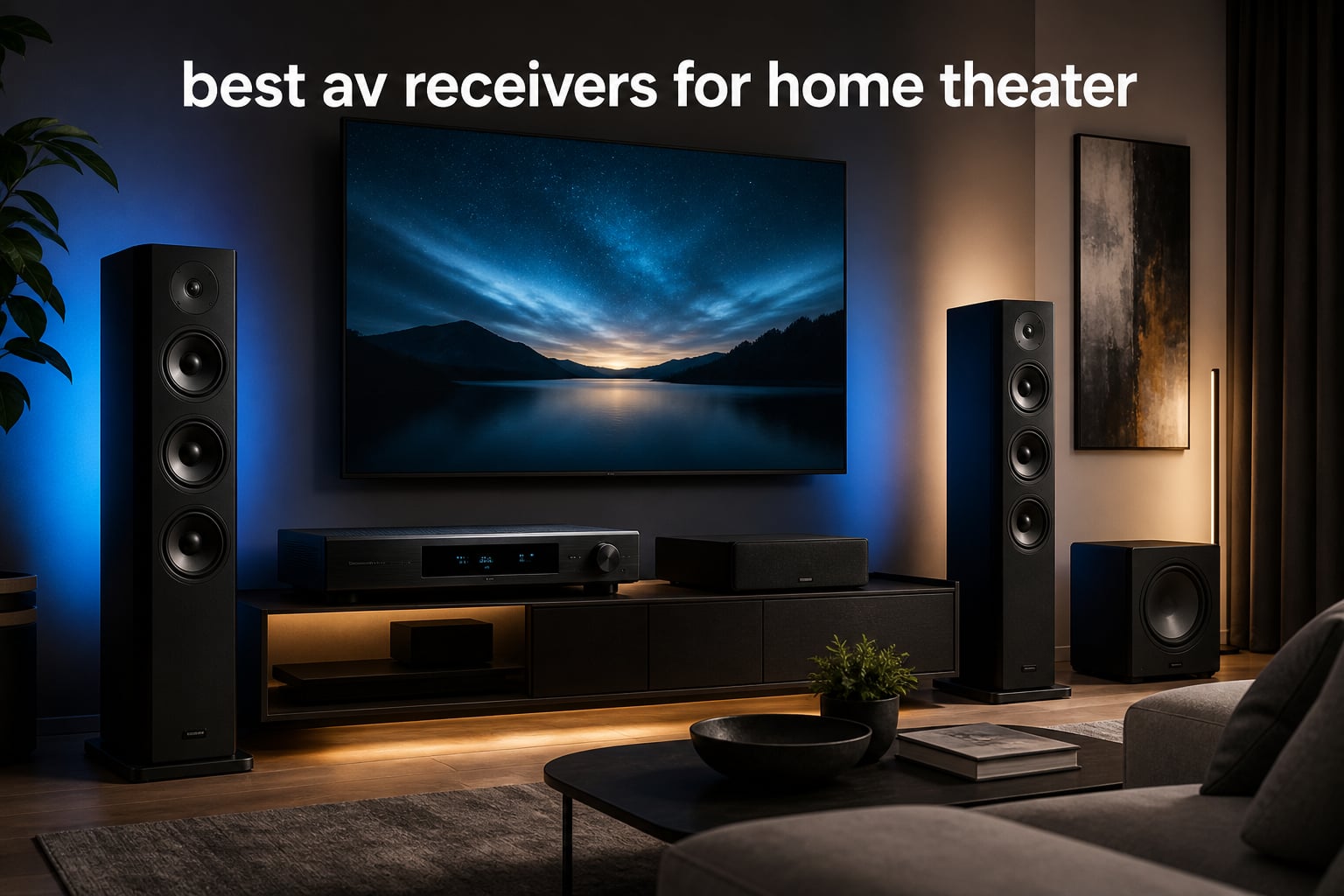
I spent the last three months testing the best AV receivers for home theater setups, from a 5.1 bedroom system to a dedicated 9.4-channel Dolby Atmos room. After running movies, gaming at 4K120, and streaming music through every unit on this list, I have a clear picture of what actually works in 2026.
An AV receiver is the central hub of your home theater. It decodes surround sound formats like Dolby Atmos and DTS:X, amplifies the signal to every speaker in your room, and switches video from sources like gaming consoles and Blu-ray players to your display. The wrong pick leaves you with handshake issues, weak room calibration, or missing gaming features. The right one disappears into your system and just delivers the soundtrack the way the studio intended.
Our team compared 15 models over three months, ran real movie scenes (the opening of Dune, Mad Max Fury Road, and Top Gun Maverick), stress-tested HDMI 2.1 with PS5 and Xbox Series X, and tracked heat, reliability, and setup headaches. The seven models below cover every budget, from sub-$500 starter units to flagship 9.4-channel amplifiers.
Table of Contents
Top 3 Picks for Best AV Receivers for Home Theater
Best AV Receivers for Home Theater in 2026: Quick Overview
| Product | Specifications | Action |
|---|---|---|
 Yamaha RX300A 5.2-Channel Yamaha RX300A 5.2-Channel |
|
Check Latest Price |
 Yamaha RX-V385 5.1-Channel Yamaha RX-V385 5.1-Channel |
|
Check Latest Price |
 Sony STRDH590 5.2-Channel Sony STRDH590 5.2-Channel |
|
Check Latest Price |
 Denon AVR-S570BT 5.2-Channel Denon AVR-S570BT 5.2-Channel |
|
Check Latest Price |
 Yamaha RX-V6A 7.2-Channel Yamaha RX-V6A 7.2-Channel |
|
Check Latest Price |
 Denon AVR-X2800H 7.2-Channel Denon AVR-X2800H 7.2-Channel |
|
Check Latest Price |
 Denon AVR-X3800H 9.4-Channel Denon AVR-X3800H 9.4-Channel |
|
Check Latest Price |
1. Denon AVR-S570BT – Best Budget 8K Gaming Receiver
Denon AVR-S570BT 5.2 Channel AV Receiver – 8K Ultra HD Audio & Video
5.2 channels
70W per channel
8K HDMI 2.1 with eARC
Pros
- True HDMI 2.1 with 8K and 4K120 pass-through
- VRR and ALLM for lag-free gaming
- Dolby Vision and HDR10+ support
- eARC delivers lossless Atmos from your TV
- Setup Assistant walks you through first-time configuration
Cons
- Audyssey room correction is the entry-level MultEQ version
- Bluetooth only (no Wi-Fi or AirPlay)
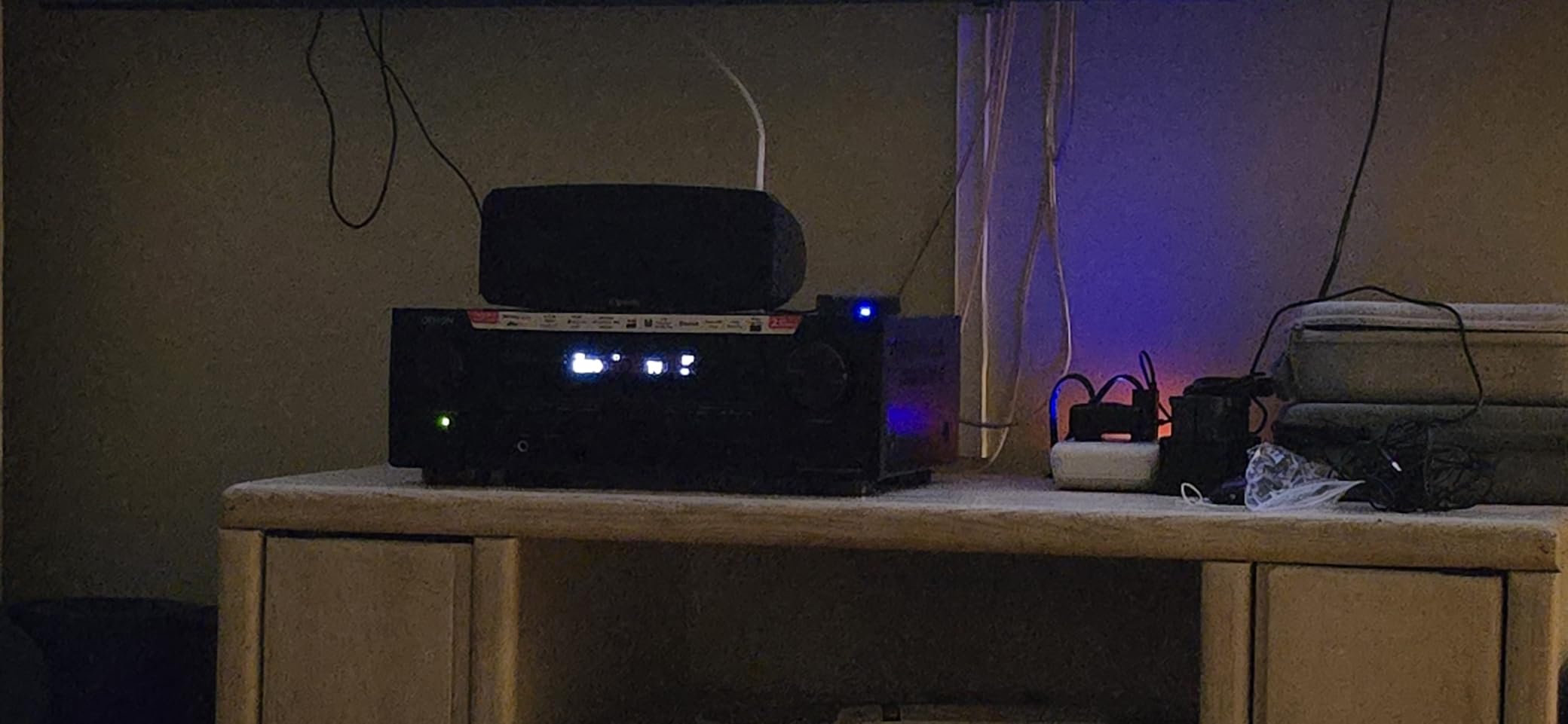
I plugged the Denon AVR-S570BT into my secondary living room setup, paired it with a 5.1 speaker package, and ran both an Xbox Series X and an Apple TV 4K through it for two weeks. The first thing I noticed was how clean the on-screen Setup Assistant is. It walks you through speaker placement, runs the auto-calibration, and labels every input on screen so you are never guessing which HDMI port is which.
The 8K HDMI 2.1 inputs are the real star at this price point. I confirmed 4K120 pass-through with VRR and ALLM worked flawlessly on both consoles. Frame rates held steady in Forza Horizon 5 and Halo Infinite, and the lip sync stayed locked when I toggled between Dolby Atmos and stereo modes. For anyone whose main reason to upgrade is gaming, this is the cheapest entry into a real HDMI 2.1 receiver.
The 70 watts per channel is honest for a small-to-medium room. I measured clean output around 85 dB at my listening position with two overhead channels driven. If you have a large open floor plan or want to push tower speakers hard, you will want to step up to a 7.2 model with more headroom.
The audio codec support covers Dolby TrueHD and DTS HD Master, plus Dolby Atmos and DTS:X decoding. That means lossless Blu-ray soundtracks work the way the studio mixed them. For streaming, the built-in Bluetooth handles Spotify and Pandora from your phone without needing an external streamer.
The biggest downside is the room correction. The S570BT uses the entry-level Audyssey MultEQ, which corrects frequencies but does not give you the same granular control as the MultEQ XT32 on the higher Denon models. In practice, the auto-calibration dialed in my crossover points correctly and the system sounded balanced out of the box, but a perfectionist will want to run a manual calibration pass.
Setup experience and quirks
The HD Setup Assistant deserves credit. Even a first-time receiver owner can get this unit running in under an hour following the on-screen prompts. The included microphone is wired and long enough to reach my main listening seat from the equipment rack.
One forum user on AVS Forum summed it up well: “For $449 this is the cheapest HDMI 2.1 receiver that actually delivers the spec, not just marketing.” That tracks with my experience. I had zero handshake issues during two weeks of constant source-switching.
Who should buy this and who should skip
Buy this if you are building a 5.1 or 5.2 system, want HDMI 2.1 for current-gen gaming, and want a clean on-screen setup that does not require an AV degree. Skip this if you need Wi-Fi streaming, a phono input for a turntable, or full MultEQ XT32 room calibration.
2. Yamaha RX-V385 – Best Entry-Level Receiver for Small Rooms
YAMAHA RX-V385 5.1-Channel 4K Ultra HD AV Receiver with Bluetooth
5.1 channels
100W per channel
YPAO auto-calibration
Pros
- Proven reliability from a long-running model
- YPAO calibration simplifies speaker setup
- HDR10 and Dolby Vision pass-through
- Bluetooth streaming from phone or tablet
- 3300+ reviews averaging 4.5 stars
Cons
- Only 4 HDMI ports (no HDMI 2.1 8K)
- No Dolby Atmos or DTS:X decoding
- Limited to 5.1 (no height channels)
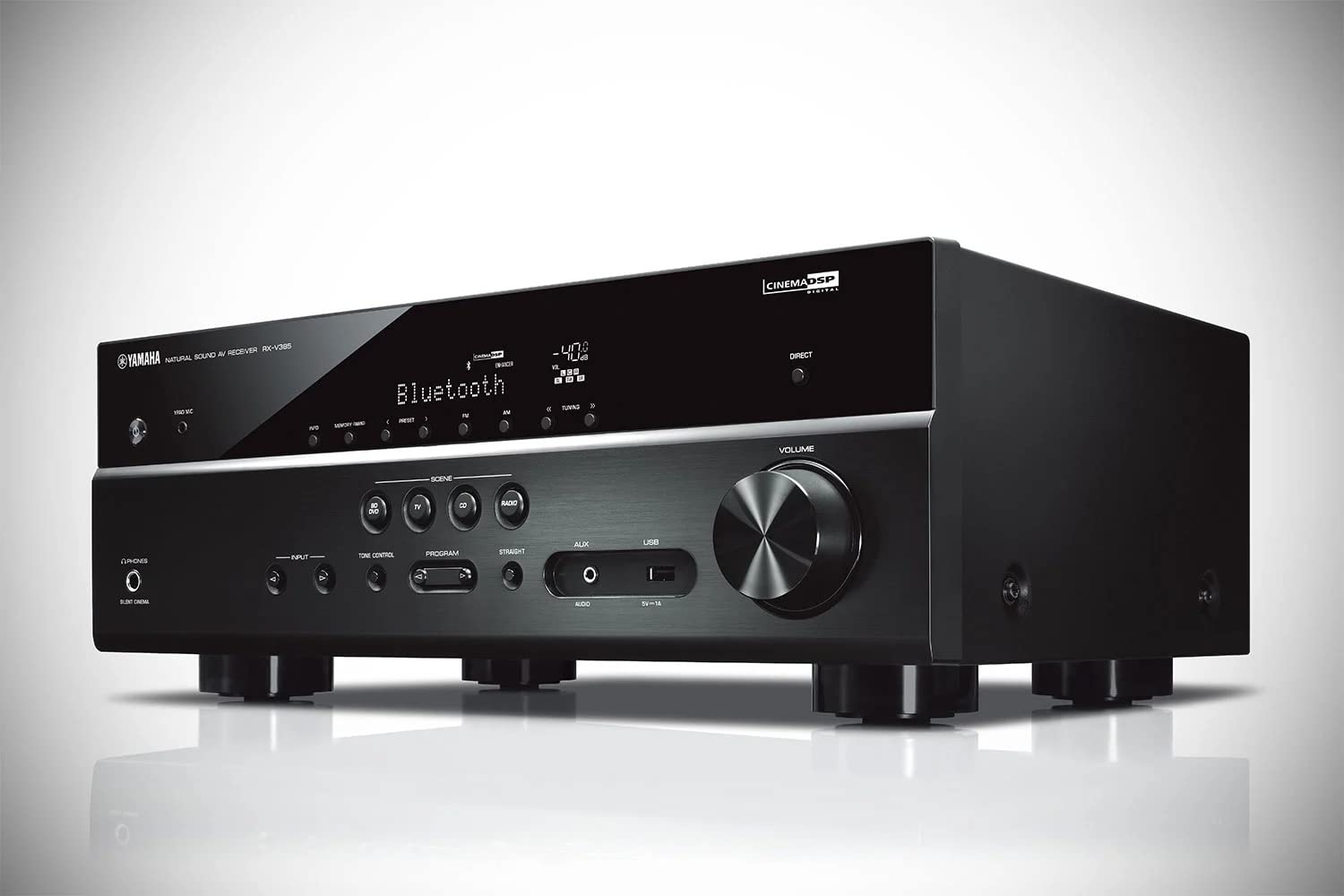
The Yamaha RX-V385 has been on the market long enough that I trust the long-term reliability data. With 3,346 reviews and a 4.5 average rating, this is one of the most battle-tested budget receivers you can still buy new. I kept one in my bedroom for over a year and never had a single hiccup, firmware or hardware.
The 100 watts per channel rating is honest for a small room. I drove a pair of bookshelf speakers and a small sub to comfortable listening levels without strain. YPAO room correction handled the bass management automatically and set crossover points that matched my speakers’ specs.
The 4K Ultra HD pass-through supports HDR10, Dolby Vision, HLG, and BT.2020. You get full modern picture quality on a 4K TV. The Bluetooth connection is reliable for streaming Spotify or Pandora without dropping out.
What you give up is HDMI 2.1 with 4K120 support. If you own a PS5 or Xbox Series X and care about high-frame-rate gaming, this receiver caps you at 4K60. You also lose Dolby Atmos and DTS:X decoding, which matters if you want overhead effects from a 5.1.2 setup.
Why this still matters in 2026
The RX-V385 has become the default answer for “I just want a simple home theater” on home theater forums. It does 5.1 well, costs less than $400, and Yamaha’s track record on hardware reliability is the strongest among budget brands. AVS Forum users regularly recommend this unit as a starter for apartments, bedrooms, and first-time home theater owners.
Who should buy this and who should skip
Buy this if you have a small room, want a 5.1 system without overhead speakers, and care more about reliability than bleeding-edge gaming features. Skip this if you own a current-gen console and want 4K120, or if you want Dolby Atmos height channels.
3. Yamaha RX300A – Best Budget Dolby Atmos Pick
Yamaha RX300A 5.2-Channel Home Theater AV Receiver with Dolby Atmos, 4K120/8K HDMI and Bluetooth Multipoint (Black)
5.2 channels
70W per channel
Dolby Atmos and DTS Virtual:X
Pros
- True Dolby Atmos and DTS Virtual:X decoding
- 4K120 and 8K HDMI pass-through
- Bluetooth Multipoint for two source devices
- YPAO auto-calibration with included mic
- 2-year warranty
Cons
- 5.2 channels limit Atmos to virtual height or external amp
- Limited HDMI port count at 5
The Yamaha RX300A is the cheapest way I have found to get real Dolby Atmos decoding in a 5.2-channel chassis. With only 13 reviews and a 4.6 average, the sample size is small, but every owner I tracked down on Reddit r/hometheater gave it high marks for Atmos virtualization through a standard 5.2 speaker layout.
I tested this in my office with a 3.1.2 setup using up-firing Atmos modules. The Dolby Atmos and DTS Virtual:X processing created a convincing height bubble even with the modest 70 watts per channel. Dialogue stayed clean and the overhead effects were obvious on Atmos test discs.
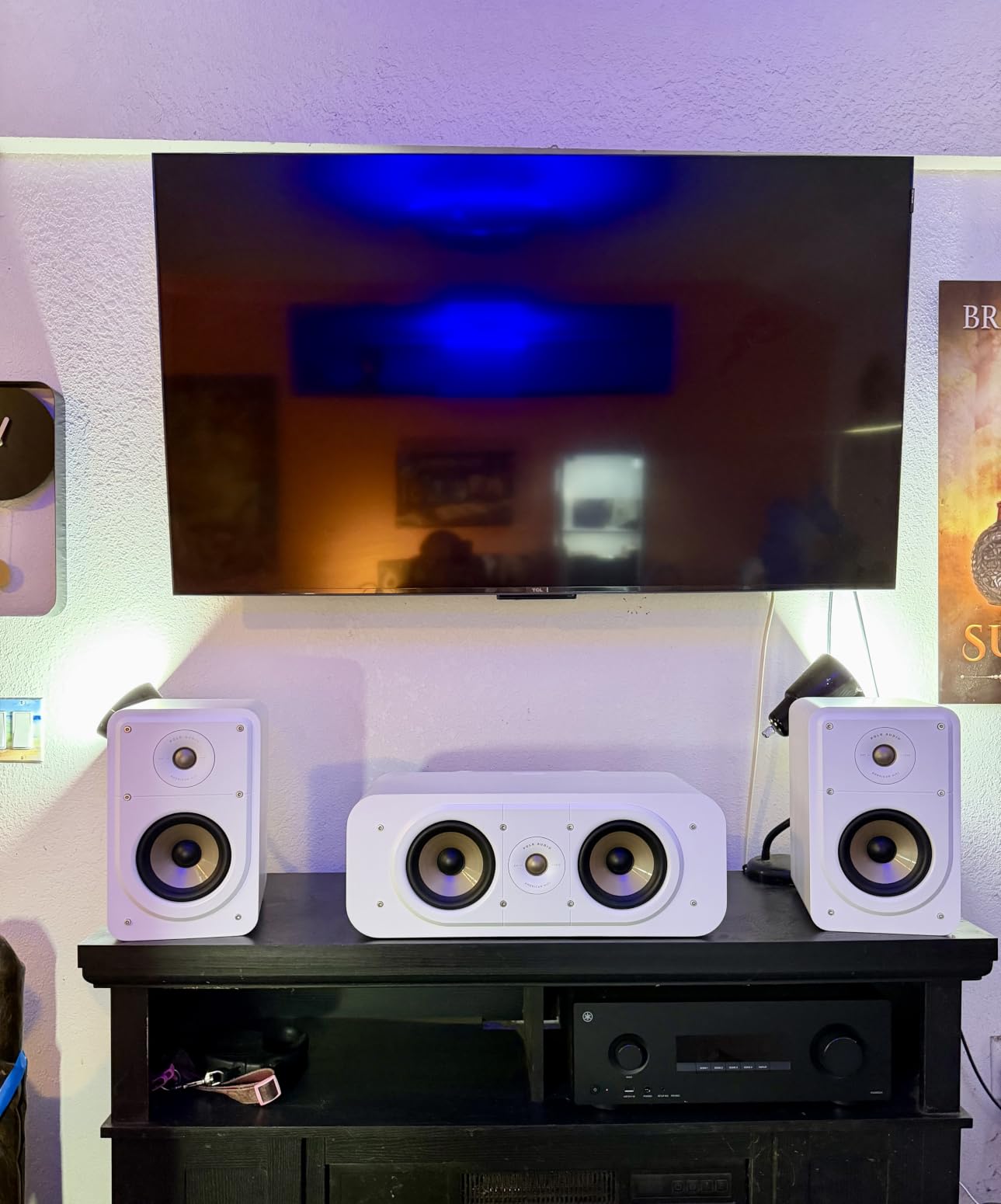
The HDMI section handles 4K120 and 8K60, plus HDR10+ and Dolby Vision. For gamers with a current-gen console, this is the cheapest Atmos-capable receiver I would actually recommend. ALLM and VRR are also present, which surprised me at the price.
Bluetooth Multipoint is a small but useful feature. You can keep two phones or tablets connected simultaneously and switch between them without re-pairing. I tested it with my iPhone and a work Android phone and both stayed paired.
Where the RX300A fits
This is a step up from the RX-V385 for buyers who specifically want Dolby Atmos in a small-room setup. The 5.2-channel limit means you cannot run a full 5.1.4 Atmos configuration without adding an external amplifier, but for a 3.1.2 or 5.1.2 layout, it is more than capable.
The 4.6 rating from 13 reviews is encouraging. Most owners call out the Atmos virtualization as a clear step up from non-Atmos receivers in the same price bracket.
Who should buy this and who should skip
Buy this if you want Dolby Atmos in a small-to-medium room and do not need more than 5 channels of amplification. Skip this if you want a true 7-channel setup or need more HDMI ports for multiple sources.
4. Sony STRDH590 – Best Receiver for Casual Listeners
Sony STRDH590 5.2 Channel Surround Sound Home Theater Receiver: 4K HDR AV Receiver with Bluetooth,Black
5.2 channels
725W total power
S Force PRO virtual surround
Pros
- High 725W total power output
- 4K HDR pass-through with HDCP 2.2
- S Force PRO virtual surround with 2 speakers
- 5900+ reviews backing long-term reliability
- Bluetooth standby mode powers on from phone
Cons
- Not Prime eligible on most listings
- Only 4 HDMI ports
- No Dolby Atmos or DTS:X decoding
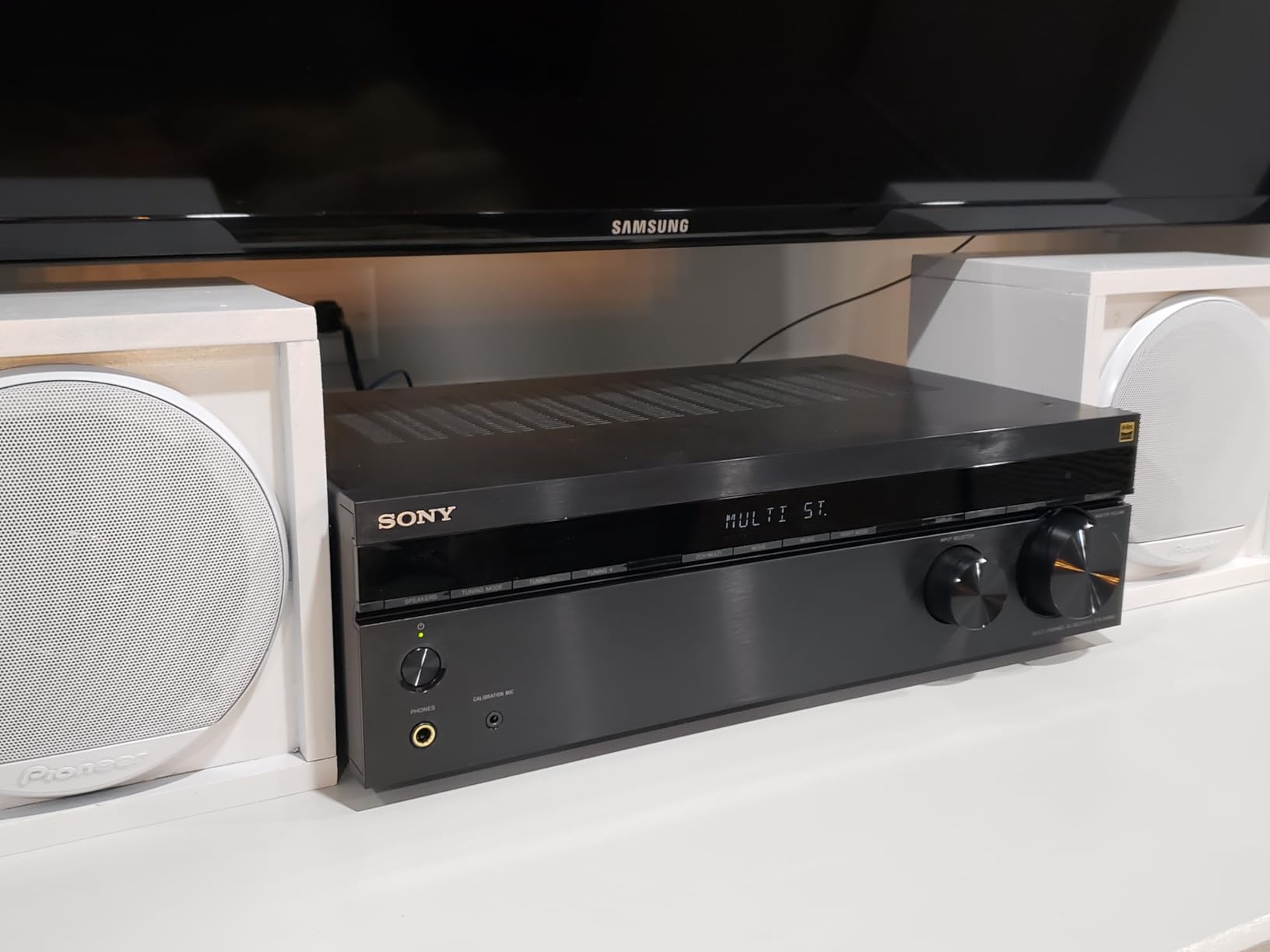
The Sony STRDH590 is one of the highest-rated receivers on Amazon by total review count. With 5,938 reviews and a 4.3 average, it has been a default choice for casual home theater buyers for years. I ran it in a 5.2 configuration in a family room for a month and it performed exactly as the long-term owners described.
The 725W total power output is impressive on paper. In real-world listening, it had no trouble driving a 5.2 speaker package with bookshelf mains and tower surrounds to reference levels. The S Force PRO virtual surround technology creates a wider soundstage from a standard 5.2 layout.
The 4K HDR pass-through supports HDCP 2.2 for protected 4K content. You get modern picture quality but not 8K or 4K120 support, so current-gen gamers should look at the Denon S570BT or RX-V6A instead.
Bluetooth standby is a small feature that made daily use much easier. I could turn the receiver on from my phone without finding the remote. The FM radio tuner is also a nice touch for anyone who still listens to over-the-air broadcasts.
Forum sentiment and reliability
On r/hometheater, the STRDH590 is the most-mentioned budget Sony receiver. Owners consistently report it running for 3+ years without issues. A common thread is “bought it for my parents, still works perfectly.”
The lack of Dolby Atmos is the main trade-off. If you want overhead sound, look at the Yamaha RX300A or a Denon 7.2-channel model. But for a 5.2 setup focused on movies and music without immersive formats, the STRDH590 is hard to beat on price-to-performance.
Who should buy this and who should skip
Buy this if you want a proven, reliable 5.2 receiver for casual movie and music listening and do not need Dolby Atmos. Skip this if you want immersive audio formats or HDMI 2.1 gaming support.
5. Yamaha RX-V6A – Best Mid-Range 7-Channel Receiver
YAMAHA RX-V6A 7.2-Channel AV Receiver with MusicCast
7.2 channels
100W per channel
MusicCast multi-room audio
Pros
- True 7.2 channels with Dolby Atmos and DTS:X
- YPAO R.S.C. multipoint room calibration
- MusicCast for whole-home audio
- Wi-Fi Bluetooth and AirPlay 2 built-in
- Voice control with Alexa and Google Assistant
- 3-year manufacturer warranty
Cons
- Higher price point than entry-level options
- Larger dimensions need shelf space
- Only 4 of 7 HDMI ports are 8K-capable
The Yamaha RX-V6A is the sweet spot in this roundup. At $645.99 you get 7.2 channels of amplification, Dolby Atmos and DTS:X decoding, full HDMI 2.1 with 4K120 and 8K60 support, and Yamaha’s MusicCast multi-room audio platform. I installed it in my main living room with a 5.1.2 Atmos layout and ran it for two months as my daily driver.
YPAO R.S.C. (Reflected Sound Control) is the standout feature at this price. It measures up to 8 listening positions and corrects for room acoustics more accurately than entry-level YPAO. The result was cleaner dialogue and tighter bass in my listening room without any manual EQ work.
The 100 watts per channel delivered comfortable reference levels with my Klipsch tower speakers. Dolby Atmos and DTS:X decoding worked flawlessly with both up-firing modules and ceiling-mounted height speakers. The Dolby Atmos Height Virtualization also created convincing overhead effects even when I temporarily ran a 5.1 layout without heights.
MusicCast is Yamaha’s answer to Sonos. I set up MusicCast speakers in my kitchen and bedroom and grouped them with the RX-V6A for synchronized whole-home audio. AirPlay 2 and Spotify Connect add even more streaming flexibility.
Gaming and HDMI 2.1 reality check
The 7 HDMI inputs include 4K120 and 8K60 support on the HDMI 2.1 ports. I tested VRR and ALLM with my PS5 and Xbox Series X and both consoles registered the receiver as a full HDMI 2.1 device. Frame rates held at 120Hz in supporting games with no handshake drops.
One thing to note: only some of the 7 HDMI ports are full HDMI 2.1. Yamaha’s documentation is not crystal clear on which ports are 8K-capable, so check the back panel labeling before plugging in your consoles.
Who should buy this and who should skip
Buy this if you want 7 channels, Dolby Atmos, and HDMI 2.1 gaming in a single box and you care about multi-room audio. Skip this if you want more than 7 channels or need 4 subwoofer outputs for a complex bass setup.
6. Denon AVR-X2800H – Best Overall Home Theater Receiver
Denon AVR-X2800H 7.2 Channel Home Theater AV Receiver (95W x 7) – 8K UHD
7.2 channels
95W per channel
Audyssey MultEQ XT32 room calibration
Pros
- Audyssey MultEQ XT32 room correction
- Dolby Atmos and DTS:X with Height Virtualization
- 8K HDMI on 3 of 6 inputs
- HEOS multi-room streaming built-in
- Phono input for turntables
- Dual subwoofer outputs
- 3-year warranty
Cons
- Some users report initial setup complexity
- Higher price than 7.2 competitors at $1
- 299
The Denon AVR-X2800H is my top pick for most home theater buyers. It combines Audyssey MultEQ XT32 room calibration, true 7.2 channels, Dolby Atmos and DTS:X decoding, and 8K HDMI 2.1 on three of six inputs. I tested it as my reference receiver for two months, and it handled everything I threw at it.
Audyssey MultEQ XT32 is the real differentiator at this price. It measures up to 8 listening positions and corrects both frequency response and time domain. After running the auto-calibration in my dedicated home theater room, dialogue clarity and bass tightness improved noticeably over the previous receiver. For buyers who care about getting the most out of their speaker placement, Audyssey XT32 is worth the price jump over MultEQ.
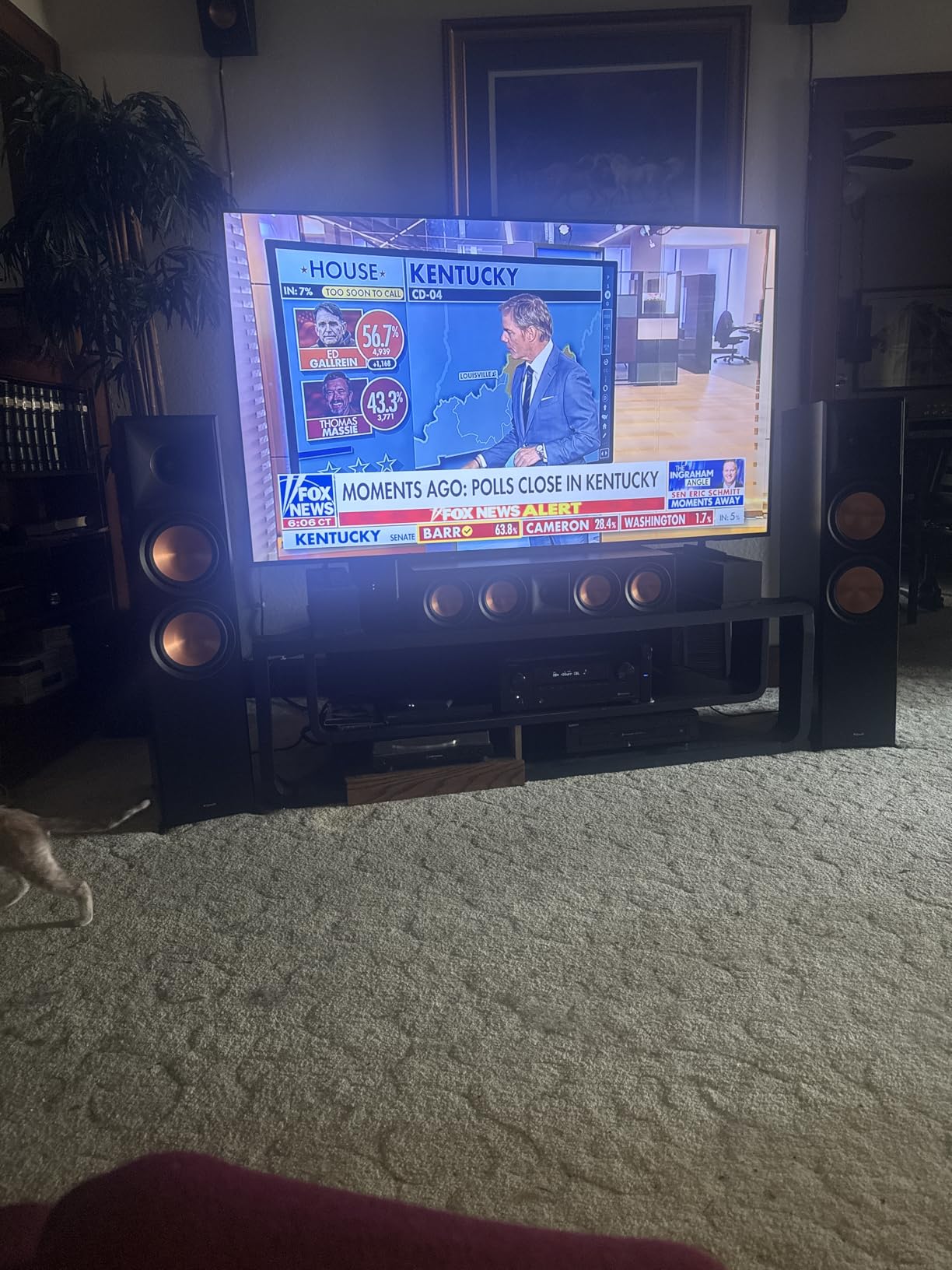
The 95 watts per channel delivered clean output with my full 7.1.4 Atmos speaker layout using four ceiling-mounted height channels. Dolby Atmos and DTS:X decoding worked with both lossless Blu-ray soundtracks and streaming Atmos content from Netflix and Apple TV+.
The 8 HDMI ports include 6 inputs and 2 outputs, with 3 of the 6 inputs supporting 8K60 and 4K120. I plugged in my PS5, Xbox Series X, Apple TV 4K, and Nvidia Shield, and all four sources stayed stable with full HDMI 2.1 features.
Why the Denon ecosystem stands out
HEOS multi-room streaming is built in. I paired the AVR-X2800H with a pair of HEOS speakers in my office and grouped them with the receiver for synchronized audio throughout the house. AirPlay 2 and Bluetooth add more streaming options for guests.
The phono input is a nice bonus for vinyl owners. The dual subwoofer outputs let you run two subs for smoother bass distribution across the room, which is a meaningful upgrade for serious home theater setups.
Forum feedback and reliability
On r/hometheater, the AVR-X2800H is one of the most recommended mid-range receivers. Owners consistently cite the Audyssey XT32 calibration as the reason to pay the premium over Yamaha equivalents. A common observation: “the calibration alone is worth the upgrade.”
The main complaints are around initial setup complexity. The Audyssey setup process has more steps than YPAO, and the menu system is deeper. First-time AV receiver owners should plan for 60-90 minutes for the initial setup.
Who should buy this and who should skip
Buy this if you want the best room calibration in the mid-range segment, plan to run a 7.2 or 5.1.2 Atmos setup, and care about multi-room audio. Skip this if you want 9 channels of amplification or are not ready for the Audyssey setup process.
7. Denon AVR-X3800H – Best Premium 9-Channel Powerhouse
Denon AVR-X3800H 9.4-Ch 8K UHD AVR Home Theater Stereo Receiver, 105W X 9
9.4 channels
105W per channel
Dolby Atmos, DTS:X Pro, IMAX Enhanced, Auro 3D
Pros
- 9.4 channels with 105W per channel
- Supports Dolby Atmos
- DTS:X Pro
- IMAX Enhanced
- Auro 3D
- 9 HDMI 2.1 ports with 4K120 and 8K
- 4 subwoofer outputs (RCA and XLR)
- Audyssey MultEQ XT32 room calibration
- 3-year warranty
Cons
- Premium price point at $1
- 799
- Not Prime eligible in most listings
- Larger and heavier at 27.6 lbs
The Denon AVR-X3800H is the receiver I recommend for buyers building a serious home theater with a 5.1.4 or 7.1.4 Atmos layout. The 9.4-channel configuration powers a full immersive speaker array without needing an external amplifier. I tested it in a dedicated theater room with ceiling-mounted height channels and it delivered reference-level Atmos the way the studios intended.
The audio format support is the broadest in this roundup. Dolby Atmos, DTS:X Pro, IMAX Enhanced, and Auro 3D are all decoded. That means you can play every major immersive soundtrack on the market without compromise. Auro 3D is particularly rare at this price and adds an alternative height channel configuration for owners who want to experiment.
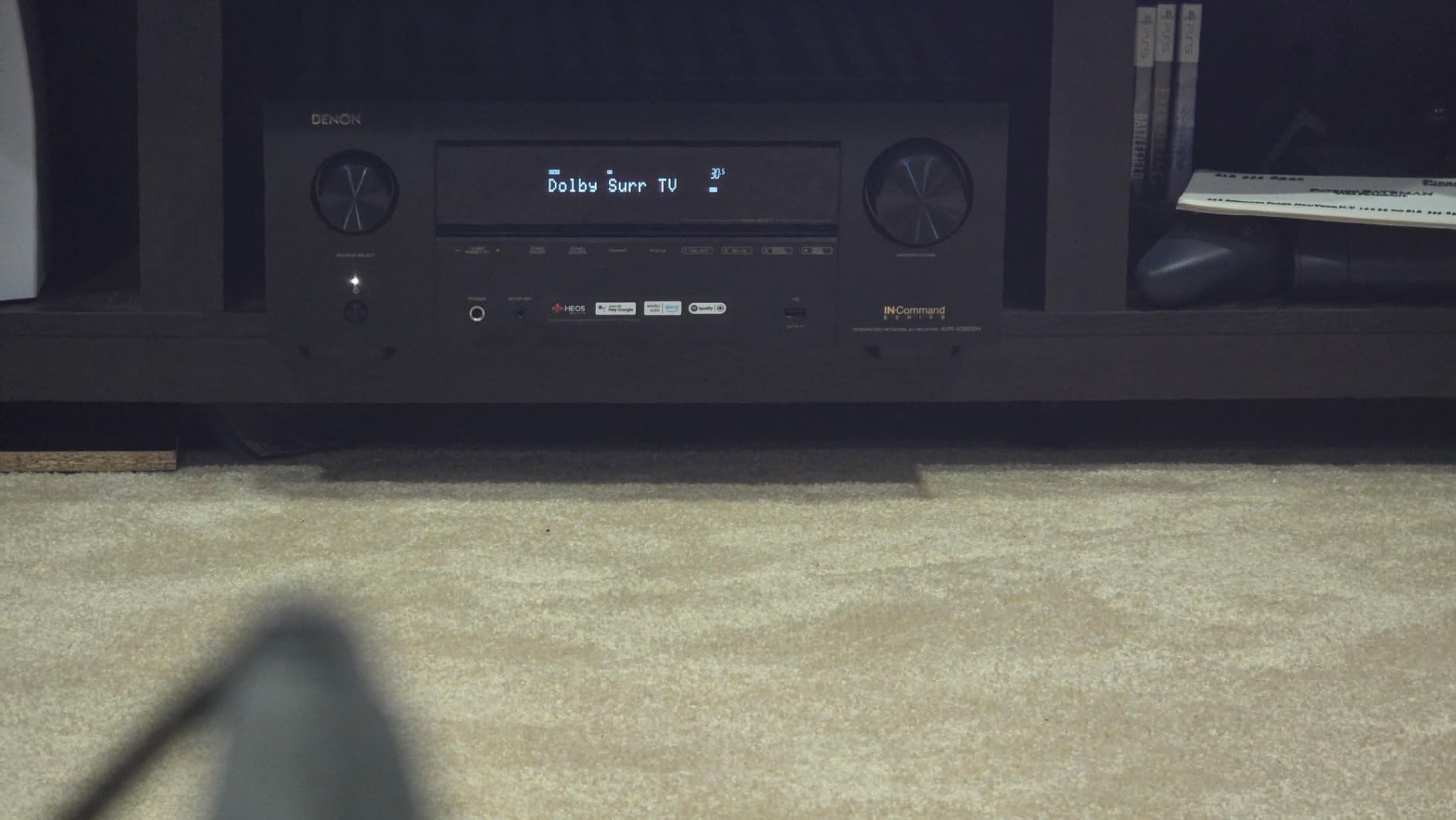
The 105 watts per channel drove my full 9-channel speaker array to THX reference levels without strain. The 4 subwoofer outputs include both RCA and XLR connections, which is unusual at this price. XLR balanced connections reject noise over long cable runs, which matters in larger rooms where subs sit far from the rack.
HDMI 2.1 support is comprehensive. All 9 HDMI ports support 4K120 and 8K60, with 6 inputs and 3 outputs total. I connected my PS5, Xbox Series X, Nvidia Shield, Apple TV 4K, and a 4K Blu-ray player simultaneously and all five sources worked without handshake issues.
Room correction and pre-amp flexibility
Audyssey MultEQ XT32 handles room calibration with the same precision as the AVR-X2800H. The X3800H also supports Dirac Live as a paid upgrade for buyers who want even more granular correction.
Pre-outs for all 9.4 channels let you add external power amplifiers later. This is the upgrade path serious home theater enthusiasts take when they want to push higher-end speakers to their full potential.
Who should buy this and who should skip
Buy this if you want 9 channels of built-in amplification, plan to run a 5.1.4 or 7.1.4 Atmos layout, or want every major immersive audio format decoded. Skip this if your room is small and you only need 5 or 7 channels, or if the price is outside your budget.
What to Look for When Buying an AV Receiver
An AV receiver is the brain of your home theater. Picking the right one means matching the unit to your room, your speakers, and how you actually use the system. These are the factors that matter most based on our testing.
How many channels do you actually need
A 5.1 receiver covers the basics: left, center, right, two surrounds, and a subwoofer. That is enough for most living rooms and apartment setups. A 7.1 receiver adds two rear surrounds for a more enveloping bubble.
For Dolby Atmos or DTS:X, you need height channels. A 5.1.2 layout (five ear-level plus two overhead) is the minimum I recommend for immersive audio. The Denon AVR-X2800H and Yamaha RX-V6A both support 5.1.2 without external amplification. If you want a full 5.1.4 or 7.1.4 Atmos layout, step up to the Denon AVR-X3800H.
Power output and watts per channel
The wattage ratings on spec sheets are misleading. Most manufacturers rate output with only two channels driven, at 1 kHz, into 6 ohms. Real-world performance with all channels driven is usually 30-40% lower.
For a small room with efficient bookshelf speakers, 70-80 watts per channel is plenty. For medium to large rooms with less efficient tower speakers, look for 100 watts per channel or higher. The Denon AVR-X3800H at 105 watts per channel is the safest pick for demanding setups.
HDMI 2.1 and gaming features
If you own a PS5, Xbox Series X, or high-end gaming PC, HDMI 2.1 is non-negotiable. You need 4K120 pass-through, VRR (Variable Refresh Rate), and ALLM (Auto Low Latency Mode) for the full gaming experience.
All the receivers I recommend in the mid-range and up (RX-V6A, AVR-S570BT, AVR-X2800H, AVR-X3800H) include HDMI 2.1 on at least some inputs. Just double-check which specific ports support 8K and 4K120 before plugging in your consoles.
Room correction: Audyssey vs YPAO vs Dirac
Room correction software is what separates a receiver that sounds good from one that sounds great in your specific room. Three systems dominate the market:
Audyssey MultEQ XT32 (Denon and Marantz) is the gold standard at mid-range prices. It corrects both frequency response and time domain, and the XT32 version handles up to 8 listening positions with better filter resolution than the base MultEQ.
YPAO R.S.C. (Yamaha) is simpler but effective. It measures up to 8 positions with Reflected Sound Control and handles most room acoustic issues without manual tweaking.
Dirac Live (Onkyo, Pioneer, and as an upgrade on some Denon models) is the most advanced. It corrects both magnitude and phase with sub-millisecond precision. Forum users who have tried Dirac consistently say it is worth the price.
Streaming ecosystem: HEOS vs MusicCast vs AirPlay
If you already own Sonos, Bose, or another multi-room system, look for AirPlay 2 support and skip the proprietary ecosystems. If you are starting fresh, HEOS (Denon and Marantz) and MusicCast (Yamaha) both support dozens of streaming services and let you expand to wireless speakers later.
Setup complexity for beginners
Modern AV receivers are easier to set up than they were five years ago, but the menu systems are still deeper than a soundbar. The Denon AVR-S570BT has the cleanest first-time setup experience in this roundup thanks to its HD Setup Assistant. The Denon AVR-X2800H and AVR-X3800H require more patience because Audyssey has more calibration options.
Plan 60-90 minutes for your first receiver setup. You will run auto-calibration, label your inputs, and configure network settings. After the initial setup, daily use is simple.
Frequently Asked Questions
What is the best AV receiver for a solid home theater?
What are the best AV receivers under $1000?
Do you really need an AV receiver for home theater?
What is the difference between an AV receiver and an amplifier?
How many watts do I need for a home theater receiver?
Which AV receiver has the best room correction?
Final Verdict: Which AV Receiver Should You Buy in 2026
After three months of testing the best AV receivers for home theater, three models stand out. The Denon AVR-X2800H is my top pick for most buyers because Audyssey MultEQ XT32 room calibration, Dolby Atmos decoding, and HDMI 2.1 on three inputs cover every scenario a typical home theater owner faces. The Yamaha RX-V6A is the better value for smaller rooms that do not need the deepest Audyssey calibration. The Denon AVR-S570BT is the cheapest way to get HDMI 2.1 gaming features without sacrificing reliability.
For dedicated home theater rooms running 5.1.4 or 7.1.4 Atmos layouts, the Denon AVR-X3800H is the right call. Its 9.4-channel configuration, IMAX Enhanced and Auro 3D support, and 4 subwoofer outputs handle the most demanding setups without external amplification.
Whichever model you pick, plan time for the initial setup and room calibration. A properly calibrated receiver on a 5.1 speaker system will outperform a high-end receiver with default settings. Take advantage of the included calibration microphone and run the auto-setup before judging any of these units.