
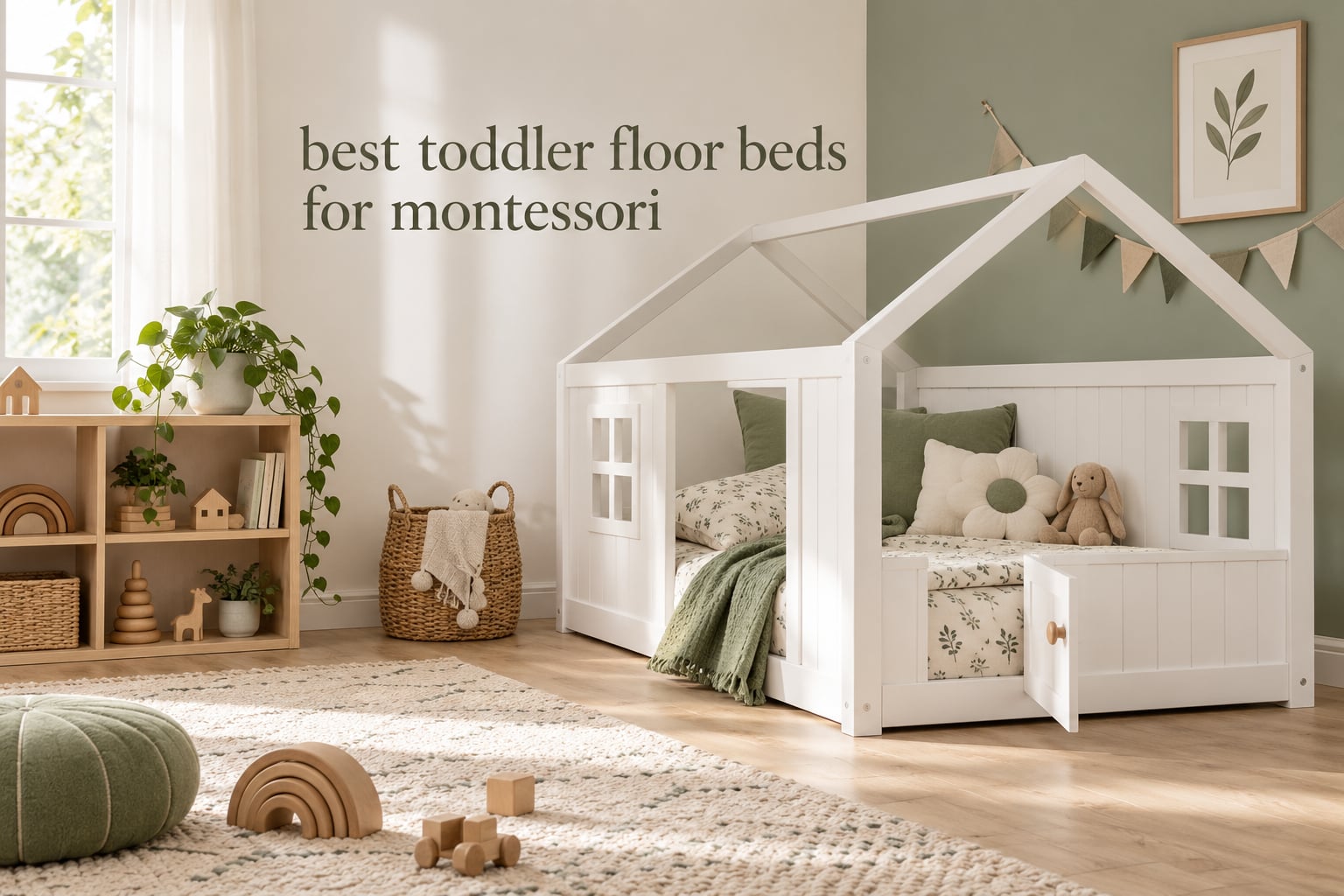
A Montessori floor bed is a low frame, or simply a mattress set low to the ground, that lets a child climb in and out without a parent lifting them. That single change matters more than any other piece of nursery furniture, because it hands a toddler control over one of the first things they ever ask to control themselves. We spent weeks going through twelve of the strongest options on the market right now to find the best toddler floor beds for Montessori homes in 2026, and the differences between them turned out to be much more practical than the marketing suggests.
The short version: if you want a frame that survives a jumping toddler and an adult lying down beside a frightened child, look for a real slat count and a published weight rating, not a house silhouette. If you want the transition to be gentle, a crib-size frame that accepts the mattress you already own will save you money and weeks. Everything in this roundup is a genuine low-profile frame designed for independent access, and every specification quoted comes from the manufacturer listing rather than a marketing page.
One thing worth saying plainly before we get into the list: the word Montessori describes the setup, not the product. A toddler bed with guardrails can live in a fully childproofed room, or it can live in a room full of hazards, and the difference is entirely in the room. We cover the room-prep steps in the buying guide further down, because that is where most floor bed transitions actually succeed or quietly fail.
If you are still deciding between a floor bed and a traditional toddler bed, our guide to the best toddler beds on the market is a useful side-by-side read, and if bedtime behaviour is already becoming an issue, how to get a toddler to stay in their bed covers the behavioural side that no frame can fix on its own.
Table of Contents
Top 3 Picks for the Best Toddler Floor Beds for Montessori

Ocodile Twin Floor Bed
- Solid pine and 14 supportive slats
- Rated to 400 lb
- Guardrails on three sides with two openings

GIANTEX Twin Floor Bed
- Pine and plywood twin frame
- Lockable door and guardrails
- Removable door as the child grows

Zumspiel Crib Size Bed
- Removable safety rails
- Velvet and foam over wood slats
- Built-in storage bag
12 Best Toddler Floor Beds for Montessori Compared in 2026
| Product | Specifications | Action |
|---|---|---|
| Ocodile Twin Floor Bed |
|
Check Latest Price |
| GIANTEX Twin Floor Bed |
|
Check Latest Price |
| Zumspiel Crib Size Floor Bed |
|
Check Latest Price |
 Tatub Twin Montessori Floor Bed Tatub Twin Montessori Floor Bed |
|
Check Latest Price |
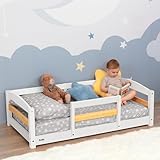 Ocodile Crib Size Floor Bed Ocodile Crib Size Floor Bed |
|
Check Latest Price |
 allamazing Toddler Bed allamazing Toddler Bed |
|
Check Latest Price |
 LLS Twin Floor Bed LLS Twin Floor Bed |
|
Check Latest Price |
 PVWIIK Twin Toddler Bed PVWIIK Twin Toddler Bed |
|
Check Latest Price |
 EXPERLAM Montessori Bed EXPERLAM Montessori Bed |
|
Check Latest Price |
 Bellemave House Frame Bellemave House Frame |
|
Check Latest Price |
 HAUOMS Upholstered 2-in-1 HAUOMS Upholstered 2-in-1 |
|
Check Latest Price |
 i-POOK Twin Floor Bed i-POOK Twin Floor Bed |
|
Check Latest Price |
1. Ocodile Twin Floor Bed – Best Overall Montessori Floor Bed
Twin Floor Bed with Safety Guardrails, 2 Openings and 14 supportive slats
Solid pine and plywood
14 supportive slats
Rated to 400 lb
79 x 41.7 x 15.4 inches
Pros
- 14 slats give genuine mattress support with no sag
- 400 lb capacity is joint-highest here
- Two openings plus a middle guardrail
- Labeled parts and an assembly video
Cons
- A heavy 50 lb frame that is harder to move or reassemble
- Gray finish shows dust and marks
- Limited colour choice for the twin size
Most floor beds in this category advertise their house-shaped fence and then quietly hope you never check the slat count. This one lists 14 of them, and the 400 lb rating that goes with them is among the highest we found across every frame we examined. That combination is why it takes the top spot: a Montessori floor bed that sags in the middle is not a Montessori floor bed, it is a trampoline with a roof on it.
The low profile is real at 15.4 inches from floor to rail top, so a two-year-old can step in and out without climbing. Two openings plus a middle guardrail means independent access stays possible while the fence still does its job on the edges. Parents in the reviews single out the slats and the capacity first, which is exactly the right order of priorities.
The trade-off is honest and worth naming: at 50 lb this frame is heavy, and moving it between rooms, taking it apart for a holiday or handing it down a family line takes real effort. It is also a frame more likely to still be there in ten years, so the weight cuts both ways.
Assembly gets a mention because the listing ships labeled parts, written instructions and an assembly video, and buyers report that this is the difference between an hour and an evening. Finishes are painted pine with a varnish and paint surface that wipes clean with a damp cloth.
Colour choice is the weakest point. The twin version comes in a narrow selection compared with the crib-size ranges offered elsewhere in this list, so if you are matching a specific nursery palette, check the finish before committing. Everything else here is difficult to fault at this level of support.
What this bed does well
The support system is the reason to buy. Fourteen slats spread across a 79 inch span means the mattress sits flat from edge to edge, which is what stops the middle dip that develops on thinly supported frames within a year or two. It is an unglamorous advantage that you will appreciate every single night.
For cosleeping families it is the practical answer to the question every parent asks about floor beds: can an adult lie down here? At 400 lb rated capacity, yes. That single number removes the most common reason parents abandon a Montessori setup after six months.
Where it falls short
Fifty pounds is genuinely heavy for a frame that may need to move between the bedroom and a playroom. If your living arrangement involves rearranging furniture regularly, this is worth thinking about before the box arrives.
The gray finish also shows dust and scuff marks readily, and the twin colour range is narrower than the crib-size equivalents. Neither is a safety issue, but both are annoyances in a room where the bed is meant to be a calm focal point rather than a maintenance item.
2. GIANTEX Twin Floor Bed with Door – Best Value
GIANTEX Twin Floor Bed with Fence for Kids, Wooden Montessori Bed Frame with Lockable Door & Guardrails, Low Floor Beds for Kids, Boys, Girls, No Box Spring Needed, Without Wood Slats, White
Pine wood and plywood
Twin size with door
330 lb capacity
78 x 42 x 16 inches
Pros
- Low profile supports independent climbing
- Lockable door can be opened closed or removed
- Works as a bed reading nook or playhouse
- Large volume of owner feedback
Cons
- Slat support is sparse and some owners added extra wood
- Door and hardware alignment is fiddly to set up
- Cover stickers over screw holes do not adhere well
This frame carries the largest volume of owner feedback of anything in our roundup, and reading through it tells you something useful about the category as a whole: buyers overwhelmingly like the house-door concept and are consistently disappointed by slat quality. The GIANTEX is no exception. It is a good, honest budget Montessori frame, and it asks you to understand its one weakness before you buy.
The adjustable door is the feature that gets the most praise. It can sit open, closed, or come off entirely as the child grows, which means you start with a contained sleep space and end with an open-ended floor bed without buying anything new. That flexibility is genuinely rare at this price level.
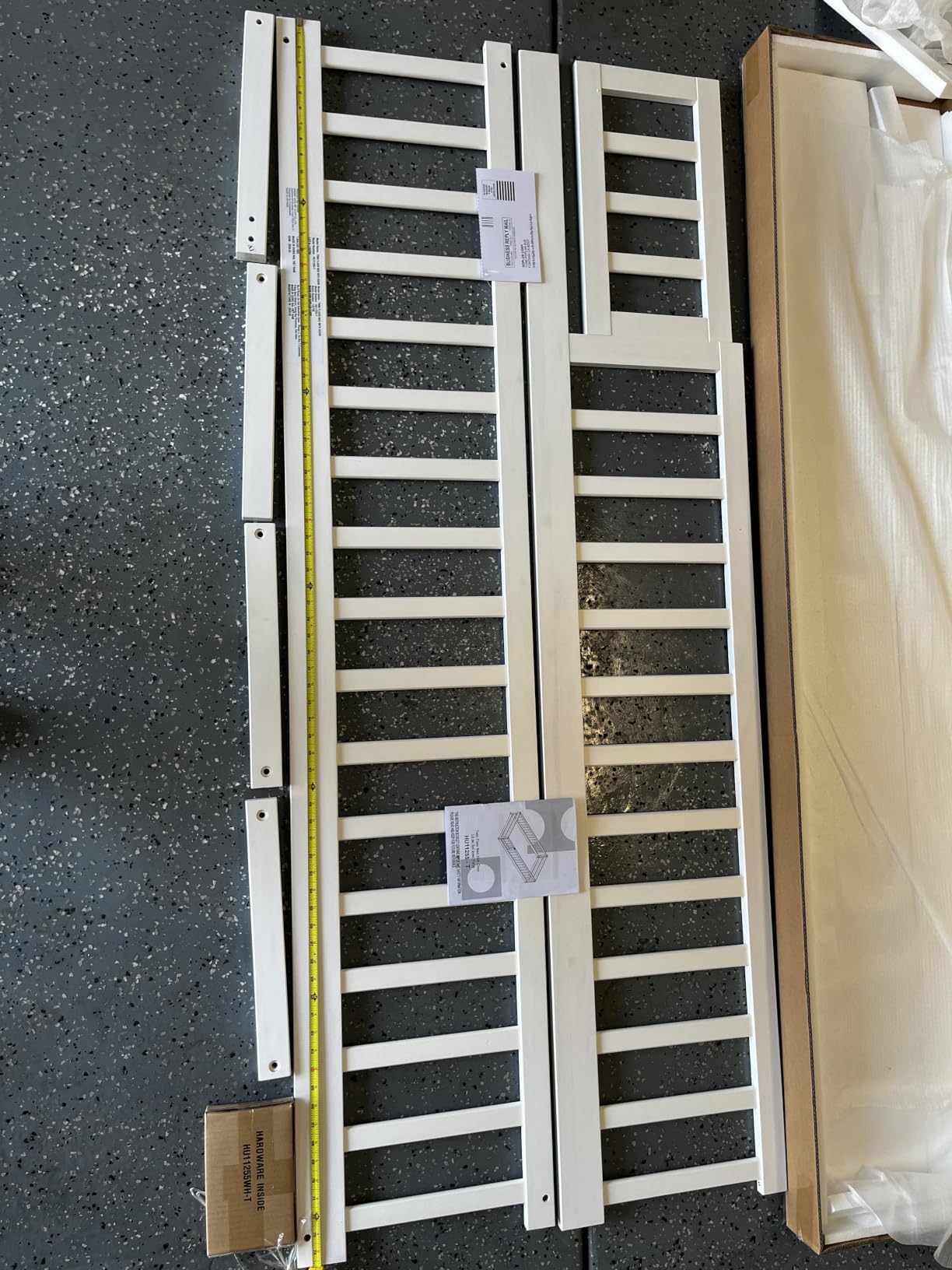
The slat situation is where your budget decides your happiness. Owners report that the supplied slat support is thin, and several ended up buying extra wood planks or a sheet of plywood to firm it up. That is a real additional cost and a real Saturday morning, and it is entirely avoidable if you plan for it before assembly begins.
Hardware quality sits a tier below the frame. Cam locks and fittings can arrive crooked or loose, and the stickers covering exposed screw holes are thin and tend to lift. None of this affects structural safety for a child who is not climbing on the fence, but it is the difference between a frame that feels premium and one that feels assembled.
The 330 lb capacity is respectable and good enough for an adult to sit on the edge during a difficult night. Creaking under load and a paint smell that lingers for a day or two after assembly are both reported, both fade, and neither is unusual for a painted pine frame.
What this bed does well
A lockable gate on a toddler bed is unusual at this level, and being able to remove it entirely as your child grows turns a transitional purchase into a long-term one. That flexibility is the single strongest reason to choose this frame.
The dimensions at 78 x 42 x 16 inches give a low, wide profile that suits small rooms well, and the frame doubles convincingly as a reading nook or playhouse, which extends its useful life far past the transition period.
Where it falls short
Buy the frame and plan to add your own slat support if the child is over three or anyone plans to sit on the edge regularly. Skipping that step is the single complaint that appears most often, and it is fixable for the cost of a few boards.
Fit and finish are also a step down from the top pick. Screws sitting proud, lifting decals and slightly loose fittings add up to the sense that this is a budget frame, which it is, fairly labelled.
3. Zumspiel Crib Size Floor Bed – Best for Removable Rails
Zumspiel Toddler Floor Bed with Removable Safety Rails and Storage Bag, Kids Bed for Girl and Boys, Standard Crib Size, Safety Upholstered Child Beds, Low to Floor Design
Crib size frame
Removable rails and storage bag
Velvet over foam and slats
56.1 x 31.9 x 20.2 inches
Pros
- Highest average rating in the roundup at 4.7 stars
- Removable rails contain a restless sleeper
- Soft velvet padding cushions bumps
- Storage bag keeps books and toys tidy
- Assembly takes about 10 to 15 minutes
Cons
- A heavy 62.4 lb frame
- Velvet texture is harder to clean than bare wood
- Mattress not included
The rails on this crib-size frame are the reason it earns its place. They are removable rather than fixed, which means you can contain a restless two-year-old who still half-rolls out of bed at night and then take them away in a minute when he no longer needs them. That two-way flexibility is the specific problem most Montessori floor bed buyers are actually trying to solve.
Underneath the upholstery there is real structure. Sturdy wood slats give proper mattress support rather than the thin ply you find on budget frames, and adjustable foot pads keep the frame stable on uneven floors while lifting it slightly off the ground. The storage bag is small but genuinely useful, and the whole thing takes ten to fifteen minutes to put together with the included video.
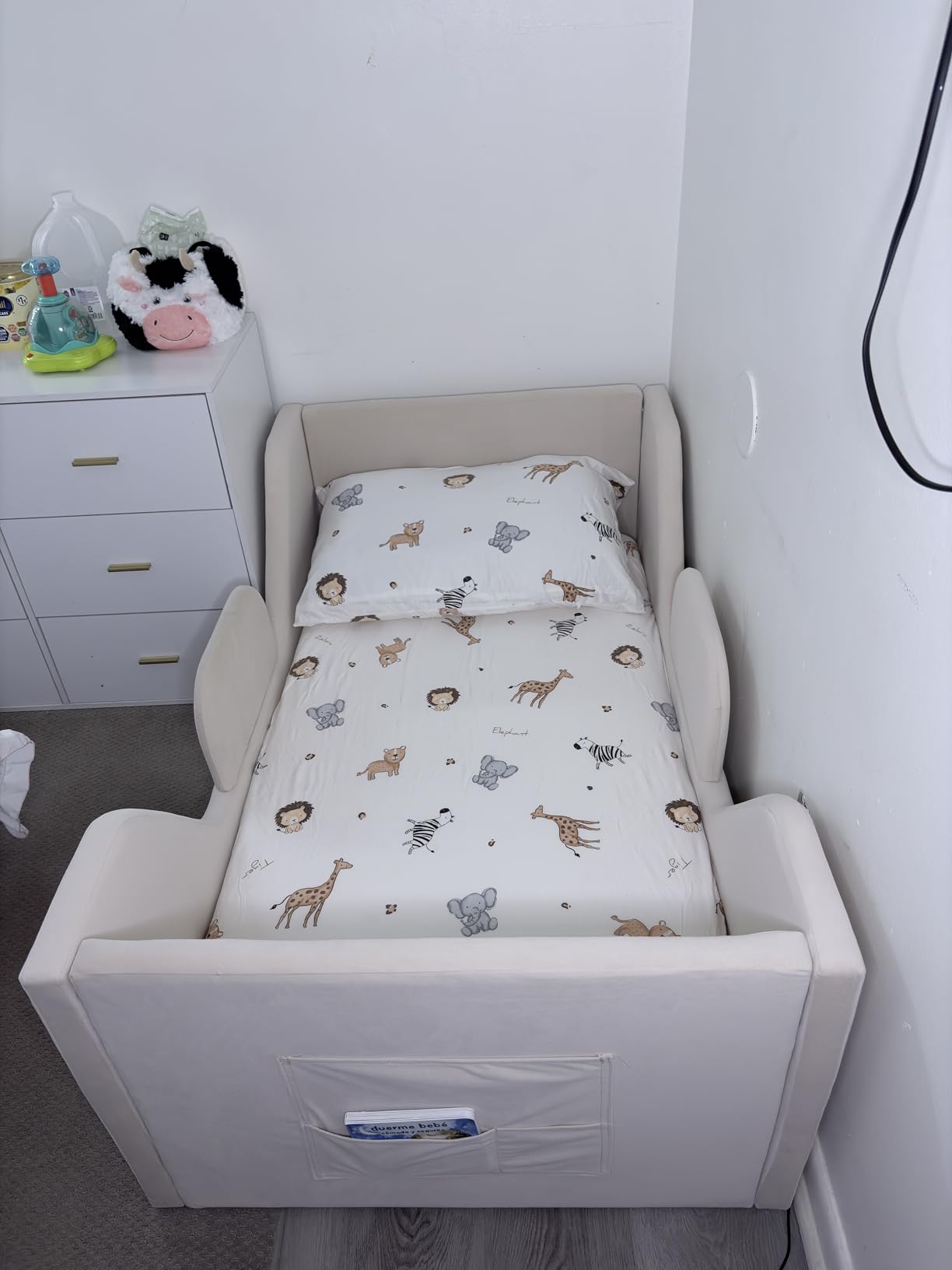
Soft velvet with foam padding wraps the rails, which matters more than it sounds. The single most common description of a child’s first floor-bed bump is a shin against a hard wooden rail, and padding removes the sharpest version of that problem entirely.
It fits a standard crib mattress, which is a practical win if you are moving straight out of a cot. You keep the mattress you already own, and if your child later moves to a bigger bed, the mattress goes with them rather than into a skip.
Be clear about the size, though. This is a crib-size frame at 56.1 x 31.9 inches, not a twin. A child outgrowing it around ages five and six is the usual expectation, so this is a step rather than a long-term solution, and it does not suit a cosleeping parent who wants to lie down beside them.
What this bed does well
Removable rails that actually come off cleanly, without tools or a fight, are the whole point of this design. Parents report that the rails are what keep a wild sleeper contained while still letting the child climb in and out alone, which is the balance the Montessori approach asks for.
The finish is one of the most room-friendly we saw among the crib-size options, blending into a child’s room rather than shouting about being nursery furniture. With a 4.7 average and a high share of five-star reviews, the consistency of feedback matches the numbers.
Where it falls short
The upholstery is the ongoing trade-off. Velvet and suede-like textures are meaningfully harder to clean than bare wood, and in a house where everything is fabric that becomes a real recurring cost rather than a one-off.
One reviewer also reports side panels that cracked, which reads as an isolated fault rather than a pattern. The mattress is not included either, so budget for that separately.
4. Tatub Twin Montessori Floor Bed – Best Solid Wood Option
Tatub Twin Montessori Floor Bed with High Rails, Solid Wood Montessori Bed Frame for Kids, Door Can Install Left and Right, Twin-Nature
Solid pine frame
Twin size
250 lb capacity
78.2 x 41.5 x 21.7 inches
Pros
- Very low floor profile reduces fall risk
- Door fits either side for awkward layouts
- Timeless wood styling
- Supports the move to independent sleep
Cons
- Listed weight of 12 lb makes it feel light under adult load
- Back panels use MDF-type board rather than solid wood
- Instructions do not clearly label front and back panels
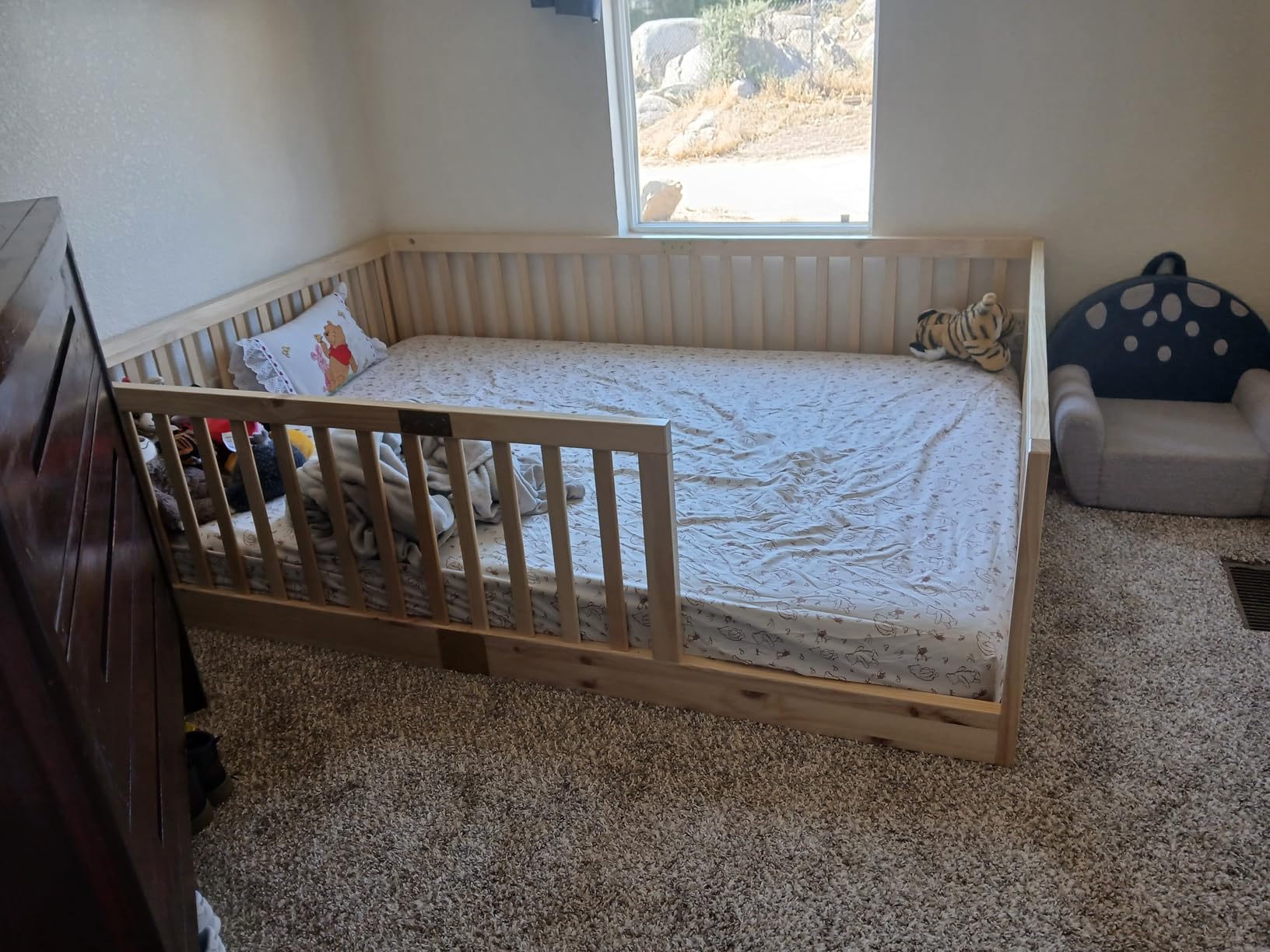
The defining feature of this design is continuous surrounding railing. Combined with a frame that sits low to the floor, those rails do more to soften bumps than almost anything else at this level. Parents who have switched from a bare wooden fence talk about accidents simply stopping.
The reversible door is quietly excellent. Being able to fit it on either side means the bed works in an awkward corner or against a shared wall, which is the difference between a frame that fits your room and one that dictates to it. Timber styling is the most timeless of the group and will not date the room.
The frame is listed at only 12 pounds, which sounds excellent for portability and in practice means less solid under an adult than the numbers on the heavier frames suggest. At 250 lb rated capacity you can sit beside a child, but this is not the frame to lie down on for a night of poor sleep.
There is also a materials compromise. The side structure is solid pine, which is what you want to see, but the back panels are an MDF-type board. That is common across the category and it is perfectly serviceable for a panel that never takes weight, but it is not what a buyer hoping for all-solid construction should expect.
Assembly instructions do not clearly distinguish front panels from back panels, which is a common source of frustration in frames that look near-identical from each side. Allow an extra fifteen minutes for careful reading before you start.
What this bed does well
Safety through low height is the design philosophy here and it is executed well. A very low frame with continuous rails means a child who rolls or stumbles in the night has very little distance to fall, which is the single most practical safety argument in favour of Montessori floor beds.
Fewer owners are as consistent in their feedback as with this frame, and the recurring praise is for exactly the right things: the low profile, the reversible door and a design that quietly disappears into an adult room.
Where it falls short
Lightweight construction is the main limitation. A frame that moves easily also moves when a child throws themselves against it, and if you plan to lie beside your child for the first weeks of the transition, choose a heavier frame instead.
Only three size and colour combinations come with a door fitted, and the MDF back panels are worth weighing if you care about avoiding engineered board in a child’s room. Otherwise, this is a quietly good solid wood floor bed.
5. Ocodile Crib Size Floor Bed – Best for Reusing a Crib Mattress
Ocodile Toddler Bed with Rails | Low Montessori Floor Bed Frame for Kids | Standard Crib Size Wooden Frame for Independent Toddlers 1-3 – White
Standard crib size
Solid pine
55 x 29.5 x 15.4 inches
Rated to 50 lb
Pros
- Fits a standard crib mattress up to 6 inches thick
- One of the lowest wooden frames with airflow beneath
- Rounded edges and a one-piece side frame
- No chemical smell reported after assembly
Cons
- Slats need a power drill because holes are not predrilled
- Included slat screws are short and can split the wood
- Instructions are confusingly written
- Only rated to 50 lb
This frame solves a problem no other bed in our roundup does quite so cleanly: it fits a standard crib mattress. At 51 5/8 by 27 1/4 inches and up to 6 inches thick, you can move your child straight from the cot without replacing the mattress. For a household already budgeting for a floor bed, that quietly removes one of the larger costs.
The frame is also one of the lowest wooden floor beds we found, at 15.4 inches overall height, which means real airflow beneath the mattress. In a humid climate that is not a cosmetic detail, it is the difference between a dry bed and a musty one. Parents report no chemical smell at all after assembly, which matters for families with a chemical sensitivity.
Sturdiness is genuinely good despite the small footprint. A one-piece side frame and rounded edges give it a solid, over-engineered feel, and several non-handy parents managed the assembly alone. A removable middle guardrail and two entries keep independent access open while the perimeter stays secure.
The 50 lb rating is the honest limitation. This bed is for a child, not a parent, and it will not suit a family hoping to lie beside their toddler during the transition. That is a common Montessori practice among breastfeeding families and worth thinking about before you commit.
On assembly, have a drill ready. There are no predrilled slat holes and the supplied screws are short enough to sit close to the wood edge, which risks splitting if you force them. Read the instructions slowly, because the wording is genuinely confusing and some letter labels are placed on the wrong pieces.
What this bed does well
The crib mattress fit is the headline. Reusing the mattress you already own removes a purchase, keeps a familiar sleep surface for a child whose whole world is changing, and avoids the odd-sized mattress hunt that floors people who buy an unconventional bed.
The very low profile with airflow underneath, combined with a solid pine frame and rounded edges, makes this one of the safer-feeling options here for a child who is still rolling unpredictably. It also ranks among the most compact, so it suits a genuinely small room.
Where it falls short
Fifty pounds rated capacity is the dealbreaker for cosleeping households. It is a child’s bed, full stop, and no amount of sturdy joinery changes that number.
Assembly needs a drill and more care than the instructions suggest, and the short slat screws are the single most reported gripe. Buy a pack of slightly longer screws and take your time, and this becomes a non-issue.
6. allamazing Toddler Bed – Best for Padded Rails
allamazing Toddler Bed, Toddler Floor Bed Frame with Guard Rails, Kids Beds for Ages 2-6 Years, Small Bed for Kids Girls and Boys, Standard Crib Mattress Toddler Beds, Certified Fabric Beds
Acacia wood frame
Fits standard crib mattress
55.5 x 32.08 x 20.27 inches
Upholstered on all four sides
Pros
- One inch foam padding inside all four upholstered sides
- Guard rails on every side with no sharp corners
- One-piece solid side frame simplifies assembly
- Crib mattress held by slats secured with full Velcro
Cons
- Upholstery can carry a chemical smell for weeks
- Very heavy at 60 lb
- Some screw threads need starting before the top pieces fit
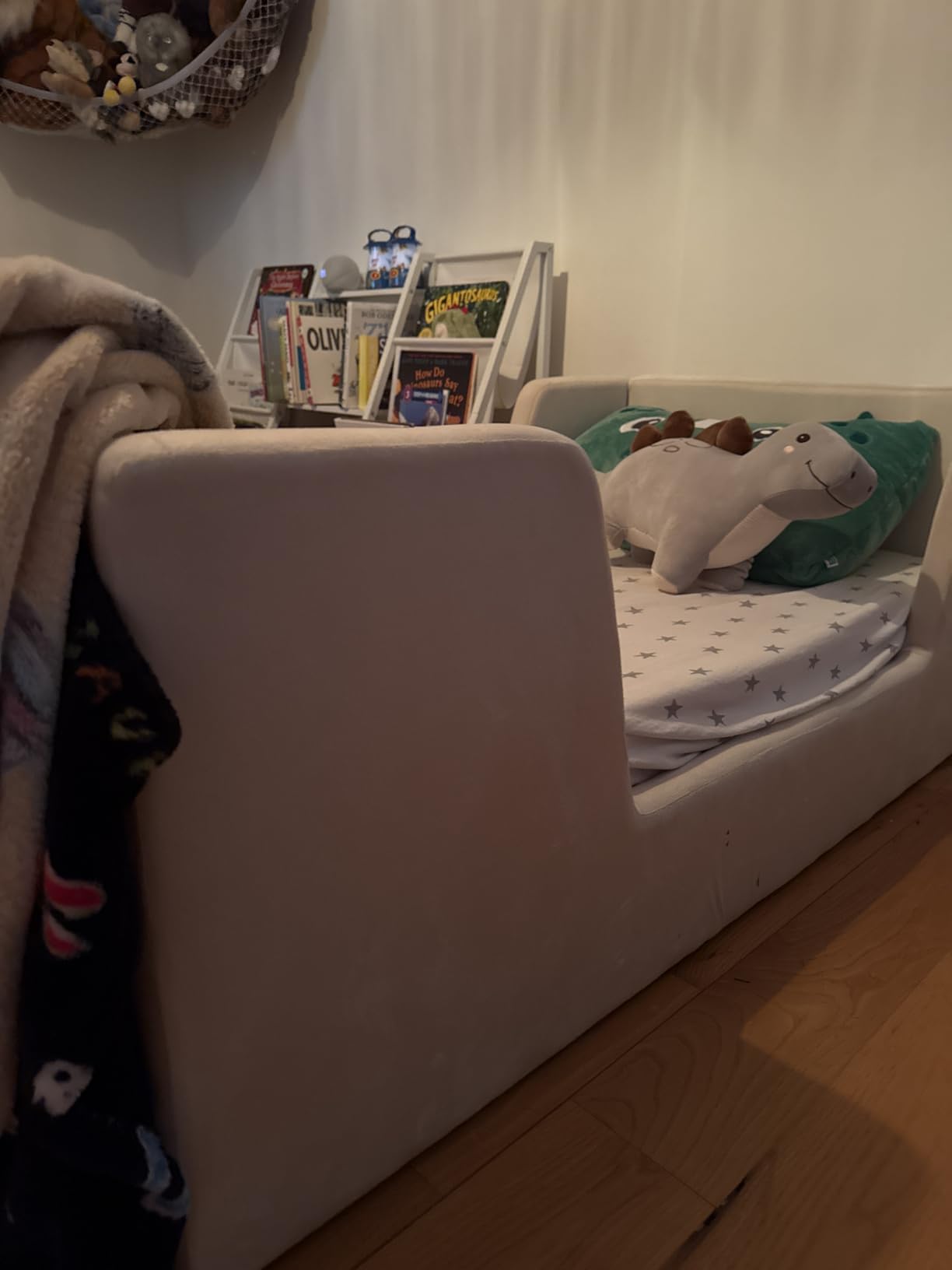
If your child has arrived at the floor bed stage by rolling out of a cot and bumping everything on the way down, this is among the gentlest designs here. Every one of the four sides is upholstered, with an inch of foam inside and guard rails on all sides, leaving no hard wooden edge anywhere a head or shin can find.
Parents rate this as one of the smoothest crib-to-bed transitions in our whole roundup, and the reason is not only the padding. The mattress sits at a genuinely low height, the corners are rounded, and an anti-slip glide underneath stops the frame sliding when a child climbs in with enthusiasm rather than care.
The build quality is better than the price band suggests. A one-piece solid side frame is stronger and simpler than the segmented frames common in this category, and holding a crib mattress with slats secured by full Velcro strips is a neat trick that stops the mattress shifting without hardware.
Assembly time reported in reviews runs from ten minutes to three quarters of an hour, with tools and clear instructions included. Several parents note that starting the screw threads before clipping the top pieces together prevents the alignment problem that trips people up.
The chemical smell from the upholstery is the issue you need to weigh honestly. It lingers for weeks in some homes rather than days, and for a family with an allergy or chemical sensitivity it is a genuine dealbreaker rather than a minor irritation.
What this bed does well
This is the one frame in our roundup with an inch of foam padding inside all four upholstered sides. For a child who has never slept anywhere but a crib, arriving at a hard wooden fence in the dark is a big sensory change, and padding removes almost all of it.
The frame itself is well made. Solid acacia, a one-piece side frame and a straightforward install mean this is a bed that will still be solid in five years, and the fabric is described as safe for a toddler to touch or chew on.
Where it falls short
The odour is the honest problem. Air it in an empty room for a week before use if you can, and if anyone in the house reacts to fragrance or fabric finishes, skip this one rather than hoping.
At sixty pounds it is very heavy for a crib-size bed, and fabric upholstery of any kind is harder to clean than bare wood. Neither matters much in a tidy room with removable covers, and both matter a great deal in a busy one.
7. LLS Twin Floor Bed – Best for a Quiet Frame
LLS Twin Floor Bed for Kids Solid Wood Montessori Bed Frame with Safety Guardrails Multifunctional Montessori Floor Bed for Toddlers, Without Door, Easy Assemble, White
Pine and engineered wood
7 reinforced plywood slats
78.2 x 41.8 x 17.5 inches
200 lb capacity
Pros
- Stays quiet even when a toddler jumps on it
- 7 reinforced plywood slats give real support
- Simple styling that suits most rooms
- Quick to assemble with tools included
Cons
- No door
- so the entry is an open gap in the fence
- Does not fit a standard twin mattress exactly
- 200 lb capacity limits adult use
Noise is an underrated factor in a child’s bedroom, and this frame has it handled. Parents report that it stays quiet when a toddler jumps on it, which is worth a great deal at bedtime when the alternative is a floor bed that creaks every time a child rolls over.
The support system is better than the seven-slat headline suggests, because the slats are reinforced plywood rather than thin pine strips. That is the difference between a mattress that stays level for years and one that develops a dip in the middle by the time a child is old enough to notice.
Styling is clean and unfussy, available in white, mist blue and natural, and it will not look out of place in a room that has to grow up with the child. It is among the least themed frames here, which is part of why we like it.
There is no door on this version, so the entry is simply an opening in the fence. That is a genuine design choice rather than a shortfall, and it means the bed looks tidier than a house frame, but it also means one side of the perimeter is open by design.
The 200 lb rating is the number to check against your plans. A parent can sit on the edge, but a parent who plans to lie down beside a child during the transition should choose a heavier frame. Also expect a small gap at one end with a standard twin mattress.
What this bed does well
Silence under jumping is unusual and genuinely useful. If your child bounces, climbs or resettles constantly, a quiet frame removes a source of irritation that no mattress choice can fix.
It is also quick and unconfusing to assemble, with instructions and the required tools in the box. A bed you can build in one sitting on a Saturday afternoon is a bed that gets built, and that is worth more than a small design flourish.
Where it falls short
Two fit issues deserve attention before you order. The open entry in the fence means a full twin mattress is not usefully contained, and the interior dimensions leave a small gap with a standard twin. Measure your mattress and your wall clearance rather than trusting the size on the listing.
At 200 lb with a mid-span that sags under adult weight, this is a child’s bed rather than a family one. For a household that wants to co-sleep in the first weeks, look higher up this list.
8. PVWIIK Twin Toddler Bed – Best for Twin Version Choice
PVWIIK Twin Size Toddler Bed with Safety Guardrails,Espresso
Twin floor bed with fence and door
77 x 41.5 x 17.5 inches
200 lb capacity
Pine with plywood slats
Pros
- Fence and small door create a secure playful space
- Reinforced plywood slats spread mattress weight evenly
- Low profile for independent access in and out
- Available in full queen and twin versions
Cons
- Only a 200 lb weight limit
- Feature descriptions disagree on the slat count
- Espresso finish shows dust and scuffs easily
The reason to look at this frame is range. It comes in full, queen and twin versions with a consistent fence-and-door design, which means you can buy for a toddler now and buy the same style of bed again later without the two clashing. For a household replacing furniture on a schedule, that continuity is worth planning around.
The build is more careful than the price suggests. Reinforced plywood slats spread mattress weight evenly and stiffen the frame as they go, which is a real upgrade from the slatless and thin-slatted beds that dominate the budget end. The low profile genuinely supports a child climbing in and out alone.
Owners use it as a sleep space, a play area and a reading nook roughly interchangeably, and the fence and door make that dual use work well. A house-shaped floor bed becomes a fort during the day and a bed at night, which extends the value considerably.
Two practical cautions. The 200 lb rating is below most sturdier frames here, and the listing’s own feature details disagree with each other about the slat count, so treat the slat figure with scepticism and check the frame on arrival. The espresso finish is also a poor choice in a room with a dog or a lot of dust.
The low profile is on the taller side for a floor bed at 17.5 inches, which is still comfortably within Montessori range while keeping more headroom than the very low frames.
What this bed does well
Consistent design across sizes is the quiet superpower here. When the next bed arrives in three or four years it will match the current one, which saves both money and the visual disruption of a mismatched room.
The fence and small door give a secure play space that still allows independent entry and exit, and the plywood slats do the structural work properly rather than nominally.
Where it falls short
The weight limit is the clear constraint. Two hundred pounds is enough for a child and a quick sit on the edge, and not enough for the adult lying beside them that many Montessori families want during a transition.
A dark espresso finish shows every scuff and dust mote, which matters in a bedroom where the bed is meant to be calm. Choose a lighter finish if you have the option and the room is not obsessively tidy.
9. EXPERLAM Montessori Toddler Bed – Best for Height Conversion
EXPERLAM Montessori Toddler Bed, Variable Twin Floor Bed Frame with Removable Guardrails and Legs, Low Wooden Kids Bed with 10 Slats and Supporting keel, Crib-to-Bed Transition for Bedroom or Nursery
Removable rails and legs
10 slats with support keel
220 lb capacity
76.89 x 41.34 x 26.89 inches
Pros
- Rails and detachable legs convert the height as the child grows
- 10 slats with a 1 inch keel and 3 centre legs
- 220 lb capacity allows a parent to lie beside the child
- Solid frame resists cracking and wipes clean
Cons
- Joint-lowest average rating in the roundup at 4.1 stars
- Two adults are recommended for assembly
- Only two colour options
- Bulkier than crib-size alternatives at 46.3 lb
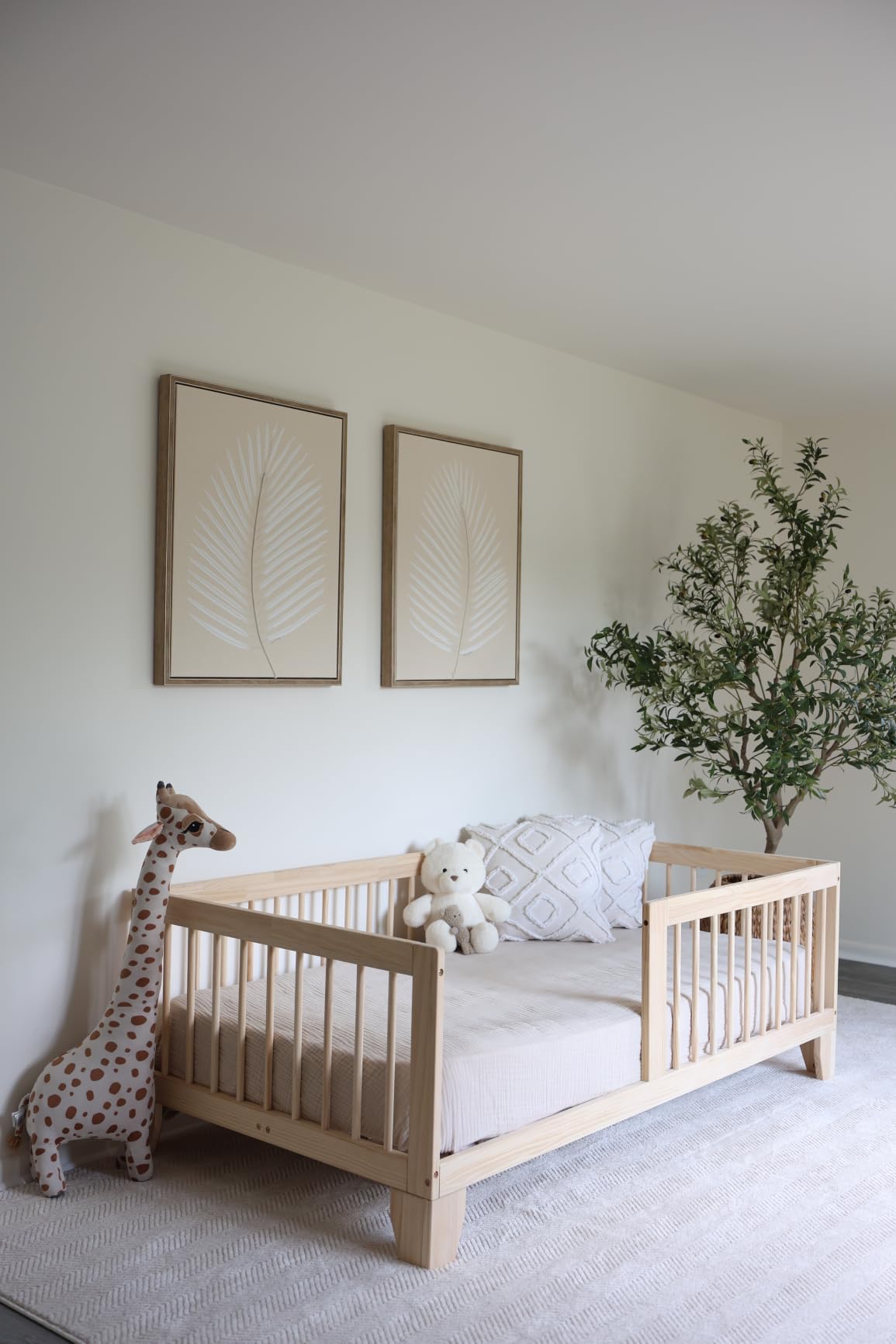
This is the frame in our roundup that changes height most directly rather than just changing the rail configuration. Detachable legs let you raise the bed from a low Montessori floor position to a standard kids bed height as the child grows, which turns a toddler purchase into something that lasts the whole primary school run.
The support engineering is unusually serious. Ten composite slats sit over a one-inch support keel with three centre support legs, and reinforced L-shaped metal brackets at the key joints. That combination is what allows a 220 lb rating, enough for an adult to lie beside the child during a difficult night.
The high fence accommodates most twin mattress thicknesses, which is a small but important detail. A fence that only clears a thin mattress leaves a gap at the top, and a gap is exactly what you are paying to avoid.
We want to be straight about the ratings, though. This sits at the joint-lowest average in our roundup at 4.1, with a meaningful share of one-star reviews, so the response is more polarised than anything else here. That is worth understanding in context: the frame is doing something more than the others, and anyone expecting a plain low floor bed will find the bulk surprising.
Assembly is a two-person job, the frame is heavy at 46.3 lb, and only two colour options are offered. None of those are faults, but all of them are reasons to plan rather than rush.
What this bed does well
Convertibility done properly. Removable rails create a cosy enclosed zone first, then come off, and detachable legs raise the height later. Few frames change height at all, and the ones that do often rely on flimsy fittings rather than the metal brackets used here.
With a 220 lb rating, this is a frame that comfortably supports that, and the metal brackets at the joints are what make the conversion hold up over time rather than wobble after a year.
Where it falls short
The polarised reviews point at assembly and bulk more than anything else. Two adults are recommended, and in a small room the raised height option needs ceiling and wall clearance you may not have yet.
Two colour options and a mid-range rating mean you are accepting some uncertainty in exchange for the conversion capability. If you only need a floor bed for two or three years and do not care about raising it later, a simpler frame will serve you better.
10. Bellemave House Frame – Best for Playhouse Style
Kids Montessori Bed Twin Size, Twin Floor Bed with High Fence, House Beds for Kids, Girls, Boys, Wood Montessori Floor Beds Without Slats(White Twin)
Full house shape with roof and door
66.26 inch overall height
300 lb capacity
CPC certified pinewood
Pros
- Complete house silhouette with roof fence and door
- Highest enclosed ceiling in the roundup at 66 inches
- CPC certified pinewood frame rated to 300 lb
- Smooth frame surfaces that will not scratch skin
Cons
- No wood slats included
- Mattress support depends on whatever base is supplied
- Tall footprint uses a lot of floor space
- Single-box build makes assembly a two-person job
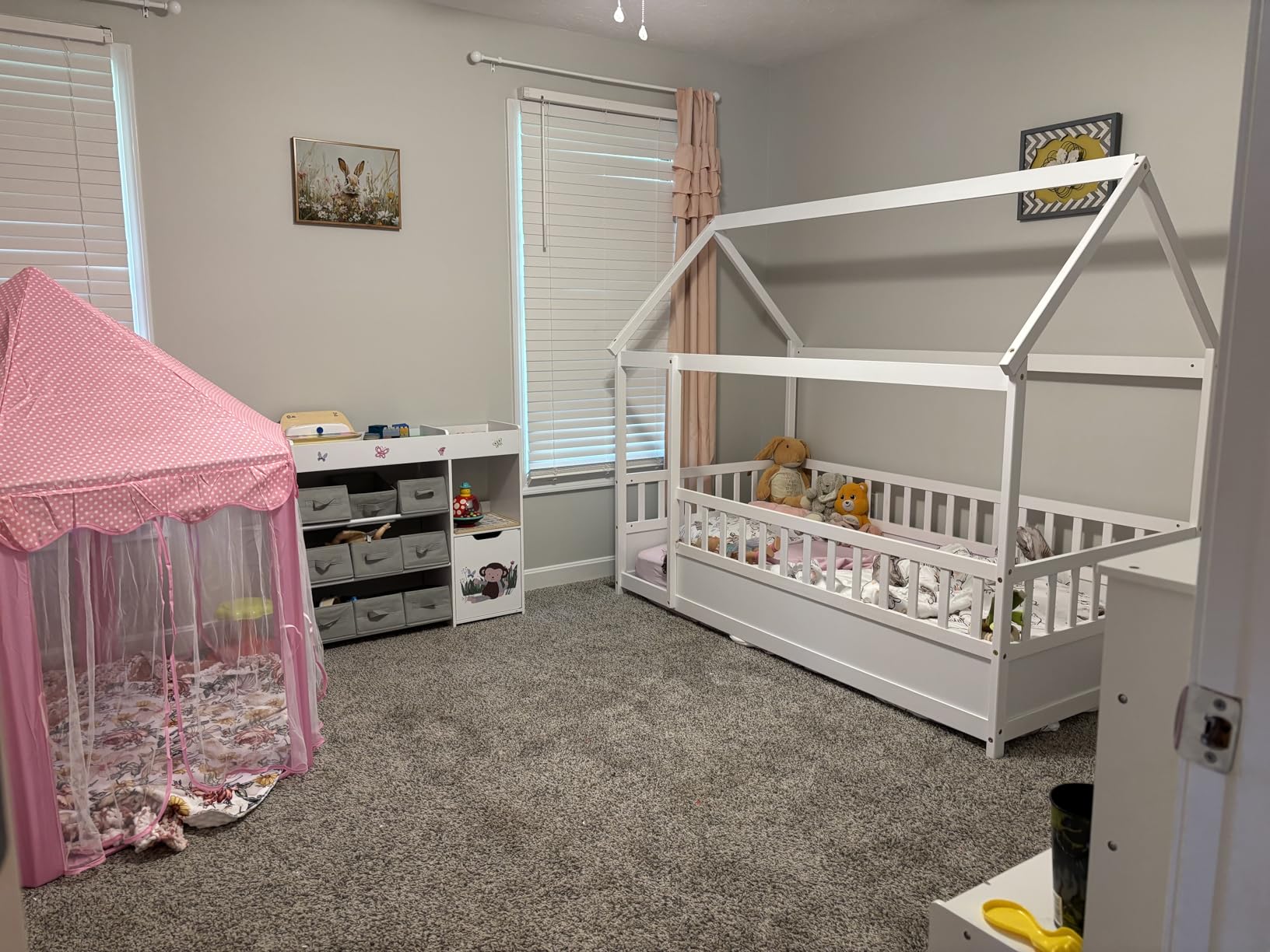
Full roof, fence and door, with an overall height of 66 inches, which makes it the tallest enclosed structure in our roundup by a clear margin. Parents describe it as feeling like a genuine little fort rather than a bed with a fence.
It is also one of the few frames here carrying a Children’s Product Certificate, and the pinewood frame is rated to 300 lb. Frame surfaces are smooth enough not to catch skin, which matters on a structure a child will be climbing across rather than lying in.
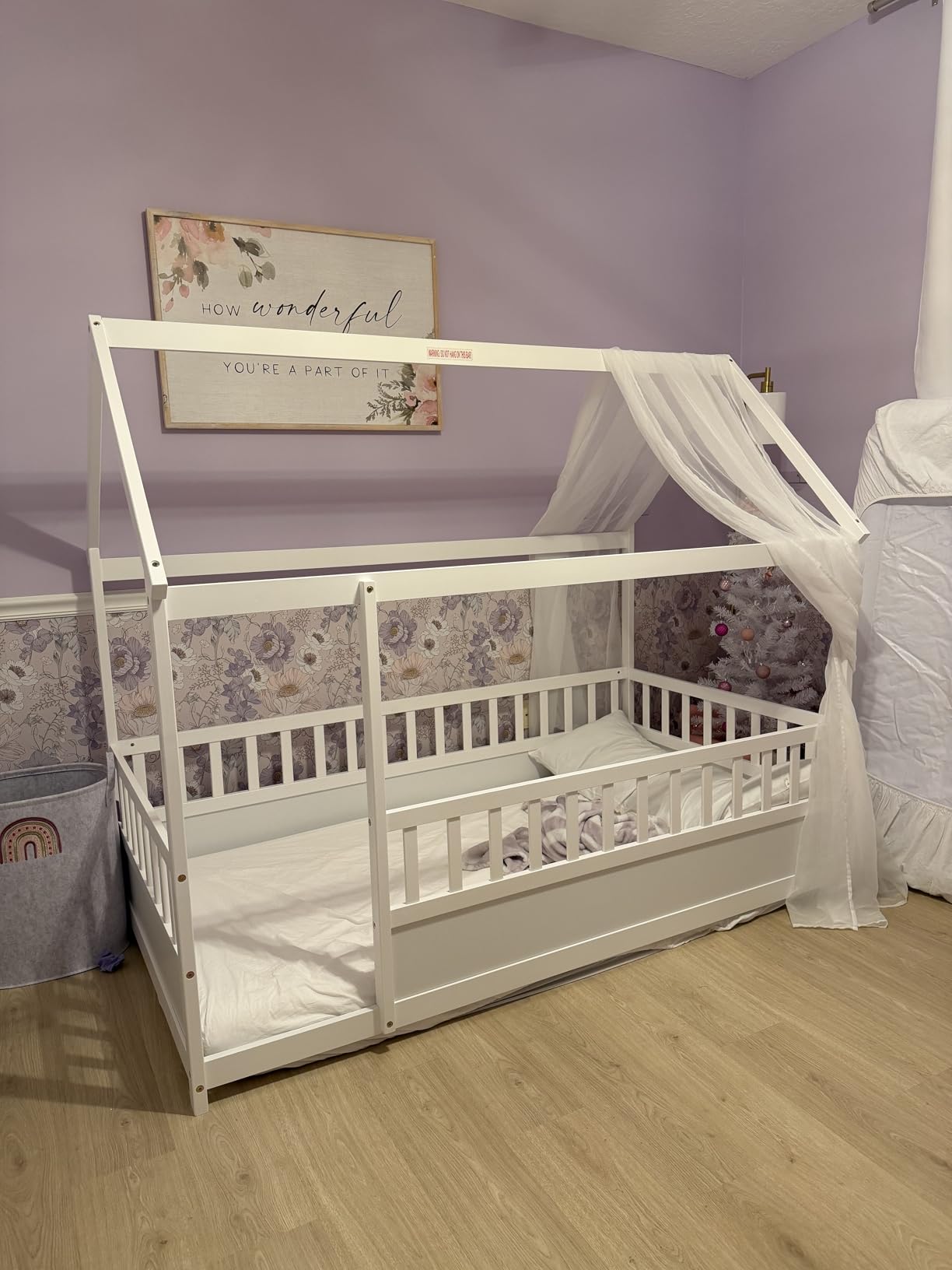
Owners like being able to dress the roof themselves. Valances, a lamp and a few soft furnishings turn the structure into a proper hideaway, and because the roof area is decorative rather than structural, decorating is easy and reversible.
The absence of slats is the reservation we keep coming back to. Mattress support depends entirely on whatever base you supply, so budget for a proper slatted base or a solid platform board if the frame does not include one. It arrives in a single box, which generally means a two-person assembly job.
The footprint is substantial at 79.53 x 44.76 inches. Measure the room and the ceiling before committing, because a 66 inch tall structure in a low room will dominate it.
What this bed does well
Imaginative play is a genuine developmental benefit, not just decoration. A bed that doubles as a playhouse gives a child somewhere to put the day’s energy, which is often why parents choose a house silhouette over a plain fence.
The height and CPC certification give it a reassuring solidity, and the 300 lb rating means an adult can sit comfortably at the edge during a restless night.
Where it falls short
Missing slats are the practical issue. Confirm exactly what base is included before you commit, and plan for the additional cost if the answer is nothing.
The size is the other limitation. This is a large structure in a child’s bedroom, and it suits a room with genuine floor space rather than a small or shared one. Parents whose children were easily distracted by imaginative play at bedtime also note the house shape can delay sleep rather than help it.
11. HAUOMS Upholstered 2-in-1 – Best for Width and Conversion
Twin Floor Bed, Low Montessori 2-in-1 Beds, Slats, High Rails, Upholstered
Metal frame with fleece upholstery
80.4 x 59.1 x 19.7 inches
400 lb capacity
Converts to a daybed
Pros
- Remove rails and legs for a floor bed
- then convert to a daybed
- 400 lb capacity so a parent can lie beside the child
- Silent heavy-duty metal frame with no creaking
- 59.1 inches wide so it does not feel cramped for an adult
Cons
- Strong chemical odour reported by some buyers
- Very heavy at 111 lb and holes are barely predrilled
- Fleece upholstery is difficult to clean
- Highest share of one-star reviews in the roundup
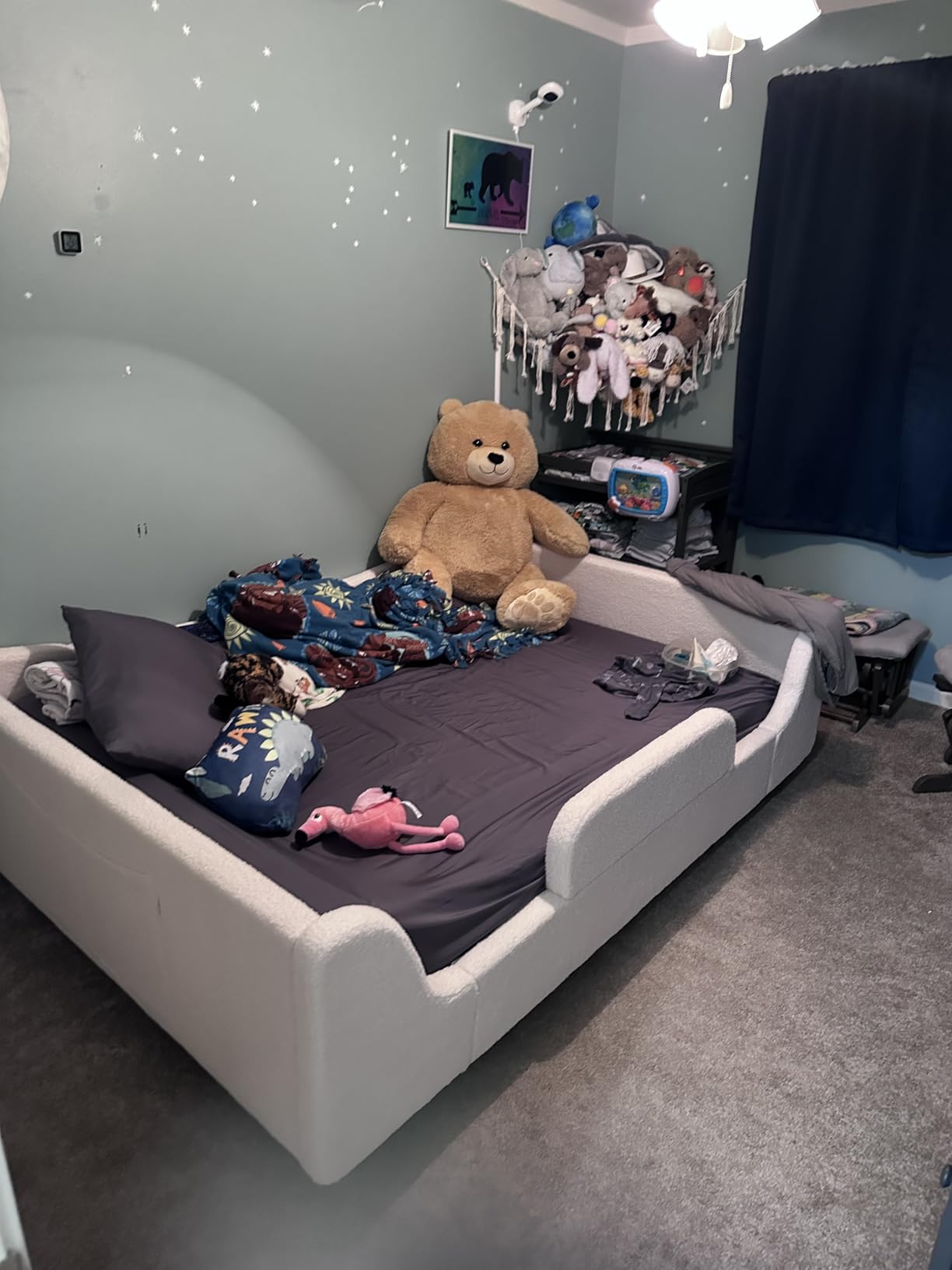
Width is the underrated feature of this bed. At 59.1 inches across it is far wider than a conventional floor bed, which means an adult can actually lie beside a child without the arrangement feeling absurd. Combined with a 400 lb rating, it handles the cosleeping scenario better than most frames in this roundup.
Three life stages from one frame is unusual in this category, and it is what justifies the weight.
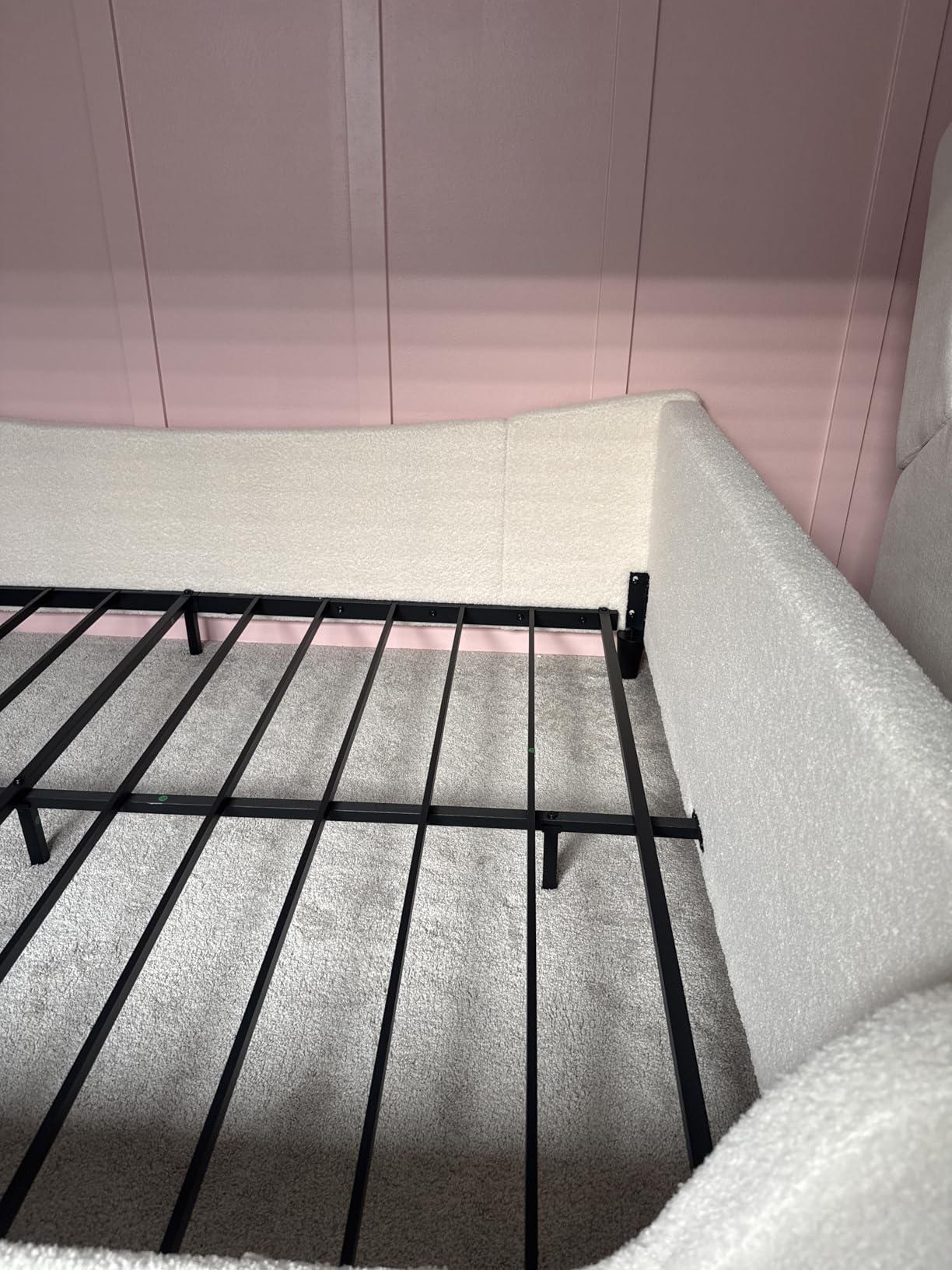
The metal frame is silent, which for a child who jumps on the bed is as valuable as it was on the wooden frame earlier in this list. There is a built-in mattress retainer and rounded edges throughout, plus a book storage pocket that keeps bedtime reading in one place.
Parents who moved from wooden rails report fewer accidents once they switched, which makes sense given the teddy fleece upholstery on the whole low frame. That is a real safety argument rather than a cosmetic preference.
The reservations are significant enough to state plainly. At 111 lb this frame is by a wide margin the heaviest here, the assembly holes are barely predrilled, and some buyers report a chemical odour that lingered even after a month of airing. Fleece upholstery is also difficult to keep clean.
What this bed does well
It is a very adult-compatible floor bed. The width, the 400 lb capacity and the fully padded frame together mean the parent lying beside the child scenario actually works, which is the arrangement many Montessori families prioritise.
Conversion is real rather than cosmetic. The mattress retainer and the removable rail and leg system mean the frame genuinely changes function instead of just shedding accessories.
Where it falls short
The odour and the weight are the two practical problems. One hundred and eleven pounds is genuinely awkward in a small bedroom and effectively immovable once it is assembled, so measure your doorways and think carefully about whether you will ever need to shift it.
It also carries the highest share of one-star reviews in the roundup, and the fleece is hard to clean in a house where things get spilled regularly. If your priority is a quiet, low-maintenance bed for a small room, this is the wrong choice even though the capability is impressive.
12. i-POOK Twin Floor Bed – Budget Pick
i-POOK Twin Floor Bed for Children, Sturdy Wood Montessori Bed Frame with Wood Slats, High Fence & Small Door, Montessori Floor Bed for Girls and Boys, White
Twin floor bed with fence and door
75.1 x 41.8 x 17.5 inches
200 lb capacity
7 plywood slats
Pros
- Entry-level frame that still includes a fence and small door
- 7 reinforced plywood slats beat slatless designs
- Quick to assemble with tools included
- Compact and tidy look
Cons
- Quality control is inconsistent with cracked parts and chipped paint
- Interior dimensions run a few inches larger than a standard twin mattress
- Loose gate latch that rattles loudly
- Side panels fixed with only a couple of screws
This is the most sensible way to spend a limited budget on a Montessori floor bed, and it does more than it has any right to at this entry point. You get a high fence, a small door and seven reinforced plywood slats, which is a real slat count rather than the slatless shell many frames at this level are built on.
Owners generally find it an attractive, quick first step down from a cot. It assembles fast with instructions and tools included, and the dimensions at 75.1 x 41.8 inches work in a modest room without dominating it.
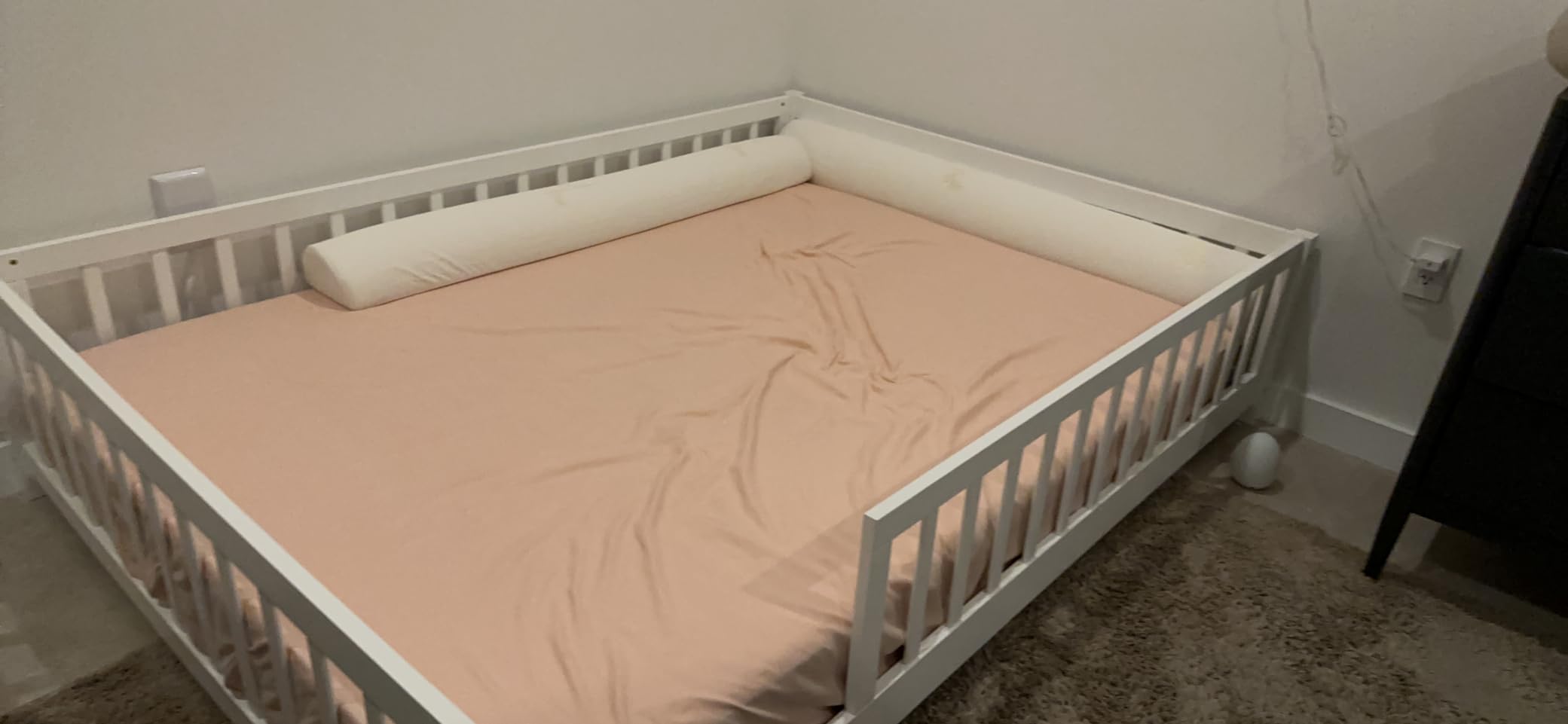
What to expect is some variation in finish quality. Reports of cracked pieces and chipped paint on arrival are consistent enough to be worth planning around, and the interior dimensions run a few inches larger than a standard twin mattress, which leaves a visible gap.
The gate lock is loose and rattles loudly when the frame is bumped, which is more irritating than dangerous but will wake a light sleeper. Side panels are held with only a couple of screws, so vigorous climbing can work them loose over time. The slat screw holes are not predrilled, so a drill saves a lot of frustration.
At 200 lb this is a child’s frame, and the mattress is limited to 6 inches thick or less. Both limits are typical for the category and neither is a hidden trap.
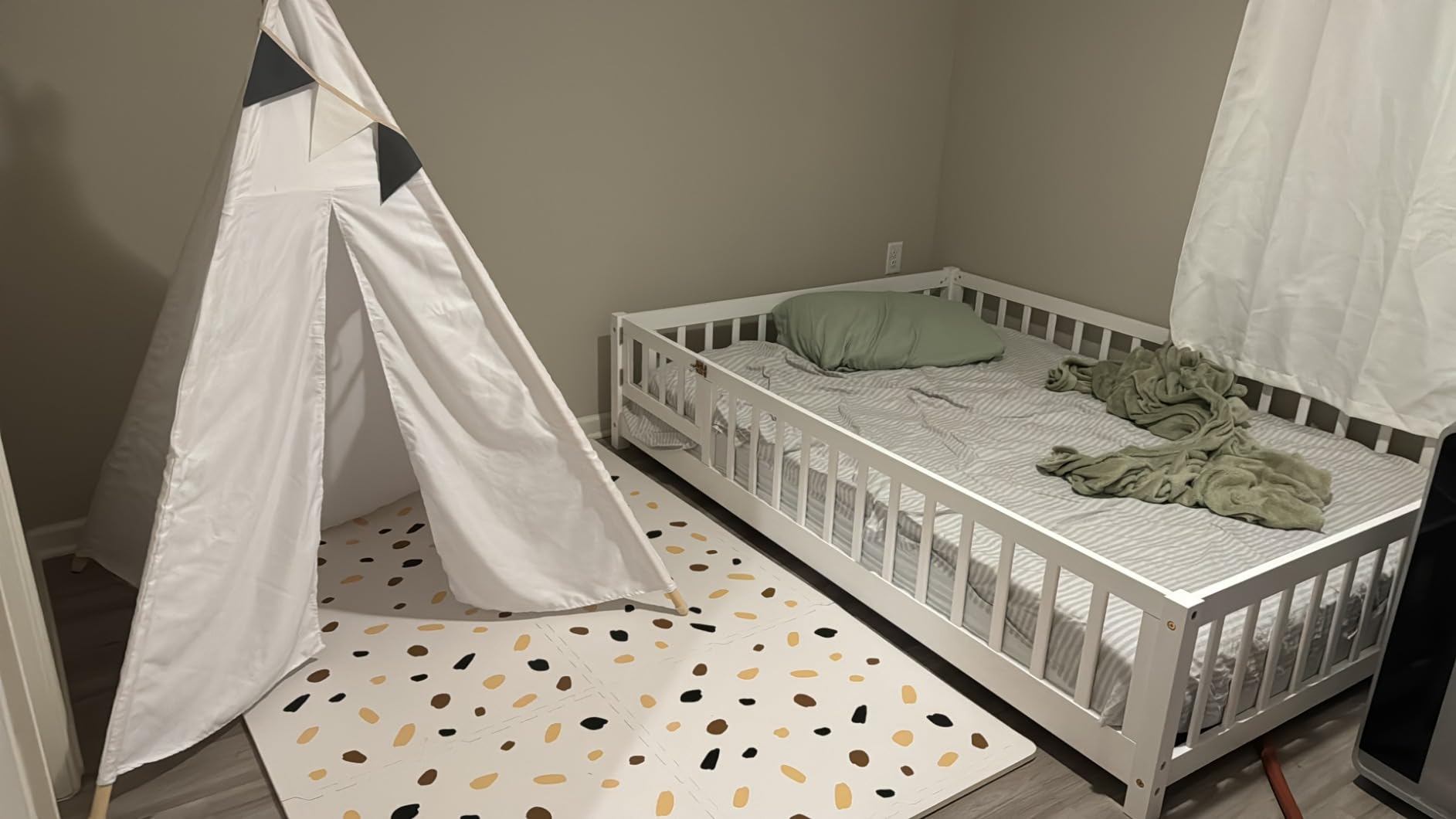
What this bed does well
It delivers the two things that matter most for a Montessori setup: a genuinely low profile for independent entry, and a fence with a door so the bed feels like a place rather than a bare mattress. Buyers get that combination without paying for a convertible or upholstered frame.
Assembly speed is a real advantage. A frame you can put together in one sitting is one you will actually put together, and the included tools remove the first trip to the garage.
Where it falls short
Quality control is the honest limitation. Inspect the frame on arrival, keep the hardware, and check the slats for cracks before a child uses it. Inspecting takes two minutes and catches the overwhelming majority of problems.
The loose gate latch and lightly fixed side panels are the two things to tighten yourself if you are comfortable with a screwdriver. Beyond that, treat it as a two-to-three-year bed and expect to move up when your child outgrows the twin dimensions.
How to Choose a Montessori Floor Bed: Mattress, Safety and Age Timing
The frame is the least important decision you are making. Parents who focus on house silhouettes and finish colours tend to have a rougher first month than parents who focus on slat count, weight rating and room preparation, because the first two determine whether the bed stays usable and the last one determines whether the child is safe in it. Here is how we think through the rest of it.
Mattress sizing and thickness
Buy the mattress to fit the frame, not the other way round. Crib-size frames in this roundup accept a standard crib mattress of 51 5/8 by 27 1/4 inches, up to 6 inches thick, which is worth a great deal if you are moving straight out of a cot and can reuse what you already own. Twin frames need a standard twin, and several of them run a few inches larger inside than a standard mattress, so check the interior dimensions against your existing mattress before ordering.
Most frames here cap mattress thickness at 6 inches. A thicker mattress can stop short of the top of the fence, which opens a gap at exactly the height where a climbing toddler would go over it. Look for the stated limit and buy to it rather than over it.
On materials, a firm, flat surface matters more than softness for a child who is learning to move independently. Look for breathable covers, particularly in a humid climate, and check the certification language carefully rather than taking the word natural as a specification. If your family reacts to finishes or fragrances, prioritise frames reported to have no chemical smell after assembly over upholstered options.
Ventilation and moisture control
Mattress on the floor invites one legitimate concern, which is trapped moisture. The very low wooden frames in this roundup, at around 15 inches overall, let air move beneath the mattress and are the better answer than any raised platform. Upholstered bases trap more, so lift them or leave a gap if you can.
Practical habits matter more than the frame. Lift the mattress and stand it on its side for an hour every few days, keep the room ventilated, and avoid pushing the bed flush into an exterior wall where condensation forms. A washable mattress protector goes a long way, and in a genuinely humid climate a dehumidifier on a timer is cheaper than replacing a musty mattress.
Age-based transition timing
Most families land somewhere between eighteen months and three years, and the honest signal is not the calendar. It is the child. A toddler who has started trying to climb out of the cot, who can push up to a standing position confidently, and who is pulling to stand on furniture has the mobility a floor bed assumes. A child who is still rolling unpredictably and has not yet sat unassisted is not there yet.
For infants under twelve months, be cautious. Free movement on a firm surface has developmental appeal, but the room needs to be genuinely infant-safe and the surface should be firm and flat rather than soft. Many parents use a floor mattress arrangement before moving to a frame at all, which is a reasonable way to test the idea without buying twice.
There is no upper age limit in the Montessori sense. A frame that converts to a raised kids bed or a daybed, which several here do, keeps going well past the toddler years. Plan for that if you can, because a frame that lasts from age one to age ten changes how you should think about the original purchase.
Room childproofing checklist
A floor bed only works in a room that has been prepared as a space for a small, capable person. Work through this before the mattress goes in: window blind cords out of reach and ideally tied up, sockets covered, furniture anchored to the wall, small objects removed, a gate on the door for the first six months, and the path between the bed and the door lit enough to be walked safely at night.
The night-time wandering question comes up constantly, and the honest answer from parents is that it settles. Children who learn their own bed edges within a fortnight or two rarely wander after that, and the beds with higher fences buy you the fortnight. If your child is a heavy night wanderer, prioritise a fence height over a house silhouette.
Free movement during the day is the part of Montessori that parents underestimate. The same open floor that lets a child get up independently also lets them reach things they should not, so treat the first two weeks as an active supervision period rather than a handover.
Assembly and finish smell
Assembly difficulty is the most common regret. Check for labeled parts, an assembly video and predrilled slat holes, because the frame is simple but the labelling is what makes it confusing. Two of the frames here need a power drill, and the shortest screws in the category can split the wood if forced.
On finish, painted frames can carry a smell for a few days that is normal, while upholstered frames are the ones where reports of a chemical odour persist for weeks. Air any new frame in an empty, ventilated room for at least a week before a child sleeps on it, longer if anyone in the house is sensitive. If a listing says safe varnish and paint and nothing more, treat that as the absence of a stronger certification rather than as a certification in itself.
What most families get wrong
Two mistakes come up repeatedly. The first is buying a high house frame for a small room, which leaves nowhere to walk and turns the bed into a piece the child uses only when supervised. The second is choosing on appearance and discovering the slat count afterwards, which is how a bed that looked wonderful starts sagging in year two.
If your child is already struggling at bedtime rather than staying in bed, the frame is not the lever. Our guide to getting a toddler to stay in their bed covers the behavioural side, and if the problem is night waking rather than leaving the bed, why toddlers wake up screaming is worth reading first.
Frequently Asked Questions
What is a good Montessori bed for a 2-year-old?
At what age is a Montessori floor bed appropriate for a child?
What kind of mattress do you use for a Montessori floor bed?
Is a Montessori floor bed safe for my child?
Until what age is it recommended to use a Montessori floor bed?
What are the pros and cons of a Montessori floor bed?
Final Verdict: Which Montessori Floor Bed Should You Buy?
The Ocodile Twin Floor Bed is our pick as the best toddler floor bed for Montessori in 2026, because 14 slats and a 400 lb rating solve the two problems that break most floor beds, sag and an adult being unable to lie down beside a frightened child. If your budget is tighter, the GIANTEX twin frame with its removable lockable door gives you the same Montessori principle for less, once you plan to reinforce its slats. If your child is a restless roller, the Zumspiel crib-size frame with removable rails is the one that solves that specific problem properly.
Whichever you choose, prepare the room first and let the frame follow. The bed is the easy part; the childproofing is what turns a floor bed from an idea into something that works every night.