

If your indoor gauge reads 20-25% relative humidity on a cold January morning, the best humidifiers for whole house use are furnace-mounted evaporative models when your home has forced-air ductwork, and large console evaporative humidifiers when it does not. Those two answers cover nearly every situation we found while reviewing the category.
The best type of humidifier for a whole house is the in-duct or bypass evaporative unit. It mounts on the furnace plenum, takes a plumbed water line, and pushes moisture into the supply ductwork every time the blower runs, so every register in the home benefits. If there is no ductwork to tap into, a console evaporative humidifier placed near the return air path is the closest equivalent, and it works well in open-plan living spaces up to about 3,600 square feet.
We spent the last few weeks reading specification sheets, owner reports and hands-on style reviews across the top whole home humidifier models on the market, then cross-checked coverage claims against real square footage. What came out the other end is a short list of six units that hold humidity in the 30s through a heating season, plus guidance on sizing, installation and the maintenance habits that decide whether a unit helps or becomes a mold problem. If you want a broader look at seasonal prep, our dry winter humidifier guide covers the timing side.
Table of Contents
Top 3 Picks for Whole House Humidifiers in 2026
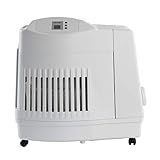
AIRCARE MA1201 Console Evaporative
- Covers 3600 sq ft
- 3.6 gallon tank
- Digital humidistat with auto mode
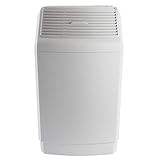

AIRCARE EP9 800 Pedestal
- Pedestal footprint
- 2400 sq ft coverage
- 70 hour low setting runtime
Whole House Humidifiers at a Glance in 2026
| Product | Specifications | Action |
|---|---|---|
| AIRCARE MA1201 Console Evaporative |
|
Check Latest Price |
| AIRCARE 831000 Space Saver |
|
Check Latest Price |
| AIRCARE EP9 800 Pedestal |
|
Check Latest Price |
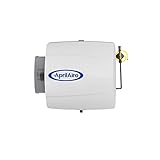 AprilAire 500 Automatic AprilAire 500 Automatic |
|
Check Latest Price |
 AprilAire 600M Manual AprilAire 600M Manual |
|
Check Latest Price |
 AprilAire 700M Fan Powered AprilAire 700M Fan Powered |
|
Check Latest Price |
1. AIRCARE MA1201 Whole-House Console Evaporative Humidifier – Best Overall
AIRCARE MA Whole-House Console-Style Evaporative Humidifier (Console)
3600 sq ft coverage
3.6 gallon tank
14 lb, casters included
1650 watts, 2 year limited warranty
Pros
- Covers open floor plans up to 3600 sq ft
- Digital humidistat with auto mode
- Evaporative wick traps minerals so no white dust
- Casters included
- Auto shut off at target level or empty
Cons
- Louder on the highest fan speeds
- Tank needs daily refills in very dry air
- Wick can dry unevenly at the top
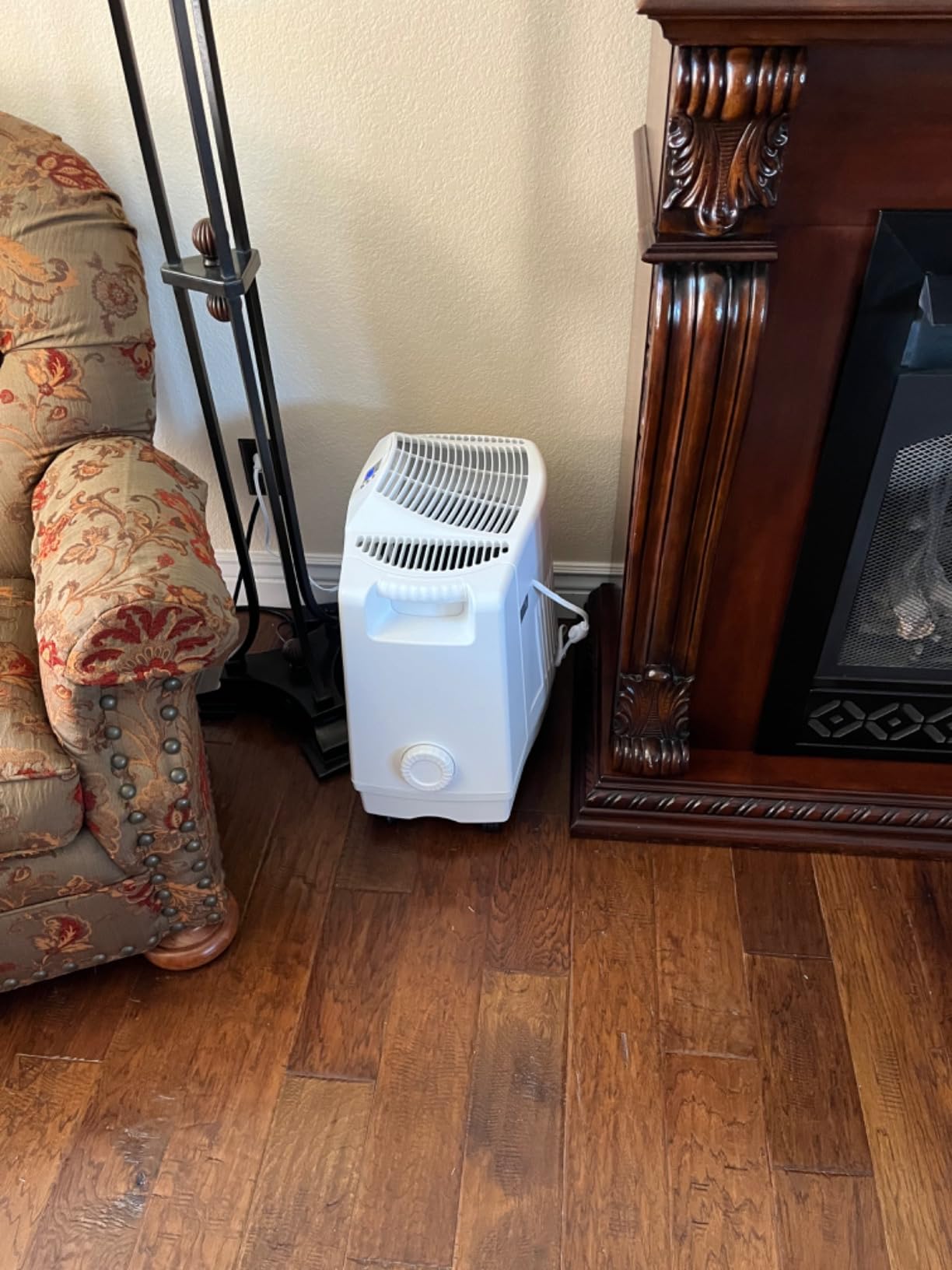
This is the console humidifier we kept coming back to. The MA1201 covers up to 3,600 square feet, which puts it in front of both other console models here, and the 3.6-gallon tank sits right in the middle of the class. Owners running it in open-plan living spaces of 2,000 to 3,000 square feet report it pulls a dry house into the 30s without constant babysitting.
The digital humidistat with auto mode is the part that matters most for a whole home humidifier. Set a target and the unit ramps itself down as it approaches it, which is what stops the runaway over-humidification problem that wrecks hardwood floors and window trim. Owners are clear that auto mode needs calibrating with separate hygrometers placed near the bedrooms, not just the unit.
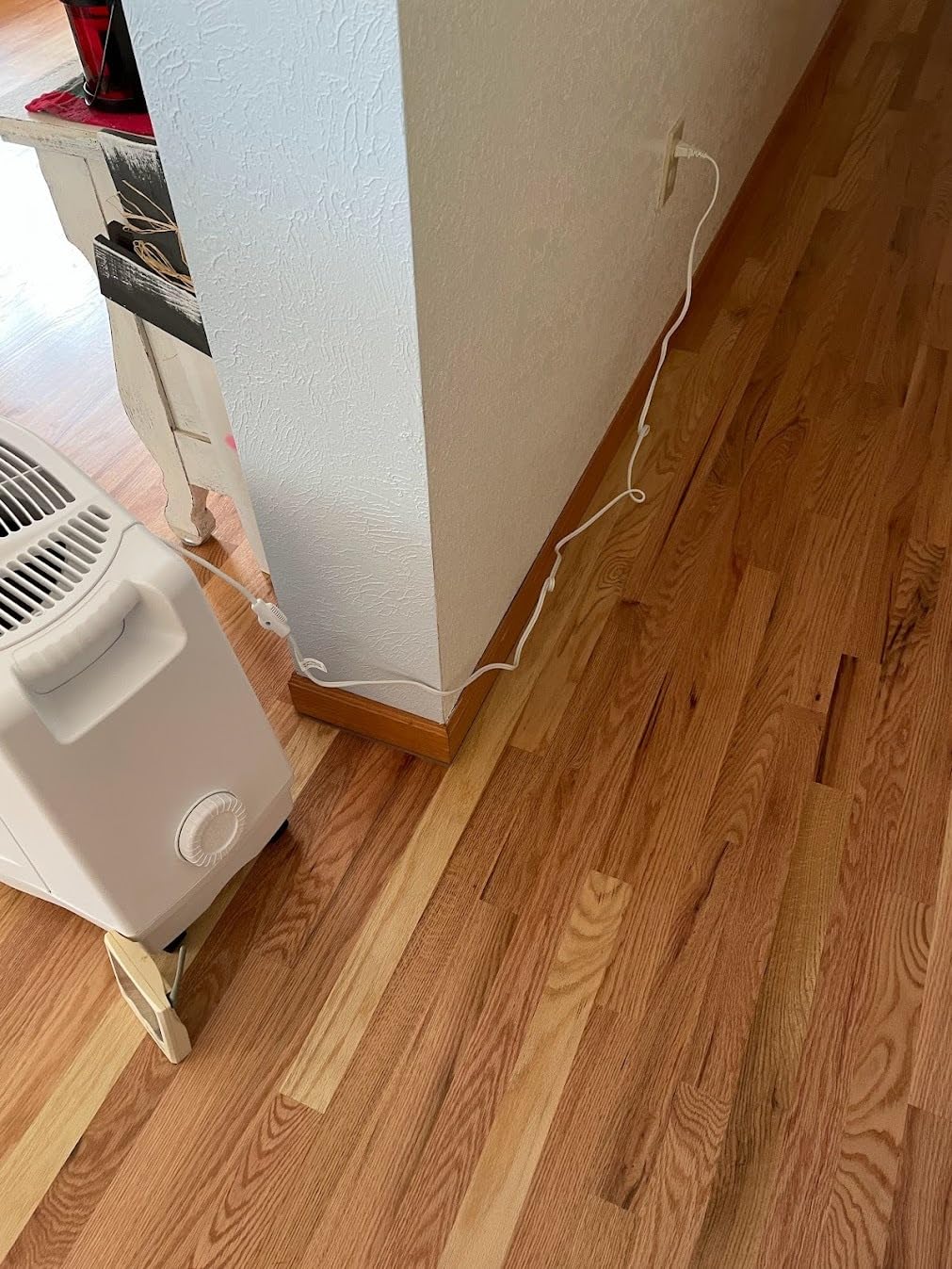
Evaporative media is the quiet hero here. The wick pulls water up by capillary action and the fan pushes humid air across it, so minerals stay trapped in the filter instead of aerosolizing onto your surfaces the way an ultrasonic unit does. In practice that means no white dust on electronics or wood furniture, and no distilled water habit to maintain.
Maintenance is the trade. Reviewers estimate the wick lasts one to two months depending on how hard your water is, and in genuinely dry winter air the tank can want a refill every day. Filtering the water with a hydrogen peroxide additive, as several owners do, stretches filter life noticeably.
How it performs in a cold open-plan home
The MA1201 runs on 1,650 watts and has no belts, pulleys or wheels in the air path, so the noise is airflow noise rather than mechanical rattle. On the low and medium fan speeds most owners describe it as unobtrusive against a background of furnace noise. Push it to the top two speeds and it becomes clearly audible, which is why most people settle on medium and let auto mode manage the cycles.
Because it is a room unit rather than a ducted unit, placement matters more than most sellers admit. Put it in the room with the lowest humidity reading and near a return grille, not tucked in a corner. In a two-story home, one on each floor outperforms a single unit fighting to move air up a stairwell.
Who should look past this model
If your home runs forced-air ductwork and you are comfortable with a plumber or HVAC tech, a furnace-mounted model serves every room through the air handler instead of relying on one living space. The MA1201 cannot do that, and no placement trick changes that limit.
It is also the wrong pick for an arid desert climate where you need maximum moisture delivery in a short heating season. Evaporative media loses output as the incoming air dries, and a steam electrode unit keeps working at full rate in genuinely dry air. And if you need more than roughly three refills a day, the Space Saver below holds far more water.
2. AIRCARE 831000 Space Saver 6-Gallon Evaporative Humidifier – Budget Pick
AIRCARE Space Saver Large Evaporative Whole House Commercial 6 Gallon Humidifier for Large Rooms 2,700 sq ft. With Digital Controls, Auto Humidistat and Automatic Shut Off
2700 sq ft coverage
6 gallon tank
14 lb, casters included
1000 watts, 2 year limited warranty
Pros
- Six gallon tank means fewer refills in dry air
- Digs lower than most console models
- Digital controls with auto humidistat
- Trapmax filter technology
- Auto shut off when empty or on target
Cons
- Runtime listed at only 6 hours at top setting
- Audible on higher fan speeds
- Filter still needs periodic replacement
- Tank may not fit under every sink
The single best thing about the 831000 is the tank. Six gallons is the largest capacity in this lineup, and in a house that sits at 20% relative humidity for three months straight, refill frequency is the thing that decides whether a whole home humidifier survives the season or ends up switched off in frustration.
Coverage is listed at 2,700 square feet, which is honest for a unit of this size in a home with normal ceilings and doors. Owners in open plans of that size report steady results with the auto humidistat doing the work. The Space Saver also draws less power than the MA1201 at 1,000 watts, which matters if you plan to run it near continuously through a heating season.
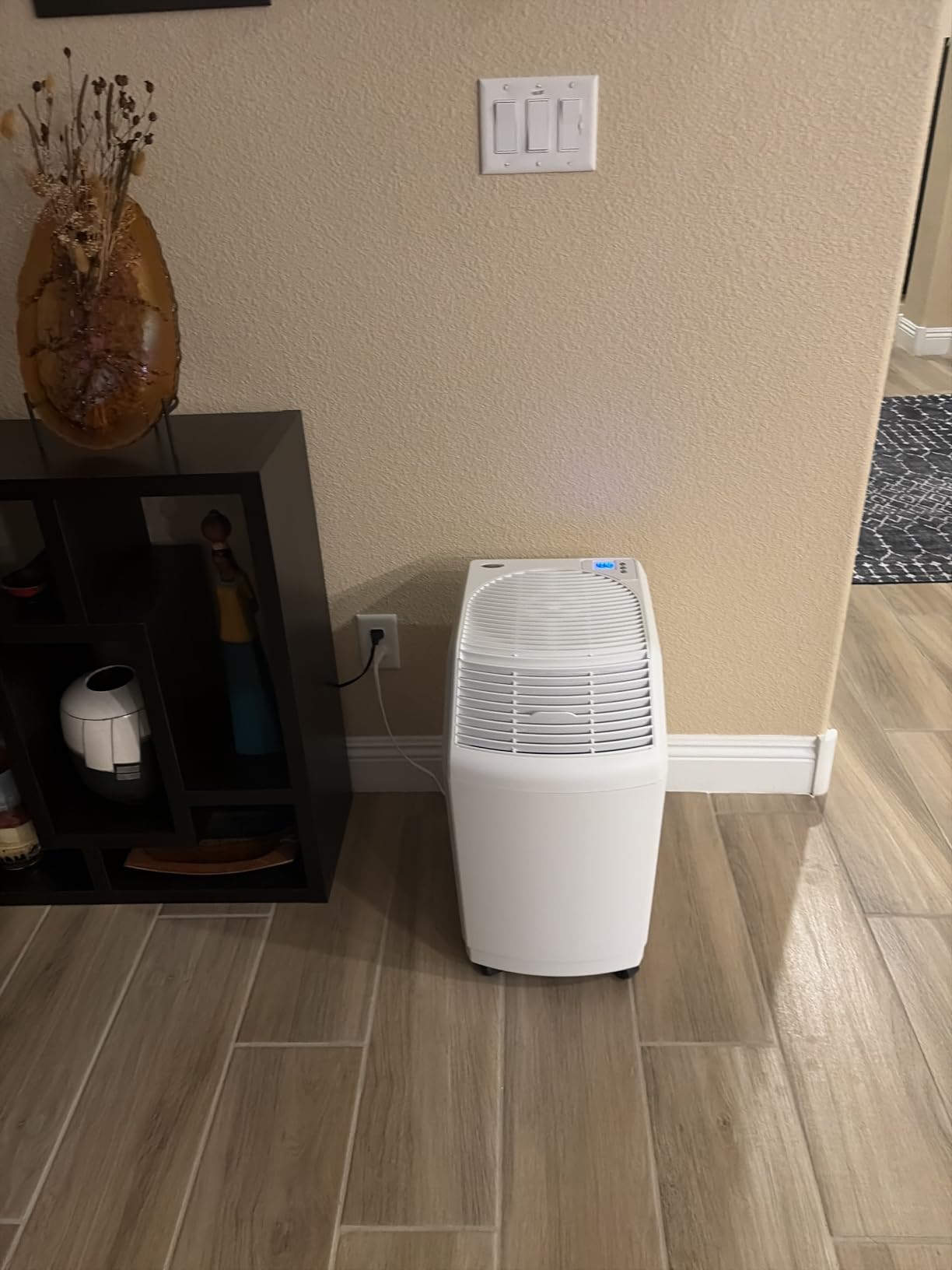
The published runtime figure is 6 hours, and that number confuses people. It reflects maximum fan speed with the wick fully saturated rather than a realistic overnight run at low or medium. Set to the lower settings most owners use, a single fill lasts through a normal night with room to spare.
Trapmax filter technology is the marketing name for the wick frame design, and it does what the name suggests: mineral scale collects in the frame rather than migrating into the fan and motor housing. That keeps the air moving well longer between filter changes than a bare wick design would.
Where the Space Saver earns its ranking
This is the pick for anyone who dreads the daily refill ritual. If you have a large family, a home with more than one floor, or simply forget to check water levels, the six-gallon reservoir removes the single most common reason whole home humidifiers end up unused after a month.
The footprint is genuinely compact at 12.5 by 17.5 inches, and the included casters make it easy to move room to room when you are chasing a dry spot. Many owners treat it as a movable unit, running it in the bedroom during the night and moving it to the living area during the day.
Where it falls short
Coverage caps at 2,700 square feet, so in a larger open plan or a home with a finished basement you will be chasing the target humidity all winter with the fan pinned high, which brings back the noise complaints. The 4.2-star average across more than 6,500 reviews reflects steady performance rather than standout capability.
The tank is also tall, and owners report it will not fit under every kitchen sink faucet. Measure your clearance before you commit, because refilling over a utility sink in the garage is the fallback most people end up with and it becomes an excuse to skip a fill.
3. AIRCARE EP9 800 Pedestal Evaporative Humidifier – Best for Smaller Spaces
AIRCARE Digital Whole-House Pedestal-Style Evaporative Humidifier (Nutmeg)
2400 sq ft coverage
3.5 gallon tank
25 lb pedestal body
70 hour low setting runtime
Pros
- Pedestal shape keeps floor space clear
- 70 hour runtime at the low setting
- Digital controls with auto humidistat
- Low water indicator and auto shut off
- Evaporative design leaves no white dust
Cons
- Heaviest of the console models at 25 lb
- Wick replacement can be fiddly to reach
- Smaller coverage than the other console picks
- Warranty length not stated
The EP9 800 solves a problem the other console models create. At 27 inches tall on a narrow 18-inch pedestal base, it pushes the water tank up off the floor, which keeps the top surface clear and makes the whole thing less of an eyesore in a living room that people actually look at.
That vertical layout also delivers the longest stated runtime here: 70 hours on the low setting. Owners running it in homes around 1,500 to 2,400 square feet like that figure because they can fill it before bed on a weekend and leave it alone for two days.
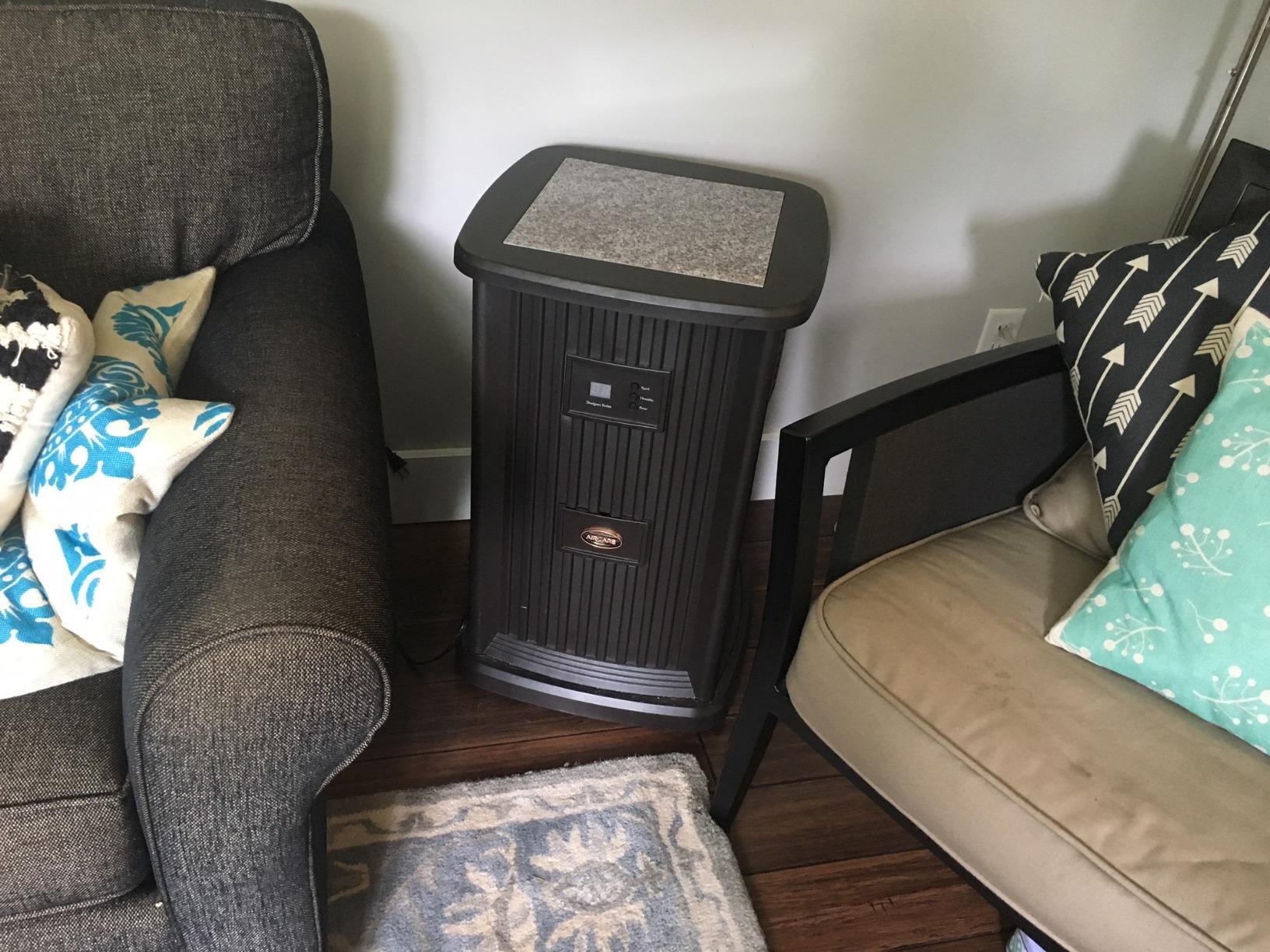
Controls are digital with an auto humidistat, plus a low water indicator and automatic shut off, which is the same feature set as the larger console units. You still get evaporative technology and the mineral-trapping wick, so there is no white dust problem and no need to chase distilled water.
Nutmeg and espresso finishes are available, and that is not purely cosmetic. A humidifier sitting in a finished living room in a warm brown or dark tone reads as furniture rather than an appliance.
Long runtime versus reach
The 70-hour runtime is only useful if your home is small enough that low-speed output meets the target. In a 2,000 square foot home with average winter humidity readings, most owners say it works without ever going above the medium speed. In a home of 3,000 square feet or more, the same low-speed setting will not get you there.
Wattage is not listed for this model, which is unusual and worth noting if you care about operating cost. In practice a pedestal unit of this size falls broadly in the same range as the other console models, but the published specification is genuinely missing rather than merely hard to find.
Maintenance and weight considerations
At 25 pounds this is the heaviest console unit here, and that shows up when you need to lift it for cleaning or move it between floors. Reviewers are also mixed on reaching the wick for replacement: the vertical design is stable but the filter sits lower and deeper inside the housing, so it takes more awkward reaching than a top-loading console.
The warranty description is listed as not specified on the specification sheet, unlike the two-year limited coverage on the other AIRCARE consoles. If you are the type to keep a unit for a decade, get the warranty terms in writing before you buy.
4. AprilAire 500 Automatic Whole-House Furnace Humidifier – Best for Automatic Control
AprilAire 500 Whole-House Humidifier, Automatic Compact Furnace Humidifier, Large Capacity Whole-House Humidifier for Homes up to 3,600 Sq. Ft., White
3600 sq ft coverage
12 gallons per day
7.8 lb, mounts on plenum
24 VAC, 15 watts, 5 year warranty
Pros
- Dual sensors track outdoor temperature and indoor humidity
- 12 GPD handles cold snaps
- Digital control panel shows level and filter status
- Quiet operation with no moving parts
- 5 year manufacturer warranty
Cons
- Installation needs HVAC
- electrical and plumbing skill
- Extra parts required for a self install
- No warranty coverage for DIY installation
- Outdoor sensor needs a hole through an exterior wall
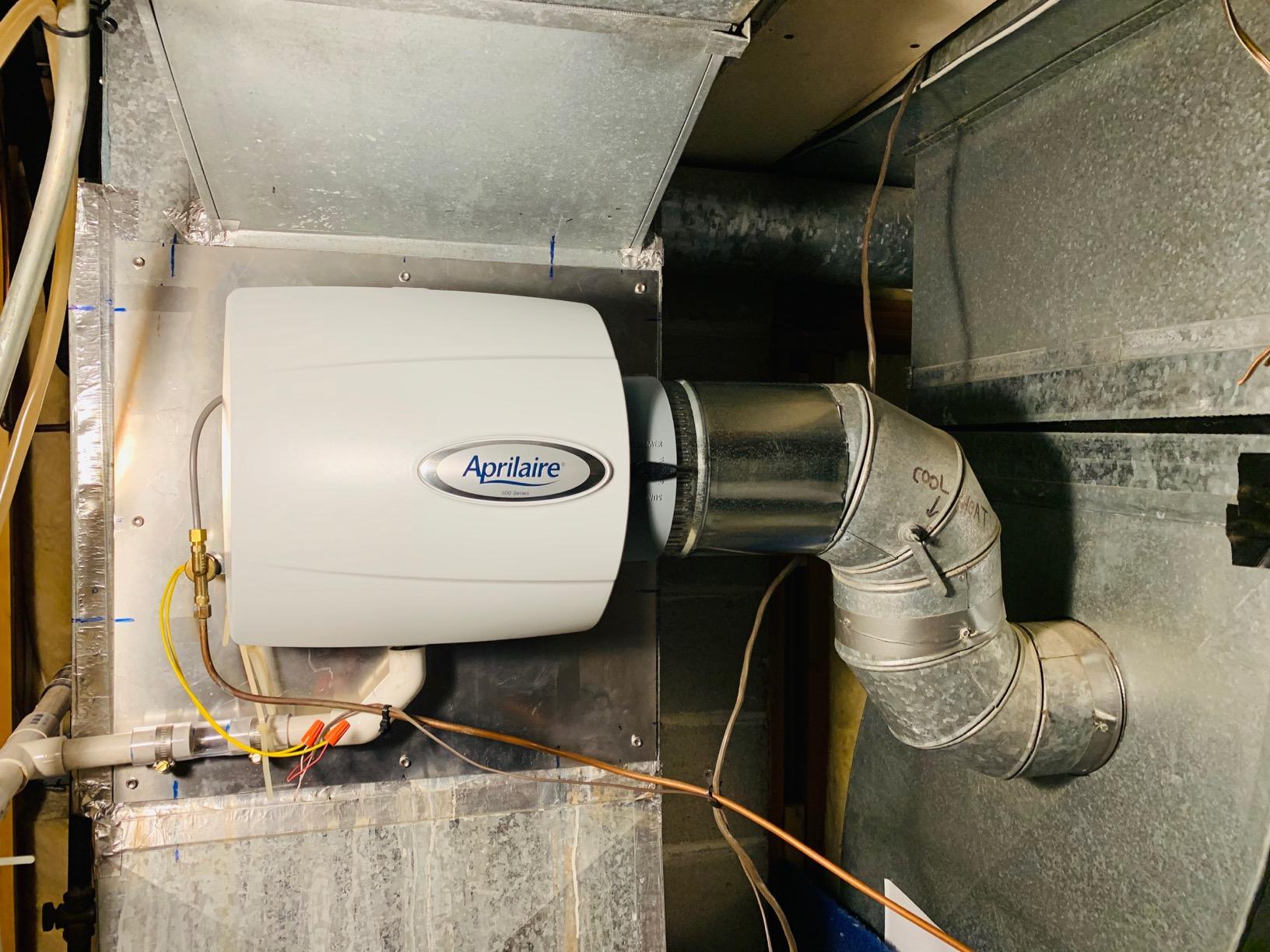
The Model 500 is the first furnace-mounted unit on this list and the shift is significant. Instead of sitting in a room blowing moisture across one space, it bolts to the furnace plenum and feeds humid air into the supply ductwork, so every register in the house receives it. Coverage is listed at up to 3,600 square feet in a tightly built home.
Output is 12 gallons per day, which is the figure that really determines whether it holds up in February. A furnace already heats incoming outdoor air, and heating air lowers its relative humidity dramatically, so the system needs real capacity to claw back to 40-60% in a deep cold snap. That is where evaporative units earn their keep.
Automatic mode is the reason to pick the 500 over its manual sibling. Dual sensors monitor outdoor temperature and indoor relative humidity, then adjust output so the house lands in target range without you touching a dial. Owners report the practical benefit directly: window condensation that used to appear in cold weather largely stops.
Power draw is 15 watts on a 24 VAC transformer, and there are no moving parts in the humidifier itself. Compared with a console unit running a fan for hours a day, the energy difference is striking.
What the automatic mode actually does
The control tracks two variables because they behave differently. Indoor humidity tells it when you have hit the goal. Outdoor temperature tells it how much extra moisture the incoming cold air will need before it reaches the rooms. Combine them and the unit ramps water flow up on a clear cold night and backs off when the weather softens.
The digital control panel shows current percent humidity, lights when the humidifier is running, when the water panel needs changing, and when service is due. A blower activation switch lets you run the humidifier continuously or only when the furnace blower runs, which is the setting most owners use.
Why installation is the real decision point
This is not a plug-it-in product. The box includes a 24 VAC transformer, humidifier control, valves and installation instructions, and a complete install also needs thermostat wire, copper tubing, a drain line, duct modifications and an electrical box. The included instruction material leans on a schematic rather than a step-by-step photo guide, and the outdoor temperature sensor has to be mounted outside through the wall.
AprilAire does not provide warranty coverage for a self-install, so the money you save on labour is partly offset by that risk. If you have no HVAC experience at all, this is a job for a technician. If you are comfortable with a drill, a soldering iron and low-voltage wiring, the r/hvacadvice community has plenty of owners who have done it themselves and would tell you it is a weekend project.
5. AprilAire 600M Manual High Output Furnace Humidifier – Best for Large Homes
AprilAire 600M Whole-House Humidifier, Manual High Output Furnace Humidifier, Large Capacity Whole-House Humidifier for Homes up to 5,000 Sq. Ft., White
5000 sq ft coverage
17 gallons per day
8.7 lb, plenum mount
24 VAC, 5 year warranty
Pros
- 17 GPD handles tightly built homes up to 5000 sq ft
- Highest rating in our lineup at 4.7 stars
- Quiet operation with no moving parts
- 5 year manufacturer warranty
- Made in the USA
Cons
- Manual humidistat needs seasonal adjustment
- No outdoor temperature compensation
- Same complex install as other ducted models
- Additional parts required
- No DIY warranty coverage
The 600M carries the highest rating of anything we reviewed here, at 4.7 stars across 976 reviews, and the capacity to match: 17 gallons per day and a stated coverage ceiling of 5,000 square feet in a tightly built home. If your square footage is large, a finished basement inflates your conditioned volume, or your winters are genuinely severe, this is the output level you are shopping for.
It is a bypass style furnace humidifier, meaning it works with the furnace blower rather than pulling air through a dedicated duct. The included box covers the humidifier, humidistat, water panel, transformer, sensor, valve and instructions, and the unit weighs 8.7 pounds, so handling it during install is not the hard part.
What separates the 600M from the Model 500 is control, not capacity. This one uses a manual humidistat with a single indoor humidity sensor. It holds your target number accurately, but it has no idea what the weather is doing, so as outdoor temperatures fall you will need to turn the setting up to keep the house in the 30s.
That sounds like a drawback, and for an owner who wants set-and-forget automation it is. Plenty of people prefer it. One adjustment point instead of an algorithm is easier to reason about when something looks off, and the simpler control chain is one fewer component that can fail.
Capacity versus automation trade-off
Compare the 600M to the Model 500 directly and the decision is clean. The 500 has dual sensors and automatic compensation at 12 gallons per day. The 600M has manual control at 17 gallons per day. In a home under 3,000 square feet with moderate winters, automation wins. In a home of 4,000 square feet or more in a harsh climate, raw capacity wins.
There is also a cost angle we cannot put a number on here, but owners consistently report spending less on the manual model than on the automatic one. If you are comfortable checking a humidistat twice a season, the money you keep can pay for a professional installation instead.
Ownership realities
The water panel is the consumable. In hard water areas it fouls faster, and a panel that scales over cuts output before you notice anything wrong because the house simply never quite reaches target. Budget for a spare panel and check it rather than waiting for the symptom.
Installation carries the same caveats as the Model 500: extra parts, a schematic-heavy instruction set, and no warranty coverage if you install it yourself. If you are replacing an older in-duct humidifier, the plenum layout is usually compatible and the work is shorter than a first install.
6. AprilAire 700M Fan-Powered Whole-House Humidifier – Best for Tight Plenum Spaces
AprilAire 700M Whole-House Fan Powered Humidifier, Manual Control, Large Capacity, Up to 5,300 Sq. Ft., 18GPD, Gray
5300 sq ft coverage
18 gallons per day
11.7 lb, fan powered
120 watts, 5 year warranty
Pros
- Highest output here at 18 gallons per day
- Built in fan removes the need for bypass duct
- Covers up to 5300 sq ft in tightly built homes
- 5 year manufacturer warranty
- Quiet during a heating cycle
Cons
- Requires a 120V power connection
- Manual humidistat with seasonal adjustment
- Complex install
- Additional parts required
- No DIY warranty coverage
The 700M solves a specific and annoying installation problem. Standard bypass humidifiers need room beside the furnace for a small bypass duct and a fan. In a tight mechanical room where the plenum is already boxed in, there is often nowhere to put that. The 700M has its own fan built in, so it pulls heated air straight from the furnace through itself with no extra ductwork.
Output is 18 gallons per day, the highest in this lineup, with a stated coverage ceiling of 5,300 square feet. It runs on 120 volts at 120 watts, which is a real circuit requirement and the one thing that can rule it out during a retrofit.
Control is a manual humidistat with a single indoor sensor, so it behaves like the 600M in that respect. Set it, check it as the season turns, and it will hold. Owners consistently report quiet operation during a heating cycle because the work happens inside the duct run rather than in your living space.
The included components are a 24 VAC transformer, humidifier control, valves, instructions and a five foot cord, which covers the control side. You still supply the water line, drain and any electrical work your panel needs.
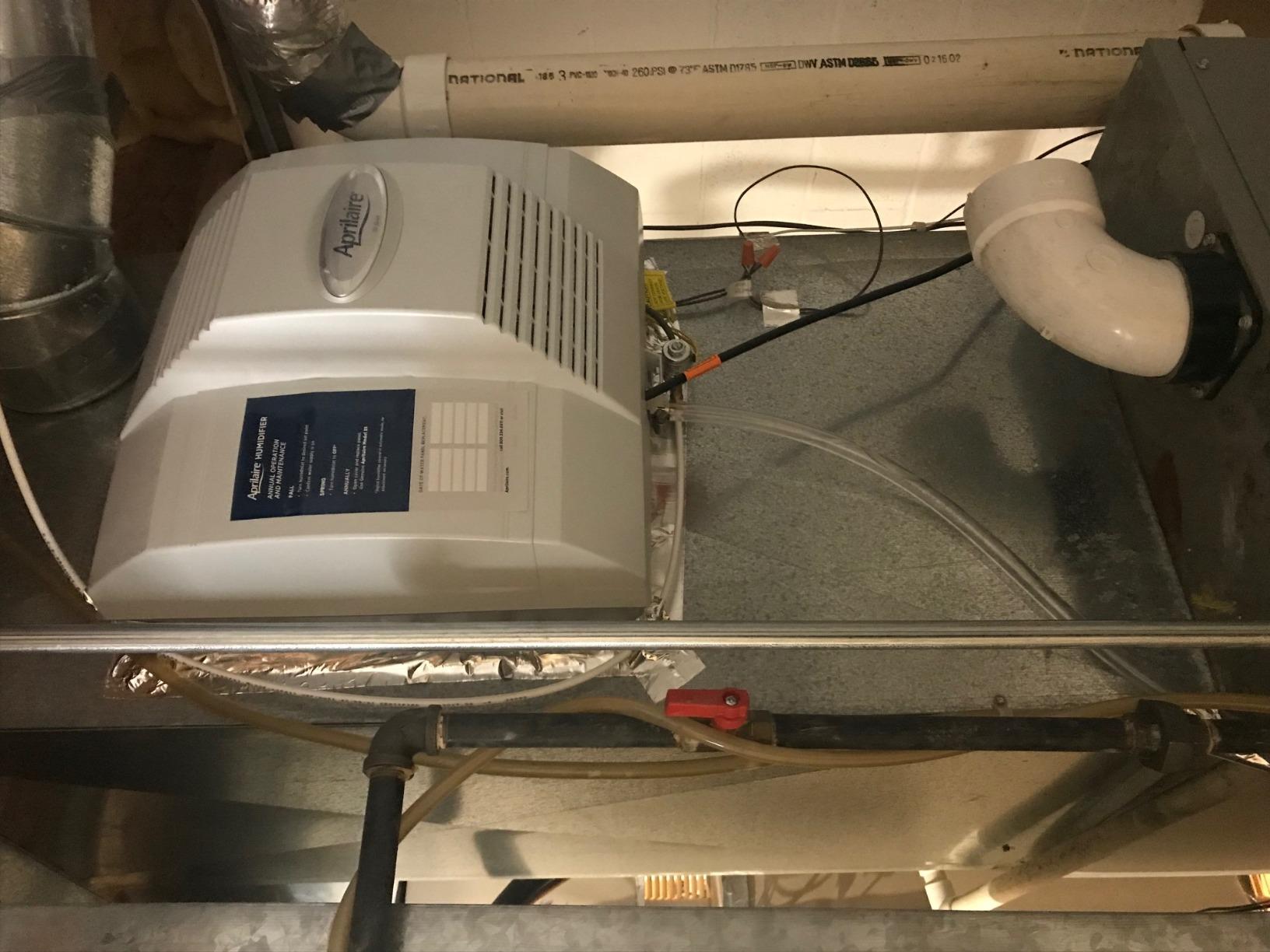
When a fan-powered design wins
Choose the 700M over a bypass model when your furnace is in a closet, a finished mechanical room or a basement where the plenum is already tight against the joists. Owners who switched from a bypass unit for this reason generally describe the swap as the fix for an install that never quite worked.
It is also the sensible high-output option for large homes where 17 gallons per day was close but not comfortably over. The extra gallon of capacity per day is meaningful when you are trying to hold 40% in a 5,000 square foot house through a cold week.
Trade-offs to weigh first
That 120-volt connection is the biggest one. A dedicated 120V circuit is more electrical work than the 24 VAC transformer used on the bypass models, so the labour saving from skipping bypass ductwork can partly disappear if your panel is far from the furnace.
Beyond that you are trading the same things the 600M trades: manual control that needs seasonal adjustment, no outdoor temperature compensation, a five year warranty that assumes professional installation, and the same general DIY complexity. Those are acceptable terms when the alternative is a unit that physically does not fit.
Do You Have Forced-Air Ductwork? The Fork That Decides Everything
Start here, because it eliminates half the list instantly. A forced-air furnace with supply registers means you can mount a humidifier on the plenum and humid air travels everywhere the heated air goes. Without that ductwork, a plenum-mounted unit has nothing to blow into.
Homes with a boiler and radiators, homes heated by a mini-split, and homes with radiant floor heat have no air handler to tap into. Those owners need a console unit placed in an open area, ideally near a return vent so air circulates, and most need one per floor for a two-story home. Larger airflow needs help; our whole house fan picks for two-story homes can move air between levels if you are combining approaches.
A quick way to identify what you have: find where your warm air comes from. If air exits vents or registers in each room, you have ductwork. If heat radiates from baseboards, a boiler or wall panels, you do not.
How to Size a Humidifier for Your Square Footage
Square footage alone is a rough guide, because ceiling height, insulation, window area and how much exterior wall you have all change how much moisture the house needs. Here is the practical version for a home with normal ceilings and average exposure.
Under 1,000 square feet: a room humidifier is usually enough. You do not need anything in this list.
1,000 to 1,500 square feet: a console unit rated around 2,000 square feet covers the space comfortably. The EP9 800 at 2,400 square feet fits well here.
1,500 to 2,500 square feet: look for a console rated 2,400 to 3,600 square feet. The Space Saver and the MA1201 both sit in this band.
2,500 to 4,000 square feet: target a console rated at the top of its range, or move up to a ducted unit rated 3,600 square feet and 12 gallons per day or more. Two console units on separate floors is a legitimate alternative.
Over 4,000 square feet, or with a finished basement: plan on a ducted unit with 17 to 18 gallons per day. The 600M and 700M are built for that range. Remember that a finished basement adds conditioned volume the posted living area figure does not capture.
For ducted sizing, ignore gallons per day if you have hard water. A hard water supply and a partly blocked water panel will cut real output well below the nameplate figure, and that is the most common reason a properly sized unit seems to underperform.
Pros and Cons of Whole House Humidifiers
Whole home humidifiers are worth it when dry air is causing real symptoms or real damage. Dry winter air often sits at 20-25% relative humidity, which dries sinuses, aggravates allergies, and is the classic trigger for static cling and cracked hardwood. Owners on r/hvacadvice describe the same pattern repeatedly: an older unit does an adequate job until a cold snap arrives, then humidity falls back into the 20s and sinuses flare.
Keeping a home between 30% and 60% relative humidity is not only a comfort measure. Dry indoor air slows the airborne spread of influenza and respiratory viruses, which is part of why the 40-60% band appears in so much guidance.
The cons are real. There is a filter or water panel to replace on a schedule, a plumbed water line to install, and a unit to service every season. Run a humidifier dirty and you risk microbial growth in the reservoir, which is the well-documented condition sometimes called humidifier lung. And over-humidification is genuinely damaging: condensation on window trim, swelling wood floors and a boost to mold and mildew.
A unit without a humidistat is the one to avoid. Manual on-off control with no humidity feedback is how people end up with a house at 65% in February and no idea why the windows are wet.
Installation: What Needs an HVAC Tech
Console units need nothing but a wall outlet and a faucet with clearance for the tank. That simplicity is the entire argument for the standalone category, and it is why these units remain the practical answer for homes without ductwork.
Furnace-mounted units are a different job. A complete install involves mounting a bypass or fan-powered unit on the plenum, tapping into a drain line, running a copper water line, connecting a humidistat and control wire to the furnace low-voltage terminals, installing a transformer, and often mounting an outdoor temperature sensor through an exterior wall. That is HVAC, plumbing and low-voltage electrical work combined.
If any of that is unfamiliar, hire a technician. AprilAire does not honour its five year warranty on a self-install, so the risk sits with you. Owners who do self-install usually have a background in HVAC, work with a furnace regularly, and treat it as a weekend project with a schematic in hand. Everyone else should ask for a quote that itemises parts separately from labour, and should ask which technician is doing the work, since homeowners report some contractors could not explain their own recommendations.
On water: if your home runs on well water, a softener or a filtration system matters more than usual. Well water hardness shortens filter life dramatically. Our whole house water filter guide covers that side.
Maintenance, Water Type and White Dust
Check water and wick filters every month during heating season. A wick that has gone hard or furred means reduced output, and the symptom appears as a house that never quite reaches target humidity rather than as an obvious fault.
Use distilled or demineralised water on any unit you can, especially ultrasonic types. Evaporative units such as everything in this lineup are far more forgiving because minerals stay trapped in the wick, which is why none of them produce the white dust that makes people give up on smaller ultrasonic models.
Clean the reservoir monthly. Empty it, wipe it, refill it, and never leave standing water in a humidifier between seasons. Run the unit dry for a day or two before storing it so nothing is left growing in the base.
Watch for signs of over-humidification: condensation on windows, a musty smell in the first week of heating season, or black speckling around window trim. Any of those mean lower the target or run the humidifier less often.
Frequently Asked Questions
What is the best type of humidifier for a whole house?
What size humidifier do I need for a 2000 square foot house?
Are whole home humidifiers a good idea?
Do whole house humidifiers actually work effectively?
What are the cons of a whole house humidifier?
Final Verdict: Which Whole House Humidifier Should You Buy in 2026
The AIRCARE MA1201 is our pick for the best humidifiers for whole house coverage without a ductwork project. It reaches 3,600 square feet, holds a digital auto humidistat, and its evaporative wick means no white dust on your furniture. If refills are your sticking point, the six-gallon Space Saver solves that instead.
Owners with forced-air ductwork should ignore the console units and look at the furnace-mounted options. Choose the AprilAire 500 for automatic dual-sensor control, the 600M for 17 gallons per day in a large home, or the 700M when your plenum is too tight for bypass ductwork.
Whichever one you choose, buy the humidity monitor before the humidifier. A cheap hygrometer in the coldest room of the house is what turns a guess into a number you can actually steer by, and it is the first thing we would add to any of these setups.