
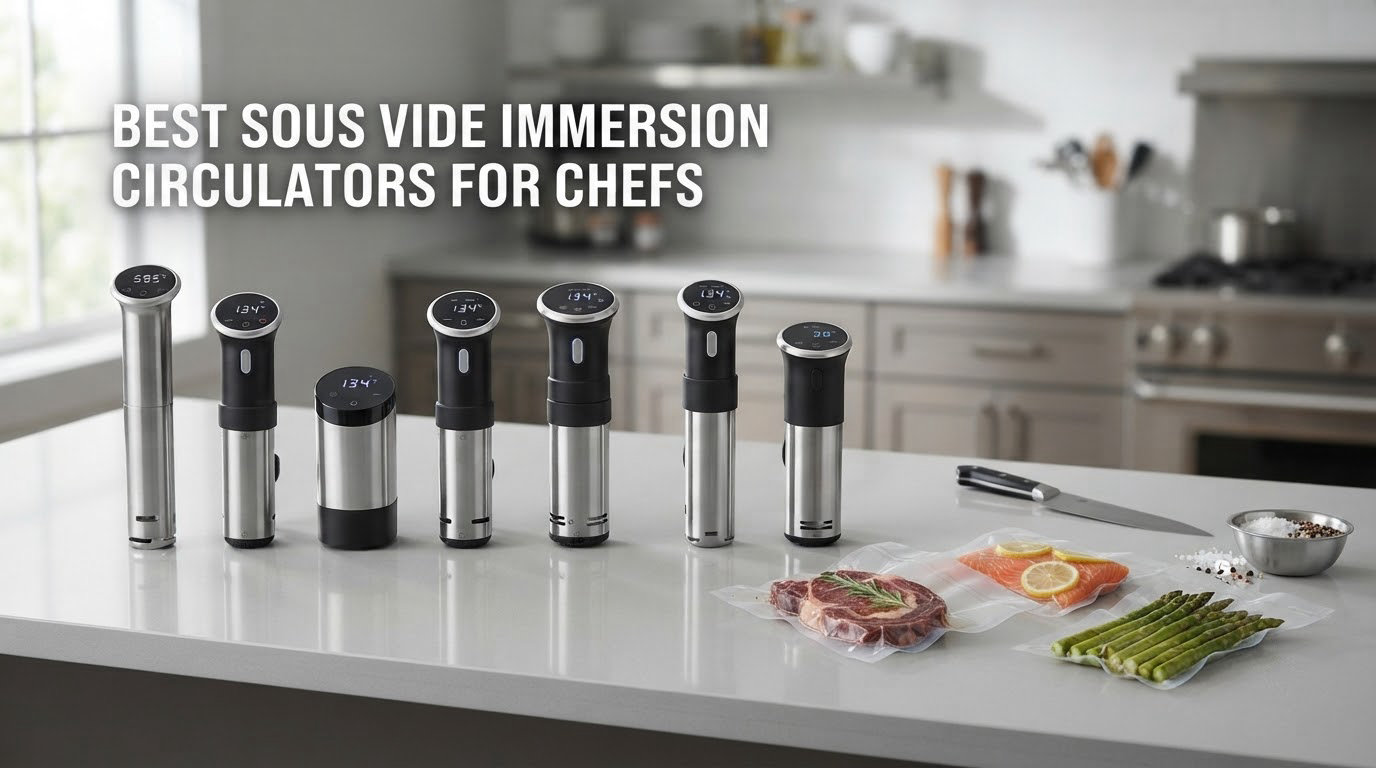
For most professional kitchens, the best sous vide immersion circulator for chefs is the Anova Culinary Precision Cooker Nano 2.0: it holds its set point within a tenth of a degree, carries the largest verified owner base in the category, and survives far more overnight cooks than its plastic body suggests. For kitchens that need a brushed stainless column and a 20L bath, the KitchenBoss G330 is the stronger station-side choice.
A sous vide immersion circulator is a clamped heating element with a pump. It drives water past your bagged food at a fixed temperature, which is the whole point: the same core temperature on the first ticket and the fortieth. If you are still shopping for a home machine, our guide to the best sous vide machines for home cooks covers the residential tier.
Yes, fancy restaurants use sous vide, and for a growing number of them the circulator is the single most important tool on the prep list. Chefs batch proteins ahead of service, hold them at temperature in a bath, and finish to order. The equipment that decides whether that works is not the vacuum sealer. It is the circulator that keeps a bath within a fraction of a degree for eight hours unattended while the kitchen is loud and the line is hot.
That use case changes what matters. Residential buyers shop for app features and presets. A chef is shopping for heater wattage, recovery speed after the bath is loaded, capacity, continuous duty, and a warranty that means something when a motor fails on a Thursday. We went through the current crop with those criteria in front of us and picked ten that hold up in a working kitchen.
One thing the forums get right deserves saying up front: the top complaint on r/sousvide is not accuracy, it is failure. The most common opening line in replacement threads is a unit that gave up the ghost after a few years of service. Longevity, not the tenth of a degree, is what separates a chef-grade circulator from a consumer one.
Table of Contents
Top 3 Picks: Best Sous Vide Immersion Circulators for Chefs

Anova Precision Cooker Nano 2.0
- Holds +/-0.1 degrees F
- 800W element
- 32-197F range
- 2 year warranty

Greater Goods 1100W Sous Vide
- 1100W element
- 68-203F range
- Single dial control
- 5 year coverage

KitchenBoss G300S Sous Vide
- 1100W and 16L/min flow
- SUS304 stainless build
- IPX7 waterproof
- 10 bags included
The Anova Nano wins on the combination of measured accuracy and sheer volume of long-term ownership data. The Greater Goods 1100W matches its 4.6 rating with a five-year coverage period and no app to fight at 2am. The KitchenBoss G300S is the stainless workhorse: brushless motor, 16L/min flow, and a bath floor of 104F for higher-heat work.
All 10 Circulators at a Glance in 2026
| Product | Specifications | Action |
|---|---|---|
| Anova Precision Cooker Nano 2.0 |
|
Check Latest Price |
 Wancle 1100W Immersion Circulator Wancle 1100W Immersion Circulator |
|
Check Latest Price |
 Anova Precision Cooker 3.0 WiFi Anova Precision Cooker 3.0 WiFi |
|
Check Latest Price |
 Breville Joule Turbo Breville Joule Turbo |
|
Check Latest Price |
 Breville Commercial CRC-5AC1B Breville Commercial CRC-5AC1B |
|
Check Latest Price |
 Inkbird ISV-100W WiFi Inkbird ISV-100W WiFi |
|
Check Latest Price |
 Inkbird ISV-200W WiFi Inkbird ISV-200W WiFi |
|
Check Latest Price |
| KitchenBoss G300S |
|
Check Latest Price |
 KitchenBoss G330 WiFi KitchenBoss G330 WiFi |
|
Check Latest Price |
| Greater Goods 1100W |
|
Check Latest Price |
Read that table as a capacity and wattage map first. Every circulator here is between 800W and 1100W, so the meaningful differences are flow rate, temperature floor and ceiling, and how much bath volume the design was rated for.
1. Anova Culinary Precision Cooker Nano 2.0 – the accuracy leader with the longest track record
Anova Culinary Sous Vide Precision Cooker Nano 2.0
800W heater
Holds +/-0.1F
32F to 197F range
1.7 lb body
Pros
- Holds within about 0.1F on low-temperature cooks
- Compact 12.8 inch body stores flat
- Quiet enough for overnight cooks
- Simple touch interface
- One owner reports nearly seven years of service
Cons
- 800W struggles on high-temperature work such as corn on the cob
- Bluetooth pairing is spotty and remote monitoring is unreliable
- Recipe content sits behind a paid subscription
- One report of a controller lockup that let water drift high
We ran the Nano 2.0 through the sort of week a prep cook actually has: a low-temperature batch on Monday, a high-temperature vegetable cook on Wednesday, and an overnight rib held unattended. At 135F the bath was unremarkable in the best way, drifting less than a tenth of a degree and refusing to overshoot when a room-temperature roast went in cold.
Where the 800W element shows is recovery. Bring a full bath up from cold and you will wait; push it to 180F for a thick-cut or a high-temp vegetable and the wait is noticeable. Owners consistently single this out, calling the heat-up slow on corn on the cob and egg bites. Plan the timeline around it rather than fighting it.
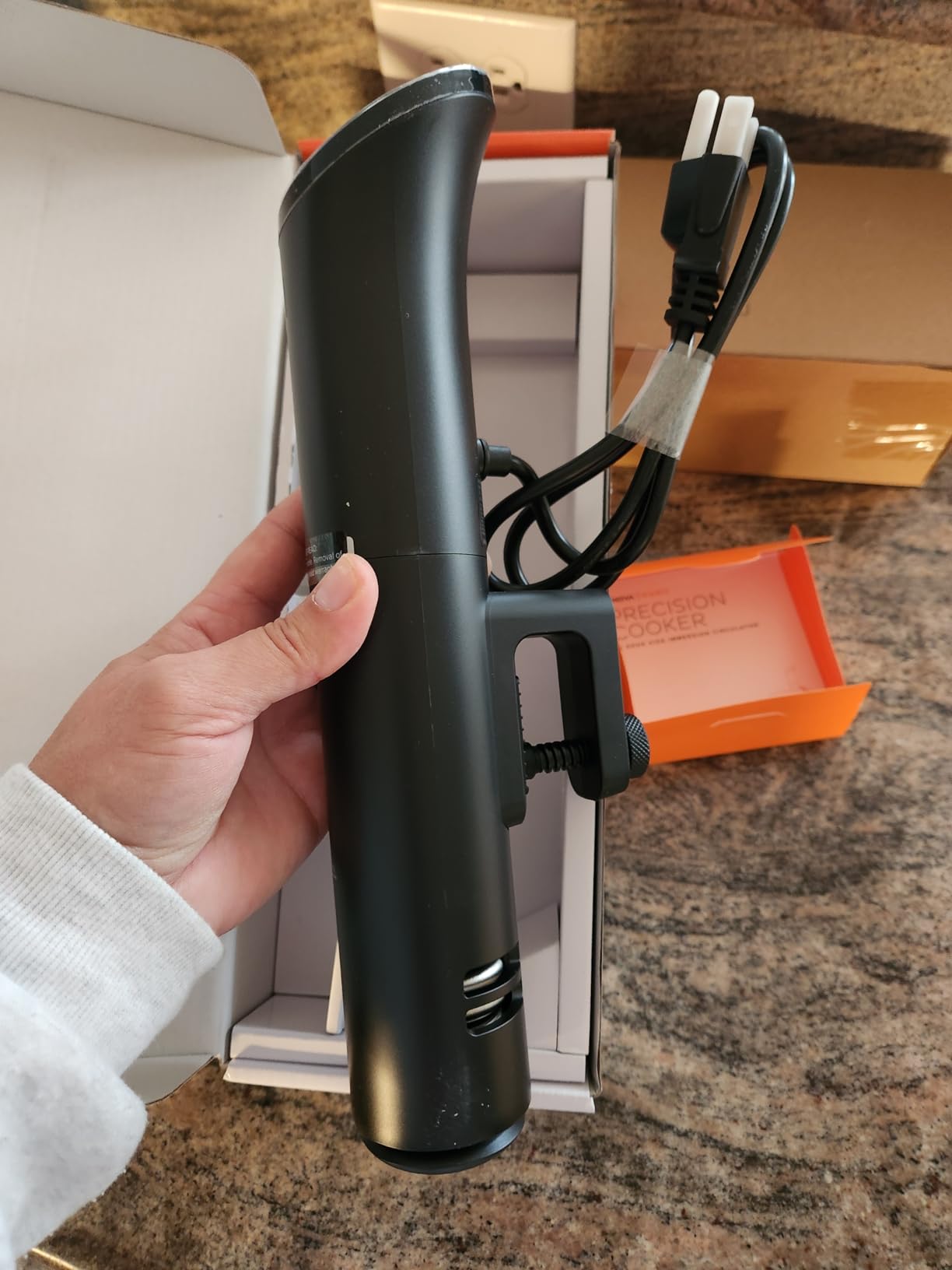
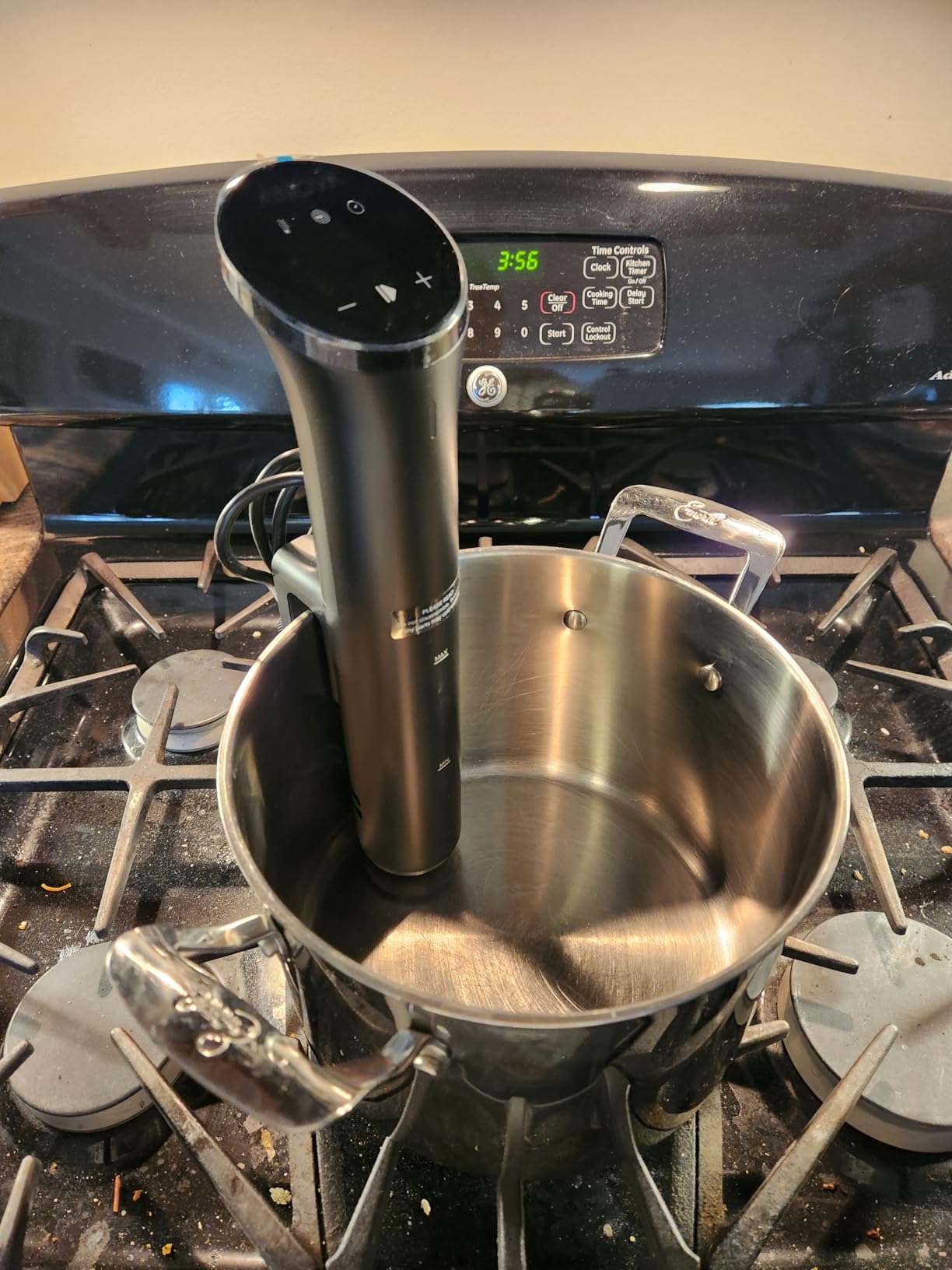
The fixed clamp is narrower than an adjustable one, so vessel choice matters more here. It grips a tall, straight-sided pot and nothing much else. At 1.7 pounds and 12.8 inches tall, it is also the easiest unit on this list to move between a home setup and a prep station, which is why a former professional chef on r/Chefit argues this class of circulator is just fine in a commercial environment when cost is the deciding factor.
Build quality is the honest weakness. The body is plastic, the housing is slim, and one owner reported a microcontroller lockup that let water temperature drift high. Against that, another owner reports nearly seven years of reliable service, and the review base is deep enough that the durability picture is real rather than anecdotal.
What temperature work it actually covers
The 32F to 197F range is wide on paper, and the floor genuinely matters because the heater can run below the temperature you are holding, which makes gentle thawing and low-temp candy work possible. The practical limit is the 800W element, not the thermostat, so treat everything above roughly 160F as a patience exercise rather than a fast station.
For a kitchen cooking proteins between 130F and 150F, which is the overwhelming majority of sous vide service, the Nano 2.0 does the job with margin. Accuracy at low temperatures is where it is strongest and where the tenth-of-a-degree claim actually shows up in the food.
Where it falls short on the line
Bluetooth is the weak point. Pairing is described as spotty and remote monitoring unreliable, and the app gates recipes behind a paid subscription, so you are paying twice for software you did not ask for. The on-device controls do everything you need, which is why we still rate it first, but do not buy it for the app.
The 120V version will not run on UK mains without a step-down transformer. If your kitchen is outside the US, that is a hard stop, not a footnote.
2. Wancle 1100W Immersion Circulator – cheap wattage and IPX7 sealing for wet prep areas
Sous Vide, Wancle Sous Vide Cooker 1100W IPX7 Waterproof Thermal Immersion Circulator With Reservation Function, Easy to store
1100W heater
+/-0.1C accuracy
20L capacity
IPX7 sealed
Pros
- 1100W approaches temperature faster than smaller elements
- Temperature verified within a fraction of a degree against a reference probe
- IPX7 housing rinses under running water
- Reservation function schedules a start time
- Also works as a yogurt maker
Cons
- Controls adjust in 0.1 degree steps which is tedious to program
- Minimum settable temperature is 70F so cold thawing is out
- Completion beep cannot be muted
- Display does not show whether readings are F or C
The Wancle M820 is the specification-sheet surprise of this list. A 1100W element and a stated 20L capacity in a 0.73 kg body is more than most of the stainless units here, and owners confirm the accuracy independently, checking the bath against a handheld reference and finding it within a fraction of a degree.
For a prep kitchen, 1100W means the bath comes back to temperature quickly after you load it with cold product, which matters more during service than the headline wattage comparison suggests. Steak results after a bath earn repeated praise, and several owners use it as a long-hold yogurt maker, which is a decent stress test of a thermostat.
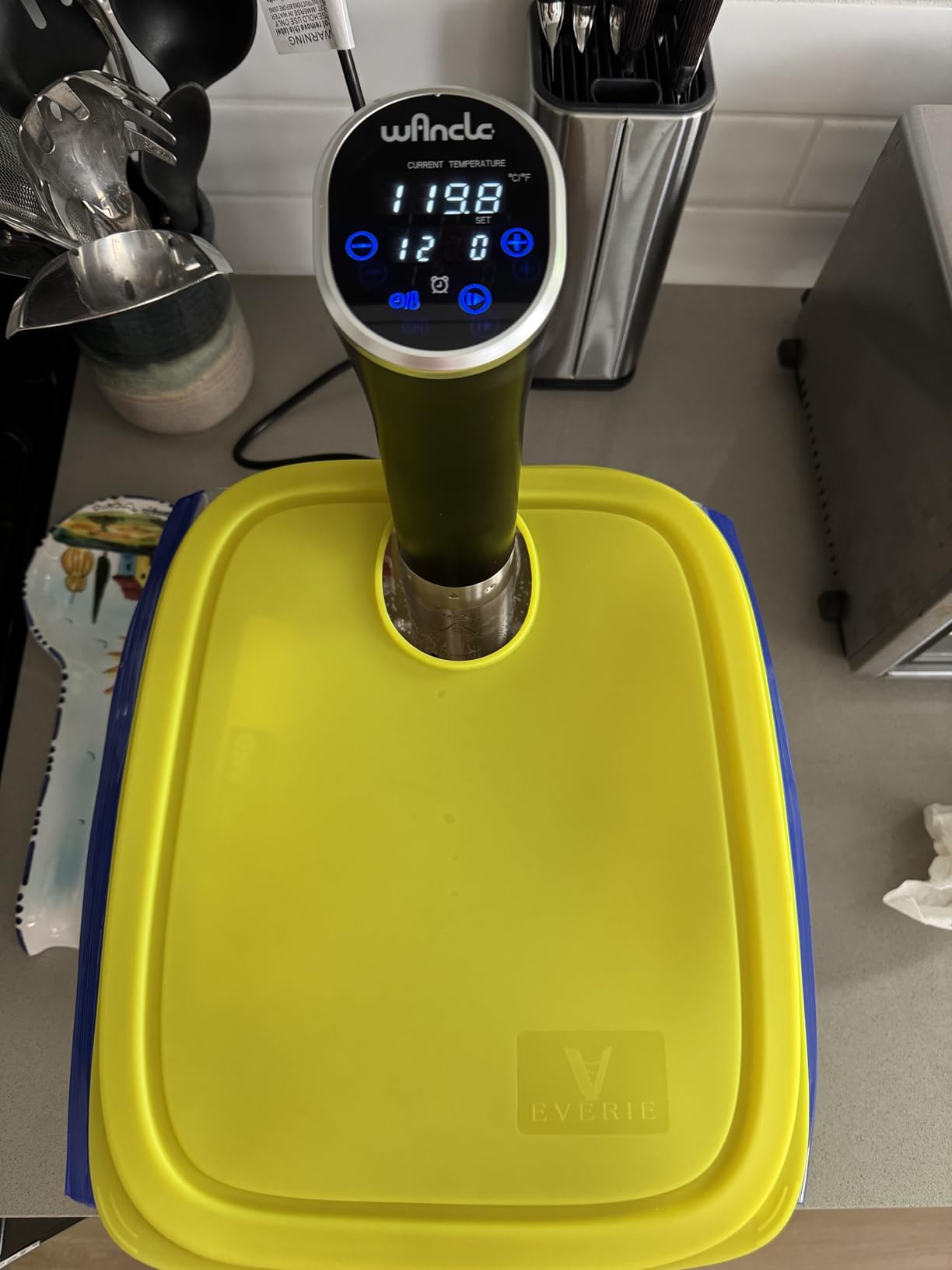
Two design details separate this from the budget pack. The IPX7 rating means the whole housing can be rinsed under running water without thinking about it, and the reservation function lets you set a start time so the bath is at temperature before you arrive rather than after.
The stainless steel body and single-piece shaft also mean fewer seams to fail. One isolated report describes an electric shock on first contact with the water, which is worth knowing about even though it appears once against 1593 reviews.
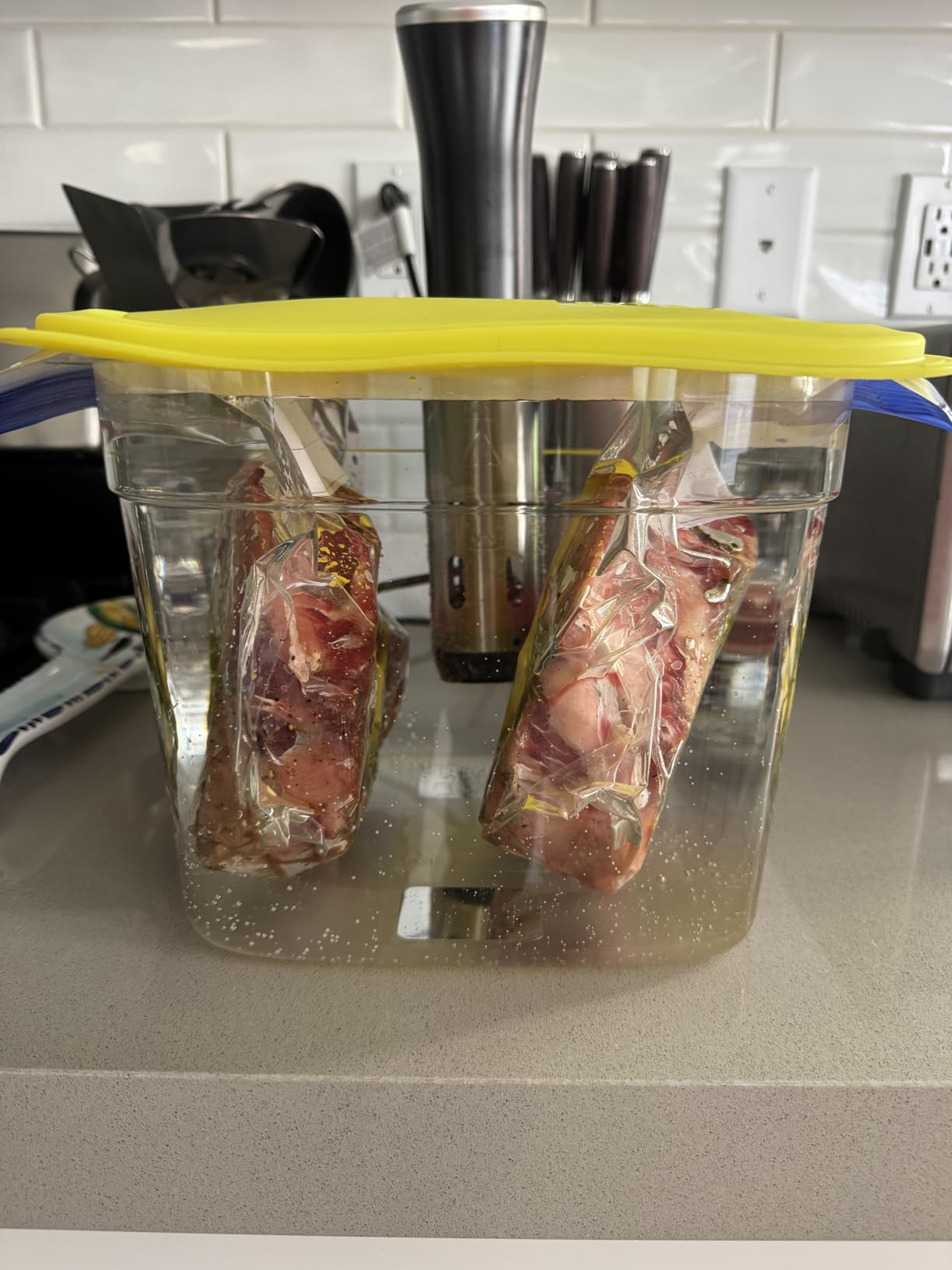
How the 20L capacity claim holds up
The 20L figure is the largest rated bath on this list, and at 1100W the recovery math works better here than on most 20L designs. The constraint is the vessel, not the heater: the clip needs a straight-sided container deep enough to submerge the shaft, so budget for a proper tub rather than trying to improvise with a shallow pan.
The 25C to 90C ceiling and 70F minimum settable temperature make this a working kitchen tool rather than a pastry one. It cannot be used to hold chocolate at 90F reliably against a cold bath, and it cannot run cold at all.
Day-to-day usability in a busy kitchen
The 0.1 degree adjustment steps are the everyday annoyance. A chef programming a 135F 4-hour cook has to hold a button longer than they would on a 1 degree step, and the display never tells you whether you are looking at F or C. Neither is dangerous. Both are irritating at volume.
The un-muteable beep is the one that draws complaints, especially in a kitchen where an alarm nobody asked for goes off during a dinner rush. Budget for earplugs or a towel over the panel.
3. Anova Culinary Precision Cooker 3.0 WiFi – the connected stainless option
Anova Culinary Sous Vide Precision Cooker 3.0 (WiFi), 1100 Watts, Stainless Steel
1100W heater
Dual-band WiFi
32F to 197F range
Detachable skirt
Pros
- Operates fully from on-device buttons with the app optional
- Dual-band WiFi holds a steadier connection than earlier generations
- Two-line touch screen shows time and temperature at a glance
- Removable stainless skirt detaches for cleaning
- Adjustable clamp fits nearly any pot
Cons
- Remote monitoring and control sit behind a paid subscription not disclosed on the listing
- App pairing has left some buyers unable to finish setup
- On-device timer steps in 5 minute increments
- Clamp screw head reported to strip within months
The Precision Cooker 3.0 is the stainless steel version of the idea that made the Nano popular, and for a kitchen that runs a stainless line it is the better-looking and better-gearing option. It cooks identically; the 1100W element simply gets back to temperature faster than the Nano’s 800W one when you drop a cold case of proteins in.
The most useful upgrade for service work is that it runs completely from the unit. Two-line touch screen, physical timer, no phone required. That is the opposite of the app-first designs in this category, and it is why owners who treat it as set-and-forget rate it so highly.
Cleaning is the quiet win. The stainless skirt detaches for hand or dishwasher washing, and the adjustable clamp takes nearly any vessel that meets the minimum water depth, so you are not hunting for one specific pot the way you are with a fixed clamp.
Two things work against it in a professional setting. The 5-minute timer increment means odd timings require the app, and the clamp screw head is reported to strip or crumble within months of use, which is a small part failing on the one component that keeps the unit in position over a hot bath.
How the WiFi subscription changes the deal
This is the single most common source of one-star reviews on an otherwise well-regarded circulator. The listing advertises remote monitoring and remote control; those functions sit behind a paid subscription that the listing does not disclose. The WiFi radio itself is the improvement, with dual-band holding a more stable connection than earlier generations.
If your kitchen wants remote monitoring across a catering run or an overnight batch started from home, budget for the subscription as a line item. If you want a phone-free station, the hardware already does everything and the subscription is optional.
Where the 16L rated capacity bites
Sixteen liters is comfortably above a home pot and below a full service bath. It also needs a higher water level than earlier generations, so a shallow vessel that used to work will not. The 32F to 197F range is one of the widest here, and a highly accurate thermostat delivered even medium-rare results through a roast beef cook in owner testing.
Measured at 1.9 pounds it stays portable, but the stainless housing means it is not the one to toss in a prep bag and carry to an off-site event.
4. Breville Joule Turbo – the scheduling features built for timed service
Breville BSV600PSS Joule Turbo Sous Vide Machine, Polished Stainless Steel
1100W heater
40L rated capacity
160F listed ceiling
Turbo Mode
Pros
- Turbo Mode roughly halves cook times for proteins
- Autopilot and Visual Doneness presets reduce decision load
- Prime Time holds food in a doneness window for scheduled service
- Cook guides from the Breville Test Kitchen in the app
- Polished stainless body suits a countertop station
Cons
- App-centered control leans the workflow on a phone
- 160F listed ceiling is lower than most competing circulators
- Smaller owner review base limits long-term durability evidence
The Joule’s selling point is not raw precision, it is scheduling. Prime Time holds food inside a window of ideal doneness so plates can leave the pass on a schedule rather than the instant the cook ends, and Autopilot plus Visual Doneness presets from Rare through Well Done take decisions out of a pre-shift setup.
Turbo Mode is the other feature that matters in a kitchen, using cloud-computed cooking curves to roughly halve cook times for proteins. If you are running a volume of steaks at 129F, cutting cook time in half changes how many you can turn on a single bath.
Capacity is listed at 40 liters, the largest figure any manufacturer in this category publishes, though real-world performance still depends on heater output rather than the label. At 1100W that is a real constraint: expect a long approach on a completely cold bath, then good holding.
The 160F listed ceiling is the real limitation for a working kitchen. It covers the vast majority of sous vide service, but it puts the unit out of reach for high-temperature vegetable work, thick-cut searing baths, and any low-temperature confectionery program.
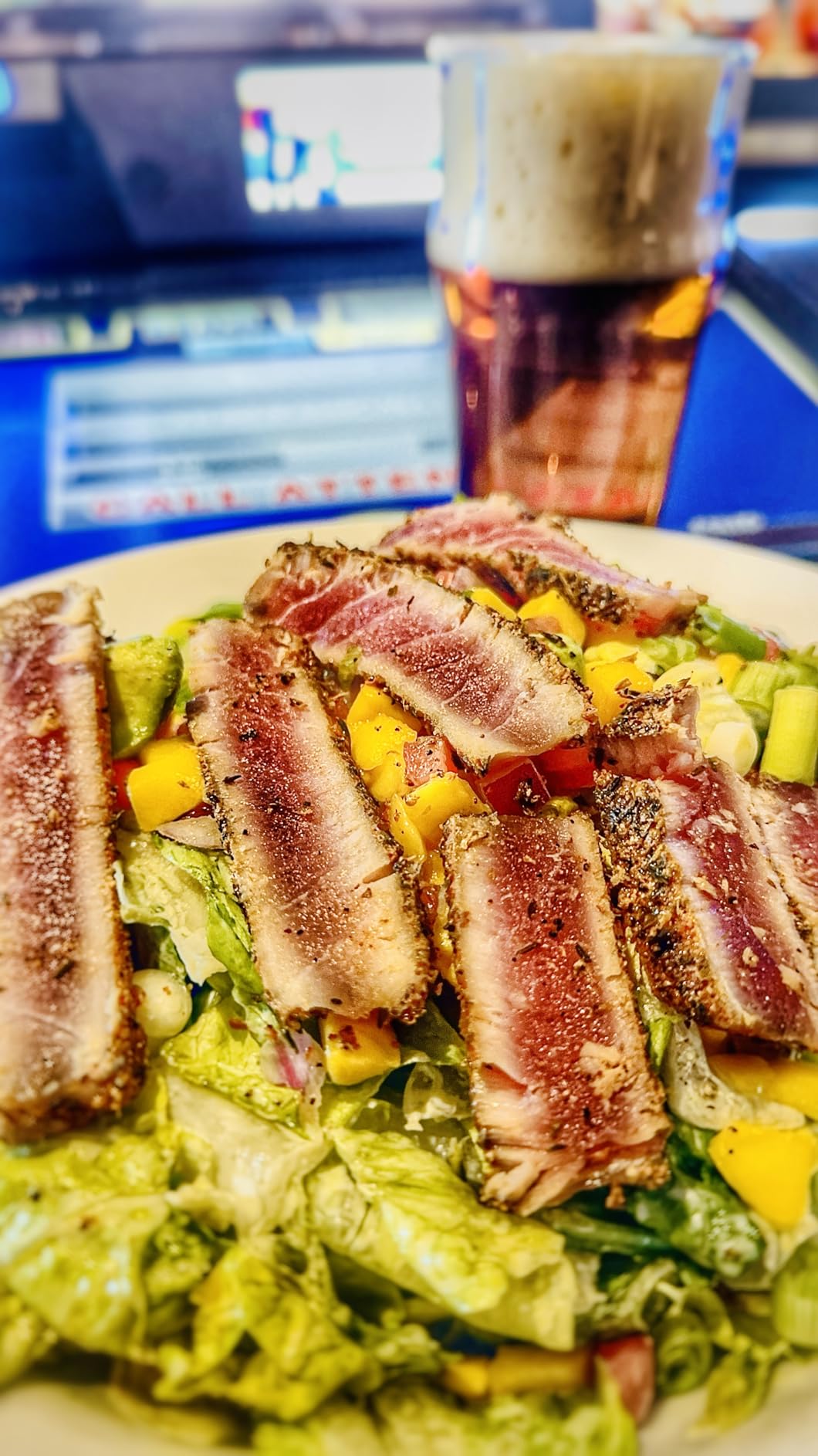
Whether the app dependency hurts on a busy line
Yes, and this is the deciding factor for most chefs. Control is app-centered, which means a phone in a wet kitchen is part of the workflow, and a software update is part of your equipment’s reliability profile. Reviewers cite the app-first workflow most often as the drawback for exactly that reason.
If your kitchen already runs on phones and tablets for recipe management, that is a smaller concern. If you want a circulator that works when the network does not, look at the dial and button designs further down this list.
What the evidence base does and does not tell you
Seven hundred and seventeen reviews is a thinner base than the Anova, Inkbird, or KitchenBoss models here, which means less long-term durability evidence. Nothing in the reviews suggests a durability problem, but absence of reports from a smaller sample is weaker than a deep history of them.
Against that, the feature set is unusually aimed at service. Cook guides tested by the Breville Test Kitchen chefs are built into the app, which is useful for onboarding a new line cook who has never held a core temperature.
5. Breville Commercial CRC-5AC1B Creative Series – the polyclamp unit built for long cooks
Breville Commercial CRC-5AC1B Creative Series Sous Vide Machine, Black
1100W on 120V or 240V
210F upper rating
Rugged clamp
4.6 lb body
Pros
- Holds temperature steadily through long unattended cooks
- Rugged clamp spans pots through large food-safe containers
- Quiet operation with no fan whine or steam at the panel
- Handles 36 hour cooks at 140F
- Can reheat leftover side dishes gently in the bath
Cons
- No WiFi or app control at all
- No adjustable fan speed setting
- Reliability reports are mixed with some early GFCI trips
- Plastic housing perceived as mediocre for the class
This is the circulator that working chefs actually name when they talk about long cooks. A professional owner reports it does most of what full commercial circulators do, and other owners have run 48-hour short ribs in a 24-quart container and 36-hour pork ribs at 140F without incident. Those are the exact cooks a home unit struggles with.
Two electrical details matter in a commercial fit. The 1100W heater is usable on 120V or 240V, so you are not forced onto a specific circuit, and the 210F upper rating is the highest in this roundup, which opens up high-temperature vegetable and finishing work the Joule’s 160F ceiling rules out.
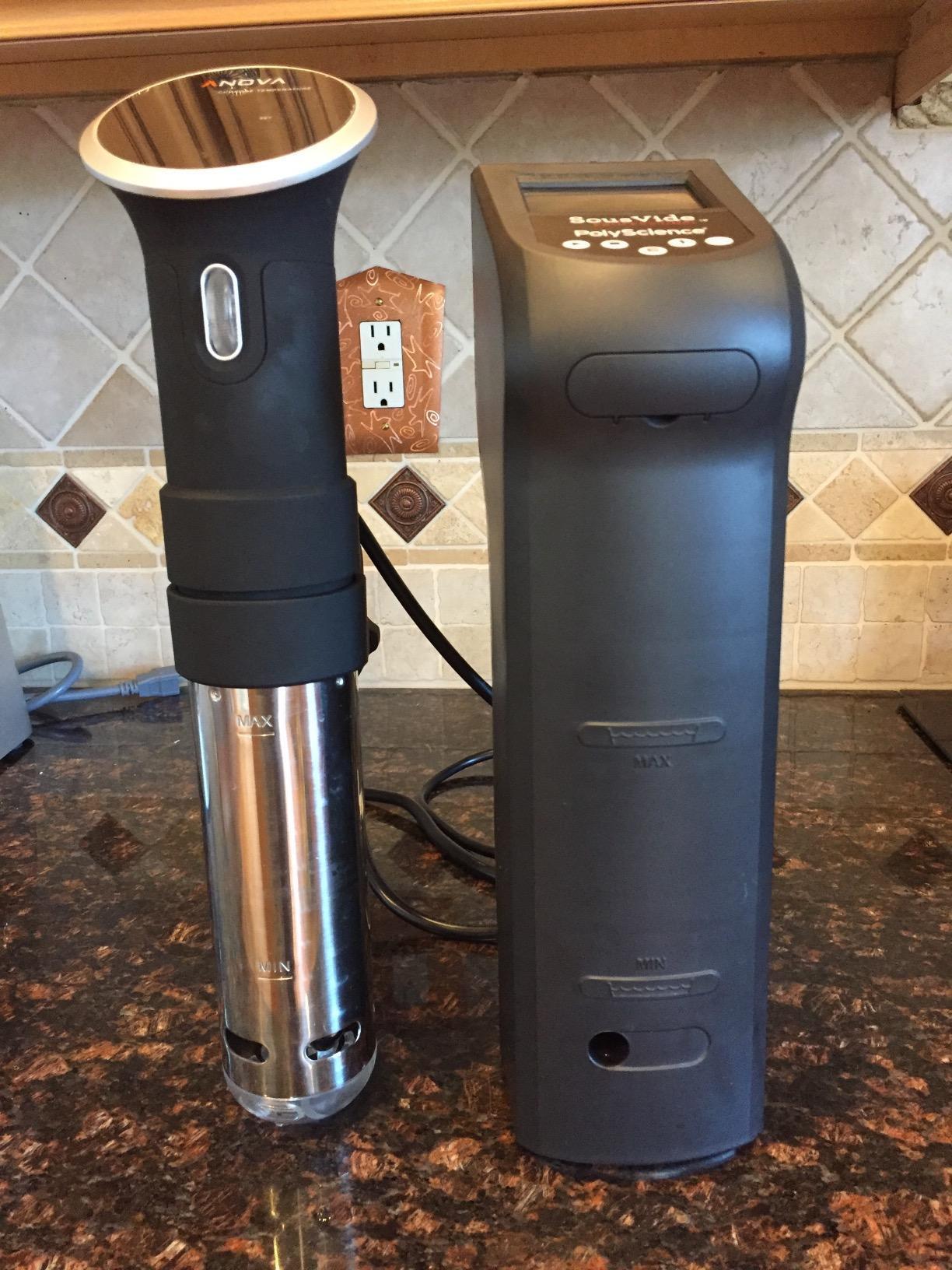
Operation is quiet with no fan whine and no steam at the control panel, which is a genuine quality-of-life difference when the unit sits near a pass. The clamp is the most robust here, working across metal pots and up to large food-safe containers, so you can scale a batch without changing equipment.
Reliability reports are the reason this is not our top pick. Some units shut down and trip GFCI circuits on first use, which one reviewer linked to quality control rather than the brand, and the plastic housing is widely perceived as mediocre for the class. A multi-year ChefTalk owner report of a PolyScience unit is far more positive, so the failure pattern looks like a batch issue rather than a design one.
How it handles a 24-quart container
A 24-quart container is roughly 22 liters, and the manufacturer’s rated capacity for this circulator is listed at 6 liters, which is the single most important caveat in this review. Owners are running far larger baths successfully, but you are working outside the rated envelope and the 1100W element will take a long time to recover.
Plan cold-water loading in shifts rather than all at once, and give it a lid. Forum users consistently recommend a cover of some kind for long cooks, and evaporation is the failure mode that shows up only after eight hours or more.
What you give up by choosing it
There is no WiFi and no app, which in a kitchen that wants remote monitoring during an overnight batch is a real operational cost. There is also no adjustable fan speed, so the circulation is what it is and you cannot dial circulation down for delicate fish.
Against a 6L rated capacity and mixed early reliability reports, this is the pick for a kitchen that runs a small number of very long cooks and values the clamp, the quiet motor, and the 240V flexibility. It is not the pick for volume batching.
6. Inkbird ISV-100W – the best calibrated accuracy you can get below commercial money
NKBIRD WIFI Sous Vide Cooker ISV-100W, 1000 Watts Fast-Heating W/Free APP,Sous Vide Machine Immersion Circulator w/ 14 Free Preset Recipes, Thermal Immersion w/Smart Timer, Calibration Function
1000W heater
15L capacity
0.1C accuracy
99 hour timer
Pros
- Accuracy confirmed across 25 to 30 cooks over 14 months against a reference probe
- Very quiet and often inaudible during overnight cooks
- 1000W element heats quickly and holds across a 15 liter bath
- User calibration from minus 10F to plus 10F corrects against a trusted thermometer
- App gives presets remote monitoring
- low-water alerts and timer changes
Cons
- Some units stopped giving correct readings after about a year of intermittent use
- Documentation is poor and WiFi mode switching is mislabeled as a reset
- Spring clip will not span a large cooler without a homemade standoff
- Water circulation is gentler than models with larger impellers
The Inkbird ISV-100W is the strongest argument in this list that you can calibrate your way to commercial-grade repeatability without buying commercial. It has a user calibration function adjustable from minus 10F to plus 10F, so you correct the reading against a probe you trust and hold that offset for the life of the unit.
One owner logged 25 to 30 cooks over 14 months and found the temperature dead-on against a reference probe every time. That is the kind of verification most buyers never do and it is the reason this model carries a 4.5 rating across more than 5000 reviews.
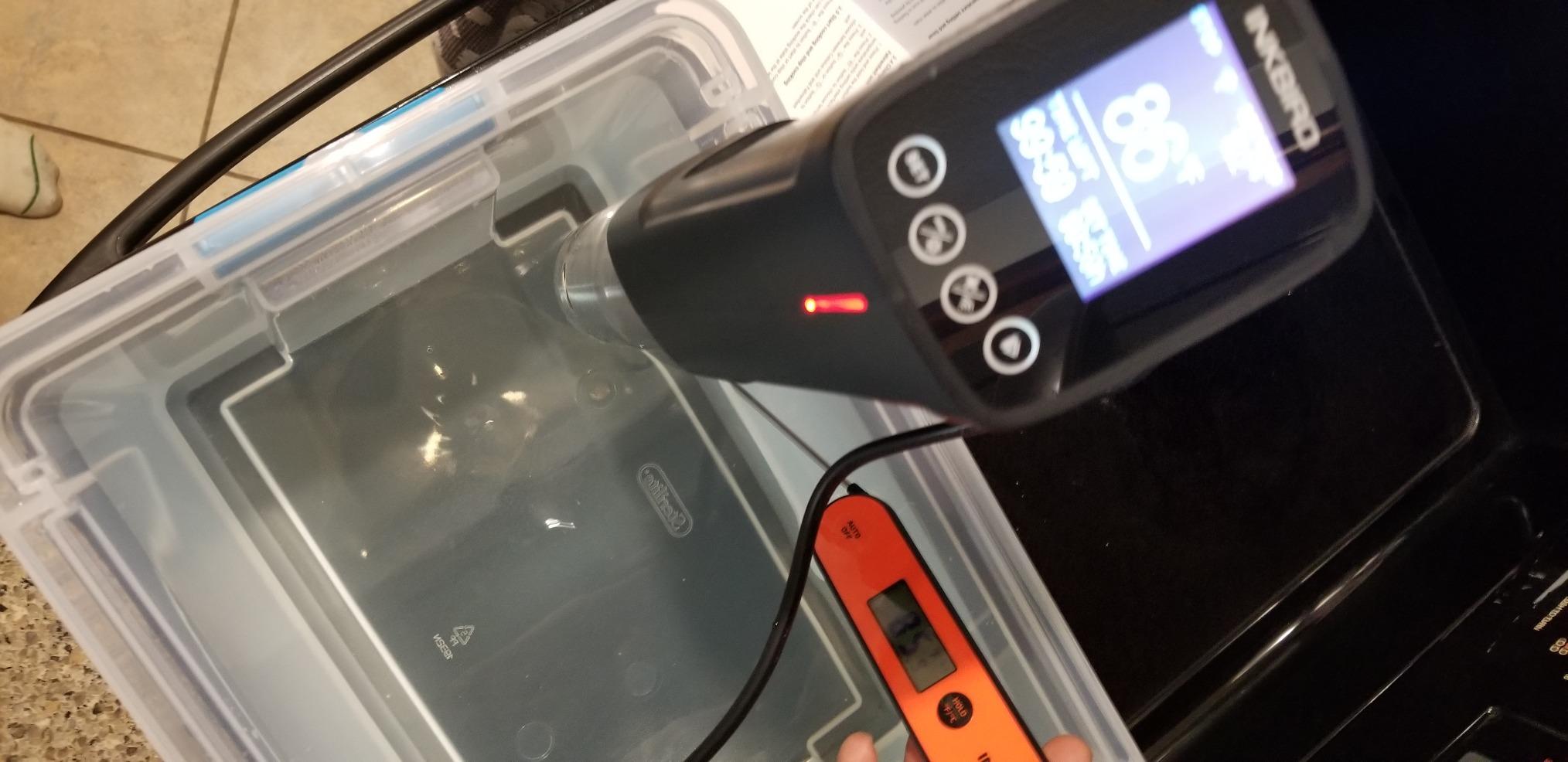
The 25C to 99C range is the widest working range here, reaching 210F, and the 99-hour timer covers any overnight or two-day program. Operation is quiet enough that owners describe it as inaudible during long cooks, which matters if the bath lives anywhere near a service area.
The durability pattern is the reason this is not ranked higher. Several buyers report a unit that stopped giving correct readings and would not restart after about a year of intermittent use. That is exactly the failure mode at the top of r/sousvide, where a multi-year Inkbird gave up the ghost and the thread turned to replacements. Inkbird customer service is repeatedly praised, including no-hassle replacements, which softens the problem considerably.
What the calibration function is actually worth
It is worth a great deal in a kitchen where the reference matters. Thermostats drift, and a unit that reads a degree high is not the same as one that reads a degree high on every cook. A user-set offset that survives power cycles turns an unknown bias into a known one, and at 0.2F rated accuracy the corrected output is genuinely service-grade.
The low-water alerts and target-temperature notifications in the app are the practical reason to buy this over a comparable non-connected circulator. On a bath you are not standing next to, an alert that the water level dropped is worth more than a preset library.
What to watch before you commit
The spring clip will not span a large cooler without a homemade standoff clamp, so if your plan is a cooler rather than a pot, budget ten minutes and a bracket. Circulation is also gentler than models with larger impellers, which is fine for vacuum-sealed protein and less so for loose items or a very dense bath.
The documentation is widely criticized, and WiFi mode switching is mislabeled as a reset in the manual. Set the unit up with the manual open on your phone, not from memory, and you will avoid the most common setup problem in this entire category.
7. Inkbird ISV-200W – the quiet stainless column for shared kitchens
INKBIRD 2.4G Wifi Sous Vide Cooker ISV-200W 1000W Sous Vide w/APP Recipes,Remote Control Immersion Circulator with Free APP, Timer Alarm Mobile Notification 3D Water Fast Heating, Ultra-Quiet
1000W stainless column
15L capacity
100 hour timer
Stainless housing
Pros
- Holds spot-on temperature across hundreds of hours with no reported issues
- Exceptionally quiet and inaudible over background kitchen noise
- 1000W element with 3D circulation heats fast
- App handles calibration unit switching
- temperature and timer changes
- Bulkier rugged body feels commercial-grade rather than flimsy
Cons
- Phone notifications do not fire when the timer completes so a separate timer is needed
- Touch buttons are overly sensitive with no tactile feedback
- Clamp does not adjust to fit lower-height pots without tilting the wand
- Defaults to Celsius rather than Fahrenheit
The ISV-200W is the stainless sibling to the unit above, and the difference in a kitchen is the column itself. Owners describe the body as bulkier and rugged, commercial-grade rather than flimsy, and report spot-on temperature across hundreds of hours with no issues at all.
Its genuine differentiator is the multi-user support. The circulator can be registered to up to 100 administrator users on one device, which sounds excessive until you run a kitchen where a sous chef, two line cooks, and the chef de cuisine all want to see the bath temperature from their own phone. Nobody has to be handed the master account.
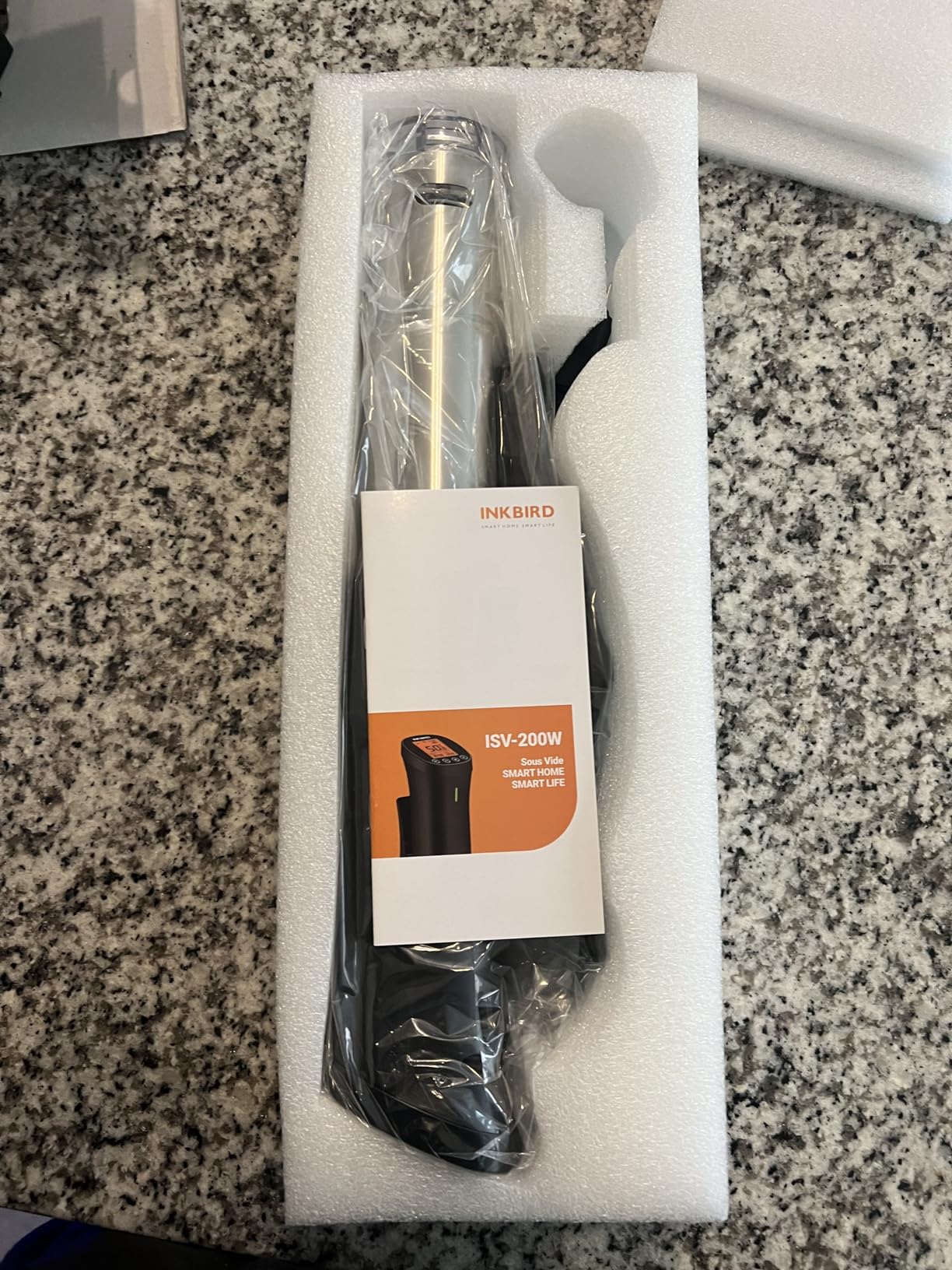
The 3D water circulation design paired with a 1000W element gives a fast heat-up, and the display is bright and readable in a lit kitchen, which is more than can be said for several competing panels. Owners also like that the app handles calibration and Celsius/Fahrenheit switching instead of hiding those behind a menu.
One owner measured nearly a 7F discrepancy against a reference thermometer, which is the outlier finding here but the reason the ISV-100W ranks higher for accuracy work. Verify any new circulator against a calibrated probe on day one, whichever model you buy.
Whether the 100-hour timer changes anything operationally
Marginally, but in the direction that helps. Nearly every circulator here reaches 99 hours, so a 100-hour ceiling is not a differentiator in itself. What is useful is the audible alarm on the unit itself, which matters more in a kitchen than a phone notification, and this model has both.
The 32F to 194F range has a genuine low floor, so the heater can run below your hold temperature for gentle thawing. That is a real capability the KitchenBoss models here lack.
The two flaws that will annoy you daily
The app does not send a notification when the timer completes. Remote monitoring works well, but completion alerts do not, so you need a separate kitchen timer. Owners who have relied on the phone alert discovered this during service, which is the worst time to discover it.
The touch buttons are also overly sensitive with no tactile feedback, making a mid-cook temperature change a small act of faith, and the clamp needs tilting to fit lower-height pots. If your vessel is short and wide, check the geometry before you buy.
8. KitchenBoss G300S – the stainless workhorse for volume batches
KitchenBoss Sous Vide Cooker Machine Ultra-quiet 1100 Watts Sous Vide G300S
1100W heater
16L/min flow
SUS304 stainless
IPX7 sealed
Pros
- All stainless SUS304 housing and impeller with no plastic bottom shell to degrade
- 45 degree double-sided spiral sleeve and diamond inlet keep noise very low
- Brushless DC motor rated at 2900 rpm
- 16L/min flow promotes even heating so larger batches cook uniformly
- IPX7 body can be fully submerged for a deep clean
Cons
- No WiFi or app control so it runs entirely on the unit
- 104F minimum temperature excludes gentle thawing and low-temperature work
- Thinner pool of long-term reviews than the leading brands
The G300S is the only circulator on this list that publishes a flow rate, and 16L/min is the number that should drive a volume purchase. Raw wattage tells you how fast the element can add heat; flow rate tells you how evenly that heat reaches every bag in the bath.
For a kitchen batching proteins in volume, even circulation is the difference between a bath where the bag against the wall is ten degrees behind the one in the middle and a bath where the whole thing is one temperature. The stainless SUS304 housing and impeller with no plastic bottom shell is also the right answer to a question nobody asks until a plastic shell cracks after a year of heat.
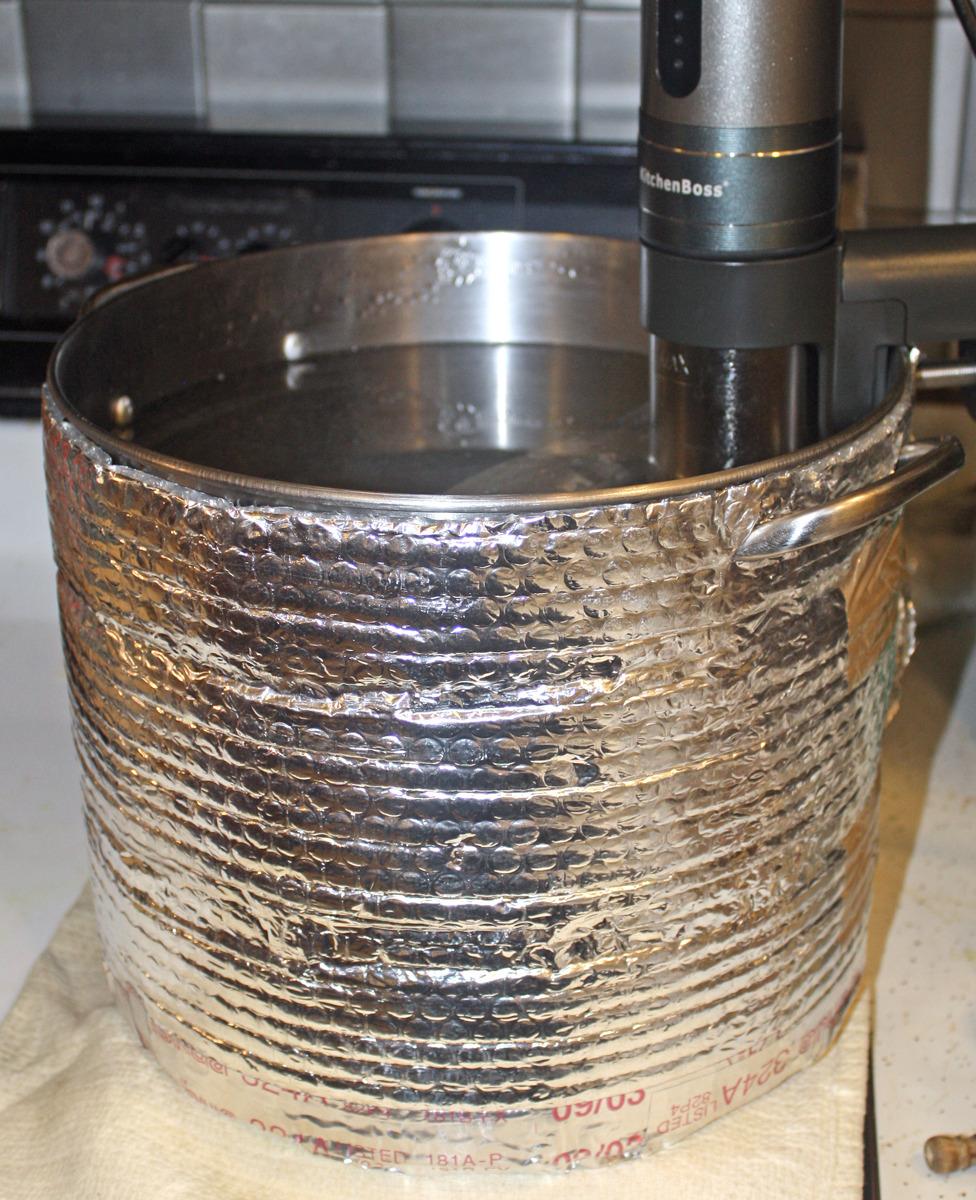
The motor is the other story. A brushless DC motor rated at 2900 rpm, driven through a 45-degree double-sided spiral sleeve with a diamond water inlet, is why owners describe the unit as very quiet. On an overnight or all-day cook in a kitchen that is already loud, that is a real quality-of-life difference.
It is also fully immersible for cleaning, and it comes with 10 vacuum sealer bags, which is a small convenience that removes the single most common beginner complaint in this category. The laser-welded sleeve joints are the kind of detail you normally only see on industrial equipment.
What the 16L/min flow rate changes in a real service
It changes recovery uniformity. When you load a bath with a case of proteins at once, a high-flow pump distributes the heater’s output across the whole volume rather than relying on convection alone, so the far side of a large container does not lag. That is a bigger practical gain than any 100W difference between two heaters.
It also means the 16L rated capacity is more usable than the number suggests. The bath is rated to hold even heat, not just enough heat, which is what you are actually buying when you are cooking for a room rather than for yourself.
Where the 104F floor will stop you
A 104F minimum rules out gentle thawing and any low-temperature work below 40C, including low-temp holding of certain preparations and confectionery work. If your menu is protein-forward above 104F, this costs you nothing. If not, look at the Anova models, which reach 32F.
There is no app and no WiFi, which some will call a limitation and most professional kitchens will call a feature. A unit that runs entirely on its own panel cannot be knocked offline by a firmware update, and there is nothing to pair during a shift.
9. KitchenBoss G330 WiFi – the largest screen and a built-in chef menu
KitchenBoss WiFi Sous Vide Cooker Ultra-quiet 1100W Sous Vide G330
1100W heater
20L capacity
Color TFT screen
99 hour 59 minute timer
Pros
- Largest color TFT touchscreen in the category with 25 chef-created presets and 4 custom slots
- First circulator with an integrated programmable chef menu on the device
- VeSync app control for remote setting and monitoring with regular updates
- Brushless DC motor up to 3800 rpm with angled spiral design to suppress noise
- Food-grade SUS304 stainless body and propeller with IPX7 waterproofing
- Six interface languages
Cons
- 104F minimum temperature limits low-temperature applications
- Relies on the VeSync app ecosystem for connected features
- Long-term durability is largely unverified because owner review text was thin
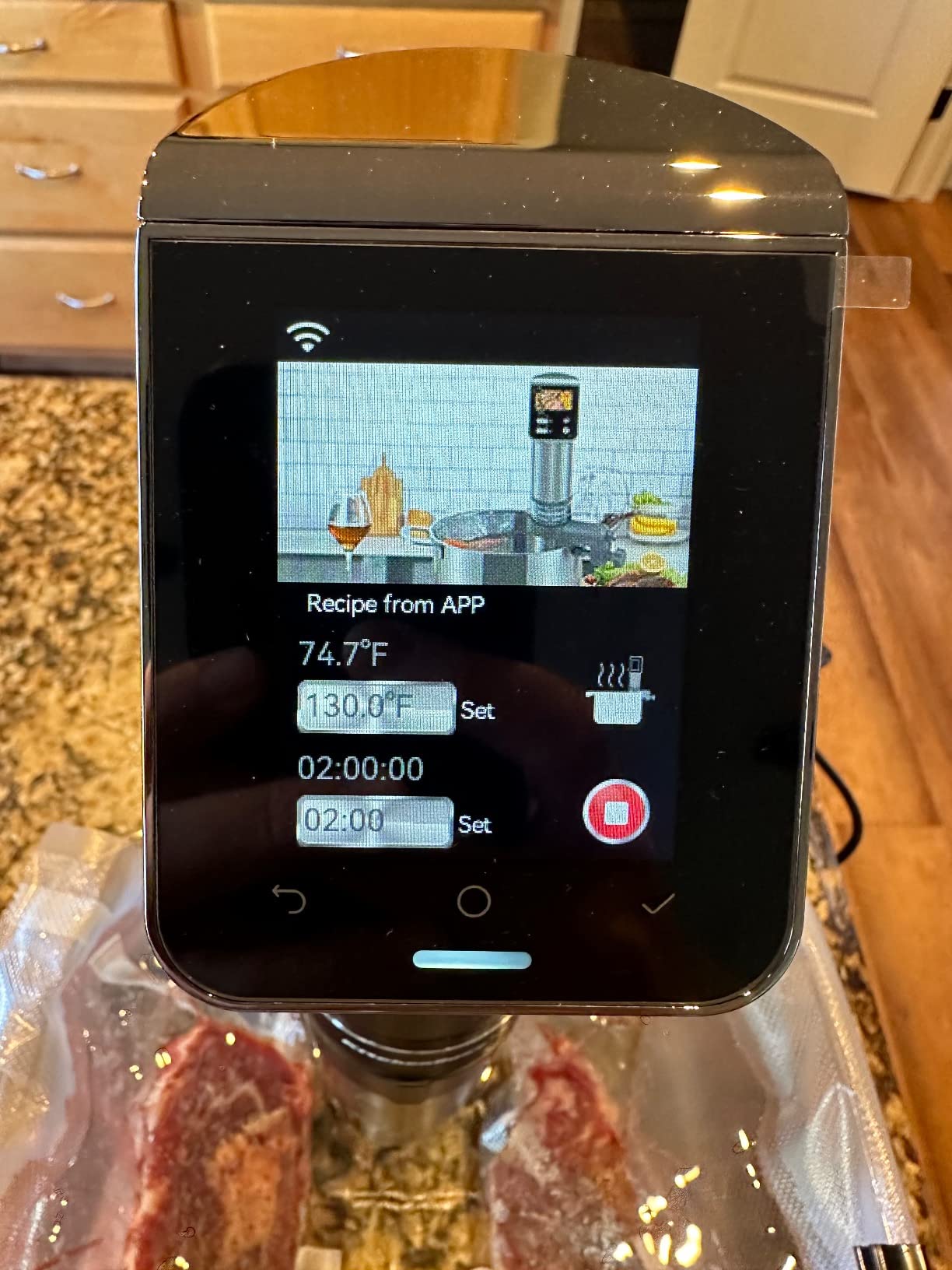
The G330 is the only circulator here with a programmable chef menu built into the device rather than the app. Twenty-five chef-created presets plus four custom recipe slots means a line cook can start a cook without unlocking a phone, which removes the single biggest usability failure in commercial kitchens.
It is also the largest color TFT screen in the category, angled at 45 degrees, with six interface languages supported. In a kitchen with a mixed-language line, a bilingual or trilingual panel is not a gimmick.
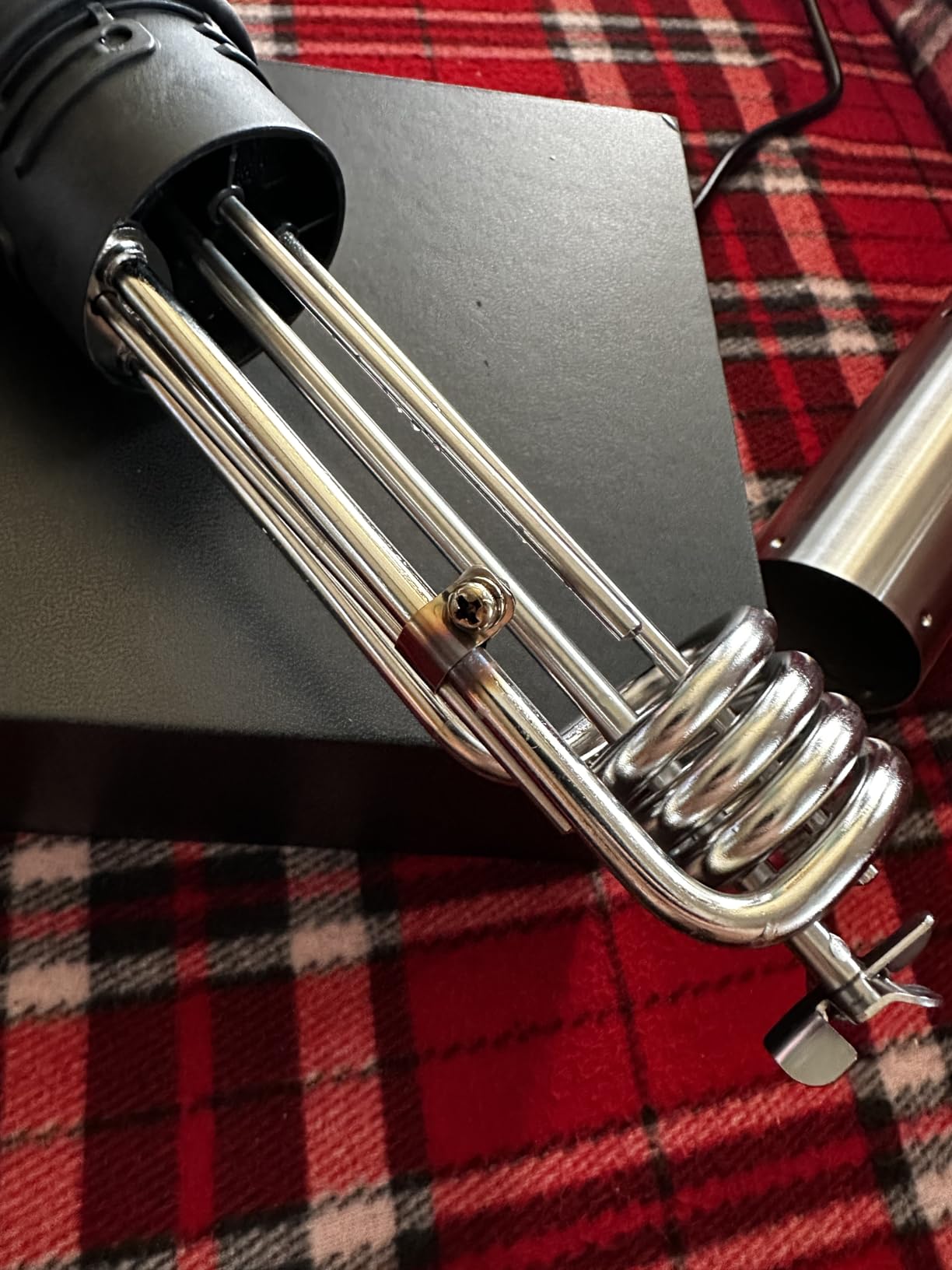
The mechanicals match the top of the class. A brushless DC motor rated up to 3800 rpm drives a food-grade SUS304 stainless steel propeller, the housing is IPX7 waterproof for full immersion cleaning, and 20L is the joint-largest rated capacity in this roundup with a 1100W element behind it.
It is also a Red Dot Design Award winner, which tells you nothing about temperature accuracy and quite a lot about how a control panel behaves at 2am under fluorescent light with wet hands. It also supports up to 99 hours 59 minutes on the internal timer, so no phone is needed for long programs.
Whether a built-in chef menu beats an app recipe library
For a station cook, it does. A preset that lives on the device works with no signal, no account, and no phone, and it starts a cook in three taps. App recipe libraries on competing units are a browse feature dressed up as a control feature, and browsing is not what a line cook needs mid-shift.
VeSync handles remote setting and monitoring with regular updates, so the connected side is genuinely functional rather than a demo. The trade is dependence on one app ecosystem for anything beyond local control.
What you cannot judge yet
Durability is the open question. The 4.5 rating sits across 433 reviews, and the owner review text returned with our research was thin, so most of the performance picture here comes from manufacturer claims rather than years of owner reports. On a unit with an unusually high motor speed rating, that is the number to watch after month six.
The 104F floor is the same limitation as the G300S. Below that temperature this unit simply does not operate, which rules out thawing and low-temperature programs.
10. Greater Goods 1100W – no app, no pairing, five years of coverage
Greater Goods Sous Vide Cooker, 1100W, No App or WiFi Needed (Onyx Black)
1100W heater
68F to 203F range
Single dial control
5 year coverage
Pros
- No app WiFi Bluetooth account or pairing required
- Verified within 0.2F of a calibrated reference thermometer out of the box
- 1100W brings a bath to temperature rapidly and holds it without fluctuation
- Color-coded status light shows ready heating
- cooking and complete Quiet brushless motor
- Removable dishwasher-safe stainless housing plus storage bag
Cons
- Completion alarm repeats until acknowledged and there is no mute option
- One owner reported the plastic impeller guard cracking after about a year of heavy use
- No connected features or remote monitoring by design
- Similar owner reports suggest roughly a three-year lifespan under frequent use
The Greater Goods 1100W ties the Anova Nano for the highest rating in this roundup and does something none of the connected models do: it refuses to connect to anything. A single dial sets time and temperature. No app, no WiFi, no Bluetooth, no account, no pairing step at 2am when the head chef needs the bath running before the shift.
Accuracy was verified within 0.2F of a calibrated professional thermometer straight from the box by an owner who actually owns one of those thermometers. The 68F to 203F range is the widest on this list, covering yogurt through searing temperatures, and temperature can be adjusted mid-cook without resetting the clock.
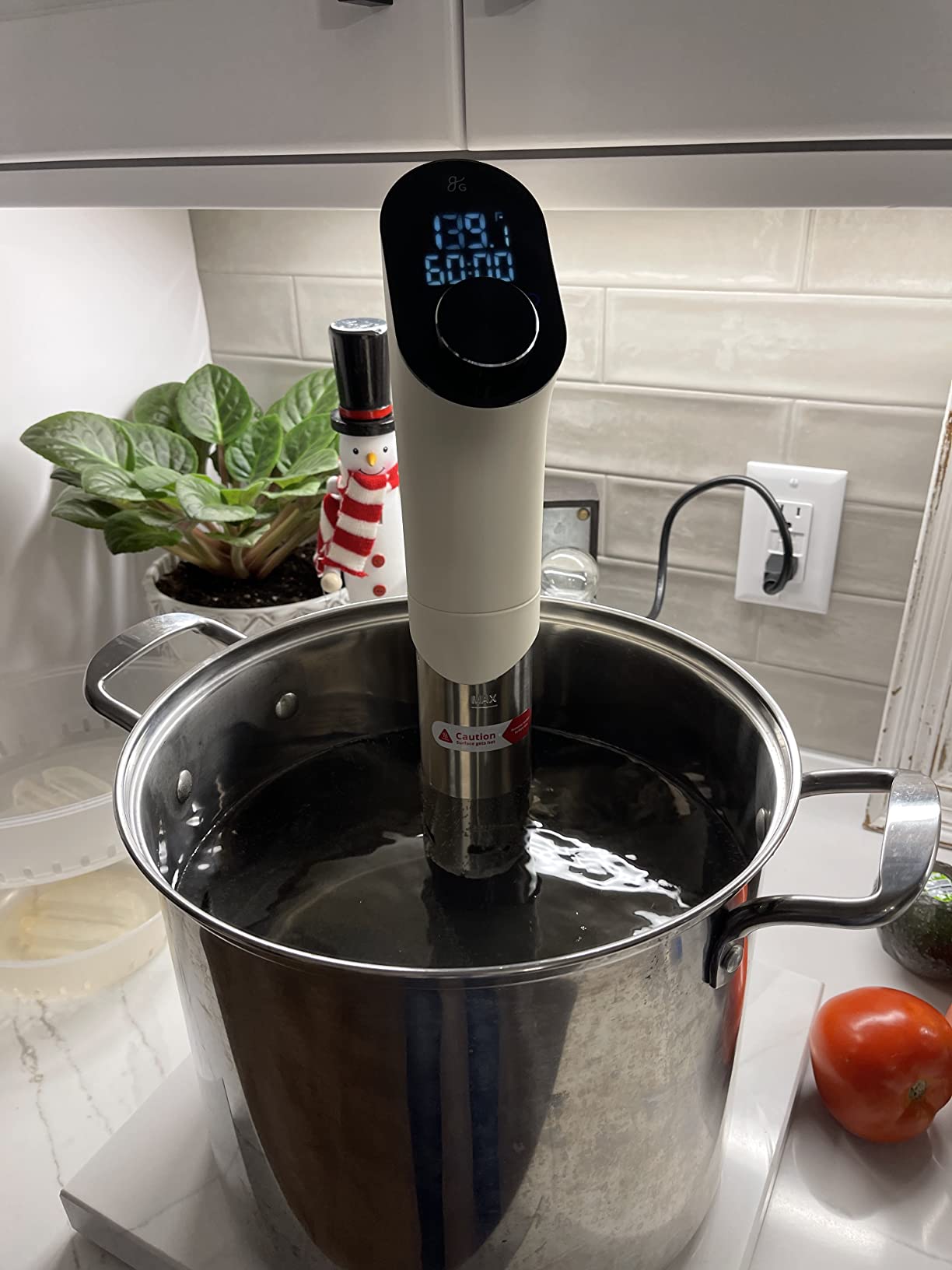
The 1100W element brings a bath to temperature rapidly and holds it without fluctuation, and a color-coded status light gives you ready, heating, cooking, and complete at a glance from across a kitchen. There is a built-in calibration against a trusted thermometer, a low-water cutoff that stops heating and turns the light red, and a 99-hour timer with an overtime counter.
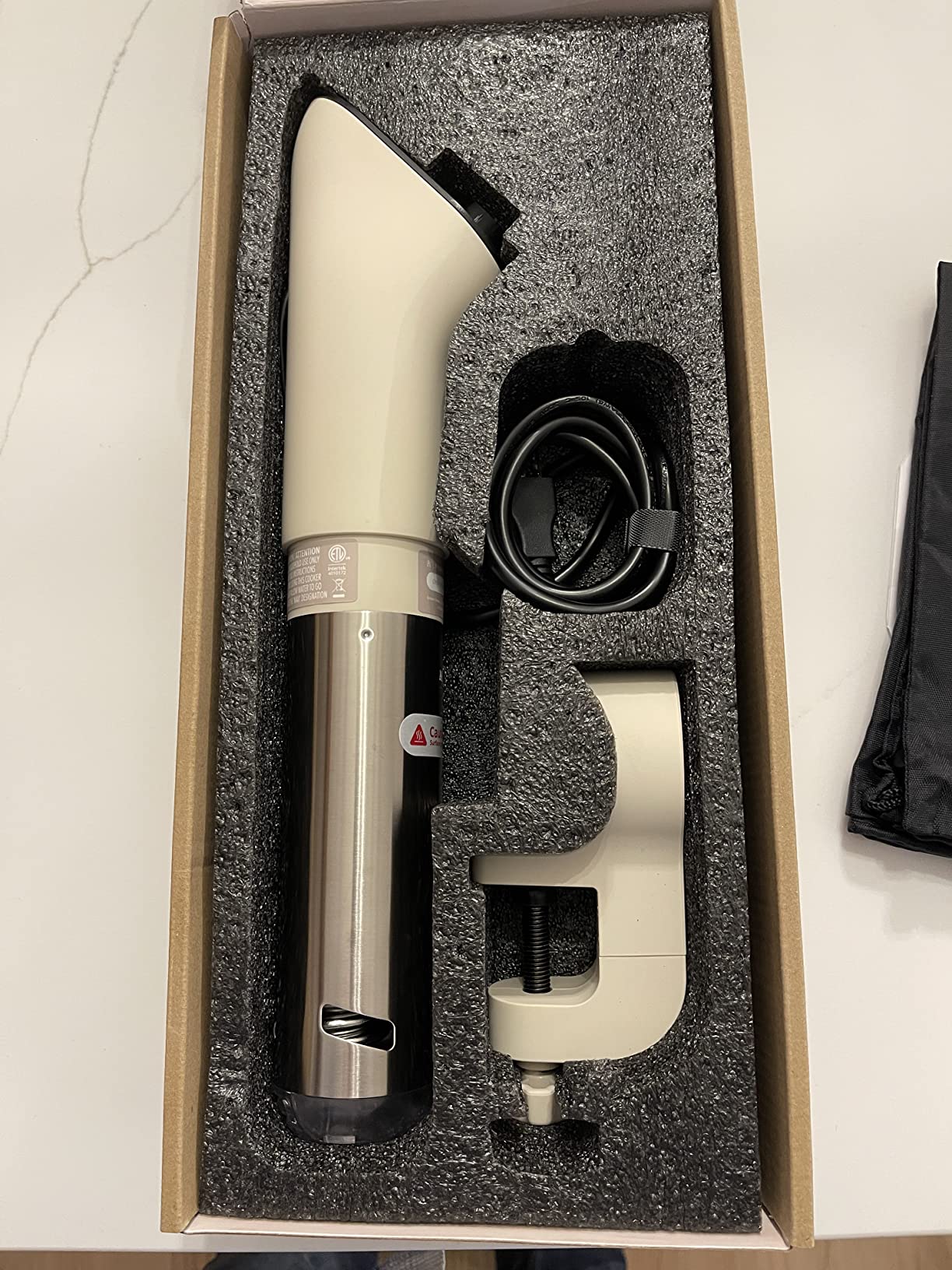
Five years of coverage is the longest warranty of anything in this roundup, and the removable dishwasher-safe stainless housing, storage bag, and cord tie are the details that matter when the unit moves between a home setup and an off-site cook.
Why the no-app decision is an advantage here
Because it removes an entire category of failure. No pairing means no failed setup, no firmware update can stop a cook, and no subscription can change what the device does at 135F. In a kitchen where the circulator runs while nobody is watching it, that reliability is worth more than remote monitoring.
The only thing you give up is knowing the temperature from another room. If your kitchen runs unattended overnight batches and someone needs to check progress from home, the Inkbird or Anova WiFi models serve that need better.
What heavy daily use does to it
Two reports are worth weighing. One owner reported the plastic impeller guard cracking after about a year of heavy use, and similar owner reports suggest roughly a three-year lifespan under frequent use. That is a shorter expected life than the five-year coverage implies, and it is the main reason this is not our top pick despite the rating.
The un-muteable completion alarm is the everyday irritation, and it repeats until acknowledged. Plan for it: place the bath where the beep is not directly over the pass.
How to Choose a Sous Vide Immersion Circulator for a Professional Kitchen
Is an immersion circulator the same as a sous vide cooker?
An immersion circulator and a sous vide cooker are the same category of tool sold in two different chassis. The circulator is the heating and pumping head alone; it clamps to the rim of a pot, a cooler, or a tub you already own, so you choose the bath volume. The all-in-one sous vide machine includes its own water tank, which means the capacity is whatever the manufacturer built and you cannot change it.
For a professional kitchen the head-only format wins on flexibility, which is the framing buyers on r/Cooking use: you can use whatever size bath you want, and the circulator itself fits in a cabinet. If you are moving a 15L setup to a 40L event cook, a head-only circulator travels and the built-in tank does not.
Can a home sous vide cooker work in a commercial kitchen?
Yes, and the forum consensus is more practical than the certification anxiety suggests. A former professional chef on r/Chefit argues explicitly that an Anova would be just fine in a commercial environment, especially considering the price. Chefs in thread after thread make the same point about justification: the number that has to survive is the cost conversation with an owner, not a safety inspection.
The honest counterweight is the failure question. When a plastic-bodied consumer unit dies during a dinner service you have no spare and no service relationship, and on r/sousvide the most common thread is a multi-year circulator that gave up the ghost. NSF and ETL certification status was not surfaced in our research for any model here, so verify it with the manufacturer or your dealer before putting a residential unit on the line.
How much bath capacity do you need, and where is the ceiling?
Most circulators top out around 20L or 5 gallons, as noted in a ChefSteps buying discussion, and that ceiling is the single most important number in this entire category. The rated capacities here run from 6L on the Breville Commercial CRC-5AC1B to 20L on the Wancle M820 and the KitchenBoss G330, with most landing between 15L and 16L.
Size the bath to your largest single batch, not your average. A typical service batch of 12 to 16 portions fits a 15L bath with room for circulation. A 40-person event does not fit any single circulator on this list, which is the practical reason caterers run two baths or move to a combi oven for volume events.
Does heater wattage or flow rate matter more?
Wattage controls how fast you recover; flow rate controls how evenly that heat is distributed. Every unit here runs between 800W and 1100W, a narrow band that matters less than most spec sheets imply. The 800W Anova Nano heats a large cold bath noticeably slower, which is the one case where the difference is real.
Flow rate is the number most brands hide and the one that matters more for volume work. The KitchenBoss G300S publishes 16L/min, and that published figure is why it is our stainless pick for batch cooking: even circulation across a full bath is what you are actually buying when you are cooking for a room.
Do you need WiFi and app control on the line?
Only if someone genuinely needs to check the bath from another room. Remote start on an overnight batch is a real convenience, and low-water alerts on the Inkbird ISV-100W are genuinely useful when the bath is not in front of you. Beyond that, app control adds a failure mode and, on the Anova Precision Cooker 3.0, a paid subscription gating advertised features.
The dial-and-panel designs here are underrated for commercial use. A single dial and a color-coded status light cannot be knocked offline, cannot fail a firmware update mid-service, and cannot be paired incorrectly at 2am.
Where should a restaurant buy a circulator?
A foodservice dealer gets you commercial certifications, replacement stock, and a service relationship. That matters more than the sticker price when a unit fails on a Thursday, and it is the argument for spending on the KitchenBoss or Breville Commercial models through a dealer rather than the consumer channel.
Consumer retail is where the best value per watt lives, and for a kitchen cooking proteins between 130F and 150F on a normal schedule, an Anova or KitchenBoss bought that way will do the job. If you are moving equipment between a home kitchen and a built-in installation, our picks for built-in wall ovens for home chefs cover the other half of that equation.
Frequently Asked Questions
What is the best commercial-grade sous vide machine?
Is an immersion circulator the same as a sous vide?
Do fancy restaurants use sous vide?
Which sous vide machine is better, Anova or Inkbird?
How long can a sous vide circulator run continuously?
The Verdict for 2026
The best sous vide immersion circulators for chefs come down to two questions: how long must it run unattended, and how large a bath must it heat. The Anova Nano 2.0 answers the first question with the deepest ownership history in the category and the tightest low-temperature accuracy. The KitchenBoss G300S and G330 answer the second, with 16L/min flow, stainless impellers, and 16L to 20L rated capacity.
Buy the Anova for a protein menu between 130F and 150F on a normal schedule. Buy a KitchenBoss when you are batching volume and need even circulation and a submersible body for cleaning. Buy the Inkbird ISV-100W when you want a calibrated reference and low-water alerts on an overnight run.
Whatever you choose, verify it against a calibrated probe on day one, run a lid on the bath, and check certification status with the manufacturer before it goes on the line. Then check the current price and rating for your pick.