
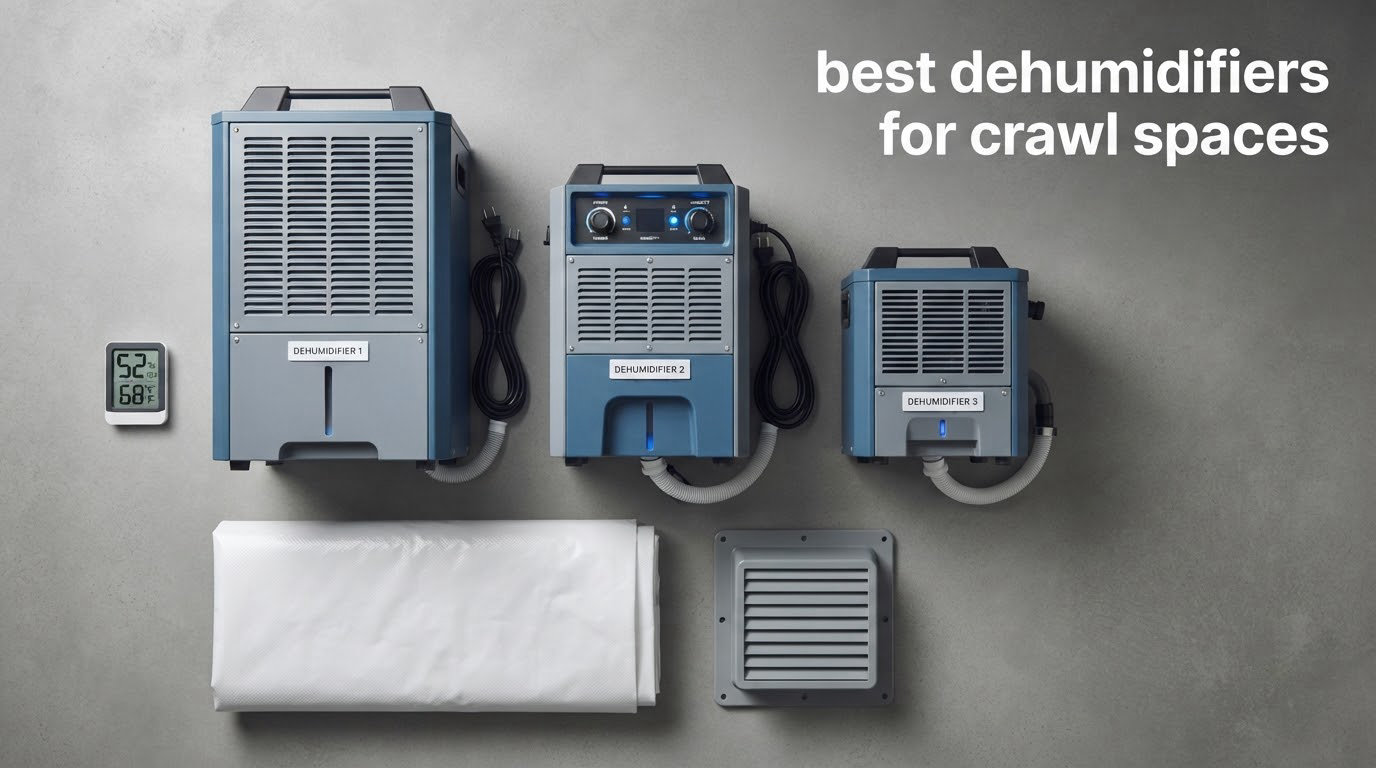
A crawl space is the one room in a house nobody wants to visit, and it is also the room that quietly decides how long your floor framing lasts. Soil moisture rises through the ground, the space stays cool all year because it sits outside the thermal envelope, and relative humidity routinely parks above 60 percent. That combination is what turns wood joists spongy, feeds mold and mildew, and pushes a musty smell up into your first-floor hallway.
Is it worth putting a dehumidifier in a crawl space? In our view, yes, and it is one of the highest-return upgrades a homeowner can make. A unit that holds the space near 50 to 55 percent relative humidity protects the subfloor framing above it, and the same moisture you are pulling out of the crawl space is moisture that never migrates into your living space. The best dehumidifiers for crawl spaces are not the shiny residential units from the appliance aisle. They are low-profile, continuous-duty machines with corrosion-resistant parts, automatic defrost, and drainage that works while you are not watching.
We spent weeks reading owner reports, installer threads, and long-term review histories on ten of the strongest crawl space dehumidifiers on the market, then matched the specifications against the real conditions each one is built for. The short version: the AlorAir Sentinel HD55S is the pick we would install in our own house, the Aiusevo AS610 is the strongest value per dollar of capacity, and the Moiswell MP70 posts the strongest owner scores in the group.
What follows is a full roundup of all ten, plus a buying guide that covers the parts most lists skip: sizing by cubic feet instead of square footage, the pump versus gravity drain decision, what encapsulation actually changes, and the compressor versus desiccant fork that matters in cold climates. If you are short on time, jump to the comparison table first and come back for the guide.
Table of Contents
Top 3 Crawl Space Dehumidifiers (October 2026)
These three earned the top spots because they combine real capacity, drainage that survives an unattended space, and enough owner history to trust. Every other pick in this roundup is worth reading, but these are the ones we would narrow the field to first.

AlorAir Sentinel HD55S
- 55 PPD at AHAM
- 120 PPD at saturation
- 1300 sq ft
- 13.3 inch tall
- continuous gravity drain


Moiswell Defender M145
- 70 PPD at AHAM
- 155 PPD at saturation
- 265 CFM
- horizontal between-joist chassis
Quick Comparison of All 10 Crawl Space Dehumidifiers
Every machine below is a genuine option for a crawl space. Read the AHAM column carefully, because that number, not the headline saturation figure, is what determines whether the unit keeps up on a humid summer night.
| Product | Specifications | Action |
|---|---|---|
| AlorAir Sentinel HD55S |
|
Check Latest Price |
| Aiusevo AS610 |
|
Check Latest Price |
 Waykar 125 Pint Crawl Space Waykar 125 Pint Crawl Space |
|
Check Latest Price |
 AlorAir 70 PPD with Pump AlorAir 70 PPD with Pump |
|
Check Latest Price |
| Moiswell Defender M145 |
|
Check Latest Price |
 Airecoler GT-X5 Airecoler GT-X5 |
|
Check Latest Price |
 AlorAir Storm LGR Extreme AlorAir Storm LGR Extreme |
|
Check Latest Price |
 Waykar 158 Pint with Remote Waykar 158 Pint with Remote |
|
Check Latest Price |
 Moiswell MP70 with Pump Moiswell MP70 with Pump |
|
Check Latest Price |
 Abestorm Guardian SN35P Abestorm Guardian SN35P |
|
Check Latest Price |
Key Features to Look For in a Crawl Space Dehumidifier
Before the individual reviews, here are the three features that decide whether a dehumidifier survives a crawl space. If a machine does not have these, it is a basement unit pointed at the wrong opening.
Low-profile, low-clearance chassis. Crawl spaces are frequently 16 inches or less between the joists, and you still have to get the machine through the access door. Chassis heights in this roundup run from 11.2 inches to 17.7 inches, which is the difference between a one-person install and a removal job.
Continuous drainage or a built-in condensate pump. Nobody empties a bucket twice a day under a house. A unit that can pump water up and away, or gravity-drain from an elevated mount, is the only realistic option for unattended operation. Gravity-only machines require you to plan the mount height before you buy.
Automatic defrost for low-temperature operation. A crawl space in winter can sit near freezing, and a standard compressor coil will ice over and stop pulling water. Every unit here uses temperature-sensor defrost cycles, with the fan continuing while the compressor pauses so the space keeps moving air.
Two more things that matter in practice: corrosion resistance, because you are running a machine in a damp box for years, and a humidistat that holds a setpoint rather than cycling on and off indefinitely. Look for metal housings, sealed control boards, and a restart-after-outage function, since a crawl space is precisely the place nobody checks on a regular basis. For the same clearance-first logic elsewhere in the home, our pick of standing desks for small spaces covers how footprint changes what fits in a tight room.
1. AlorAir Sentinel HD55S Review – Best Overall Crawl Space Dehumidifier
ALORAIR 120 Pints Energy Star Crawlspace Dehumidifier, Sentinel HD55S
55 PPD at AHAM and 120 PPD at saturation
1300 sq ft
130 CFM
13.3 inch tall
Pros
- Largest review base here at 1393 ratings
- continuous gravity drain
- metal housing
- Energy Star certified
- automatic defrost
Cons
- 41.7 pounds is heavy to haul through a crawl space access door
- gravity drain only so it needs an elevated mount
- remote monitoring needs a separately purchased accessory
The Sentinel HD55S is the unit we would put under our own house, and the reason is durability rather than headline capacity. It pulls 55 pints per day under standardized AHAM conditions and up to 120 pints at saturation, moves 130 CFM of air, and carries a coverage rating of 1,300 square feet. Owners running it in real crawl spaces report dropping readings from around 70 percent to under 60 percent within roughly two weeks of continuous summer operation.
What stands out on inspection is the build. The housing is metal rather than the rotomolded plastic used on residential machines, which matters a great deal in a space that may hold standing water during heavy rain. It ships with a MERV-1 filter to keep dust off the internals, carries Energy Star certification, and has a cETL safety listing. The warranty is a 6-year limited structure, though read the fine print, because parts and labor on the refrigeration system are covered on a shorter schedule than the headline years suggest.
The drainage design is the real reason this one wins. AlorAir built in a continuous gravity drain outlet, so once you mount the unit high enough on a stand or a joist, you run a hose to a sump, a perimeter drain, or an outside drain line and never touch it again. In a crawl space with 4 feet or more of clearance that is a five-minute job. In a 16-inch clearance space, you have no elevation to work with, and the lack of a pump becomes a genuine problem.
That caveat is the one real weakness. There is no built-in pump on this model, so if your only drainage runs downhill and below the machine you are stuck with a gravity-only unit or a separate pump. The optional remote monitoring path also requires additional WiFi or Ethernet hardware, and the humidistat readout on the unit itself is the only feedback you get out of the box.
Why We Picked It Over the Bigger Units
Several machines in this roundup have higher saturation numbers and more airflow. The HD55S still wins because the combination of 55 PPD real-world capacity, 1,300 square feet of rated coverage, and a 13.3 inch chassis height means it fits spaces where the bigger boxes simply cannot go, and it will not be cycling nonstop trying to catch up in a space it can actually cover.
It is also the most proven machine we found. A pro installer in r/basement described installing dozens of AlorAir dehumidifiers in crawl spaces and choosing a pump model each time, and an owner in r/raleigh reported about a year of service on an AlorAir in a crawl space with no complaints and humidity held well. Buyers who want the brand’s pump-driven version have a lower-capacity sibling later in this list.
Where It Falls Short
Two things to plan around. At 41.7 pounds it is a two-person lift through a typical 16 by 24 inch access opening, and the manufacturer does not include a pump, so the drainage plan has to be designed before the unit arrives. A few owners also report warranty service being narrower than the marketing language implies, with return shipping falling on the buyer.
2. Aiusevo AS610 Review – Best Value Crawl Space Dehumidifier
130Pints Crawl Space Dehumidifier with Pump and Drain Hose up to 6500 Sq.Ft
130 PPD at saturation
265 CFM
6500 sq ft
pump hose with 16.4 ft lift
Pros
- Built-in pump with 16.4 ft hose plus gravity option
- 265 CFM airflow
- covers up to 6500 sq ft
- 6-inch ductable outlet
- metal casing
Cons
- Some units reported arriving defective
- control panel does not retain settings across power cycles
- US-style plug only
The AS610 is the pick if you want serious extraction capability and a pump without moving up to the specialist price band. It delivers 130 pints per day at saturation, 265 CFM of airflow, and a coverage rating of up to 6,500 square feet. That airflow figure is at the top of this group and matters more than most buyers realize, because air changes per hour, not just water removal, is what stops humidity pockets in the far corners of a long crawl space.
Some owners running it in 1,000 square foot crawl spaces report moving from 90 percent readings down under 60 percent in a matter of days. The dual drainage setup is the standout feature: a built-in pump moves water upward or across long runs with a 16.4 ft hose, and a separate gravity path with a 6.6 ft hose covers spaces where you have elevation to work with. You are not locked into one drainage style.
Controls are handled by a touchscreen panel with humidity adjustment, a timer, a real-time temperature readout, auto restart after outages, and an error code display. A 6-inch ductable air outlet lets you connect the machine to existing HVAC ducting if you eventually want whole-house dehumidification rather than crawl space only, which is unusual capability at this capacity level.
Automatic defrost runs off ambient temperature sensors, which is exactly what you want in a space that can drop below freezing overnight. The housing is metal, the feet are adjustable, and there is a carry handle plus ceiling or floor mounting options. The washable filter keeps dust off the coil, which in a crawl space full of fibers and soil dust is the difference between one annual service and five.
Best Fit and Setup Notes
At 19.3 by 17.8 by 17.5 inches and 51 pounds, this is taller than the low-profile picks, so measure your clearance before committing. In a 3 to 4 foot crawl space it is a non-issue and the pump-driven drainage means you can mount the unit right on a block near the ground, which keeps the install simple.
The pump lift is what makes it work in the awkward cases. Crawl spaces usually drain to a sump that sits below floor level, so a pump that can push water up and away is the difference between a clean install and an improvised one. Run the hose to a sump pump inlet or a new perimeter drain line and you never have to think about the machine again.
What Owners Complain About
Reliability is the weak spot. A noticeable number of reviews describe machines arriving defective or failing to power on consistently, and the control panel does not remember custom settings through a power cycle, so you may need to re-set the humidistat after an outage. The remote upgrade is sold separately, and the handset feels cheaper than the machine itself. It also ships with a US-style plug only.
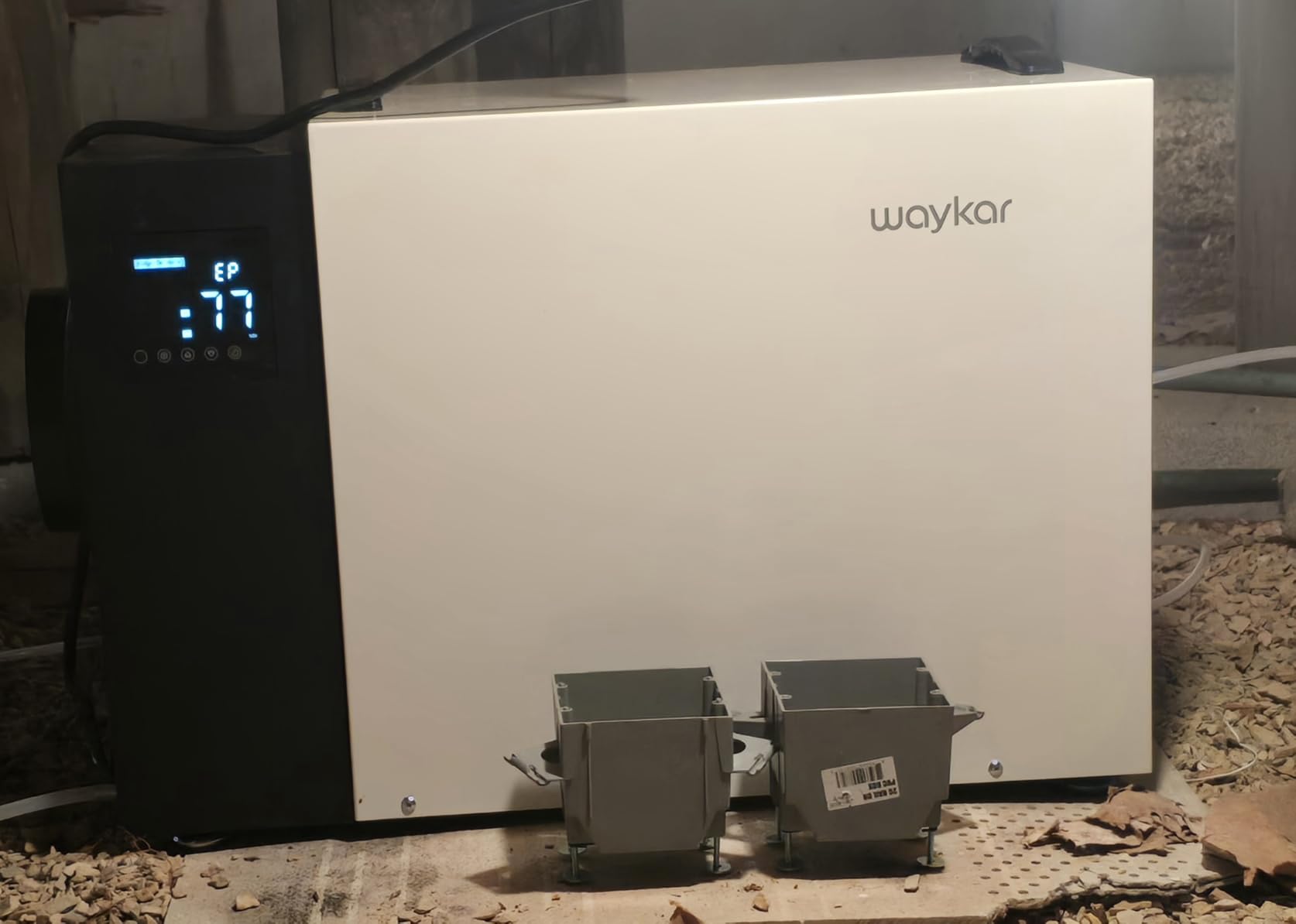
3. Waykar 125 Pint Review – Best for Large Crawl Spaces
Waykar 125 Pint Crawl Space Dehumidifier with Pump & Drain Hose for Basements, Commercial & Water Damage Spaces up to 6500 Sq. Ft., Compact, Strong Dehumidification, 5-Year Quality Coverage
125 PPD at saturation
176 CFM
6500 sq ft
16.4 ft pump hose
Pros
- Widest humidity adjustment range at 10 to 90 percent RH
- 16.4 ft pump hose with matching vertical lift
- rotary compressor
- adjustable feet cut noise and vibration
Cons
- Heaviest of the compact units at 49.8 pounds
- remote sold separately
- a noticeable share of 1-star reviews
When your crawl space is genuinely large, the Waykar 125 is built around the right idea: move a lot of air, run the compressor efficiently, and give the drainage system enough reach that you can put the drain line wherever the plumbing allows. It pulls 125 pints per day at saturation, circulates 176 CFM, and is rated for coverage up to 6,500 square feet. Power draw is listed at 530 watts.
The 10 to 90 percent relative humidity adjustment range is wider than anything else in this roundup, and that is genuinely useful in a crawl space. You can set a more aggressive target during the initial dry-out and then relax it for steady-state operation, and you can tighten it near 50 percent where the wood actually sits rather than aiming at the reading on the machine.
The hardware behind that is a high-efficiency rotary compressor rated to TUV standards, working with a 2+3 layer condenser for better heat exchange. The rotary design is worth noting because scroll and rotary compressors are generally the ones that show up in long-term reliability discussions in the HVAC trade. Drainage covers both styles again, with a 16.4 ft pump hose that lifts vertically up to 16.4 ft and a 6.6 ft gravity hose for elevated mounts.
Adjustable feet are a small detail that pays off in a space where the machine sits on bare soil or a sloped crawl space floor. Reviewers note a meaningful reduction in noise and vibration, and there is a washable removable filter plus a service reminder on the touchscreen panel. Coverage on the compressor runs to 5 years, with 2 years of quality coverage on the unit and lifetime technical support.
How to Size It Against Real Conditions
The 6,500 square feet coverage figure assumes a space you are actually trying to hold at a moderate humidity. If your crawl space reads 80 percent or higher at install, size up rather than trusting the coverage number, because a machine at its limit runs continuously and wears out faster. Continuous operation is exactly the scenario most owners in this category complain about, and it is almost always an undersizing problem.
Airflow is where this unit trades with the AS610. At 176 CFM it moves less air than the 265 CFM machines, which matters in a long, divided crawl space where the far end stays damp. If your space is a simple rectangle under a house, this is fine. If it has multiple chambers, run short ducting to push air into the corners.
Where the Weaknesses Show
Weight is the practical issue. At 49.8 pounds with a rotary compressor and multi-layer condenser packed in, this is a heavy machine for a tight access opening, and the compressor hardware is precisely what adds the mass. The remote control is a separate purchase, and no tank capacity is published, which means continuous drainage is effectively required rather than optional.
4. AlorAir 70 PPD with Pump Review – Best Budget Crawl Space Dehumidifier
ALORAIR 70 PPD Dehumidifier with Pump for Crawl Space and Basement
35 PPD at AHAM and 70 PPD at saturation
1000 sq ft
19.6 ft pump lift
under 50 dB
Pros
- Built-in pump with 19.6 ft vertical lift
- quiet operation below 50 dB
- compact 15.2 by 11.2 by 11.4 inch body
- 6-year limited warranty
Cons
- 35 PPD at AHAM is well under the 70-pint headline
- 1000 sq ft rated coverage is the smallest here
- 4.0 average with a heavy one-star share
This is the entry point into pump-equipped crawl space dehumidification, and for a small space it does the job properly. The 70 PPD headline is a saturation figure; the honest number is 35 PPD at AHAM conditions, with rated coverage of 1,000 square feet and airflow listed at 115 cubic meters per minute. It draws 331 watts and carries the same 6-year limited warranty structure as the larger AlorAir machines.
The built-in condensate pump is the feature that matters, lifting water up to 19.6 ft vertically with a 19.6 ft drain hose included. In a crawl space where the nearest drain is a sump below the floor, that lift capability is what makes unattended drainage possible at all. Automatic defrost handles cold conditions, auto restart with memory start returns the machine to its setpoint after an outage, and a MERV-1 filter captures dust that would otherwise coat the coil.
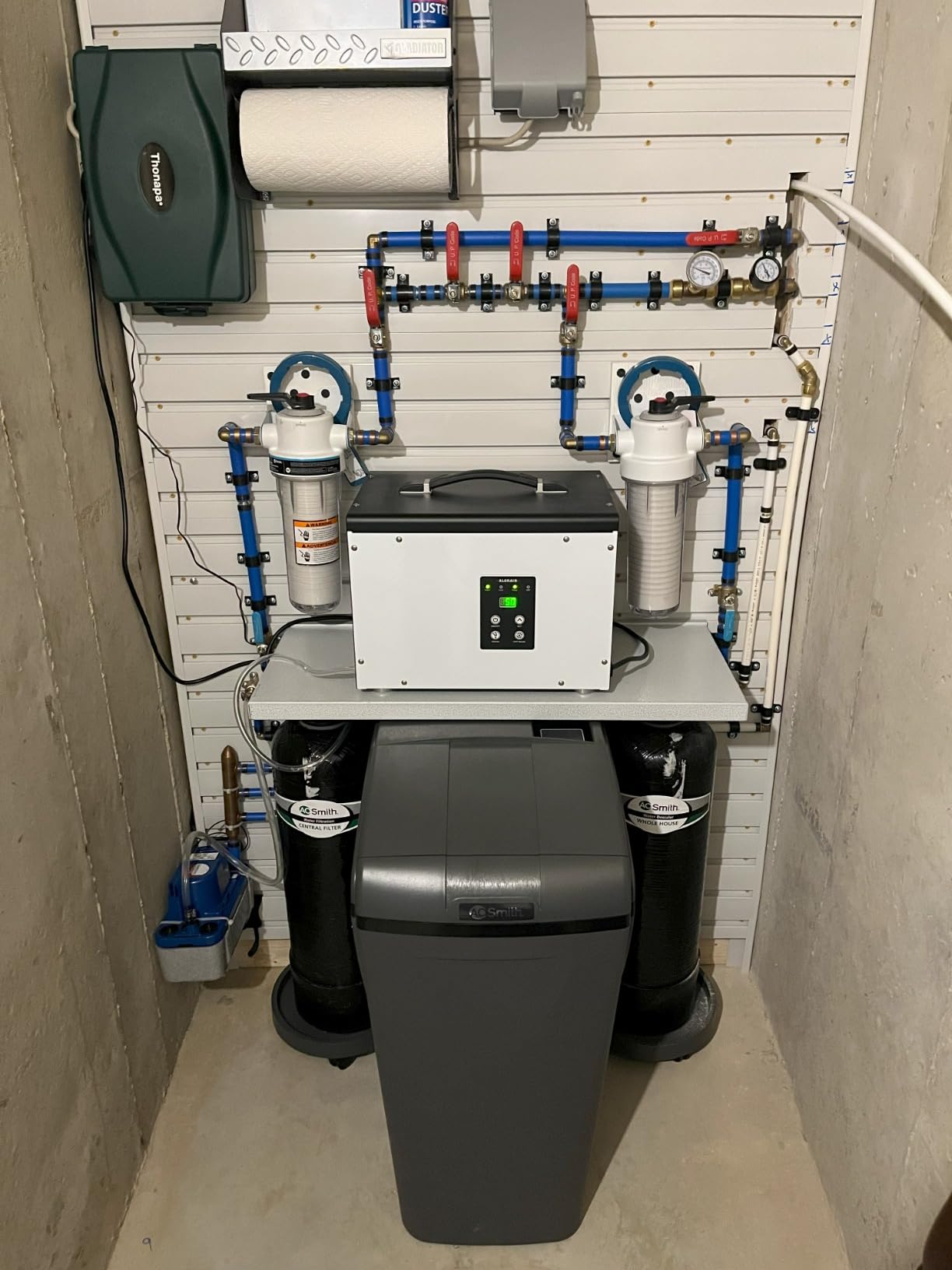
It is also the quietest machine in the group at under 50 dB, and at 15.2 by 11.2 by 11.4 inches with a 38.2 pound weight, it is one of the easiest to get through a tight access opening. For a crawl space under 1,000 square feet with moderate humidity, that combination of size, pump lift, and noise level is hard to beat.
Owners in small crawl spaces and basements consistently mention the pump-driven drainage, the quiet run, and the compact footprint as the reasons they like it. The 6-year warranty is also cited as a selling point more often than on competing budget machines, which typically offer 2 to 3 years.
When This Is the Right Buy
If your crawl space measures 1,000 square feet or less and your goal is to bring readings from the 60s down to the low 50s, this is the right size. Undersizing in this category is the most common and most expensive mistake, so measure your space first. If it is larger than about 1,000 square feet or starting humidity is high, the 35 PPD real-world capacity will not keep up and you will be running the compressor nearly continuously.
Its 90 degree F upper temperature rating is the lowest of the units with published limits here, which is not a practical concern in most crawl spaces but is worth noting if yours is exceptionally warm or you plan to use the machine in a garage or workshop as well.
Honest Downsides
The 4.0 average rating and heavy one-star share are the honest parts of this review. A meaningful minority of buyers report reliability or support problems, and the gap between 70 pints on the box and 35 PPD under standardized test conditions frustrates people who do not read carefully. Know the real number before you buy, because it is the number that decides whether the machine earns its keep.
5. Moiswell Defender M145 Review – Best Energy-Efficient Horizontal Unit
Moiswell 155 Pint Commercial Dehumidifier with Drain Hose for Crawl Spaces
70 PPD at AHAM and 155 PPD at saturation
265 CFM
6000 sq ft
horizontal chassis
Pros
- 4.5 average rating with a 78 percent five-star share
- 265 CFM airflow
- horizontal chassis fits between joists
- Energy Star certified
Cons
- Gravity drain only so it needs an elevated mount
- no built-in pump
- 63 pounds is heavy
The Defender M145 scores well on owner satisfaction, holding a 4.5 average with a 78 percent five-star share, and the recurring themes in reviews are raw extraction rate, airflow, efficiency, and a chassis that fits where it needs to. It pulls 155 pints per day at saturation, 70 PPD at AHAM, and moves 265 CFM, with rated coverage of 6,000 square feet.
The physical design is the differentiator. At 22.5 by 14 by 14.7 inches, it is a horizontal unit that slides between floor joists rather than standing upright, which is how most crawl space equipment is actually installed. Power draw is listed at 860 watts and it is Energy Star certified, so the operating cost for continuous summer duty is reasonable for that capacity.
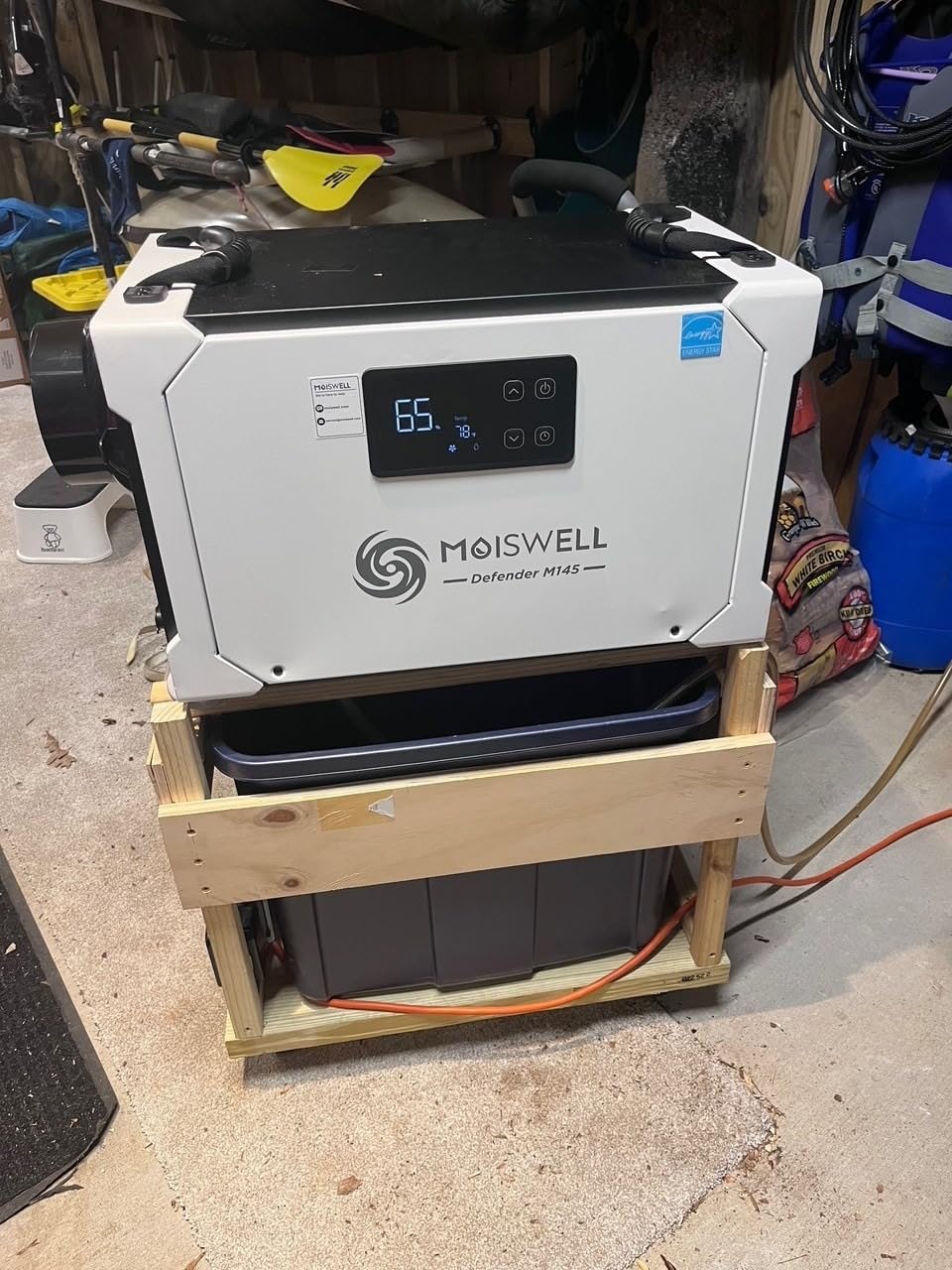
Controls are entirely set-and-forget: auto ON/OFF humidity cycling, memory starting so the machine returns to its setpoint after a power event, automatic defrost, auto restart after an outage, and a 24-hour timer. The drain is a gravity auto drain with the hose included, which is the one specification you have to think about before buying, because there is no pump inside this chassis.
Warranty coverage runs 5 years, split as 2 years on the whole dehumidifier and 3 years on parts, and the upper temperature rating is 95 degrees F. The M145 also shows up in the product lists that search engines surface for this keyword, alongside AprilAire and AlorAir models, which is a reasonable read of where the category currently sits.
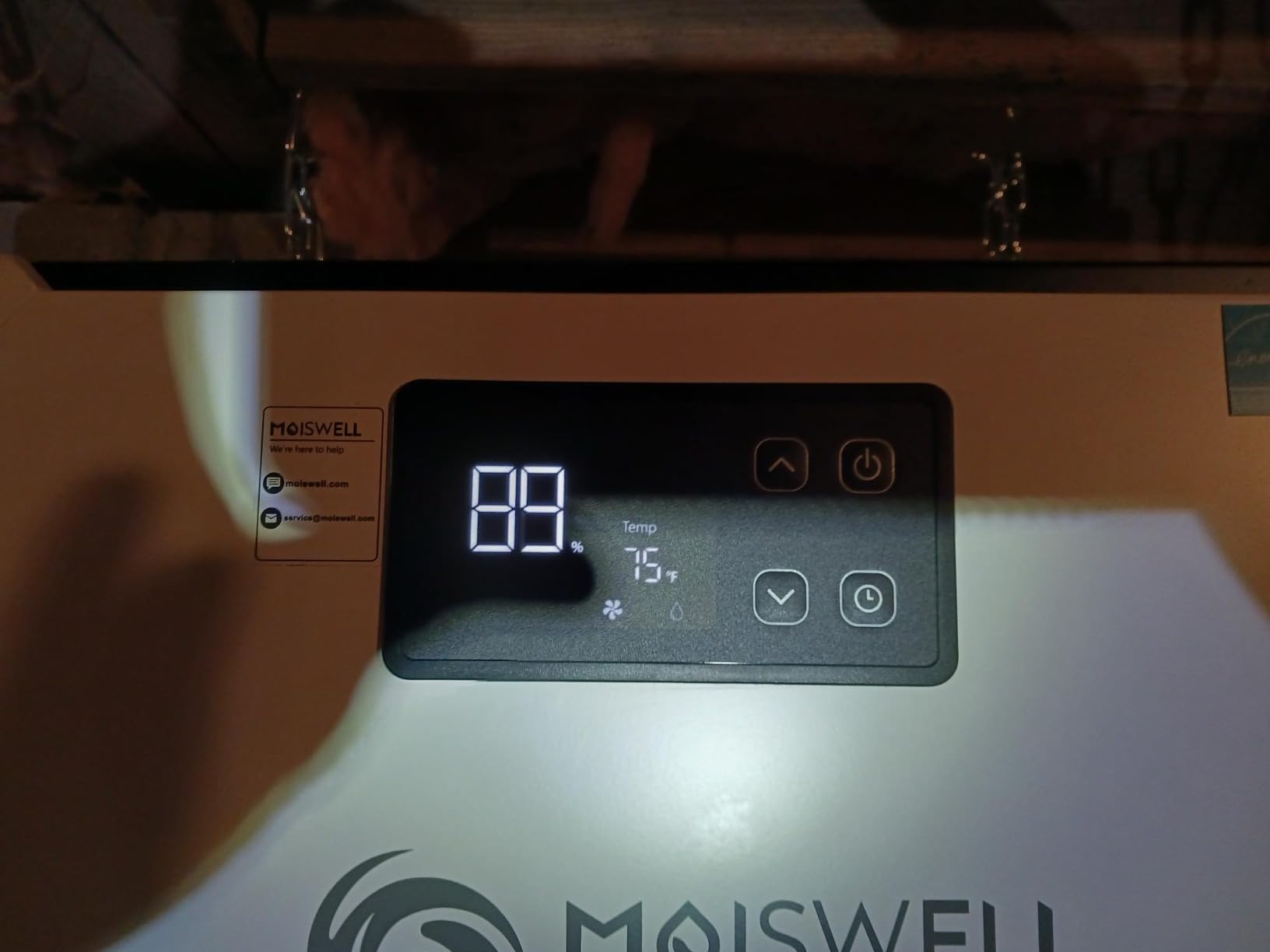
Reading the Horizontal Chassis Properly
The between-joist orientation is not a cosmetic choice. A 14.7 inch tall horizontal body clears standard 16 inch joist spacing, where most vertical 17 inch machines do not. If your crawl space is a typical 16 by 24 inch joist bay with limited headroom, this is one of the few machines here that installs without cutting a hole in the framing.
The tradeoff is footprint length. At 22.5 inches deep, you need enough open bay length to slide it in, and you need to plan a support. Reviewers running it in real crawl spaces report that the drainage plan is the only fiddly part, and they are unequivocal that it must be mounted high enough for gravity discharge to work reliably across a long run.
What Buyers Flag as Downsides
Gravity drain only is the dominant complaint, and it is a legitimate one in spaces where you cannot get elevation. At 63 pounds it is also one of the heavier machines to maneuver, and Moiswell is a newer brand with a shorter service history than the established names in this category, which matters if you are buying for a ten-year expectation.
6. Airecoler GT-X5 Review – Best Power-Saving Crawl Space Dehumidifier
Airecoler 125 Pints Commercial Dehumidifier for Crawl Space & Basement
60 PPD at AHAM
265 CFM
6000 sq ft
R32 refrigerant system
Pros
- 60 PPD at AHAM is one of the strongest real-world figures at this size
- R32 refrigerant system lowers power use
- 19.2 by 12.2 by 13.4 inch body suits low clearance
- 5-year coverage
Cons
- Gravity drain on this variant so it needs a higher mount
- 830 watt draw is higher than many peers
- only 290 reviews
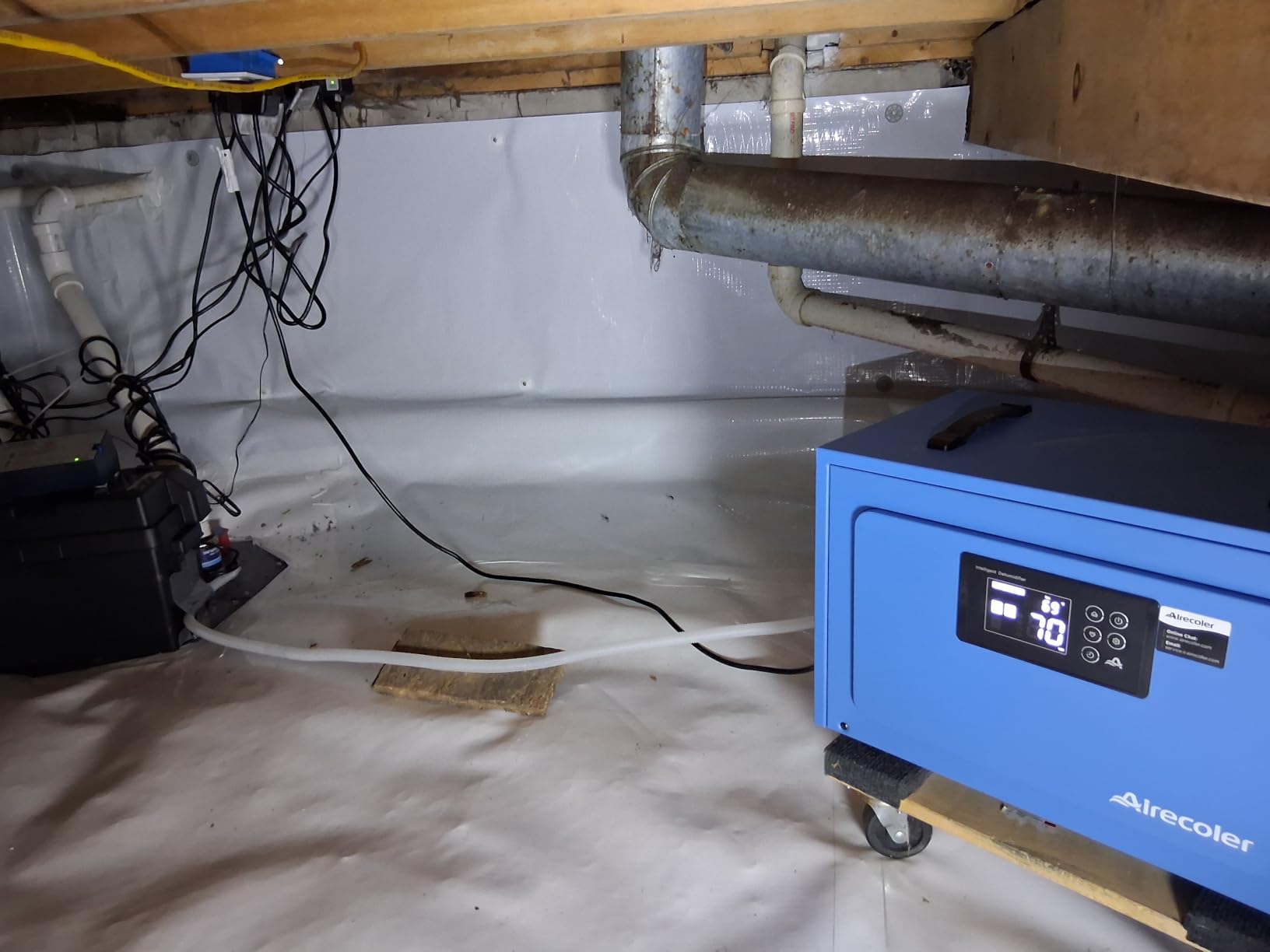
The GT-X5 is the pick if your electricity bill is a live concern, because its R32 refrigerant system is designed to cut power draw relative to older refrigerant designs. It delivers 125 pints per day maximum and 60 PPD at AHAM conditions, moves 265 CFM of air, and is rated for 6,000 square feet. That 60 PPD real-world figure is one of the better ones for a machine in this physical size class.
It scores a 4.4 average with a 74 percent five-star share across 290 reviews, and owners tend to lead with three things: strong moisture removal, genuinely set-and-forget operation, and a compact body. The chassis measures 19.2 by 12.2 by 13.4 inches, which means it can stand on the ground, sit on a counter, or be suspended between floor joists depending on what your access looks like.
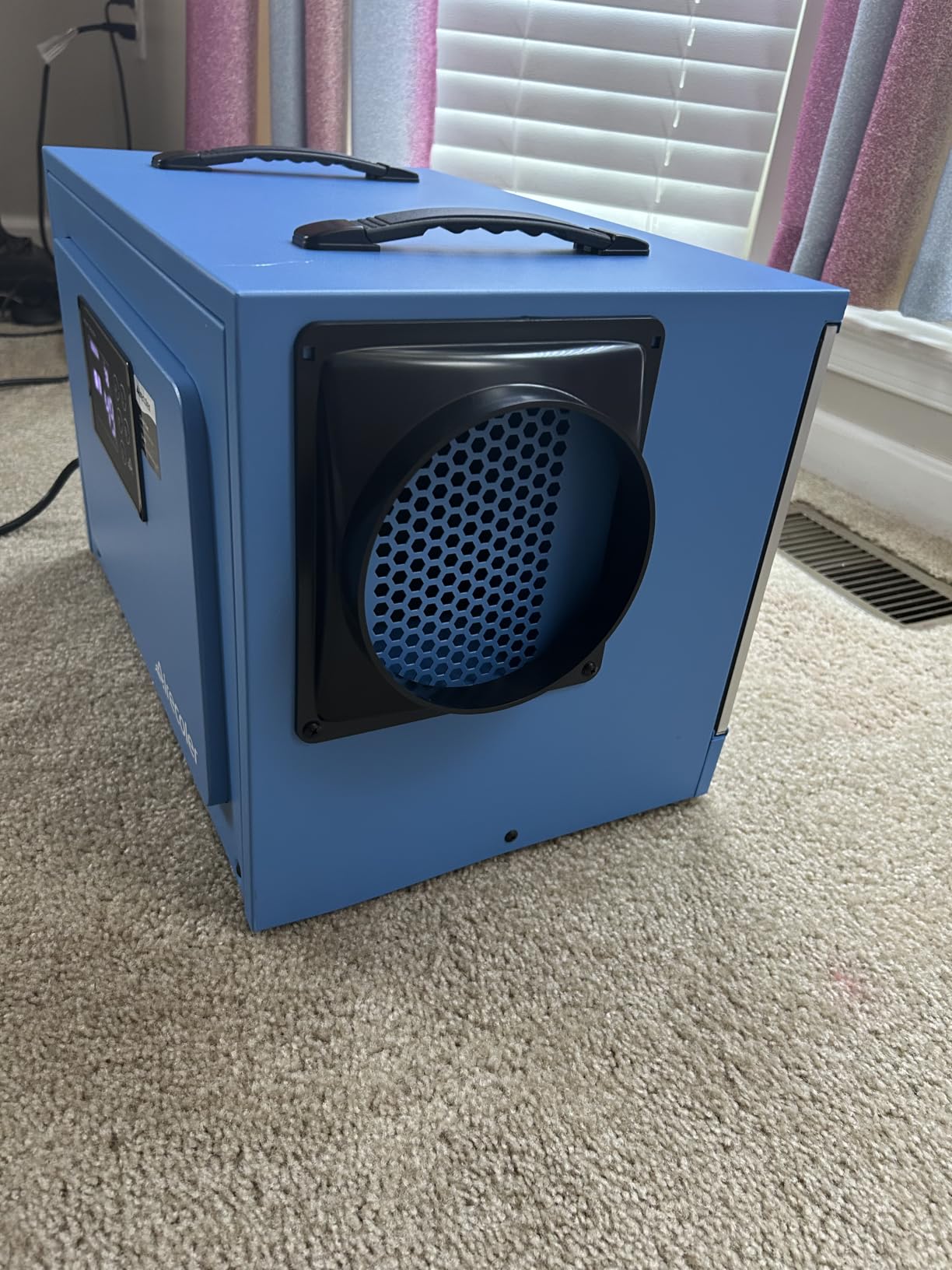
Operation is handled with a 24-hour auto ON/OFF timer, a continuous mode, auto restart after outages, automatic defrost, and memory starting so your humidity setpoint survives a power event. A 6.56 ft drain hose is included for gravity discharge. Warranty coverage is 5 years, split as 2 years on the entire dehumidifier and 3 years on the dehumidification system, with an upper temperature rating of 95 degrees F.
At 50 pounds and 830 watts, the power draw is higher than several 125-pint peers, so the R32 efficiency gain is relative rather than absolute. Still, in a space that may run for months of continuous duty, a more efficient refrigerant cycle is a real operating cost difference over the life of the machine.
Choosing This Over the Drier-Only Alternative
Compare the GT-X5 directly against the Waykar 125 and the Aiusevo AS610 if drainage is your deciding factor. The GT-X5 uses gravity only, so it needs a higher mount and a downhill run. Both of those alternatives carry a built-in pump, which is a decisive advantage in a crawl space where the drain is below the floor or far to one side.
Where the GT-X5 wins is footprint and review quality for its size. At 13.4 inches tall it clears low spaces better than the AS610, and its 4.4 rating with 290 reviews is a better signal than the heavier one-star shares on some cheaper machines. Measure clearance and drainage first, then choose.
Limitations Worth Knowing
Two practical issues. The gravity-only configuration means the unit has to be mounted where the drain line falls continuously, and the 830 watt draw is at the higher end for a 125-pint class machine. Review volume is also the thinnest of the main contenders, so long-term reliability data is thinner here than on the machines with over a thousand ratings.
7. AlorAir Storm LGR Extreme Review – Best for High-Capacity Recovery
ALORAIR 180 PPD Commercial Dehumidifier with Pump, 6-Year Limited Warranty
85 PPD at AHAM and 180 PPD at saturation
210 CFM
2300 sq ft
14.7 ft pump lift
Pros
- Highest raw extraction here at 180 pints per day
- 19.6 ft pump hose with 14.7 ft vertical lift
- GPP digital readout
- modular pump and control panel design
Cons
- Very heavy at 64.3 pounds
- significant fan noise
- unsealed bottom-mounted control board
- some coil icing failures within one to two seasons
When a crawl space is in genuine crisis, with standing water, a flooded basement, or post-rain readings in the eighties and nineties, the Storm LGR Extreme is the recovery machine. It pulls 180 pints per day at saturation and 85 PPD at AHAM, the highest real-world figure in this roundup, moves 210 CFM, and is rated for 2,300 square feet. The 2,300 square foot rating looks conservative next to the 6,000 figure on some rivals, and that is deliberate: this machine is built to do a hard job fast, not to idle gently in a large dry space.
Crawl space owners running this unit report dropping 87 to 94 percent readings to 50 percent within four days, without full encapsulation. That is the fastest documented result we found from any of these machines, and it is the scenario that separates an 85 PPD compressor from a 35 PPD one. Power draw is listed at 646 watts and the unit carries an ETL safety listing.
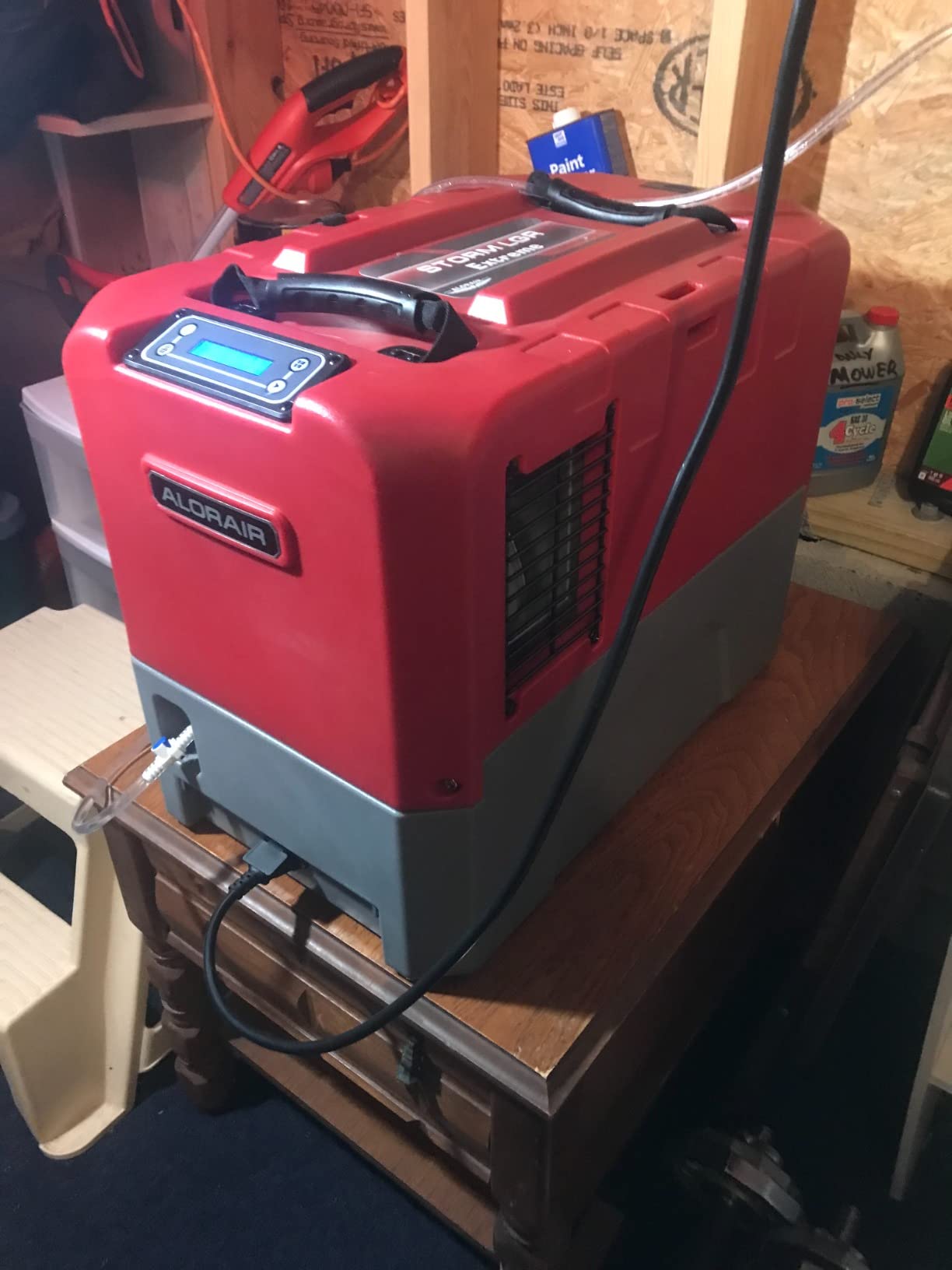
The built-in condensate pump comes with a 19.6 ft drain hose and 14.7 ft of vertical drain height, which is enough reach to route water to a sump or a perimeter drain without adding a separate pump. Automatic defrost uses temperature sensors and pauses the compressor while the fan continues running, so the space keeps moving air during a defrost cycle. Auto ON/OFF, memory starting, and auto restart after a power failure round out the unattended-operation features.
Two design details worth calling out: a digital display with a GPP reading, which tells you actual moisture removed in gallons per day rather than just a relative humidity number, and a modular design with a swappable pump and control panel. Two top carrying handles are included for positioning in confined areas, which matters given the weight.
When a Recovery Unit Is the Right Call
If your crawl space has recently taken on water, or your readings are still above 75 percent after you have fixed the obvious sources like a leaking supply line or a failed perimeter drain, this class of machine earns its keep fast. Owners running it in garages and shops describe steady hands-off humidity control around 47 to 50 percent, and report a noticeable improvement in whole-home comfort once the source space is dry.
For a crawl space that has been wet for a while, drying speed is not just convenience. Mold spores, insects, and microbial activity all scale with time in moisture, so a machine that pulls the space down in days instead of months is doing something structurally protective that a small unit running continuously never will.
Failure Points to Plan Around
Several owners report coil icing and refrigerant leaks within one to two summers. There is also a documented design weakness: the control board sits unsealed at the bottom of the unit and can be ruined by standing water, so install it above the highest expected water line, on a platform. The fan noise is significant and not appropriate for a finished living space, and at 64.3 pounds plus weak transit packaging, the rear coil grille is vulnerable to damage in shipping.
8. Waykar 158 Pint Review – Best for Remote Monitoring
Waykar 158 Pints Crawl Space Dehumidifier with Remote Control and Pump, Dual Duct HVAC Commercial Whole-House Dehumidifier for Basement, Industry Water Damage Unit – 5-Year Quality Coverage
158 PPD at saturation
206 CFM
7500 sq ft
included remote and sensor
Pros
- Only machine here with an included remote control and humidity sensor
- dual duct intake and exhaust for HVAC integration
- 158 PPD with 206 CFM covers 7500 sq ft
- 16.4 ft pump hose plus gravity hose
Cons
- Heaviest unit in the roundup at 70.9 pounds with a 24.4 inch width
- sensor must be installed for automation to work
- 14 percent one-star share
The reason this one is on the list is the accessories nobody else includes. It ships with a 16.4 ft remote controller, effective to a range of about 32.8 ft once installed, and a 16.4 ft humidity sensor cable. That sensor is the important half, because a crawl space dehumidifier is only as good as its reading, and mounting a remote humidistat near the wood rather than at the machine is the single best way to verify your target humidity is actually being held.
Capacity is substantial: 158 pints per day at saturation, 206 CFM of airflow from a brushless motor, and coverage rated up to 7,500 square feet, the largest figure of any machine here. Power draw is listed at 530 watts, which is low for that capacity, and it holds a 4.3 average with a 70 percent five-star share.
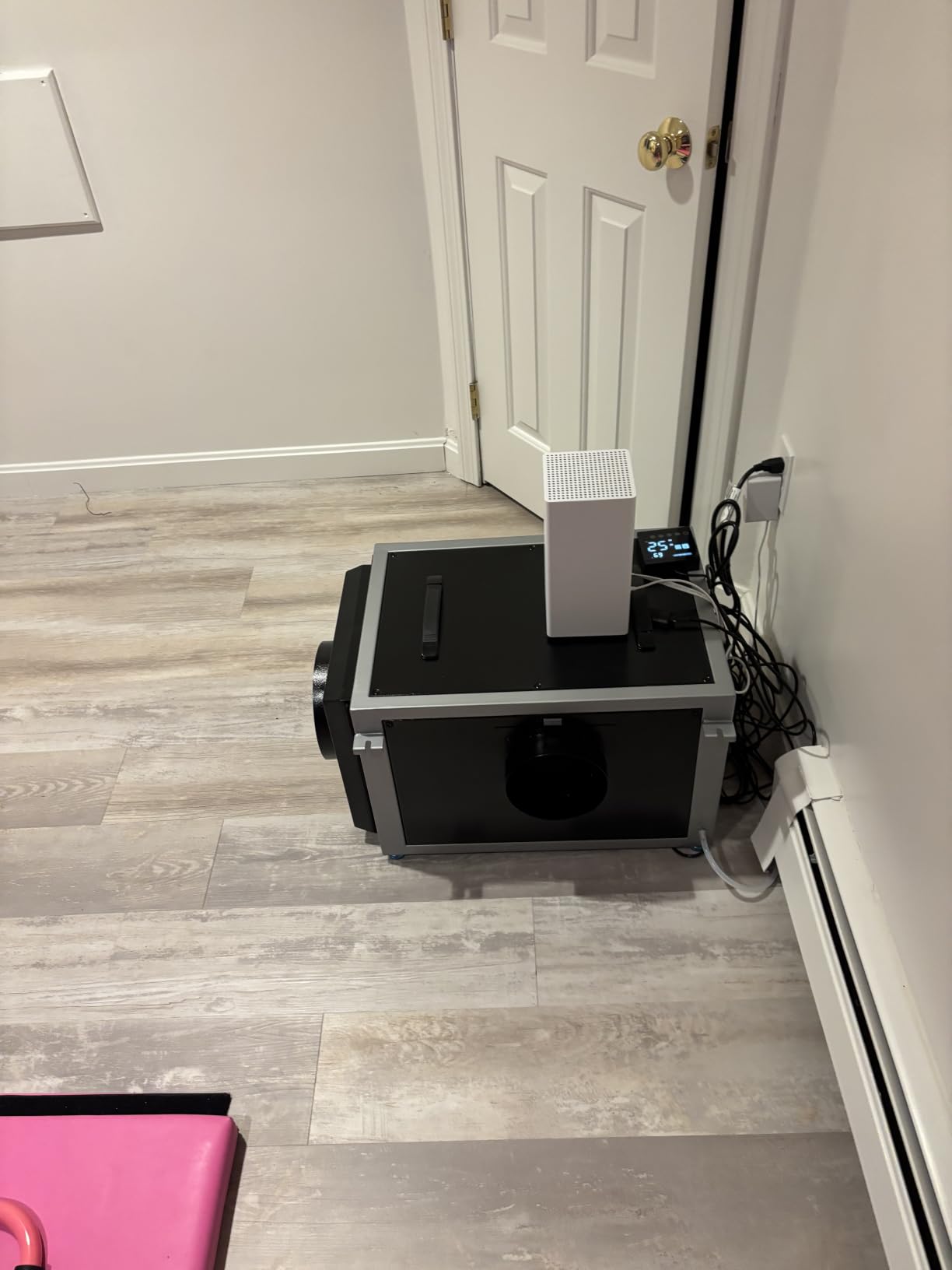
The dual duct design with separate ducted inlets and outlets is genuinely rare at this level and is aimed at HVAC integration, so you can push conditioned, dried air into the living space rather than only circulating air under the house. Drainage covers both styles with a 16.4 ft pump hose lifting vertically up to 16.4 ft and a 6.6 ft gravity hose. Automatic defrost, overload protection, power-off memory, a cord-winding column, adjustable feet, and a washable filter complete the feature set.
Warranty structure is 1 year of full quality coverage, 2 years extended, and 5 years on the compressor, with lifetime expert technical support. That is a shorter whole-unit term than the AlorAir machines offer, so factor it into a long-horizon purchase.
Why the Included Sensor Changes the Install
Run the 16.4 ft sensor cable to the far corner of the crawl space, ideally near a floor joist, and the humidistat will control to the conditions the wood is actually experiencing. This is the single change that most reliably separates a crawl space that stays dry from one that develops musty patches at the far end, and it is why we think this machine is worth considering even if its size is not ideal.
It also means you can check the space without crawling under the house. Nobody wants to make that trip weekly, and the remote is what makes the space genuinely unattended rather than nominally unattended.
Where the Bulk Becomes a Problem
At 70.9 pounds and 24.4 inches wide, this is the heaviest and broadest unit in the roundup, and those two numbers together make it the hardest to move into a tight crawl space. A caution on the sensor: automated functions will not work properly if it is not installed, so budget the time to run and secure the cable. A 14 percent one-star share also suggests some units fail within a year or two.
9. Moiswell MP70 Review – Best Between-Joist Installation
155 Pints Commercial Dehumidifier with Pump for Crawl Space
70 PPD at AHAM and 155 PPD at saturation
206 CFM
6000 sq ft
16.5 ft pump lift
Pros
- Highest average rating in the roundup at 4.6 with 82 percent five-star share
- built-in pump drains sideways or vertically up to 16.5 ft
- Energy Star with 2.01 L/kWh IEF
- horizontal chassis about 40 percent smaller than vertical units
Cons
- Highest wattage figure here at 1050W
- 62.2 pounds is heavy for between-joist work
- smallest review base at 203
The MP70 is the same core machine as the Defender M145 with one decisive change: it has a pump. That turns the best-rated unit in this group into the better choice for most crawl spaces, because the vast majority of crawl spaces drain to a sump that sits below floor level and gravity discharge simply will not work without heroic elevation. This unit moves condensate sideways or vertically up to 16.5 ft.
It posts a 4.6 average with an 82 percent five-star share, the highest scoring product in the roundup. Extraction is 155 pints at saturation and 70 PPD at AHAM, with 206 CFM of airflow and coverage rated to 6,000 square feet. Efficiency is a highlight: Energy Star certified at an IEF of 2.01 L/kWh in continuous operation, which is the kind of number that matters when the machine runs for a full season without stopping.
The chassis is the second reason to like it. At 24.3 by 14.37 by 15.11 inches, the manufacturer positions it as roughly 40 percent smaller than a comparable vertical dehumidifier, and the horizontal orientation is designed around floor joists specifically. That means you can suspend it in a bay rather than standing it on the ground, which in a space with a high water table is a real safety and durability advantage.
Auto ON/OFF humidity control, auto drain, auto defrost, and auto restart after a power outage handle unattended operation. Gravity drain and external pump drain options are both supported, so you are not locked into one routing. The metal outer casing is built for long service life in a damp environment.
The Pump Is the Whole Argument
Compare this directly against the M145 and the choice becomes clear in almost every real crawl space. Same horizontal between-joist format, same 70 PPD at AHAM, similar 6,000 square feet coverage rating, but one drains itself to wherever you route the hose and the other needs a downhill line from an elevated mount. If you have a sump, this is the one.
It also handles a wide range of crawl space conditions in a single machine. Sideways discharge covers a long run to a perimeter drain, and vertical discharge covers a sump inlet. When you can choose your routing freely, the pump removes a constraint that otherwise dictates your whole install.
Honest Limitations
At 1,050 watts, this draws more power than anything else in the roundup, and the Energy Star efficiency rating partly offsets that but does not erase it. At 62.2 pounds it is heavy for a between-joist lift, and with 203 reviews it has the thinnest long-term history here. The listing itself is inconsistent on capacity, quoting 145 pints in one field and 155 in the headline, so rely on the 70 PPD AHAM figure.
10. Abestorm Guardian SN35P Review – Best for Small Crawl Spaces
Abestorm 70 PPD Dehumidifier with Pump & Hose for Crawl Space & Basement
35 PPD at AHAM and 70 PPD per day
1000 sq ft
19.6 ft pump lift
5-year warranty
Pros
- Compact 15.2 by 11.4 by 11.2 inch body
- built-in pump with 19.6 ft lift plus gravity drain option
- replacement parts orderable directly
- 5-year limited warranty
Cons
- Two detailed reviews report units dying at roughly 6 and 16 months
- warranty service can require buyer-paid return shipping
- 4.0 average with a 16 percent one-star share
The Guardian SN35P targets the same 1,000 square foot segment as the AlorAir 70 PPD, and the two are close competitors. It delivers 70 pints per day, 35 PPD at AHAM, and 130 CFM of airflow with 1,000 square feet of rated coverage. The built-in condensate pump lifts water 19.6 ft, and a gravity drain alternative is available through the hose connection.
Automatic defrost runs off ambient temperature sensors, the unit stops at your set humidity and restarts after a power interruption, and the stated operating range is 45 to 55 percent relative humidity, which is a sensible crawl space target. Several owners report it held their crawl space in that band for more than a year, and the metal construction feels noticeably more durable than plastic residential units of the same size.
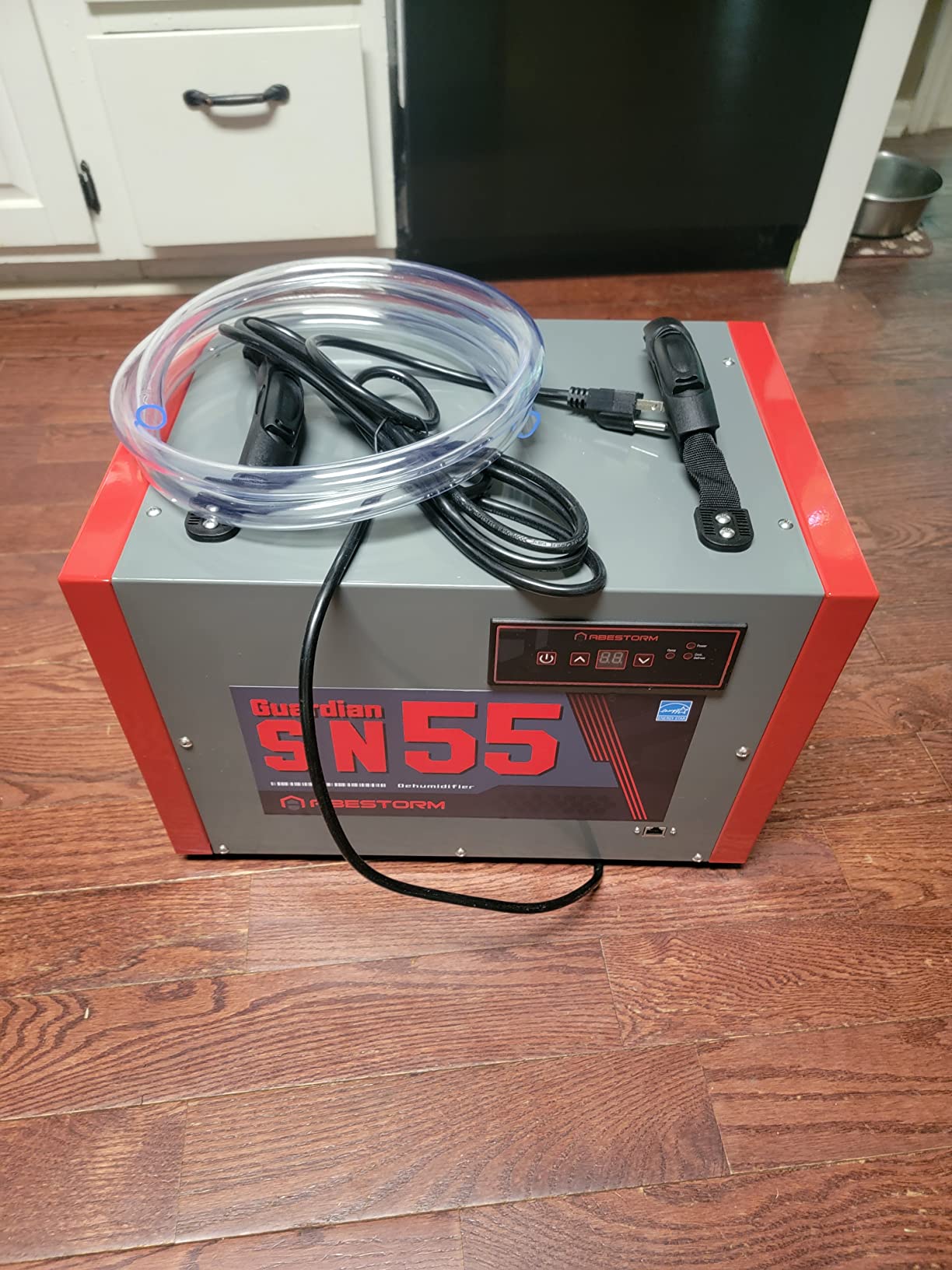
What separates it from cheaper alternatives is the parts story. Replacement parts, including filters and whole units, are orderable directly from the manufacturer, which means a failed component does not necessarily end the machine’s life. Support responsiveness is genuinely mixed, but the capability to send a replacement filter or unit rather than telling you to dispose of a working chassis is real.
At 15.2 by 11.4 by 11.2 inches and 38.2 pounds, it is among the easiest machines here to get through a crawl space access opening and position in a tight bay. The 5-year limited warranty with lifetime expert technical support is better than the 2-year terms common on comparable machines.
Choosing Between the Two Small-Space Options
Against the AlorAir 70 PPD, this unit runs louder when the pump activates and its 4.0 average carries a heavier one-star share. The AlorAir’s 6-year warranty structure and far larger review base make it the safer long-term bet. Choose the Abestorm if orderable replacement parts and the metal build matter more to you than the longer warranty.
Both are correctly sized for the same job. Neither is appropriate above roughly 1,000 square feet, and both need a plan for where the water goes. Measure first, then pick between them on warranty length and support access rather than on capacity, because their capacity numbers are effectively the same.
Reliability Reports to Take Seriously
Two detailed reviews report units that stopped condensing at roughly 6 months and 16 months respectively, and warranty handling has meant paying return shipping on a 38 pound unit or posting a public review to get action. Buttons and instructions are also confusing for first-time users. Buy it knowing the documented failure pattern, and keep the contact details for parts ordering handy.
Crawl Space Dehumidifier Buying Guide
Spec sheets tell you what a machine can do. They do not tell you whether it fits your crawl space, drains properly, and still works in year five. This section covers the decisions that actually determine whether an install succeeds.
How big a unit do you need? Cubic feet beats square feet
Coverage in square feet is the least useful number on the spec sheet, because it assumes a standard ceiling height that no crawl space has. Compute volume instead: multiply the floor area by the average clearance from the ground to the underside of the floor joists. A 2,000 square foot crawl space with 4 feet of clearance is roughly 8,000 cubic feet, and that is the figure that should drive your decision. A 2,000 square foot crawl space with 18 inches of clearance is closer to 3,000 cubic feet and needs far less capacity.
For a worked example: a 2,000 square foot crawl space at 4 feet of clearance is about 8,000 cubic feet. If your starting relative humidity is in the mid 60s and you want to land in the 50 to 55 percent band, you want a unit in the 50 to 70 PPD range under AHAM conditions. Below about 30 PPD you will be running the compressor nearly nonstop, and above about 85 PPD you are paying for capacity you will never use in a healthy space.
Airflow is the number most people skip and most people should not. As a rough rule, aim for enough CFM to move the crawl space air several times a day, which is why the 265 CFM machines handle large divided spaces better than a 176 CFM machine with similar capacity. Where a crawl space has multiple chambers, short ducting runs to push air into the far corners fix what undersized airflow cannot.
Pump or gravity drain: the decision that matters most
Most crawl spaces drain to a sump that sits below floor level, and most crawl spaces also have a floor that slopes. Gravity drainage requires the machine to sit high enough, and usually on a platform, for water to flow continuously downhill for the whole run. If you cannot achieve that, the machine will either overflow or cycle off constantly. A built-in condensate pump removes the constraint entirely, and it is the single most important feature in this category.
Pump lift distance tells you how much vertical height the pump can move. The 19.6 ft lift on the AlorAir and Abestorm machines and the 16.4 to 16.5 ft lift on the Moiswell, Waykar, and Aiusevo units all cover a standard crawl space with margin. Route the hose to a sump pump inlet, a new perimeter drain, or an outside drain line, and add a secondary float switch or a pump failure alarm if the space is one you cannot check easily. A pro installer in r/basement put it simply: install the pump-equipped model, because you are not going under the house twice a day with a bucket.
Encapsulated vs unencapsulated: what changes
You can run a dehumidifier in an unencapsulated crawl space, and several of the owners in this roundup did. Owners running the AlorAir Storm LGR Extreme report dropping 87 to 94 percent readings to 50 percent within four days without full encapsulation, and the HD55S reports suggest 70 percent readings fall under 60 percent in about two weeks of continuous summer operation.
What encapsulation changes is the workload, not the principle. A properly sealed crawl space with a repaired vapor barrier and adequate perimeter drainage keeps ground moisture out, so the dehumidifier removes far less water and cycles less often. In an unencapsulated space the unit is fighting the soil continuously, which means longer run times, more energy, and more wear on the compressor. Fix the vapor barrier and the drainage first if you can, and treat the dehumidifier as the second step rather than the first.
Compressor or desiccant: which technology fits a cold crawl space
Every unit in this roundup is a compressor or refrigerant dehumidifier, which is the right choice for a crawl space that stays above freezing most of the year. A desiccant unit uses a desiccant media instead of a refrigerant coil and keeps working at much lower temperatures, which makes it the correct answer in a cold climate where a crawl space drops below 40 degrees for long stretches. It is typically larger, more expensive, and produces less condensate per unit of electricity, which is why it is a niche answer rather than a default one.
If your crawl space never drops below roughly 50 degrees, a compressor unit with automatic defrost is more efficient and cheaper to run. If you are in a climate with deep winter freezes and you cannot guarantee the space stays warm, investigate a low-temperature or desiccant model instead. Whichever technology you choose, measure humidity near the wood rather than at the unit, because the reading you care about is the one at the cold surface where mold actually starts.
Before you install: crawl space prep checklist
Work through this list before the unit arrives, because most of the fixes are easier with an empty space.
Inspect the vapor barrier on the walls and under the floor for tears, rodent damage, and open seams, and repair or replace what is failing.
Fix every water source first: a leaking supply line, a cracked drain line, a hose bib that drips. A dehumidifier cannot outrun an active leak.
Add or clear a perimeter drain and confirm the ground slopes away from the foundation.
Install a GFCI-protected outlet within reach of the unit, because a damp space and standard wiring are a poor combination.
Build a level platform or joist-mounted bracket that holds the machine above the highest expected water level, and plan the drainage route at the same time.
Clear the joist bays of debris and old vapor barrier scraps so air can actually move through the space.
Installation, ducting and a maintenance schedule
Position the unit centrally in the space if you can, since that gives the evenest humidity distribution, and offset it slightly toward the wet side if one end of the crawl space stays damper. Set the humidistat to your target, 50 to 55 percent if you are measuring near the wood, and let the machine control itself from there. Every unit in this roundup cycles on a humidistat, so the setpoint is the single most important setting on the machine.
Where a crawl space has more than one chamber, run short flexible ducting from the outlet to the far spaces so air reaches the corners. The AS610 and the Waykar 158 both have ductable outlets designed for this. If you want the dried air to serve the living space above, the dual duct design on the Waykar 158 is the purpose-built option here.
For maintenance, rinse the washable filter monthly during the operating season, more often if the space is dusty. Check the coil for debris and corrosion twice a year, and look at the drain line and pump for blockage at the same time. Test the machine and its auto restart after a power event once a year, and read the humidity at a sensor location near the wood rather than at the control panel. None of this is demanding, but all of it has to be scheduled, because a crawl space is not going to tell you it stopped working. If you are also short on utility space above, our guide to countertop dishwashers for small spaces covers the same footprint-versus-capacity tradeoff from the other direction.
Frequently Asked Questions
Is it worth putting a dehumidifier in a crawl space?
What size dehumidifier do I need for a 2000 sq ft crawl space?
Can I put a dehumidifier in my crawl space without encapsulation?
What is the fastest way to dry out a crawl space?
What type of dehumidifier is best for a crawl space?
Do I need a dehumidifier with a pump for a crawl space?
Conclusion: Our Best Dehumidifier for Crawl Spaces
If we were installing one unit under a house, it would be the AlorAir Sentinel HD55S. Its 55 PPD at AHAM, 1,300 square feet of rated coverage, 13.3 inch chassis height, and metal housing add up to the most dependable combination in this roundup, and its 1,393 ratings give it the longest track record of anything we looked at.
For a different set of constraints, the Moiswell MP70 is the best-rated machine here and the right answer when you need a pump with a between-joist horizontal body, while the Aiusevo AS610 gives you the most airflow and pump capability per dollar. If the space is under 1,000 square feet, the AlorAir 70 PPD with pump or the Abestorm Guardian is the sensible size, and if the crawl space is genuinely wet, the AlorAir Storm LGR Extreme has the raw extraction to fix it in days.
Whichever one you choose, measure your clearance in inches, compute your crawl space volume in cubic feet, and sort out where the water goes before the machine arrives. That preparation does more for the result than any specification on the spec sheet. For more ways to protect the tight, overlooked spaces in your home, our guides to standing desks for small spaces and ironing boards for small spaces cover the same clearance-first thinking in other rooms.