
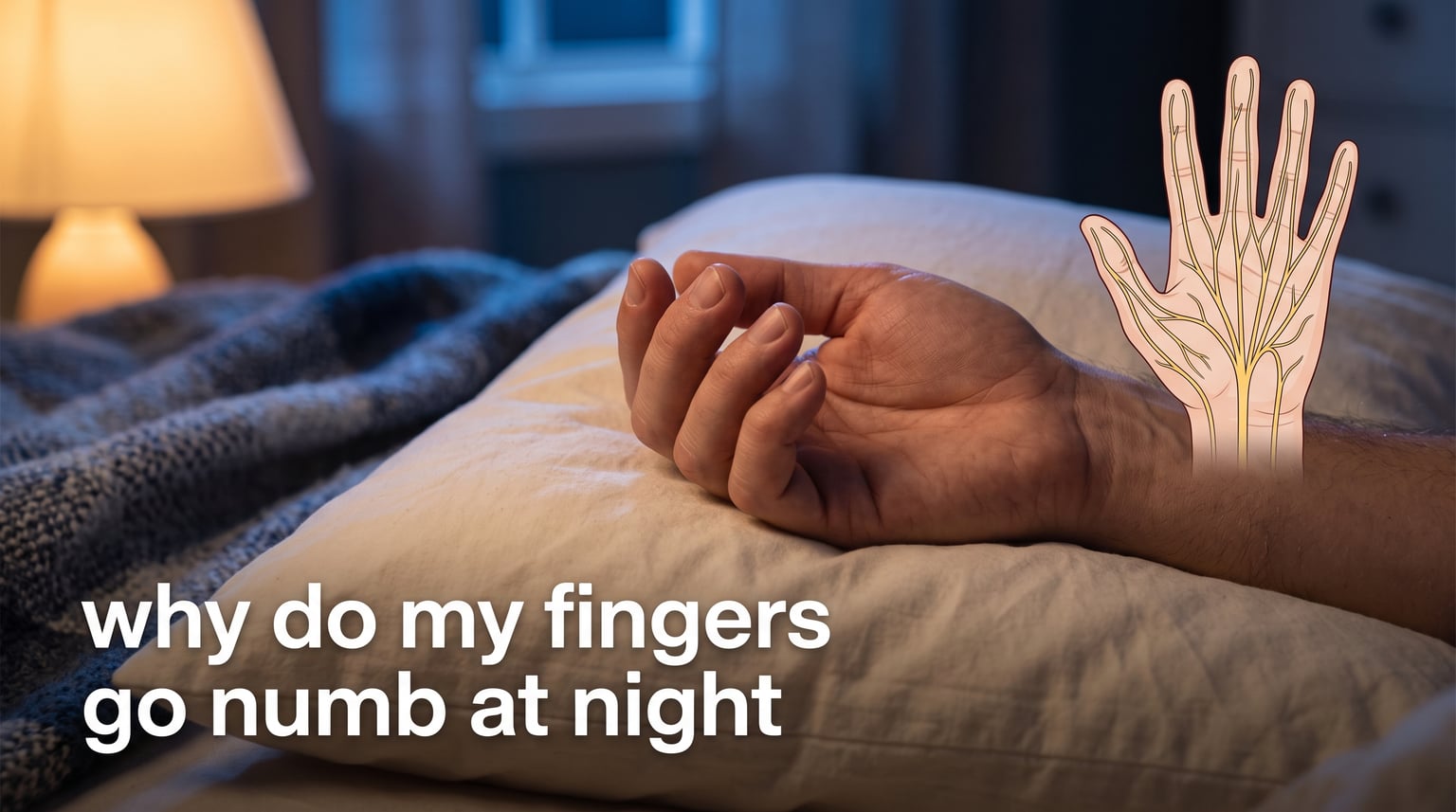
You wake up in the middle of the night, and your fingers feel like they belong to someone else. That familiar tingling, the pins and needles sensation, the strange numbness that makes you shake your hand over and over to get feeling back. If this sounds familiar, you are far from alone.
Nighttime finger numbness affects millions of people, and it is one of the most common reasons people search for answers about their sleep-related symptoms. The good news is that most cases are highly treatable once you understand what is happening.
If you are wondering why do my fingers go numb at night, the answer usually comes down to how your nerves are being compressed while you sleep. But there are several different causes, and figuring out which one applies to you makes all the difference in finding the right solution.
In this guide, I will walk you through every major cause of nighttime finger numbness, from simple sleep position issues to underlying medical conditions. I will also share practical prevention tips, home exercises, and clear guidance on when numbness signals something that needs medical attention.
Table of Contents
Why Do My Fingers Go Numb at Night? The Quick Answer
Finger numbness at night happens when nerves traveling from your neck down to your hands get compressed or irritated. The compression interrupts the signals between your brain and your fingers, producing that characteristic tingling or dead feeling. Here are the five most common causes:
Sleep position – Bending your wrists or elbows while sleeping compresses nerves. This is the single most common cause of nighttime finger numbness.
Carpal tunnel syndrome – The median nerve gets squeezed as it passes through the narrow carpal tunnel in your wrist, causing numbness in your thumb, index, and middle fingers.
Cubital tunnel syndrome – The ulnar nerve gets compressed at your elbow, producing numbness in your ring and little fingers.
Cervical radiculopathy – A pinched nerve in your neck sends numbness, tingling, or pain radiating down your arm into your fingers.
Underlying health conditions – Diabetes, vitamin B12 deficiency, thyroid disorders, and other medical issues can cause nerve damage that shows up as nighttime numbness.
Most cases fall into the first two categories, which is encouraging because both respond well to simple changes. Let us look at each cause in detail so you can identify what is likely happening with your hands.
How Sleep Position Causes Finger Numbness
The way you position your body during sleep has a bigger impact on your hands than most people realize. When you sleep, you may hold positions for hours that you would never tolerate while awake. Those sustained positions are where nerve compression begins.
When you curl your wrists inward while sleeping, you narrow the carpal tunnel space in your wrist. The median nerve running through that tight space gets squeezed between ligaments and bones. Hours of this compression add up, and you wake up with numbness in your thumb, index, and middle fingers.
Similarly, many people sleep with their elbows sharply bent, especially side sleepers who tuck their arms close to their bodies. This bent-elbow position stretches and compresses the ulnar nerve, which runs through a channel on the inside of your elbow. That is the same nerve you hit when you bump your funny bone.
Side sleeping is particularly problematic for hand numbness. When you sleep on one side, the arm underneath your body bears weight that restricts blood flow and compresses nerves. The arm on top may also drape in ways that bend the wrist or elbow into bad positions.
Phone Usage in Bed: A Modern Cause
Here is something most guides overlook. If you scroll through your phone while lying in bed before sleep, you may be setting yourself up for nighttime numbness. Holding a phone while lying on your side forces your wrist into an awkward bent position and your elbow into sharp flexion.
I have seen many people who only experience finger numbness on nights when they use their phone in bed for extended periods. The sustained nerve compression from phone browsing can linger even after you fall asleep, making your symptoms worse. If this sounds like your routine, try propping your phone on a stand instead of holding it.
Carpal Tunnel Syndrome: The Leading Medical Cause
When finger numbness at night becomes a regular occurrence rather than an occasional annoyance, carpal tunnel syndrome is the most likely medical cause. This condition affects roughly 4 to 5 percent of adults, and its hallmark symptom is numbness that wakes you from sleep.
The carpal tunnel is a narrow passageway in your wrist formed by bones and a tough ligament. The median nerve, which provides sensation to your thumb, index finger, middle finger, and part of your ring finger, passes through this tunnel along with the tendons that bend your fingers.
When the tendons become irritated and swollen, or when the ligament thickens, the space inside the tunnel shrinks. The median nerve gets pinched, and the result is numbness, tingling, and sometimes sharp pain in the specific fingers it serves.
Carpal tunnel syndrome gets worse at night for a clear reason. Most people naturally flex their wrists during sleep. That flexion further narrows the already tight carpal tunnel, increasing pressure on the median nerve. Many patients report needing to shake or flick their hands to get relief, a habit doctors call the flick sign.
Who Develops Carpal Tunnel Syndrome?
Several factors raise your risk. Women are three times more likely than men to develop carpal tunnel syndrome, partly because the carpal tunnel is naturally smaller in women. Pregnancy, diabetes, thyroid disorders, and rheumatoid arthritis all increase risk as well.
Your occupation plays a role too. Jobs involving repetitive hand movements, vibrating tools, or prolonged typing can irritate the tendons in your wrist over time. Assembly line workers, cashiers, hairdressers, and office workers all see elevated rates of carpal tunnel syndrome.
If your numbness affects mainly your thumb, index, and middle fingers, carpal tunnel syndrome should be high on your list of suspects. The key pattern is symptoms that wake you between midnight and early morning, forcing you to shake your hands for relief.
Cubital Tunnel Syndrome: The Ulnar Nerve Problem
The second most common nerve compression causing nighttime finger numbness is cubital tunnel syndrome. This condition involves the ulnar nerve, which runs from your neck down through your arm and passes through a narrow channel at your elbow called the cubital tunnel.
Unlike carpal tunnel syndrome, cubital tunnel syndrome affects a different set of fingers. The ulnar nerve provides sensation to your ring finger and little finger, so that is where you will feel the numbness and tingling. If you wake up with numbness concentrated in your smallest two fingers, cubital tunnel syndrome is the probable cause.
The problem almost always traces back to elbow position. When you bend your elbow beyond 90 degrees, the ulnar nerve stretches around the bony point of your elbow. Sustained flexion increases pressure on the nerve by up to seven times compared to a straight arm.
Side sleepers who tuck their arms tightly against their chest or under their pillows put maximum stretch on the ulnar nerve. Add hours of sleep in that position, and the nerve becomes irritated enough to produce numbness, tingling, and even weakness in your hand.
The Connection Between Cubital Tunnel and Phone Use
Holding your phone to your ear for long calls or propping yourself up in bed with bent elbows can trigger cubital tunnel symptoms. The prolonged elbow flexion compresses the ulnar nerve in exactly the same way that sleeping with a bent elbow does.
Some people develop what has been informally called cell phone elbow from holding their phone for extended conversations. The symptoms are identical to nighttime cubital tunnel syndrome: numbness and tingling in the ring and little fingers, sometimes accompanied by hand weakness.
Other Medical Conditions That Cause Nighttime Numbness
While nerve compression from sleep position and tunnel syndromes account for most cases, several other medical conditions can produce finger numbness at night. If your symptoms do not match the patterns of carpal or cubital tunnel syndrome, one of these conditions could be responsible.
Cervical Radiculopathy (Pinched Neck Nerve)
Nerves that supply your hands actually originate in your cervical spine, the seven vertebrae in your neck. When a herniated disc or bone spur compresses one of these nerve roots, the symptoms can radiate all the way down your arm into your fingers.
Cervical radiculopathy often produces numbness that follows a specific path from your neck through your shoulder and down one arm. Unlike carpal tunnel or cubital tunnel syndrome, the numbness from a pinched neck nerve may also include shoulder pain, arm weakness, or pain that worsens when you turn your head a certain way.
Sleeping positions that twist or strain your neck can worsen symptoms at night. If your pillow is too high or too low, your neck may be held at an angle that increases pressure on the affected nerve root throughout the night.
Peripheral Neuropathy and Diabetes
Peripheral neuropathy is nerve damage that typically starts in the longest nerves, which are those reaching your feet and hands. Diabetes is the leading cause of peripheral neuropathy in the United States, responsible for roughly 60 percent of cases.
Diabetic neuropathy usually affects both hands symmetrically, meaning you feel numbness in the same fingers on both sides. The numbness from peripheral neuropathy tends to be constant rather than position-dependent, and it often coexists with similar symptoms in your feet.
If you have not been diagnosed with diabetes but are experiencing bilateral hand numbness, especially with increased thirst, frequent urination, or fatigue, ask your doctor about checking your blood sugar levels. Early detection of diabetes can prevent further nerve damage.
Vitamin B12 Deficiency
Vitamin B12 is essential for maintaining the protective myelin sheath around your nerves. When B12 levels drop too low, nerve function deteriorates, and one of the earliest symptoms is numbness or tingling in the hands and feet.
B12 deficiency is particularly common in vegans and vegetarians who do not supplement, older adults whose absorption decreases with age, and people with digestive conditions like celiac disease or Crohn’s disease. Pernicious anemia, an autoimmune condition that impairs B12 absorption, is another important cause.
The numbness from B12 deficiency usually affects both hands and both feet, develops gradually over weeks or months, and may be accompanied by fatigue, balance problems, or memory changes. A simple blood test can check your B12 levels.
Thyroid Disorders
Both an underactive thyroid (hypothyroidism) and an overactive thyroid can contribute to nerve problems. Hypothyroidism can cause fluid retention that compresses nerves, particularly the median nerve in the carpal tunnel. In fact, carpal tunnel syndrome is sometimes the first sign of a thyroid problem.
If you have hand numbness along with unexplained weight changes, temperature sensitivity, hair thinning, or persistent fatigue, a thyroid panel blood test can check for dysfunction. Treating the underlying thyroid condition often resolves the nerve symptoms.
Raynaud’s Phenomenon
Raynaud’s phenomenon causes blood vessels in your fingers and toes to temporarily narrow, usually in response to cold or stress. While not strictly a nerve problem, it can produce numbness, tingling, and color changes in your fingers.
During a Raynaud’s episode, your fingers may turn white, then blue, then red as blood flow returns. Nighttime episodes can occur if your bedroom is cold or if your hands are outside the blankets. The numbness typically resolves once your fingers warm up.
Carpal Tunnel vs Cubital Tunnel: How to Tell the Difference
Since carpal tunnel and cubital tunnel syndrome are the two most common causes of nighttime finger numbness, knowing how to distinguish between them helps you target the right solutions. The key difference comes down to which fingers are affected.
Carpal tunnel syndrome produces numbness and tingling in your thumb, index finger, middle finger, and the thumb-side half of your ring finger. The discomfort is centered in your wrist and palm. Symptoms typically worsen when your wrist is bent, and shaking your hand often brings temporary relief.
Cubital tunnel syndrome produces numbness and tingling in your ring finger and little finger, specifically the pinky-side half of the ring finger and the entire little finger. The discomfort originates at your elbow and may include aching along the inner forearm. Symptoms worsen when your elbow is bent for long periods.
One simple self-check: look at which fingers go numb. If your thumb, index, and middle fingers are affected, think carpal tunnel. If your ring and pinky fingers are the problem, think cubital tunnel. If all fingers go numb, the issue may involve your neck or a combination of conditions.
Another useful clue is timing. Carpal tunnel symptoms classically wake people between 1 and 4 AM because wrist flexion peaks during deep sleep. Cubital tunnel symptoms may appear whenever your elbow stays bent, including during daytime activities like reading in bed.
How to Prevent Fingers From Going Numb at Night
The most effective prevention strategy depends on the underlying cause, but several universal approaches can dramatically reduce nighttime finger numbness regardless of the specific diagnosis.
Fix Your Sleep Position
If you sleep on your side, try to keep your arms relaxed and extended rather than tucked under your pillow or chest. Avoid sleeping with your wrists bent or your elbows folded sharply. A body pillow can help keep your upper arm supported in a neutral position.
Back sleepers generally experience less nerve compression than side or stomach sleepers. If you can train yourself to sleep on your back with your arms at your sides, you may see a significant reduction in nighttime numbness.
Use a Wrist Splint at Night
For carpal tunnel syndrome, wearing a wrist splint while you sleep is one of the most effective non-surgical treatments. A splint keeps your wrist in a neutral position, preventing the flexion that compresses the median nerve.
Studies show that night splinting alone improves symptoms in 50 to 80 percent of carpal tunnel patients. Look for a splint that holds your wrist straight but allows your fingers to move freely. Wear it consistently for at least four to six weeks to see meaningful improvement.
Adjust Your Pillow Setup
For cervical radiculopathy, the right pillow can make a big difference. Choose a pillow that keeps your neck in a neutral alignment, not tilted up or down. Cervical pillows with contoured support help maintain proper neck positioning throughout the night.
For cubital tunnel syndrome, wrapping a towel loosely around your elbow at night can serve as a reminder to keep your arm straighter. Some people find relief by hugging a pillow, which keeps the upper arm extended and reduces elbow flexion.
Change Your Evening Phone Habits
If you browse your phone in bed, try to avoid lying on your side while holding it. Instead, prop your phone on a stand or hold it with a straight wrist and relaxed elbow. Limit screen time before bed to reduce sustained compression on your nerves.
Even better, establish a phone-free wind-down routine. Not only will this reduce nerve compression, but the blue light reduction will also improve your sleep quality.
Home Remedies and Morning Exercises for Relief
Beyond prevention, there are several exercises and remedies you can use to relieve numbness when it happens and keep your nerves healthy over time. Here is a practical routine you can start tonight.
Nerve Gliding Exercises
Nerve gliding, also called nerve flossing, involves gentle movements that help compressed nerves slide more freely through tight spaces. These exercises are particularly helpful for carpal and cubital tunnel syndrome.
For the median nerve, extend your arm with the wrist bent back, then slowly curl your fingers inward while bringing your wrist toward a neutral position. Repeat this sequence 5 to 10 times, stopping if you feel sharp pain.
For the ulnar nerve, extend your arm with the palm facing up. Slowly bend your elbow while tilting your head toward the same shoulder, then straighten your arm while tilting your head away. This gentle stretch helps the ulnar nerve move more freely through the cubital tunnel.
Morning Stretch Routine
When you wake up with numb fingers, try this quick routine to restore circulation and nerve function. Start by opening and closing your fists 10 times to get blood flowing. Then rotate your wrists in circles, 10 times in each direction.
Next, stretch your fingers apart as wide as you can and hold for 5 seconds. Repeat 5 times. Finally, gently massage your palm and the base of your thumb using circular motions with your opposite thumb for about 30 seconds per hand.
Warm Compress Therapy
Applying warmth to your wrist or elbow before bed can relax tight muscles and tendons that contribute to nerve compression. Use a warm compress or heating pad for 10 to 15 minutes. The increased blood flow helps reduce inflammation around the affected nerve.
Some people find that alternating warm and cool compresses provides even better relief. Two minutes of warmth followed by 30 seconds of cool, repeated 3 to 4 times, can reduce swelling and improve nerve mobility.
Hand and Wrist Massage
Massaging the muscles of your forearm and hand can relieve tension that contributes to nerve compression. Use firm but comfortable pressure and focus on the flexor muscles on the underside of your forearm. Work from your elbow toward your wrist for 2 to 3 minutes per arm.
If you have carpal tunnel syndrome, you can also try gently pressing and releasing the center of your inner wrist. This self-massage technique helps mobilize the flexor tendons that crowd the median nerve.
When to See a Doctor: Warning Signs You Should Not Ignore
Occasional numbness from sleeping in an awkward position is normal and usually nothing to worry about. But certain warning signs indicate that you should seek medical evaluation rather than trying home remedies alone.
Red Flag Symptoms
Seek medical attention promptly if you experience any of the following:
Numbness that persists throughout the day and never fully goes away
Weakness in your hands that causes you to drop objects or struggle with tasks like buttoning shirts
Loss of muscle bulk at the base of your thumb, which you may notice as a flattening of the palm pad
Numbness that spreads to involve your entire hand, both hands, or other parts of your body
Severe pain accompanying the numbness, especially pain that shoots down your arm
Sudden onset of numbness, especially if accompanied by facial drooping, confusion, or difficulty speaking, which could indicate a stroke
Duration-Based Severity Indicators
The timeline of your symptoms matters. Numbness that has been present for less than a few weeks and clearly correlates with a new sleep position or activity is likely positional and may resolve on its own. Track when symptoms occur and whether changing position helps.
If numbness has been present for more than 4 to 6 weeks despite trying position changes and exercises, it is time to see a doctor. Chronic nerve compression can cause permanent nerve damage if left untreated, so do not wait indefinitely.
Symptoms that are steadily worsening, spreading to more fingers, or becoming more frequent each night warrant professional evaluation. Progressive symptoms suggest an underlying condition that needs proper diagnosis.
What to Expect at the Doctor
Your doctor will start with a physical examination, testing your sensation, strength, and reflexes. They may perform specific provocative tests, such as Tinel’s sign, where they tap over the carpal tunnel to see if it triggers tingling.
If nerve compression is suspected, the gold standard diagnostic test is electromyography (EMG) and nerve conduction studies. These tests measure how well electrical signals travel through your nerves and can pinpoint exactly where and how severely a nerve is compressed.
Blood tests may be ordered to check for diabetes, thyroid dysfunction, vitamin B12 deficiency, or inflammatory markers. In some cases, imaging studies like an MRI of your cervical spine can identify herniated discs or other structural problems causing nerve root compression.
Treatment Options Beyond Home Care
If conservative measures are not enough, your doctor may recommend additional treatments. Corticosteroid injections into the carpal tunnel can reduce inflammation and provide months of symptom relief. Prescription wrist splints and targeted physical therapy are other options.
In cases of severe or progressive nerve compression, surgery may be recommended. Carpal tunnel release and cubital tunnel release are common, minimally invasive procedures that decompress the affected nerve. Success rates are high, with most patients experiencing significant symptom improvement.
The key takeaway is that effective treatments exist at every stage. The earlier you seek evaluation, the more treatment options are available and the better your outcomes tend to be.
FAQ
When should I be worried about numbness in my fingers while sleeping?
What is the disease that starts with numb hands?
When should I worry about numb fingers?
What deficiency causes numbness in hands while sleeping?
Understanding Why Your Fingers Go Numb at Night
Figuring out why do my fingers go numb at night starts with paying attention to which fingers are affected, when symptoms appear, and how long they last. For most people, the answer is a combination of sleep position and nerve compression that responds well to simple changes.
Start with the basics. Adjust your sleep posture, try a wrist splint, modify your phone habits, and practice the nerve gliding exercises. If symptoms persist beyond a few weeks or include any red flag warning signs, do not hesitate to see a doctor for proper diagnosis and treatment.
Your hands work hard for you every day. Taking action now, whether through prevention or professional care, can protect your nerve health and help you sleep through the night without that unsettling numbness stealing your rest.
This article is for informational purposes only and is not a substitute for professional medical advice. Always consult with a qualified healthcare provider regarding any medical concerns or before starting any new treatment.