
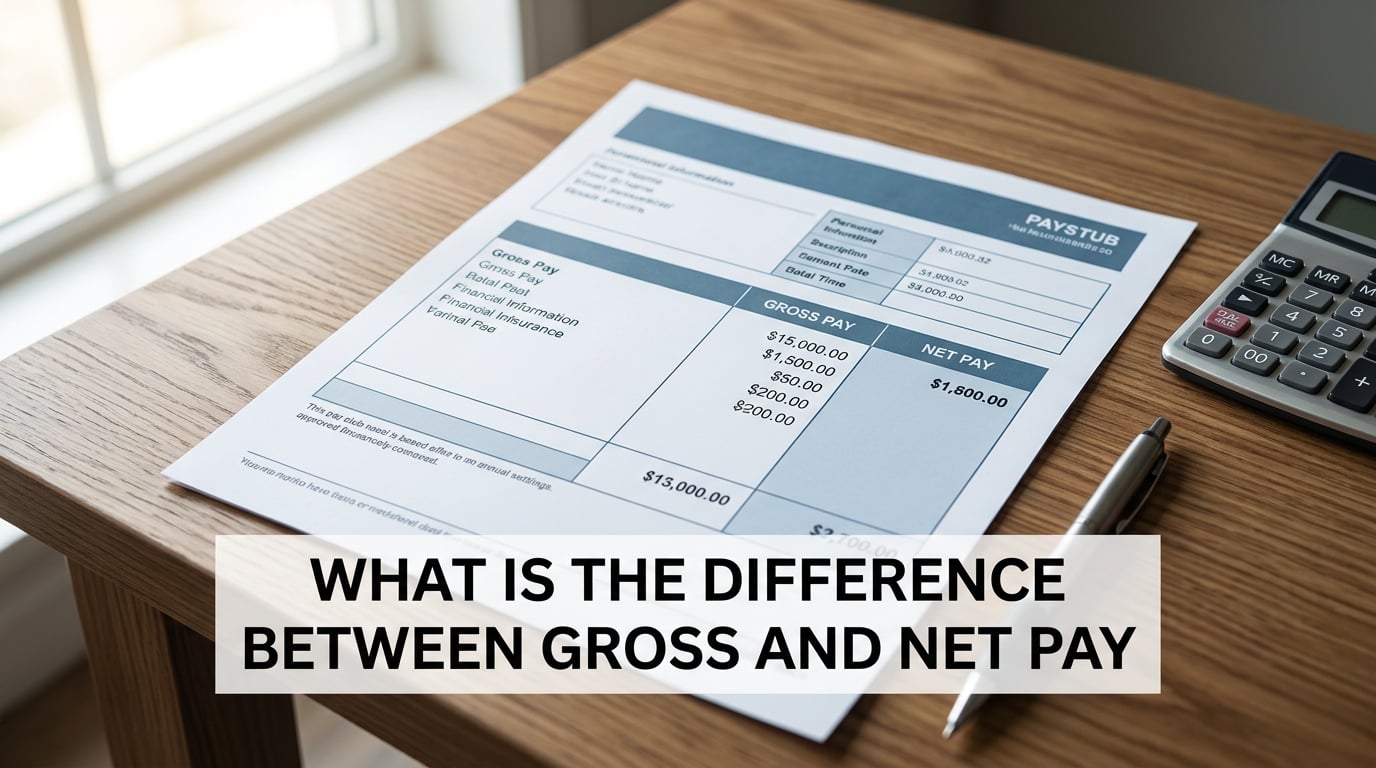
When you get a job offer for $60,000 a year, that number is your gross pay. The money that actually lands in your bank account each payday is your net pay. Understanding the difference between gross and net pay is one of the most important financial basics every worker should know.
I’ve spent years helping people decode their paychecks, and the same confusion comes up over and over. People budget based on the number on their offer letter, then wonder why their account runs out before the next payday. In this guide, I’ll break down exactly how gross and net pay work, what gets deducted, and why it matters for your wallet.
Table of Contents
What Is Gross Pay?
Gross pay is the total amount of money you earn from your job before any taxes or deductions are taken out. It is the full number on your offer letter, employment contract, or hourly rate agreement. No withholdings have been applied yet.
For hourly workers, the formula is simple:
Gross Pay = Hourly Rate x Hours Worked
If you earn $23.50 per hour and work 40 hours in a week, your gross pay for that week is $940. Before taxes, before health insurance, before anything else.
For salaried employees, gross pay is your annual salary divided by the number of pay periods in the year. A $60,000 salary paid biweekly equals about $2,307 per pay period before deductions. That $2,307 is your gross pay, not your take-home amount.
What Is Net Pay?
Net pay is the amount of money that actually reaches your bank account after every required and elected deduction has been subtracted from your gross pay. Most people call this take-home pay because it is what you actually take home.
Net pay reflects what is left after federal income tax, state and local taxes, Social Security, Medicare, health insurance premiums, retirement contributions, and any other withholdings. It is the number that matters for budgeting, paying rent, and covering daily expenses.
Here is the core formula:
Net Pay = Gross Pay – Taxes – Deductions
If your gross pay is $2,307 per biweekly period and $731 gets deducted for taxes and benefits, your net pay is $1,576. That is what you can actually spend or save.
Gross vs Net Pay: Key Differences at a Glance
Gross pay is your total earnings before deductions; net pay is what you receive after deductions. Here are the main differences:
- Definition: Gross pay is total earnings before deductions; net pay is take-home pay after deductions
- Includes taxes: Gross pay does not include taxes; net pay has taxes already subtracted
- Includes benefits: Gross pay does not include benefits; net pay has benefit contributions already subtracted
- Used for: Gross pay is used for loan applications, benefits eligibility, and tax forms; net pay is used for budgeting, spending, and bill payments
- Amount: Gross pay is always higher; net pay is always lower
- Typical percentage: Gross pay is 100%; net pay is typically 65-85% for most workers
What Deductions Are Taken From Gross Pay?
Six main categories of deductions reduce gross pay to net pay. Each affects your paycheck differently, and some are mandatory while others are optional.
Federal Income Tax Withholding
Federal income tax is the biggest deduction for most U.S. workers. The amount withheld depends on your income, filing status, and the elections you make on your Form W-4. The U.S. uses a progressive tax bracket system, meaning higher income portions are taxed at higher rates.
For 2026, federal tax brackets range from 10% to 37%. Your employer uses the IRS withholding tables and your W-4 to estimate how much to withhold each pay period. If too much is withheld, you get a refund at tax time. If too little is withheld, you owe money.
FICA Taxes (Social Security and Medicare)
FICA stands for the Federal Insurance Contributions Act. It funds Social Security and Medicare and applies to nearly all working Americans.
The exact percentages are:
- Social Security: 6.2% of gross pay (employee portion)
- Medicare: 1.45% of gross pay (employee portion)
- Total FICA: 7.65% combined
Your employer also pays a matching 7.65% on your behalf, but that does not come out of your paycheck. Together, FICA accounts for a predictable 7.65% reduction in gross pay for most workers. High earners pay an additional 0.9% Medicare surtax on wages above $200,000 (single filers).
State and Local Income Tax
Most U.S. states also tax wages, with rates ranging from 0% to over 13%. As of 2026, nine states have no state income tax: Alaska, Florida, Nevada, New Hampshire, South Dakota, Tennessee, Texas, Washington, and Wyoming. New Hampshire taxes interest and dividends but not wages.
Some cities and counties also levy local income taxes. If you live in New York City or work in a locality with an income tax, expect an additional line item on your paycheck.
Pre-Tax vs Post-Tax Deductions
Deductions fall into two categories based on when they reduce your taxable income.
Pre-tax deductions are subtracted from gross pay before federal income tax is calculated. Common examples include traditional 401(k) contributions, health insurance premiums, and HSA contributions. Lowering your taxable income this way can reduce your overall tax burden.
Post-tax deductions are subtracted after taxes are calculated. Examples include Roth 401(k) contributions, wage garnishments, and certain union dues. They do not reduce your taxable income but still lower your net pay.
Voluntary Deductions (401(k), Health Insurance)
Beyond taxes, many workers elect benefits that reduce their net pay. The most common are 401(k) retirement contributions, health insurance premiums, dental and vision coverage, and life insurance. These are voluntary, so you can adjust them during open enrollment or after qualifying life events.
A typical employee might contribute 5-10% of gross pay to a 401(k), with employer matching common. That contribution lowers your take-home pay but builds your retirement savings.
Wage Garnishments
Wage garnishments are court-ordered deductions taken directly from your paycheck. Common triggers include unpaid taxes, child support, student loans in default, and creditor judgments. Federal law limits how much can be garnished (typically 25% of disposable income for most debts).
Garnishments are post-tax deductions and reduce net pay without affecting your tax calculation.
How to Calculate Gross Pay
Calculating gross pay is straightforward once you know your rate and hours. Here is the step-by-step process.
Step 1: Identify your hourly rate or salaried annual amount. Check your offer letter, employment contract, or pay stub for this number.
Step 2: Multiply by hours worked (hourly workers). For a 40-hour week at $20 per hour, gross pay is $800. Add overtime at 1.5x the regular rate for hours over 40 in a week.
Step 3: Divide annual salary by pay periods (salaried workers). Common pay schedules are weekly (52 periods), biweekly (26 periods), semi-monthly (24 periods), or monthly (12 periods). A $52,000 annual salary paid biweekly equals $2,000 per pay period in gross pay.
Step 4: Add bonuses, commissions, and other earnings. These count toward gross pay for the period they are received.
How to Calculate Net Pay
Net pay is gross pay minus every deduction. Walking through a real example makes the math clear.
Let’s say you earn $60,000 per year, paid biweekly, and live in a state with a 5% income tax. Your gross pay per pay period is $2,307. Here is how that becomes net pay.
Step 1: Calculate pre-tax deductions. Suppose you contribute 5% to a traditional 401(k). That is $115.39 deducted before taxes. Health insurance premiums add another $125. Your taxable gross is now $2,066.61.
Step 2: Calculate federal income tax withholding. For a single filer with this income, federal withholding is roughly 12% of taxable gross. That is about $248.
Step 3: Calculate FICA taxes. Social Security (6.2%) and Medicare (1.45%) apply to your full gross pay before pre-tax deductions. That is $176.50 total.
Step 4: Calculate state income tax. At a 5% state rate on your taxable gross, that is $103.33.
Step 5: Subtract all deductions from gross pay. $2,307 (gross) minus $115 (401k) minus $125 (health) minus $248 (federal) minus $176 (FICA) minus $103 (state) equals $1,540 in net pay.
Your net pay of $1,540 is 66.7% of your gross pay for this period. That is realistic for a single filer with a 401(k) and health insurance. Across all U.S. workers, net pay typically lands between 65% and 85% of gross, depending on income, state, and benefit elections.
Why Employers Use Gross Pay as the Standard
One of the most common questions I hear is: why do job listings and loan applications ask for gross income when I never actually see that amount? The answer comes down to consistency and tax calculation.
Gross pay is a stable, predictable number. It does not change based on your benefit elections, filing status, or number of dependents. Lenders, landlords, and benefits administrators use gross pay because it allows them to compare applicants fairly without diving into everyone’s personal tax situation.
When you apply for a mortgage, the lender wants to know what you earn before deductions so they can apply their own debt-to-income ratios. When an employer offers health benefits, eligibility is based on full-time status, which is determined by gross hours worked. When the IRS calculates your tax liability, it starts with gross income and works downward.
Net pay, by contrast, is highly personal. Two people earning the same gross salary could have very different net pay depending on their 401(k) contributions, health plan choices, and state of residence. Standardizing on gross creates a level comparison field.
Practical Implications for Employees
Knowing the difference between gross and net pay changes how you handle your finances. Here are the practical takeaways I share with anyone who asks.
Budget based on net pay, not gross. The gross number on your offer letter is aspirational. Your actual spending power is your net pay. If you budget $60,000 a year but only take home $45,000, you will be short every month. Always budget using the dollars that actually hit your account.
Check your Form W-4 annually. The W-4 form controls how much federal tax your employer withholds. Major life changes like marriage, a new child, or a second job should trigger a W-4 update. Getting this right prevents both surprise tax bills and unnecessarily large withholdings.
Understand that take-home percentage varies. From the forum discussions I’ve seen, real-world net pay ranges from 49% to 85% of gross. Lower earners in high-tax states can see nearly half their pay deducted, while higher earners in no-tax states might keep 85% or more. Where you fall depends on your specific situation.
Negotiate salary on gross terms. When comparing job offers, focus on gross pay because benefits and tax situations can differ. A $70,000 gross offer with poor benefits may be worth less than a $65,000 gross offer with strong health coverage and a 401(k) match.
Track both numbers in your records. Your pay stub shows both gross and net pay for each period. Keeping these records helps with tax filing, loan applications, and verifying that deductions are accurate. Mistakes do happen, and spotting them early can save you money.
Frequently Asked Questions
Is it better to be paid gross or net?
What is the key difference between net pay and gross pay?
What is my gross monthly income if I make $23.50 an hour?
What is your net income if you make $100,000 a year?
Final Thoughts
The difference between gross and net pay is the difference between what you earn and what you keep. Gross pay is the starting number on every offer letter and tax form. Net pay is the reality that funds your daily life.
Take a few minutes to look at your latest pay stub. Identify the gross pay, list every deduction, and confirm the net pay matches what hit your bank account. That simple habit is the foundation of smart financial planning and the clearest way to understand how your paycheck really works in 2026.