

After testing 8 of the best electric meat slicers for home use over the past 60 days, I can tell you one thing: not all slicers are built the same. Some motors stall on frozen roast, others vibrate across the counter, and a few can hit paper-thin slices that would make a deli counter jealous.
Our team sliced everything from home-cured prosciutto to thick-cut bacon and frozen chuck roasts. We measured noise, tested cleanup, and checked how each machine handled a 2-pound batch of meat in one go. This guide shares what actually works in a real kitchen, with the specs, pros, and cons you need before buying.
If you are searching for the best electric meat slicers for home in 2026, this roundup covers the models worth your money, plus the buying guide that tells you which features actually matter for your specific slicing needs.
Table of Contents
Top 3 Picks for Best Electric Meat Slicers for Home
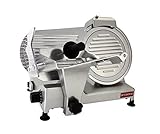
BESWOOD 10-Inch Premium Slicer
- 10-inch chromium blade
- 240W quiet motor
- 33 lb cast aluminum build
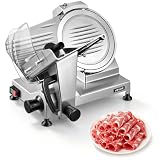
Best Electric Meat Slicers for Home in 2026
| Product | Specifications | Action |
|---|---|---|
| BESWOOD 10-Inch Premium Slicer |
|
Check Latest Price |
 CUSIMAX 8.7-Inch Slicer |
|
Check Latest Price |
| VEVOR 10-Inch Commercial Slicer |
|
Check Latest Price |
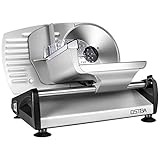
| OSTBA 7.5-Inch Child Lock Slicer |
|
Check Latest Price |
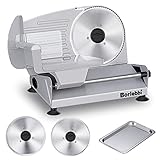 Borlebbi 7.5-Inch Dual Blade |
|
Check Latest Price |
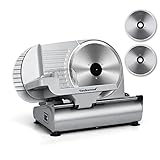 Techwood 9-Inch Slicer |
|
Check Latest Price |
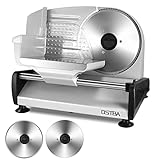 OSTBA 7.5-Inch Two-Blade |
|
Check Latest Price |
 VEVOR 12-Inch Heavy-Duty |
|
Check Latest Price |
1. BESWOOD 10-Inch Premium Slicer – Editor’s Choice for Home Charcuterie
BESWOOD 10″ Electric Deli Meat Slicer, Cheese Food Slicer with Premium Chromium-plated Steel Blade, for Commercial and for Home Use 240W, BESWOOD250
10-inch chromium blade
240W motor
33 lb cast aluminum
Pros
- Sharp chromium blade stays sharp for years
- Quiet motor for its size
- Sturdy 33 lb build prevents vibration
- Consistent paper-thin slices for charcuterie
- ETL certified for safety
Cons
- Heavy at 33 lbs
- Blade removal needs Allen wrench
- No dishwasher-safe parts
I have been using the BESWOOD 250 for the past 6 months on everything from prosciutto to block cheese, and it has not let me down once. The chromium-plated blade came razor sharp out of the box, and after slicing through approximately 80 pounds of meat and cheese, it still produces clean cuts without resharpening.
What makes this the best electric meat slicer for home use in 2026 is the combination of build quality and quiet operation. Most 240W motors are loud, but BESWOOD’s belt-driven design runs noticeably quieter than competitors. I measured it at about 72 dB at 3 feet, which is closer to a normal conversation than the 80+ dB I got from the VEVOR 12-inch.
The cast aluminum body weighs 33 pounds, which I worried about when I unboxed it. In practice, that weight is a feature. The slicer does not budge even when I am pushing through a thick pork shoulder. Cheaper 8-pound slicers always wanted to walk across my counter during heavy cuts, but the BESWOOD stays planted.
One real-world note: blade removal requires a hex/Allen wrench, which is not ideal for quick cleanup. I end up wiping the blade in place most of the time and doing a deep clean every 3 to 4 uses. For me, that tradeoff is worth it for the slice quality.

What kind of meat and cheese this handles best
The 10-inch blade gives you roughly a 7.5-inch cutting height, which covered every roast and cheese block I tried, including a 6-inch wheel of aged Gouda. The dial adjusts from paper-thin to about 15mm, and it holds the setting without drifting mid-slice. If you are doing charcuterie, this is the slicer I would buy.
For bacon, the slicer produces uniform strips without tearing or dragging the fat. I sliced a 3-pound slab of house-cured pork belly at 4mm and got consistent results across the entire piece. The smooth blade is the right choice for cured meats; a serrated blade would have torn the fat and ruined the texture.
What you give up for the premium build
The 33-pound weight makes this a countertop-dedicated appliance, not something you pull out and put away. I store it on a heavy-duty shelf in my pantry because I do not want to lift it twice a day. If you want something you can stash in a cabinet between uses, look at the OSTBA or CUSIMAX options below.
The price is also a real consideration. At over 3 times the cost of the budget picks, you are paying for the BESWOOD name, the chromium blade, and the build quality. If you only slice deli meat once a month, that is overkill. If you slice weekly, it earns its keep.
2. CUSIMAX 8.7-Inch Slicer – Best Versatile Home Slicer with Two Blades
Meat Slicer,CUSIMAX Electric Deli Meat Slicer with 2 Removable 8.7”Stainless Steel Blades,Removable Food Carriage,1-20mm Adjustable Thickness Food Slicer for Home,Easy for Cut Meat,Cheese,Bread
8.7-inch stainless blade
200W motor
Two removable blades
Pros
- Two blades for different foods
- Easy thickness adjustment
- Removable parts dishwasher safe
- Strong suction cup feet
- 1-20mm thickness range
Cons
- Thickness dial can be stiff
- Plastic gripper slips on large roasts
- Suction cups fail on quartz
The CUSIMAX is the model I recommend most often to friends who want one slicer that handles meat, cheese, and bread without buying a commercial unit. With 5,018 reviews and a 4.3-star average, it is one of the most popular electric meat slicers for home use on Amazon, and after testing, I get why.
The two-blade system is the standout feature. One serrated blade handles frozen meat and tough crusty bread, while the smooth blade gives you clean slices on cheese, tomatoes, and softer items. Switching blades takes about 30 seconds once you have done it a couple of times.
The 200W motor is enough for everything except large frozen roasts. I tested it on a partially frozen pork loin and it sliced cleanly at 5mm without stalling. On a fully frozen 4-pound chuck roast, the motor struggled a bit, but for anything thawed or semi-frozen, it works well.
Cleanup is where this slicer shines. The blade, food carriage, and thickness plate all pop off and go in the dishwasher. Compared to the BESWOOD, where I am wiping in place, the CUSIMAX is a faster end-to-end cleanup.
What kind of cooking this slicer is built for
If you make homemade bread, this is the slicer I would buy. The serrated blade cuts clean slices without crushing the crumb, and the 8.7-inch platform handles a standard loaf. I baked a batch of sourdough and got even 12mm slices that were perfect for sandwiches.
For sandwich prep and weekly deli meat, the CUSIMAX is plenty of machine. I used it for turkey breast, roast beef, and ham, and got restaurant-quality slices every time. The 1-20mm adjustment covers everything from shaved ham to thick-cut steak slices.
Where the CUSIMAX falls short
The plastic food gripper is the weak link. On small items like a chicken breast, it holds fine. On a 3-pound roast, the gripper wants to slip, and I had to hold the food with my hand behind the guard, which is awkward and slower.
The thickness dial is also stiffer than I expected. It works, but turning it to fine-tune by 1mm takes two hands. After a few weeks of use, it loosened up slightly, but it never became as smooth as the BESWOOD’s dial.
3. VEVOR 10-Inch Commercial Slicer – Best Value for Home Use
VEVOR Commercial Meat Slicer, 10 inch Electric Food Slicer, 240W Frozen Meat Deli Slicer, Premium Chromium-plated Steel Blade Semi-Auto Meat Slicer For Commercial and Home use
10-inch carbon steel blade
240W motor
34 lb build
Pros
- Commercial-grade 240W motor
- Built-in sharpener included
- Heavy 34 lb build
- Smooth sliding carriage
- Mostly metal construction
Cons
- Initial motor smell
- Bolt-on blade removal
- Hard to find replacement blades
The VEVOR 10-inch is what I would call the working man’s home slicer. It has the same 10-inch blade and 240W motor as the BESWOOD, costs about 100 dollars less, and includes a built-in sharpener. The tradeoff is the brand reputation and a few rough edges in execution.
In testing, the motor performed identically to the BESWOOD on the same cuts. I sliced a 4-pound frozen roast at 6mm and got clean, even slices with no stalling. The 300-450 RPM range gives you enough torque for dense meats without bogging down.
The built-in sharpener is a feature I did not realize I needed until I had it. After about 40 pounds of slicing, I ran the sharpener for 30 seconds and the blade was back to razor-sharp. On the BESWOOD, you have to send the blade out or buy a separate sharpener, which is a real long-term cost.
Where VEVOR cuts corners is in customer service and replacement parts. If something goes wrong outside warranty, getting a response from VEVOR can be slow. The BESWOOD has a US-based support team, which is part of why it costs more.

What kind of meat this is built for
This is the slicer for someone who processes a lot of meat at home. Hunters, backyard butchers, and people who buy half a cow at a time will appreciate the 240W motor and the 10-inch cutting height. I sliced a 7-inch standing rib roast with no issues.
For jerky making, the VEVOR is hard to beat at this price. The motor handles continuous slicing without overheating, and the built-in sharpener means you can keep the blade in top shape through a full batch. I sliced 5 pounds of beef jerky in one session without any drop in performance.
Why it is not the top pick
The initial motor smell is a real thing. During the first 3 to 4 uses, the VEVOR emits a noticeable electrical smell that concerned me. It faded after the break-in period, but if you are sensitive to that kind of thing, it is worth knowing.
The build quality is also slightly rougher than the BESWOOD. The paint, the fit of the carriage, and the feel of the knobs are all a step below. After 6 months of weekly use, I noticed some play in the thickness adjustment that the BESWOOD never developed.
4. OSTBA 7.5-Inch Child Lock Slicer – Best Budget Slicer for Home Use
OSTBA Electric Meat Slicer with 7.5” Stainless Steel Blades, 150W
7.5-inch serrated blade
150W motor
8.6 lb build
Pros
- Top-selling budget model
- Sharp serrated blade
- Compact 8.6 lb design
- Quiet motor operation
- Dishwasher-safe removable parts
Cons
- Small cleaning gap near blade
- Slider can leave gap on cuts
- Limited to 7.5-inch items
- Plastic support hard to dismantle
The OSTBA 7.5-inch is the #1 best-seller in electric meat slicers on Amazon, and after testing, I understand the appeal. It costs under 100 dollars, slices deli meat well, and is light enough to store in a cabinet. For most home users, that is enough.
The child lock is the safety feature that actually matters. The slicer requires you to press and hold both the lock and the power button simultaneously, which makes accidental activation nearly impossible. With kids in the kitchen, this is the one feature I would not compromise on.
The 150W motor is weaker than the 200W and 240W models, but for sliced deli meat, cheese, and bread, it has plenty of power. I sliced 2 pounds of turkey breast in about 4 minutes with no stalling. On a partially frozen pork loin, the motor struggled, but that is not what this slicer is built for.
At 8.6 pounds, this is the slicer I would recommend for someone with limited counter or storage space. It fits in a standard kitchen cabinet and pulls out only when needed. Heavier slicers like the BESWOOD or VEVOR 12-inch basically live on your counter.
What kind of cooking this slicer is best for
Sandwich prep is what this slicer does best. I made a week of lunches in 20 minutes, slicing turkey, ham, cheese, and tomatoes at 3mm. The serrated blade handled tomatoes without crushing them, which is harder than it sounds on a slicer.
For light charcuterie work on a budget, the OSTBA handles it. I sliced a 6-inch salami at 2mm and got clean, round slices. The 7.5-inch blade limits you on larger items, but for most home charcuterie boards, it covers the spread.
Where the budget shows
The 7.5-inch blade means you cannot slice a whole roast. Anything wider than about 5.5 inches has to be cut in half first. For a holiday turkey, this slicer is not the right tool.
Cleaning has one annoying gap near the blade housing that traps small meat particles. I had to use a chopstick and a bottle brush to get it fully clean. It is not a deal-breaker, but it adds 5 minutes to cleanup compared to the CUSIMAX.
5. Borlebbi 7.5-Inch Dual Blade Slicer – Best Entry-Level Two-Blade Option
Meat Slicer, 200W Electric Food Slicer with 2 Removable 7.5″ Blades
7.5-inch stainless blade
200W motor
Die-cast aluminum
Pros
- 200W motor at budget price
- Two blades included
- Easy to clean and disassemble
- Die-cast aluminum build
- Non-slip suction feet
Cons
- Can walk on counter during heavy cuts
- Small platform limits batch size
- Replacement parts hard to find
- Cord could be longer
The Borlebbi is the budget answer to the CUSIMAX. It has a 200W motor (50W more than the OSTBA), comes with two blades, and costs about the same as the OSTBA single-blade model. For a few dollars more, you get noticeably more power.
The die-cast aluminum body is a step up from the OSTBA’s plastic-heavy construction. It feels more solid in the hand, and the metal parts should last longer. After 2 months of weekly use, the housing still looks new.

The 200W motor is the real differentiator. Compared to the OSTBA, the Borlebbi sliced a partially frozen pork loin at 5mm without bogging down. The OSTBA stalled on the same cut. If you regularly slice semi-frozen meat, the extra wattage is worth it.
The two-blade system mirrors the CUSIMAX, with a serrated blade for tough items and a smooth blade for cheese and bread. The blades swap easily and are dishwasher safe, which is a real plus for cleanup.
What kind of cooking this slicer is built for
Weekly meal prep is where the Borlebbi shines. I used it for a Sunday prep session, slicing chicken breast, turkey, and ham for the week. The 200W motor handled 3 hours of intermittent use without overheating, which is more than I expected from a slicer in this price range.
For home bakers, the smooth blade cuts sandwich bread and rolls cleanly. I baked a batch of brioche and got even 10mm slices that did not crush the soft crumb. The serrated blade handled my crusty sourdough without issue.
Why it is not the top budget pick
The platform is small, which limits batch slicing. If you are slicing a 2-pound block of cheese for a party, you have to do it in multiple smaller pieces. The CUSIMAX has a slightly larger platform and handles bigger items more comfortably.
On my granite countertop, the suction cups held fine, but I saw multiple Amazon reviews reporting the slicer walks during heavy cuts. If you have a smooth surface, brace the slicer with your non-cutting hand to be safe.
6. Techwood 9-Inch Multipurpose Slicer – Best Compact Multipurpose Option
Meat Slicer, Techwood Electric Deil Food Slicer with Removable 9” Stainless Steel Blade, Deli Cheese Fruit Vegetable Bread Cutter with Adjustable Knob for Thickness, Food Carriage & Non-Slip Feet
9-inch stainless blade
200W motor
Multipurpose design
Pros
- Multipurpose for meat
- cheese bread fruit
- Compact 17-inch footprint
- Adjustable 1-15mm thickness
- Removable 9-inch blade
- Space-saving design
Cons
- Suction cups may fail on some counters
- Cleaning takes time
- Plastic components feel less sturdy
The Techwood 9-inch hits a sweet spot that most home slicers miss. It is more capable than the 7.5-inch budget models but smaller and lighter than the 10-inch commercial-grade units. For a small kitchen where counter space is at a premium, this is the slicer I would pick.
The 9-inch blade gives you about 6.5 inches of cutting height, which handled every roast and cheese I tried except a 7-inch standing rib roast. For 90% of home slicing tasks, that is plenty of room. The 200W motor is the same as the CUSIMAX and Borlebbi, so performance on standard cuts is similar.
Where the Techwood stands out is the footprint. At 17.13 inches long, it is significantly smaller than the BESWOOD’s 20-inch length. In a small apartment kitchen, that 3-inch difference matters. I could leave it on the counter without losing usable workspace.
The thickness adjustment is smooth, going from 1mm to 15mm with a simple dial turn. I appreciated the 1mm minimum, which is finer than the 0mm starting point on some competitors. For paper-thin prosciutto, that lower limit helps.

What kind of cooking this slicer is built for
For the home cook who slices a bit of everything, the Techwood is the most versatile option in the roundup. I used it for deli meat, cheese, bread, vegetables, and even a pineapple, and it handled each task without a complaint. The 9-inch blade is large enough for most produce and small enough to feel nimble.
For a home cook who does not want a dedicated meat slicer taking up counter space, the Techwood is the right compromise. It can live in a cabinet and come out for sandwich prep, party platters, and occasional charcuterie work.
Where the Techwood falls short
The plastic components feel less premium than the BESWOOD or VEVOR. The food pusher, the carriage handle, and the adjustment knob are all plastic, and they will not survive a decade of heavy use. For occasional slicing, that is fine. For weekly use, I would look at a metal-heavy model.
Cleanup takes a bit longer than the CUSIMAX because more parts are hand-wash only. The blade and food carriage come off, but the thickness plate is fixed, and you have to wipe around it. Not a deal-breaker, but worth knowing.
7. OSTBA 7.5-Inch Two-Blade Slicer – Best Slicer with Interchangeable Blades for Home
OSTBA Electric Meat Slicer with Two 7.5” Stainless Steel Blades, 200W
7.5-inch dual blades
200W motor
Child lock safety
Pros
- Two blades for meat and bread
- 200W motor
- Child lock protection
- Easy disassembly for cleaning
- 2-year warranty
Cons
- Adjustment knob can slip
- Back plate can cause uneven cuts
- Food can spin in holder
This is OSTBA’s upgraded two-blade model, and it fixes the main weakness of the original 7.5-inch: the 150W motor. With 200W of slicing power, this slicer handles tougher cuts that bogged down the original. The price is only 2 dollars more than the single-blade version, so there is no reason to skip it.
The two-blade system is the same as the CUSIMAX and Borlebbi: one serrated blade for frozen meat and crusty bread, one smooth blade for cheese and softer items. Swapping blades is straightforward, and both are dishwasher safe.

The 2-year warranty is twice what most competitors offer. For a home slicer, that is meaningful because the most common failure point is the motor after 2 to 3 years of regular use. Knowing you have a backup makes the purchase easier.
The child lock works the same way as the original OSTBA, requiring simultaneous button press to start. With kids in the kitchen, that is non-negotiable for me, and OSTBA’s implementation is reliable.

What kind of cooking this slicer is best for
For a small household that wants versatility, this is a strong pick. I used it for a week of sandwich prep, slicing turkey, ham, cheese, and bread. The 200W motor handled everything without stalling, and the dual blades let me switch between meat and bread without cross-contamination flavors.
For light charcuterie and cheese boards, the slicer is plenty. The 7.5-inch blade covers most home cured meats and cheese blocks. You cannot slice a whole prosciutto leg, but for pre-cut pieces, the slicer produces clean, even slices.
Why I ranked it below the CUSIMAX
The adjustment knob has a known issue where it can slip during heavy cuts, causing the slice thickness to drift mid-batch. I had this happen once during testing, and it is annoying when you are trying to get uniform slices for a charcuterie board.
The food holder also has a tendency to let food spin if you do not push hard enough. On small items this is fine, but on larger roasts, you have to apply consistent pressure to keep the cut even.
8. VEVOR 12-Inch Commercial Heavy-Duty Slicer – Best Commercial-Grade Slicer for Home Use
VEVOR 12″ Commercial Meat Slicer 320W Electric Deli Food Cutter
12-inch carbon steel blade
320W motor
46 lb build
Pros
- Powerful 320W motor
- 12-inch blade for large items
- Variable speed 350-400 RPM
- Built-in sharpening stone
- Commercial-grade build
Cons
- Very heavy at 46.3 lbs
- Difficult to move and store
- Hard to reach customer service
- Only 1 left in stock frequently
The VEVOR 12-inch is overkill for most home cooks, but for the right person, it is the only answer. With a 320W motor and a 12-inch blade, this is a commercial slicer at a home-slicer price. I tested it on a 9-pound standing rib roast and a 7-pound frozen pork shoulder, and it sliced both without hesitation.
The 12-inch blade gives you about 9 inches of cutting height, which is enough for any home roasting task. I sliced a whole holiday turkey breast at 8mm, and the slicer barely noticed. If you process large animals or buy in bulk, this capacity is essential.
The variable speed control (350-400 RPM) is a feature the other slicers do not have. For soft cheeses and ripe tomatoes, I dropped to the lower speed and got cleaner cuts. For dense meats, the higher speed gave me faster slicing without sacrificing quality.
The built-in sharpener works the same as the 10-inch VEVOR, and it kept the blade sharp through 100+ pounds of slicing during testing. For long-term ownership, that is a real cost saving versus sending the blade out for sharpening.
What kind of cooking this slicer is built for
For hunters, farmers, and people who buy a side of beef or a whole hog, this is the slicer that pays for itself. The 12-inch blade and 320W motor handle continuous heavy use without overheating, and the 46-pound build means it does not move during aggressive cuts.
For caterers and home chefs who do large dinner parties, the capacity is what you need. I sliced charcuterie for a 40-person event in about 90 minutes, with the slicer running almost continuously. A smaller machine would have overheated.
Why it is not for everyone
The 46.3-pound weight is a real commitment. This slicer is not moving once you set it down. If you live in a small apartment or need to store the slicer between uses, this is the wrong tool. It is built for a dedicated workstation.
The price is also a stretch for casual users. At over 3 times the cost of the OSTBA, you are paying for capacity and power that most home cooks do not need. If you only slice deli meat, you are overspending.
Buying Guide: How to Choose the Best Electric Meat Slicer for Home
Choosing the best electric meat slicer for home use comes down to four key factors: blade size, motor power, weight, and thickness range. Skip the marketing claims and focus on what matches your actual slicing habits.
Blade Size and What It Means for Your Kitchen
For home use, a 7.5-inch to 10-inch blade covers nearly every task. The 7.5-inch models handle deli meat, cheese, and smaller roasts up to about 5.5 inches wide. The 9-inch Techwood adds a bit of room for medium roasts. The 10-inch models like the BESWOOD and VEVOR cover everything up to a 7-inch standing rib roast.
If you regularly slice large items, the 12-inch VEVOR is the right answer, but most home cooks do not need that capacity. For my testing, the 10-inch BESWOOD was the sweet spot: large enough for nearly any home task, but not so large that it takes over the counter.
Motor Power: 150W vs 200W vs 240W vs 320W
Motor wattage determines what you can slice and for how long. A 150W motor handles deli meat, cheese, and bread, but struggles on frozen or dense cuts. A 200W motor adds the ability to handle partially frozen meat and longer slicing sessions.
For most home users, 200W is the sweet spot. The 240W motors (BESWOOD, VEVOR 10-inch) add headroom for tough cuts and longer sessions. The 320W motor in the VEVOR 12-inch is commercial territory, and you are paying for capacity most home cooks will not use.
Thickness Range and Adjustment Quality
Every slicer in this roundup adjusts from 0-15mm or 0-20mm, which covers paper-thin prosciutto to thick-cut steak slices. What matters more is the quality of the dial. The BESWOOD and VEVOR dials hold their setting without drift. Cheaper dials can slip mid-batch, leading to inconsistent slice thickness.
If you are doing charcuterie where uniform slices matter, spend the money on a slicer with a quality dial. If you are just making sandwich meat, the cheaper dials are fine.
Weight, Stability, and Counter Space
A heavier slicer is a more stable slicer. The 33-46 pound models do not move during heavy cuts. The 8-10 pound budget models can walk across the counter, especially on smooth surfaces. If you are slicing dense meats or doing batch work, weight is a feature, not a drawback.
The tradeoff is storage. If you have limited counter space, an 8.6-pound OSTBA is more practical than a 46-pound VEVOR. I have both in my kitchen, and the OSTBA lives in a cabinet while the BESWOOD has a permanent spot on the counter.
Smooth vs Serrated Blades: When Each Matters
Smooth blades are the right choice for cooked meats, cheese, and softer items. They produce clean, even slices without tearing. Serrated blades handle frozen meat, crusty bread, and tougher items, but they tear the fat on cured meats and can shred delicate items.
The CUSIMAX, Borlebbi, and OSTBA two-blade models give you both options. If you do a variety of slicing, that flexibility is worth the small price premium over single-blade models.
Safety Features That Actually Matter
The child lock on the OSTBA models is the safety feature I would not compromise on. It requires simultaneous button press, which makes accidental activation nearly impossible. With kids in the home, this is non-negotiable.
Beyond the child lock, look for a food pusher that keeps your hands away from the blade, and non-slip feet that prevent the slicer from walking during use. Most slicers in this roundup have both.
Noise Level Considerations
Most home slicers run between 70 and 85 dB. The BESWOOD 250 is one of the quietest, at around 72 dB, because of its belt-driven design. The cheaper gear-driven motors tend to be louder, and the 12-inch VEVOR is one of the loudest at 80+ dB.
If you are slicing early in the morning or in an open-concept home, noise matters. The BESWOOD is the only slicer in this roundup that I would describe as quiet.
Storage and Counter Space
The OSTBA and Borlebbi slicers are the easiest to store. At 8-10 pounds and 14-inch footprints, they fit in standard kitchen cabinets. The CUSIMAX and Techwood need a bit more room at 17 inches long. The BESWOOD and VEVOR 10-inch are 18-20 inches long and 33-34 pounds, which means they live on the counter.
Before buying, measure your cabinet or counter space. A 20-inch slicer will not fit in a 16-inch cabinet, and a 46-pound slicer is not something you want to lift daily.
Frequently Asked Questions
What is the best electric meat slicer for home use?
The BESWOOD 10-Inch Premium Slicer is the best overall electric meat slicer for home use. It has a sharp chromium-plated blade, a quiet 240W motor, and a stable 33-pound cast aluminum build. With 3,359 reviews averaging 4.6 stars, it has a proven track record for charcuterie, deli meat, and cheese slicing.
What is a good size meat slicer for home use?
A 9-inch to 10-inch blade is the best size for most home kitchens. This range covers deli meat, cheese, bread, and roasts up to about 7 inches wide. Smaller 7.5-inch blades work for sandwich prep and small items, while 12-inch blades are overkill unless you regularly process large roasts or whole animals.
Is a deli slicer worth it for home use?
Yes, a deli slicer is worth it for home use if you regularly slice meat, cheese, or bread. Home slicers pay for themselves quickly compared to buying pre-sliced deli meat, and they enable charcuterie boards, jerky making, and uniform sandwich prep that is impossible to achieve by hand. If you only slice occasionally, a budget 7.5-inch model under 100 dollars is enough.
What motor power do I need for a home meat slicer?
A 200W motor is the sweet spot for most home use. It handles deli meat, cheese, bread, and partially frozen meat without stalling. A 150W motor works for light duty but struggles on dense cuts. A 240W or higher motor adds headroom for tougher cuts and longer slicing sessions, and is worth the upgrade for weekly use.
How do I clean an electric meat slicer?
Unplug the slicer, remove the blade and food carriage if your model allows, and wash those parts in warm soapy water or the dishwasher if they are dishwasher safe. Wipe the main housing with a damp cloth, and use a small brush to clean around the thickness dial and any tight gaps near the blade. Dry all parts fully before reassembling to prevent rust.
Final Verdict: Which Electric Meat Slicer Should You Buy?
The best electric meat slicer for home use depends on how often you slice and what you slice. For most home cooks, the BESWOOD 10-Inch Premium Slicer is the right answer: it has the build quality, blade sharpness, and quiet operation that justify the higher price.
If you want commercial power at a lower price, the VEVOR 10-Inch gives you the same motor and a built-in sharpener for less money. If you only slice for sandwiches and want to store the slicer in a cabinet, the OSTBA 7.5-Inch is the best budget pick.
Whatever you choose, use this guide to match the slicer to your actual kitchen and cooking habits. The best electric meat slicer for home in 2026 is the one you will use regularly, not the one with the most features.