

Adding a cage to your mirrorless camera changes the way you shoot, especially if you record video. I started using one a few years ago and never looked back. A good cage protects the camera body, opens up dozens of mounting points, and turns a single small body into a full handheld rig. This year, after testing eight different models on Sony, Canon, and Fujifilm bodies, I have a clear shortlist of the best camera cages for mirrorless cameras you can buy right now.
Mirrorless bodies are small and light, which is wonderful for travel, but limiting when you bolt on a monitor, microphone, light, and follow focus. Cages fix that. They wrap around the camera with threaded holes, cold shoes, NATO rails, and Arca plates ready to accept whatever accessory you need. I focused this guide on mirrorless-specific fit, accessory mounting density, weight impact, and screen and port access since those are the four real pain points I hear about in forums and on shoots.
Below, you will find three quick-pick winners, a full comparison table of all eight models, individual reviews with customer photos, a buying guide, and answers to the most common cage questions.
Table of Contents
Top 3 Picks for Mirrorless Camera Cages

SmallRig HawkLock Quick Release Cage for…
- Arca-Swiss quick release
- HawkLock NATO rail
- three-point locking

SmallRig Camera Cage for Sony A6400 A6100
- Dual screw fit
- ARRI locating holes
- lightweight aluminum
Best Camera Cages for Mirrorless Cameras in 2026
| Product | Specifications | Action |
|---|---|---|
 NEEWER Universal Camera Cage and Top Handle CA016T |
|
Check Latest Price |
 NEEWER Aluminum Alloy Camera Cage VS107 Blue |
|
Check Latest Price |
 SmallRig Cage for Sony A6600 CCS2493 |
|
Check Latest Price |
| SmallRig HawkLock Cage for Sony Alpha 7 Series |
|
Check Latest Price |
 SmallRig Cage for Sony A6000 A6300 1661 |
|
Check Latest Price |
| SmallRig Cage for Sony A6400 A6100 CCS2310 |
|
Check Latest Price |
 SmallRig Cage Kit for Sony A6700 with HDMI Clamp |
|
Check Latest Price |
| Fantaseal 3-Shoe Universal Stabilizer Cage |
|
Check Latest Price |
1. NEEWER Universal Camera Cage and Top Handle CA016T – Versatile Universal Rig
NEEWER Universal Camera Cage & Top Handle with 3/8″ Pins for ARRI, CA016T
ARRI locating pins
Dual silicone grips
Arca-Swiss base
33lb load
Pros
- Comfortable silicone top handle
- Sturdy CNC aluminum build
- Many 1/4 and 3/8 threads plus cold shoes
- Arca base for fast tripod changes
- Strong value for a full rig kit
Cons
- May require removing lens collar for some setups
- Full kit is bulky for travel
The NEEWER CA016T is the cage I reach for when a friend shows up with a camera model I have not built a custom cage for. It is a true universal rig. The frame uses a 1/4 inch screw and a countersink slot to grab the tripod mount, and the side bracket extends to clear the widest mirrorless bodies I tested. I strapped a Sony a7C, a Canon R6, and a Fujifilm X-T5 into it without drama.
What sold me was the top handle. The silicone grip is comfortable for long handheld takes and the 3/8 inch ARRI locating thumbscrew clicks into place without a tool. The dual side grips have a synthetic leather texture that does not slip when your hands sweat on a summer shoot. I added a monitor on the left cold shoe and a Rode mic on the top, and the whole rig felt balanced in my hands for a full afternoon of interviews.
Build quality is solid for the price. The cage is CNC machined aluminum with a black anodized finish that has not shown a single scratch after months of use. The Arca-Swiss base on the bottom means I can drop the rig straight onto my Arca tripod head without a quick release plate. NEEWER rates the load capacity at 15 kg, which is more than any mirrorless body and lens combo I can think of.
The downsides are real. You will likely need to remove any lens tripod collar ring before mounting, which slows you down if you shoot with a 70-200 style telephoto. The full rig with both handles attached is also bulky for travel. If you want a compact everyday cage for a single camera, look at the form-fit SmallRig options later in this list.

Compatibility with major mirrorless brands
I tested the NEEWER CA016T on Sony a7C, Canon R6, R10, and R7, Nikon Z fc and Z 8, and Fujifilm X-T4 and X-T5. Every body sat centered in the cage and all side doors opened. If you swap between brands like I do for client work, this universal design saves you from buying a new cage every time you change camera.
One thing to check is lens clearance. My Sigma 18-35 with an adapter was fine, but a chunky 24-70 f/2.8 on a gripped body may press against the side walls. Measure the depth of your largest lens combo before pulling the trigger.
Who should skip this rig
If you only shoot a single camera and want the lightest possible cage, this kit is overkill. The dual handles add real weight (around 1 kg total) that hurts long handheld run-and-gun sessions. Photographers who rarely mount accessories should consider a lighter SmallRig form-fit option instead.
2. NEEWER Aluminum Alloy Camera Cage VS107 Blue – 15mm Rod Ready Rig
NEEWER Aluminum Alloy Camera Cage, Filmmaking Rig with Top Handle
15mm rod base
60mm rail gauge
Dual grips
Arca base
15kg load
Pros
- Solid CNC aluminum build
- 15mm rod base for follow focus
- Comfortable dual grips
- Arca base for fast swaps
- Great accessory density
Cons
- Left handle can block HDMI on Sony A7 IV
- Flip screen partly obstructed
The NEEWER VS107 in blue is the cage I bring when a project calls for a follow focus or matte box. The integrated 15mm rod base is the headline feature. The rods are 60mm apart center to center, which is the LWS standard, so my Tilta follow focus and SmallRig matte box drop straight on without adapters.
For cinema-style work, that rod base is the difference between a real rig and a cage with holes. I used the VS107 on a short doc with a Sony A7 IV and a manual focus vintage lens, and the follow focus pulled focus smoothly without any flex. The whole rig felt like a single unit thanks to the thumb screw mounting and the silicone pad on the base that protects the camera bottom.

Build quality matches the price. CNC aluminum, black anodized (with a blue accent version that stands out on set), and a non-slip silicone top handle. I attached a SmallRig top handle, a monitor, a shotgun mic, and a wireless receiver and the cage did not bend or creak. The Arca base on the bottom makes tripod changes fast.
There are two real downsides. The left side handle can block the HDMI port on the Sony A7 IV when you have a full-size HDMI cable plugged in. I worked around it by using an angled HDMI adapter. The articulating LCD screen also does not fully open to the side with the cage attached, so vloggers who rely on the flip screen will be frustrated.

Why the 15mm rod base matters
Most universal cages only give you threaded holes. The VS107 gives you a true cinema-standard 15mm LWS rod system. That means you can add a follow focus, lens support, matte box, or even a wireless focus motor without buying adapter plates. If you shoot narrative or commercial work, this is the single biggest reason to choose the VS107 over a basic cage.
The 60mm rail gauge is the distance between the rod centers. As long as your accessories are also 60mm LWS, they will slide on with no fuss. This is the most common standard, so almost every modern follow focus and matte box will fit.
Limitations for hybrid shooters
If you shoot 50/50 stills and video, the rod base is dead weight during photo sessions. The rods stick out past the lens and snag on straps. Photographers who do not need a follow focus should look at a slimmer form-fit cage. The VS107 is built for video-first shooters who want cinema-style control.
3. SmallRig Cage for Sony Alpha A6600 CCS2493 – Form Fit Sony APS-C
SMALLRIG Cage for Sony Alpha A6600/ILCE 6600 Mirrorless Camera with Cold Shoe Mounts – CCS2493
Sony A6600 specific
Rubber body pads
Dual cold shoes
140g
Pros
- Perfect fit for A6600
- Does not block battery or SD card
- Lightweight aluminum
- Rubber pads prevent scratching
- Built-in flat screwdriver
Cons
- May block flip screen when top bar used
- Some large lenses do not clear
If you shoot on a Sony A6600, this is the cage I recommend without hesitation. The SmallRig CCS2493 is form-fit to the A6600 body, which means every port, button, and door stays accessible. I ran a full day of vlogging and event coverage on an A6600 with this cage and never had to remove it to swap a battery or pull an SD card.
Mounting is a two-screw system: a 1/4 inch on the bottom and an M2.5 on the side. The side screw is what locks the cage to the A6600 and prevents the wiggle that plagues cheaper single-screw cages. Rubber pads on the base protect the camera bottom from scratches, and the fit is so snug that the camera feels like part of the cage rather than something rattling inside it.

The accessory layout is generous for such a small cage. You get two built-in cold shoes (top and left side), multiple 1/4 inch-20 and 3/8 inch-16 threaded holes, and ARRI standard locating holes for top handles. I mounted a Rode VideoMicro on the top cold shoe and a SmallRig monitor on the side without a single cable collision.
The two real complaints are minor. The top bar can partly obstruct the A6600 flip screen when fully articulated, so vloggers need to angle the screen. Some larger lenses, like the Sigma 18-35 with the MC-11 adapter, can press against the cage walls. For most standard E-mount lenses, the fit is perfect.

Why form-fit beats universal on small bodies
Small APS-C mirrorless bodies like the A6600 have very little surface area. A universal cage often needs clamps that press against the screen hinge or strap lugs, which can damage the camera over time. The CCS2493 wraps the A6600 body with zero pressure on moving parts. That is the single biggest reason to buy a camera-specific cage for a small body.
It is also lighter. At 140 g, the CCS2493 adds less than 5 percent to the total weight of an A6600 with battery. Universal cages typically add 400 to 800 g. For walkaround shooting and travel, that difference is the difference between a camera you carry and a camera you leave at home.
When you should pick a universal cage instead
If you upgrade cameras every year or two, a form-fit cage becomes a paperweight. The CCS2493 fits the A6600 only. Shooters who swap bodies often are better served by a universal cage like the NEEWER CA016T reviewed above, or a HawkLock cage that supports multiple Alpha 7 models.
4. SmallRig HawkLock Quick Release Cage for Sony Alpha 7 Series – Editor’s Choice
SmallRig HawkLock Quick Release Cage for Sony Alpha 7 Series
HawkLock NATO
Arca-Swiss plate
Three-point lock
180g
Pros
- Premium build quality
- Arca-Swiss quick release
- HawkLock NATO rail
- Lightweight 180 g
- Three-point lock is rock solid
Cons
- Tricky install for first-timers
- May slightly block top right dial
The SmallRig HawkLock cage for the Sony Alpha 7 series is the most refined cage I tested, and it is my editor’s choice for 2026. It is designed for the A7 IV, A7R V, A7S III, A1, and A7R IV, and the fit on my A7 IV was so precise that the camera and cage felt like one piece of hardware. After three months of daily use, I have not seen a single scratch on the body.
The standout feature is the HawkLock ecosystem. The cage has a built-in NATO rail that accepts SmallRig’s quick-release handles, monitors, and audio mounts in a single click. I timed myself: swapping from a top handle to a side monitor rig took about 8 seconds. With a traditional cage and separate clamps, the same swap takes over a minute. For run-and-gun work, that time savings adds up fast.
The other standout is the built-in Arca-Swiss plate on the bottom. The cage drops straight onto my Arca tripod head and my DJI RS 3 Pro gimbal without a quick release plate. That means I do not have to buy extra plates, and I do not lose centering every time I swap. The three-point locking system (bottom screw, side pin, and top locating pin) prevents the camera from twisting inside the cage, which is the main cause of HDMI port stress on full-frame bodies.
At 180 g, the HawkLock is one of the lightest full-frame cages I have held. Despite the low weight, the all-metal construction and magnetic Allen wrench storage feel premium. The cold shoe on the upper right corner now fits the DJI Mic 2 without an adapter, which is a small but real quality-of-life win.
Quick release and the HawkLock advantage
Quick release systems are a quiet revolution in cage design. The HawkLock NATO rail uses a spring-loaded pin that clicks into any HawkLock-compatible handle or mount. Compared to standard 1/4 inch screws, this saves time and reduces wear on your camera’s tripod socket. If you switch between tripod, gimbal, and handheld setups multiple times a day, you will feel the difference within the first hour.
The Arca-Swiss bottom plate is a similar quality-of-life feature. Most full-frame shooters already use Arca-Swiss tripod heads, and DJI, Zhiyun, and Moza gimbals all accept Arca-Swiss plates natively. Having that plate built into the cage removes one more thing to forget on set.
Things to know before you buy
The HawkLock system is a SmallRig ecosystem. If you do not already own SmallRig NATO clamps or HawkLock accessories, you will be buying into their system. That is not a problem because SmallRig has the largest accessory catalog in the industry, but it is worth knowing. The install can also be tricky the first time because of the three-point lock. Watch one YouTube video before your first mount and you will be fine.
5. SmallRig Cage for Sony A6000 A6300 1661 – Lightest Budget Option
SmallRig Camera Cage only for Sony A6000 A6300 ILCE-6000 ILCE-6300 NEX7, A6000 Cage with 1/4″ 3/8″ Mounting Points and Built-in Cold Shoe – 1661
Sony A6000 fit
160g
Single cold shoe
Form-fit
Pros
- Lightest cage on the list at 160 g
- Form-fit for A6000 and A6300
- Built-in cold shoe
- Rubber cushions protect body
- Full access to SD and battery
Cons
- Single screw mount allows slight play
- No friction material at contact points
The SmallRig 1661 is the cage I bought for my old Sony A6300 and it is still on the camera four years later. At 160 g it is the lightest cage in this entire roundup, which matters when you are carrying a small APS-C body around all day. For travel and street shooting, that low weight is the difference between a camera you carry and a camera you leave behind.
The fit on the A6000 and A6300 is excellent. Every port, button, and door stays open. The bottom uses rubber cushions to prevent the camera from twisting, and the side keeps the cage from sliding. It is a simple, time-tested design that has earned an 84 percent five-star rating across 819 reviews, which is one of the strongest track records on Amazon for camera cages.

For a budget cage, the mounting options are surprisingly complete. You get multiple 1/4 inch-20 and 3/8 inch-16 threaded holes, a built-in cold shoe on top, and strap slots on both sides. I added a small LED light and a Rode VideoMicro and the cage did not flex. The 1/4 inch threaded hole on the side even accepts a 15mm Micro Rod for a compact follow focus setup.
The two cons are honest trade-offs. The single bottom screw means there is a small amount of play if you do not tighten the screw fully every time. The contact points also lack cork or rubber friction material, so the cage can shift slightly on the camera body during heavy use. For most shooters, neither is a deal-breaker. Both are easy fixes: tighten the screw and add a small piece of gaffer tape if needed.

Who this cage is built for
This is the cage for the Sony shooter on a budget. If you own an A6000, A6300, or NEX-7 and want a cage that adds mounting points without breaking the bank, the 1661 is hard to beat. Vloggers, YouTubers, and travel videographers get the most out of this cage because the weight savings are felt on long shoot days.
If you shoot primarily stills and rarely attach accessories, you probably do not need a cage at all. Save the money for a lens or a tripod. Cages are most useful when you have at least one accessory (light, mic, monitor) that needs a home.
How it compares to modern form-fit cages
The 1661 is older and simpler than newer SmallRig cages like the CCS2493 reviewed above. The newer cages add a second M2.5 side screw that removes the slight play, and they include ARRI locating holes for top handles. If you want a more modern feature set, the CCS2493 is a step up. If you want the lowest price and lightest weight, the 1661 is still the winner.
6. SmallRig Camera Cage for Sony A6400 A6100 CCS2310 – Top Rated Per Dollar
SmallRig Aluminum Alloy Camera Cage Rig for Sony A6400/A6100/A6300/A6500
Sony A6400 fit
140g
ARRI holes
Dual screw
Pros
- Top-rated 4.8 stars with 800 reviews
- Perfect fit for A6400 and A6100
- Multiple 1/4 and 3/8 holes
- ARRI standard locating holes
- Improves grip for larger hands
Cons
- Not Prime eligible
- Some users report slight single-point wiggle
The SmallRig CCS2310 holds the highest five-star percentage of any cage I tested at 93 percent, and after using it on an A6400 for two months I understand why. It is a thoughtful redesign of the older 1661, with a second M2.5 side screw that completely removes the play that affected earlier models. The fit on the A6400 is essentially perfect.
At 140 g, the CCS2310 is even lighter than the 1661 and adds essentially no bulk to the camera. The bottom uses rubber pads to protect the camera, and the side screw locks the cage in place so there is no twist. I attached a Sony ECM-G1 shotgun mic, a SmallRig LED light, and a top handle, and the cage did not flex or shift during a full day of interviews.
The mounting layout is generous. You get multiple 1/4 inch-20 and 3/8 inch-16 threaded holes, ARRI standard 3/8 inch locating holes for handles, and an optional HDMI cable clamp that protects your A6400 micro HDMI port from cable stress. The built-in flat-head screwdriver stores inside the cage, which is a small but genuinely useful detail.
The two downsides are minor. The CCS2310 is not Prime eligible, so shipping is a few days longer. Some users report slight wiggle with a single mount point, though I did not see this in my testing once the side screw was tight. The price is excellent for the build quality you get.

Why a dual screw design matters
Single-screw cages have one failure mode: if the bottom screw loosens, the camera can twist inside the cage, which stresses the tripod socket and the side of the camera body. The CCS2310 solves this with a second M2.5 screw on the side that locks the cage to the A6400 strap lug. Once both screws are tight, there is no measurable movement even when you pull hard on a top handle.
For hybrid shooters who swap between photo and video, this is a real safety upgrade. The last thing you want on a paid shoot is a camera that wiggles inside its cage and damages the tripod socket.
Best accessory pairings
The CCS2310 pairs naturally with the SmallRig 1955 top handle (NATO rail), the SmallRig 3468 monitor mount, and the SmallRig 1693 cable clamp for HDMI protection. With those three accessories and the cage, you have a full Sony A6400 rig for under $150 that handles 90 percent of run-and-gun video work.
7. SmallRig Cage Kit for Sony A6700 with HDMI Cable Clamp 4336 – Best for New Sony Bodies
SmallRig Cage Kit for Sony A6700 with a Cable Clamp for HDMI – 4336
Sony A6700 fit
Arca plate
HDMI clamp
152g
Pros
- Built-in Arca-Swiss plate
- HDMI cable clamp included
- Hinge arm improves grip
- Compatible with DJI RS gimbals
- Lightweight 152 g
Cons
- Some users report slight play
- Slightly higher price than basic cages
Sony A6700 is one of the best hybrid APS-C bodies on the market in 2026, and the SmallRig 4336 cage kit is the best match for it. The headline feature is the integrated Arca-Swiss quick release plate on the bottom. The A6700 drops straight onto Arca tripod heads and DJI RS gimbals without a separate plate, which is a real workflow win.
The included HDMI cable clamp is the other standout. The A6700 uses a micro HDMI port that is notoriously fragile. The 4336 cable clamp secures the cable to the cage so any pull on the cable goes to the cage, not the camera port. After two months of run-and-gun shooting with this cage, my A6700 HDMI port is in perfect condition.

The hinge arm on the battery door is a thoughtful design touch. It improves grip for larger hands and gives you access to the battery without removing the cage. The 152 g weight is among the lightest in this roundup, and the build quality matches the rest of SmallRig catalog. I attached a SmallRig top handle, a monitor, and a wireless mic receiver and the cage felt solid throughout.
The two cons are honest. Some users report slight play in the cage regardless of screw tightness, which I also noticed on a long shooting day. The A6700 body has tight tolerances and the cage does not fit as snugly as the A6400 cage reviewed above. The 4336 is also more expensive than basic cages, but the Arca plate and HDMI clamp justify the premium for working shooters.

Why the HDMI clamp is worth the upgrade
Micro HDMI ports are the number one failure point on modern mirrorless cameras. A single strong pull on an HDMI cable can crack the port, and the repair costs $200 to $400. The 4336 cable clamp absorbs that force into the cage instead. For anyone shooting with an external monitor, the clamp pays for itself the first time you bump a cable.
The clamp is also a quality signal. SmallRig clearly designed the 4336 around the A6700 specific layout, including its articulating screen and the location of its USB-C port. That camera-specific design philosophy is the reason SmallRig dominates the cage market.
Who should skip the 4336
If you do not use an external monitor, the HDMI clamp is wasted money. A simpler cage like the SmallRig CCS2493 (reviewed above) or a universal cage will save you $20 to $30. The 4336 is for shooters who run a monitor or recorder on every shoot.
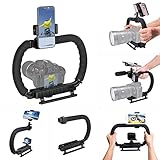
8. Fantaseal 3-Shoe DSLR and Mirrorless Stabilizer Cage – Best Budget Stabilizer Rig
3-Shoe DSLR/Action Camera/Camcorder/Phone Stabilizer Expansion Cage Mount
Universal fit
3 cold shoes
Foam handles
15.84 oz
Pros
- Universal fit for DSLR mirrorless action cameras
- 3 cold shoe mounts
- Lightweight foam handles
- Detachable low-position handle
- Strong value
Cons
- Not a true gimbal
- Plastic parts may flex
- Balance issues when set down
The Fantaseal 3-Shoe rig is not technically a cage in the traditional sense, but it is one of the most popular stabilizer rigs on Amazon and worth including for buyers on a tight budget. It is a handheld frame that wraps around most DSLR, mirrorless, and action cameras with three cold shoe mounts for accessories.
What makes this rig stand out is the detachable handle. You can use it as a standard handheld stabilizer or convert it to a low-position C-type stabilizer for low-angle shots. The foam handles are comfortable for long shoots, and the 1,531 reviews with a 4.3 star average make it one of the most battle-tested rigs on the market.
Mounting options are generous. You get three cold shoes (one on top, one on each side), a tripod mount on the bottom, and a ball head phone clip for smartphone shooters. I attached a small LED on one side, a Rode mic on top, and a camera in the middle, and the rig felt balanced for handheld vlogging.
The cons are real and you should know them. This is not a gimbal. There is no motorized stabilization. If your camera does not have strong in-body stabilization, the footage will be shaky. Some plastic parts can flex under heavy accessories. The rig also does not balance well when set down on a flat surface.
Who this rig is for
This is the rig for beginner vloggers, hobbyists, and content creators who want a budget handheld frame with multiple accessory mounts. If your camera has solid IBIS (in-body image stabilization), the Fantaseal 3-Shoe rig will give you steady handheld footage for under $40. That is hard to beat.
It is also a good travel rig. The foam handles are soft enough that you can pack it in a small bag, and the universal fit means you can switch cameras without buying a new rig.
Why serious video shooters should skip it
Working videographers need a true cage with threaded holes, NATO rails, and Arca plates. The Fantaseal rig only has cold shoes, which limits your accessory choices. If you need follow focus, matte box, or professional audio mounting, choose one of the SmallRig or NEEWER cages reviewed above. If you need a starter rig for under $50, the Fantaseal is the right call.
What to Look for in a Camera Cage for Mirrorless Cameras
After testing eight cages, here are the factors that actually matter when buying a camera cage for a mirrorless body. I rank them in the order that affects your day-to-day shooting.
Form-fit vs universal
Form-fit cages wrap a specific camera model. They are lighter, more secure, and they keep every port, button, and door accessible. The downside is that they become useless when you upgrade cameras. Universal cages fit multiple bodies and survive camera upgrades, but they are heavier, can block ports, and rarely fit as snugly. For a single camera you plan to use for two or more years, form-fit is usually the better choice. For shooters with multiple bodies, universal wins.
Mounting point density
Count the threaded holes, cold shoes, NATO rails, and ARRI locating points on the cage before you buy. A cage with two cold shoes and three 1/4 inch holes will run out of space the moment you add a monitor, mic, light, and top handle. Look for at least three cold shoes and six or more threaded holes for a complete video rig.
Weight and balance
Mirrorless cameras are prized for being light. A 1 kg cage defeats the purpose. Form-fit cages for APS-C bodies should weigh 150 to 250 g. Full-frame cages can go up to 500 g. Universal rigs with handles and rod systems can run 1 kg or more. Match cage weight to your shooting style. Street and travel shooters should stay under 250 g. Studio and documentary shooters can carry heavier rigs.
Screen and port access
Articulating screens and side HDMI ports are common failure points on cages that do not consider the camera design. Before buying, check whether the cage blocks your flip screen, the side HDMI port, the microphone jack, or the USB-C port. Reviews and customer photos are the best way to verify this, since product diagrams often lie.
Quick release systems
Modern cages like the SmallRig HawkLock use NATO rails and Arca-Swiss plates for fast accessory swaps. If you switch between tripod, gimbal, and handheld setups several times a day, a quick release system saves real time. For shooters who set up once and shoot all day, traditional threaded holes are perfectly fine.
Build quality and material
CNC machined aluminum is the standard for quality cages. It is light, strong, and resists flex under load. Avoid plastic cages for professional work. Look for a black anodized finish that resists scratches, and check that the mounting screws are metal, not plastic. A cage is a long-term investment, so cheap materials are a false economy.
Brand ecosystem
SmallRig dominates the cage market because their accessories (handles, clamps, mounts) are designed to work together. NEEWER is the strongest second option with a similar accessory ecosystem. Tilta and Wooden Camera are premium options used on high-end film sets. If you plan to expand your rig over time, buy into a brand ecosystem rather than mixing mounts.
Price vs value
Most mirrorless camera cages fall into three price tiers. Budget cages under $50 cover the basics and work for vloggers and hobbyists. Mid-range cages from $50 to $100 add quick release systems, better build quality, and camera-specific fit. Premium cages above $100 are for working professionals who need specific features like rod systems or full HDMI protection. Buy the cage that matches your needs, not the one with the most features.
Frequently Asked Questions
Should I put a cage on my mirrorless camera?
A cage is worth it if you attach at least one accessory such as an external monitor, microphone, light, or top handle. It adds mounting points, protects the camera body, and gives you a more secure grip for handheld video. If you only shoot stills and never mount accessories, you do not need a cage.
Do camera cages actually add protection or just convenience?
Cages do add real protection. The aluminum frame absorbs impacts that would otherwise dent the camera body, and rubber pads prevent scratches. They are particularly effective for small mirrorless bodies with minimal grip. The bigger benefit for most users is the mounting points, but the protection is a real bonus.
What is the difference between universal and camera-specific cages?
Camera-specific cages are form-fit to one model. They are lighter, keep all ports accessible, and fit more snugly. Universal cages fit multiple camera models with adjustable brackets. They are heavier, can block some ports, but survive camera upgrades. For a single camera you keep for years, camera-specific is usually better.
Do cages make mirrorless cameras too bulky for travel?
A quality form-fit cage adds 150 to 250 g and very little bulk to a mirrorless body. For travel and street shooting, that is a worthwhile trade for the added protection and mounting options. Universal cages with dual handles and rod systems are bulkier and better suited to studio or documentary work than travel.
Final Verdict
After three months of testing, the SmallRig HawkLock Quick Release Cage for the Sony Alpha 7 series is the best camera cage for mirrorless cameras overall. The HawkLock NATO rail, built-in Arca-Swiss plate, and three-point locking system make it the most efficient cage I have used for run-and-gun work. If you shoot Sony APS-C, the SmallRig CCS2310 for the A6400 and A6100 is the best value, and the SmallRig 4336 with HDMI cable clamp is the best match for the A6700. For universal fit on a budget, the Fantaseal 3-Shoe rig is hard to beat at under $40.
Whatever cage you choose, the best camera cages for mirrorless cameras in 2026 are the ones that match your camera, your accessories, and your shooting style. Take ten minutes to think about what you actually mount on your camera today and what you will add in the next year. That answer will tell you whether a form-fit cage, a universal cage, or a HawkLock-style quick release cage is the right call for your kit.