
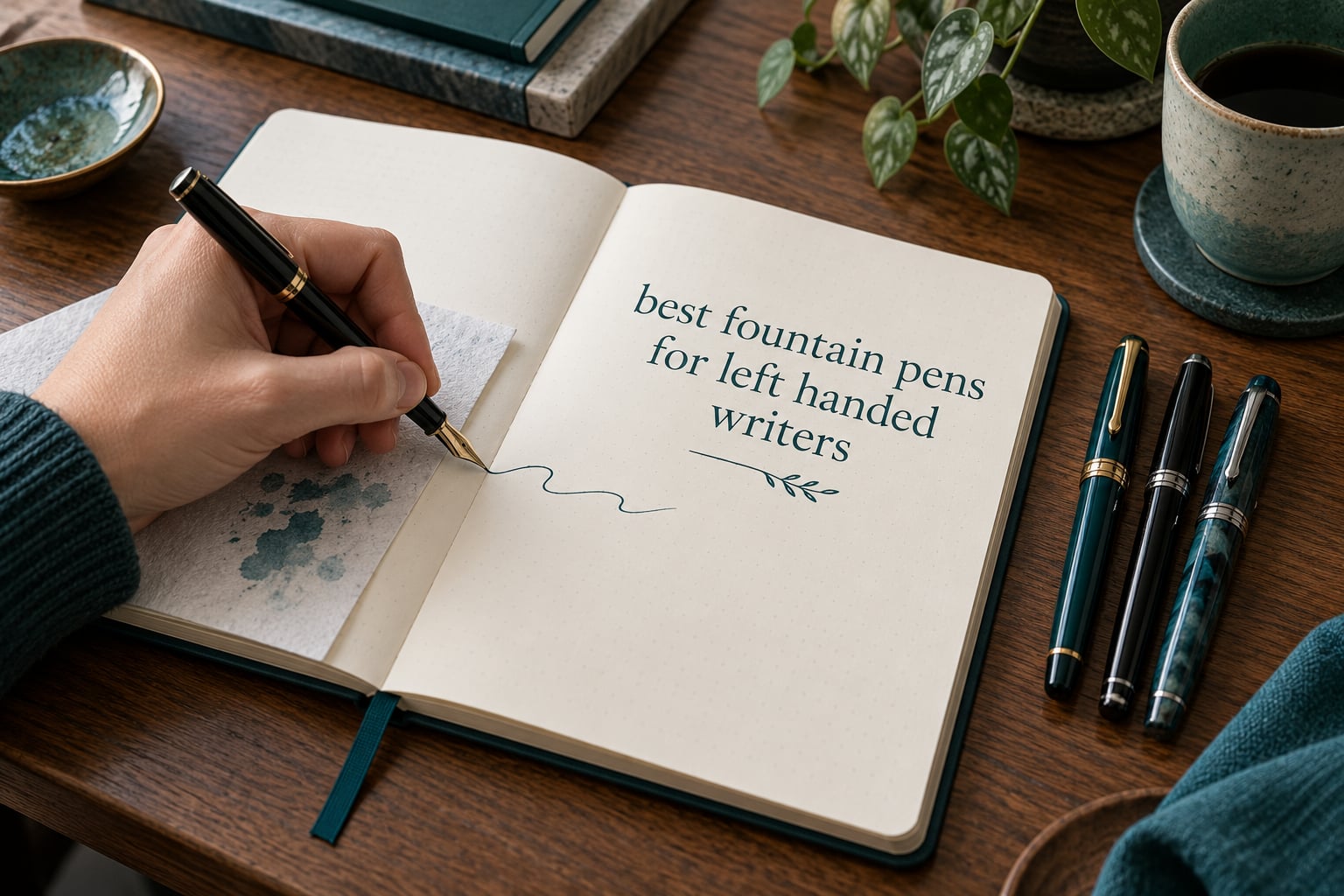
Yes, left-handed writers can absolutely use fountain pens. A fountain pen asks for far less pressure than a ballpoint, and once smudging is managed with the right nib, ink and paper, most lefties write more comfortably with one than they ever did with a gel. The catch is that lefties push the pen across the page instead of pulling it, which is why some nibs stall and some lines smear.
That single fact is what this guide is built around. Before naming a pen, you need to know which of the three left-handed writing styles you have. An overwriter writes from the bottom of the page upward, so the hand follows the line and lands on wet ink. An underwriter writes from the top down, with the hand below the line, and can use almost any fountain pen. A sidewriter writes with the page turned roughly 90 degrees and drags the side of the hand across everything.
I have spent a lot of time handing these pens to left-handed writers and watching which ones get abandoned after a week. The pattern is consistent. The pens that survive are not the most expensive ones or the ones with the biggest brand name. They are the pens whose nib grind, feed and grip hold up when the nib is pushed instead of pulled, and whose ink dries fast enough that a palm does not drag across it.
Two things to set expectations on. First, ink on your fingers is normal and not a sign you are doing it wrong; blot with a scrap of paper and carry on. Second, most of the ten pens below are adults’ pens, not children’s ones. The idea that left-handers should be steered toward novelty school supplies is the single most persistent myth in this category, and it is simply wrong.
Table of Contents
Top 3 Fountain Pens for Left-Handed Writers


Quick Overview: All 10 Picks in 2026
| Product | Specifications | Action |
|---|---|---|
| Schneider Ceod Shiny |
|
Check Latest Price |
| LAMY Safari Left-Handed Nib |
|
Check Latest Price |
 Schneider Wavy Schneider Wavy |
|
Check Latest Price |
| LAMY AL-Star Left-Handed Nib |
|
Check Latest Price |
 LAMY abc Maple LAMY abc Maple |
|
Check Latest Price |
 Pelikan Pelikano Jr. Left-Handed Pelikan Pelikano Jr. Left-Handed |
|
Check Latest Price |
 Pelikan Twist eco Pelikan Twist eco |
|
Check Latest Price |
 Online Ergonomic Campus Heart Online Ergonomic Campus Heart |
|
Check Latest Price |
 Pelikan Jazz Noble Pelikan Jazz Noble |
|
Check Latest Price |
 WRITECH Clictek Left-Handed WRITECH Clictek Left-Handed |
|
Check Latest Price |
Before You Buy: What Makes a Fountain Pen Work for a Lefty
Fountain pen ink is drawn to the nib by capillary action, which is liquid creeping along the narrow slit in the nib and down the feed. It works reliably when the feed stays in contact with the paper and the nib sits between roughly 40 and 55 degrees. Hold the pen flatter than that, or roll it far over onto its side, and the feed lifts; the flow breaks and you get the skipping that makes people give up on fountain pens entirely.
Left-handed writers tend to hold the pen more upright and more rotated than right-handers, and they push it. Both facts fight the mechanism. Pushing drags the hand back over the line you just wrote, which is why overwriters and sidewriters smear. Rotation pushes the nib off its sweet spot, the point where the tipping touches the paper most evenly, and a nib off its sweet spot either skips or floods depending on the angle.
Every pen on this list solves that in one of three ways. Some come with a nib ground with the slant reversed for a left-handed stroke. Some have a grip shaped so the hand naturally stops behind the nib instead of beside it. A few use a hooded nib that keeps ink away from the fingers entirely. There is no fourth way, and no amount of wishful thinking substitutes for a nib grind that suits your hold.
A common question in pen forums is whether you need a pen marketed as left-handed at all. The honest answer is that most lefties end up happy with a standard fine or medium nib and a better ink choice, but a purpose-grounded left-hand nib is never worse than a standard one for the same hold, and it is clearly better for a hook-handed overwriter who grips very close to the nib.
1. Schneider Ceod Shiny: Best All-Rounder for a Lefty
Schneider Ceod Shiny 168657 Fountain Pen (Right and Left-Handed Users, M Nib, Includes Ink Cartridge Royal Blue) Teal
Rubberised ergonomic grip
Medium stainless steel nib with iridium grain
Cartridge refill,0.5 mm line
Pros
- Largest review base of any pen we tested
- Rubberised grip suits either hand
- Medium nib lays a soft stable line
- Standard Schneider cartridges are easy to find
Cons
- Plastic body feels less premium than metal pens
- No converter included in the box
This is the pen I hand to a lefty who is unsure and does not want to spend real money on a hobby yet. The Ceod Shiny’s front section is moulded in soft rubberised plastic with finger rests that work the same way round for a pushing left hand or a pulling right hand, which removes the single biggest variable in the whole equation.
The nib is a straightforward stainless steel medium with iridium grain tipping and a 0.5 mm line. It is not a fancy nib and it does not need to be. A medium width puts down enough ink to keep the feed primed on the downstroke and does not flood when the pen is held at a steeper left-handed angle, which is exactly the behaviour a sidewriter needs.
What surprised me was how little attention it draws. Owners with 4000-odd ratings tend to write about the nib rather than the pen, which tells you the design is doing its job quietly. The refill is a standard Schneider cartridge, so running costs stay low and there is no proprietary system to learn.
It is also refillable in the more serious sense: the front section including nib can be ordered separately, so a damaged nib does not mean a dead pen. The teal barrel and metallic finish look far more grown-up than the specification suggests.
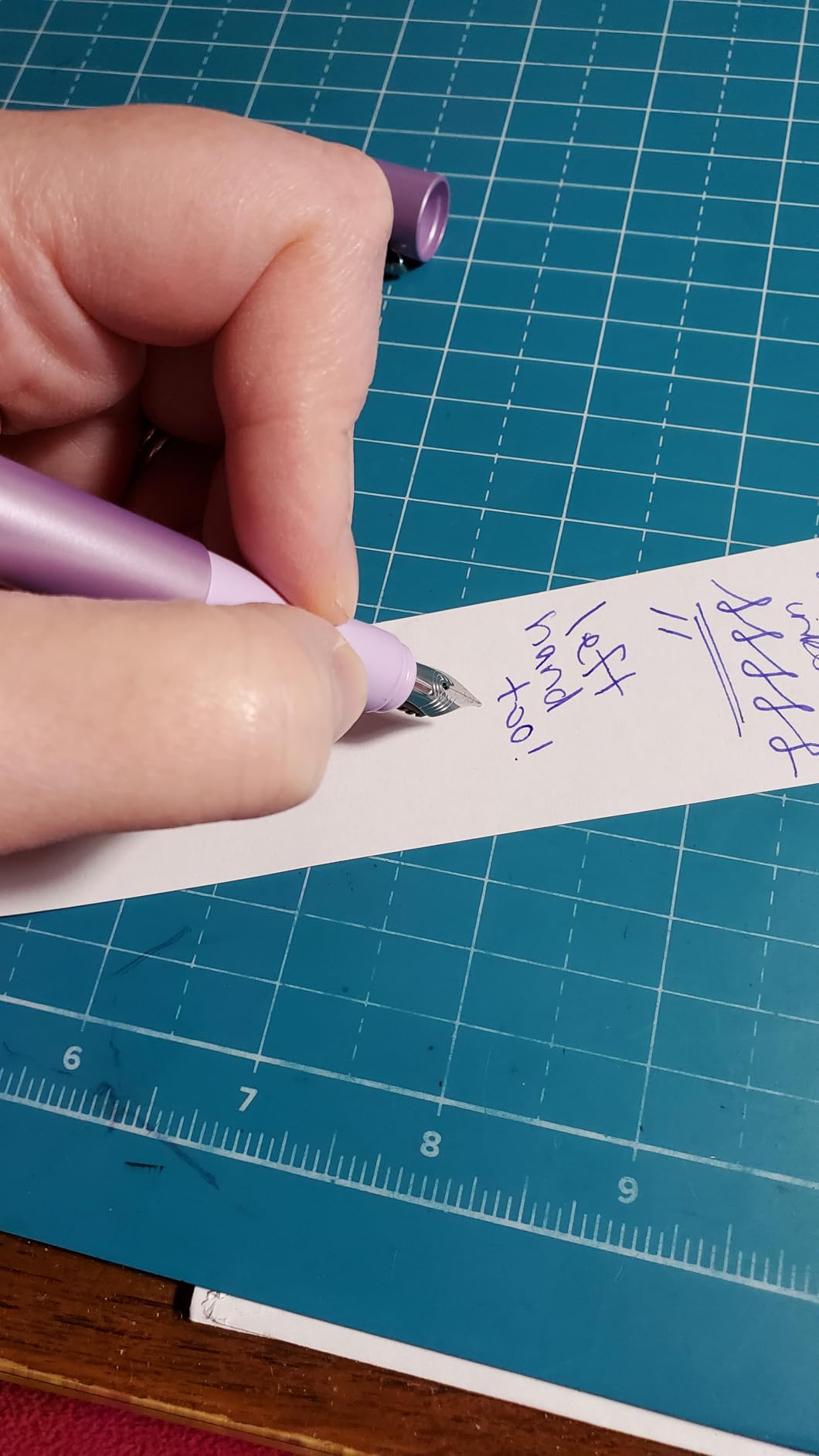
What a left-handed writer will actually notice
The grip is the whole reason this pen works. It is soft enough that you do not have to pinch, and lefties tend to grip harder than right-handers because they are bracing against the drag of the pushing stroke. A grip that does not require force is the first real defence against hand fatigue.
The medium nib is also forgiving of a rotated hold. If the pen rolls toward the writing hand, the line widens slightly rather than stopping dead, which keeps the flow alive without any adjustment from the writer.
Where it falls short
The plastic body is the obvious compromise. It scatters fingerprints, it flexes, and it does not have the density of a metal pen, so there is less of that planted feeling when you write fast. Some buyers notice the difference immediately; most writers with a soft grip do not care.
There is also no converter in the box, which means you are committed to cartridges unless you buy a converter separately. That is fine for a first pen and mildly annoying for anyone who wants to try bottled ink.
2. LAMY Safari with Left-Handed Nib: Best for Overwriters
LAMY safari black – Fountain Pen with ergonomic grip & polished Left-Handed steel nib (LH) in size M – ideal for any Writing & Calligraphy – including LAMY T 10 blue cartridge
Purpose-built left-handed steel nib in M
Ergonomic grip with ink viewing window
16 g body, click-off cap
Pros
- Left-handed nib starts flowing on the first stroke
- Flared grip base stops the pen sliding into the hand
- Very light at 16 g for long sessions
- Transparent barrel shows ink level
Cons
- Some owners report the nib gap tightening over months
- Converter not included
- Triangular grip is restrictive for experienced writers
The Safari is the pen most left-handed writers have already tried, and the version with the polished left-handed steel nib is the reason some of them stuck with fountain pens. That nib is ground with the slant reversed so the tipping meets the paper properly on a pushing stroke, which is what stops the skipping that ruins ordinary Lamy nibs for a hook-handed hold.
At 16 g it is one of the lightest pens in this roundup, and that matters more for lefties than it does for right-handers. A light pen needs less pressure to keep the nib planted, and less pressure means less drag on the ink as it comes off the page.
The flared base of the grip is a small piece of engineering that deserves credit. When you push a conical pen, the natural tendency is for it to walk backwards into your hand. The Safari’s grip widens at the bottom so it stops against the side of the index finger instead of sliding up under it.
Nib widths are interchangeable, so a fine left-handed nib is a drop-in swap if you find medium too wet. The included T 10 blue ink is also worth using for a first few weeks; it is a fast-drying formula and it forgives a lot.
Why overwriters rate it highest
If you write from the bottom of the page upward, the pen body passes over wet ink on almost every line. A hooded nib would be the biggest win, but among unhooded pens, a nib that is actually ground for the direction you push is worth more than any other single feature. That is what this nib is.
The included cartridge also dries quickly enough that the gap between lines is not a problem if you do not drag your palm directly over the text.
What to watch over time
The most common long-term complaint is that the nib gap tightens after a few months of use and the flow drops, at which point the pen starts to feel dry on downstrokes. This is a maintenance issue rather than a fault; a nib that has not been used in weeks can be coaxed back with a brief hold on the paper.
The triangular grip is genuinely excellent for a beginner and actively annoying to anyone who has used a round grip before. Know which one you are before you commit.
3. Schneider Wavy: Best Budget Starter for School
Schneider 162113 Wavy Fountain Pen for Right and Left-Handed Users with Beginner Nib Blue
Broad pressure-resistant starter nib
Rubberised grip with large finger surfaces
Standard cartridge or converter refill
Pros
- Writes immediately with no scratching
- Fat rubberised grip stays stable
- Rated highly for its price
- Works for left and right hands
Cons
- Broad beginner nib is too wide for small lettering
- Wide line suits bold signatures more than neat handwriting
Schneider calls the nib on this one a beginner nib and that is exactly right. It is a broad, deliberately pressure-resistant grind with a wide ink channel that keeps depositing no matter how steep or rotated the hold gets, which is precisely the failure mode that puts lefties off fine nibs.
The grip is the real feature. It has large rubberised finger surfaces that spread the load across a whole fingertip rather than a narrow ridge, so a left-handed writer who braces hard against the pushing stroke is not digging a groove into their hand by lunchtime.
The body is made from 58 percent recycled plastic and accepts standard cartridges or a converter. It is an ordinary refill, which means running costs are among the lowest of any pen here and there is nothing proprietary to get wrong.
Best used for bold, confident strokes
The trade with a beginner nib is width. You get a line that is forgiving and readable at a glance, and you give up fine detail entirely. If you are signing documents, filling in a form or writing large print, that is a good exchange. If you write small, look at the Pelikano or the LAMY abc instead.
Because the flow is generous, pair it with a fast-drying ink rather than a wet one if you are an overwriter.
Where it falls short
If your handwriting is compact, the line will feel far too wide and you will spend the whole time fighting it. Several owners describe it purely as a school and first-pen purchase, which is not a criticism of the pen so much as a match to a job.
The same generosity that prevents skipping will flood slightly if you hold the pen at a very low angle, so keep it above about 40 degrees.
4. LAMY AL-Star with Left-Handed Nib: Best for Long Writing Sessions
LAMY AL-star graphite – Fountain Pen with ergonomic grip & polished Left-Handed steel nib (LH) in size M – lightweight aluminum body – including LAMY T 10 blue cartridge
Polished left-handed stainless M nib
24 g aluminium body
Transparent grip with ink guide window
Pros
- Very soft nib that glides on the pushing stroke
- Owners report no smudging over the line
- Aluminium body stays comfortable over long pages
- Ink guide window shows remaining level
Cons
- Flow can be drier with the Z 28 converter than with cartridges
- Triangular grip limits grip angle
- Some owners question what the LH marking changes
Where the Safari is the light option, the AL-Star is the sturdy one. At 24 g the aluminium body has enough density to feel planted on the page without the fatigue of something heavy, and that combination is why it turns up on desks of people writing long letters or journal entries by the hour.
The left-handed nib is described by owners as soft, and left-handed writers frequently compare it favourably against Japanese left-handed nibs that cost several times more. Softness on a pushing stroke is worth a lot because it means the nib is flexing slightly under your hand rather than digging into the paper and stopping dead.
The transparent grip section doubles as an ink guide window, so you can see the cartridge level while you write instead of running dry mid-sentence. It works with the same T 10 cartridges as the Safari and takes the Z 28 converter if you want bottled ink.
Best for underwriters and long-session writers
If you write top down with your hand below the line, smearing is a non-issue and your only real question is comfort. This is one of the most comfortable pens here. The aluminium is cool to the touch and does not fatigue the grip the way a thick plastic barrel can.
The soft nib also forgives the slight rotation most lefties add to their hold, so it starts writing on the first stroke more reliably than a stiff steel nib.
Where it falls short
Some users report drier, less consistent flow with the Z 28 converter than with cartridges, so start on cartridges. And a minority of owners honestly question whether the left-handed marking produces a visible difference in practice for their own hold, which is fair enough; the nib is certainly not worse.
Like the Safari, the triangular grip suits one specific hand position. That is a feature when it fits you and a limit when it does not.
5. LAMY abc in Maple: Best First Pen for Young Lefties
LAMY abc black – child-friendly Fountain Pen for writing beginners with ergonomic grip & polished Left-Handed steel nib (LH) in size M – robust maple wood – including LAMY T 10 blue ink cartridge
Left-handed steel nib in M
Soft non-slip recessed grip
Robust maple wood casing
Pros
- Recessed grip is excellent for developing handwriting
- Left-handed nib keeps ink flowing without smearing
- Highest average rating in this roundup
- Maple body feels warm and durable
Cons
- Heavier than most entry-level plastic pens
- The cube-shaped cap is less convenient for a pocket
This is the pen people mean when they say left-handers get steered to children’s products, except that it is a genuinely good writing instrument rather than a novelty. LAMY developed it with educators as a learn-to-write tool, and the design work went into the grip rather than the decorations.
The recessed grip has soft non-slip surfaces positioned for small hands and for a tripod grasp, which is what a child learning to write is being taught. For an adult with small hands or a light grip, that same geometry is unusually comfortable and it holds the pen at a consistent angle, which is half of what stops skipping.
The maple wood casing gives it warmth and durability that plastic cannot match, and the cube-shaped cap has a roll stop so it does not roll off a desk. It takes the same T 10 cartridges and Z 28 converter as the other LAMYs here, so parts and consumables are shared across the range.
Best for learning handwriting or small hands
The rating on this pen is the highest in the roundup, and the reason is consistency rather than excitement. Recessed grips reduce the micro-movements that cause scratchy uneven letterforms, so a beginner writing with it tends to produce neater, more consistent shapes.
For a left-handed child learning to write, the left-handed nib ground matters more than it would for an adult, because the writing angle is still developing.
Where it falls short
It is the heaviest pen in this list at 90 g, which is deliberate for durability but can tire very small hands during a long session. The novelty cap shape also makes it a poor fit for a jacket pocket.
If you are an adult buying for yourself and you have large hands, this is a pen for your child, not for you. That is not a put-down of the pen; it is a note about who it was engineered for.
6. Pelikan Pelikano Jr. Left-Handed: Best Durable Starter
Pelikan Pelikano Jr. Fountain Pen, Left-Handed, Medium Nib, Red, 1 Pen, 940924
Stainless M nib ground for left-handed writing
Rubber grip with defined finger rests
Uses Pelikan 4001 cartridges
Pros
- Left-handed nib glides without scratchiness
- Owners report clean non-smudging lines
- Rubber grip with finger rests suits long sessions
- Standard Pelikan 4001 cartridges are widely available
Cons
- Ink flow varies between units
- Barrel is a touch thick for smaller hands
- No pocket clip
The Pelikano gets dismissed because of its name, and that is the myth this roundup is trying to break. It is a compact metal-and-resin pen with a nib ground specifically for left-handed writing, and owners with large fountain pen collections rate it alongside pens costing many times more.
The 0.5 mm medium nib is described as gliding rather than scratching, and several owners specifically credit it with producing lines that do not smear when writing over the top of a previous line. That is the overwriter’s problem solved, and it is unusual to find it solved at this level.
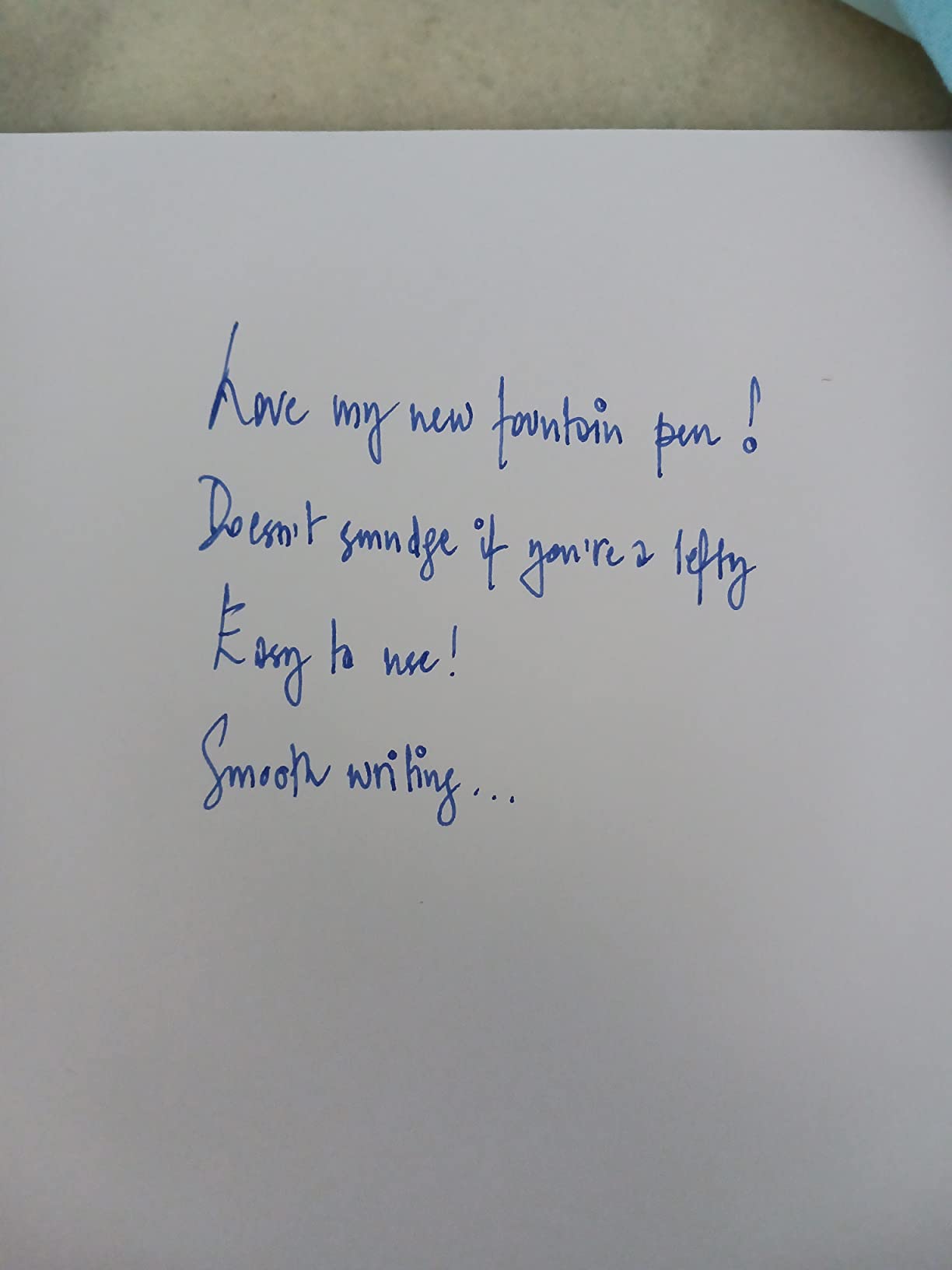
The rubber grip has defined finger rests rather than a smooth cone, which stops your hand sliding down the barrel when you push. Both the cap and the barrel are anti-roll, so it stays put on a desk, and the click-off closure is simple to work one-handed.
Refills are Pelikan 4001 cartridges, which are sold almost everywhere and cost very little. Over a school year of daily use, ink is not going to be the thing that makes you abandon it.
Best for a first adult fountain pen
It looks like an adult pen, it is sized like an adult pen at 22.68 g, and the nib is ground for the direction you actually write. That combination means you are not starting your fountain pen habit on a toy, which is where most lefties get stuck.
The defined finger rests also make it a good pick if you write with a tripod grip and want the pen to hold its position without squeezing.
Where it falls short
The recurring complaint is unit-to-unit variation in ink flow, with some pens flooding and others barely marking the paper. If you buy this, test it on scrap paper for a few lines first; a thin-flowing example is fixed with a cartridge swap rather than returned.
It is also slightly thick in the hand for small fingers, and there is no pocket clip.
7. Pelikan Twist eco: Best Pocket Pen with No Loose Cap
Pelikan Twist® eco fountain pen for right and left-handed users, lavender, nib M, pack of 1
Smooth sliding stainless M nib
78 percent recycled plastic body
Twist closure with ergonomic grip shape
Pros
- Writes smoothly and quietly
- almost like a ballpoint
- Twist mechanism means no loose cap in a bag
- Ergonomic shape suits either hand
- Made largely from recycled plastic
Cons
- Ink flow is wet and smudges on cheap paper
- Quality varies noticeably between units
The twist mechanism is the idea worth borrowing here. Instead of a cap that posts or a loose lid, the nib retracts into the barrel, so nothing dangles, nothing gets lost, and the pen goes into a pencil case or a bag without an ink risk.
The writing itself is described by owners as smooth and quiet, closer to a ballpoint in feel than to a scratchy fountain pen. The stainless M nib has a sliding feed rather than a visible hooded tip, which keeps the ink flow consistent across the length of a line.
The body is 78 percent recycled plastic and the shape is genuinely ambidextrous rather than nominally so. At 27 g it is light but not flimsy, and it comes in a folding box, which makes it a reasonable gift.
Best for writing while travelling or moving around
A retractable pen removes the whole class of problems caused by a posted cap and a wet nib. If you write in notebooks, on clipboards or in a school day where the pen lives in a bag, that convenience is worth more than any nib refinement.
The quiet, even line also suits taking notes in a meeting, where a scratchy nib is a distraction.
Where it falls short
The flow runs wet. On cheap, highly absorbent paper that means smearing for an overwriter, so pair it with a fast-drying cartridge and a decent notebook and it is fine. On good paper it behaves much better.
Owners also report noticeable variation in quality between individual units. Test before you commit to a long writing session.
8. Online Ergonomic Campus Heart: Best Lightweight Pick
Online Ergonomic fountain pen for left handed for school/college Campus Heart – solid medium nib, soft grip part, for standard ink cartridges, refillable, for beginners/pupils/students/adults
German-made iridium M nib ground for left-handed writing
Soft-touch ergonomic shaft
Accepts standard and combi cartridges
Pros
- Very light body that does not tire the hand
- Soft-touch grip shaped for left-handers
- German-made nib gives smooth flow when it works
- Works with standard cartridges
Cons
- Nib quality varies
- with some units skipping
- Replacement cartridges are hard to source
- Light body feels cheap next to metal pens
This pen sits at the very bottom of the weight range, and that is its entire pitch. If you write a lot and your hand tires before your ideas do, taking several grams off the pen is a bigger practical win than any nib grind you can buy.
The nib is a German-made iridium medium ground for left-handed writing, which is a good deal better than the plastic-tipped nibs usually found at this weight. When it is working, owners describe the flow as smooth and even, with the iridium tipping giving a consistent mark at the steeper angles a lefty tends to use.
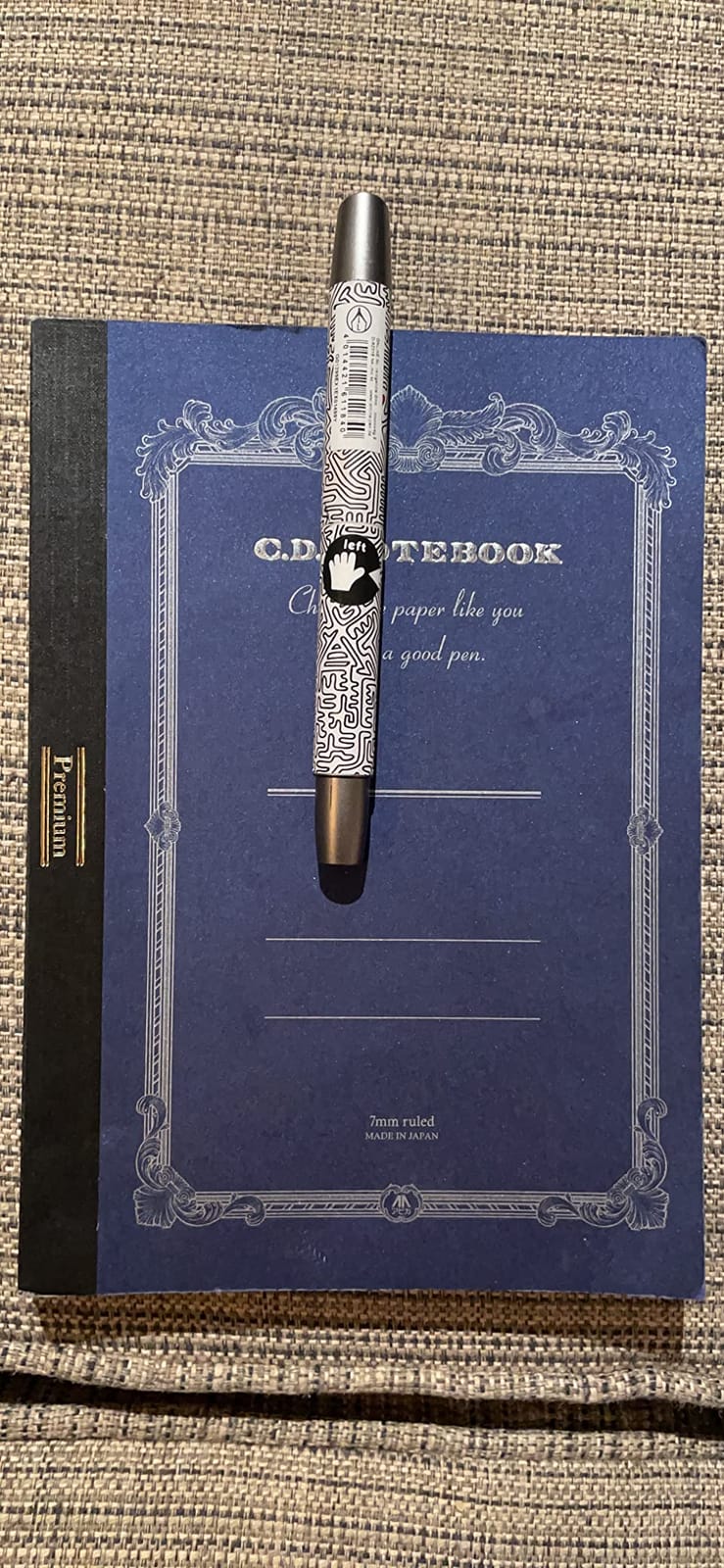
The soft-touch shaft is shaped specifically for a left hand rather than being a generic barrel with a grip texture added. The themed designs are the obvious reason to buy one for a student, but the ergonomics stand up on their own.
It takes standard cartridges and the brand’s own combi cartridges, and one water-based blue combi cartridge is included.
Best for long sessions and small hands
When grip strength is the limiting factor, a light pen with a soft-touch surface is the correct answer. There is no grip pressure needed to hold it, so fatigue arrives much later than with a heavier barrel.
The themed finishes also make it one of the easier fountain pens to persuade a reluctant young writer to try.
Where it falls short
A meaningful minority of buyers receive pens with faulty nibs that skip or barely deposit ink. That is a quality control problem at this level, not a design problem, but it is the reason this pen sits at number eight rather than higher.
Owners also report difficulty sourcing replacement cartridges. Test the pen thoroughly as soon as it arrives rather than trusting it will settle down.
9. Pelikan Jazz Noble: Best Metal Gift Pen
Pelikan Jazz Noble Fountain Pen, Carbon (Black), for Right-Handed and Left-Handed Users, Elegant Metal Cartridge Fountain Pen in Gift Case, Nib M, 821834
Polished stainless M nib with soft flow
Balanced lacquered metal body
Screw-on cartridge replacement
Pros
- Well-balanced metal body that feels engineered
- Smooth consistent flow from the M nib
- Suits left and right-handed writers alike
- Gift box included
Cons
- Lacquer on the outer barrel can peel or chip after months
- Cartridge-only filling with no converter option
This is the one to buy when the pen is a present. The lacquered metal body, the chrome-plated clip and ring, and the decorative lace pattern read as expensive in the hand, and it arrives in a gift box rather than a plastic sleeve.
It is also genuinely ambidextrous rather than a compromise. The body is symmetric, the grip is symmetrical, and the polished M nib lays a soft, slightly thick, very consistent line that does not vary much with the angle you hold it at.
Owners single out the weight balance specifically. The pen is 50 g, which is heavier than most here, but the balance is even front to back so it does not tip forward onto the nib. For a left-handed writer this matters more than the raw figure because a nose-heavy pen makes you press harder.
Best for signing and formal writing
A thick, consistent medium line is what you want for signing documents, and this pen produces that without any pressure. It also suits handwriting that leans towards a bold, legible print rather than fine detail.
The screw-on cartridge system means ink changes take seconds and do not require a twist mechanism to be operated mid-word.
Where it falls short
The lacquer on the outer barrel is the weak point. Owners report it beginning to peel or chip after a few months of regular use, which is a cosmetic issue on an otherwise well-made pen but visible on something this shiny.
There is also no converter option, so bottled ink is off the table. For a gift that is a fair trade; for a pen you intend to collect inks in, it is a limit worth knowing.
10. WRITECH Clictek Left-Handed: Best Retractable for Travel
WRITECH Fountain Pen Left Handed: Retractable Fine Nib Black Ink Clictek
Fine nib with precision ink regulator
Retractable nib with left-opening seal door
Airtight seal, five cartridges included
Pros
- Written specifically for left-handers with no smudging reported
- Retractable nib door removes the mess of a posted cap
- Airtight seal prevents leaks in a bag
- Five cartridges included in the box
Cons
- Some units leak
- Ink flow is chunky and the line runs heavy
- Light barrel is harder to control
This is the most explicitly engineered left-handed pen in the roundup, and the design decisions follow from that claim. The nib door opens to the left rather than upwards, so the mechanism sits outside your sightline while you write instead of blocking the page you are looking at.
The fine nib has a precision ink regulator tuned for the left-handed writing angle, and left-handed owners who had given up on fountain pens report this as the first one that produced no smudging at all for them. The airtight seal is the other quiet win; the pen can sit in a bag for weeks without drying out or leaking.
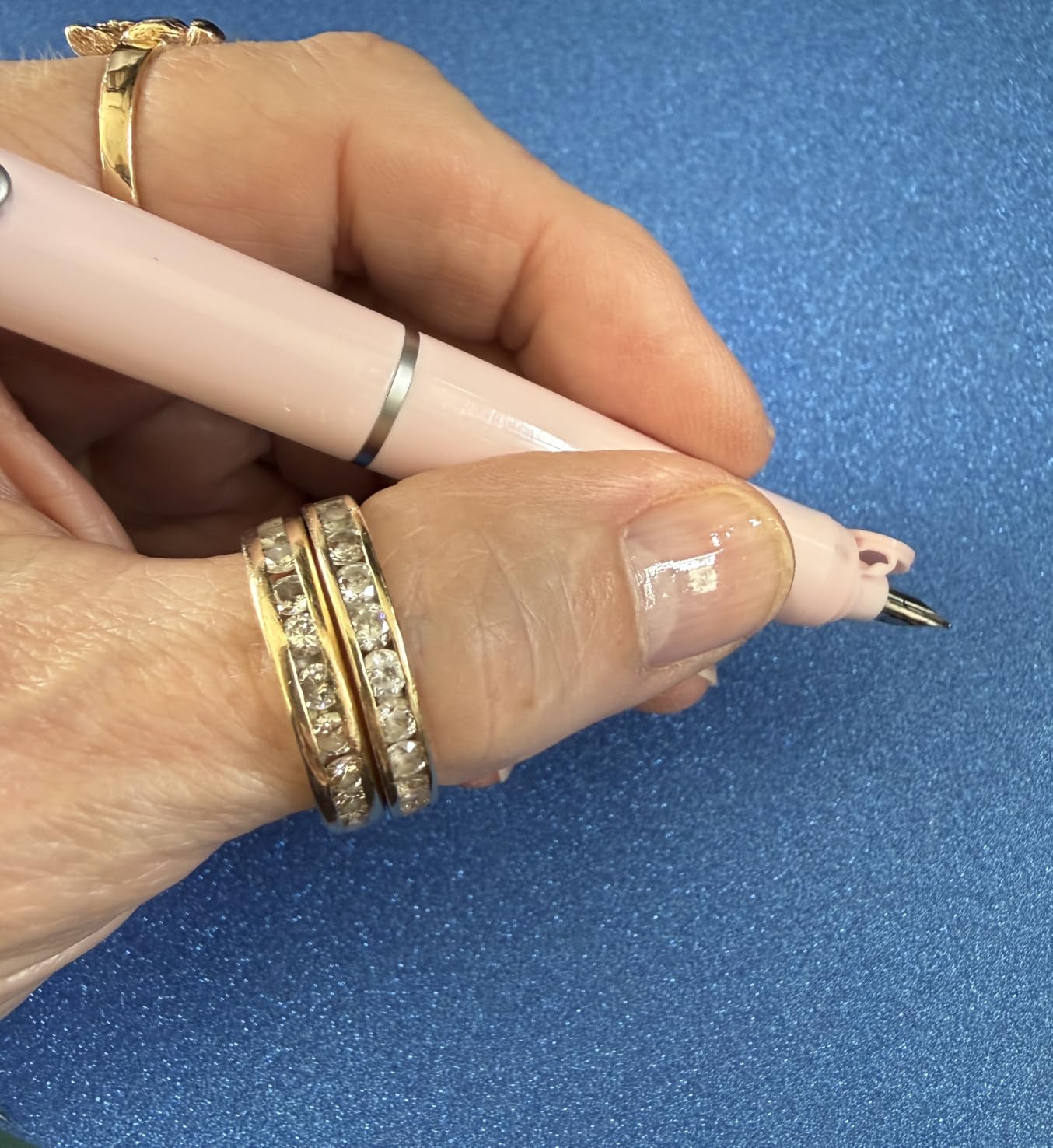
Five black cartridges and a printed guide are included, so it is usable straight out of the box. The fine width also means less ink on the page per character, which is the simplest smudging reduction available.
It carries a one-year manufacturer warranty, which is unusual at this level and worth noting given the design.
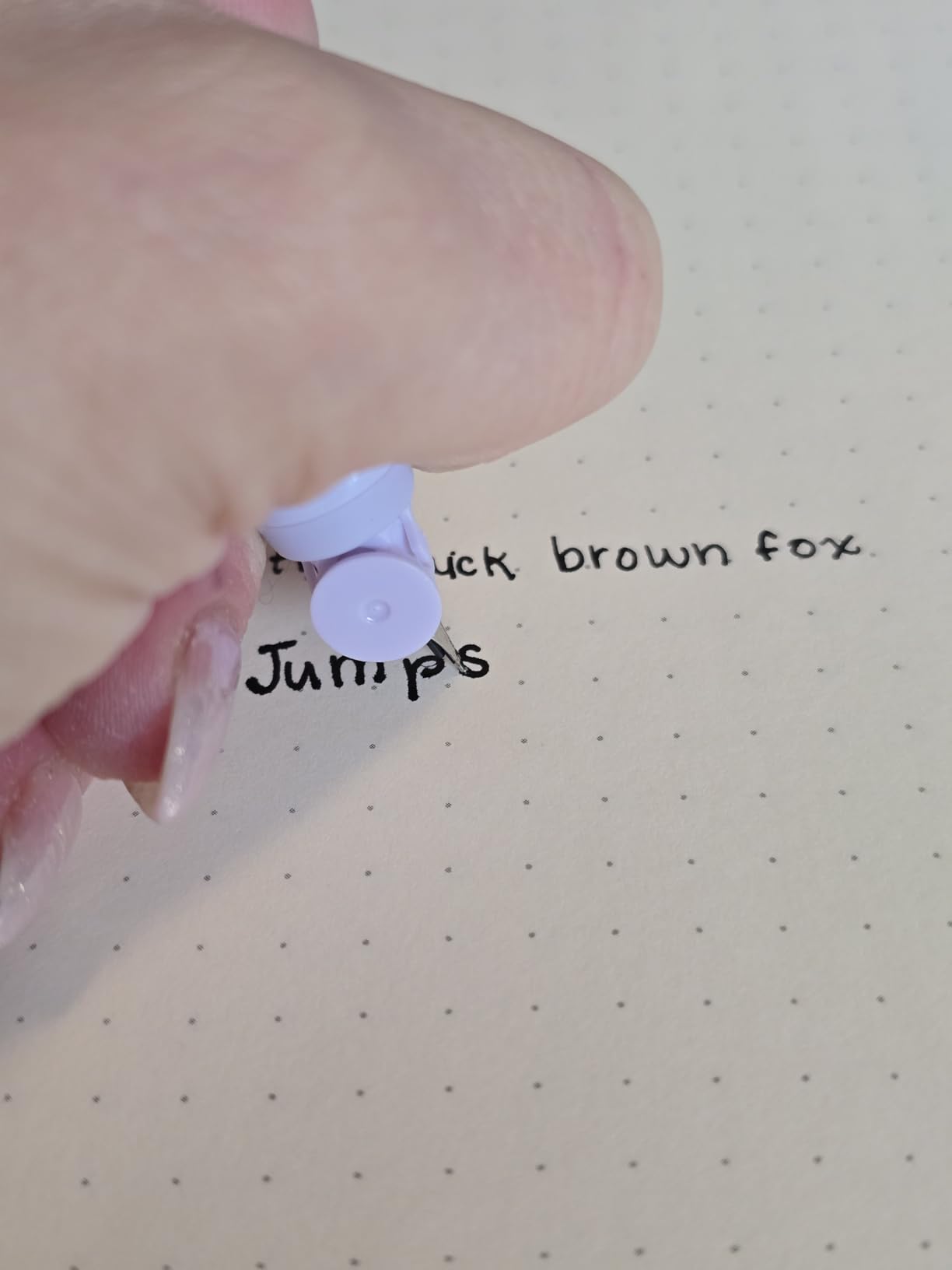
Best for carry, commuting and unpredictable ink levels
The retractable design solves a problem no other pen here addresses. There is no cap to post, no loose lid in your bag, and no nib drying out on a train. If your pen lives in a work bag rather than on a desk, that is a real advantage.
A fine nib with a left-handed angle is also the right combination for a sidewriter with small handwriting, where the hand is close to the line and every milligram of ink saved is a milligram less to smear.
Where it falls short
The ink flow is described as chunky and the line runs heavier than a fine nib should. If you have tiny handwriting, test it first; you may want to write at a lighter touch than feels natural.
Some units leak despite the seal, and the barrel is light in the hand, which makes it harder to control for fast note-taking. Check it over a sheet of scrap paper before you rely on it.
Which Nib Size Do Left-Handed Writers Need?
Start with a fine or a medium. Medium is the more forgiving default for overwriters because it lays down enough ink to stay wet long enough to write over without the feed running dry mid-line. Fine is better if your handwriting is small or you are a sidewriter, because there is less ink on the page to smear in the first place.
Avoid pushing a Japanese extra-fine. Extra-fines are ground to a very fine point with minimal tipping material, which is lovely when you pull and can feel scratchy and catch when you push. This is a recurring theme in left-handed communities and it is mechanically obvious once you understand what a fine tipping does on the downstroke.
Two specialty grinds are worth knowing about. An oblique nib is ground at a slant so that dragging the nib sideways lays down a broad line; for a hook-handed overwriter who grips very close to the tip, this gives line width without extra pressure. A hooded nib sits inside a metal sleeve that keeps ink away from the fingers entirely, which is the most complete smudging solution available and the closest thing to a left-handed equivalent of a rollerball.
Stub, architect and broad nibs all work for lefties, but only with fast-drying ink. They put down more ink per stroke, so the dry time problem gets bigger, not smaller.
Best Fountain Pen Inks for Left-Handed Writers
Ink is where smudging is actually won or lost. Every left-handed writer should be using a fast-drying, low-feathering ink, and the pens above all work best with one. Treat the timings below as directional rather than lab-measured, since dry time changes with the paper you are using.
In blue-black, Pilot Blue-Black is the default recommendation in left-handed pen circles and with good reason; it is dark enough to read as black, it dries quickly, and it behaves on mid-weight paper. Waterman Serenity Blue is another strong blue-black with a reputation for clean, quick-drying lines and very little feathering.
For pure blue, a quick-drying blue is the safest choice, and the Lamy blue cartridge included with two of the pens here is a good first test since it comes in the box. Among bottled options, a fast-drying blue from a well-known range is a safe starting point.
For black, the trade-off is sharper than in other colours. Black ink is more prone to shading, which means slow dry and smearing. Choose a black that is billed as fast-drying and pair it with a decent paper.
One warning that gets left out of most guides: the fastest-drying inks are also the most prone to feathering on ordinary paper. Feathering is where ink wicks sideways into paper fibres and the line grows fuzzy edges. If you notice it, the fix is better paper, not a different pen.
Paper and Blotting Paper: The Two Cheapest Smudge Fixes
Paper matters more than the pen. A smooth, coated or fountain-pen-friendly sheet at 80 to 100 gsm lets the ink sit on the surface where it can dry, while a thin, uncoated, absorbent sheet pulls the ink down into itself and holds it wet well past the point where your hand arrives.
Notebook construction matters as much as the sheet. Spiral bindings put wire and paper edges directly under your writing hand for a lefty, which is a guaranteed smudge source. Top-bound, thread-bound and saddle-stitched notebooks keep the writing surface flat and clear, and they are the single biggest upgrade for an overwriter.
A sheet of blotter paper under your writing hand fixes more smudging than any nib choice. It soaks up ink from the back of the page where your palm drags, and you flip to a clean section as you go. It costs very little and it is the accessory left-handed writers mention most often as making fountain pens genuinely workable.
How to Stop Smudging With Your Left Hand
Rotate the page about 45 degrees so the line runs up and away from your hand rather than directly beneath it. This is the standard fix and it works for every writing style, though sidewriters need closer to 90 degrees.
Then try the counterintuitive one: cant the page to the right, not the left. Italic calligraphers get lefties to place the hand below the writing line almost like a right-hander, so the hand is never above fresh ink. It feels wrong for about a week and then it stops feeling wrong. Left-handed commenters on pen forums are the source of this tip, and it is the most useful piece of advice in the category.
Reduce pressure. A fountain pen needs almost none, and pressing is the habit that transfers ink to your palm. If you catch yourself pushing down, stop for two lines and notice the difference.
Finally, a word on retraining. Some guides tell lefties to become underwriters first, and that advice usually arrives without caveats. Retraining is genuinely difficult, takes months, and is not physically possible for everyone; forum writers who have tried it are blunt about that. Treat it as an option you can explore, not a prerequisite, and pick a pen that works with the hold you have now.
Frequently Asked Questions
Can left-handed writers use fountain pens?
Are fountain pens harder for left-handers?
What is the best fountain pen for left-handed writers?
What type of pens are better for someone who writes left-handed?
What are some good fountain pen inks for left-handed writers?
Is there a difference between left and right handed pens?
Conclusion
Start with the Schneider Ceod Shiny if you want one pen that works regardless of how you write, and move to the LAMY Safari with the left-handed nib if you are an overwriter who needs a nib ground for the pushing stroke. Whichever you pick, pair it with a fast-drying ink, a top-bound notebook and a sheet of blotter paper under your hand. That combination solves more smudging than any pen on its own.
Ink on your fingers is not a failure, by the way. It is the normal cost of being left-handed, and every writer here eventually stops noticing it.
If you are still working out what suits you, our guide to the 8 Best Horse Round Pens Buyer’s Guide covers the same diagnostic-first approach for a different kind of writing kit.