
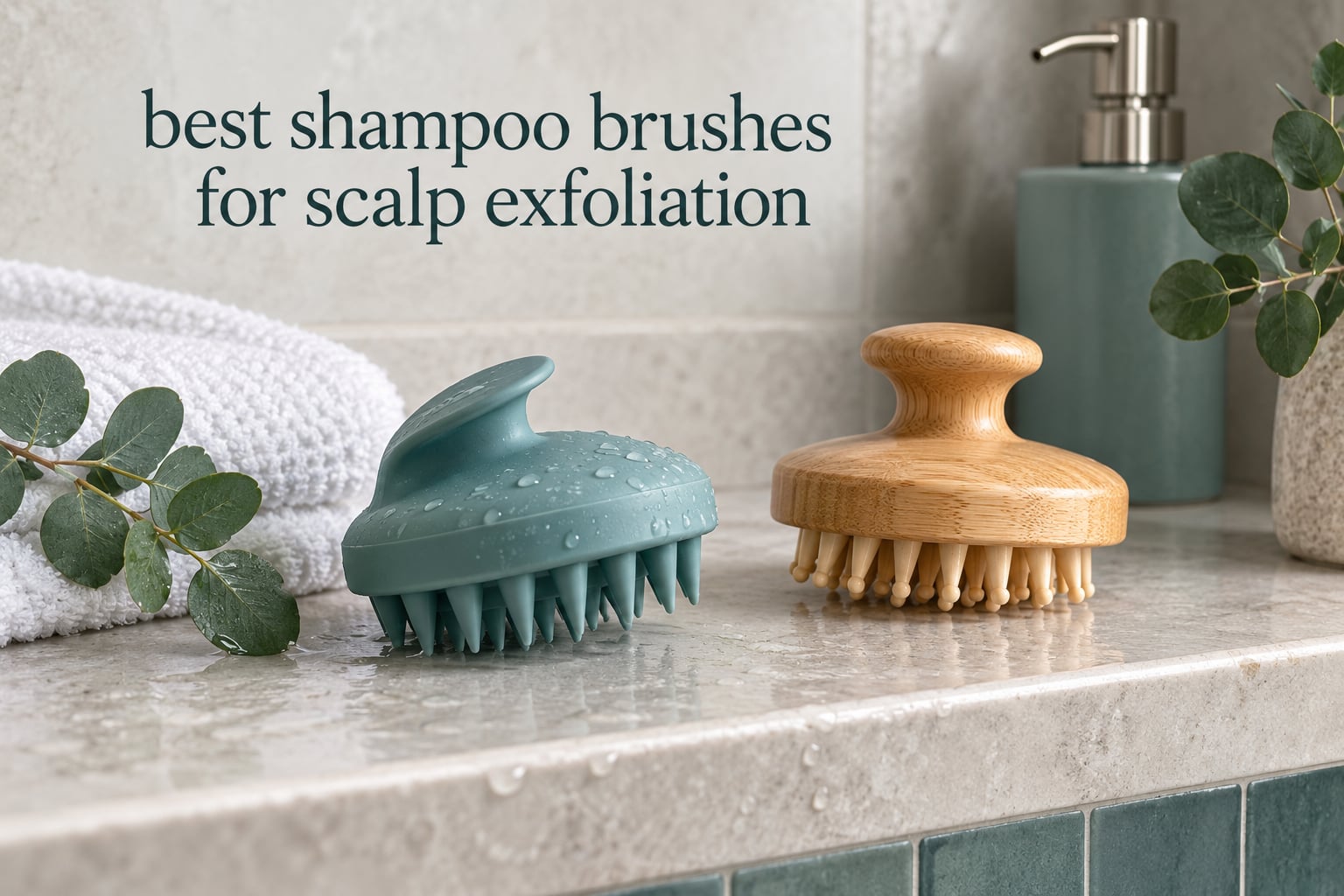
Yes, scalp exfoliating brushes work, but not for the reason most listings claim. The bristles flex against your scalp and create gentle friction that dislodges dead skin cells, trapped sebum and styling-product residue, while the mechanical massage increases blood flow to the area. That is why a brush clears buildup your shampoo leaves behind. It is not a treatment for seborrheic dermatitis and it will not make your hair grow on its own.
A shampoo brush is a palm-sized hand tool with flexible silicone, bamboo or nylon teeth that you work through lathered hair to massage and exfoliate the scalp. Most people exfoliate their face twice a week and never touch their scalp at all, so sebum, dead cells and product film build up into the itchiness, flaking and post-wash squeaky feeling that sends people hunting for a stronger shampoo.
We spent weeks comparing the ten scalp brushes below across bristle material, bristle length, firmness, wet and dry usability, build quality and how they behave on fine versus thick hair. This guide covers the best shampoo brushes for scalp exfoliation for 2026, plus the technique that stops tangles, the hair-texture matching that decides whether you like the tool at all, and who should skip it entirely.
If you are still building a hair routine from scratch, our guides to hair straightening brushes for frizzy hair and hot air brushes for fine hair cover the styling side of things.
Table of Contents
Top 3 Shampoo Brushes for Scalp Exfoliation
HEETA Scalp Massager Scrubber
- Soft flexible silicone bristles
- Waterproof with hanging loop
- Lightweight 2.47 oz build

FREATECH Scalp Scrubber
- Food-grade silicone teeth
- Mouse-like non-slip handle
- Works wet or dry

Cbiumpro 2 Pack Scalp Massager
- Two brushes in one pack
- Ultra-soft silicone bristles
- Waterproof and lightweight
Best Shampoo Brushes for Scalp Exfoliation in 2026
| Product | Specifications | Action |
|---|---|---|
| HEETA Scalp Massager Scrubber |
|
Check Latest Price |
| FREATECH Scalp Scrubber |
|
Check Latest Price |
| Cbiumpro 2 Pack Scalp Massager |
|
Check Latest Price |
 Sosoon Scalp Massager Brush Sosoon Scalp Massager Brush |
|
Check Latest Price |
 Sndyi Wheat Straw Scalp Brush Sndyi Wheat Straw Scalp Brush |
|
Check Latest Price |
 Tangle Teezer Scalp Shampoo Brush Tangle Teezer Scalp Shampoo Brush |
|
Check Latest Price |
 G.B.S Scalp Exfoliator 4 Pack G.B.S Scalp Exfoliator 4 Pack |
|
Check Latest Price |
 Meartchy Silicone Scalp Massager Meartchy Silicone Scalp Massager |
|
Check Latest Price |
 Jupiter Scalp Exfoliator Tool Jupiter Scalp Exfoliator Tool |
|
Check Latest Price |
 Avilana Dual-Sided Scalp Massager Avilana Dual-Sided Scalp Massager |
|
Check Latest Price |
What Is a Scalp Brush and How Does Scalp Exfoliation Work?
A shampoo brush, scalp brush, scalp massager and scalp scrubber are the same palm-sized tool sold under different names. It has a handle, a curved head and dozens of flexible teeth you press into the scalp through wet or dry hair. The teeth are what makes it different from a normal hairbrush: they are short, spaced apart and designed to flex on contact rather than rake through the lengths of your hair.
Your scalp is skin, and skin sheds. But unlike the face, most people never exfoliate it, so sebum, dead cells and styling residue compact into a film that ordinary shampoo runs straight over. Friction from the teeth breaks that film loose so it can rinse away, which is the whole mechanism. The massage component increases blood flow to the area, which is why these tools feel relaxing and why many people use them dry with a scalp oil.
Two things worth separating. Exfoliation is about clearing buildup. Stimulation is about pressure and blood flow, and it works best on a clean scalp, not a clogged one. People who want sebum moved down the shaft to the ends are looking for a boar bristle hairbrush, a different tool with a different job.
1. HEETA Scalp Massager Scrubber: Best Overall Scalp Exfoliator
HEETA Scalp Massager Hair Growth Scrubber for Dandruff Removal Hair Care
Soft flexible silicone bristles
3.2 x 3.2 x 2.8 inches
2.47 ounces
Waterproof with hanging loop
Pros
- Noticeable exfoliation that loosens dead skin
- Reduces flaking and itchiness with regular use
- Soft bristles that do not tangle or pull
- Non-slip handle with hanging loop
- Spreads shampoo and oil evenly
Cons
- Bristles soften and lose firmness over long-term use
- Some buyers report colour differs from listing photos
This is the tool we kept reaching for. The bristles are soft at the tip and firm at the base, the balance most cheap silicone brushes get wrong in one direction or the other. It sits at the top of the Manual Scalp Massagers category, and that volume of feedback matters because the tool is unremarkable in the best way.
At 2.47 ounces it is genuinely palm-sized, with a non-slip handle and a hanging loop so it dries between uses instead of sitting on a wet shelf. Wide bristle spacing is what keeps it from snagging.
Reviewers describe the circular motion as a salon scalp massage, and the visible change they report is flaking dropping away in the rinse rather than a vague feeling of cleanliness. It also distributes a heavy oil evenly across the roots, which fingertips never do.
The recurring note is that the silicone eventually softens after a year or more of daily use. That is normal wear for the material rather than a defect, and because it is such a light item most people end up with one in the shower and one in a travel bag.
Is the bristle pressure right for a sensitive scalp?
Yes, for most people. The tips are described as soft and flexible and are widely reported not to scratch or pull. Firmness sits in the base of each bristle, so pressure only increases if you press harder.
With an active flare, eczema or psoriasis, drop the circular motion entirely and use light combing strokes to work shampoo through without exfoliating.
How long does the silicone last before it softens?
Most owners buy a second one rather than a replacement, with softening showing up after a year or more of daily use. The hanging loop matters here, because a properly dried brush keeps its snap longer than one left damp in a caddy.
2. FREATECH Scalp Scrubber with Silicone Teeth: Best for Kids and Pets
FREATECH Scalp Scrubber Scalp Massager Hair Growth, Shower Shampoo Brush with Silicone Bristles for Dandruff Removal and Hair Care, Wet & Dry Hair Massager Scalp Exfoliator for Men Women Kids,Black
Food-grade silicone teeth with tourmaline
3.7 x 3.1 x 2.8 inches
1.06 ounces
Concave silicone head
Pros
- Food-grade silicone is hygienic near the scalp
- Flexible tips move through hair without tangling
- Mouse-like handle with non-slip grooves
- Rinses clean and hangs to dry
- Works on people and pets
Cons
- Smaller head feels less thorough than two-piece designs
- Neutral reviews focus mostly on size relative to the hand
This is the lightest tool in the roundout at just over one ounce, and that weight is why it works on a child who will not sit still or a dog who has decided the bath is optional. The handle is shaped like a computer mouse with deep grooves, so a wet hand does not send it spinning across the tub.
The concave head is formed from a compact set of flexible silicone tips, and the material is described as 100 percent food-grade silicone with tourmaline added. We cannot verify what the tourmaline does beyond the maker’s word, but the silicone claim is the part that matters for contact with a young or reactive scalp.
Owners call it a comfortable upgrade on washing with fingertips, which is a fair benchmark because most people scrub their nails into their scalp at some point. The tips flex rather than drag, so exfoliation happens without the snagging that turns a shower tool into a detangling problem. If you also groom a pet at home, our guide to dog brushes for shedding covers that side of the routine.
Rinsing under the tap clears soap out of the concave head, and it dries on a hook without holding water in the base. That easy clean is the difference between a tool you keep using and one you stop using.
Is the head too small for a full wash?
It is on the smaller side compared with the oversized one-piece designs, and the most common critical comment across reviews is about size relative to the hand rather than function. If you have small hands, hold it like a computer mouse and work in smaller sections.
On children and pets the compact head is an advantage rather than a limitation, because it gives you precise control over where the pressure lands.
Does food-grade silicone actually stay hygienic?
It does in a practical sense. Non-porous silicone does not absorb shampoo residue the way moulded plastic grooves can, it does not rust, and it rinses clean with water alone. That matters over a long life because trapped residue is what turns a tool into a source of recontamination for the scalp you are trying to fix.
The trade-off is that silicone flexes more, so it exfoliates less aggressively than hard plastic. If your problem is heavy product film rather than general grime, a gentler tool may not be enough alone.
3. Cbiumpro 2 Pack Scalp Massager: Best Budget Two-Pack
Cbiumpro 2 Pack Scalp Massager Shampoo Brush Scrubber Exfoliator
Ultra-soft silicone bristles
3.3 x 3.3 x 3.15 inches
2.19 ounces each
25 bristles per brush
Pros
- Two brushes in one pack
- Soft tips stiffer at the base
- Long enough bristles for thick hair
- Non-slip handle stays secure when wet
- Produces more lather than fingers
Cons
- Circular motions can tangle thick curly hair
- Rubber tips can loosen or pop out over time
- May feel small with smaller hands
The two-pack is the practical argument. One brush lives in the shower and one goes in a second bathroom, a gym bag or the house, and reviewers specifically call out that arrangement as the reason to prefer it over a single unit. At under two ounces each, the pair is still light enough to travel.
The bristles are described as ultra-soft and stiffer toward the base, the same pressure-ramp design the HEETA uses. The tips are long enough to reach the scalp through thicker hair, and the handle is shaped for wet hands.
The strongest praise is about lather. A silicone brush moves more shampoo into the roots than fingers do, so you can often get away with a single wash instead of the double cleanse people default to when their hair feels coated.
The caveat is real: owners with very dense curly hair report pulling and tangling, particularly in circular motions. The same reviews say single-direction strokes solve it. Also worth knowing, the tool lifts dead skin but does not rinse it away on its own.
Will it tangle coily or 4C hair?
It can, if you use it the way most people do by instinct, which is small circles. Reviewers with dense curl report tangles specifically in that pattern. Used in a single direction the bristles stay in the hair without dragging it around.
Are two brushes worth it versus one?
If you have one bathroom and one person, a single brush is a better spend on a more considered tool. If you share a home, travel often or want a backup that never goes missing, the pair is genuinely more useful than the same money spent on one premium option.
Rubber tips can loosen over months, which is the most common durability complaint, and that is a reason to own two rather than a reason to worry.
4. Sosoon Scalp Massager Shampoo Brush: Best Compact Grip Option
Sosoon Scalp Massager Shampoo Brush, Hair Scalp Scrubber Shower Hair Brush Head Massager for Stress Relax Hair Growth, Dandruff Brush Scalp Exfoliator for Women Men Kids Pets, Black
Elastic silicone bristles
5 x 5 x 2 inches
1.76 ounces
Finger-rest grip for pressure control
Pros
- Cleans without scratching or pulling
- Lathers far better than fingertips
- Finger-rest grip works with wet hands
- Reported reduction in dandruff and itch
- Works for the whole family
Cons
- Silicone insert can pop out of the handle after repeated use
- Some find it less effective on wet hair
- Reported to shatter if dropped on hard tile
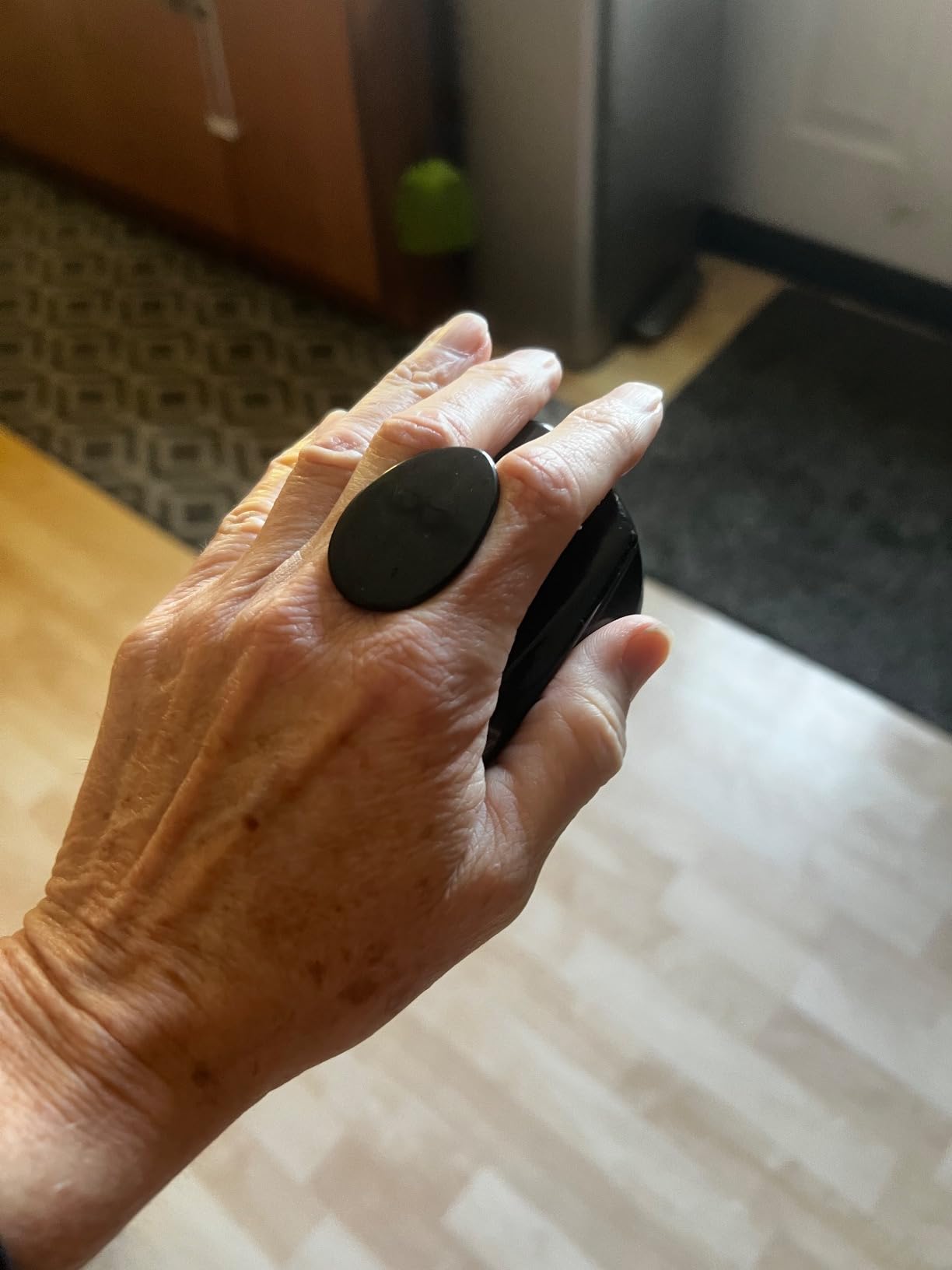
The distinguishing feature is the finger rest. Rather than asking you to squeeze the handle in a wet shower, it sits under your fingers so you can control downward pressure precisely, which is the difference between exfoliation and scratching. Reviewers who prefer a firmer scrub rate it highly for that reason.
Owners report the practical benefit immediately: it lathers shampoo far better than hands, and it protects your fingernails, which matters more than it sounds if you scrub your scalp with your nails during a wash.
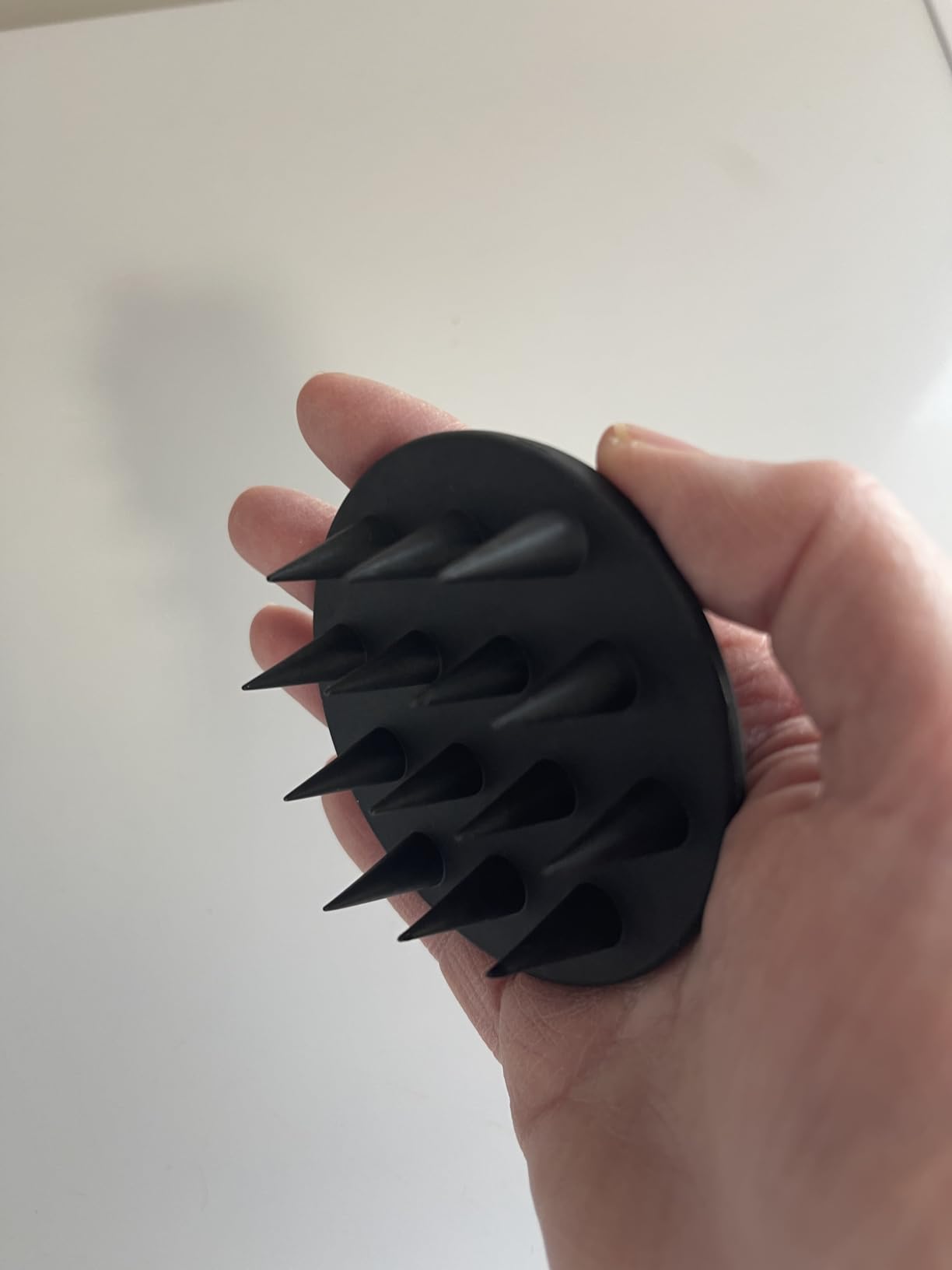
The most common positive theme is a visible reduction in dandruff and itch after a few weeks of regular use. Several people use it with hair oil or serum, which works well because the bristles distribute the product rather than dumping it in one spot.
Build quality is the weak point. Owners report the silicone insert loosening or popping out of the handle after weeks, and a few mention it shattering if dropped on hard tile. Treat it as a bathroom tool, not a travel accessory.
Is the finger rest worth switching to?
It is the main reason to choose this over a plain palm grip. The rest gives you a fixed reference point for pressure, so you can keep the same stroke across the whole head instead of unconsciously pressing harder on one side.
At the firmer end of the silicone range, it is a good middle ground between the very soft tips on the HEETA and the hard plastic prongs further down this list.
Why does the silicone insert loosen?
It is a fit-and-flex design where the silicone core plugs into the handle, and repeated hot water plus pressure loosens that interference fit over time. Owners report it within weeks for some and much longer for others.
If it starts to feel wobbly, replace it rather than pushing it back in. A tool that moves under pressure will not exfoliate consistently and can scratch at an odd angle.
5. Sndyi Wheat Straw Scalp Brush: Best for Thick Hair and Plastic-Free Shoppers
Sndyi Scalp Massager Shampoo Brush, Scalp Scrubber with Soft Silicone Bristles, Scalp Exfoliator for Dandruff Removal, Scalp Massager for Hair Growth, Wet Dry Hair Brush for Scalp Care, Green
Wheat straw and food-grade silicone body
44 teeth at 0.67 inches
2.36 x 3.54 x 3.54 inches
3.24 ounces
Pros
- 0.67 inch teeth reach through thick hair
- Wheat straw composite instead of ordinary plastic
- Hanging handle with non-slip grooves
- Eases itchiness and reduces oil
- Gift-boxed with a satin hair tie
Cons
- Some find the bristles softer than expected
- No featured customer review text was returned for this listing
Bristle length is the number that matters here, and this one specifies it: 44 high-density teeth, each 0.67 inches long. That is long enough to travel through dense or thick hair and still reach the scalp, which is where most shorter tools stall. If your hair is heavy at the root, that measurement alone decides it.
The body is a wheat straw composite with food-grade silicone teeth rather than conventional plastic, which matters to anyone trying to reduce plastic in the bathroom. We would not call it zero-impact, but it is a real alternative to the standard plastic shell most competitors use.
Reviews concentrate on two things: that the teeth reach the scalp through thick hair, and that the handle hangs with grooved grip so it stays put in the shower. Users report easing itchiness and reducing oil over a few weeks of use.
It arrives gift-boxed with a satin hair tie, and reviewers mention gifting it frequently. The rating distribution is unusually positive at around 80 percent five-star, on a much smaller review base than the top picks.
Does bristle length really matter for thick hair?
It is the most important spec on this list and most listings never state it. Bristles shorter than about half an inch work on the outside of your hair but never touch your scalp on anything but fine or flat hair. Longer teeth reach the roots, which is the entire point of a scalp tool.
Longer teeth also mean more chance of catching curl, so pair that length with single-direction strokes.
Is a wheat straw body genuinely a sustainable choice?
Partly. Wheat straw composite uses agricultural residue rather than fossil fuel feedstock, a genuine improvement over virgin plastic. It is not compostable and not plastic-free, since the silicone teeth are a petrochemical product.
Read it as a step rather than a solution. If sustainability is drawing you in, also check packing and expected lifespan, because a durable tool used for five years beats a sustainable one replaced annually.
6. Tangle Teezer Scalp and Shampoo Brush: Best for Stubborn Dandruff
Tangle Teezer Scalp & Shampoo Brush to Exfoliate & Massage, Lavender Purple
Dual-tier flexible teeth
Winged non-slip handle
Works wet or dry with oils and treatments
Pros
- Dual teeth exfoliate and massage in one pass
- Glides without the tangling silicone brushes cause
- Owners report less dandruff and itch
- Works with oils and pre-wash treatments
- Bristles hold their shape over time
Cons
- Felt painful for the first few uses
- Circular motions can knot longer hair
- Awkward for small hands
- Not recommended for sensitive or inflamed scalps
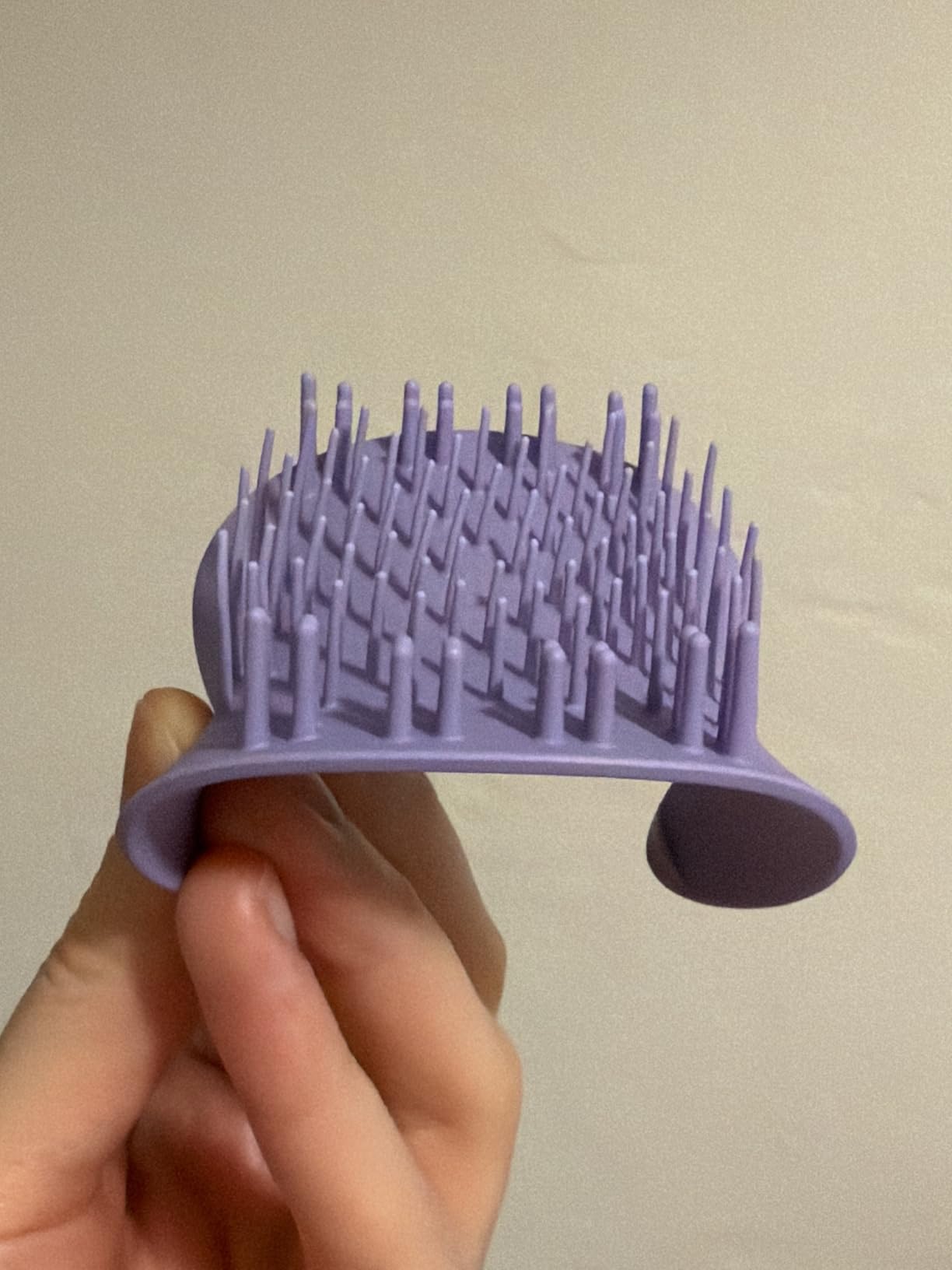
This is the most considered design in the roundup and the one that behaves least like a generic silicone nub. It has two tooth heights: long flexible teeth that clear buildup and dead skin, and shorter thicker teeth that press into pressure points along the scalp. One pass does both jobs, which is why the shape is worth the extra cost over a single-height brush.
Owners dealing with stubborn dandruff describe it as the tool that finally worked after a run of failed shampoos. It also glides through hair in a way most silicone scrubbers do not, so it is the safer choice if tangling is what has been stopping you.
The most useful tip repeated across reviews is technique: comb rather than circle. The teeth are shaped to travel in a line, and owners report that switching to a combing motion eliminated the knots they had with circular scrubbing. Durability is a genuine strength too, since the teeth hold their shape rather than softening.
Is it too painful at first?
It can feel aggressive for the first few sessions, and reviews do mention that. The teeth are firm rather than ultra-soft, so a new user working in tight circles will feel more than a new user working in long combing strokes.
Anyone with a sensitive or inflamed scalp should skip this one. The listing says it is not suitable for sensitive scalps, inflamed skin or detangling, and that exclusion is narrower than any other product here.
Why should I comb rather than scrub in circles?
Because circles rotate hair around the tooth as it travels, which is how knots form at the roots. A combing motion sets the hair down in a line, lets the teeth enter and exit along the same path, and still delivers the friction you want.
It also concentrates pressure where you are steering, so you get more exfoliation with less force. The combing motion is better technique for every tool on this list.
7. G.B.S Scalp Exfoliator 4 Pack: Best for Heavy Buildup on Thick Hair
G.B.S Scalp Exfoliator 4 Pack – Shampoo Brush, Scalp Scrubber for Dandruff Removal, Massager & Hair Exfoliator – Red & Black
Moulded plastic bristles with ring grip
6.9 x 2.7 x 3.7 inches
3.04 ounces
Firm bristle bed
Pros
- Firm bristles give a strong exfoliating scratch
- Reaches the scalp on thick and coily hair
- Deep cleaning extends time between oily buildups
- Sturdy finger ring grip
- Four brushes suit a whole household
Cons
- Hard plastic tips can be scratchy or unevenly rounded
- Too aggressive for sensitive scalps
- Ring grip is awkward on smaller fingers
- Prongs can snap off with regular use
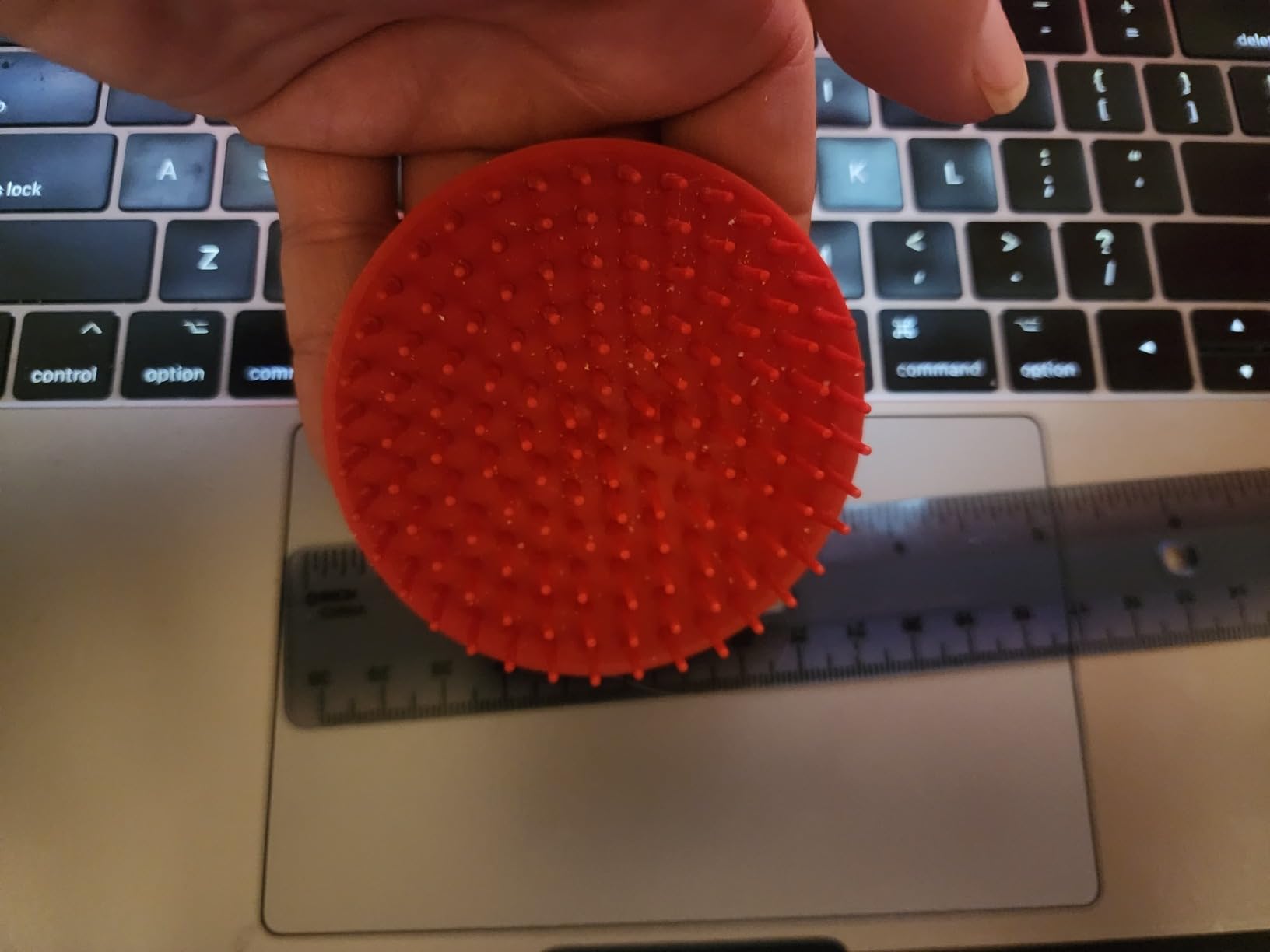
This is the most aggressive tool here and the right one for a specific job. If you have thick or coily hair and hard product film that a clarifying shampoo has not shifted, softer silicone brushes do not generate enough friction to move it. Firm moulded plastic prongs do.
Owners with oily, heavy scalps report that deep cleaning visibly extends the time between oily buildups, and several mention that shampoo struggles to reach the scalp on dense hair, which is the gap this brush fills. It also doubles as a beard exfoliator and a deshedding tool for short-haired pets.
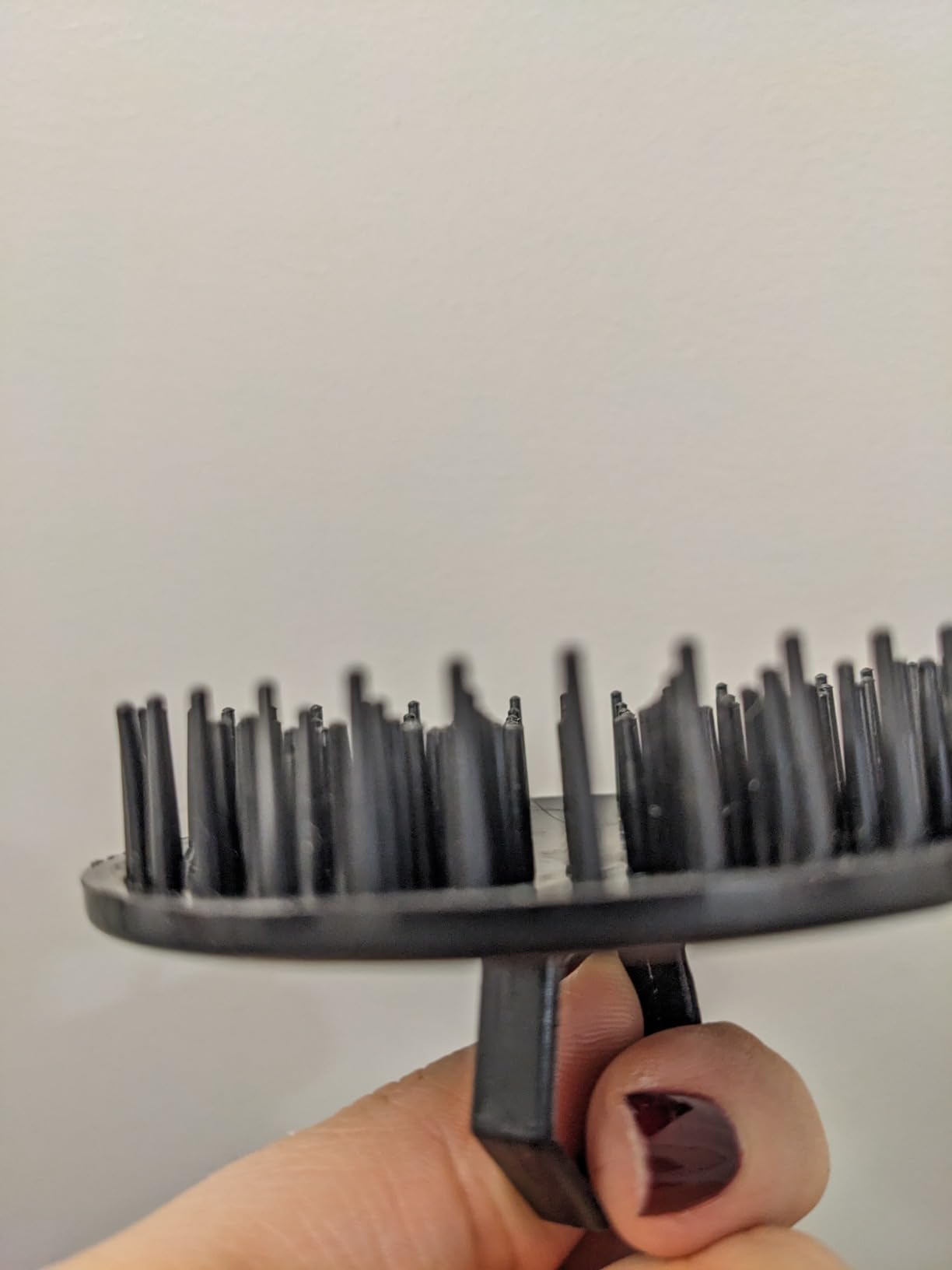
It is also the most polarizing pick here. Reviewers with flake-prone or sensitive skin report scratching from the hard tips, some of which are not smoothly rounded. Consensus advice across reviews is a light rub in the shower rather than aggressive scrubbing, with water running over the head so debris goes down the drain. The four-pack keeps one per bathroom or household member.
Is a hard plastic brush safe for sensitive skin?
No. This is the pick most likely to cause problems on a reactive scalp, and reviewers with sensitive or flake-prone skin say so directly. The tips are rigid and some are not smoothly rounded, the classic setup for micro-scratches.
If you have seborrheic dermatitis, eczema or a history of broken skin on the scalp, use one of the silicone options instead.
Will it break hair on thick or coily hair?
The rigidity cuts both ways. Because the teeth do not flex, they are less likely to wrap around and snap a strand than soft tips, but the scratching risk is higher and the tool is not gentle. Use it lightly and in one direction.
Reviews also mention prongs snapping off with regular heavy use, which is the price of the harder plastic.
8. Meartchy Silicone Scalp Massager: Best One-Piece Design and Highest Rated
Meartchy Silicone Scalp Massager Shampoo Brush, Scalp Brush for Hair Growth & Dandruff Removal, Hair Scrubber Scalp Stimulator Exfoliator Brush with Soft Bristles for Wet Dry Scalp Care (Black)
One-piece food-grade silicone body
4.2 x 4.2 x 2.5 inches
4.06 ounces
Oversized curved head
Pros
- Highest average rating in the roundup
- Curved head covers more scalp per pass
- Teeth firm at base and soft at the tip
- Users report losing less hair than massaging by hand
- Excellent lather so one wash is often enough
Cons
- Some users find the bristles on the harder side
- A small number of reviews question build quality
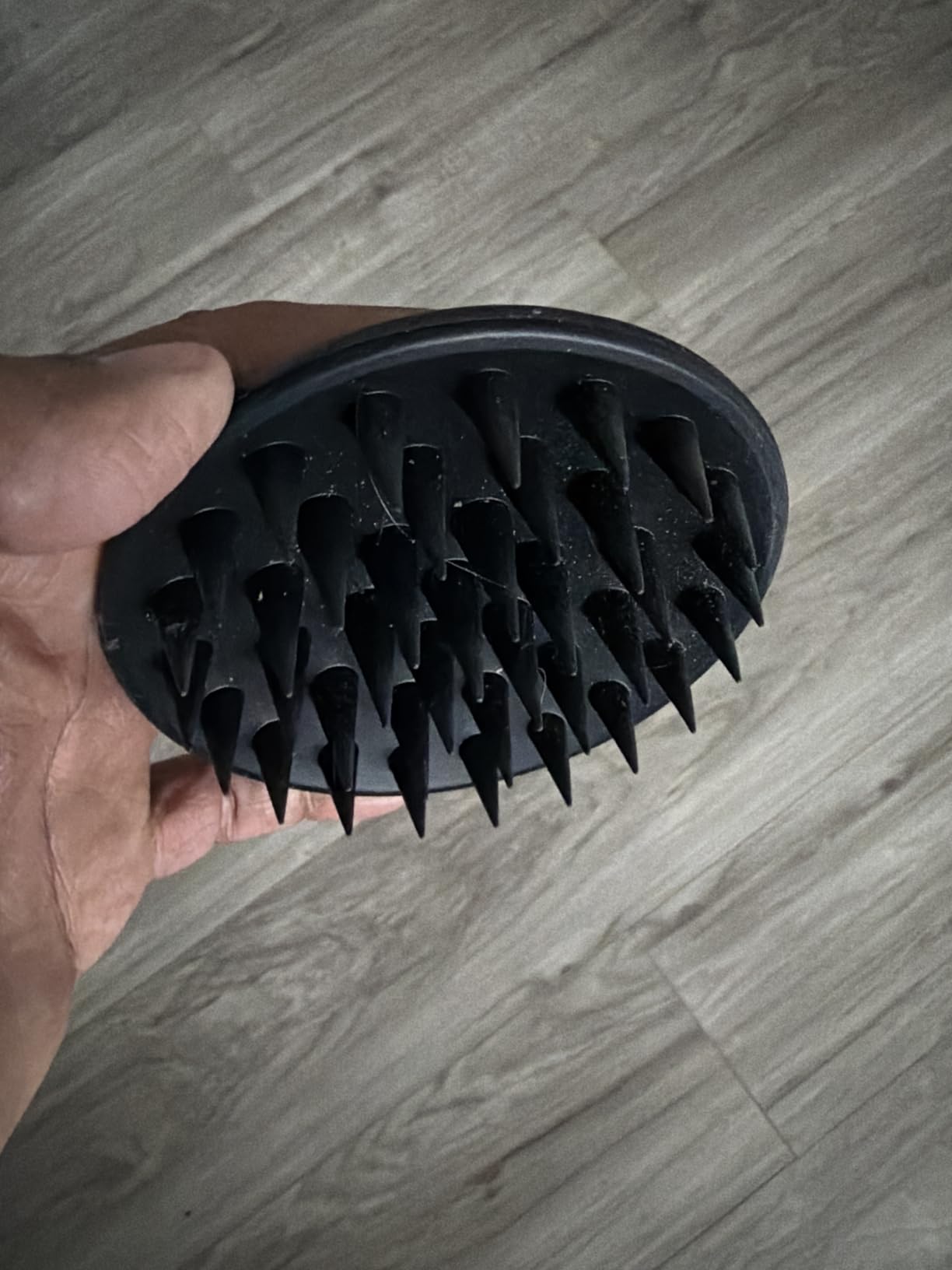
This has the highest average rating in the set at 4.7 stars with around 85 percent five-star reviews, and the design behind that is easy to see. It is moulded as one continuous piece of food-grade silicone with no separate core or join, which removes the failure mode that weakens most cheaper brushes here.
The head is the largest relative to the palm, at 4.2 inches across with a curve that follows the skull. Reviewers point out that you cover more scalp per pass, so a full head takes fewer strokes. The palm-rest section is thinner for finer control.
The claim we found most persuasive is that people lose noticeably less hair than when massaging with bare hands. That tracks with the design, because there is no seam for a strand to catch on. It also handles topical treatments well, which makes it useful for applying scalp oils.
There are no standing water pockets in the construction, so it rinses clean and dries out rather than holding moisture against your scalp. Two drawbacks appear consistently: some users find the teeth firmer than they want, and a small number question build quality.
Why does one-piece construction matter?
Because the most common durability failure in this category is a part coming loose. Tools with a separate silicone core plugged into a plastic handle eventually wobble and fall out, and the seam between two moulded sections becomes a place where fine hair catches.
Moulding the whole body as one piece removes both problems, and there is no joint to trap soap.
Is this the right brush for colour-treated hair?
It is a reasonable choice, though not for the reason you might expect. Smooth silicone with no hard plastic edges will not abrade the cuticle, and reviewers use it for at-home colour and scalp treatments where product needs even distribution.
The oversized head works in your favour here, because it means you can spread a treatment across the whole scalp in fewer passes without dragging the same section repeatedly.
9. Jupiter Scalp Exfoliator: Best for Fine and Thinning Hair
Jupiter Scalp Exfoliator – Scalp Massager Tool for Wet & Dry Hair – Ergonomic Detangler Brush – Dandruff Comb & Scrub to Remove Dandruff & Buildup and Support Circulation – Black/White
Multi-height flexible nylon bristles
3.5 x 3.5 x 2.5 inches
1.5 ounces
Ergonomic ring grip
Pros
- Two bristle lengths reach scalp and grip hair
- Does not tangle or snag like silicone brushes
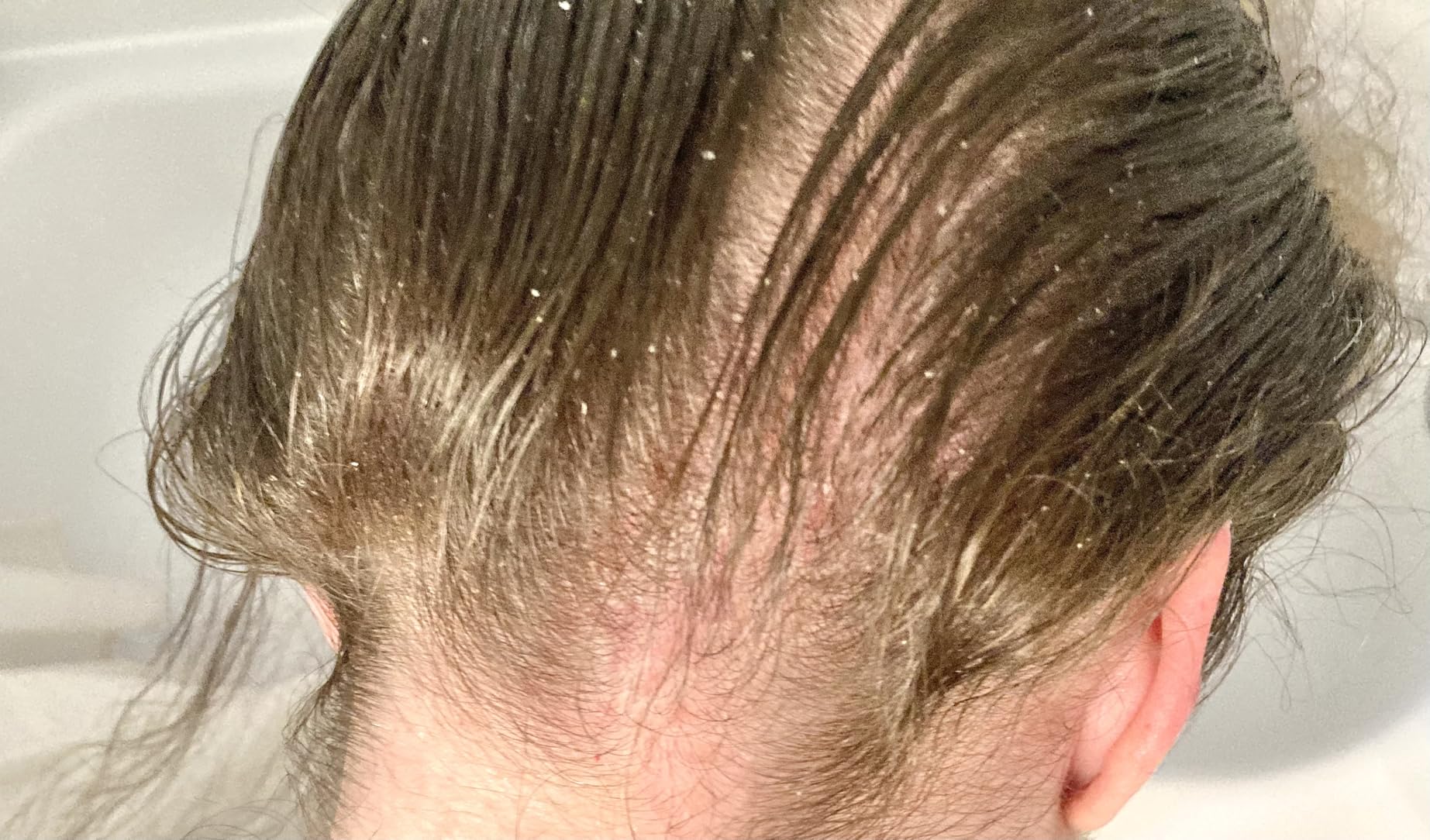
- Dry itch and flaking reported as reduced
- Lightweight with a secure finger ring grip
- Hangs to dry between uses
Cons
- Two-piece seam can catch and break fine hair
- Flat profile means rocking the hand to cover each area
- Nylon bristles feel brittle over time
- Costs more than most silicone options here
This is the one to consider if you have fine, thinning or chemically treated hair and have been put off by scalp brushes entirely. Reviewers with fine 4C hair describe it as genuinely exfoliating and stimulating without tangling, and it is listed as safe for thinning, colour-treated and treated hair as well as extensions, wigs and weaves.
The mechanism is the bristle heights. Two lengths are interspersed: the longer tips reach the scalp to exfoliate while the shorter ones grip the hair so you are not just pushing strands aside. At 1.5 ounces it is one of the lightest tools here.
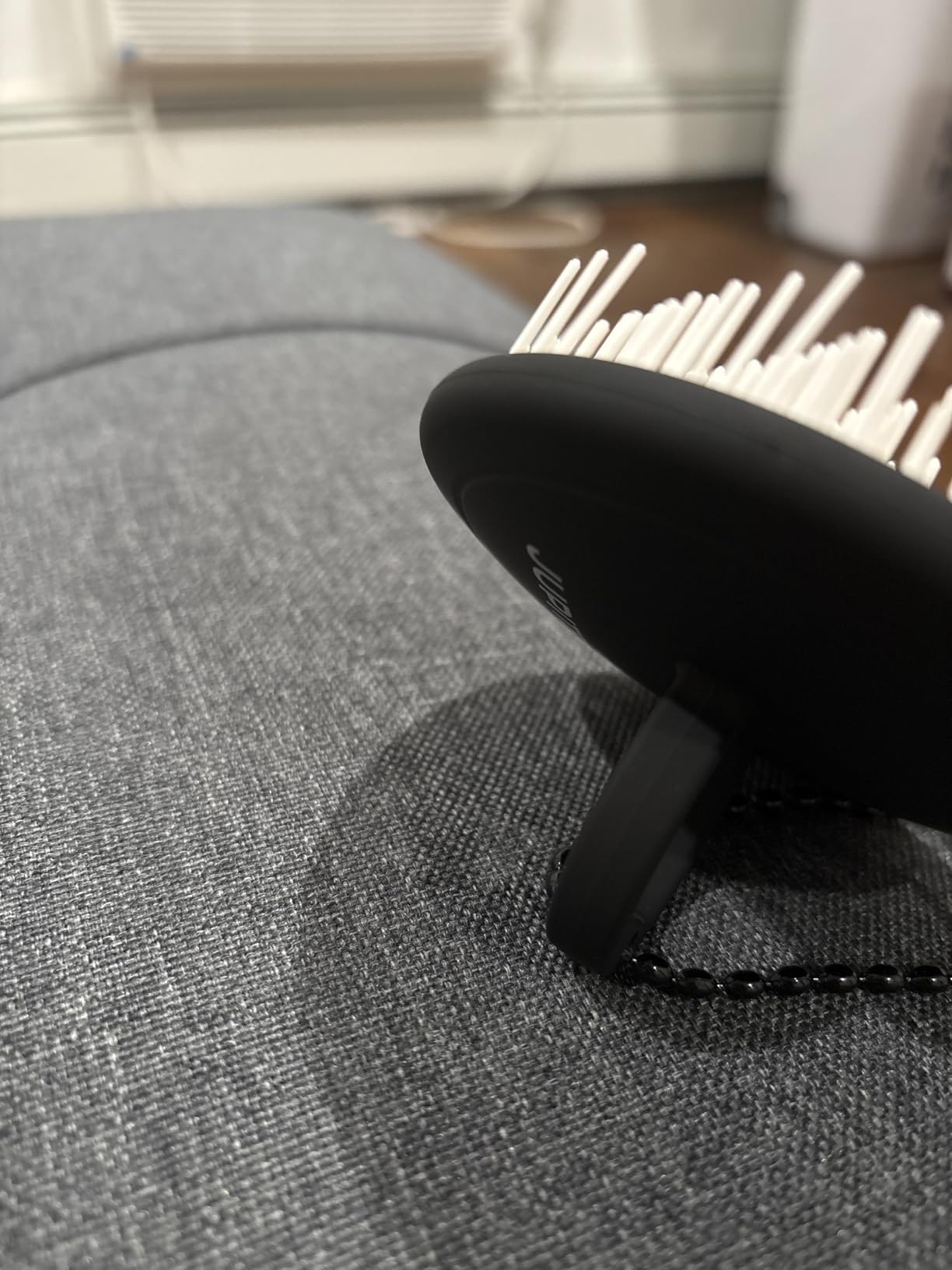
Owners with dry, itchy scalps report a noticeable reduction in flaking, and the ring grip with a hanging eyelet makes bathroom storage simple while letting the tool dry fully between uses.
The build is the weak point and reviews are specific. The junction between the two sections creates a seam that can snag fine hair, the profile is flat rather than curved so you must rock your hand to cover each area, and the thin nylon bristles feel brittle over time.
Is it safe for fine or thinning hair?
It is designed to be, and the listing names fine, thinning, colour-treated and chemically treated hair explicitly. The nylon tips are firm but thin, so they exfoliate without the coarse scratch of hard plastic.
The caveat is the seam. Owners of very fine hair report it catching strands at the join, so inspect it periodically and retire it if the plastic starts splitting.
Can you use it dry before shampooing?
Yes, and that is the intended dry use. Worked through dry hair before the shower, it lifts flakes and loose dead skin that then rinse away cleanly instead of being redistributed when you wet the hair.
It also applies a scalp oil well, since the shorter bristles distribute product evenly rather than concentrating it.
10. Avilana Premium Dual-Sided Scalp Massager: Best Dual-Sided Tool
Avilana Premium Scalp Massager Shampoo Brush – 8 Years Trusted Since 2017 – SGS Certified Silicone Scrubber, Soft Bristles All Hair Types, Gentle Scalp Exfoliation Hair Care Women Men Color Treated
SGS-certified food-grade silicone
Dual-sided scalp and body use
5.87 x 3.11 x 2.09 inches
5.61 ounces
Pros
- Certified silicone avoids odour and mould issues
- Dual-sided for scalp and body
- Non-porous surface rinses clean and dries fast
- Will not fade colour-treated hair
- Integrated hanging loop for drying
Cons
- Bristles can be too soft for a strong scrub
- Some variants lack the advertised hanging loop
- Lathers less readily so uses more soap
This is the pick where hygiene is the entire argument. The silicone is SGS-certified food-grade and the listing states it is BPA-free, phthalate-free and Prop 65 compliant, and owners who came from cheaper brushes single out the absence of odour and mould as the reason they stayed with it.
It is also the only genuinely dual-sided tool here. One face is shaped for the scalp with fine bristles and the other is coarser for the body, so it replaces a loofah too. The bristles are safe for colour-treated hair because smooth silicone will not abrade the cuticle.
The non-porous surface is the practical headline. It rinses clean with no soap residue, it does not discolour over time, and it dries quickly rather than sitting damp. One owner reports three years of use before a handle loop broke, which is exceptional in this category.
The recurring drawback is that the bristles are gentle, so people seeking a vigorous scrub or heavy lather are disappointed, and the body side needs more soap than a traditional loofah. Some buyers received a variant without the advertised hanging loop, so check the box on arrival.
Is a certified silicone scalp brush worth the extra cost?
You are paying for a material that will not absorb residue and develop odour, and a certification claim you can check rather than take on trust. For a tool that lives in a wet shower and touches your scalp regularly, that is a defensible premium.
It is also the easiest of these tools to keep clean, which reduces the small risk of a grimy tool recontaminating the scalp you are trying to improve.
Does it work as a body scrubber as well?
Yes, that is the second side’s purpose. It exfoliates the body better than most scalp tools because the bristles are denser, though it produces less lather than a loofah, so plan on using more soap.
If you already own a decent loofah, the dual-sided format is a bonus rather than the reason to buy it.
How to Use a Shampoo Brush Without Tangling Curly or Coily Hair
Combing strokes beat circular strokes, every time, on every hair type. Circles rotate hair around each tooth as it travels, which is how knots form at the roots. A combing motion sets the hair down in a line so the teeth enter and exit along the same path, and you get more exfoliation for less force.
Here is the sequence that works. Wet your hair thoroughly and saturate the scalp with water first, because friction on dry hair is what causes both scratching and tangling. Work your shampoo into a real lather with your hands before you introduce the brush, then start at the front hairline and comb backwards in short strokes, section by section, using light pressure.
Keep water running over your head as you work so lifted debris goes down the drain rather than onto your shoulders, and rinse before deciding whether a second pass is needed.
Pressure is the variable people get wrong. You want the bristles to flex against the scalp, not dig into it. If the silicone bends sharply under your hand, you are pressing too hard. Curly and coily hair needs the combing direction even more than straight hair, because the curl pattern gives the teeth something to wrap around.
How often should you use it? Most people get the best results weekly, or every other wash. Daily use is reasonable for an oily scalp with heavy product use, but it is unnecessary for most people and it is where irritation comes from.
Real users on haircare forums describe the same pattern: the tool made the biggest difference at the shampooing stage, after a clarifying shampoo had already loosened the buildup. For stubborn film, an oil pre-wash to dissolve sebum before shampooing is the community workaround that pairs best with a brush.
Which Bristle Type Is Best for Your Hair Texture?
Silicone bristles are the best default for most people. They flex on contact, so they clean and exfoliate without scratching, and they rinse clean without rusting or tangling easily. Almost every pick here uses them, and for a sensitive scalp or a first-time user they are the right starting point.
One important caveat before the material breakdown: a boar bristle hairbrush is not a scalp exfoliator. Boar bristles distribute sebum down the hair shaft and are a separate tool from everything on this list.
Nylon bristles are firmer still and give you defined pressure points. They are a good middle ground for someone who found silicone too gentle but does not want hard plastic, though they tend to feel brittle over time, so expect a shorter working life.
Hard plastic bristles are for thick, coily hair and heavy product film only. They generate the most friction of anything here and the reviews are polarised on exactly that axis: owners with oily, dense scalps rate them very highly, owners with sensitive or flake-prone skin report scratching. Some tips are not smoothly rounded.
Matching by texture is straightforward. Fine or straight hair wants shorter, softer tips so you are not levering hair upward and creating breakage. Medium and wavy hair handles anything mid-range. Thick, textured and coily hair wants long tips, half an inch or more, to reach the roots, plus the combing technique above.
Dandruff and styling-product buildup are the two jobs where the choice differs. For flaky skin, softness wins and pressure comes down. For heavy film, you need length and firmness, ideally paired with a clarifying shampoo.
Is It Safe to Use a Scalp Brush With Dandruff or Flaking?
Use a soft-bristled tool, at low pressure, no more than about once a week, and stop immediately if the scalp feels irritated afterwards. A brush can lift flakes and product that washing leaves behind, but it is not a treatment for seborrheic dermatitis and it is not a substitute for a medicated shampoo or a dermatologist’s advice.
Scratching flakes off with your nails is the thing to avoid. It spreads flakes, damages the barrier and risks excoriation, which is exactly the cycle that keeps a scalp flaking. A soft silicone brush is a controlled alternative to nails because the pressure is even and the tips are smooth, but only if you keep the pressure light.
Skip a scalp brush entirely if you have active psoriasis, eczema, any open wound on the scalp, a recent scalp procedure, or if you are using a retinoid or acid treatment there. Those cases need healing, not friction. Exfoliation that goes too far shows up as increased flaking rather than less, so rising flakes after two weeks is your signal to stop.
That last point inverts the usual instinct. More scrubbing does not fix a flaking scalp. If flakes rise after a few sessions, the answer is a softer brush, less pressure and less frequency, not more work.
How to Clean, Dry and Store a Shampoo Brush
Rinse the brush under the shower immediately after every use, working the bristles through your fingers to clear soap and lifted skin rather than just tipping the head back. That takes seconds and it is the single most important habit, because trapped residue in a bristle bed is what turns a helpful tool into something that recontaminates the scalp you were trying to fix.
For a deeper clean, work a small amount of mild shampoo through the bristles by hand once a week, or soak it in warm water with a drop of shampoo for ten minutes and work it through again. If your tool is silicone, an occasional diluted vinegar soak helps clear film and odour. Avoid boiling water, harsh cleansers and dish soap, which degrade silicone over time.
Dry it upright or by its hanging loop with the bristles facing down so water drains out. Most of the tools here include a loop or an eyelet for a shower hook, which is the detail that keeps bristles from staying damp. Never seal it in a drawer while wet, because a damp bristle bed is exactly where odour and biofilm start.
Replacement is not a fixed schedule, it is a condition check. Replace a brush when the silicone tips have lost their snap and bend under light pressure, when any bristle has cracked or snapped off, when the moulded surface has gone rough and holds residue, or when the handle joint moves. For most people that lands somewhere between one and two years with regular use.
What Real Users Report
The forum consensus is more positive than the scepticism online suggests. In haircare communities the tool is routinely recommended rather than dismissed, with users saying the thing they most wanted was to see buildup actually come away.
The most common positive report is mechanical and specific: flakes and product coming loose in the rinse, less itch after a couple of weeks, and better lather so one wash replaces two. The most common complaints are tangles from circular motions, bristles that feel too hard, and tools that trap soap.
The other recurring theme is scepticism about hair growth claims. Users tend to accept the buildup and itchiness benefits and treat growth language as marketing, which is the right read. This tool clears a congested follicle surface. It does not change hormones or biology, and anyone promising growth from a brush alone is overselling.
Frequently Asked Questions
Do scalp exfoliating brushes work?
What is the best brush for removing scalp buildup?
What is the best hair brush for exfoliating the scalp?
Which brush is recommended for scalp stimulation?
Do scalp massagers get rid of dandruff?
Is it good to brush your scalp if you have dandruff?
Is it good to scrape dandruff off the scalp?
Do scalp massage brushes actually work?
How often should I use a shampoo brush?
Should you exfoliate your scalp with a brush or a scrub?
Will a scalp brush break my hair?
Is scalp exfoliation good for hair growth?
The Bottom Line
The HEETA scalp massager is our pick for the best shampoo brushes for scalp exfoliation in 2026 because soft silicone bristles that exfoliate without scratching, a bristle spacing that will not tangle and a review base far larger than anything else here add up to a tool you will actually keep using.
Pick the Sndyi if your hair is thick and you want long bristle reach, the Tangle Teezer if dandruff is your main problem and you like a considered design, the G.B.S if you have heavy product film on dense hair, and the Avilana if hygiene and material certification matter most to you. The Cbiumpro two-pack is the sensible choice for a shared bathroom.
Whatever you choose, wet your hair first, comb rather than scrub in circles, keep the pressure light and wash the tool after every use. Those four habits do more for your scalp than any amount of extra scrubbing.