
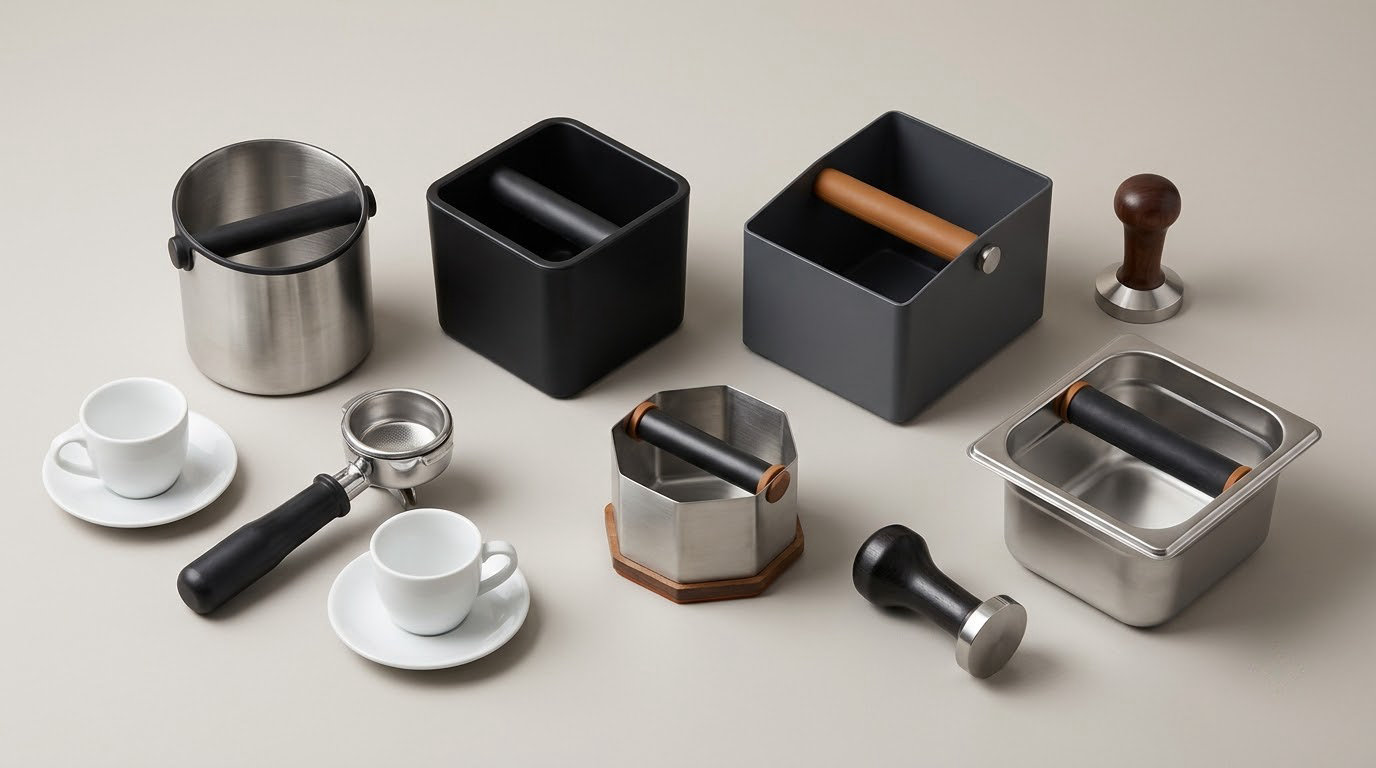
The best knock box for espresso is the Dreamfarm Grindenstèin, because its solid steel core and thick rubber knock sleeve absorb the strike instead of ringing, and the whole thing tucks onto your machine’s drip tray. I tested knock boxes the way I actually brew: pull a shot, knock the puck, look at the counter afterwards. That simple loop exposes the three things that matter, and most cheap bins fail at least one of them.
This roundup covers seven knock boxes for espresso that survive real home use, from the compact plastic models you can store under a machine to the 1.5 litre stainless option built for a busy station. I weighed every one of them on the same three criteria the people who publish roundups keep naming: knock bar material, base grip, and capacity. I also tracked the two things buyers complain about most, noise and scattered grounds.
Worth saying up front, because it comes up constantly in the forums: yes, you need one. An espresso knock box is the only place to put a spent puck that is not your counter, your grinder’s chute, or your sink drain. If you have just bought a machine from our beginner’s espresso machine guide and your setup has a tamper and a mat but no bin, that is the gap to close first.
Table of Contents
Top 3 Picks for Espresso Knock Boxes in 2026


HOMEE 4.8 Inch Knock Box
- Detachable rubber bar
- Tucks under most machines
- Non-slip rubber base
Quick Overview: All 7 Knock Boxes in 2026
Every pick below appears in the same order as the full reviews, so you can jump straight to the one that matches your counter. The short version: the Grindenstèin and the homeffect win on knock-bar design, the Apexstone wins on volume, and the Ourokhome wins if grinds on the counter bother you more than bulk does.
| Product | Specifications | Action |
|---|---|---|
| Dreamfarm Grindenstèin |
|
Check Latest Price |
| homeffect Knock Box |
|
Check Latest Price |
| HOMEE 4.8 Inch Knock Box |
|
Check Latest Price |
 Ailelan Metal-Bar Knock Box Ailelan Metal-Bar Knock Box |
|
Check Latest Price |
 Apexstone 1.5 L Knock Box Apexstone 1.5 L Knock Box |
|
Check Latest Price |
 Breville Knock Box 10 Breville Knock Box 10 |
|
Check Latest Price |
 Ourokhome Knock Box with Lid Ourokhome Knock Box with Lid |
|
Check Latest Price |
1. Best Overall: Dreamfarm Grindenstèin Knock Box for Espresso
Dreamfarm Grindenstèin Sturdy, Compact, Modern Space-Saving Espresso Coffee Grind Knock Box – Silver
Solid steel core
Rubber knock sleeve
4 x 4 x 4 inches
8.6 ounces
Pros
- Compact enough to store on the drip tray
- Thick rubber sleeve absorbs impact quietly
- Solid steel core is hard to break
- Dishwasher safe and rinses in seconds
- Rubber base protects the countertop
Cons
- Holds only about 3 to 6 pucks
- Centred bar splits a puck into two halves
- Small diameter scatters grounds on an off-angle knock
The Grindenstèin is the one I reach for first, and it is the pick I put on the counter of anyone who asks me where to start. The build is unusual for something this small: a solid steel core wrapped in a shock-absorbing body, which explains why it feels dead rather than springy when you strike it. Around 8.6 ounces and 4 x 4 x 4 inches, it is genuinely a drip-tray object, not a countertop object.
Over weeks of daily shots, the knock sleeve did the job it advertises. The rubber absorbs the strike, the puck releases cleanly most times, and the sound is a dull thud rather than the metallic ring that makes people flinch at 6am. The rubber base also means it does not skate across the tray when you hit it harder than you meant to.
The honest weakness is capacity. Owners consistently report three to six pucks, which on a two-coffee-a-day routine means emptying most mornings, and on a four-shot morning means emptying twice. If you compost, that is a walk to the pile every day or two, which is exactly the friction that makes people abandon a bin and start knocking pucks onto the bench. The packaging even includes ideas for using the collected grounds as garden fertilizer, which is a nudge in the right direction.
Two smaller quirks show up often. The knock bar is centred, so a puck can break into two halves rather than dropping whole, and the small diameter means a knock from an angle can put grounds on the counter. Neither is a dealbreaker at two shots a day. Both are annoying at six.
Check the capacity before you commit
If you pull more than three coffees a day, do the arithmetic on emptying rather than falling for the footprint. Three to six pucks at four shots a day is a bin you empty every day and a half, and the round trip to an outdoor compost pile is what pushes people toward something larger.
Also measure your drip tray. The Grindenstèin’s whole argument is that it stores on the tray, and that only works on machines with a wide, flat drip tray. Curved or narrow trays will push it onto the counter beside the machine, which is still fine but negates the saving.
Skip it if your counter is already tight on space
This is the smallest bin in the lineup, and the smallness is the feature, not a flaw. But if you are already rationing counter space, buying a compact bin and then having to clear it out twice a day is a trade that will annoy you within a fortnight.
Owners of larger, quieter bins report the opposite experience, where the puck drops past the bar without breaking up and the splash guard keeps everything in. If your priority is a calm counter rather than a small one, the Apexstone or the Breville is the better fit.
2. Most Versatile: homeffect Knock Box with Column-Style Knock Arm
homeffect Knock Box for Coffee Grounds – Innovative Barista Accessory with Improved Handling – Coffee Knock Box for Espresso Machine, Black
Column-style knock arm
600 ml capacity
4.8 x 4.8 x 4.6 inches
180 g
Pros
- Raised back panel stops grounds hitting the counter
- Anti-slip rubber base dampens sound
- Column arm resists the basket dislodging
- 600 ml holds more pucks than most
- Double as a bin for stray tamping grounds
Cons
- ABS plastic looks less premium than steel
- Holds roughly 4 to 6 pucks
- Needs a light tap rather than a hard knock
The homeffect is the pick that solves the two complaints the forums repeat most, which are counter mess and noise. Instead of a simple crossbar, it uses a column-style knock arm with a raised back panel, and that geometry is what keeps the puck travelling in one direction rather than arcing over the rim. The anti-slip rubber base does double duty, holding the box steady and killing the rattle underneath it.
At 600 ml and 4.8 x 4.8 x 4.6 inches, it is a little larger than the Grindenstèin but still fits most drip trays. Around 180 g, it is still light enough to move one-handed while dealing with a hot portafilter. The body is ABS plastic and the wide opening means cleanup is a quick rinse, or the dishwasher.
Technique is the thing to read carefully. Because the column arm is designed to resist the portafilter basket coming loose, several users report needing several gentle taps rather than one hard swing. Hit it hard and you can dislodge the basket or shift the box. Once you switch to a firm, controlled tap, the grounds stay contained and the noise stays low.
Doubles as a tamping bin is a nice secondary use. When you tamp, stray grounds fall straight into the wide opening rather than across your counter, which is a real time saver across a morning of single shots.
Style is the trade. ABS plastic reads as a step below the stainless models, and buyers who wanted a bin to match a brushed steel machine often find it looks plainer. That is an appearance judgement, not a build judgement, and the knock-arm design is the more interesting engineering on offer here.
Check whether a column arm suits your knock style
Column arms reward control. If you are the person who swings the portafilter hard out of habit, the first few shots will feel wrong and the box may shift under the strike. Two or three sessions of a firmer, shorter tap and the behaviour changes completely.
If you are not fussy about technique, the Breville’s simpler bar is easier to hit without thinking, and the Dreamfarm’s centred sleeve is the most forgiving of the three. This pick is for the person who has already decided that mess on the counter is the thing to eliminate.
Skip it if a plastic body bothers you
There is no way around the material. If your machine is brushed stainless and you want the bin to disappear into the setup visually, the Breville Knock Box 10 or the Ourokhome is a closer match, both of which carry a steel exterior.
Capacity is also worth a second look. 600 ml sounds generous until you count pucks, and the realistic figure from owners is four to six. That is a modest improvement on the Grindenstèin, not a different class of capacity.
3. Best Value: HOMEE 4.8 Inch Knock Box with Removable Bar
HOMEE Coffee Knock Box 4.8 Inch Barista Style Knock Box With Removable Bar
Detachable rubber knock bar
4.8 x 4.8 x 5 inches
10.4 ounces
Non-slip base
Pros
- Stores under most espresso machines
- Rubber bar will not dent or scratch a portafilter
- Bar lifts out for fast cleaning
- Non-slip base keeps it stable and quiet
Cons
- Basic plastic construction
- Flexible bar lets grounds go over the rim on a very hard knock
The HOMEE is the one to buy if you want a knock box for espresso that simply works and does not ask for anything. The 4.8 inch body is designed to slide underneath most machines, which means it takes up counter space you were not using, and the detachable rubber bar lifts out so emptying is a two-second job rather than a fishing expedition with a spoon.
The bar itself is food-safe rubber, and the maker is explicit that it will not dent or scratch a portafilter. That matters more than it sounds. A hard plastic bar concentrates the whole strike into one small contact point, and the chrome on your basket rim takes the hit. A rubber sleeve spreads it.
Over daily use the non-slip rubber base did its job, both stabilising the box and cutting the noise that comes from plastic sliding on a hard surface. Owners describe it as an affordable, compact bin that tucks away, which is exactly the brief.
The limitation is flexibility. Because the bar is rubber rather than a metal-rubber hybrid, a very hard knock can send grounds over the rim. If you are a heavy hitter, either moderate your knock or look at the Ailelan, which pairs the rubber with a metal core.
Build is straightforward ABS plastic with no premium feel. It does not look like a piece of equipment you would leave out for display, which is a feature if your machine lives in a cabinet-adjacent corner and a drawback if the coffee corner is the room’s focal point.
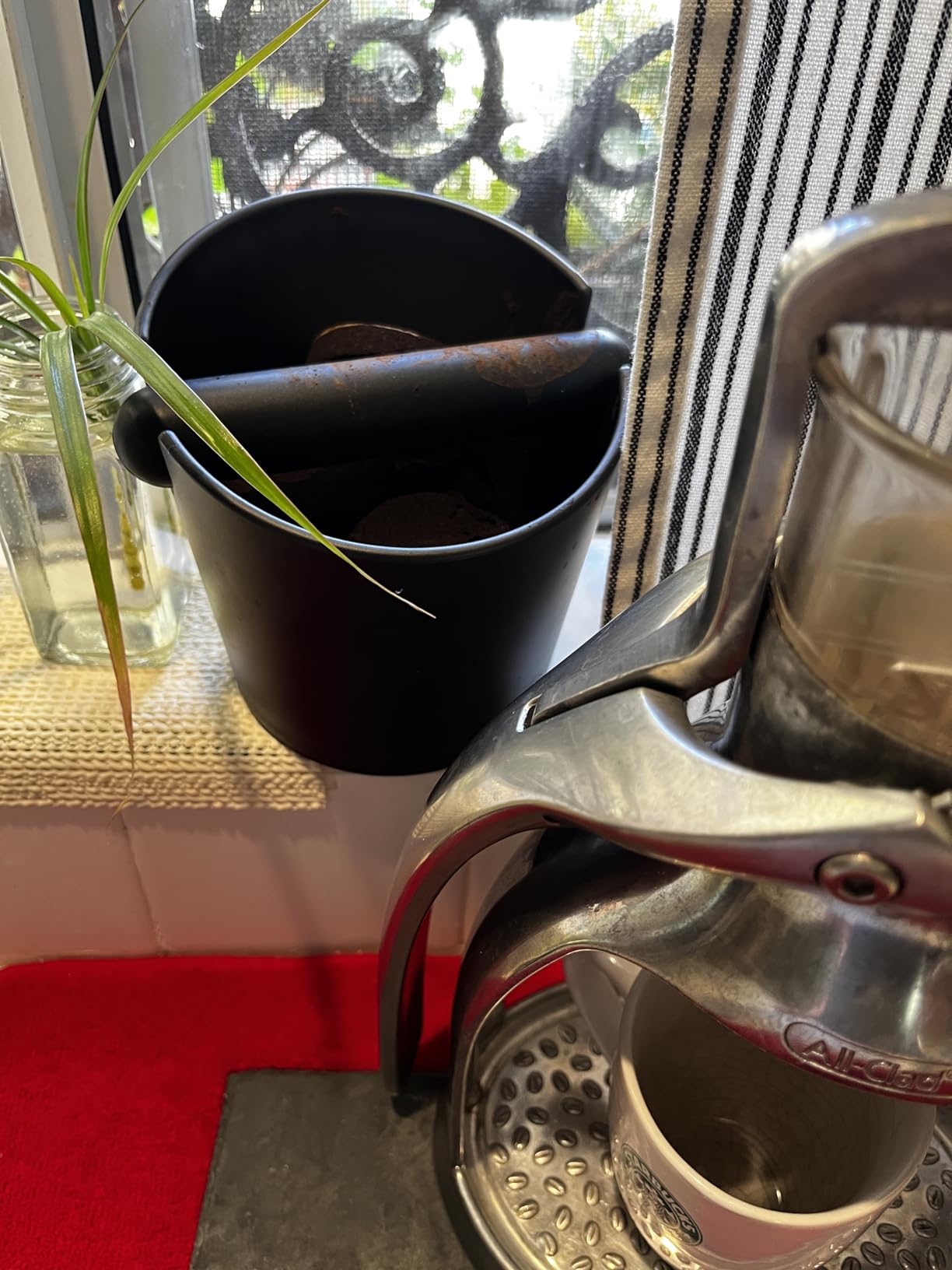
Check the height clearance under your machine
The selling point is that it stores underneath most espresso machines, and that depends on how high you can raise the drip tray plus the machine’s clearance. Measure the gap with the tray in its highest position before you order, because a bin that has to live beside the machine instead of under it is a different product.
At 5 inches tall it is the tallest of the compact plastic models here, which is why the clearance check matters more for this one than for the flatter Grindenstèin.
Skip it if you knock aggressively or want a steel look
Heavy hitters should know that the pure rubber bar deflects further than a metal-rubber one, and that deflection is what throws grounds over the edge. A knock box with a reinforced bar, or a wider mouth, will tolerate a hard strike without a mess.
There is also no lid and no splash guard, so a puck that lands wrong can put grounds on the counter. For a low-to-moderate knocking style in a small kitchen, that is an acceptable trade for the simplicity.
4. Best Metal-Bar Durability: Ailelan Knock Box with Removable Metal Bar
Ailelan Coffee Knock Box, Espresso Knock Box, Coffee Bin, Espresso Dump Bin, 4.8 Inch Shock-Absorbent Durable Barista Style Espresso Knock Box with Removable Metal Knock Bar and Non-Slip Base(Round)
Metal-rubber knock bar
Deep-bent body
4.72 x 4.72 x 4.84 inches
10.6 ounces
Pros
- Metal-rubber bar outlasts plain rubber
- Deep-bent body contains splashing
- Bar detaches for cleaning
- Compact enough to sit under a machine
Cons
- Plastic body looks plain
- Modest capacity for heavy daily use
The Ailelan’s reason to exist is the bar. Where most of the compact bins use a rubber or plastic crossbar, this one uses a metal-and-rubber knock bar, which resists wear and keeps its shape after months of daily strikes. If your worry is a bar that slowly deforms, this is the one built to avoid that.
The second design decision is the deep-bent body with an oblique mouth. The bend pushes the puck downward and inward instead of letting it skid along a flat floor, and the angled opening means you can get a closer approach angle when knocking. In practice it is one of the better-contained bins at this size.
At 4.72 x 4.72 x 4.84 inches and 10.6 ounces, it sits in the same footprint class as the other compact models and stores under most machines. The bar detaches, so cleaning and emptying are quick, and the non-slip base keeps it planted on the counter.
Owners rate the build as sturdy and no-frills, and the manufacturer positions it for home use as much as cafes and bars. The shock-absorbing body takes the edge off the strike, which keeps the noise down without needing extra damping.
Capacity is the honest limit. Owners describe it as fine for a few coffees a day and wanting more for heavy use. It is a bin sized to a domestic routine that occasionally hosts friends, not a station that runs shots back to back.
Check whether you need a reinforced bar at all
Reinforcement is only worth paying for if you knock hard or if your current bar has started to deform. If your knocking style is controlled, a well-made rubber sleeve on a steel core, like the Grindenstèin’s, absorbs more energy than this design and will outlast most plastic bars anyway.
A useful test is to look at the bar on a box you already own. If it is visibly compressed, faded, or shedding rubber, you are the person this pick is for. If the box is going in the bin after a year, the metal core is the safer long-term choice.
Skip it if you want a premium appearance
This is a functional bin. The plastic body is not trying to match brushed steel, and it will read as the most utilitarian object on a coffee corner. Buyers who are matching finishes should look at the Breville or the Ourokhome instead.
There is also no lid, so a badly aimed knock can still scatter. The deep bend reduces it rather than eliminating it, which is a different promise from the wrap-around design on the Ourokhome.
5. Best Built-In Design: Apexstone 1.5 L Stainless Steel Knock Box
Apexstone Coffee Knock Box Stainless Steel, 6.9 Inch Espresso Knock Box for Espresso Coffee Grounds, 1.5L Large Capacity Built-In Knock Box with Rubber Knock Bar for Home Barista & Coffee Bar
1.5 L capacity
6.9 x 6.4 x 4 inches
Stainless steel body
15.2 ounces
Pros
- Stainless body survives years of daily knocking
- 1.5 L means far fewer emptying trips
- Smooth interior resists coffee residue
- ITL rubber rod cushions the handle
- Drop-in design suits a built-in station
Cons
- Bulky footprint for a small counter
- Steel base on a hard counter is loud
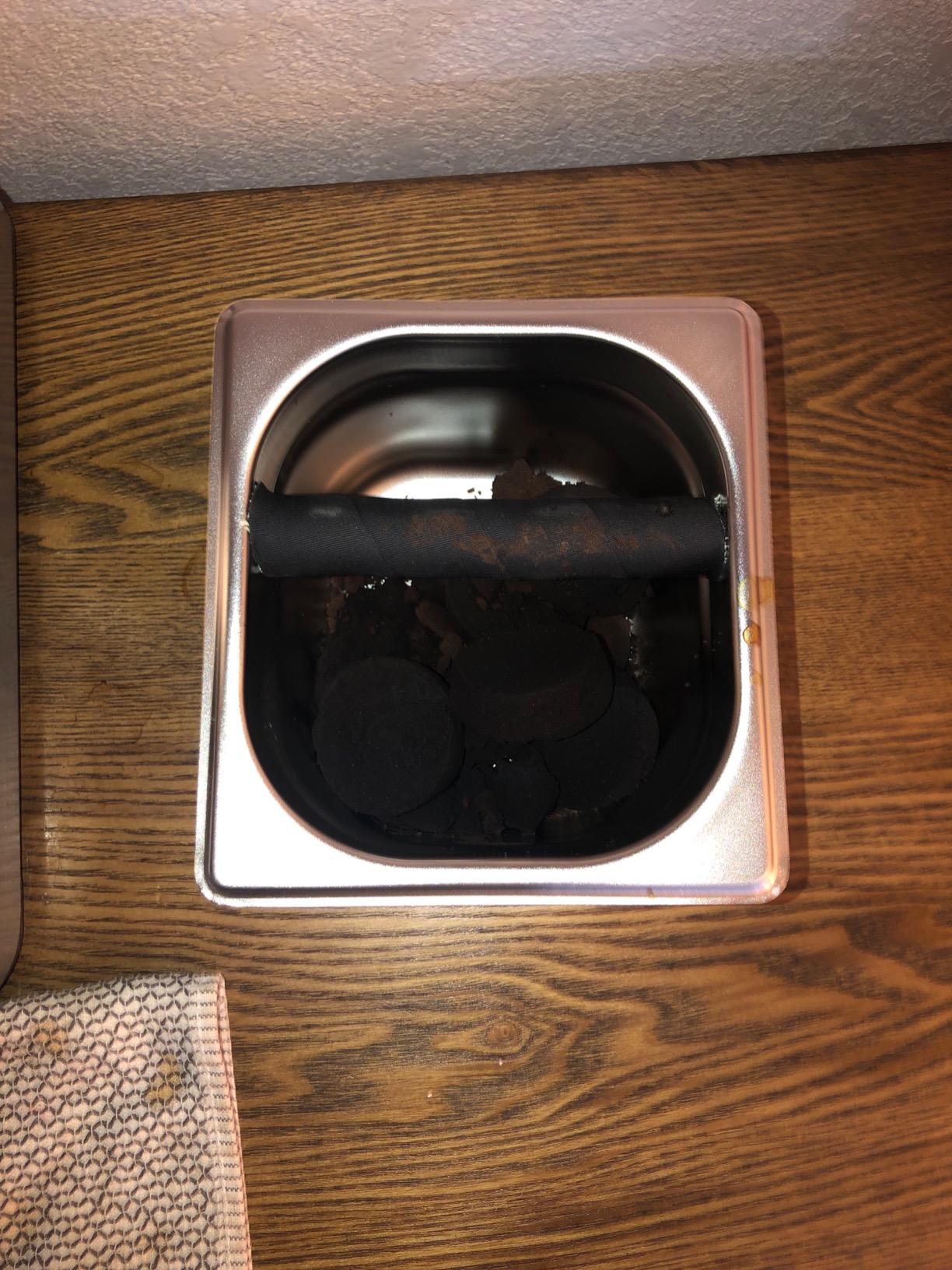
The Apexstone is the volume answer. At 1.5 litres and 6.9 x 6.4 x 4 inches, it holds far more pucks than the compact models, and that is the whole point. If you pull four or more coffees a day, or you compost, this is the pick that stops the daily bin run. If your setup runs long hours rather than a couple of quick shots, our dual boiler espresso machine roundup covers the machine side of a high-volume station.
Long-term owners report no visible wear on the rubber rod after years of daily use, and the stainless body is the most rigid in this roundup. The stainless interior is smooth, resists residue, and goes through the dishwasher, so there are no seams to trap wet grounds and no lingering smell.
The knock rod is ITL engineering rubber, chosen for cushioning. It takes the sting out of the strike and protects the portafilter handle, which is the same job the rubber sleeves on the smaller bins do, just in a body that is far more rigid around it.
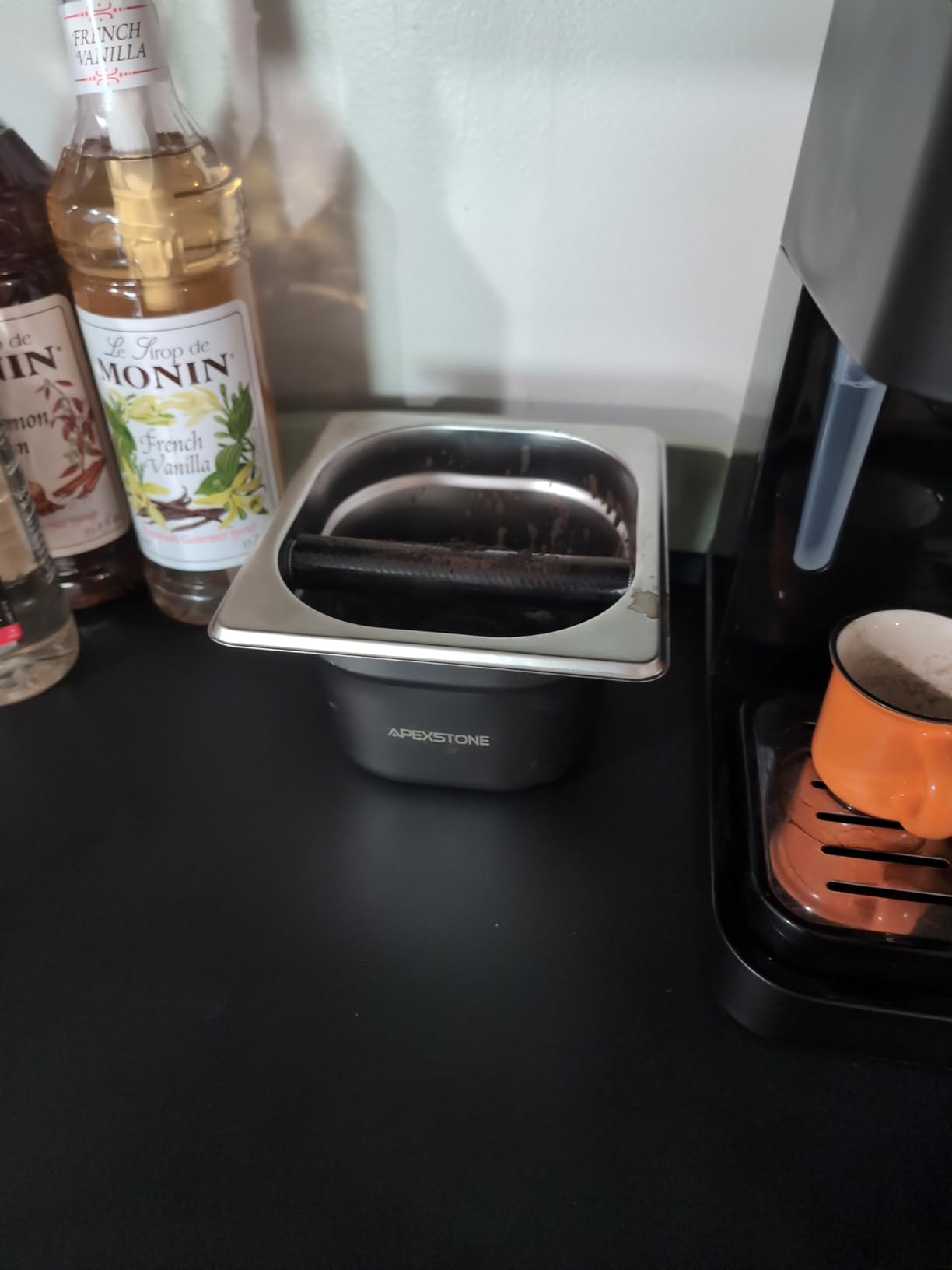
It is also designed as a drop-in unit for a built-in station, which is worth noting if you have ever considered the counter-sunk route. The built-in knock box threads in r/espresso are the most-requested idea in the category and the option most roundups skip, so a unit that supports a drop-in install is a genuine advantage if your counter can take it.
Size is the other side of that coin. Buyers routinely find it bulkier than expected, and on a small counter it will not tuck under a machine or live on a drip tray. It wants a dedicated square of worktop.
Check whether your counter can take a drop-in install
Before committing to a built-in setup, work out whether your counter has a plumbed or angled waste opening and how thick the surface is. The drop-in design suits a planned station, and retrofitting one into an existing counter is a much bigger job than ordering a bin.
If you are not building a station, treat the built-in capability as a bonus rather than the reason to buy. Sit it on the counter instead, and confirm the 6.9 by 6.4 inch footprint leaves you room to get the portafilter in and out without knocking the machine.
Skip it if noise on a hard surface bothers you
A steel body on a stone or laminate counter rings. Some owners solve it with a silicone mat or a wooden housing under the base, and that fix works, but out of the box this is the loudest pick here for a hard surface.
The other reason to pass is counter space. Everything the compact models give you in footprint, this one takes back in bulk. That is a fair trade for fewer emptying trips, and a bad trade for a single coffee a day.
6. Best for Breville Owners: Breville Knock Box 10
Breville BEA501BSS Knock Box 10 Espresso Accessory, Brushed Stainless Steel
Holds up to 10 pucks
7 x 7 x 7 inches
Stainless steel
Padded base
Pros
- Matches Breville machines visually
- Removable bar makes cleaning a quick rinse
- Sturdy bar gives a clean satisfying knock
- Stores on the drip tray when not in use
- Build holds up over years of daily use
Cons
- Brushed stainless shows fingerprints easily
- Capacity suits one or two coffees a day
The Knock Box 10 is the pick if you want the bin to look like it came from the same people who made your machine. Breville designs these as official accessories in their own Luxe design language, and the brushed stainless finish sits next to a Breville machine without a seam. That is a harder thing to buy than it sounds, because a plastic bin next to a steel machine looks borrowed.
Capacity is the useful headline: up to 10 espresso pucks, with owners reporting around eight to ten in practice. That is a real improvement on the three to six pucks of the compact drip-tray bins, and it means a couple of mornings between emptying at a normal domestic volume.
The bar removes for cleaning the inner vessel, so cleanup is a sink rinse rather than a scrub, and the padded base absorbs the force of the strike. Several years of daily use reports show no functional issues and barely visible wear on the rubber bar.
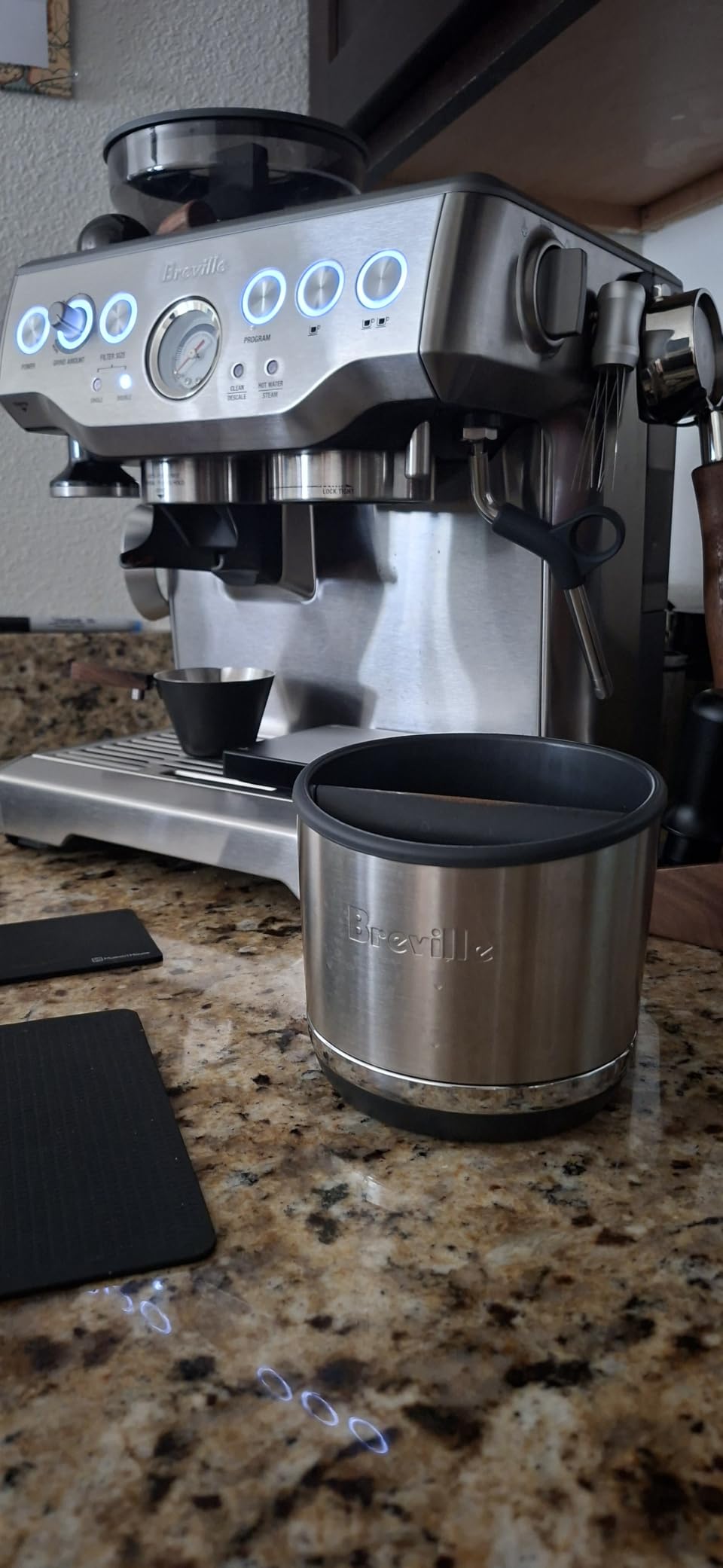
On the question people search for most about this product, the consensus is favourable: owners describe it as well made, stable, quiet, and easy to empty, with the removable bar and 10-puck capacity the two most-praised details. The complaints are cosmetic rather than functional.
The 7 x 7 x 7 inch cube is the one detail to check. It is a large shape for a knock box, though it is designed to stow on the drip tray when you are not using it, so its resting place is under the machine rather than on the counter.
Check the 10 and 20 size question before you buy
The number in the name refers to puck capacity, not litres or dimensions. The Knock Box 10 holds up to 10 espresso pucks. If you have seen the 20 referenced, that is the larger sibling with double the puck capacity, and it is the right choice for heavy daily volumes or a shared household bar.
For one or two coffees a day, the 10 is already more than you need. For four or more, or for a small cafe-style setup, go up a size rather than emptying twice as often.
Skip it if fingerprints drive you mad
Brushed stainless shows handprints and smudges readily, and this is the most-cited drawback across reviews. On a dark kitchen it is a weekly wipe-down; on a matte black machine it is a non-issue.
If you do not own a Breville, this becomes a generic stainless knock box at a premium tier, and the Apexstone gives you more volume and a similar material for less. Buy it for the match, not just the steel.
7. Best With a Lid: Ourokhome 304 Stainless Steel Knock Box with Lid
Ourokhome Espresso Knock Box with Lid, Compact Coffee Grounds Container for Home Coffee Bar, Removable Knock Bar, 304 Stainless Steel Exterior, Non-Slip Base & Handle, Easy Clean
304 stainless steel exterior
Three-quarter wrap-around body
Four silicone base pads
4.7 x 4.7 x 5.5 inches
Pros
- Wrap-around shell blocks grounds splashing
- Thickened 304 steel resists tipping
- Four silicone pads dampen sound
- Rubber-encased bar resists denting
- Detachable bar for cleaning
Cons
- Heavier than typical plastic bins at 1.37 pounds
- Bigger footprint than drip-tray models
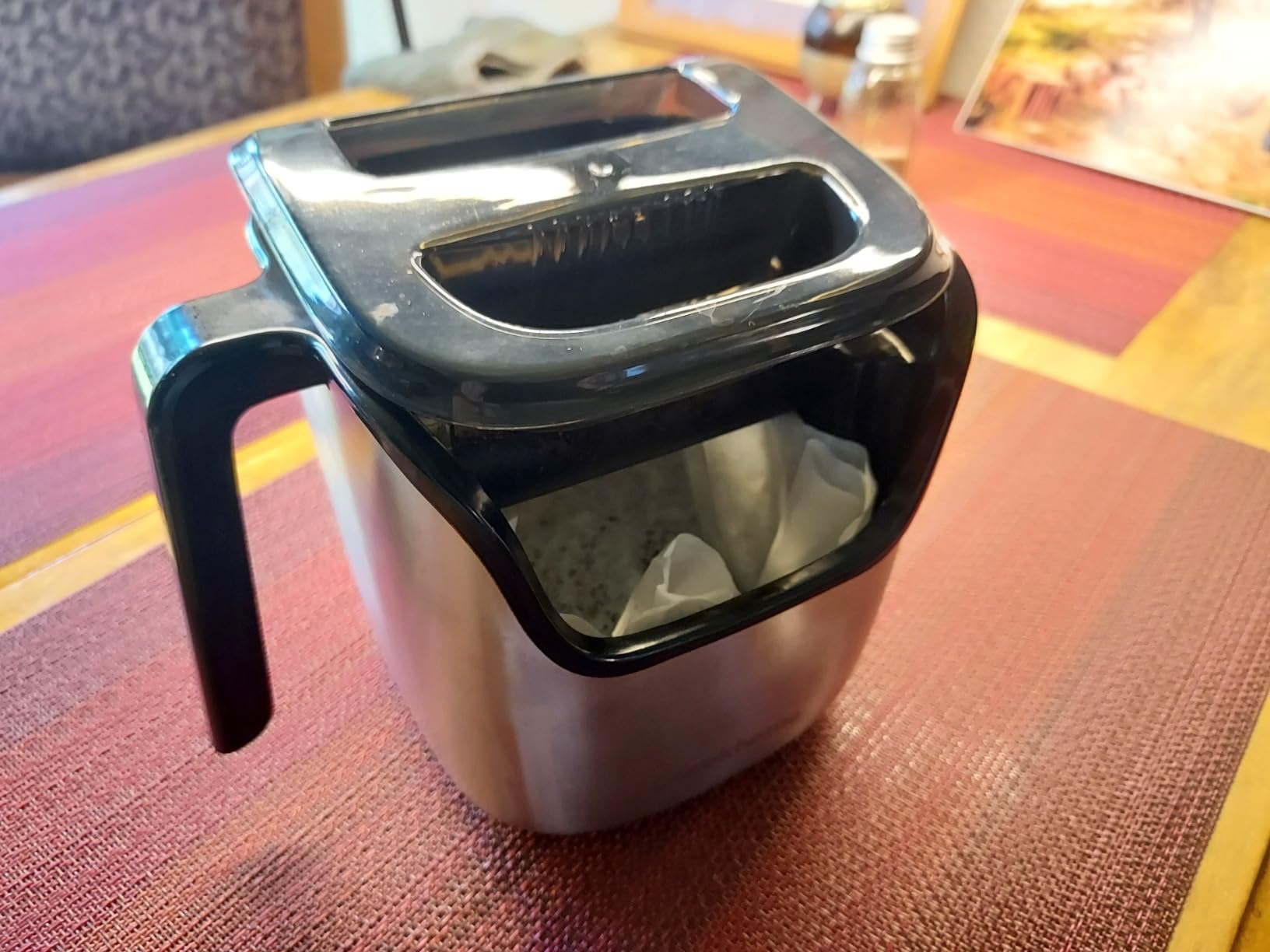
The Ourokhome is the containment specialist. The three-quarter wrap-around body rises high enough on three sides that a puck landing at a bad angle still goes in rather than across the counter, and that is the single most common complaint about every other bin in this roundup. If grinds on the worktop bother you more than anything, this is the one to shortlist.
Noise is handled by four silicone pads on the base rather than a single ring. They dampen the impact of the strike and protect the counter surface underneath, which is a small detail that makes a noticeable difference on a hard worktop.
The body is thickened 304 stainless steel at 1.37 pounds, and that weight is deliberate. It is the heaviest bin here, and heavy means it does not tip or walk when you knock. The tapping rod is rubber-encased so it resists denting and warping, and it detaches for cleaning.
Storage volume is larger than the compact plastic models, so you collect more grounds before emptying. Combined with the lid and the wrap-around shell, that makes this the tidiest option for a counter where tidiness is the priority.
The trade is footprint and mass. At 4.7 x 4.7 x 5.5 inches it is taller than the drip-tray bins and will not store under a machine, and at 1.37 pounds it is not a bin you move one-handed while holding a hot portafilter in the other.
Check whether you have a dedicated square of counter
This unit wants to live on the worktop, not in the tray. Measure 5 inches of height plus enough room in front to swing a portafilter, and make sure it is not blocking your grinder’s chute or the machine’s drip tray door.
Because the body is tall and wrap-around, it is also the hardest of the seven to hide in a cabinet between uses. If your coffee corner is meant to disappear when you are not brewing, that is a real downside.
Skip it if you want something lightweight and stowable
Weight is the honest drawback. A bin that stays put is worth something, but 1.37 pounds of steel is a lot to shift for a quick rinse, and it adds up if you move it to the sink several times a day.
On a small counter in a compact kitchen, the footprint alone may rule it out. The HOMEE and the Grindenstèin both tuck away; this one does not.
How to Use a Knock Box for Espresso
Using one takes about five seconds per shot, but the sequence matters more than the force. Most of the mess and noise people complain about comes from doing step three wrong.
Position the portafilter directly over the bin opening, tilted so the basket is centred.
Turn the portafilter handle to one side so the basket lip meets the knock bar flat rather than at an angle.
Tap firmly, not hard. One or two controlled strikes are enough; a full swing risks dislodging the basket or sliding the box.
Check the knock bar. Pucks sometimes lodge on it, and a second short tap clears them.
Empty when it reaches roughly two-thirds full, then rinse with hot water.
Never leave wet pucks sitting overnight. That is the single cause of the mould and smell complaints in the forums.
There is a technique worth knowing that skips the bar entirely. Some home barists knock the puck screen out against the edge of the bench knock block or a tamping mat first, so the loose puck drops free and lands in the bin without ever touching the bar. It is quieter, it is gentler on the portafilter, and it works best with a puck screen already installed.
A knock box versus an integrated tamping station is a fair question too. A tamping station stores your tamper, grounds distribution tools and often a funnel in one block, and some include a drawer for spent grounds. If you want the knock and the tamping mat in the same footprint, a station covers it. If you want a bin that genuinely holds volume and survives hard knocks, you still want a separate box. If your machine grinds and brews on its own, the workflow is different again, and our super automatic machine guide for beginners covers the setup where there is no puck to knock at all.
What to Look For in a Knock Box for Espresso
Knock bar material decides noise and portafilter wear
This is the first thing to check because it drives both of the criteria readers care about most. A hard plastic bar concentrates the entire strike into a small contact point on your basket rim, which is how a knock box ends up marking a portafilter or bending a rim over time. A rubber or silicone sleeve spreads the same energy across a wider area and absorbs most of it.
Above that, a metal core inside the rubber adds durability. The Ailelan uses that construction, and it is the one to pick if your current bar has started to deform. The pure rubber bars on the Grindenstèin, the HOMEE and the Breville are all fine for normal home use and absorb more energy than a hard bar, which is the reason for preferring them.
One more geometry note. A centred crossbar tends to split a puck into two halves, and a bar positioned across the middle of the opening gives you a bigger target. The homeffect’s column-style arm is worth a look for a different reason: it resists the basket dislodging when you tap.
Base grip keeps the box planted
A thick rubber or silicone ring under the box does two jobs. It stops the bin sliding when you knock, and it damps the rattle of plastic or metal on a hard worktop. Every pick in this roundup has one, and it is worth checking that the base is a full contact area rather than four small feet, which leave the middle of the base free to resonate.
The Ourokhome’s four silicone pads and the Grindenstèin’s rubber sleeve are the strongest versions of this in practice. The Apexstone is the exception that proves the rule, since an undamped steel base on stone or laminate is the noisiest combination you can put on a hard worktop, and a silicone mat under it solves it.
Capacity should match your daily shot count
Capacity is where compact bins disappoint people, and the realistic figures are much smaller than the litre numbers suggest. The Grindenstèin and the homeffect hold roughly three to six pucks. The HOMEE and the Ailelan are similar. The Breville Knock Box 10 holds up to 10. The Apexstone, at 1.5 litres, holds considerably more.
Work out your own number before buying. Count your coffees on a normal morning, and multiply by the number of days you can go without emptying. If the answer is more than five, a compact drip-tray bin means daily emptying. That matters far more if you compost, because the trip out to the pile is the part that stops people bothering.
There is a knock box versus tamping station argument here too. A tamping station’s drawer handles a couple of pucks and then needs emptying mid-session. A dedicated box sized to a full week does not.
Noise and mess containment decide whether you keep using it
Noise is described more often than anything else as the loudest part of home espresso, and the fix is almost always material rather than design. Rubber on the bar, rubber on the base, a body that absorbs rather than rings.
Containment is the second half. A raised back panel, a deep bend, or a three-quarter wrap-around body all stop the puck leaving the bin on a bad angle. The homeffect and the Ourokhome are the strongest here, the Ailelan is decent, and the flat compact bins are the ones most likely to put grounds on your counter.
Can a knock box damage your portafilter?
Yes, but the mechanism is almost always technique rather than the box itself. The risk is a hard swing that concentrates force into the basket rim, and the fix is a rubber or silicone knock bar plus a controlled tap instead of a full knock. Every pick here uses a cushioned bar, which is why the answer in practice is usually no.
Two habits remove the risk almost entirely. Keep the portafilter over the bin before you make contact, so a misjudged strike is not landing on a rim with nothing behind it. And knock with the handle turned so the basket lip meets the bar flat. Angle is what chips rims, not force.
Built-in and counter-sunk knock boxes
The most-requested idea in this category is a knock box sunk into the counter, and no mainstream roundup covers it. The appeal is obvious: the bin disappears into the worktop, so a full box never sits in view and you knock at counter height rather than bending over a bin.
Two routes exist. A drop-in unit like the Apexstone is designed for a built-in install, and it works well if you are building or renovating a station. For an existing kitchen, a counter-sunk box is a plumbing job, and you should weigh that against what you gain, which is a tidier counter rather than a better knock.
For everyone else, the DIY route is genuinely popular in the enthusiast communities. A Pringles can, a rolling pin with a stainless prep tin, or a wooden box built to your counter depth all work, and the appeal is the same as the built-in option: the grounds go somewhere that is not a bin you carry to the sink.
What we did not pick, and why: we did not include a walnut-lidded box, a fully welded commercial steel unit, or a dedicated under-grinder drawer, because none of them were available to us with verified specifications and consistent review history. We would rather give you seven we can vouch for than fourteen we cannot.
Frequently Asked Questions
What is the best home espresso knock box?
Can a knock box damage my portafilter?
Do you really need an espresso knock box?
How do you use a knock box for espresso?
What are people saying about the Breville knock box?
How big should my espresso knock box be?
Final Verdict: Which Knock Box Should You Buy?
The Dreamfarm Grindenstèin is our best knock box for espresso, and for most home bars the decision stops there. It is quiet, it is nearly indestructible, and it disappears onto the drip tray. Its only real weakness is holding three to six pucks, which is a problem only if you brew more than a few coffees a day or compost.
If you do brew heavily, buy volume instead. The Breville Knock Box 10 holds up to 10 pucks and matches a Breville machine perfectly, and the Apexstone at 1.5 litres is the choice for a busy station or a built-in install. If grinds on the counter are what irritate you most, the Ourokhome’s wrap-around body and lid solve it better than anything else here.
Whichever you pick, buy it before the puck ends up in the sink. Then pair it with the right grinder from our home barista grinder guide, and the rest of your setup is a solved problem. This roundup was updated for 2026.