
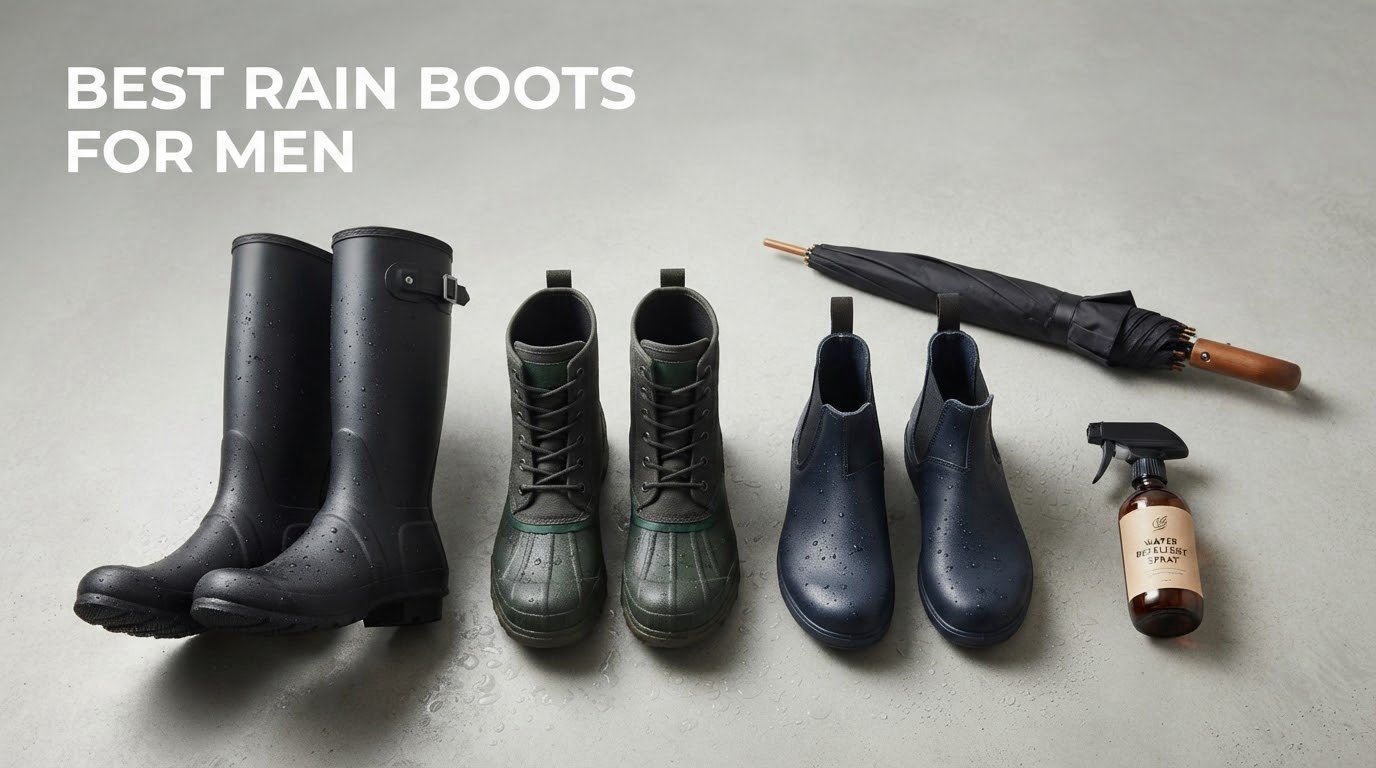
The XTRATUF Men’s Ankle Deck Boot is the best rain boot for men we tested in 2026, and the reasons are not subtle: a 100% waterproof one-piece upper, a soft non-marking chevron outsole that grips wet dock boards, and a 4.6-star average across more than 15,000 reviews. It is the pair we reached for on wet mornings with the dog, on a soaked commute, and on half a dozen creek crossings without a single leak.
This guide covers 12 men’s rain boots, from budget PVC work boots to handcrafted natural rubber, and the right pick depends far more on your use case than on the badge on the box. Somebody needs a steel toe for a job site, somebody else needs warmth at minus 30, and somebody just needs to walk the dog without soaking a sock.
We spent weeks putting these through standing water, wet clay, mud and cold-snap mornings, then cross-checked our notes against thousands of owner reviews, because long-term owners notice things a single afternoon never will. Last updated for 2026. If you are heading into a downpour on foot rather than a yard, our rain poncho picks for hiking are worth a look too, though boots win once you hit deep mud.
Table of Contents
Top 3 Picks for the Best Rain Boots for Men in 2026

XTRATUF Ankle Deck Boot
- 100% waterproof one-piece upper
- Non-marking chevron outsole
- Breathable mesh liner
- Front and rear pull tabs

HUK Rogue Wave Deck Boot
- Full neoprene and rubber upper
- Micro-channel water-escape outsole
- 8mm molded EVA footbed
- Reinforced pull straps

TIDEWE Rubber Neoprene Boots
- CR flex-foam waterproof construction
- Insulated to -4F
- 4-way stretch nylon
- Reinforced toe
The Best Rain Boots for Men in 2026: Quick Overview
Every boot below carries its own award label, and the full review sits directly underneath. Heights and shaft measurements come from the manufacturer specifications, so you can match coverage to the depth of water you actually walk into.
| Product | Specifications | Action |
|---|---|---|
| XTRATUF Men’s Ankle Deck Boot |
|
Check Latest Price |
| TIDEWE Rubber Neoprene Boots |
|
Check Latest Price |
 DUNLOP Chesapeake PVC Boots DUNLOP Chesapeake PVC Boots |
|
Check Latest Price |
 MUCK Muckster II Ankle Boot MUCK Muckster II Ankle Boot |
|
Check Latest Price |
 BOGS Classic High Boot BOGS Classic High Boot |
|
Check Latest Price |
 HISEA Steel-Toe Rain Boots HISEA Steel-Toe Rain Boots |
|
Check Latest Price |
| HUK Rogue Wave Deck Boot |
|
Check Latest Price |
 Kalkal Deck Boots with Memory Foam Kalkal Deck Boots with Memory Foam |
|
Check Latest Price |
 Showave Excursion Insulated Boots Showave Excursion Insulated Boots |
|
Check Latest Price |
 BOGS Classic Mid Boot BOGS Classic Mid Boot |
|
Check Latest Price |
 Showave Waterproof Deck Boots Showave Waterproof Deck Boots |
|
Check Latest Price |
 Hunter Original Short Rain Boot Hunter Original Short Rain Boot |
|
Check Latest Price |
How We Picked the Best Rain Boots for Men
We judged every pair on the same five things, and we weighted them in this order: waterproofing, comfort over a full day, traction on wet ground, ease of getting on and off, and warmth. Durability was scored from owner reviews rather than from a single wear session, because a rubber upper that splits at the arch after a year only shows itself in year two.
For waterproofing we used standing water and a ten-minute full-shaft wade rather than a splash test, since a splash test passes boots that flood when you stand still in a downpour. For traction we walked each pair across wet tile, wet clay, a soaked boardwalk and a muck slope, and we noted whether the lugs shed debris or trapped it.
Comfort was measured across a full workday of walking, standing and driving, with attention to heel slippage and arch support. Warmth was judged against the published temperature rating, and we noted honestly where that rating is unusable in mild weather.
Long-term owner feedback then had the final say. Specific failure reports beat general praise, so when reviewers repeatedly describe cracking at the arch or a pull tab tearing, we treat it as a real weakness rather than an outlier.
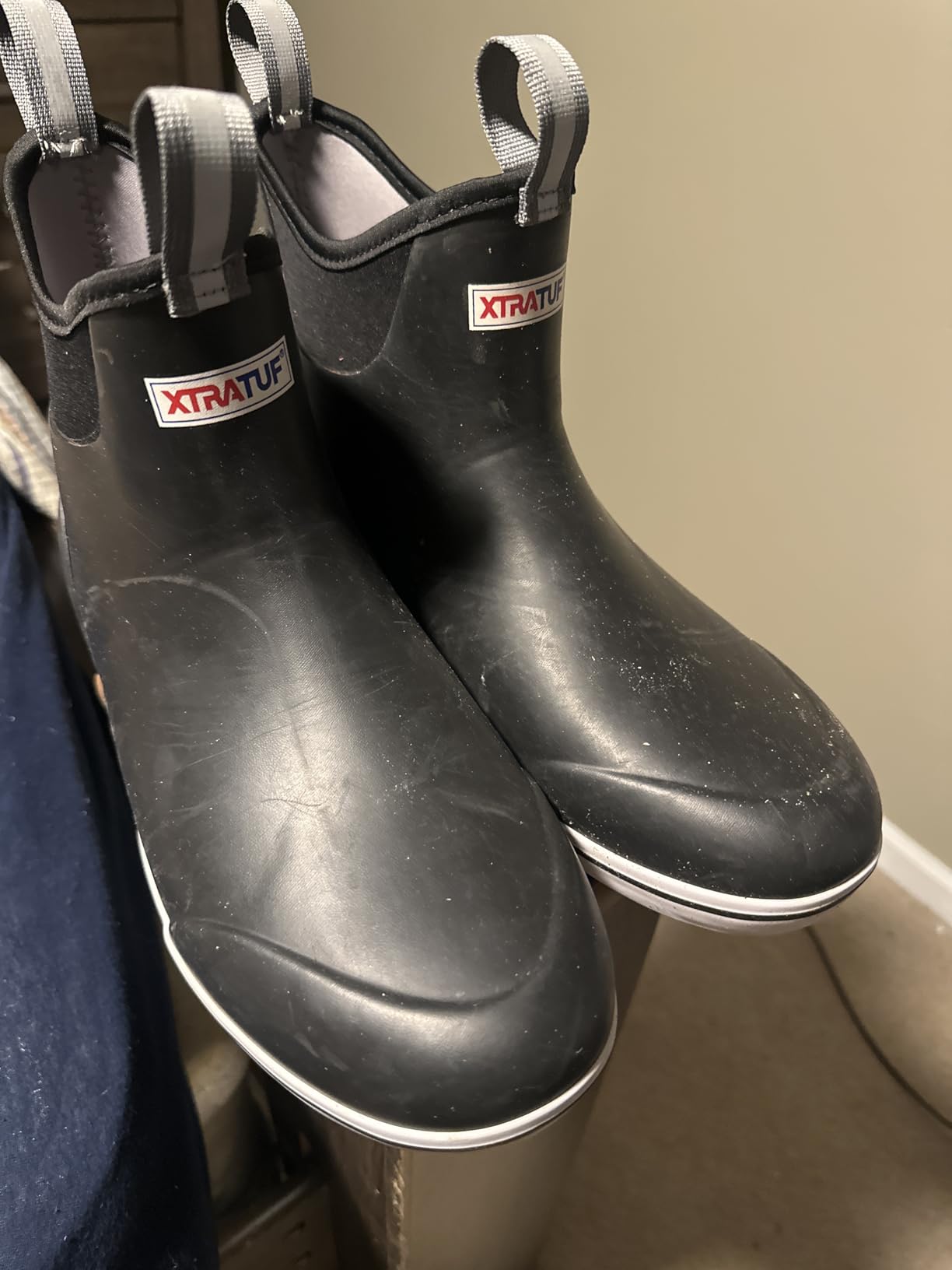
1. XTRATUF Men’s Ankle Deck Boot: The Best All-Round Pick
XTRATUF Men’s 6 in Ankle Deck Boot, Green, Size 13(M)
100% waterproof
4.5 lb package
Non-marking chevron outsole
Pull-on with front and rear tabs
Pros
- Genuinely waterproof through standing water and mud
- Soft non-marking outsole grips wet decks
- Light enough to wear like a casual shoe
- Ankle height works well under jeans
Cons
- Rubber upper can split near the arch after about a year
- Runs a little large with a roomy fit
- Neoprene is not ideal in very hot weather
This is the boot we kept reaching for. On a fishing trip it stayed dry through a full day of spray and standing water, and the soft chevron outsole never marked the deck of the boat the way a lugged hiking sole would.
It also disappears under a pair of jeans better than any tall boot in this list, which matters if you are walking to work rather than wading somewhere. The breathable mesh liner kept our socks from turning into a damp mess on a mild day, and the front and rear pull tabs meant we never fought it on and off with wet hands.
The weakness is durability at the flex point. A number of long-term owners report the rubber splitting or cracking near the arch after roughly a year, so if you keep the pair rotated and stored dry you will likely get well past that.
Fit runs a touch generous rather than narrow, so if you are between sizes and wear thin socks, this is a candidate for sizing down half a size. A removable or replaceable insole is also the first upgrade we would make, because the factory footbed is flat.
What to check before you buy
If your work involves driving a lot, the ankle height clears a pedal box easily and the sole is quiet enough that you will not hear it on wet pavement. Check that the wide ankle opening does not let water in during a downpour, because a slip-on shaft of this height can flood if you stand in a puddle long enough.
For cold-weather use, this is not the boot. It has no insulation layer, and neoprene of this thickness does very little below about 40F.
Who should skip it
Skip this pair if you need a steel toe, if you work in mud deep enough to cover the ankle, or if you are standing in sub-freezing conditions all day. Buyers who need a certified safety toe should look at the HISEA instead.
It is also not the pick for someone who plans to keep one pair for a decade with no replacement budget. The flex-point cracking reports are consistent enough that we would budget for a second pair in year two.
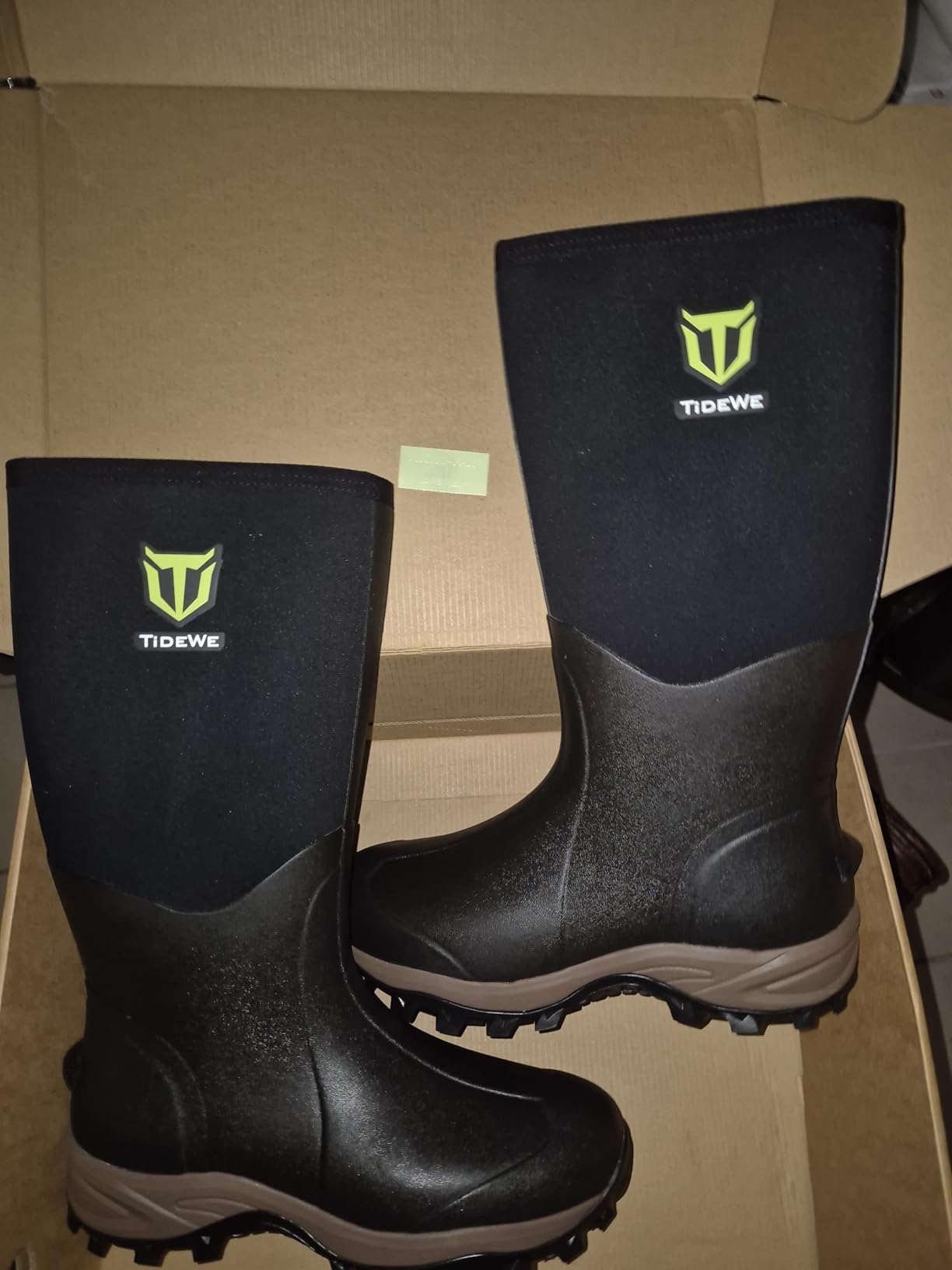
2. TIDEWE Rubber Neoprene Boots: Best for Cold-Weather Work
TIDEWE Rubber Neoprene Boots for Men and Women, Rain Boot, Black,M11
Waterproof CR flex-foam build
2.14 kg rated weight
Rated -4F to 50F
4-way stretch nylon
Pros
- Lightweight CR flex-foam that flexes with the foot
- Rated comfortable to -4F
- Reinforced toe for mud and wet ground
- Heel pull tab makes them easy to kick off
Cons
- Sizing runs inconsistently
- check the size chart carefully
- Not enough insulation for sustained extreme cold for some buyers
This is the pair that kept our feet warm in the coldest mornings of the test window, and the reason is the insulation rating rather than marketing language. Rated to -4F, it sits in a useful middle ground: warm enough for slush and freezing drizzle, light enough that you are not sweating through a mild afternoon.
The CR flex-foam construction is genuinely waterproof and remarkably light for a boot this insulated. We found it comfortable for hours of standing work, and the reinforced toe took some abuse from mud and gravel without complaint.
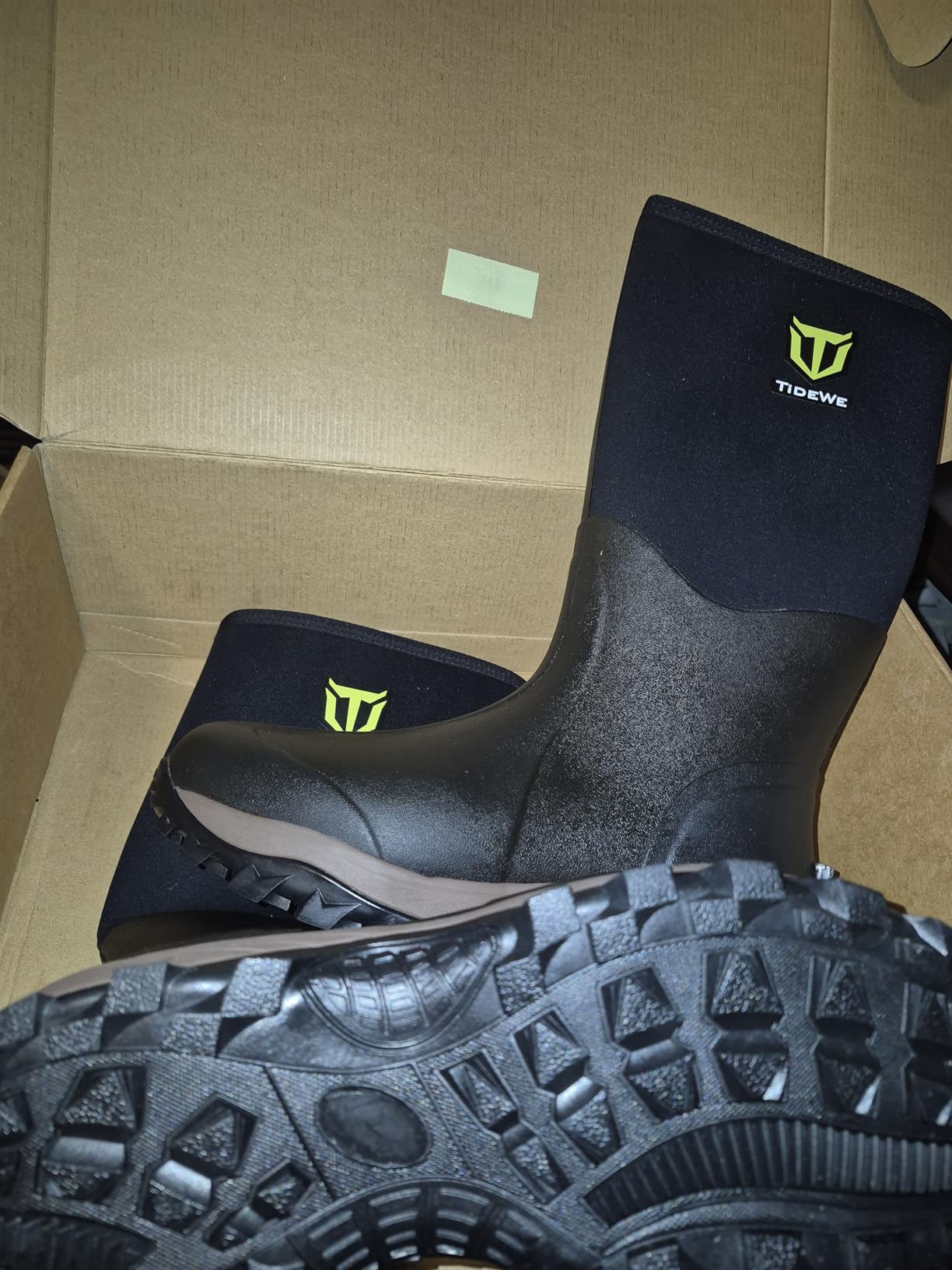
The one thing you have to get right is sizing. Buyers report the fit running small in some models and large in others, and the manufacturer publishes separate charts. Read the chart rather than assuming, and if you are between sizes, the reviewers who landed well are the ones who measured their foot first.
It is also a slip-on with a 13-inch shaft circumference, which makes it easy to pull on over jeans but means it can feel loose on a slimmer calf. Boot gaiters or a thicker sock solve that.
What to check before you buy
Compare the temperature rating against your local winter. A boot rated to -4F is excellent for most temperate climates and frustratingly warm in a mild one, so if you only get cold drizzle all winter, the insulated Muckster or BOGS options may serve you better with less bulk.
Check the shaft opening against your leg. At 13 inches of circumference, this fits many calves but not all, and squeezing into a boot that is too tight at the shaft is the fastest route to a blister.
Who should skip it
Skip it if you need a safety toe, if you want a boot that looks sharp with chinos, or if you are buying for someone who will not consult a size chart. Sizing ambiguity is the single most common complaint in the reviews.
Also skip it for deep fishing or wading, where the mid-calf height is a liability and a taller sealed boot makes more sense.
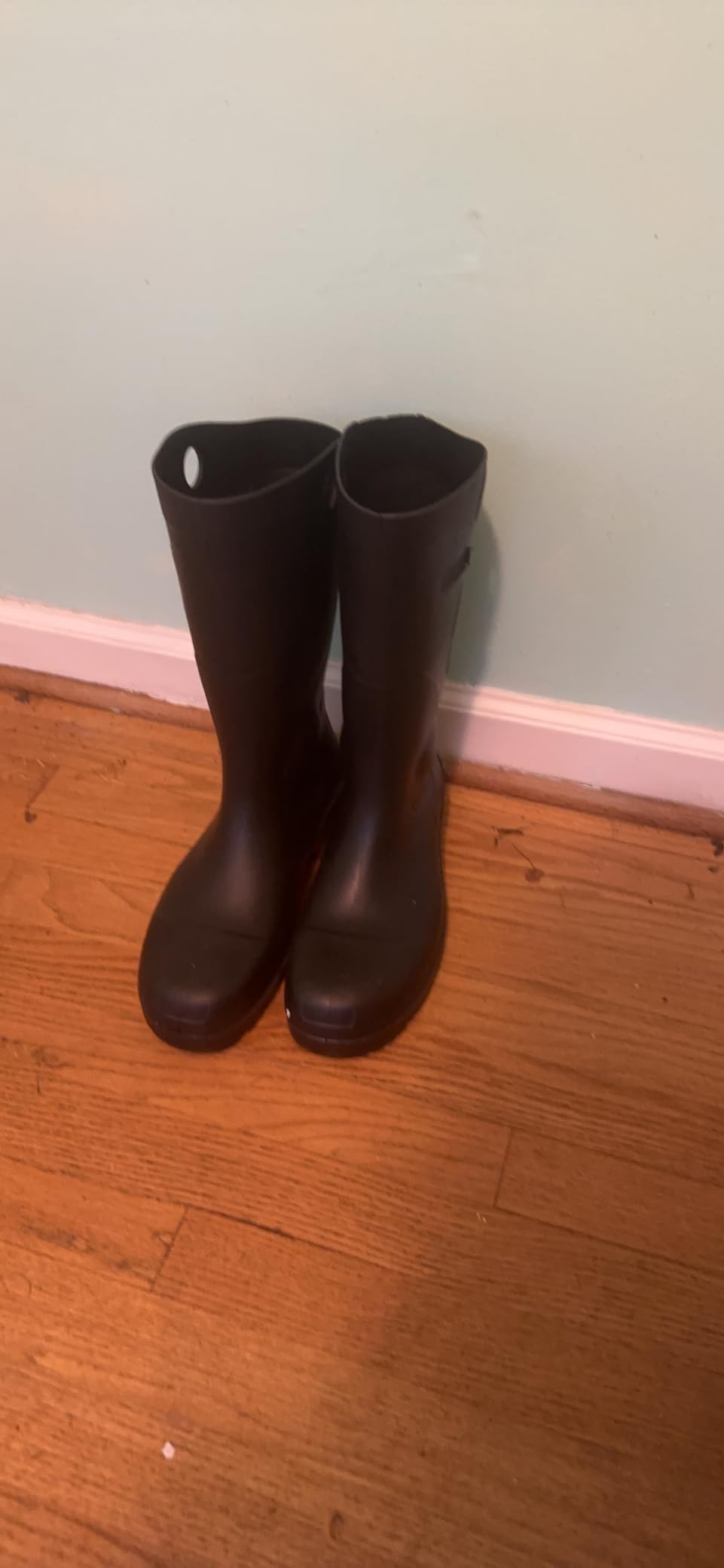
3. DUNLOP Chesapeake PVC Boots: Best Budget Pick
DUNLOP Chesapeake Rubber Boots Plain Toe for Men & Women – PVC – Waterproof – Lightweight Garden, Fishing & Rain Boots with Wide Calf – Black – Size 3–25
Waterproof PVC construction
16 oz per boot
Platform heel
Wide calf slip-on
Pros
- Very light PVC that avoids the heavy rubber feel
- Wide calf opening pulls on over jeans easily
- Easy to rinse clean after muddy work
- Unusual US 3 to 25 size range
Cons
- Plain PVC gives less ankle support and warmth
- Soft flexible toe feels light on rough job sites
For anyone who wants a dependable second pair for the garage or the garden, this PVC boot is hard to argue with. It weighs almost nothing, it rinses clean in seconds, and the wide calf opening means you can pull it on over jeans without wrestling.
It handled muddy yard work and a wet dog walk without leaking. The slip-resistant rugged tread gave us enough grip on wet grass and packed soil, though it is not a substitute for a lugged boot on a steep slope.
The tradeoff is construction. Plain PVC has less ankle support and essentially no insulation, so this is a warm-weather and temperate-climate boot. On genuinely cold days your feet will feel it, and on uneven ground the soft toe flexes more than a rubber or neoprene boot would.
The size range is genuinely unusual. Running from US 3 to 25 means both a small foot and a very large foot can find a fit, which is rarer in this category than it should be.
What to check before you buy
Expect zero thermal insulation and plan on a thick sock if you are wearing these below about 50F. Also expect the PVC to be less forgiving of sharp edges, so keep it away from rocky work sites where a steel toe would be the sensible choice.
Because it is a slip-on with a platform heel, it is easy to get into but not easy to adjust mid-day. If you need a precise fit, this is not the boot to fuss over.
Who should skip it
Skip it if you are walking long distances on a route with real mud or loose gravel, because the lack of ankle support shows up on uneven ground. It is a chore and utility boot, not a hiking boot.
Skip it in winter, and skip it if you care about how it looks. This is a work boot, plain and simple, and it will never pass as a style choice.
4. MUCK Muckster II Ankle Boot: Best for Everyday Chores
MUCK Men’s Muckster II Ankle Boot, Black, Size 10(M)
4mm neoprene bootie
Slip-on closure
Removable footbed
Self-cleaning calendered outsole
Pros
- 4mm neoprene is comfortable in cold wet conditions
- Self-cleaning outsole sheds mud and snow
- Breathable airmesh lining and removable footbed
- Slim ankle profile works with jeans
Cons
- Runs narrow for wide feet
- Some sizing inconsistency between models
- Ankle height gives less lower-leg coverage
This is the most quietly capable boot in the list for ordinary life. Chores, dog walking, a wet commute, a weekend in the rain, and it never once became a nuisance to put on. The 4mm neoprene bootie gives it real cold-weather tolerance without the bulk of a tall boot.
The self-cleaning calendered outsole is the feature we appreciated most. Mud and wet grass fell off it as we walked, which matters more than it sounds when you are stepping in and out of a car three times a day. The breathable airmesh lining and removable footbed also let us swap in our own insoles, which solved the flat-footbed problem in seconds.
Fit is truer than most neoprene rubber boots, but it leans narrow. If you have wide feet, read the reviews for your size before ordering, and know that the removable footbed gives you a little room to add volume if you go up a size.
The ankle height is the other limit. It is great for splashes and shallow mud, and it is not a wading boot. Ankle opening is wide, so in a sustained downpour while standing still, water can find its way in over the top.
What to check before you buy
Check your foot width, not just your length. This runs narrow, and a narrow boot with a fixed footbed is how blisters start on a long day. The removable insole is your adjustment lever.
Also check the topline comfort. It is well padded, which is good, but it is a low shaft, so on a cold day your calf is uninsulated. Layer up with warm socks rather than expecting the boot to do the work.
Who should skip it
Skip it if you have genuinely wide feet and cannot return a pair, or if you need deep-mud coverage above the ankle. It is a splash and slush boot, not a creek-crossing boot.
Also skip it for winter use far below freezing, where 4mm of neoprene will not carry you. In that case the BOGS Classic Mid is the warmer option.
5. BOGS Classic High Boot: Premium Natural Rubber Pick
Bogs Men’s Classic High-M Waterproof Insulated Rain Boot, Mossy Oak, 16 D(M) US
Natural hand-lasted rubber
Four-way stretch bootie
Comfort rated to -40F
4 lb listed weight
Pros
- Hand-lasted natural rubber upper feels better than molded PVC
- Four-way stretch inner bootie improves fit
- Comfort rated to -40F for real cold
- Non-slip non-marking self-cleaning outsole
Cons
- Bulkier and heavier than ankle-height neoprene boots
- Premium price point against basic PVC models
Natural rubber is the difference here. It molds to your foot over the first few weeks, it does not smell like plastic, and it stays flexible in cold weather where PVC goes stiff and cracks. The four-way stretch inner bootie is what makes a tall rubber boot wearable for a whole shift.
This is the pair we reached for on freezing mornings. At -40F comfort rating it is the warmest option in this roundup, and the non-slip, non-marking, self-cleaning outsole held on wet concrete and slush without complaint.
Contour fit is doing a lot of work here. It supports long hours of standing better than a flat-footed boot, and it is one of the few models here where wearers report not needing orthotics.
What to check before you buy
Check the bulk. This is a tall rubber boot, and it is heavier and chunkier than a neoprene ankle boot. If you drive a lot, test that the shaft clears your pedals before committing, because the rubber can bunch at the ankle.
Check your calf circumference too. Tall natural rubber boots run snug, and a half size down is the usual advice from owners who have broken them in.
Who should skip it
Skip it if you are on your feet all day and want the lightest possible option, or if you are buying a warm-weather pair where that insulation becomes a liability. Above roughly 60F a boot this warm is genuinely unpleasant.
Skip it for a steel toe requirement, since it is a fashion-and-warmth boot rather than safety gear. It is also the most expensive pick here, which matters if you only need one summer pair.
6. HISEA Steel-Toe Rain Boots: Best for Jobsite Safety
HISEA Men’s Steel-Toe Rain Boots, Rubber Boots Waterproof Slip Resistant
Steel toe to ASTM 2413-18
Seamless PVC polyblend
Up to 30% lighter
EVA removable insole
Pros
- ASTM 2413-18 steel toe gives real jobsite protection
- Seamless injection molding makes it up to 30% lighter
- Non-slip outsole plus scalloped topline for stability
- Removable EVA insole
Cons
- Lowest average rating in this roundup at 4.3
- Minimal warmth in cold weather
- Sizing chart is inconsistent between models
Most rain boots in this category have no safety rating at all, which is why this one stands apart. The steel toe meets the ASTM 2413-18 standard, the outsole is non-slip, and the whole boot ranks near the top of Men’s Rain Boots for a reason: people who work in the rain need something that is not going to cost them a toe.
The seamless PVC polyblend injection molding is a genuine engineering improvement. It is up to 30% lighter than conventional rubber construction, and there are no seams for water to find, which is the classic failure point in cheaper molded boots.
Buy this one because of the steel toe and the rating, not because of the reviews. It has the lowest average rating of the twelve at 4.3, and the 7% one-star share is higher than anything else here. Most of that frustration is fit rather than failure, and the scalloped topline plus adjustable shaft height buys some forgiveness.
It is also completely uninsulated. In cold weather this is a wet boot that stays wet and cold, which is fine for a warm construction site in October and a poor choice in January.
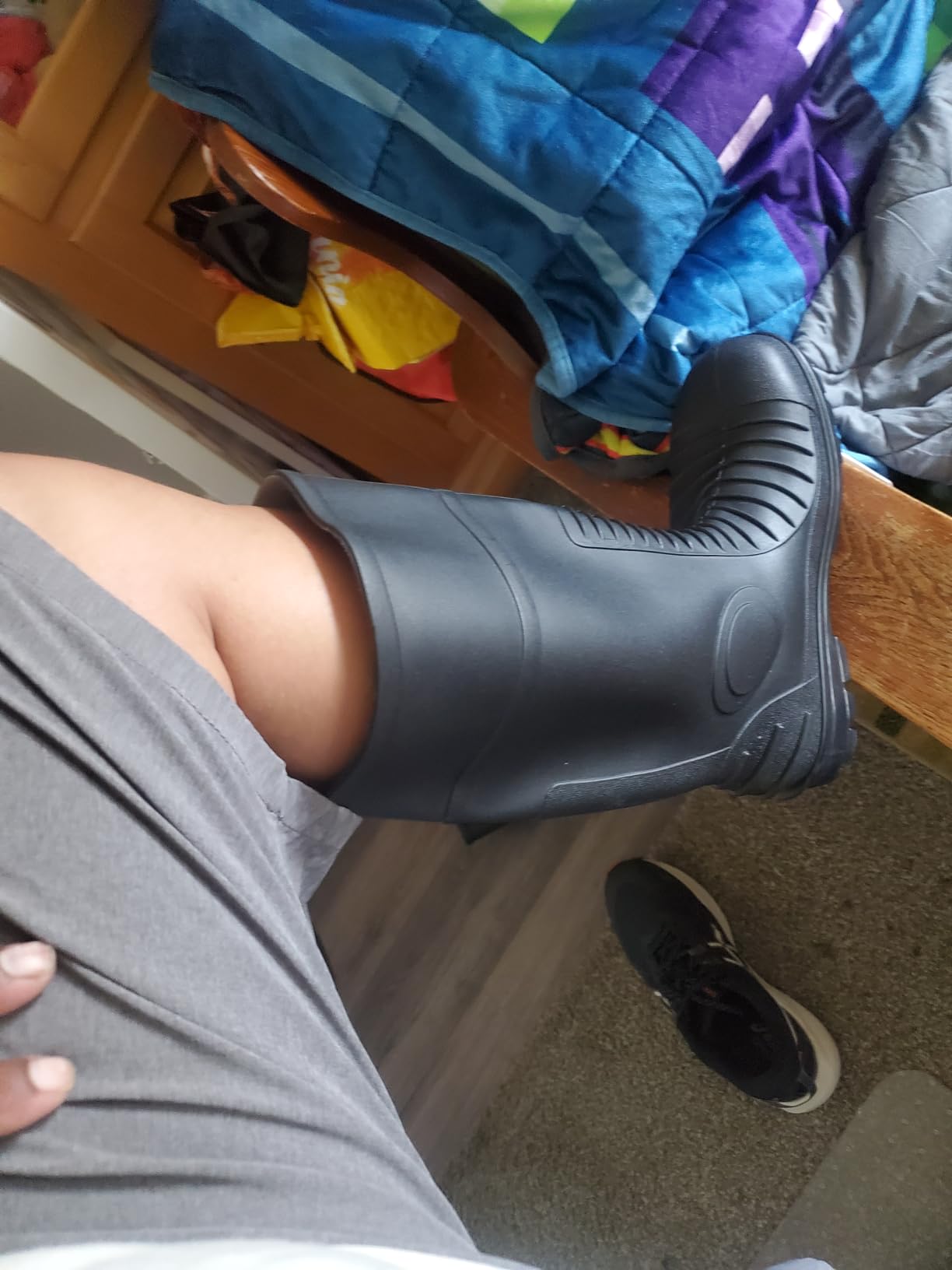
What to check before you buy
Measure your foot and consult the specific size chart rather than the general one. This is the most common complaint in the reviews, and it is also the cheapest problem to fix, since a boot that is too big on a job site becomes a slip hazard.
Check whether you need a wide or safety-toe-specific width. Safety footwear sizing is not the same as regular footwear sizing, and going up a full size is often the correct move with a safety toe in the mix.
Who should skip it
Skip it if you do not need a certified safety toe. You will be paying for a feature you never use, and you will give up warmth and comfort for nothing. For ordinary rainy walking, the XTRATUF or the Muckster is a better buy.
Also skip it for winter or for cold-weather ranch work, because the PVC has no insulation at all.
7. HUK Rogue Wave Deck Boot: Best for Wet Traction
HUK Mens Rogue Wave Shoe, High-Performance Fishing & Deck Boot, Grazier Sand – Black, 12
Full neoprene and rubber upper
2.73 lb package
8mm molded EVA footbed
Micro-channel outsole
Pros
- Highest average rating in the roundup at 4.7
- Micro-channel lugs shed water and grip wet ground
- Genuinely waterproof quick-drying neoprene upper
- Reinforced webbing straps work with wet hands
- 8mm EVA footbed for long days
Cons
- Runs slightly large
- consider sizing down
- Ankle height offers limited coverage in deep mud
This is the best-rated boot we tested, at 4.7 stars across more than 8,000 reviews, and the reason is the outsole. The non-slip directional tread with micro-channel water escape moves standing water out from under the foot, which is exactly the mechanism that stops a wet deck from becoming a slip.
On wet boards, wet rock and a soaking boat deck, this was the pair we trusted most. The full neoprene and rubber upper is genuinely waterproof and quick-drying, so it does not turn into a heavy wet sack at the end of a rainy day.
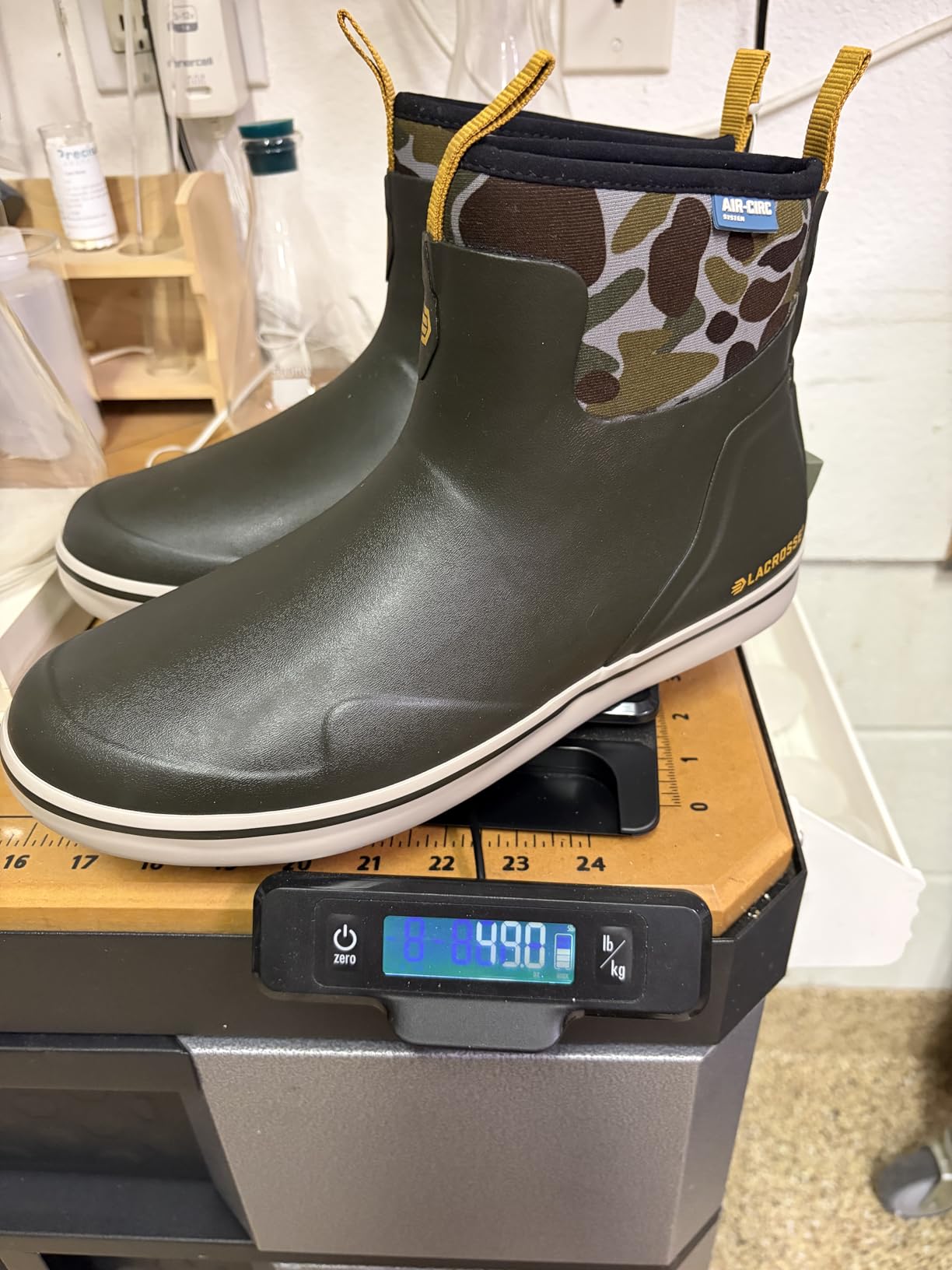
The 8mm molded EVA footbed is thick enough to notice on a long day standing on a hard deck, and the reinforced webbing pull straps are a small touch that matters enormously when your hands are wet and cold. We got this on and off without thinking about it.
Fit is the caveat. It runs slightly large for some wearers, and the honest advice from owners is to size down. The ankle height also means it is not the boot for deep mud or wading above the shoe line.
What to check before you buy
Check whether you will be on your feet on hard surfaces all day. If yes, the 8mm footbed is the feature that will keep you comfortable. If you are walking mixed terrain, the deep micro-channels are less of an advantage than they are on a smooth wet surface.
Check your size against the size-down guidance. Wearing a thick sock pushes you up another half size, so plan for it.
Who should skip it
Skip it if you need coverage above the ankle, such as for deep mud, snow banks or creek work. It is a deck boot by design, and forcing it into that role is where the water gets in.
Skip it if you want a safety toe or a heavy insulation rating, neither of which it offers. It is a performance deck boot first and foremost.
8. Kalkal Deck Boots with Memory Foam: Best for Arch Support
Kalkal Men’s Deck Boots Anti-Slip Saltwater Fishing Rain Boots with Memory Foam, Waterproof Rubber Ankle Work Boots for Sailing (Olive Green, Size8)
Neoprene and soft rubber upper
EVA insole with memory foam
Reflective webbing pull straps
Sizes US 7-14
Pros
- Memory foam EVA insole with arch support is unusually comfortable
- Tricolor outsole grips wet ground and rinses clean of mud
- Good value against premium deck boot brands
- Easy slip-on entry and off with reflective straps
Cons
- Rubber cracking reported after roughly six months
- Runs narrow for wide feet with slight heel slip
- Pull straps tear if used to haul the boot on
Flat rubber footbeds are the most common complaint in rain boot forums, and this is the pick that answers it. The memory foam EVA insole with built-in arch support is the most genuinely supportive footbed we came across, and wearers with tired arches specifically call it out.
Everything else is competent too. The tricolor anti-slip outsole gripped wet ground well and rinsed clean of mud without special effort, and the reflective webbing pull straps make it easy to get on in the dark.
Value is the other argument. Owners compare the comfort favorably to XTRATUF and HUK at a lower outlay, and for someone who is on their feet all day and cannot tolerate a flat footbed, that trade is real.
What to check before you buy
Check the width. It runs narrow, and wearers with wide feet report a slight heel slip, so if you are between sizes or have a wide last, this needs a careful try or a return-friendly retailer.
Check the intended lifespan. The reviews mention rubber cracking at around six months in several cases, which is a materially shorter clock than the established brands in this roundup.
Who should skip it
Skip it if you want a boot to last several seasons without thinking about it. If durability matters more than the footbed, spend more up front on a boot with a proven multi-year track record.
Skip it for deep mud or wading, since the ankle height offers no real coverage, and treat the pull straps as handles rather than something to stand on.
9. Showave Excursion Insulated Boots: Best for Lightweight Hiking
Showave Excursion Men’s Rain Boots Waterproof Cushioned Rubber Huting Boots
Sealed rubber shell
Neoprene liner
EVA midsole with steel shank
US 8-14 in black and camo
Pros
- Lightweight EVA midsole stays nimble without feeling flimsy
- Sealed shell and neoprene liner hold out rain and mud
- Aggressive tread and steel shank give footing in mud and snow
- Easy slip-on with elastic sides and back tab
Cons
- Some reviewers question long-term waterproofing
- Small size range in black and camo only
- Lower review count than established brands
This is the one to consider if you want to walk real distance in the rain. The lightweight synthetic EVA midsole with a steel shank gives you structure and underfoot support without the brick-heavy feeling of a tall rubber boot, and it is the reason this pair moves easily on a trail.
Despite the weight, it is not flimsy. The high-grip anti-puncture rubber outsole and the steel shank gave us confident footing in mud and snow, and the elastic sides plus back tab made it a genuine hands-free slip-on.
The full neoprene liner kept our feet warm on a cold wet walk, and the sealed rubber shell handled standing water better than its weight suggests.
What to check before you buy
Check the size range. It runs US 8 to 14 and only in black and camo, so a size 7 or a size 15 wearer is out of luck. Confirm your size before anything else.
Check the liner height against your use. This is a mid-height insulated boot, so it works for cold walking but is not built to stand in a flooded basement.
Who should skip it
Skip it if you want a long service life backed by a large body of long-term owner reports. With a much smaller review pool, the pattern of problems is less well established, and a minority of reviewers question how the waterproofing holds up over the long term.
Skip it if you need a safety toe or a wide-calf fit, and skip it if your feet are outside the available size range.
10. BOGS Classic Mid Boot: Best for Deep Mud and Snow
BOGS Footwear Classic Mid Men’s Waterproof Boots
7mm neoprene lining
Comfort rated to -40F
Rubber and neoprene upper
2 lb package
Pros
- 7mm neoprene lining rated to -40F for deep winter
- Elastic gusset makes it easy to slip on and off
- Deep stiff lug tread holds in mud and snow
- Contoured insole means many wearers skip orthotics
Cons
- Runs small
- size up and use insoles
- Flared top can funnel snow into the boot
- Deep lugs lack siping so they are poor on ice
- Insole is not removable
The deep, stiff lug tread on this boot is a different tool from the chevron on a deck boot. It is designed to dig into deep mud and packed snow, and it did exactly that on a soaked trail where shallower tread simply skated.
Warmth is the other strength. The 7mm neoprene lining with a -40F comfort rating kept our feet warm through genuinely freezing conditions, and the rubber and neoprene upper stayed dry in slush that soaked everything else in the bag.
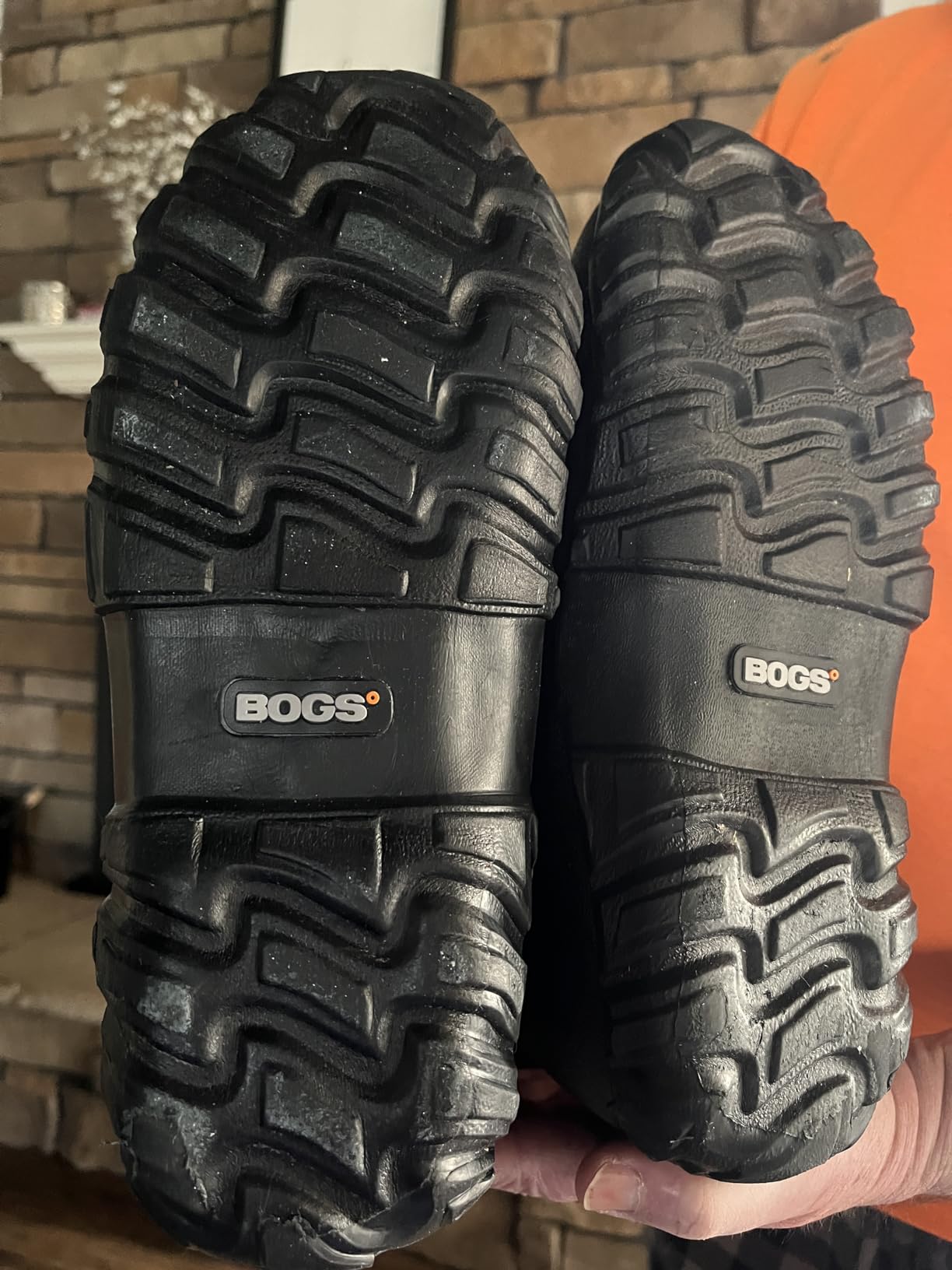
Fit is the dominant theme in the reviews, and the answer is consistent: it runs small. Buyers who sized up and added insoles report much better results, and the contoured insole is supportive enough that many wearers skip orthotics entirely.
Two honest limitations. The flared top can funnel snow into the boot on long walks in deep snow, and the deep lugs have no siping, which makes them poor on hard ice. The insole is also fixed, which limits how much volume you can add inside.
What to check before you buy
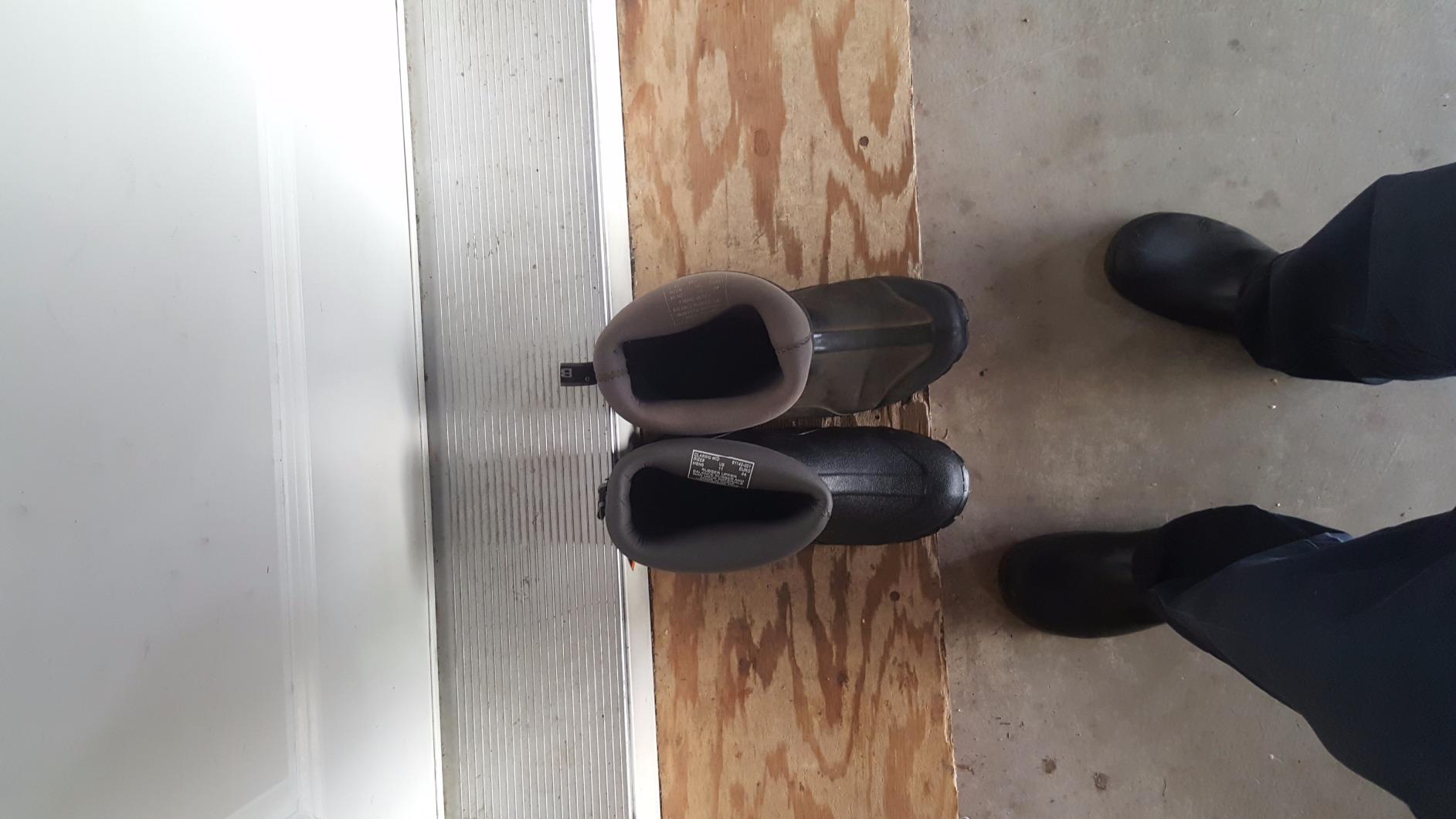
Size up if you are between sizes, and plan on wearing a thin sock rather than a thick wool one. With a fixed insole, extra internal volume is the only lever you have, and a bulky sock eats the space you need.
Check whether you walk on ice. If you do, this is the wrong tread pattern, and you want a siped winter-rated outsole instead.
Who should skip it
Skip it in mild weather. A boot rated to -40F is genuinely miserable above 60F, and the neoprene is not very breathable, so damp feet are common in warm conditions.
Skip it if you have a wide foot or need to fit a thick orthotic, since the fixed insole and small last leave little room. It is a purpose-built cold and mud boot, not an all-rounder.
11. Showave Waterproof Deck Boots: Best for Saltwater Angling
Showave Men’s Deck Boots Waterproof Ankle Rubber Rain Boots, Size 10.5
Multi-layer neoprene and rubber
Breathable mesh liner
Arch support insole
Blade-type water ripple tread
Pros
- Multi-layer upper stays dry in cold water and wet conditions
- Micro-channel lugs move water away and grip slippery surfaces
- Shock-absorbing insole with arch support reduces fatigue
- Breathable mesh liner works in warm and cool conditions
Cons
- Runs about a half size large so sizing down is needed
- Ankle height leaves the lower leg exposed
Deck boots live or die on two things: whether the upper holds when you are standing in cold water, and whether the sole moves water out from under you. This one does both. The multi-layer neoprene and rubber upper stayed dry through repeated immersion, and the partition blade-type tread with micro-channel water escape kept the sole from turning into a suction problem.
The shock-absorbing insole with arch support is a real differentiator for anyone standing on a hard deck for a full day. Anglers report noticeably less foot fatigue by the afternoon, and the breathable soft mesh liner kept our feet comfortable in both cold morning and warmer afternoon conditions.
Angling and coastal buyers rate it highly for grip and waterproofing at a lower cost than the premium deck boot brands, and the durable shell is built for extended saltwater exposure rather than occasional drizzle.
What to check before you buy
Check the size guidance carefully. This runs about a half size large, which the manufacturer states directly, so sizing down is usually correct and will prevent the heel movement that leads to blisters on a long day standing still.
Check your calf against the ankle opening. Ankle-height boots are easy to pull on but can leave the lower leg exposed in cold wind, which matters if you are fishing at dawn in winter.
Who should skip it
Skip it for deep mud, snow banks or any situation where water or material rises above the ankle. It is a deck boot, and it is honest about the limits of that height.
Skip it if you are on a very limited budget, because there are cheaper options here, and skip it if you need a safety toe. For comfort-focused all-day wear, the memory foam footbed in the Kalkal is a step up.
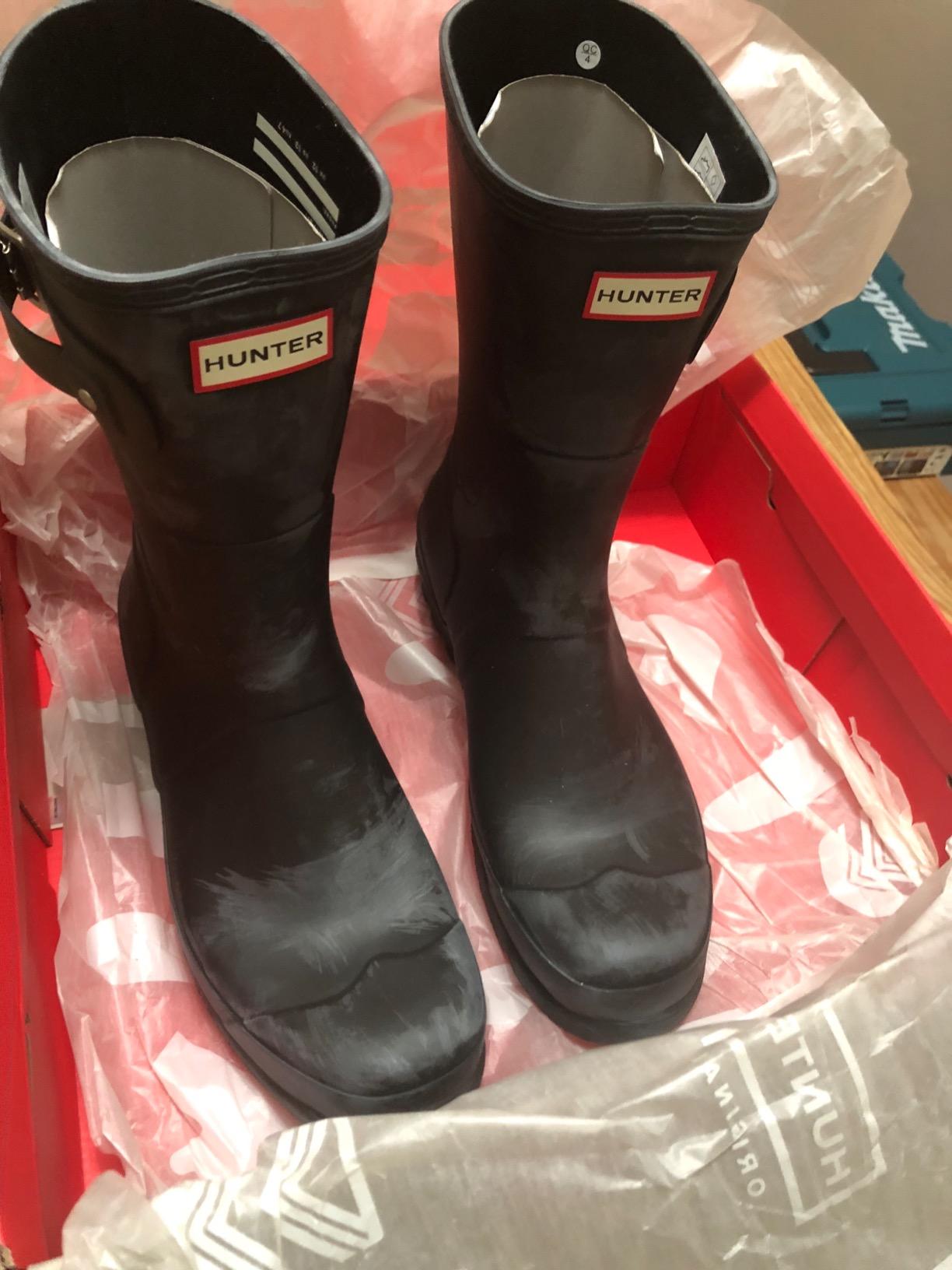
12. Hunter Original Short Rain Boot: Best for Heritage Style
Hunter Men’s Original Short Rain Boot, Black, 9
Handcrafted natural rubber
11-inch shaft
5.94 lb listed weight
1-inch heel
Pros
- Handcrafted natural rubber vulcanised for lasting waterproofing
- Signature tread pattern with strong wet-surface grip
- 11-inch shaft gives good coverage for driving and heavy rain
- Recycled polyester lining adds comfort without bulk
Cons
- Heaviest boot in the roundout at nearly 6 pounds
- Premium price point against basic PVC models
- Styling less suited to work or hiking
If the question is whether rubber boots look foolish on a man, this is the argument that they do not. The handcrafted natural rubber is assembled over three days and then vulcanised, and the result is a boot that looks considered rather than utilitarian. The 1-inch heel and the 11-inch shaft also read as a deliberate silhouette, not a flood emergency.
It performed well, too. The Hunter Original tread pattern gave solid grip on wet surfaces, the waterproofing was dependable in heavy rain, and the recycled polyester lining adds comfort without adding bulk.
Weight is the honest trade. At nearly 6 pounds listed, this is the heaviest boot here, and you feel it at the end of a long day, especially on stairs. The 11-inch shaft is excellent coverage for driving in heavy rain, which is where most people actually use a boot like this.
This is a lifestyle and heritage boot. It is not a steel-toe option, not a deep-mud option, and not the choice for long walks on a trail, though it is more than capable on a city street in a downpour.
What to check before you buy
Check that you are willing to carry the weight. The construction is heavy because it is built to last, and if you will be on your feet walking all day, a lighter neoprene boot will serve you better.
Check the shaft against your calf. Eleven inches is a genuine mid-calf height, and it needs to fit comfortably or you will be rubbing raw skin on every step.
Who should skip it
Skip it for work or hiking, where purpose-built traction and lighter construction matter more than looks. It is also the premium option here, and if the budget is tight, the same waterproofing is available for far less.
Skip it if you are shopping for the lightest possible pair or if you need a certified safety toe. Those are different jobs entirely.
How to Choose the Best Rain Boots for Men
Most people buy the wrong height first and the wrong material second. Work backwards from the deepest water you will actually stand in, then from the coldest temperature you will actually walk around in, and the rest of the decision makes itself.
Pick the shaft height for the water, not the trend
Ankle-height boots at roughly 6 to 8 inches handle puddles, wet grass, rain and light mud. Mid-calf at 11 inches covers a downpour while standing and is the sweet spot for driving and everyday city rain. Knee-high at 17 to 18 inches is for flooding, deep mud, snow banks and work where standing water is routine.
A taller boot is not automatically better. Above the ankle you gain coverage and lose weight, and heel slippage becomes more likely when the shaft is too roomy for your calf.
Understand the four construction types
Deck boots are low, neoprene and rubber, and built for wet grip on boats and docks. Duck boots are leather or synthetic uppers on a rubber foot with a gusseted tongue, and they are the warmest for winter because of the insulation. Mud boots are tall with aggressive lugs for deep mud and snow. Chelsea rain boots are slip-on ankle styles that read as casual footwear.
Material matters as much as the type. Natural rubber molds to your foot and stays flexible in cold weather, but it is heavy. PVC is light and cheap and easy to clean, but it stiffens in the cold and can crack. Neoprene is light, warm and flexible, and is the compromise most of these picks use.
Waterproofing is construction, not coating
A fully injected one-piece upper has no seams for water to travel through, which is why the seamless molded boots here outperform stitched leather approaches. When a boot has seams, look for a gusseted tongue, because that is the feature that stops water running down the laces or seams into the boot.
Water-resistant is not waterproof, and marketing language blurs the line constantly. If you will wade, only treat a boot marked waterproof as a candidate.
Traction is the outsole, and the outsole is the use case
Shallow chevron and directional patterns are for smooth wet surfaces like decks and pavement. Deep multi-directional lugs are for mud, snow and loose ground. Siping, the little grooves cut into the lugs, is what gives grip on hard ice, and almost no general-purpose rain boot has it.
Also check whether the lugs shed debris. Self-cleaning or directional patterns let mud fall away as you walk, while flat shallow treads hold it and turn slick after an hour in the garden.
Insulation is only useful below a threshold
Insulation thickness is usually stated in millimeters of neoprene, and a temperature rating is the more useful number. Treat any rating much colder than your local winter as a liability rather than a bonus, because a -40F boot is genuinely unpleasant above 60F and generates sweat that makes feet damp.
If you only face occasional cold drizzle, an uninsulated neoprene or rubber boot will serve you better than a heavily insulated one you will overheat in.
Sizing: size down, then adjust
Rubber runs large, and the most common return reason in this entire category is buying a half size too big and getting heel slippage and blisters. Unless you wear thick socks, sizing down half a size is the most common piece of advice across owners of these boots.
Two other checks matter. A wide calf is a real issue on tall boots, and a fixed insole leaves you no room for a thick orthotic, so if you need one, choose a boot with a removable footbed. Measuring your foot in the evening, when it is largest, is the most reliable method.
Care and style, two things people skip
Rinse mud off after each use and dry at room temperature, never on a radiator, since direct heat is what cracks rubber. Stuff the shafts with paper or use boot shapers to hold the shape, and let the inside dry fully before storing, because trapped moisture is what causes odor and interior breakdown.
For style, ankle and mid-calf heights read best with jeans and chinos, where the cuff sits just above the top line. Tall wellies work with shorts and work pants, and the heritage natural rubber options are the ones that look intentional in town. If you are already sorted on the upper body, our rain poncho guide covers the full-body option, and if you are camping through the same weather, keeping a tent from flooding solves the other half of the problem.
Frequently Asked Questions
What is the most comfortable waterproof boot for men?
What are good quality rain boots?
Which rain boots are the most comfortable?
What rain boots are in style right now?
Should rain boots be sized up or down?
How do you keep rubber rain boots from cracking?
The Best Rain Boots for Men: Our Final Word
The best rain boots for men are not one boot, they are four decisions made in the right order. If you want the single best all-round pair, take the XTRATUF Men’s Ankle Deck Boot: waterproof, grippy, light and backed by the largest owner base in this roundup. If your work demands a certified steel toe, the HISEA is the only pick here with an ASTM rating, and no amount of waterproofing substitutes for it.
Below ankle height, this is a deck-boot category and the HUK Rogue Wave sets the standard for wet traction, with the Kalkal taking comfort for anyone whose arches need real support. Above the ankle, the choice is between warmth and weight: the BOGS Classic High for genuine winter, the BOGS Classic Mid for deep mud and snow, the TIDEWE for cold-weather shifts, and the Hunter Original when the boot needs to look like footwear rather than equipment.
Whichever you choose, size down half a size unless the reviews say otherwise, and replace the factory footbed with your own insoles. That single habit fixes more complaints than any other change, and it costs almost nothing. Check the current details before you decide, and keep a second cheap pair in the car for the days when the good ones are still drying.
While you are stocking up for wet weather, our guide to collecting rainwater and our step-by-step on starting a campfire in the rain cover the rest of a wet-weather kit.